
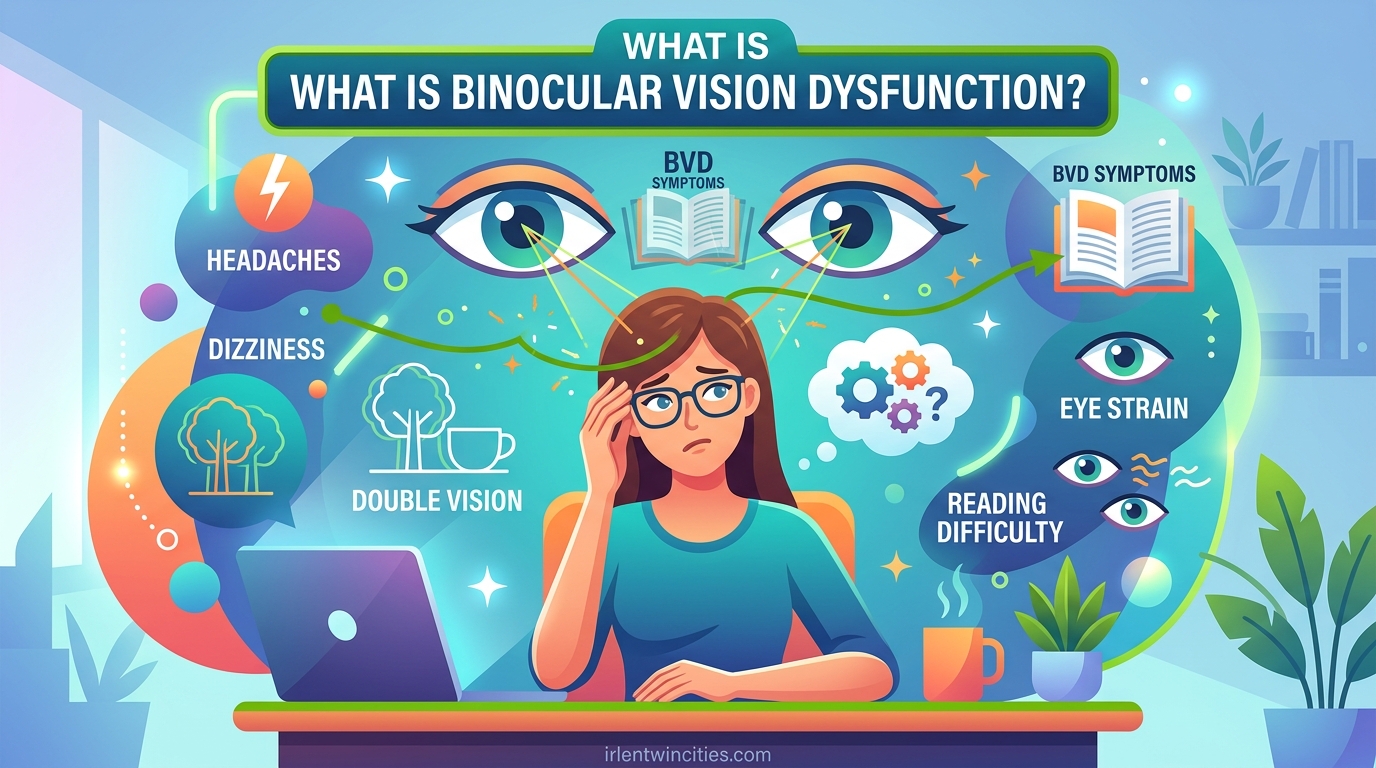
Binocular vision dysfunction (BVD) is a condition where your eyes are slightly misaligned, causing them to send two separate images to your brain that cannot be properly fused into one clear, seamless picture. Even a tiny misalignment as small as one degree can force your eye muscles to work overtime to correct the discrepancy, leading to chronic headaches, dizziness, balance problems, and vision discomfort that standard eye exams often miss.
Many people with BVD struggle for years seeing multiple doctors who cannot explain their symptoms. They’re told their vision is “20/20” or their eyes appear healthy, yet they continue experiencing debilitating symptoms that affect their daily lives. Understanding BVD is the first step toward getting the right diagnosis and finding relief.
At Irlen Twin Cities, we see how often BVD overlaps with other visual processing issues like Irlen Syndrome. The connection between how your eyes work together and how your brain processes visual information is profound, and addressing both aspects can lead to significantly better outcomes.
Table of Contents
What is Binocular Vision Dysfunction
Binocular vision dysfunction occurs when your eyes don’t work together as a team the way they should. In a healthy visual system, both eyes send slightly different perspectives to your brain, which fuses them into a single three-dimensional image. This fusion gives you depth perception, clear vision at all distances, and comfortable sight even during prolonged visual tasks.
When your eyes are misaligned even slightly, your brain receives two images that don’t match up perfectly. Your eye muscles must constantly strain to realign your eyes and force these images to fuse. This continuous overwork exhausts your visual system and creates the symptoms associated with BVD. The misalignment can be vertical (one eye higher than the other), horizontal (eyes turned inward or outward), or torsional (eyes rotated differently).
What makes BVD particularly challenging to diagnose is that the misalignment is often microscopic. Unlike strabismus, where eye misalignment is visible, BVD involves subtle alignment issues that require specialized testing to detect. Someone can have BVD and still pass a standard eye exam with flying colors because traditional exams focus on each eye individually rather than testing how well they work together.
There are several types of binocular vision dysfunction. Vertical heterophoria (VH) is one of the most common forms, where one eye sits slightly higher than the other. Convergence insufficiency means your eyes struggle to turn inward to focus on near objects. Accommodative dysfunction involves problems with your eyes’ ability to focus clearly at different distances. Each type creates specific symptom patterns but all stem from the same core issue: your eyes aren’t working together efficiently.
How Healthy Vision Should Work
Understanding BVD requires knowing how normal binocular vision functions. Your two eyes work together like a team, constantly making precise micro-adjustments to maintain proper alignment. Six muscles control each eye’s movement, and these muscles must coordinate perfectly between both eyes. When you look at something, your brain receives two slightly different images and merges them instantly into one clear picture with depth perception.
This process happens automatically and continuously throughout your day. Your visual system tracks moving objects, shifts focus between near and far, maintains alignment even when you move your head, and processes complex visual information all without conscious effort. When this system works well, you don’t even think about it. When BVD disrupts this system, even simple visual tasks become exhausting.
The BVD-Visual Processing Connection
At Irlen Twin Cities, we’ve observed a significant overlap between BVD and other visual processing issues. When your eyes struggle to work together, it places additional stress on your brain’s visual processing centers. This can exacerbate or mimic symptoms of Irlen Syndrome, where the brain has difficulty processing specific wavelengths of light and visual patterns.
Many individuals we see have both BVD and visual processing stress. The constant effort to align their eyes fatigues their visual system, making them even more sensitive to lighting, contrast, and pattern glare. Addressing both the mechanical alignment issues (BVD) and the brain’s processing challenges (Irlen Syndrome) often produces the best outcomes for these patients.
Symptoms of BVD
BVD symptoms vary widely from person to person, which is one reason the condition often goes undiagnosed. Some people experience primarily visual symptoms, while others struggle more with physical discomfort or balance issues. The severity can range from mild annoyance to debilitating symptoms that dramatically affect quality of life. Many people don’t realize all their seemingly unrelated symptoms might stem from the same underlying vision problem.
Visual Symptoms
The most obvious BVD symptoms affect your eyesight directly. You might experience blurred vision that comes and goes, especially when reading or using digital screens. Double vision (diplopia) is common, particularly when you’re tired or focusing on near objects. You may notice words appear to move, float, or jump on the page, making reading frustrating and exhausting.
Light sensitivity (photophobia) affects many BVD patients. Bright lights, sunlight, fluorescent lighting, or even computer screens can cause discomfort or pain. You might find yourself squinting frequently or wearing sunglasses even indoors. Some people report seeing halos around lights or experiencing glare that makes night driving difficult.
Depth perception problems are another hallmark of BVD. You might have trouble judging distances accurately, reaching for objects and missing, or struggling with tasks that require precise hand-eye coordination. Escalators and stairs can feel particularly challenging because you can’t trust your depth perception.
Eye strain and fatigue develop quickly during visual tasks. Your eyes might feel tired, sore, or like they’re pulling or being stretched. You may experience aching behind your eyes or a sensation of pressure in your forehead. These symptoms often worsen throughout the day and are especially pronounced after reading, computer work, or other concentrated visual tasks.
Physical Symptoms
The physical symptoms of BVD often surprise people because they seem unrelated to vision. Headaches are the most common complaint, ranging from mild tension headaches to debilitating migraines. These headaches typically affect the forehead, temples, or back of the head and may occur daily or several times per week.
Neck and shoulder pain frequently accompany BVD headaches. As your body unconsciously tilts your head to compensate for vision misalignment, this creates muscle tension in your neck and shoulders. You might experience chronic tightness, knots, or pain that doesn’t respond to typical massage or chiropractic treatment.
Dizziness and vertigo affect many BVD patients. You might feel lightheaded, unsteady, or like the room is spinning. These sensations can occur randomly or be triggered by visual stimuli like busy patterns, scrolling on screens, or moving your head quickly. Some people describe a persistent feeling of being slightly off-balance that never fully goes away.
Motion sickness is another common symptom. You might feel nauseous in cars, on boats, or even just watching movement on screens. The disconnect between what your eyes see and what your vestibular system senses creates motion sickness symptoms. Many BVD patients avoid certain activities like amusement park rides or 3D movies because they know they’ll feel sick afterward.
Balance and Coordination Issues
Your vision plays a crucial role in balance, and BVD can significantly affect your stability. You might feel unsteady walking, especially in unfamiliar environments or when lighting is poor. Stairs, escalators, and uneven surfaces become challenging because you can’t rely on accurate depth perception.
Some people with BVD report bumping into door frames, walls, or furniture. They might knock things over when reaching for them or trip frequently. Others notice they tend to lean to one side when standing or walking without realizing it. These balance issues aren’t related to muscle weakness or neurological problems—they’re caused by your eyes sending unreliable spatial information to your brain.
Clumsiness that developed suddenly or gradually worsened over time can indicate BVD. If you’ve always been coordinated but find yourself becoming accident-prone, vision misalignment might be the culprit. This is particularly common after concussions or head injuries, which can cause or worsen BVD.
Reading and Learning Difficulties
BVD can make reading an exhausting, frustrating struggle. Words might appear to move, float, or blur on the page. You might lose your place frequently, skip lines, or read the same line repeatedly. Some people report that words seem to float off the page or that the white space between words is distractingly bright.
Reading comprehension suffers when your visual system is strained. You might read a paragraph and realize you absorbed nothing because you were concentrating so hard on just seeing the words clearly. Children with BVD are often misdiagnosed with learning disabilities or ADHD because they can’t focus on schoolwork when reading causes physical discomfort.
Concentration during visually demanding tasks becomes nearly impossible. You might find yourself avoiding reading, avoiding computer work, or procrastinating on tasks that require sustained visual focus. This isn’t laziness or lack of ability—it’s your brain protecting you from an activity that causes physical discomfort and fatigue.
Symptoms in Children
Children with BVD often display different symptoms than adults. They might rub their eyes frequently, squint, or tilt their head to one side when reading. Teachers might notice they hold reading material unusually close or unusually far from their face. Some children lose their place often while reading, use their finger to track text, or skip words and lines.
Behavioral issues can indicate undiagnosed BVD in children. They might avoid reading or homework, act out during visually demanding tasks, or seem unusually fidgety and unable to sit still. Many children with BVD are misdiagnosed with ADHD because they can’t maintain focus when reading causes physical discomfort.
Complaints about letters moving, words blurring, or pages being “too bright” should be taken seriously. Children might not have the vocabulary to explain exactly what they’re experiencing, so they might say their eyes “hurt” or simply refuse to do reading tasks. Parents should pay attention if their child seems intelligent but struggles unexpectedly with reading or schoolwork.
Psychological and Emotional Impact
The emotional toll of BVD is significant and often overlooked. Chronic pain, dizziness, and visual discomfort create anxiety and stress. Many people worry they have a serious neurological condition or tumor because their symptoms are so persistent and unexplained. The diagnostic journey to identify BVD often takes years, creating frustration and hopelessness.
Social anxiety can develop when you’re constantly unsteady, dizzy, or afraid of having symptoms in public. You might avoid driving, avoid social situations, or withdraw from activities you used to enjoy. Some people develop agoraphobia because they don’t trust their balance or vision outside their home.
Depression is common among BVD patients, especially those who’ve spent years seeking answers without success. When you can’t read comfortably, can’t work effectively, and can’t participate in normal activities, it’s natural to feel discouraged. The good news is that proper BVD treatment often improves these psychological symptoms dramatically as physical symptoms resolve.
Causes of Binocular Vision Dysfunction
BVD can develop from various causes, and understanding the origin helps guide treatment. Some people are born with predispositions to binocular vision problems, while others develop BVD later in life due to injury, illness, or age-related changes. The specific cause often influences which treatment approach will be most effective.
Natural Eye Teaming Problems
Many people with BVD have inherent differences in how their eyes work together. One eye might be naturally higher than the other, or the muscles controlling eye movement might have slight imbalances. These small variations exist in everyone but become problematic when they’re large enough to cause symptoms. You might have had these alignment issues your whole life but only developed symptoms when other factors (stress, illness, age) pushed your visual system past its ability to compensate.
Developmental issues during childhood can create binocular vision problems. If the neural pathways for binocular vision didn’t develop properly, or if eye muscle coordination didn’t mature correctly, BVD can result. This is why some children struggle with reading and schoolwork despite having normal vision when each eye is tested individually.
Head Trauma and Concussion
Concussions and head injuries are among the most common triggers for BVD. Even mild traumatic brain injuries can disrupt the delicate coordination between your eyes. The impact can damage the nerves controlling eye movement, create muscle imbalances, or affect the brain’s ability to fuse images from both eyes.
Many people develop BVD after car accidents, falls, sports injuries, or other trauma. Symptoms might appear immediately after the injury or develop gradually over the following weeks and months. Post-concussion syndrome often includes BVD symptoms that persist long after other concussion symptoms have resolved. Athletes, military personnel, and anyone who has experienced head trauma should be evaluated for binocular vision problems if visual symptoms persist.
Neurological Conditions
Various neurological conditions can cause or contribute to BVD. Stroke, multiple sclerosis, brain tumors, and other conditions affecting the nervous system can disrupt eye teaming. The nerves controlling eye movement might be damaged, or the brain areas responsible for fusing images might be affected.
Neurodegenerative conditions like Parkinson’s disease can affect eye coordination as they progress. Some autoimmune conditions that affect the nervous system can also impact binocular vision. When BVD develops alongside other neurological symptoms, it’s especially important to work with both neurologists and vision specialists to coordinate care.
Age-Related Changes
BVD often develops or worsens with age, typically beginning around age 40. As we age, the muscles controlling our eyes can lose tone and flexibility. The lens inside each eye becomes less able to change focus for different distances. Presbyopia (age-related loss of near focus) can create additional strain on your binocular vision system.
Many people first notice BVD symptoms in their 40s or 50s even though they’ve had minor alignment issues their whole lives. The cumulative effect of decades of compensating for eye misalignment eventually becomes too much for their visual system to handle. Hormonal changes during menopause can also affect vision and exacerbate BVD symptoms.
Genetic Factors
BVD tends to run in families, suggesting a genetic component. If one family member has binocular vision dysfunction, other relatives are more likely to develop it. This might involve inherited structural differences in eye shape, muscle patterns, or neural processing of visual information.
Some inherited conditions affect eye alignment directly. Strabismus (eye turn) and amblyopia (lazy eye) have genetic links and can predispose someone to binocular vision problems. Even when these conditions are treated in childhood, subtle alignment issues can persist and cause BVD symptoms later in life.
How BVD is Diagnosed
Diagnosing BVD requires specialized testing beyond a standard eye exam. Most people with BVD have normal vision when each eye is tested individually—the problem only becomes apparent when testing how well the eyes work together. This is why many people see multiple doctors before finally getting a correct diagnosis.
What to Expect During BVD Testing
A comprehensive BVD evaluation typically takes 1-2 hours and includes multiple specialized tests. The doctor will assess your eye alignment at various distances, test your eye teaming abilities, evaluate how your eyes move and track, and measure your ability to fuse images from both eyes. You’ll be asked about your symptoms, medical history, any head injuries, and how your vision problems affect your daily life.
Common tests include cover tests (observing how your eyes move when covered and uncovered), prism testing (using prisms to measure and correct alignment issues), and binocular vision assessments. The doctor might use specialized equipment to track your eye movements precisely or measure tiny misalignments that aren’t visible to the naked eye.
Neuro-Optometrist vs. Regular Optometrist
Not all eye doctors are trained to diagnose and treat BVD. Regular optometrists focus primarily on visual acuity (how clearly you see) and eye health. They’re excellent at prescribing glasses and contact lenses and detecting eye diseases, but most don’t receive extensive training in binocular vision dysfunction.
Neuro-optometrists specialize in the relationship between your eyes, your visual system, and your brain. They have additional training in diagnosing and treating binocular vision problems, vision processing issues, and vision problems related to brain injury. If you suspect BVD, specifically seek out a neuro-optometrist or an optometrist who specializes in binocular vision dysfunction.
Self-Assessment Indicators
While you can’t diagnose yourself, certain symptom patterns strongly suggest BVD. If you have multiple symptoms from different categories (visual, physical, balance, reading), BVD becomes more likely. If you’ve seen multiple doctors without finding an explanation for chronic headaches, dizziness, or reading difficulties, BVD is worth investigating.
Family history matters too. If close relatives have BVD or if you’ve had a head injury, your risk increases. Children who struggle unexpectedly with reading or who avoid visually demanding tasks should be evaluated. Trust your instincts—if something feels off with your vision or balance, and standard exams haven’t provided answers, consider seeking a BVD specialist.
Treatment Options for BVD
The good news about BVD is that it’s highly treatable. Most people experience significant improvement with proper treatment, and many achieve complete or near-complete resolution of their symptoms. Treatment typically involves correcting the eye alignment so your eyes can work together efficiently without constant strain. The specific approach depends on the type and severity of your BVD.
Prism Lenses
Prism lenses are the most common and effective treatment for BVD. These specialized lenses bend light to compensate for your eye misalignment, essentially doing the work your eye muscles have been straining to do. The prisms allow your eyes to work together without excessive effort, dramatically reducing symptoms.
Micro-prism lenses use very small prism corrections that can be fine-tuned to your specific needs. Unlike the thick prism glasses of the past, modern micro-prisms are thin and lightweight. Many people don’t even realize someone is wearing prism correction.
Finding the correct prism prescription requires precision and often multiple adjustments. Your doctor will start with a measured correction based on diagnostic tests, then fine-tune based on your symptom response. Some people need different prism corrections for different distances (reading vs. distance vision). It may take several visits to find your optimal prescription, but most people notice significant improvement even with the initial correction.
Vision Therapy
Vision therapy is like physical therapy for your eyes and brain. Through structured exercises and activities, vision therapy trains your eyes to work together more efficiently and strengthens the neural pathways responsible for binocular vision. This can improve eye teaming, focusing ability, and visual processing.
Vision therapy programs typically involve weekly in-office sessions combined with daily home exercises. The exercises might involve tracking moving targets, focusing on different distances, using 3D viewing techniques, or working with specialized computer programs. Progress is measured objectively, and exercises are adjusted as your skills improve.
Vision therapy is particularly helpful for convergence insufficiency, accommodative dysfunction, and certain types of eye teaming problems. It’s often used in combination with prism lenses—the prisms provide immediate symptom relief while the therapy addresses underlying functional issues. Children especially benefit from vision therapy because their visual systems are still developing and more responsive to training.
What to Expect from Treatment
Most people notice symptom improvement within the first few weeks of treatment, though complete resolution may take several months. Prism lenses often provide faster relief, while vision therapy produces gradual improvement over time. Many people use both approaches together for optimal results.
Realistic expectations are important. Most people experience 80-95% improvement in symptoms with proper treatment, but complete elimination of every symptom isn’t always possible. Some residual symptoms might persist, especially during periods of stress or fatigue. However, the dramatic reduction in symptoms most people experience significantly improves their quality of life.
Treatment isn’t always permanent. Some people need periodic adjustments to their prism prescription as their eyes and brain adapt. Others might benefit from occasional vision therapy tune-up sessions. Your doctor will monitor your progress and adjust treatment as needed. The goal isn’t just symptom relief but lasting improvement in how your visual system functions.
Living with BVD
While you’re undergoing treatment or waiting for diagnosis, certain strategies can help manage BVD symptoms. These coping techniques don’t address the underlying problem but can make daily life more manageable until proper treatment takes effect.
Daily Adaptations
Small changes to your environment and habits can reduce BVD symptom triggers. Using proper lighting (avoiding fluorescent lights when possible, using natural light or warm LED lighting), reducing screen time, taking frequent breaks during visually demanding tasks, and using larger font sizes can all help. Some people find wearing tinted lenses reduces light sensitivity and visual stress.
Reading strategies include using a bookmark or ruler to track lines, listening to audiobooks as an alternative to visual reading, using e-readers with adjustable font and background settings, and positioning reading material at an optimal distance. These adaptations don’t fix BVD but can make reading less exhausting while you’re pursuing treatment.
Work and School Accommodations
If BVD affects your work or school performance, accommodations can help. These might include extended time on tests, permission to use audiobooks, preferential seating to reduce visual strain, breaks during visually demanding tasks, and access to printed materials rather than only digital. Most schools and workplaces are willing to provide reasonable accommodations once you have a diagnosis.
Long-Term Outlook
With proper treatment, most people with BVD can return to normal activities without significant limitations. Driving, reading, computer work, sports, and other activities typically become comfortable again as your visual system heals. The key is getting an accurate diagnosis and consistent, appropriate treatment.
BVD tends to be a chronic condition in that the underlying predisposition doesn’t disappear, but with proper management, symptoms can be controlled long-term. Some people need ongoing treatment or occasional adjustments, but many achieve lasting symptom relief. The earlier BVD is diagnosed and treated, the better the outcomes tend to be.
Conclusion
Binocular vision dysfunction is a complex but highly treatable condition that affects how your eyes work together. The symptoms—headaches, dizziness, balance problems, reading difficulties, and visual discomfort—can be debilitating, but proper diagnosis and treatment bring significant relief for most people. If you’ve struggled with unexplained vision or balance symptoms, BVD might be the missing piece of the puzzle.
At Irlen Twin Cities, we understand how BVD connects to broader visual processing issues and how it affects every aspect of your life. The journey from unexplained symptoms to proper diagnosis can be frustrating, but the improvement in quality of life makes seeking answers worthwhile. Don’t give up if you haven’t found relief yet—the right diagnosis and treatment can transform your daily experience.
If you recognize your symptoms in this article, consider scheduling an evaluation with a neuro-optometrist or binocular vision specialist. The combination of proper diagnosis, targeted treatment, and appropriate support can help you reclaim comfortable vision and return to the activities you love.
FAQ
How do you tell if you have BVD?
Common BVD signs include chronic headaches, dizziness, balance problems, reading difficulties, eye strain, and light sensitivity. If you have multiple symptoms from different categories (visual, physical, balance, reading) that standard eye exams can’t explain, BVD is likely. Other indicators include bumping into objects, motion sensitivity, and symptoms worsening during visually demanding tasks.
What are the signs of BVD?
BVD signs include visual symptoms (blurred vision, double vision, light sensitivity, depth perception problems), physical symptoms (headaches, neck/shoulder pain, dizziness, motion sickness), balance issues (unsteadiness, clumsiness, difficulty with stairs), reading difficulties (words moving, losing place, comprehension problems), and in children: head tilting, avoiding reading, and behavioral issues during visually demanding tasks.
Can BVD be corrected?
Yes, BVD is highly treatable. Most people experience 80-95% symptom improvement with proper treatment. Prism lenses compensate for eye misalignment and provide rapid symptom relief. Vision therapy trains eyes to work together more effectively. Many people use both approaches together. While complete symptom elimination isn’t always possible, significant improvement is the norm, and most people return to normal activities.
At what age does BVD usually develop?
BVD can develop at any age. Some people are born with predisposing factors and develop symptoms in childhood. Others develop BVD after head trauma, concussion, or neurological injury. Many people first notice symptoms around age 40 when age-related changes reduce their visual system’s ability to compensate for minor alignment issues. BVD can be congenital, developmental, or acquired depending on the underlying cause.