
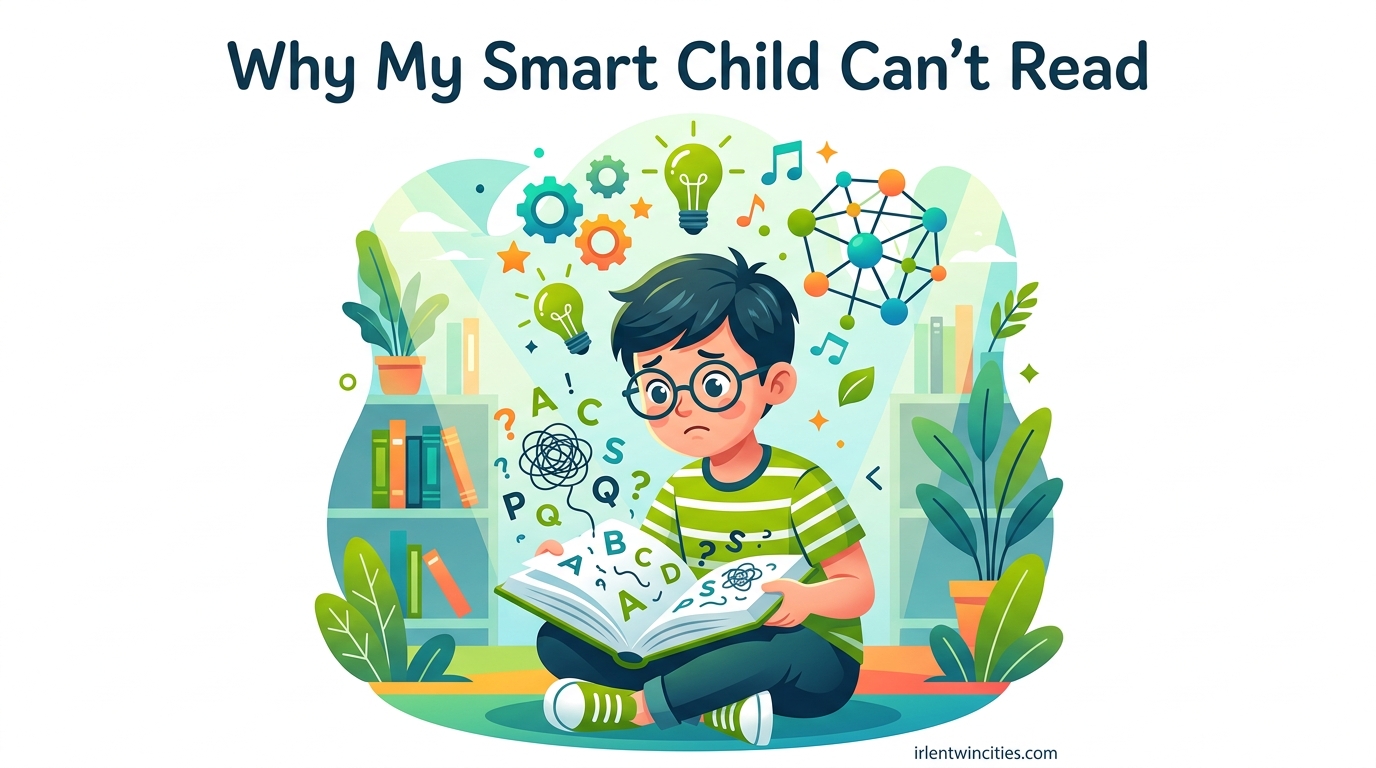
You know your child is bright. They solve puzzles effortlessly, remember every detail of a movie, and ask questions that make adults pause. But when it comes to reading, something just does not click. You are not alone. Thousands of parents find themselves asking, “Why can’t my smart child read?” The answer is more complex than simple laziness or lack of effort. Hidden reasons, often invisible to teachers and pediatricians, keep bright children from accessing the written word. Understanding these reasons is the first step toward getting your child the right support.
Intelligence and reading ability are not the same thing. Reading is a learned skill that requires specific brain pathways to develop. When those pathways do not develop in the typical way, even the most intelligent child can struggle. This gap between intelligence and reading ability causes deep frustration for children and parents alike. The good news is that once you understand the hidden reasons, you can seek targeted help that makes a real difference.
Table of Contents
The Connection Between Intelligence and Reading Difficulty
Research shows that children with higher IQs often experience more frustration when they cannot read well. Unlike children who expect difficulty, smart children know something is wrong when their brain does not work the way they expect it to. They see words that will not stay still, letters that seem to swap places, or sounds that do not match what they see on the page. Your child may feel smart in every other area but helpless when confronted with text.
This disconnect creates a unique kind of pain. Smart children who struggle with reading often develop elaborate coping strategies that mask the underlying problem for years. By the time parents realize there is a serious issue, children may have spent years compensating, exhausting themselves, and watching their self-esteem crumble. Understanding these hidden challenges gives you the power to intervene earlier and more effectively.
Stealth Dyslexia: When Dyslexia Hides in Bright Children
Stealth dyslexia is a term used to describe dyslexia that remains hidden because a child’s intelligence allows them to compensate for their reading difficulties. Unlike traditional dyslexia, which shows up clearly on standardized tests, stealth dyslexia allows a child to appear to read adequately while working dramatically harder than their peers. These children use context clues, strong vocabulary, and pattern recognition to guess their way through text, never truly decoding words efficiently.
The danger of stealth dyslexia is that it often goes unrecognized until middle or high school, when reading demands increase exponentially. A child who could memorize words or figure out stories in early elementary may completely fall apart when required to read textbooks, understand complex passages, or read aloud with fluency. Teachers and parents may assume the child is lazy or not trying hard enough, when in reality they are fighting an invisible neurological battle every time they open a book.
Twice exceptional learners, or 2e children, frequently experience stealth dyslexia. These are children who are both gifted and dyslexic. Their high intelligence allows them to develop compensation strategies that mask their reading difficulties, while their dyslexia masks their giftedness. This creates a perfect storm where neither challenge gets identified or addressed. Many twice exceptional children spend their school years feeling like something is wrong with them rather than understanding they have a neurodiversity that comes with both strengths and challenges.
Visual Processing Differences: Beyond Eyes That See Clearly
Many children who struggle with reading have perfectly healthy eyes that see clearly. The problem lies in how their brain processes visual information. Visual processing differences affect how the brain interprets what the eyes see, making reading an exhausting and frustrating experience. One well-known condition is optilexia, a term used to describe difficulty with visual processing that affects reading ability despite normal vision.
Children with visual processing challenges may experience letters that appear to move, blur, or double on the page. They may lose their place frequently, skip lines while reading, or have trouble tracking from the end of one line to the beginning of the next. These children often tire quickly during reading tasks, rub their eyes frequently, or complain that reading hurts their head. Because their eyes technically work fine, these symptoms are often dismissed as daydreaming, laziness, or inattention.
The technical aspects of visual processing involve complex neural pathways that coordinate eye movements, focus, and visual discrimination. For reading, children need to develop smooth saccades, which are the rapid eye movements that allow us to move from word to word and line to line. When these movements are inaccurate or inefficient, reading becomes a constant struggle. Some children develop abnormally large saccades that jump over words or lines entirely, while others have difficulty coordinating both eyes together.
Auditory Processing Challenges
Reading and auditory processing are deeply connected. Before children can decode written words, they must understand the sounds that letters represent. Auditory processing disorder affects how the brain interprets sounds, making it difficult for children to distinguish between similar sounds, remember sequences of sounds, or connect sounds to their written symbols. A child with auditory processing difficulties may know what they want to say but struggle to translate that into written form.
Phonemic awareness, the ability to hear and manipulate individual sounds in words, is fundamental to reading success. Children who struggle with phonemic awareness have difficulty connecting letters to their sounds, blending sounds together to form words, and segmenting words into individual sounds for spelling. This creates a foundation problem that no amount of reading practice can fix until the underlying auditory processing issue is addressed.
Children with auditory processing differences may also struggle in classroom settings where they must listen and process information simultaneously. They may seem to ignore instructions, ask for repeated clarification, or appear confused even when they are trying hard to pay attention. These behaviors are often mislabeled as attention problems when they actually reflect auditory processing challenges that make traditional instruction inaccessible.
The Stress Spiral: How Anxiety Affects Learning
When reading is difficult, every reading task becomes a source of stress. This stress does not just make children uncomfortable emotionally; it actively interferes with their ability to learn. The stress response triggers the release of cortisol, which impairs memory formation, reduces cognitive flexibility, and makes it harder for the brain to develop new neural pathways. A child who experiences reading as stressful is literally creating biological conditions that make reading even harder.
This creates a devastating cycle that researchers call a stress spiral. The child struggles to read, which causes stress. The stress makes reading more difficult, which causes more stress. Over time, this cycle becomes so ingrained that children develop a conditioned stress response to reading itself. Simply seeing a book can trigger anxiety symptoms in children who have experienced this spiral. Their heart rate increases, their breathing becomes shallow, and their cognitive resources are diverted away from the reading task toward managing their emotional response.
The impact of stress spirals goes beyond reading. Children caught in these cycles often develop school avoidance, somatic complaints like stomachaches or headaches, and learned helplessness. They begin to believe they are incapable of learning to read, which becomes a self-fulfilling prophecy. Breaking this cycle requires addressing both the underlying reading difficulty and the emotional response to it, which is why comprehensive approaches that include social-emotional support tend to be more effective than remediation alone.
Compensation Strategies That Hide Reading Difficulties
Bright children are often excellent problem-solvers. When they realize reading is harder for them than it should be, they develop compensation strategies that allow them to function while hiding their struggles. These strategies can be so effective that parents and teachers may not realize there is a serious problem for years. Understanding these compensation methods helps parents recognize when apparent competence is actually a mask for difficulty.
Common compensation strategies include using picture context to guess what words say, memorizing passages rather than decoding them, using surrounding words to figure out unfamiliar ones, and developing an extensive vocabulary that allows them to infer meaning even when they cannot read every word accurately. Some children become so skilled at guessing from context that they appear to read fluently while actually misidentifying numerous words on each page.
Another common compensation is relying on exceptional listening comprehension. Children who are strong auditory learners may understand complex information when read aloud but struggle to decode the same words on a page. These children often become voracious listeners, using audiobooks and read-alouds to access information while their reading skills stagnate. Parents may not realize there is a problem because their child seems to comprehend everything when the truth is their comprehension is limited to what they can hear rather than what they can decode.
The Grade 2-3 Reading Cliff
Educational researchers have identified a phenomenon called the grade 2-3 reading cliff, sometimes referred to as the fourth grade slump. This describes a sudden drop in reading performance that occurs when children move from learning to read to reading to learn. In early elementary grades, reading instruction focuses heavily on decoding skills, and children who struggle with decoding receive significant support. Around third or fourth grade, the assumption shifts, and children are expected to already have mastered basic reading.
At this point, reading becomes a tool for learning rather than the object of learning. Children must read to understand history, science, and literature. They must extract information from textbooks, follow written instructions, and complete reading-based assignments. For children with hidden reading difficulties who have been compensating through memorization and context clues, this transition can be catastrophic. The strategies that allowed them to appear competent in second grade completely fail when reading demands increase exponentially.
The grade 2-3 cliff is particularly cruel for bright children because they often excel in early grades, leading parents and teachers to believe they are on track. When they suddenly cannot keep up in third or fourth grade, adults may assume the child has become lazy or stopped trying. In reality, the child’s brain has hit a ceiling imposed by their undiagnosed reading difficulty. Understanding this transition point helps parents recognize that a child who seemed to be progressing well may actually need intervention before they fall off the cliff.
Irlen Syndrome and Contrast Sensitivity
Irlen syndrome, also called scotopic sensitivity syndrome, is a condition that affects how the brain processes visual information, particularly when there is high contrast between colors or when certain colors are present. Unlike eye diseases or traditional vision problems, Irlen syndrome originates in the brain’s visual cortex and cannot be detected through standard vision tests. For children with this condition, reading creates visual distortions that make the task slow, exhausting, and sometimes impossible.
Children with Irlen syndrome may report that words appear to move, ripple, or blur on the page. They may see letters as overlapping or experience visual distortions when looking at high-contrast text like black letters on white paper. This is why many children with Irlen syndrome prefer reading in low lighting, benefit from colored overlays, or avoid reading for extended periods despite appearing to understand the material when it is read aloud.
Contrast sensitivity difficulties often coexist with or mimic other reading challenges. A child may struggle with the visual stress of reading black text on white paper while their classmates read comfortably. When text is presented with reduced contrast or with colored backgrounds, their reading speed and comprehension may improve dramatically. This is why systematic evaluation for contrast sensitivity and visual stress can reveal hidden barriers to reading that other interventions cannot address.
Warning Signs Every Parent Should Watch For
Recognizing the warning signs of hidden reading difficulties can help you seek help before your child falls further behind. Use this checklist to evaluate whether your smart child may be experiencing hidden reading challenges that require professional assessment.
- Your child solves complex puzzles or logic problems but struggles with age-appropriate reading
- Your child memorizes lengthy passages without actually decoding the words
- Your child uses extensive vocabulary but avoids reading aloud
- Your child frequently loses their place, skips lines, or re-reads words while reading
- Your child complains that words appear to move, blur, or double on the page
- Your child becomes exhausted, frustrated, or anxious around reading assignments
- Your child has strong listening comprehension but weaker performance when reading independently
- Your child relies heavily on guessing words from context rather than sounding them out
- Your child reads slowly and deliberately, avoiding lengthy texts
- Your child has a significant discrepancy between verbal intelligence and reading achievement
- Your child developed reading skills normally in kindergarten or first grade but regressed later
- Your child covers one eye while reading or tilts their head to an unusual angle
If your child demonstrates several of these warning signs, consider seeking a comprehensive evaluation that includes assessment for dyslexia, visual processing disorders, auditory processing difficulties, and Irlen syndrome. Early identification and targeted intervention can dramatically improve outcomes for children with hidden reading challenges.
Frequently Asked Questions
Why can’t my intelligent child read despite being smart in other areas?
What is stealth dyslexia and how is it different from regular dyslexia?
What is the grade 2-3 reading cliff?
How do I know if my child has Irlen syndrome or visual processing issues?
Can stress and anxiety cause reading difficulties in children?
What should I do if I suspect my child has hidden reading difficulties?
Conclusion
If you have been asking yourself “why can’t my smart child read,” the answer is that reading difficulties in intelligent children often stem from hidden causes that standard assessments miss. From stealth dyslexia that masks itself through compensation strategies to visual processing differences that distort text on the page, from auditory processing challenges that prevent sound-symbol connection to stress spirals that interfere with learning itself, these hidden barriers keep bright children from accessing the written word.
The emotional impact of these hidden reading difficulties can be devastating. Smart children know they are intelligent, which makes their reading struggles more confusing and painful than they might be for children who assume they are simply not smart. These children develop learned helplessness, school avoidance, and damaged self-esteem that compound over time. As a parent, your understanding and advocacy are the most powerful forces for change in your child’s life.
The path forward begins with recognition. Trust your instincts when you sense something is not adding up. Seek comprehensive assessment that looks beyond surface-level reading skills to the underlying processing challenges that may be affecting your child. With the right identification and targeted intervention, children who struggle with hidden reading difficulties can develop into confident readers who finally have access to all the knowledge and joy that books contain. Your smart child can learn to read; they simply need the right kind of help tailored to the specific reasons behind their struggle.