
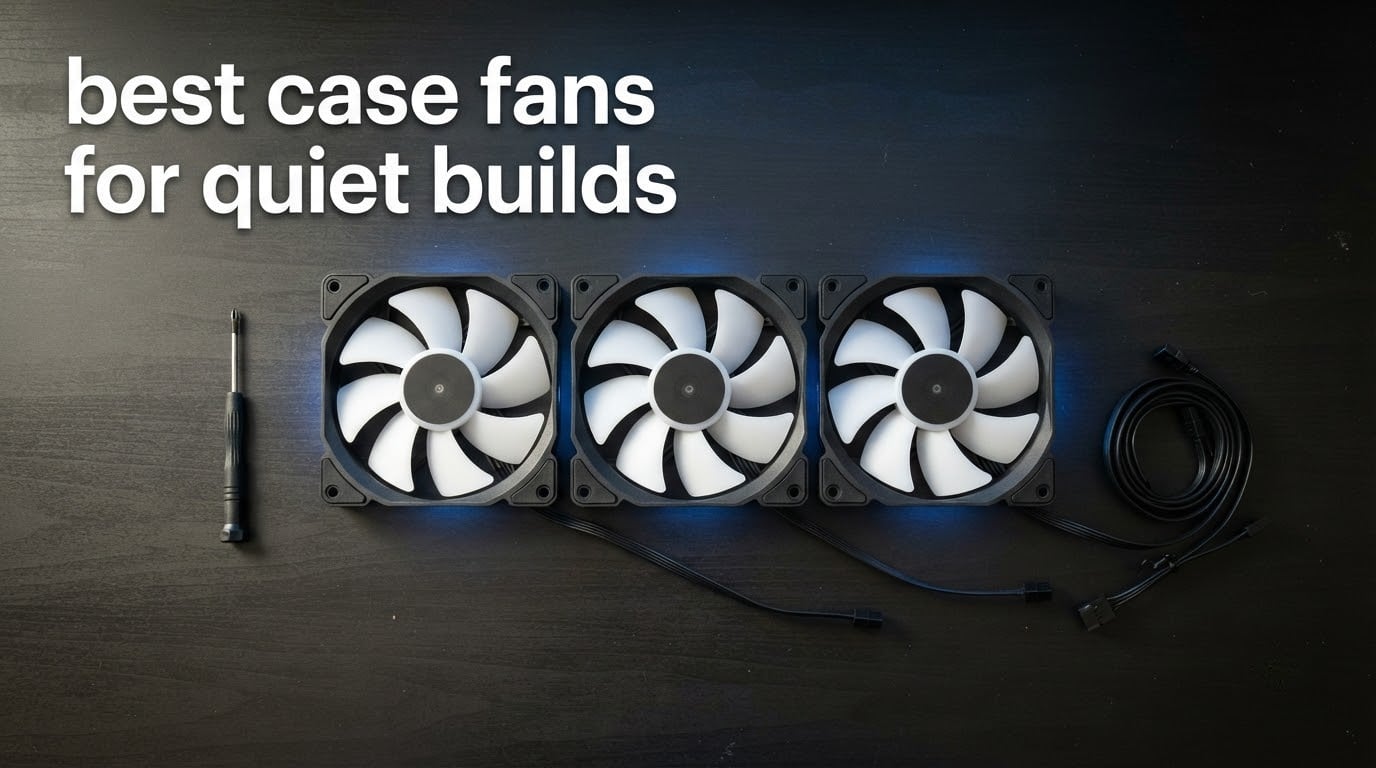
There is one winner if you want the best case fans for quiet builds right now: the Noctua NF-P12 redux 1700 PWM. It pairs a 25.1 dB(A) manufacturer rating with a 1700 rpm ceiling, a 4-pin PWM control signal, and a six-year warranty, and more than 20,000 owners have rated it 4.8 stars. If you want the quietest rated fan we tested rather than the most proven one, the Noctua NF-A12x25 G2 drops to 22.5 dB(A) and costs more per fan.
That is the whole argument this roundup is built on. Manufacturer dB(A) numbers get quoted constantly and rarely mean what a reader assumes, because every one of them is a rating at maximum speed, not the speed your fan will actually sit at. A fan rated at 25 dB(A) running at 30 percent PWM on a sensible curve is not a 25 dB(A) fan.
We looked at eight case fans for quiet builds, all of them PWM-controlled with published noise ratings, and ranked them on the only three things that decide whether a build is quiet in practice: how low the fan can be dialed down without stalling, how much static pressure it can push through a filter or radiator, and how it feels and sounds at low RPM. Two of the three most-repeated pieces of advice across r/buildapc, r/mffpc and the PCPartPicker forums never appear in a roundup like this, so we cover them in full further down: run fewer and larger fans, and tune the curve after you install them.
If your real problem is household noise rather than PC noise, our guides to the quietest fans for sleeping and the best ceiling fans for bedrooms cover the other half of the bedroom acoustics problem.
Table of Contents
Top 3 Picks for Case Fans for Quiet Builds in 2026

Noctua NF-A12x25 G2 PWM
- 22.5 dB(A) rated
- 360-1800 rpm PWM
- Stops fully at 0 percent PWM
- SSO2 bearing
Noctua NF-A14 PWM
- 24.6 dB(A) rated
- 300-1500 rpm PWM
- 140.2 m3/h airflow
- Square frame for radiators
All 8 Case Fans for Quiet Builds Compared in 2026
| Product | Specifications | Action |
|---|---|---|
| Noctua NF-P12 redux 1700 PWM |
|
Check Latest Price |
| Noctua NF-A12x25 G2 PWM |
|
Check Latest Price |
| Noctua NF-A14 PWM 140mm |
|
Check Latest Price |
 ARCTIC P12 Pro 120mm ARCTIC P12 Pro 120mm |
|
Check Latest Price |
 be quiet! Silent Wings Pro 4 140mm be quiet! Silent Wings Pro 4 140mm |
|
Check Latest Price |
 be quiet! Pure Wings 3 140mm be quiet! Pure Wings 3 140mm |
|
Check Latest Price |
 NZXT F120Q 120mm NZXT F120Q 120mm |
|
Check Latest Price |
 be quiet! Pure Wings 3 120mm be quiet! Pure Wings 3 120mm |
|
Check Latest Price |
How We Picked: What Counts as Quiet Here
Every dB(A) figure in this article is a manufacturer rating measured at the fan’s maximum speed, and we have labelled them as such throughout. None of them is an independent measurement, and the gap between a rated number and what you hear at 30 percent PWM is often larger than the gap between two products in this list.
That is why we rank on three things instead. First, the width and shape of the PWM range, because a fan that can be held at a low duty cycle without stalling is a quiet fan in practice. Second, static pressure behaviour, because a fan that stalls against a mesh panel gets pushed to full speed to compensate. Third, bearing and mounting, because bearing rattle and panel vibration are the two noise sources that a dB(A) rating does not capture at all.
All eight are 4-pin PWM fans, which is non-negotiable for a quiet build. A DC-controlled fan cannot be held at an intermediate speed, so it either runs silent at 500 rpm or loud at 2000, with nothing in between.
1. Noctua NF-P12 redux 1700 PWM – Best Overall Quiet Fan
Noctua NF-P12 redux-1700 PWM, Quiet Fan 120mm
120x120x25 mm
25.1 dB(A) at max
1700 rpm PWM
150000 h MTTF
Six year warranty
Pros
- Proven design with 20050 reviews at 4.8 stars
- Low 25.1 dB(A) rating for a 1700 rpm fan
- Pressure-optimised blades that handle radiators
- Deep accessory ecosystem for mounts and splitters
- Six year warranty and 150000 h MTTF
Cons
- 1700 rpm ceiling is below high-RPM alternatives
- No RGB option
- Beige and brown colouring divides opinion
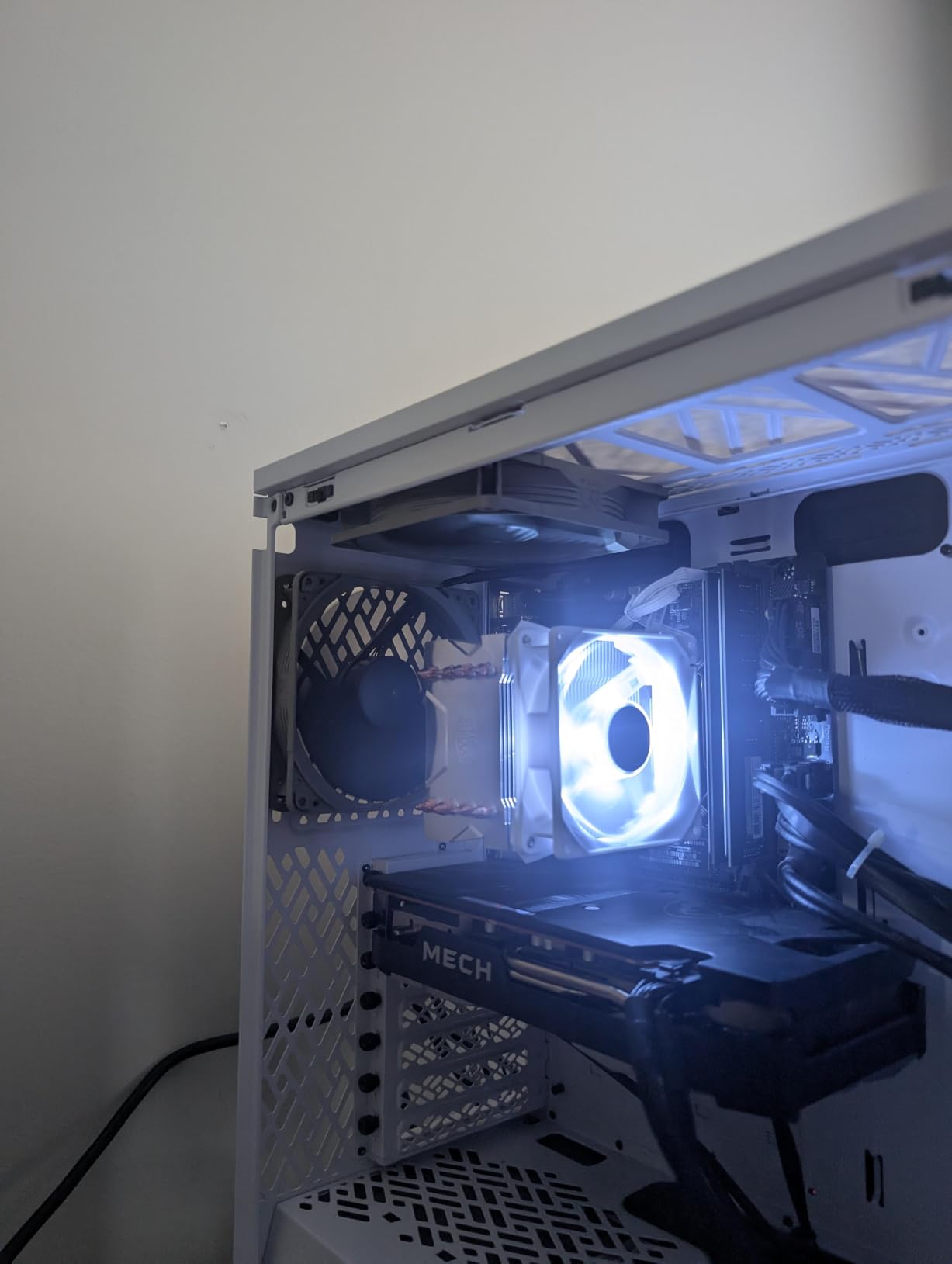
This is the fan we keep coming back to. It is a 120x120x25 mm unit in fibre-glass reinforced PBT, drawing 1.08 watts, rated at 25.1 dB(A), and moving 120.2 cubic metres of air per hour at its 1700 rpm ceiling. That combination of a modest ceiling and a strong pressure-optimised blade design is exactly what a quiet build wants, because the fan spends more of its life in the middle of its range instead of pinned at the top.
Twenty thousand reviews at an average of 4.8 stars is the largest evidence base of anything in this roundup by a wide margin, and the pattern in that feedback is consistent: owners like the airflow for the size, like how quiet it gets on reduced PWM, and find it easy to install. The complaints are almost entirely cosmetic.
Where it earns the top spot is the boring stuff. A stated MTTF above 150,000 hours and a six year manufacturer warranty give it the longest documented service life in this group, and the bearing and frame are tuned for low noise rather than peak output. Reviewers treat warranty length as a proxy for build quality, and on that measure this fan leads the field.
The accessory range is the quiet advantage too. Anti-vibration mounts, S-ATA power adaptors, Y-splitters and extension cables all exist for this exact model, so if you end up needing a fan hub or a fourth fan in a non-standard position you are not hunting for a third-party part that fits badly.
What you should know before buying it
The 1700 rpm ceiling is the honest limitation. Modern high-RPM 120 mm fans reach 3000 rpm, and if you are pushing air through a dense radiator or a heavily filtered intake you will eventually want that headroom. For plain chassis ventilation, exhaust, and a modest radiator, you will not miss it.
There is no lighting option in any colourway, and the beige and brown scheme is the single most-mentioned complaint across reviews. If your build is on show and the fans are visible through a glass panel, that is a real consideration. If they sit behind a mesh front, it is irrelevant.
Who should and should not buy it
Buy this fan if you are building a quiet work-from-home PC, a bedroom machine, or any build where a proven long-life fan matters more than a headline noise number. It is the safest default of the eight, and the accessory ecosystem is what tips it over the alternatives for multi-fan layouts.
Look elsewhere if you need RGB, if you need a 3000 rpm high-static-pressure fan for a very restrictive intake, or if you want the lowest published rating rather than the best-proven option. Our quieter-rated alternative is the Noctua NF-A12x25 G2, covered next.
2. Noctua NF-A12x25 G2 PWM – Quietest 120mm In This Group
Noctua NF-A12x25 G2 PWM, High-Performance Quiet Fan 120mm
120x25 mm
22.5 dB(A) at max
360-1800 rpm PWM
Stops at 0 percent PWM
Pros
- Lowest 120mm noise rating in this group
- Stops completely at 0 percent PWM
- 4.9 stars from 428 reviews
- Full accessory kit in the box
- Premium SSO2 bearing rated above 150000 h
Cons
- Higher cost per fan than the redux
- Stiff sleeved cable complicates tight routing
- No RGB and no reverse-blade version
This is the 120 mm fan with the lowest published noise rating in our group, at 22.5 dB(A), and it is the only one here that stops completely. The PWM range runs 360 to 1800 rpm and the fan halts at 0 percent PWM, which means a properly configured curve gives you true silence at idle rather than a low hum.
It is built in Sterrox LCP with an ultra-tight tip clearance, which is where a lot of that number comes from: less blade-to-frame gap means less turbulence and less efficiency loss. Owners report the same cooling at lower RPM than louder competitors, and reviewers benchmarking it against premium 120 mm options consistently find it quieter at higher speeds.
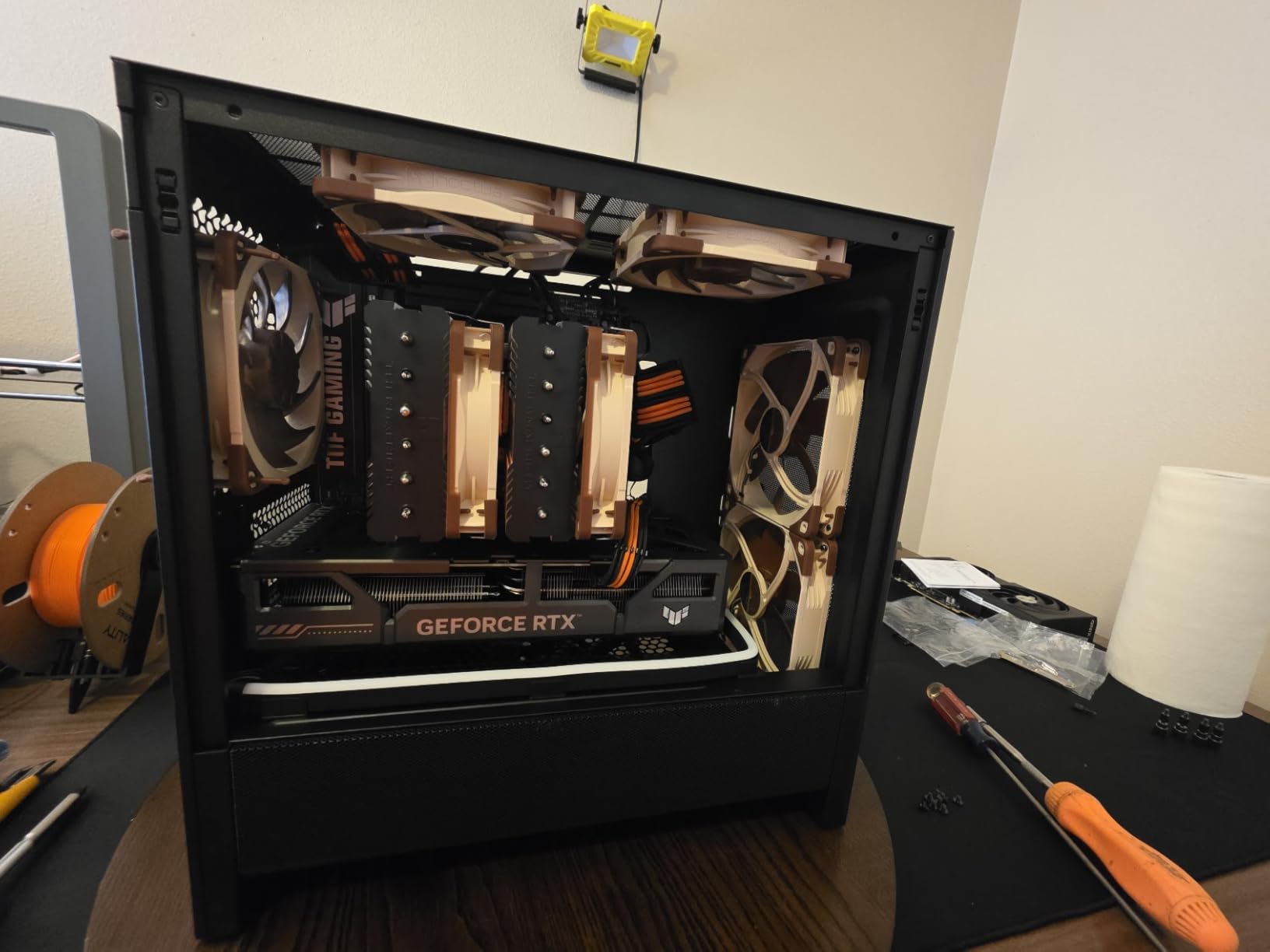
The in-box kit is unusually complete for a 120 mm fan. You get anti-vibration mounts, a 12 cm gasket, screws, a Low-Noise Adaptor, and both an extension and a splitter cable, so there is nothing to buy separately for a multi-fan install. The bearing is the premium-grade SSO2 unit, rated at over 150,000 hours, and the construction is UL and TUV certified.
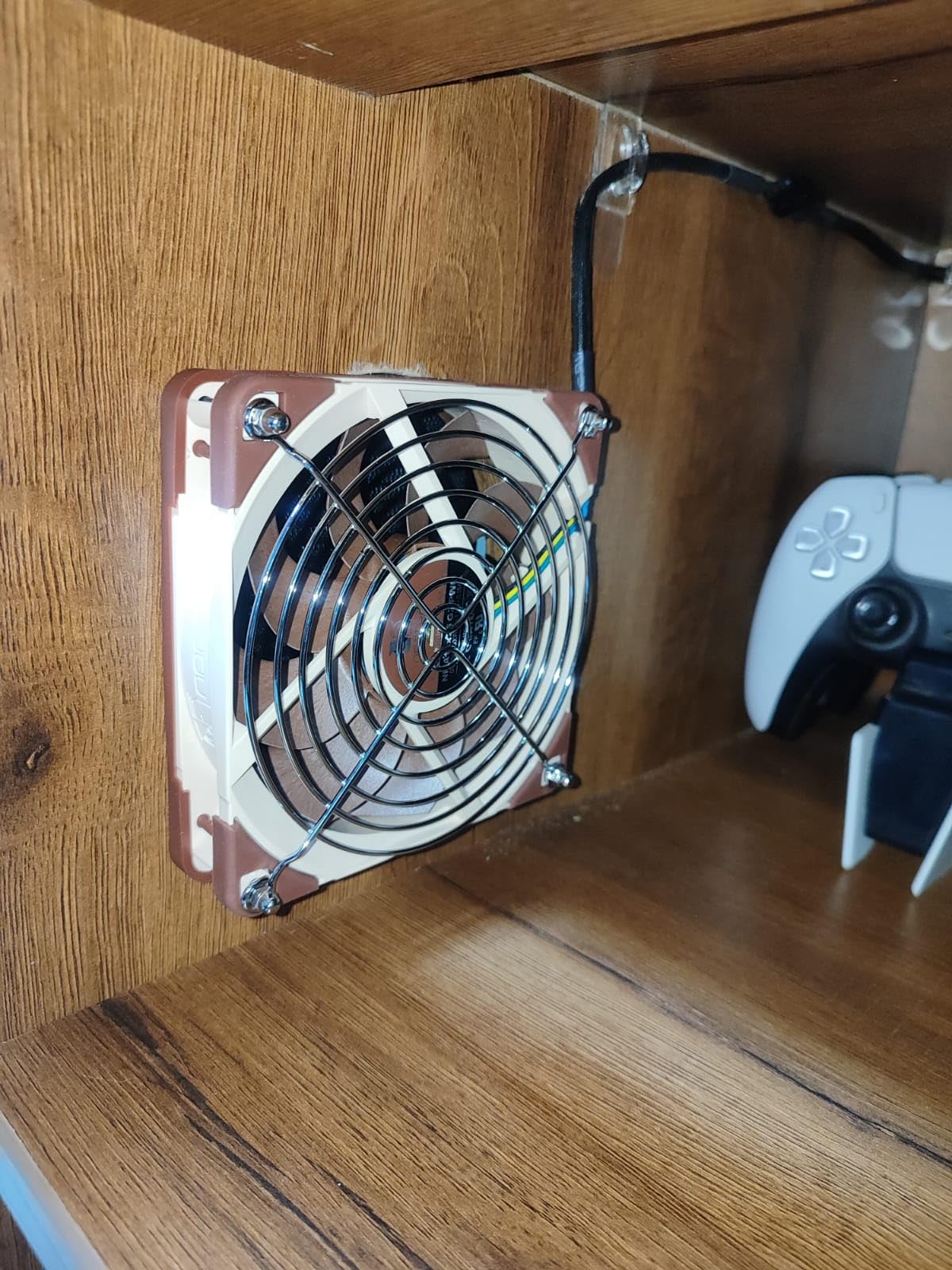
One owner reported roughly 5 degrees lower CPU temperatures in an AIO radiator swap after moving to this fan, which is the kind of result that matters if your noise budget is the constraint rather than raw heat rejection.
What you should know before buying it
The cost per fan is the highest in this roundup, and you should be clear with yourself about why you are paying it. You are buying the lowest rated noise in the group, the true zero-RPM stop, and the tightest tip clearance. If you do not need those three things, the redux model above is the more rational buy.
The sleeved cable sections are stiff, which several owners mention as a routing problem in tight builds. Plan your cable path before you screw the fan in rather than after. There is also no reverse-blade configuration and no RGB version.
Who should and should not buy it
Buy it if the machine sits next to a microphone, if you record voice or stream, or if you genuinely want a fan that is physically stopped when the system is idle. The semi-passive behaviour is a real feature in a bedroom or studio, not a spec-sheet trick.
Skip it if you are populating a case with six or more fans on a limited budget. At that count the per-fan cost dominates and a quieter curve plus a good 140 mm layout will get you closer to silence for less money. Read the buying guide below before committing to a count.
3. Noctua NF-A14 PWM – Best 140mm For Quiet Radiators
Noctua NF-A14 PWM, High-Performance Quiet Fan 140mm
140x140x25 mm
24.6 dB(A) at max
300-1500 rpm PWM
140.2 m3/h airflow
Pros
- Moves more air than any 120mm fan here
- 300-1500 rpm range for fine idle control
- Square frame suits AIO and DIY radiators
- Over 6000 reviews at 4.8 stars
- Anti-vibration mounts and Low-Noise Adaptor included
Cons
- 1500 rpm ceiling is below modern high-speed 140mm
- No RGB option
- Design has not been substantially revised in years
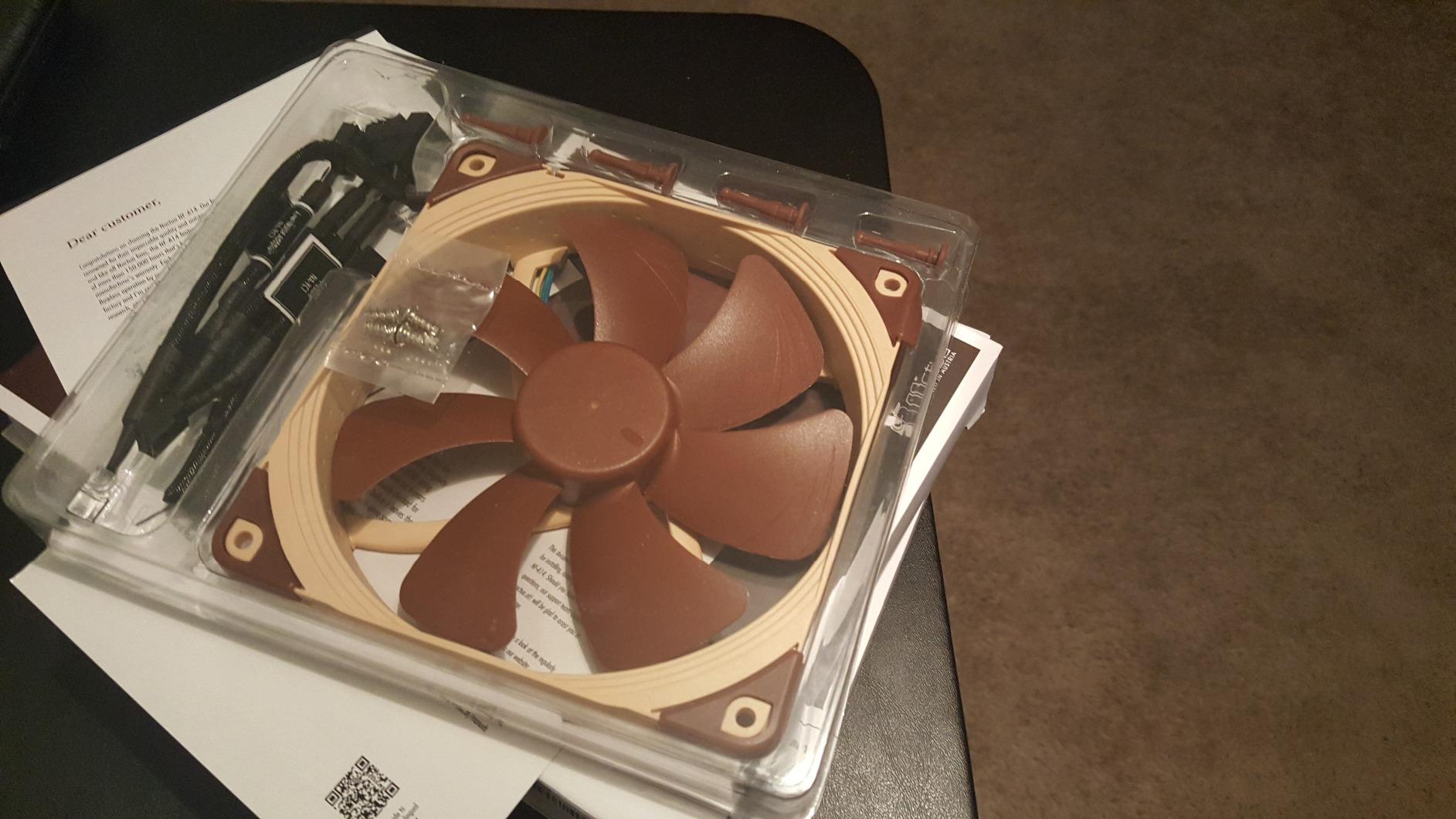
This is the quiet-build version of the fewer-larger-slower principle, and it is the reason we would rather see someone run two 140 mm fans than three 120 mm ones. At 140.2 cubic metres per hour it moves more air than any 120 mm fan in this roundup, while its 1500 rpm ceiling is 300 rpm lower than the 120 mm Noctua above it.
Same air moved, slower rotation, lower pitch. That is the whole trick, and it is why 140 mm fans get perceived as quieter even when their dB(A) rating is worse. This one is rated at 24.6 dB(A), uses Flow Acceleration Channels and an Advanced Acoustic Optimisation frame, and shares the fibre-glass reinforced PBT construction and 150,000 hour MTTF with the rest of the Noctua line.
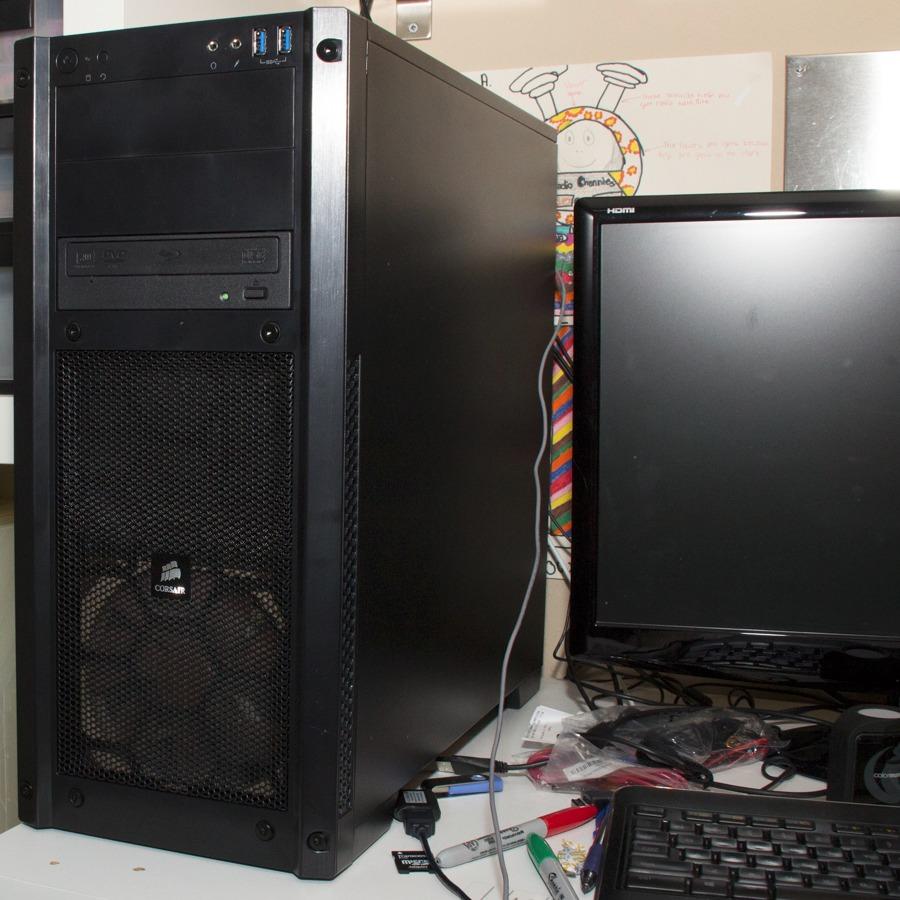
The PWM range of 300 to 1500 rpm is wide enough that a gentle curve holds it near inaudible at idle and still gives you headroom in a hot room. Owners also use the included Low-Noise Adaptor to cap the maximum at 1200 rpm, which is a genuinely effective trick for a bedroom machine: the fan simply cannot reach the noisy end of its range.
It is the older design, and reviews reflect that. The 1500 rpm ceiling is the most-cited limitation, and several owners note the design has not been substantially revised compared with newer 120 mm options. Over 6,100 reviews at 4.8 stars still makes it one of the most proven 140 mm fans you can fit.
What you should know before buying it
The square frame is a feature, not a quirk. It is what makes this fan a good match for AIO and DIY radiators and for cabinets where a 140 mm mounting pattern is standard, so check your radiator and case support 140 mm before you commit.
There is no lighting option, and the accessory bundle includes anti-vibration mounts, screws, a Low-Noise Adaptor, an extension cable and a Y-cable, which covers most installs without a separate hub.
Who should and should not buy it
Buy it if you are running an all-in-one liquid cooler, if your case supports 140 mm, or if you want to reduce fan count without reducing airflow. Pairing two of these as intake with the 120 mm redux fans as rear exhaust is the layout we would build today.
Skip it if your case only takes 120 mm, or if you need a 140 mm fan that can push through a thick radiator at high speed. For that, the be quiet! Silent Wings Pro 4 is the higher-headroom option.
4. ARCTIC P12 Pro – Best For Mesh Panels And Radiators
ARCTIC P12 Pro – Powerful Premium Fan, 120 mm PWM Fan, 600-3000 RPM
120 mm
600-3000 rpm PWM
77 cfm
Stops below 5 percent PWM
Pros
- Highest static pressure design in this group
- 77 cfm of airflow for a 120 mm
- 600-3000 rpm range with a full stop below 5 percent
- Fluid dynamic bearing and automatic rotor balancing
- Six year warranty
- Community favourite on cost per unit of performance
Cons
- Noticeably loud above 2000 rpm
- No anti-vibration pads or long cable in the box
- Plain all-black design with no reverse-blade or RGB version
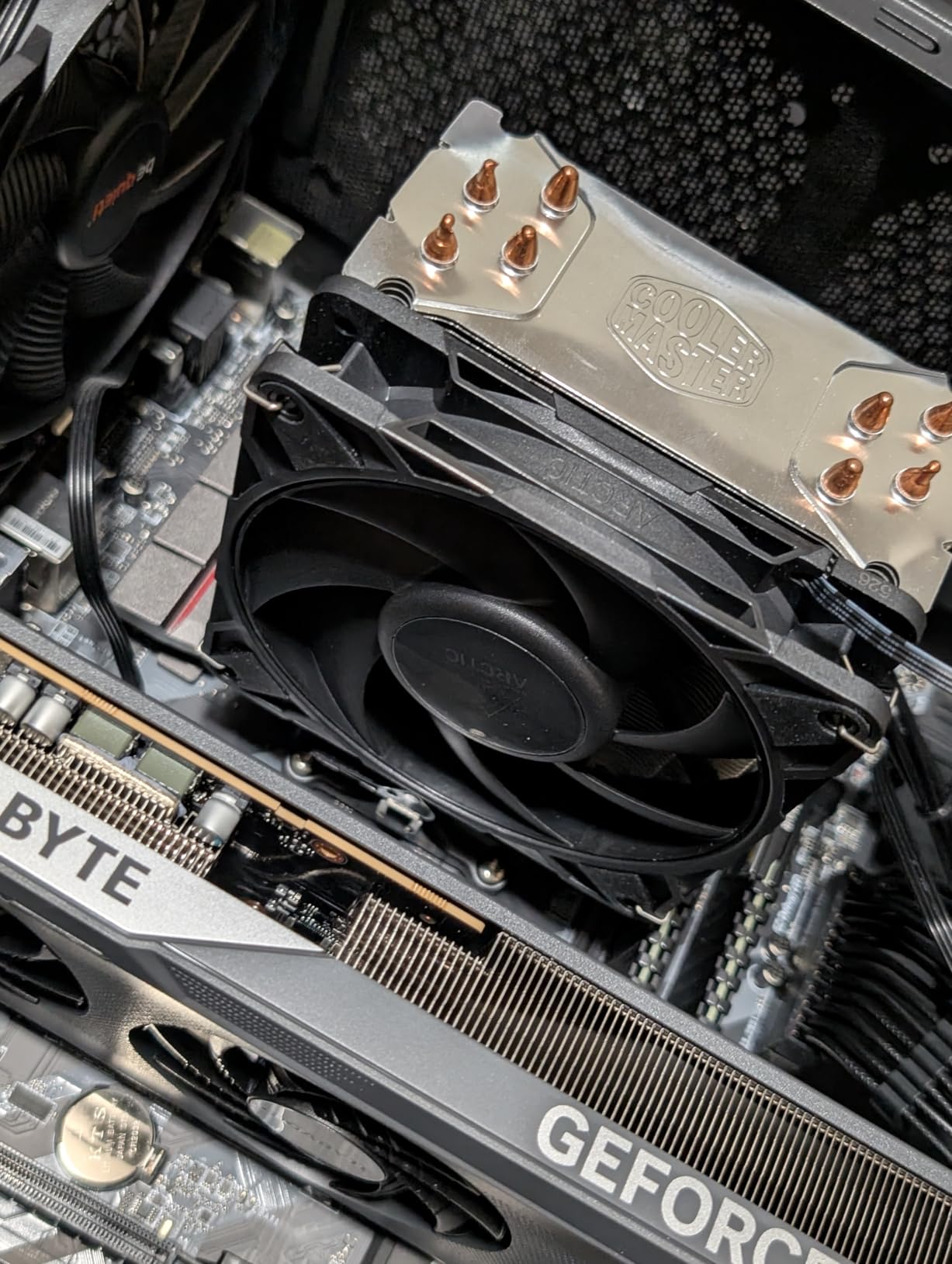
This is the fan to buy when your case has a dense filter, a fine mesh front panel, or a radiator that everything else struggles with. The P12 Pro is designed around high static pressure, moving 77 cfm at a 600 to 3000 rpm PWM range, and that ceiling is the point: it means you can run it slowly when you want quiet and still have the headroom to force air through a restrictive panel when you need it.
That headroom is also the catch. Buyers consistently note it is noticeably louder than premium 1200 to 1800 rpm fans when it reaches the top of its range, which is exactly what you would expect from a fan capable of 3000 rpm. On a sensible PWM curve at moderate speeds, reviews say it is quieter than expected, and the design was reworked specifically to balance performance and low noise at low RPM.
The bearing is a self-lubricating fluid dynamic bearing, and manufacturing precision plus automatic rotor balancing are used to keep vibration down. It stops completely below 5 percent PWM, so it can genuinely reach silence at idle, and it carries a six year warranty despite costing a fraction of the premium Noctua models.
The community consensus is strong here. r/buildapc and r/mffpc repeatedly nominate the Arctic P12 line as better value than Noctua while staying quiet, and a LinusTechTips thread from 2026 makes the same case, pointing to the Redux line as the pick. A separate Overclock.net thread on this fan reports an internal case noise floor around 19 dB(A) and makes a useful point: in a push configuration the weakest fan can end up being the loudest.
What you should know before buying it
It does not ship with anti-vibration pads, long fan screws, or a hub. If you are mounting it to a radiator or running more than two, budget for a separate pack of anti-vibration mounts and long screws, which is a few dollars and a few minutes of work.
There is no reverse-blade or RGB variant in the line-up, so if you want a lit intake you are looking elsewhere entirely. And if your case has a well-open front panel, this fan’s static pressure advantage largely goes unused.
Who should and should not buy it
Buy it if you have a mesh or heavily filtered front panel, a thick radiator, a restrictive SFF case, or you simply want the most airflow per unit of money across multiple fans. On a six-fan budget build this is the fan that makes the budget work.
Skip it if silence at full speed is your priority, or if your case is open-air. For a bedroom machine where fans never need to spin hard, a lower-ceiling fan sounds better at every point of its range.
5. be quiet! Silent Wings Pro 4 140mm – Best High-Speed 140mm
be quiet! Silent Wings Pro 4 140mm PWM High-Speed Gaming PC Case Fan, Black
140 mm
36.8 dB(A) at max
2400 rpm with speed switch
97.4 cfm
Six pole FDB motor
Pros
- Strong radiator and heatsink performance in 140 mm
- On-body speed switch drops the ceiling when you want quiet
- 97.4 cfm of airflow in a 140 mm frame
- Rubber corner mounts dampen vibration
- Braided cabling suits a clean build
Cons
- Loud above roughly 2000 rpm and the max rating is 36.8 dB(A)
- Heaviest fan here at 310 g
- One year warranty is the shortest in this group
This is the one to buy when a radiator is the constraint. It is a 140 mm fan rated at 2400 rpm maximum, moving 97.4 cfm, with a 6-pole motor on a fluid dynamic bearing. A small tip clearance and a funnel-shaped frame outlet give it very high static pressure, and reviewers report temperature reductions in the region of 5 to 20 degrees alongside a silent idle in multiple builds.
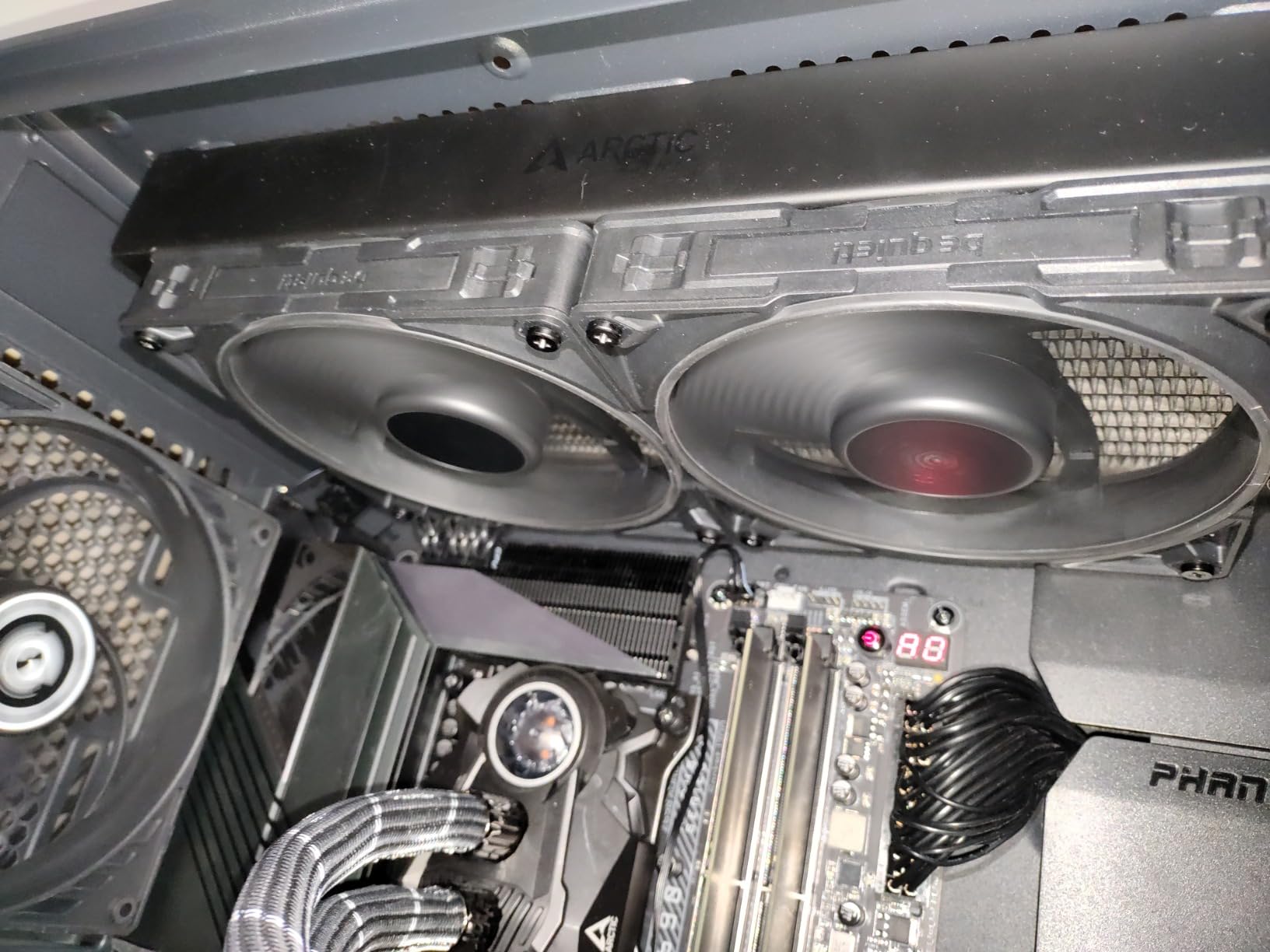
The feature that makes it interesting for a quiet build is the speed switch on the fan body. It lets you set the maximum PWM ceiling to medium, high or ultra-high rather than committing to the top speed permanently, so you can cap it for a bedroom machine and unlock it when the GPU is loaded. Reviewers with direct head-to-head experience regularly rank it alongside the Noctua NF-A12x25 G2 and the Phanteks T30 among the best-performing 140 mm options, and it is the only one of that group in all black.
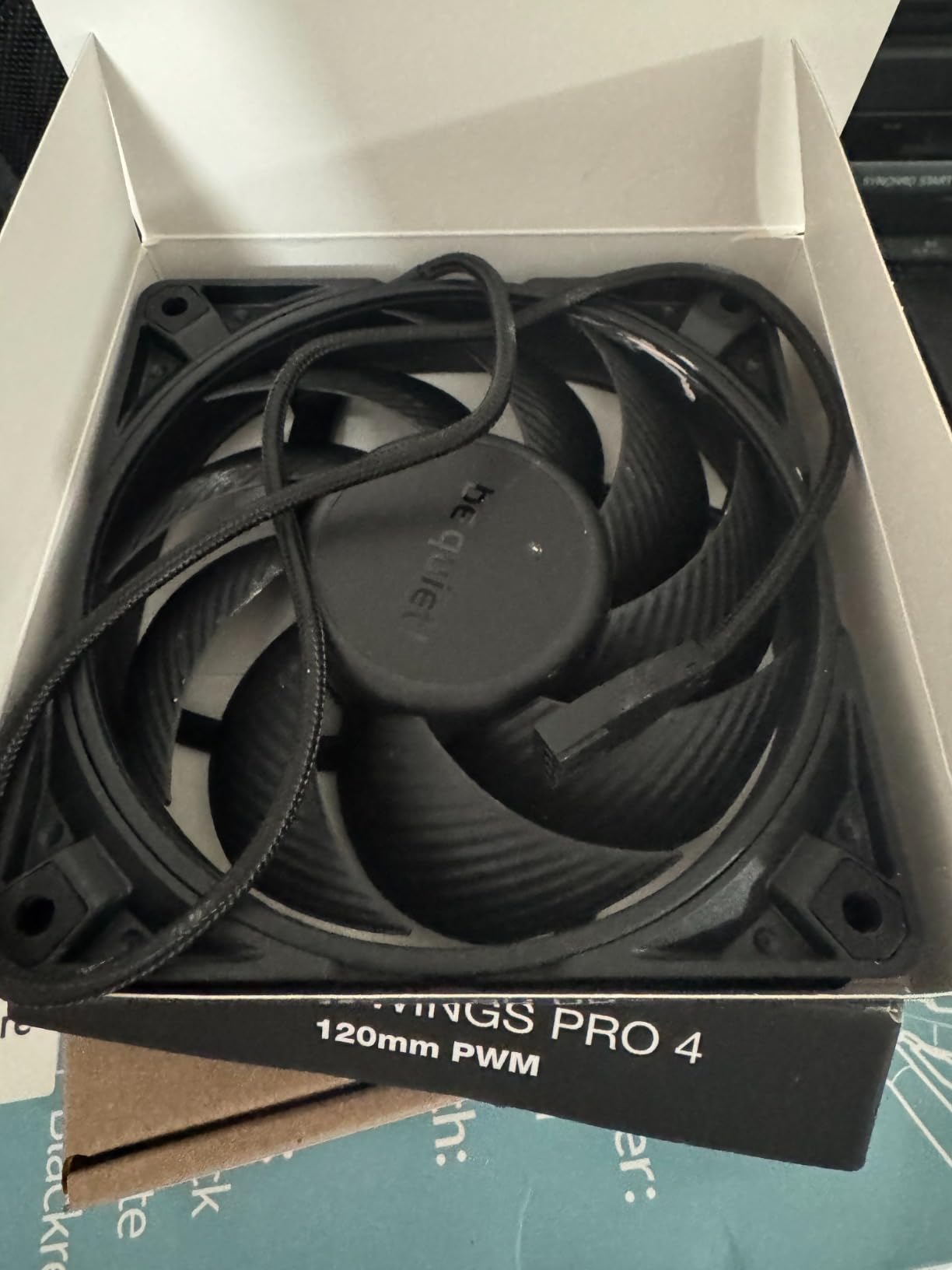
Vibration is handled with rubber corner mounting points, and the braided, higher-quality cabling is a small touch that matters if you are routing visible cable through a glass-panel case. The motor is smooth and quiet at regular speeds according to most owners.
The honest framing is that it is only truly quiet below about 2000 rpm, and its published maximum of 36.8 dB(A) is the highest number in this roundup by a wide margin. One reviewer found it less silent than expected at higher speeds. This is a performance fan that can be quiet, not a quiet fan that can also perform.
What you should know before buying it
At 310 g it is the heaviest fan here, which matters in a tight radiator sandwich where the fan is bearing part of the assembly’s weight and screw length is marginal. Check your radiator’s clearance for fan thickness before committing.
The one year warranty is the shortest of the eight, against six years on three of the Noctua models. Forums treat warranty length as a proxy for build quality, so if you intend to keep the build for years, that is a fair concern. There is no RGB version.
Who should and should not buy it
Buy it if you have a 240 mm or 280 mm radiator, a thick AIO, or a hot GPU that needs real pressure, and you want an all-black fan that will not clash with a dark build. Set the speed switch to medium and it becomes a genuinely quiet radiator fan.
Skip it if you want the lowest possible noise with no radiator to feed, or if warranty length matters to you more than airflow. The Pure Wings 3 140 mm below is quieter in every respect except headroom.
6. be quiet! Pure Wings 3 140mm – Lowest Noise Rating Here
be quiet! Pure Wings 3 140mm Quiet PWM Case Fan | High top-end Speed with Low Minimum RPM | Extraordinary air Pressure | BL108
140 mm
21.9 dB(A) at max
1500 rpm max
57.4 cfm
Rifle bearing 80,000 h
Pros
- Lowest published noise rating in this roundup at 21.9 dB(A)
- Very low minimum RPM for near-silent idle
- Frame outlet optimised for radiator performance
- Seven airflow-optimised blades
- Two year manufacturer warranty
Cons
- 1500 rpm and 57.4 cfm lag the high-speed 140mm options
- 80000 hour bearing rating is shorter than the Noctua 150000 h
- No RGB version
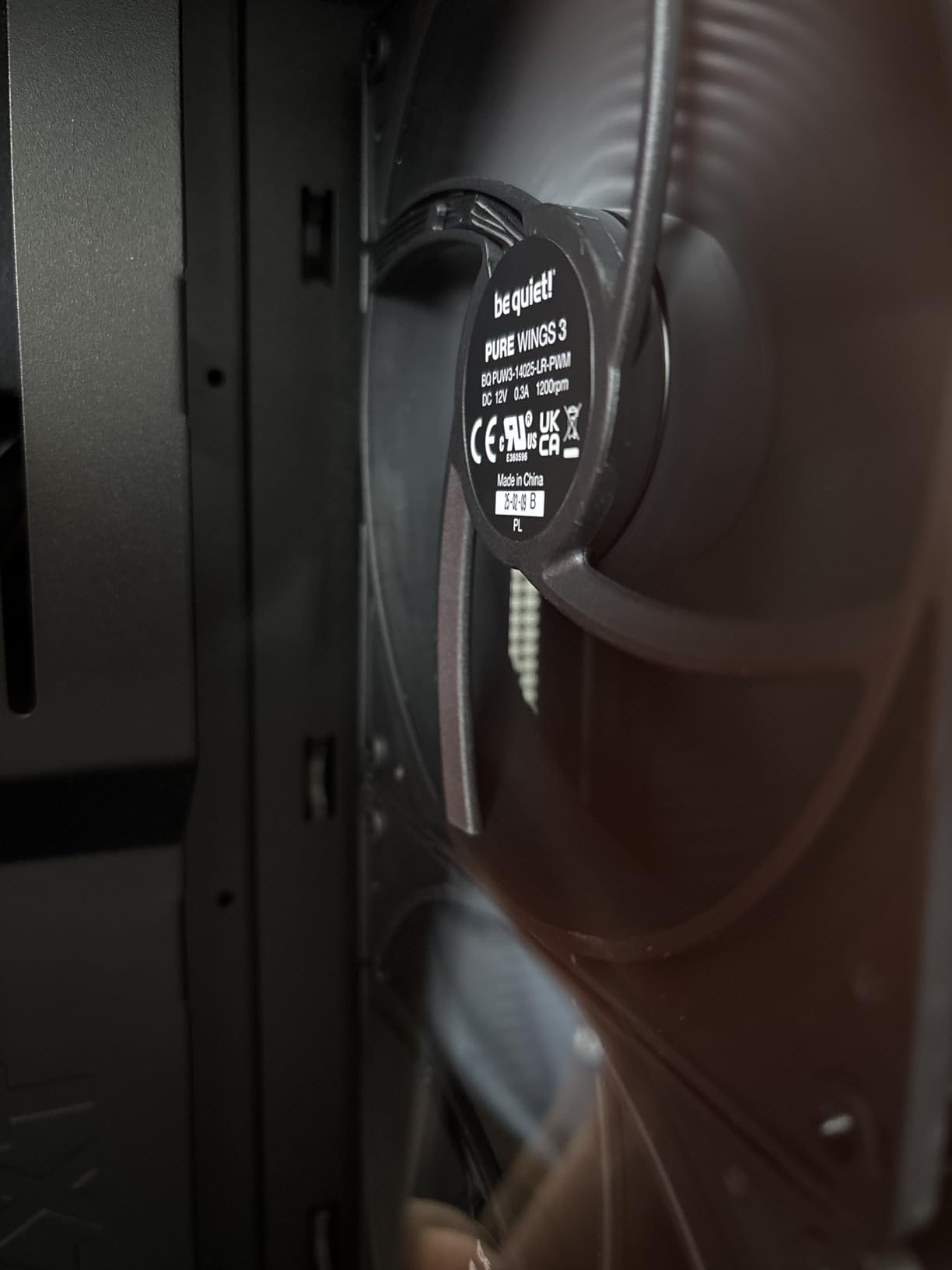
At 21.9 dB(A) this carries the lowest published noise rating of the eight, and the reason is not clever blade design so much as restraint: a 1500 rpm ceiling on a 140 mm frame. It moves 57.4 cfm, which is not a lot next to the 97.4 cfm fan above it, and that gap is exactly the trade you are making.
What you get in return is the ability to run it very low. The seven airflow-optimised blades and the frame outlet are tuned for low noise, and the standout trait in reviews is how far down it can be dialled. Buyers position it as a quiet, well-priced 140 mm option for case ventilation and radiators, with build quality that reviewers repeatedly describe in terms of German engineering at a mid-range price.
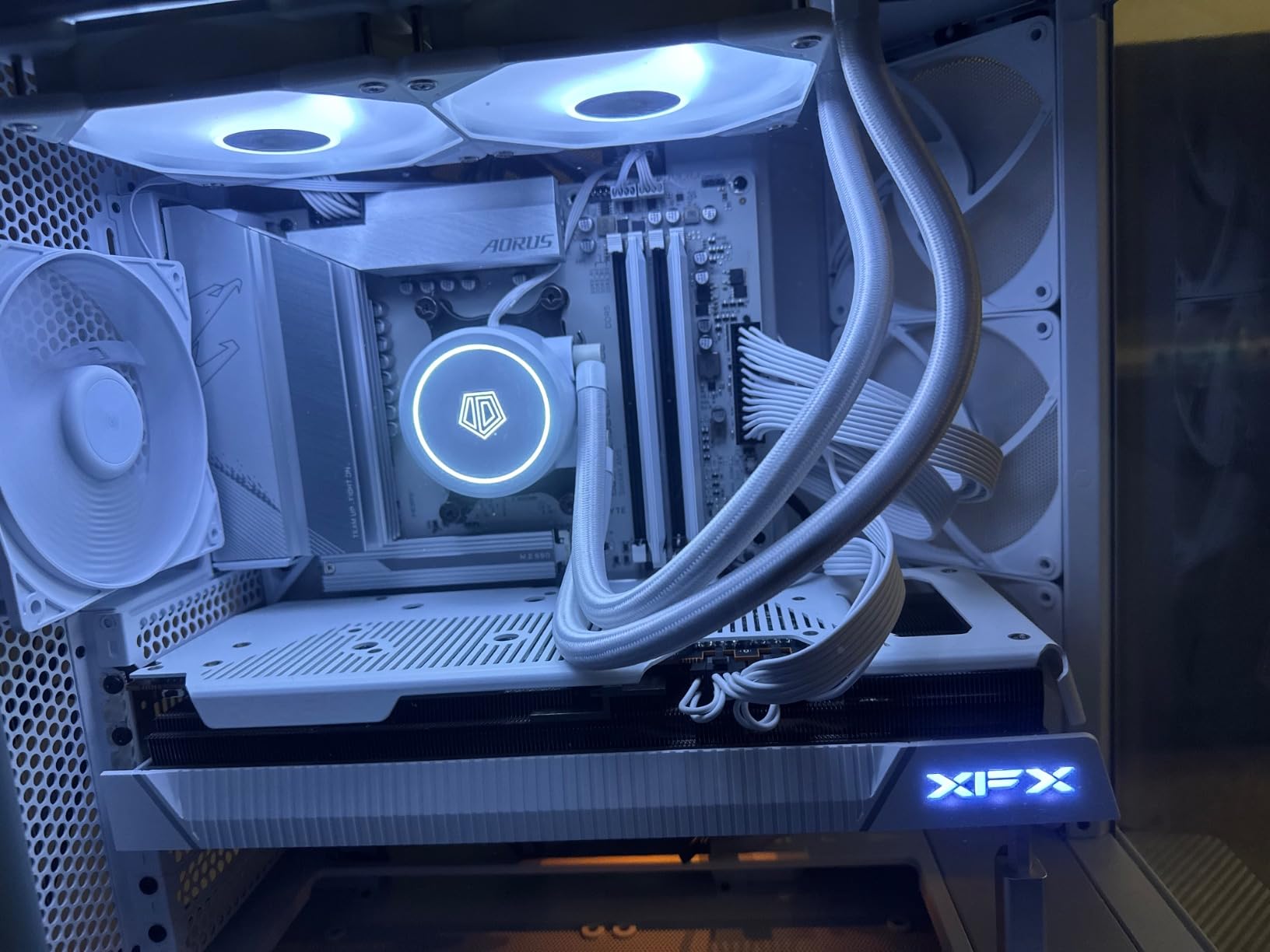
On r/buildapc, the Pure Wings 3 is consistently the reference point people name immediately after Noctua, which tells you how it is perceived in the community for silence. It is one of the two products in this roundup that a named forum source actually puts in the conversation as a quiet-first choice.
The bearing is a rifle bearing rated at 80,000 hours, and the warranty is two years. Both figures are below the Noctua models, which is the trade for the lower noise ceiling. At 210 g it is also notably lighter than the Silent Wings Pro 4.
What you should know before buying it
If you have a thick radiator, 57.4 cfm may not be enough. Owners who push it against dense radiators report the top-end airflow is modest compared with high-speed 140 mm models, and that is exactly where the Silent Wings Pro 4 earns its place.
The 80,000 hour bearing rating is a little over half the 150,000-plus hours of the premium Noctua models, so for a machine you expect to keep for many years the longer-lived options are worth considering.
Who should and should not buy it
Buy it if you want the quietest rated fan here, if your case is well ventilated, or if you want a 140 mm fan that will spend most of its life at low RPM. On a fan curve it is an easy recommendation for a bedroom or home office build.
Skip it if you are cooling a high-heat GPU or a thick radiator, or if you want the longest service life available. For those, step up to the Noctua NF-A14 PWM for longevity or the Silent Wings Pro 4 for pressure.
7. NZXT F120Q – Best All-Black Match For A Clean Case
NZXT F120Q – 120mm Quiet Airflow PC Case Fan – Black
120 mm
25.1 dB(A) at max
1700 rpm max
Nine sickle style blades
FDB 60,000 h
Pros
- Matches a minimalist all-black case without visible branding clutter
- Nine sickle style blades move large volumes of air
- Minimal blade-to-frame gap increases spinning area
- Chamfered frame concentrates the airflow
- PWM control tied to system temperature
Cons
- 60000 hour FDB lifespan is the shortest here
- Some tonal noise at full speed in a cluster of three star reviews
- No RGB version
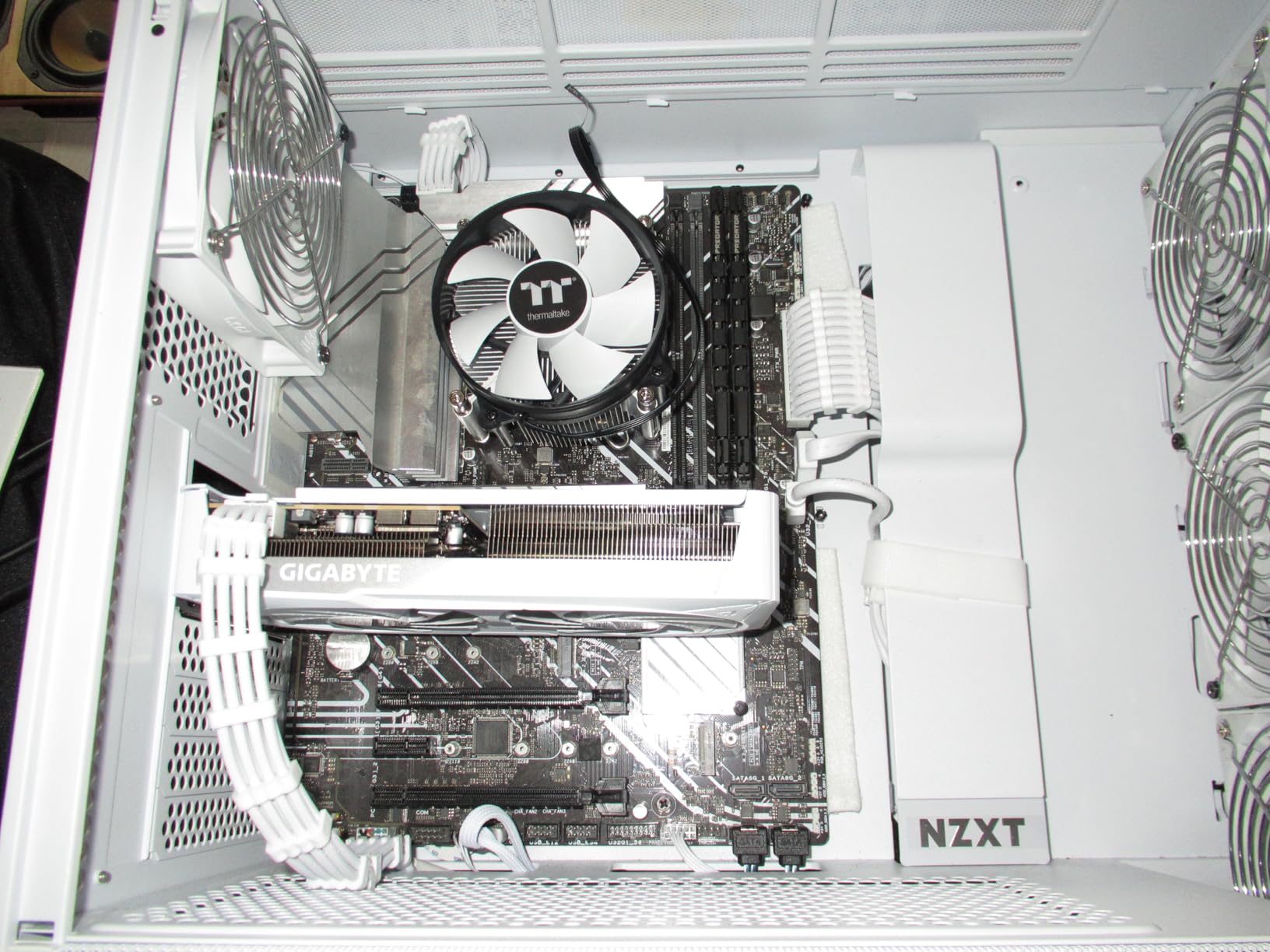
This is the pick for a build where fans are visible through glass and you do not want a beige or brown fan sitting in a black chassis. It is designed to blend into an NZXT-style clean aesthetic, and it is the only fan here whose purchase case is partly visual.
The engineering underneath is more serious than the minimal look suggests. Nine sickle-style blades move large volumes of air for either intake or exhaust, a minimal gap between the blade edges and the frame maximises the spinning area for higher airflow and lower turbulence, and a chamfered frame directs air in a concentrated pattern well into the case. Rated at 25.1 dB(A) with a 1700 rpm ceiling, that is a respectable quiet-build spec sheet.
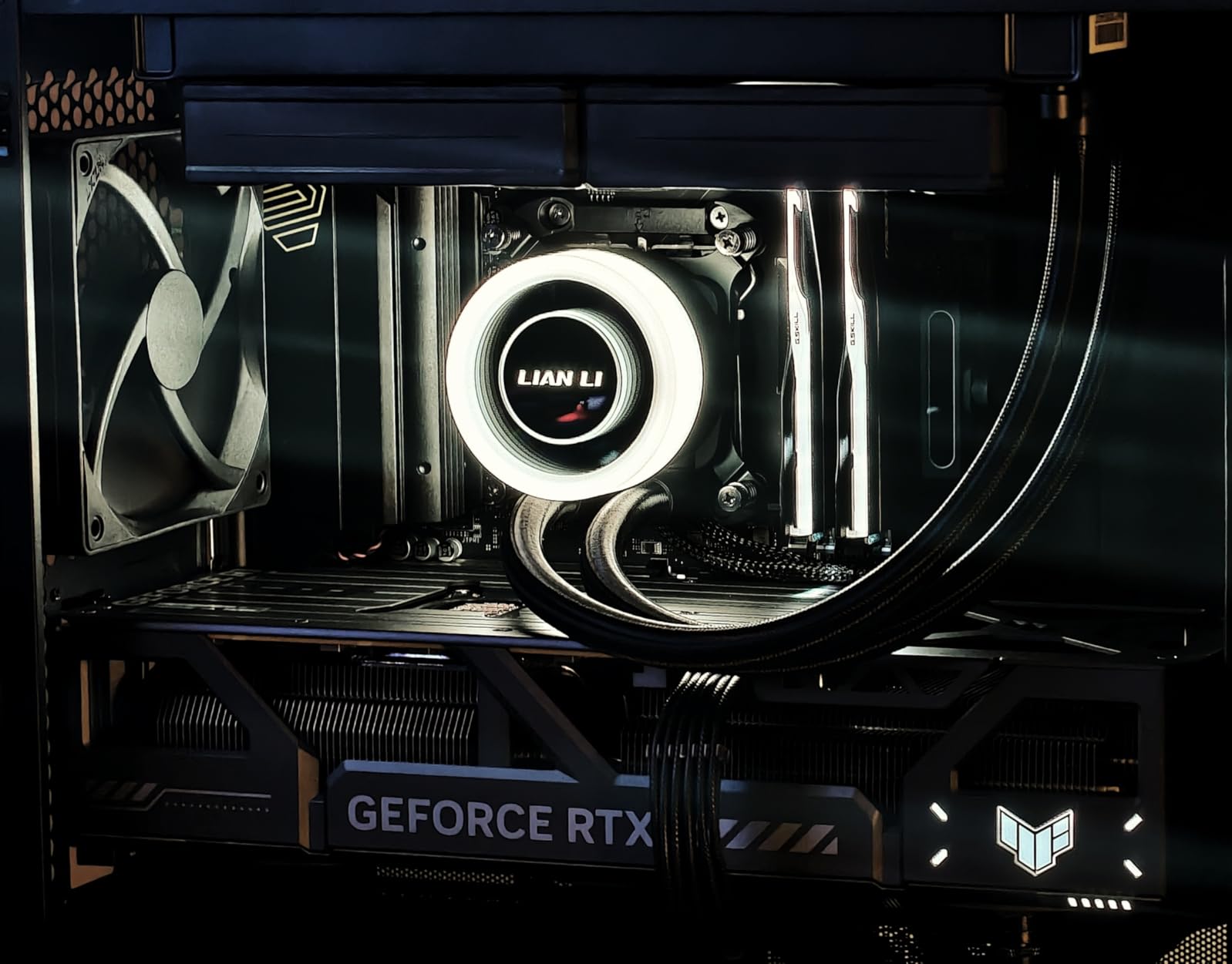
Owners like the airflow and the low noise output on a normal PWM curve, and it is frequently run alongside other fans in the same colourway so a multi-fan build stays visually consistent. That is a genuine advantage over the Noctua options for anyone who cares how the finished machine photographs.
Two things to know. The fluid dynamic bearing is rated at 60,000 hours, the shortest in this roundup, and the review spread includes a small cluster of three-star feedback focused on a slight tonal noise signature at full speed. Under a normal curve that is rarely the issue, but it is a real complaint that exists.
What you should know before buying it
There is no RGB version, which is a strange thing to note for a fan sold largely on looks. If your priority is lighting, this is not that product and there is no lit variant listed in this line.
Because it is sold individually and in matching colour, mixing it with a different brand in the same case means the visible fans will not match. If you are going to mix, put these where they are hidden.
Who should and should not buy it
Buy it if the visual match matters, if your case is well ventilated, and if you want a black 120 mm fan that does not look like a budget part in a glass-panel build. It also pairs naturally with an all-black be quiet! radiator fan if the theme is consistent.
Skip it if longevity across a decade matters, or if you are mounting against a restrictive panel where the ARCTIC P12 Pro’s static pressure will make a bigger difference than the colour will.
8. be quiet! Pure Wings 3 120mm – Best Budget Quiet Fan
be quiet! Pure Wings 3 120mm Silent PWM Computer Case Fan, Maximum Airflow
120 mm
25.5 dB(A) at max
1600 rpm max
49.9 cfm
Rifle bearing 80,000 h
Pros
- Widely described as one of the quietest 120 mm fans owners have used
- Low minimum RPM for a very quiet idle under a standard curve
- Owners report 1-3 degree drops in drive and SSD temperatures
- Light at 0.15 kg
- Two year manufacturer warranty
Cons
- Anti-vibration pads are not included
- No long screws or hub for multi-fan or radiator mounting
- 49.9 cfm is the lowest airflow figure here
This is the consensus budget quiet fan in this group, and the reviews make that clear. Owners in quiet cases and home servers report it as inaudible on a normal fan curve, and several describe it as one of the quietest 120 mm fans they have used even at full speed. It is also the lightest fan here at 0.15 kg.
Rubber corner mounts dampen vibration, and the fan can be held at a very low minimum RPM under a standard PWM curve, which is where a quiet build gets most of its real-world benefit. Several owners report measurable 1 to 3 degree drops in drive and SSD temperatures in quiet, airflow-restricted cases, which is a sensible result for a machine that is not trying to cool a hot GPU.
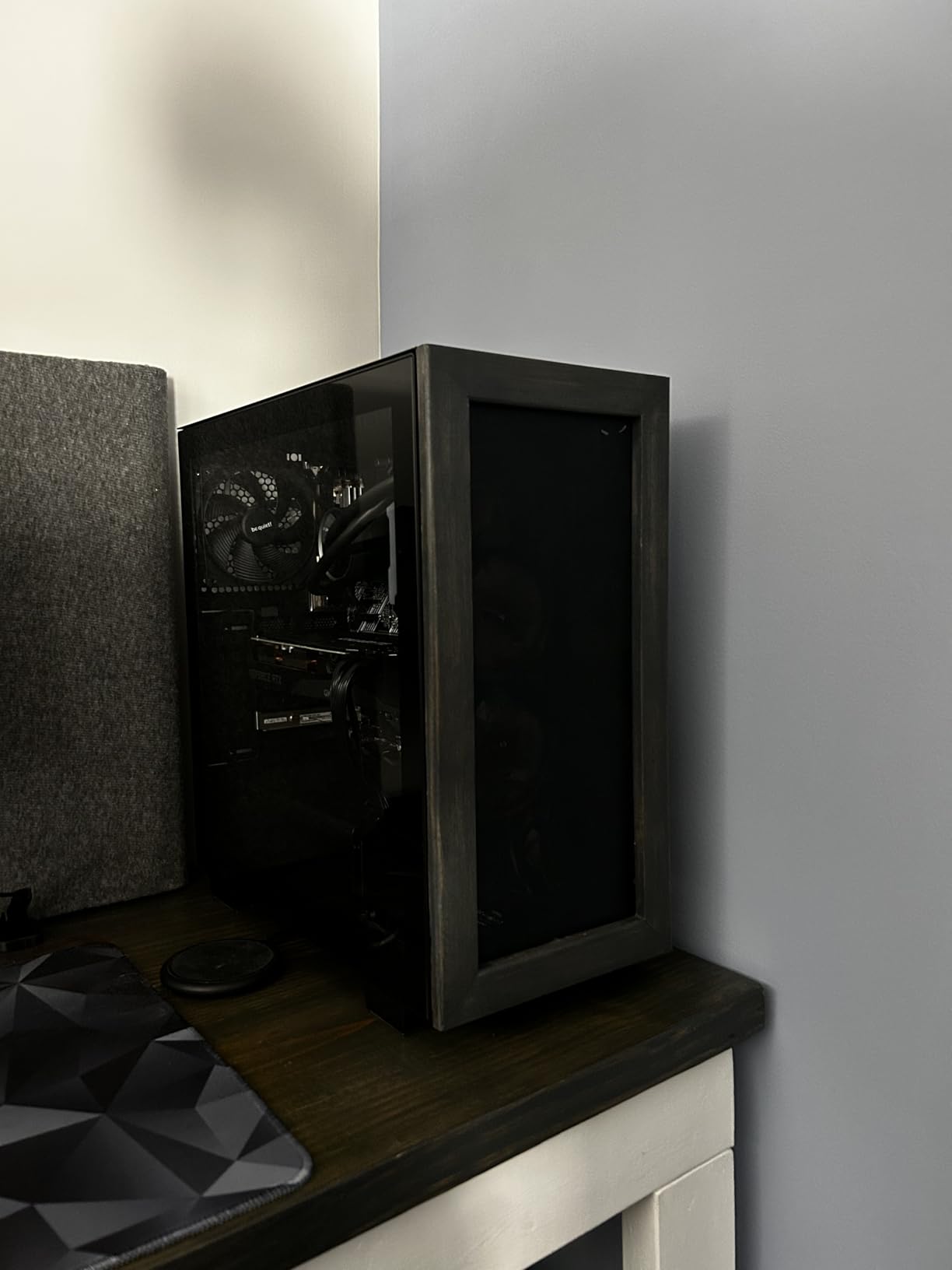
It runs at 1600 rpm maximum, moves 49.9 cfm, draws 2.4 watts, and carries a two year manufacturer warranty. The rifle bearing is rated at 80,000 hours, the same figure as the 140 mm version. At 4.7 stars from 637 reviews, its rating sits comfortably above the middle of this roundup.
The build quality is repeatedly described as solid for the price point, and the most common complaints are about what is missing from the box rather than what the fan does.
What you should know before buying it
Anti-vibration pads are not included, unlike the equivalent Noctua models, so a pack of pads is the first thing to add if you are chasing silence. Long screws and a fan hub are also absent, which matters if you are mounting more than two or attaching a radiator.
At 49.9 cfm this is the lowest airflow figure in the roundup. It is a case ventilation fan, not a radiator fan, and pairing it with a restrictive front panel will force it to spin up.
Who should and should not buy it
Buy it if you are filling out a case on a budget, if you need quiet intake or exhaust positions, or if you want a black fan with a restrained logo for a clean build. It is the pick for a home server or a secondary machine that needs to be present but not heard.
Skip it if you need radiator support or a high-heat GPU, and consider spending up once on a quieter-rated 120 mm fan if you are replacing all of them anyway rather than adding a few. Our guide to the quietest appliances for a shared home covers the same principle for a different category.
What 25 dB(A) Actually Sounds Like In A Real Room
A single fan rated at 25 dB(A) is close to a quiet library. Six fans rated at 25 dB(A), running at the same time, are not, because sound sources add. The practical rule that gets repeated across build forums is that a case is quiet only as quiet as its loudest fan and as slow as its slowest curve.
This is the gap that vendor numbers hide. A 24 dB(A) fan and a 15 dB(A) fan both look excellent in isolation, and they mean very different things once you have a full case of them pushing air through a filter. Look at the whole build’s noise budget, not the single spec.
Another thing the numbers do not capture: dB(A) is a logarithmic scale, so 3 dB is a perceptible step and 10 dB is transformative. When you read a comparison, a 2 dB difference between two fans is a different buying decision from a 6 dB difference. Do not treat a 0.6 dB gap on a spec sheet as meaningful; the measurement conditions are rarely identical anyway.
And the last thing: the rating is almost always taken at maximum speed. Your fan spends most of its life between 20 and 50 percent duty cycle. Which is why the next two sections matter more than the spec table.
120mm Vs 140mm Fans For Quiet Builds
For quietness, 140 mm wins in most cases for one reason: the same volume of air at a lower rotation speed. The Noctua NF-A14 PWM moves 140.2 cubic metres per hour at a 1500 rpm ceiling while the NF-P12 redux moves 120.2 at 1700 rpm. More air, less speed, lower pitch.
That is also the single most repeated piece of advice in the build forums we read, and it appears in almost no roundup: cut down the number of fans, adjust their curves, and buy the biggest fan the case supports. Two 140 mm intake fans and one 120 mm rear exhaust will usually be quieter than three 120 mm intakes and one rear exhaust, because you have one fewer motor and each one is turning more slowly.
The exception is restrictive airflow. A 140 mm fan on a dense radiator at 1500 rpm can stall, and a stalled fan gets pushed to full speed and gets loud. If your radiator is thick or your front panel is heavily filtered, the high-static-pressure options win regardless of size, which is why the ARCTIC P12 Pro is in this roundup despite being a 120 mm part.
Check your case’s supported fan sizes before you choose, and check the radiator thickness against the fan depth. A 25 mm fan in a 27 mm radiator space is fine; a 25 mm fan in a 27 mm sandwich with 15 mm of hardware is not.
Tune It After You Buy: Fan Curves, Hysteresis And Zero-RPM Mode
Which fan you buy matters less than what you do with it afterwards. Every build forum we read makes the same point: the curve you set is the difference between a silent machine and a quiet-sounding machine with expensive fans in it. Five steps, in order.
Enable PWM control on every case fan header before you do anything else. A fan stuck in DC mode cannot be throttled, and a fan at 100 percent is the reason a build sounds like a jet engine.
Set a generous hysteresis value, commonly 5 to 7 degrees in your BIOS or fan utility. Without hysteresis, a one-degree temperature fluctuation makes the fan audibly hunt, and hunting is more annoying than a steady low hum.
Build a gentler curve than the default. Start case fans at 30 to 40 percent for temperatures below 60 degrees and let them climb slowly after that. Most of the noise people complain about happens in the 40 to 60 degree band where fans are barely needed.
Use zero-RPM mode where the case supports it. Fans that can stop entirely, such as the Noctua NF-A12x25 G2 at 0 percent PWM or the ARCTIC P12 Pro below 5 percent, give you true silence at idle instead of a low idle hum.
Match fan speed to position, not to each other. Front intakes do more work and can run slower; rear exhaust and radiator fans benefit from more speed. A uniform curve across all headers is leaving quietness on the table.
If your motherboard has enough PWM headers, you do not need a fan hub. A hub is only required when you are running more fans than you have headers, and it does not reduce noise on its own. Where it does help is giving you per-position or per-group speed control, which is worth it on a six-fan build and unnecessary on a three-fan build.
Fixing A Noisy Build: A Short Diagnosis Checklist
Before you replace fans, work through this. Most “my PC is too loud” complaints are not fan quality problems.
Check the curve first and confirm the fans are actually under PWM control. Unpinned 100 percent fans explain most of the jet-engine reports.
Check for a blocked or dirty intake filter. A clogged filter forces every downstream fan to work harder to move the same air.
Test the case panel for resonance by pressing gently on it while the fans spin. A case that hums when touched is transferring fan vibration into the panel, and anti-vibration mounts are the fix.
Listen for rattle with the case off the desk. A fan bearing that has dried out rattles and buzzes, and unlike a pitch problem it does not go away as RPM drops.
Rule out coil whine separately. A high-pitched whine that rises and falls with GPU load is electrical, not airflow, and no case fan will fix it.
Count your fans. Reducing three to two, or swapping 120 mm for 140 mm, frequently does more than any fan upgrade.
For bearing rattle specifically, the fix is replacement rather than adjustment. Bearing type is a reasonable proxy for how likely that is to happen, which is why the 150,000 hour claims on the Noctua models matter to people building machines they intend to keep.
Frequently Asked Questions
What are the most quiet PC fans?
The quietest fans we found are the Noctua NF-P12 redux 1700 PWM at 25.1 dB(A) and the Noctua NF-A12x25 G2 at 22.5 dB(A), both rated by the manufacturer at maximum speed. For 140 mm, the be quiet! Pure Wings 3 has the lowest rating here at 21.9 dB(A). All three are 4-pin PWM fans, which is what makes them quiet in practice: they can be held at a low duty cycle instead of running at full speed. Note that a lower dB(A) number only matters if the fan can also be throttled, so PWM control is not optional.
What is the quietest dB for a fan?
The lowest published rating in this roundup is 21.9 dB(A) for the be quiet! Pure Wings 3 140 mm, and the lowest for a 120 mm fan is 22.5 dB(A) for the Noctua NF-A12x25 G2. For a quiet build we would treat anything under 25 dB(A) as the target range. Remember that these are maximum-speed manufacturer ratings, not independent measurements, and that your fan usually spends most of its life well below maximum speed.
Is 35 dB loud for a PC?
Yes, for a case fan 35 dB(A) is loud, and in this roundup only one fan carries a rating that high: the be quiet! Silent Wings Pro 4 140 mm at 36.8 dB(A). That figure is its maximum speed rating. A fan rated 35 dB(A) at full RPM can still be quiet in practice if a gentle PWM curve keeps it below about 2000 rpm, and several builders cap the Silent Wings Pro 4 with its on-body speed switch for exactly this reason.
Should I use 120mm or 140mm fans?
For a quiet build, 140 mm is usually the better choice because it moves the same air at a lower RPM. The Noctua NF-A14 PWM moves 140.2 cubic metres per hour at a 1500 rpm ceiling, against 120.2 at 1700 rpm for the 120 mm redux. Fewer, larger, slower fans is the most repeated advice in build forums. The exception is restrictive airflow, where a thick radiator or fine mesh panel makes a high static pressure 120 mm fan like the ARCTIC P12 Pro the better pick.
What is the best fan curve for a silent PC?
Start case fans at 30 to 40 percent below 60 degrees and let them climb slowly, and set hysteresis to 5 to 7 degrees so the fan does not hunt on small temperature changes. Confirm every case fan header is in PWM mode, and use zero-RPM mode on fans that support it. Finally, do not use one uniform curve: front intakes can run slower than rear exhaust and radiator fans, and matching them to position recovers a surprising amount of quietness.
The Quiet Case Fans We Would Build With Today
Our pick for the best case fans for quiet builds is the Noctua NF-P12 redux 1700 PWM, because a 25.1 dB(A) rating, a 1700 rpm PWM ceiling, a 150,000 hour MTTF and a six year warranty is the combination we would put in most builds without thinking about it. For absolute silence at idle, the Noctua NF-A12x25 G2 stops completely at 0 percent PWM and carries the lowest 120 mm rating we found.
For 140 mm, the Noctua NF-A14 PWM is the value pick, and its 300 to 1500 rpm range is ideal for a gentle curve. If your radiator is the constraint rather than your ears, the be quiet! Silent Wings Pro 4 has the pressure and the on-body speed switch to cap it. If your front panel is restrictive, the ARCTIC P12 Pro is the fan that will not stall, and it is the community’s cost-per-performance answer.
For the budget tier, the be quiet! Pure Wings 3 in either 120 mm or 140 mm is the pick, and the 140 mm version carries the lowest published rating in this roundup at 21.9 dB(A). If appearance in a glass-panel build is part of the brief, the NZXT F120Q does the job in all black. And whichever you choose, set the curve before you decide you picked the wrong one.