
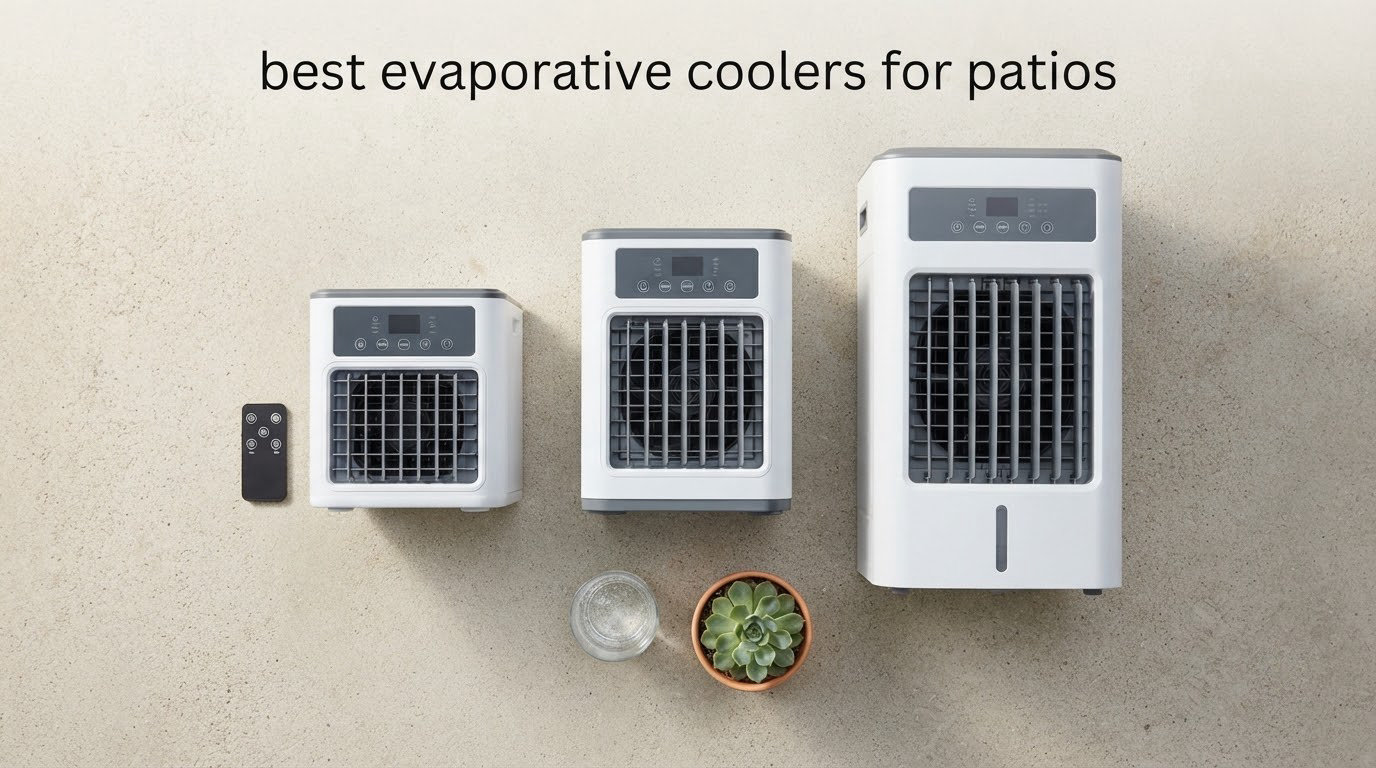
Most people buy an evaporative cooler for a patio in the wrong order. They pick a brand, then wonder why the breeze feels weak. The order that works is climate first, patio size second, unit third, and the climate question has a hard cutoff: an evaporative cooler pulls real cooling from the air only when relative humidity stays below roughly 60 percent. Above that, the water in the pad has little air left to absorb, and you are running a fan through a wet filter.
That is why this guide opens with an eligibility check instead of a product list. If you live in the desert Southwest, the high plains, inland California or another genuinely dry climate, the best evaporative coolers for patios on this page will do real work. If you live somewhere with monsoon summers or year-round coastal humidity, read the honest limits section first and consider a misting line or a shade sail instead.
We compared ten evaporative coolers built for outdoor spaces, sorted them by patio size rather than by indoor room, and cross-checked every CFM figure, tank capacity and noise rating against the manufacturer spec sheet. We also went through owner reviews, which is where the useful detail lives: the real air throw on a patio is shorter than the square-footage claims suggest, and the units that survive multiple seasons outdoors are rarely the ones with the flashiest spec sheet.
Before we get into the list, one honesty note. We do not test evaporative coolers in a lab, so where you see an experience claim it comes from aggregated owner reports and manufacturer documentation, not from our own thermometer. What we did do is cross-check every number so the spec blocks below match the spec tables, which is not something competitors reliably manage.
Table of Contents
Top 3 Picks for the Best Evaporative Coolers for Patios in 2026
If you want the short version, these three cover the three common patio situations. The Hessaire MC37M is the one we would put on most covered patios, the Uthfy 4800 CFM is the one that throws air the widest, and the OEMTOOLS 23969 is the one that handles the biggest spaces. All three run on water and electricity, never on refrigerant, and all three need dry ambient air to earn their keep.

Hessaire MC37M 3100 CFM
- 3100 CFM airflow
- 950 sq. ft.
- 10.3 gallon tank with hose fill
- 3 speeds at 59 dB

Uthfy 4800 CFM Swamp Cooler
- 4800 CFM airflow
- up to 970 sq. ft.
- 11 gallon tank
- 120 degree oscillation

Best Evaporative Coolers for Patios in 2026: Quick Overview
Here is the eligibility test in one paragraph. An evaporative cooler moves air through a wet pad, and the evaporation step is what removes heat. Dry desert air in the 10 to 25 percent relative humidity range can absorb a great deal of water, which is why owners in places like Phoenix and Albuquerque describe these units as transformative in summer. Air above 60 percent relative humidity is already close to saturated, so the same unit delivers mostly a fan and a faint damp smell. If your afternoon humidity regularly sits above 60 percent, this category is the wrong tool.
Sizing is the second filter. The square-footage numbers on the box assume ideal airflow and full pad saturation, so treat them as a ceiling and aim a tier below. For a small balcony or apartment patio under 200 square feet, a unit in the 900 to 1800 CFM range is realistic. For a typical covered patio between 300 and 600 square feet, 3000 CFM or more is the sweet spot. For a large deck, covered outdoor kitchen or patio over 900 square feet, you want 4500 CFM and up.
Here is our patio size guide:
Under 200 sq. ft. patio or balcony — 900 to 1800 CFM. Spot cooling within about 6 to 10 feet of the louvers is the realistic outcome.
200 to 400 sq. ft. covered patio — 1800 to 3100 CFM. Wide oscillation matters more than headline CFM at this size.
400 to 700 sq. ft. covered patio or pergola — 3100 to 5300 CFM. This is the most common residential patio size band.
700 to 1300 sq. ft. deck or outdoor kitchen — 4500 to 6000 CFM. Expect air throw of roughly 20 to 40 feet, not full-area cooling.
Over 1300 sq. ft. or commercial patios — 5300 CFM and up with a tank above 14 gallons, ideally with a hose float valve so you are not babysitting a reservoir.
Expected temperature drop also tracks humidity, and honest expectations prevent most returns. In arid air below 25 percent relative humidity, manufacturer and owner reports support a drop of roughly 15 to 25 degrees across the pad. In moderate air around 40 to 50 percent relative humidity, expect closer to 5 to 15 degrees. In humid air above 60 percent relative humidity, expect essentially nothing beyond a breeze. Peak heat matters too: in 100 degree air the cooler still works, but the incoming air is so hot that the drop is smaller than the same unit produces in the morning.
Noise is the other thing patio buyers underestimate. Below about 45 dB, a cooler sits near conversation level and works on a covered patio. Between 50 and 60 dB, it is noticeable but tolerable in open air, because wind and background noise mask it. Above 65 dB, plan on talking over it, and avoid placing it next to a neighbor wall at dinner time.
| Product | Specifications | Action |
|---|---|---|
| Hessaire MC37M 3100 CFM Evaporative Cooler |
|
Check Latest Price |
| Uthfy 4800 CFM Swamp Cooler |
|
Check Latest Price |
| OEMTOOLS 23969 5300 CFM |
|
Check Latest Price |
 Hessaire DC18 Mobile Evaporative Cooler Hessaire DC18 Mobile Evaporative Cooler |
|
Check Latest Price |
 DEWALT DXACN01B Portable Air Cooler DEWALT DXACN01B Portable Air Cooler |
|
Check Latest Price |
 VCJ 1800 CFM Evaporative Air Cooler VCJ 1800 CFM Evaporative Air Cooler |
|
Check Latest Price |
 PNTCK 3-in-1 Swamp Cooler PNTCK 3-in-1 Swamp Cooler |
|
Check Latest Price |
 Cajun Kooling CK4500-S Cajun Kooling CK4500-S |
|
Check Latest Price |
 VEVOR 1400 CFM Evaporative Air Cooler VEVOR 1400 CFM Evaporative Air Cooler |
|
Check Latest Price |
 Uthfy 6000 CFM Swamp Cooler Uthfy 6000 CFM Swamp Cooler |
|
Check Latest Price |
For anyone still narrowing the field, our guide to the best evaporative coolers for home covers the indoor side of the category, and the patio lighting options in our best outdoor string lights for patios roundup pair well with any of the units below.
1. Hessaire MC37M 3100 CFM – Best Overall for a Covered Patio
Hessaire MC37M 3100CFM Evaporative Cooler
3100 CFM
950 sq. ft.
10.3 gal tank
3 speeds
59 dB
250 W
Pros
- 3100 CFM suits a 400 to 700 sq ft covered patio
- 10.3 gal tank with built-in float valve and hose adapter
- 3-panel intake widens the evaporation surface
- Locking casters and a simple drain plug
- Quiet enough for conversation on the low setting
Cons
- Molded plastic build with a small latch that can break
- No low-water automatic shutoff
- Loud on the higher two settings
This is the unit we keep coming back to because the numbers line up with the most common residential patio. 3100 CFM, a claimed 950 square feet of coverage and a 10.3 gallon reservoir put it squarely in the 400 to 700 square foot band, which is where a covered patio with a seating area and a table usually falls. The three-panel air intake is the part that matters on a patio, because a wider intake means more dry outdoor air pulled across the wet pad every minute.
Owner reports are unusually consistent for a product with almost 5000 ratings. People in low-humidity regions describe genuinely cool air on the low setting and good coverage of a large covered area. That low setting is the one to use when you are eating outside, because at 59 dB rated noise the high speeds are audible across a quiet patio.
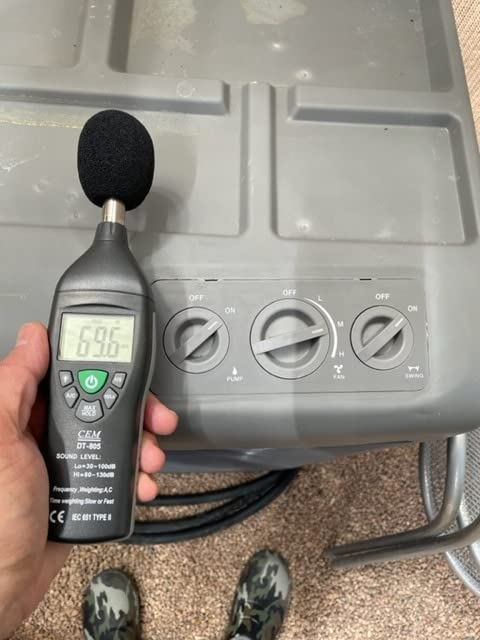
The tank is the other reason this one keeps owners. Ten gallons plus a built-in float valve and a garden hose adapter means you can run it through a dinner party without walking out with a watering can. The manufacturer quotes 3 to 4 hours of continuous flow, and refill logistics are the single most common complaint about smaller units, so the hose option matters more on a patio than it does indoors.
There is a real caveat. This unit has no automatic shutoff when the water runs out, so if you hook up a hose and the float valve fails you can pump dry pad overnight. Reviewers also report that the plastic latch on the manual fill door is a weak point, and the oscillation mechanism can creak where plastic parts rub.
How it performs on a real patio
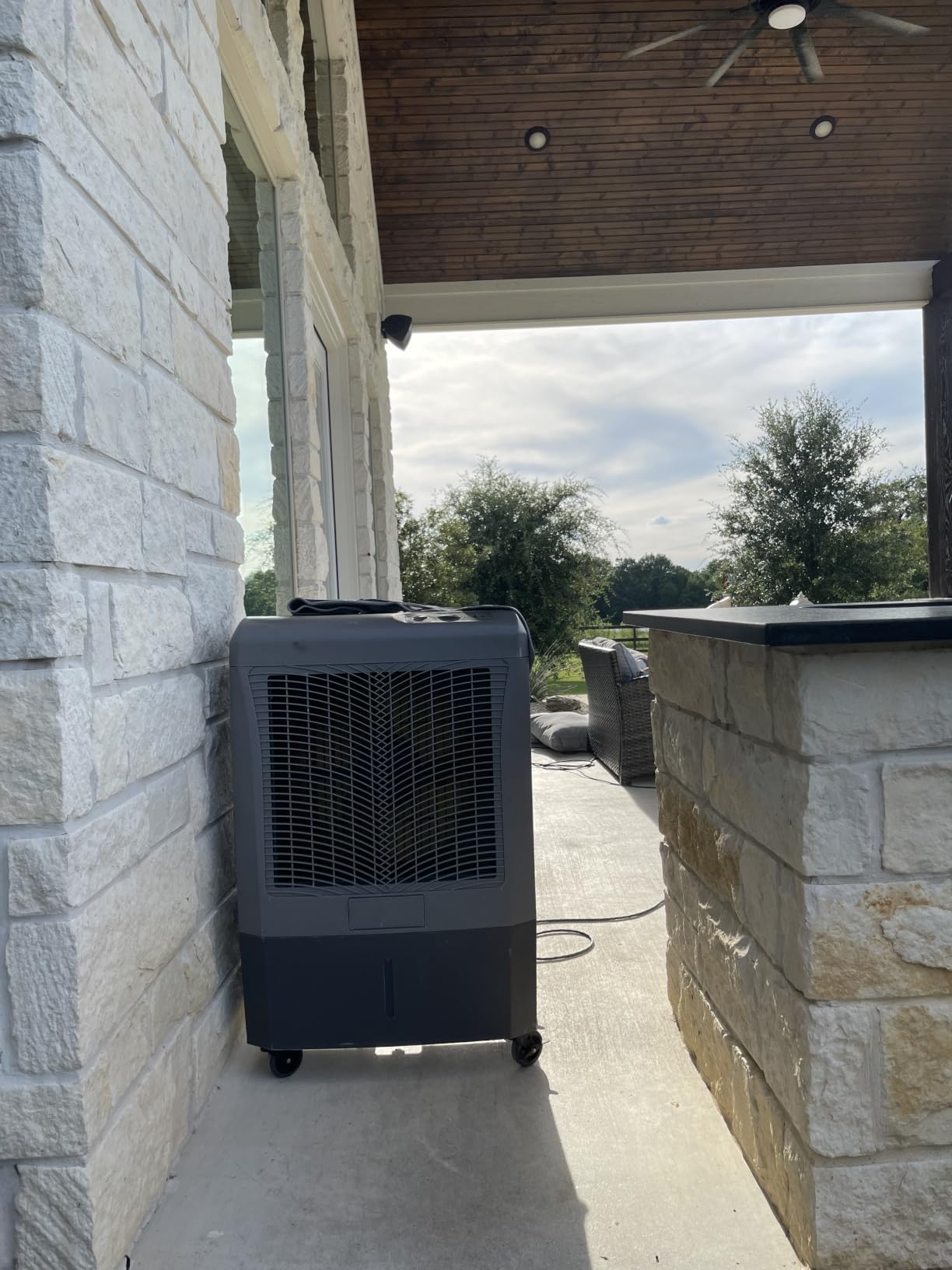
On a covered patio with one wall and an open side, owners report a usable breeze zone of roughly 10 to 15 feet from the louvers. Beyond that, the effect fades. The square-footage figure describes the footprint the unit can influence, not the footprint where you feel the temperature drop, and that distinction matters when you are planning where to sit.
It also draws 250 watts, which works out to about 2 kWh for a full evening of continuous running. That is a small fraction of what a portable air conditioner pulls for the same nominal cooling, and it is the quiet advantage of the category that competitors rarely put in plain numbers.
Who should skip this one
Skip it if you plan to leave the unit running unattended overnight without a hose connection, because there is no low-water cutoff. Skip it if you are in a humid climate, since humid owners consistently report disappointment with this and every similar unit. And skip it if you are on a tight budget with no need for 950 square feet of claimed coverage, because the plastic build quality at this level is not what a premium patio setup deserves.
2. Uthfy 4800 CFM Swamp Cooler – Best for Wide Swing Coverage
Uthfy 40″ 4800 CFM Swamp Cooler, Large Evaporative Cooler with 11 Gal Water Tank, 3 Speeds, 120° Oscillation, 3 Ice Packs, Metal Frame Portable Air Conditioners for Outdoor, Patio, Shop, Yard, Factory
4800 CFM
970 sq. ft.
11 gal tank
120 deg swing
50 dB
200 W
Pros
- Highest airflow of the residential units here at 4800 CFM
- 120 degree oscillation spreads air across a wide patio
- 11 gallon tank supports long evenings
- Galvanized iron frame with a copper motor
- 4 caster wheels including 2 lockable
Cons
- Rigid button controls with no dial or remote
- Ice packs add only marginal extra chill
- Cooling output still depends on dry air
This 40 inch tower is built around one idea: throw air far and wide. 4800 CFM with 120 degree oscillation is the combination that lets you place the unit in a corner and still have both ends of a dining table in the breeze, which is the hardest part of cooling an L-shaped covered patio. The claimed coverage is up to 970 square feet.
The hardware is the interesting part. A galvanized iron frame and a copper motor are unusual in a category dominated by molded plastic, and the copper motor in particular is the part owners credit for stronger airflow and lower energy draw at 200 watts. The 11 gallon tank is among the larger residential tanks here and, with the auto-refill option, removes the top-up chore for most evenings.
What you give up for that airflow is control refinement. The controls are push buttons rather than a dial or a remote, so changing speed means walking over to the unit. The three included ice packs run behind a composite ice curtain that also filters dust, but owners are candid that the extra chill is marginal compared with plain cold water in the tank.
At 50 dB the unit is quieter than most of its size class, which helps in a patio setting where there is no wall to reflect sound back at you. Realistic air throw on an open patio is somewhere around 20 feet, and the oscillation is what converts that throw into wide coverage.
Where the metal frame earns its keep
Two practical advantages. First, an iron frame tolerates the drag of rolling it over a threshold or a paved patio edge far better than a plastic shell, and casters with two locks keep it put once positioned. Second, on a hot day the frame does not soften the way thin plastic bodies can when they sit in direct sun for hours, which is a real consideration for a unit that lives outside.
The tradeoff is weight at 39.7 pounds. That is manageable for two people but not a one-person lift onto a step, and it is heavier than the plastic alternatives in the same airflow band.
Who should skip this one
Skip it if you want remote or dial control, because every adjustment is a walk across the patio. Skip it if your patio is small, since 4800 CFM on a 200 square foot balcony is wasted capacity and an open door to dust. And skip it if you are counting on the ice packs for a real temperature drop, because owners across this size class report they melt within minutes and add little.
3. OEMTOOLS 23969 5300 CFM – Best for Large Patios and Garages
OEMTOOLS 23969 3-Speed Portable Swamp Cooler Cools 1600 sq ft, 5300 CFM
5300 CFM
1600 sq. ft.
14.6 gal tank
3 speeds
68 dB
430 W
Pros
- Largest claimed coverage in the group at 1600 sq. ft.
- 5300 CFM suits patios over 700 sq. ft.
- 14.6 gal tank means rare refills
- Shipped with a GFCI plug
- Built-in tool tray and large casters
Cons
- Loudest unit here at 68 dB
- Heavy at 57 lb to reposition
- Needs open airflow paths to perform
This is the one we would consider for a large covered patio, a two-car garage, or a workshop that doubles as a gathering space. 5300 CFM and a claimed 1600 square feet puts it at the top of the residential airflow range on this list, and the 14.6 gallon reservoir means an evening or two of use without a refill.
One spec detail matters more here than anywhere else on the page: it ships with a GFCI plug. For a unit that sits outdoors with a large reservoir of water and a 430 watt motor, ground-fault protection is not a nice-to-have, and having it factory fitted removes the most common safety objection people raise about outdoor evaporative coolers.
The manufacturer states the unit can lower air temperature by 15 to 30 degrees depending on humidity, which is the manufacturer maximum at dry-climate readings. High-density media panels are cited as giving 80 percent more evaporation surface than standard pads, which is the mechanism behind the strong dry-air performance.
What the tool tray tells you about the design
The built-in tray at the top is a workshop and job-site feature, and it is a good signal about where the manufacturer expects this unit to live. Owners who move large workshop and garage spaces rate it well for the combination of airflow, tank size and that tray, and they consistently note the same limitation: the unit wants an open window or door path to move air well.
On a patio that requirement is easy to meet, because a patio is open by definition. Indoors it is the reason this unit is not our indoor recommendation.
Who should skip this one
Skip it if noise is a factor, because 68 dB is the loudest figure on this page and it is loud at a dinner table with no background music. Skip it if you plan to move it often, since 57 pounds with large casters is a two-person job over a step. And skip it if a 400 square foot patio is your actual use case, because you would be paying for airflow you cannot direct usefully.
4. Hessaire DC18 900 CFM – Best for Cordless Battery Cooling
Hessaire DC18 Mobile Evaporative Cooler
900 CFM
300 sq. ft.
2.8 gal tank
18V and 20V tool battery
Pros
- Runs on any 18V or 20V tool battery you already own
- Strong and quiet airflow for its 900 CFM rating
- Ice water gives a noticeable boost
- Compact body fits tents and trailers
- Owners report buying multiples
Cons
- Cooling power drops sharply in humid air
- Small 2.8 gal tank drains fast for its output
- Manual conflicts with the included AC adapter
This is the odd one out on the list, and the reason is simple: it does not need an outlet. The Hessaire DC18 runs on 18V and 20V tool batteries from every major platform, or on the included 115V AC adapter. On a patio where there is no outlet, that removes the single biggest obstacle to running a cooler outdoors.
At 900 CFM and 300 square feet, it is a spot cooler. Owners are clear about that framing: it is built to reduce heat stress for a person, not to condition a space. The airflow is described as strong and quiet for the rating, and several owners specifically note that filling the tank with ice water rather than cold water makes a noticeable difference in the output.
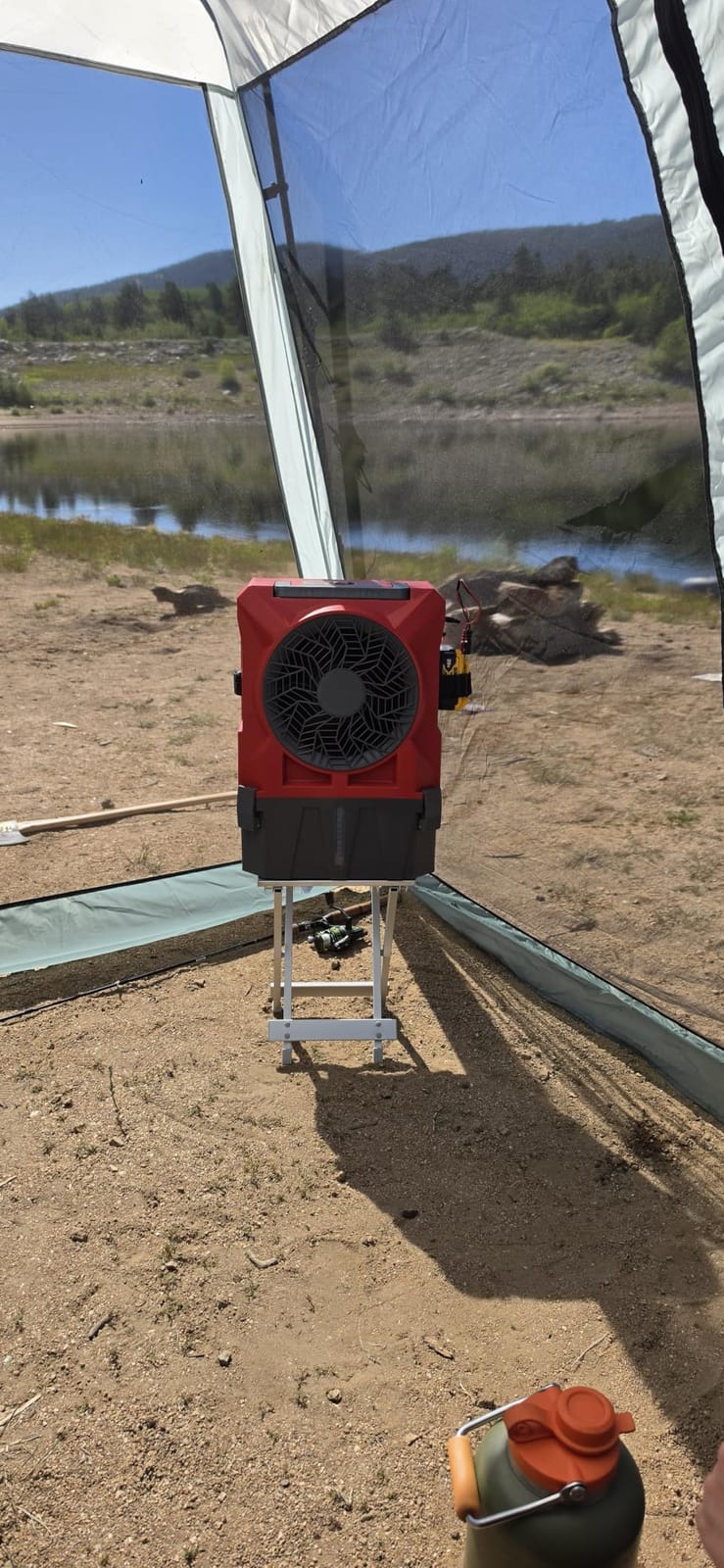
Those same owners flag the boundaries. Cooling drops off sharply in humid conditions, which is the category-wide limitation rather than a fault of this design. The 2.8 gallon tank is small for a unit that drinks meaningfully faster than a fan, so plan on more top-ups than the capacity suggests.
One practical snag: the owner manual conflicts with the AC adapter that ships in the box. If you plan to run on mains power rather than a battery, verify the adapter specification before you rely on it for an evening.
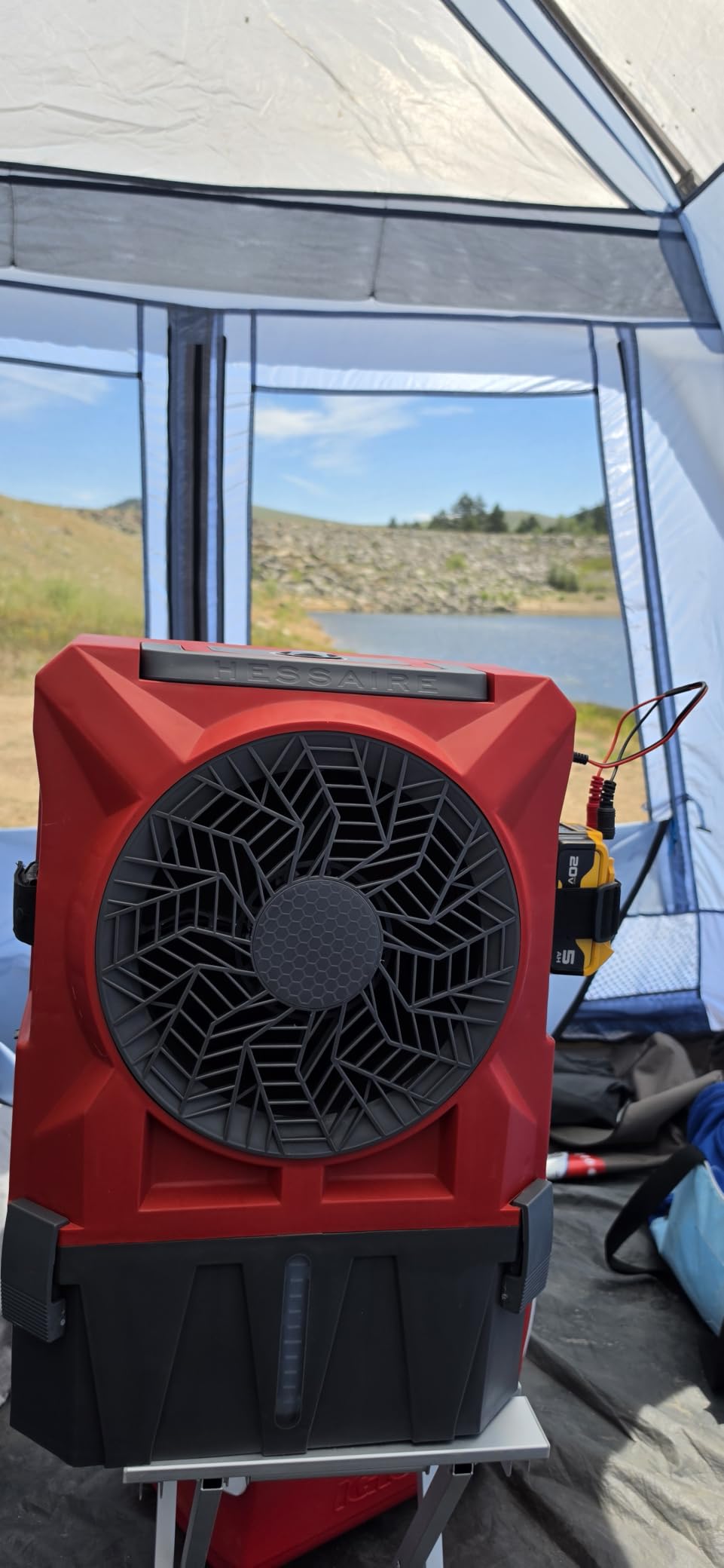
When cordless power is the deciding factor
There are patio situations where the electrical situation decides the purchase rather than the cooling. A pergola with no outlet, a pool deck where running a cord across the deck is a trip hazard, a camping setup, or a market stall all fall into this category. For those, a tool-battery cooler removes a code compliance question and a length of cable in one move.
The enthusiast community has also found a way to automate these, wiring the pump and a single blower speed to a smart relay, which lets a humidity sensor or a thermostat switch the unit on without a phone app. That is a real advantage over fixed-speed mains units.
Who should skip this one
Skip it if you want to cool a whole patio, because 300 square feet of coverage is a sitting area for two people, nothing more. Skip it if you do not own a compatible tool battery, since the battery is not included and the cost of adding one changes the value calculation entirely. And skip it in a humid climate, where the already modest capacity loses most of its effect.
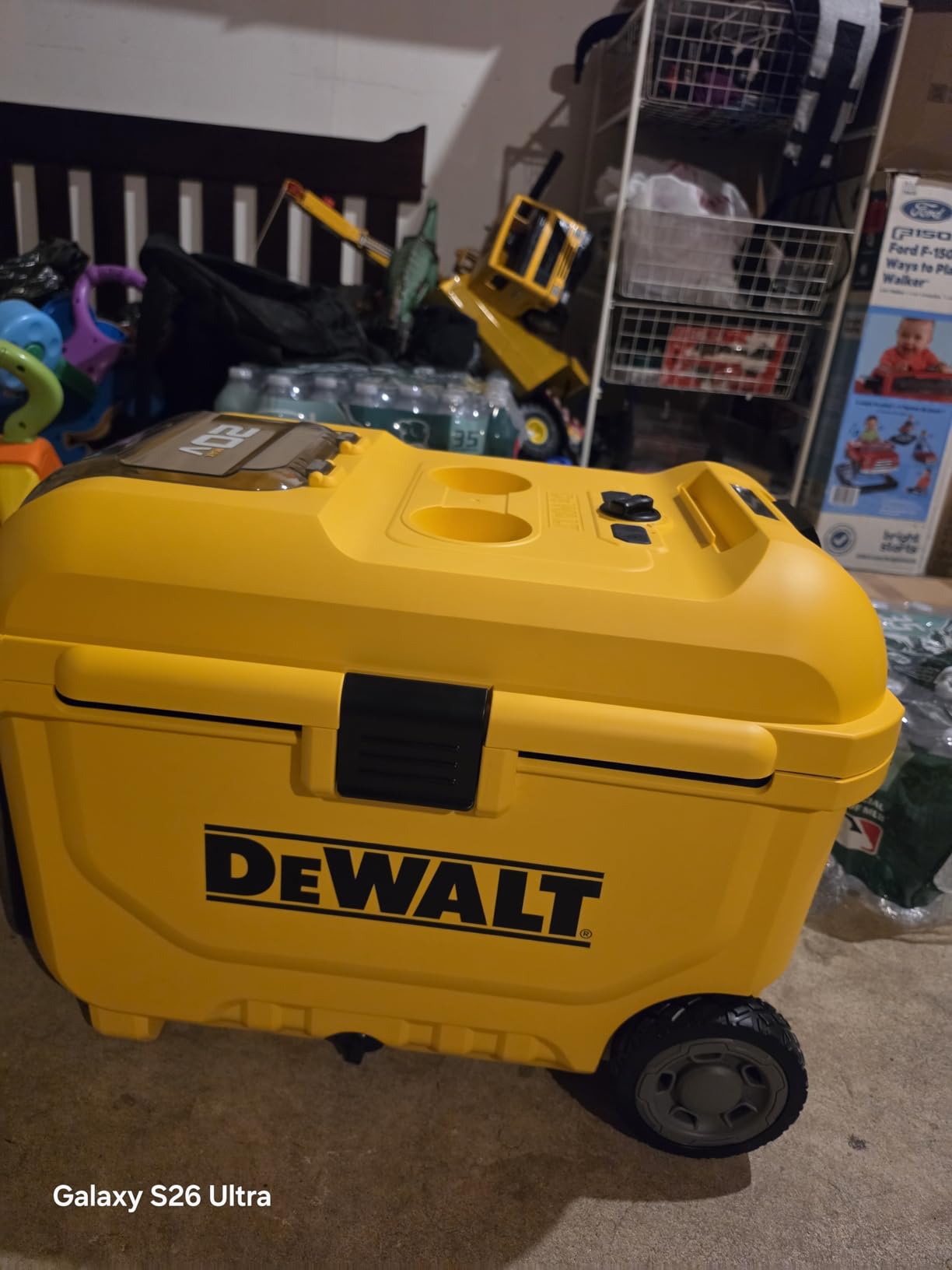
5. DEWALT DXACN01B – Best for Patio Drinks and Cordless Power
DEWALT Evaporative Air Cooler Portable Air Conditioner DXACN01B (Tool Only)
8 gal dual-use tank
20V battery,120 min
Turbo mode to 53.6F
Digital display
Pros
- The 8 gallon tank doubles as an ice chest for drinks
- Digital display shows output air temperature directly
- Turbo Cool mode reported as low as 53.6F
- All hoses and connectors store inside the body
- 3 year limited warranty
Cons
- Tool only
- battery and charger sold separately
- Both ice and water needed for the lowest output
- Rated output swings heavily with ambient humidity
This one solves a patio problem nobody else on the list addresses: where the drinks go. The 8 gallon reservoir is a dual-purpose ice chest, which means the same water doing the cooling is the water keeping cans and bottles cold on the side table. On a patio that is a genuinely better use of volume than evaporation alone.
The digital display showing real-time output air temperature is the feature patio owners mention most, because it converts a vague feeling into a number you can watch. Turbo Cool mode is reported to reach air output as low as 53.6 degrees, though that figure assumes both ice and water in the tank.
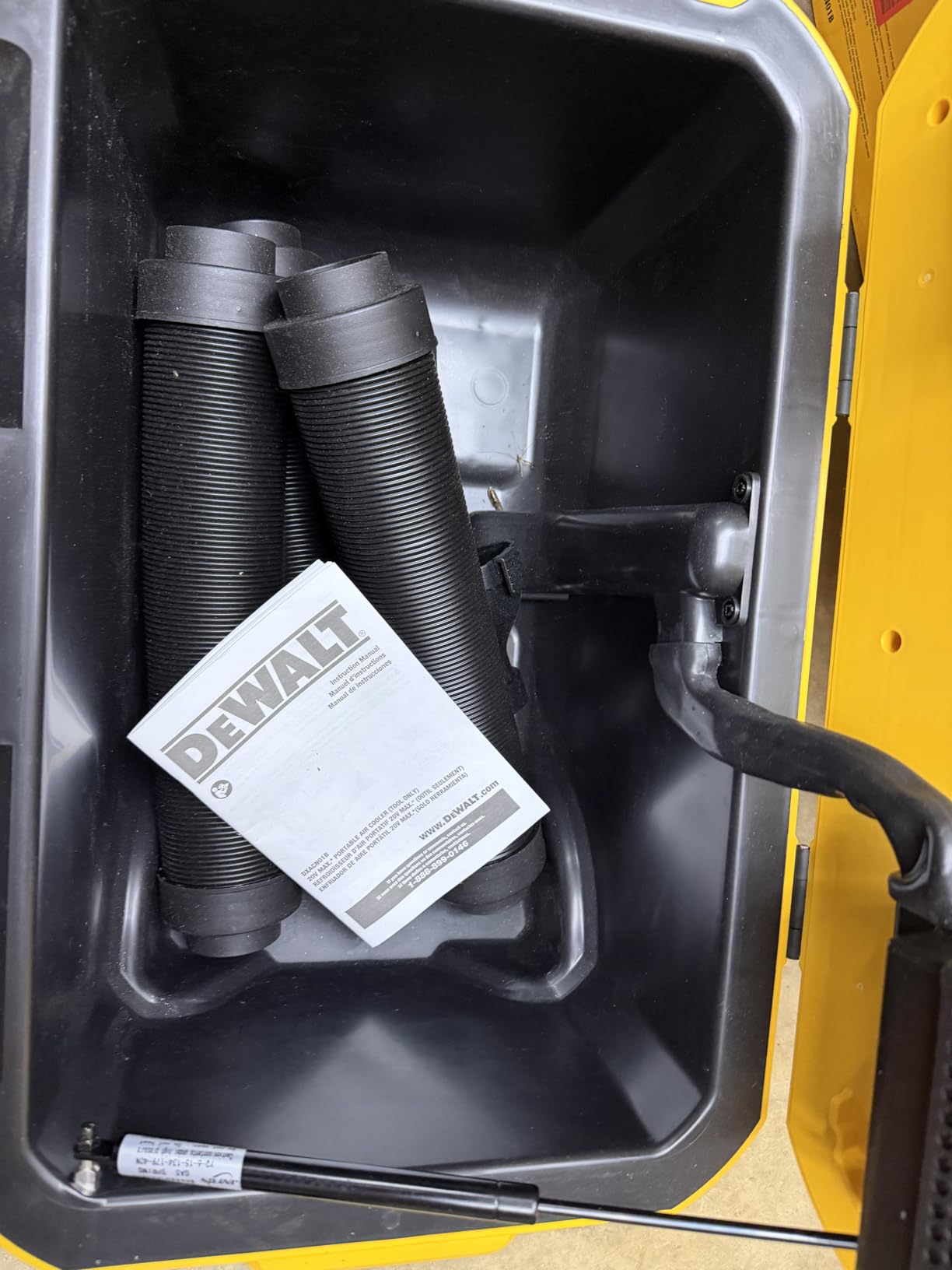
Runtime is the constraint. On a 20V battery you get up to 120 minutes of cordless operation, which is enough for a dinner service but not an afternoon barbecue. The included kit has an air hose connector, three extension hoses, a three-way connector and an ice pack, and owners like that all of it stores inside the body for transport.
It is a tool-only package, so the battery and charger are separate purchases. If you already run DEWALT tools that is a rounding error. If you do not, the value picture changes quickly.
Patio entertaining versus patio cooling
Set expectations carefully here. Owners consistently note that real cooling depends on ambient humidity, which is the same constraint as every other unit on this page. The honest framing is a cordless personal cooler with a very large cold storage compartment attached, and for a patio barbecue where drinks matter as much as temperature, that combination is more useful than a bigger CFM figure.
The 3 year limited warranty is the longest on this list, which tells you something about how the manufacturer expects the hardware to age.
Who should skip this one
Skip it if your patio cooling plan depends on all-afternoon battery runtime, because 120 minutes will not carry an afternoon. Skip it if you do not own 20V DEWALT batteries, since that is a real added cost. And skip it if you need it to serve a seating area of more than two people, because this is a personal cooler with a generous storage tank.
6. VCJ 1800 CFM – Best for Timer and Remote Control
VCJ 1800CFM Evaporative Air Cooler, 5.6 Gal 3 IN 1 Windowless Portable Swamp Cooler Air Conditioner,120° Oscillation, 3 Speeds, 12H Timer, 4 Ice Packs, Air Cooling Fan for Bedroom Room Office Garage
1800 CFM
5.6 gal tank
12 hr timer
120 deg swing
17 lb
150 W
Pros
- Only 17 lb with 4 wheels including 2 locking
- 5.6 gal tank with a visible fill line
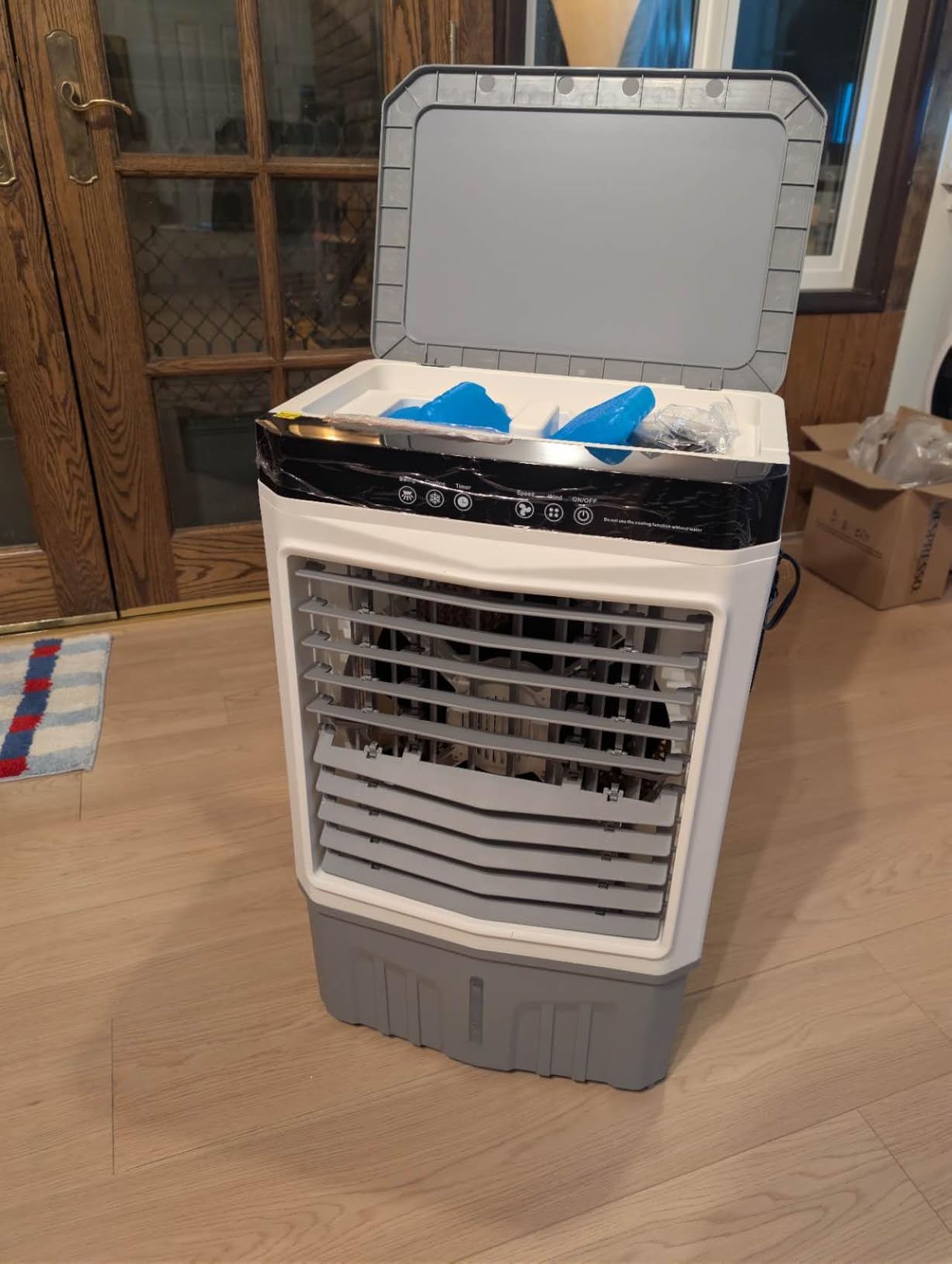
- 12 hour timer with remote control
- Glass top cover wipes clean and looks modern
- Four ice packs included
Cons
- Lowest CFM of the larger units here at 1800
- Needs four ice packs refrozen often
- Relies on dry ventilated air to avoid adding humidity
The VCJ is the compromise pick for a medium patio where convenience beats raw airflow. 1800 CFM, a 5.6 gallon tank with a visible fill line, three speeds and 120 degree oscillation, all in a 17 pound body with four wheels, two of which lock. That combination makes it the easiest unit here to move between the dining table and the grill.
The 12 hour timer with a remote is the feature that changes daily use. You can start it before guests arrive from a chair, and you can set it to shut off overnight without walking out to the patio in the dark. For a covered space where you want cooling from dinner through the evening, that is worth more than a few hundred CFM.
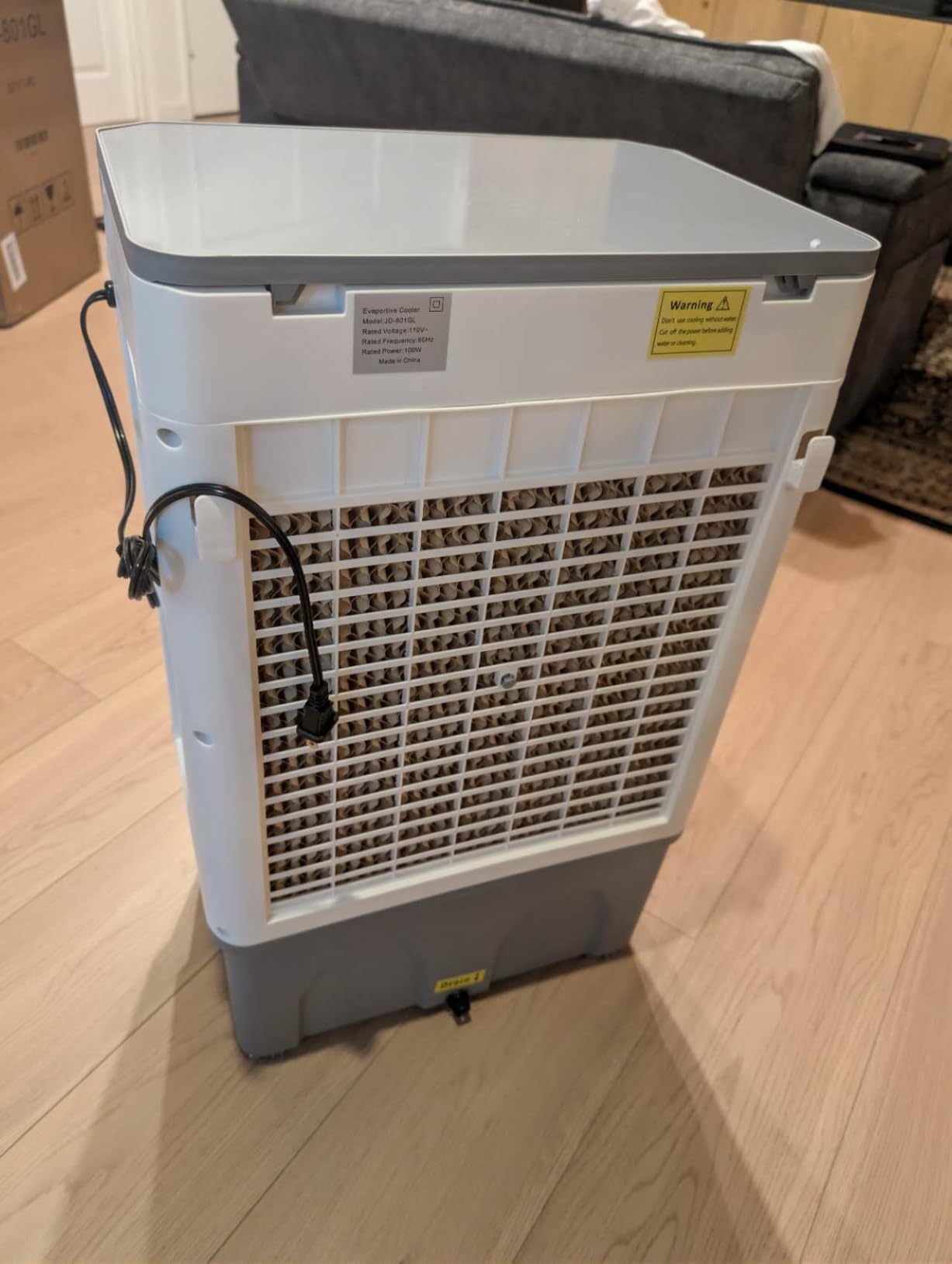
Owners also like the glass top cover, both because it looks modern and because it wipes clean, which matters on a unit that lives outdoors near food and dust. It is a 3-in-1 design, so the same body can run as a fan, an evaporative cooler, a water mist or an aroma diffuser, and it draws only 150 watts.
The honest limitation is output. 1800 CFM covers a 200 to 300 square foot area, and owners note that the four included ice packs need frequent refreezing to keep contributing anything. Reviewers also point out that the cooling depends on dry, ventilated air, or the unit is adding humidity to your patio rather than removing heat.
Why the timer matters more than the tank
On a patio, the failure mode is not an empty tank, it is an empty tank at 2 am. Units with a low-water cutoff can be left alone; units without one cannot, because a dry pump is the first thing to break. A 12 hour timer solves a different but related problem, which is an appliance that never gets turned off and ends up running all night and all day, which is both a power waste and a pad-drying problem.
The floating indicator on the water level is worth looking for in this class, because a clear sight line means fewer trips to the hose.
Who should skip this one
Skip it if your patio is above about 400 square feet, because 1800 CFM will not move enough air to matter at that size. Skip it if your priority is pad-cooling performance, since this is a lighter-duty machine. And skip it in a humid climate, where the owners themselves say the effect is limited.
7. PNTCK 3-in-1 Swamp Cooler – Best for Lightweight Portability
PNTCK Portable Air Conditioners, 3-IN-1 Swamp Cooler with 3 Fan Speeds, 4 Modes, 12H Timer, Remote, Ice Packs, 2.1Gal Water Tank, Evaporative Air Cooler for Bedroom Dorm Office Garage Home
2.1 gal tank
4 modes,3 speeds
12 hr timer
80 deg swing
10 lb
Pros
- Only 10 lb with a built-in handle and casters
- Four modes including a sleep mode
- 12 hour timer with remote and touch panel
- Airflow reaches a useful distance for personal cooling
- Child lock for households
Cons
- Only a 2.1 gal tank so refills are frequent
- Cooling depends on rotating frozen ice packs
- Not able to cool a large room
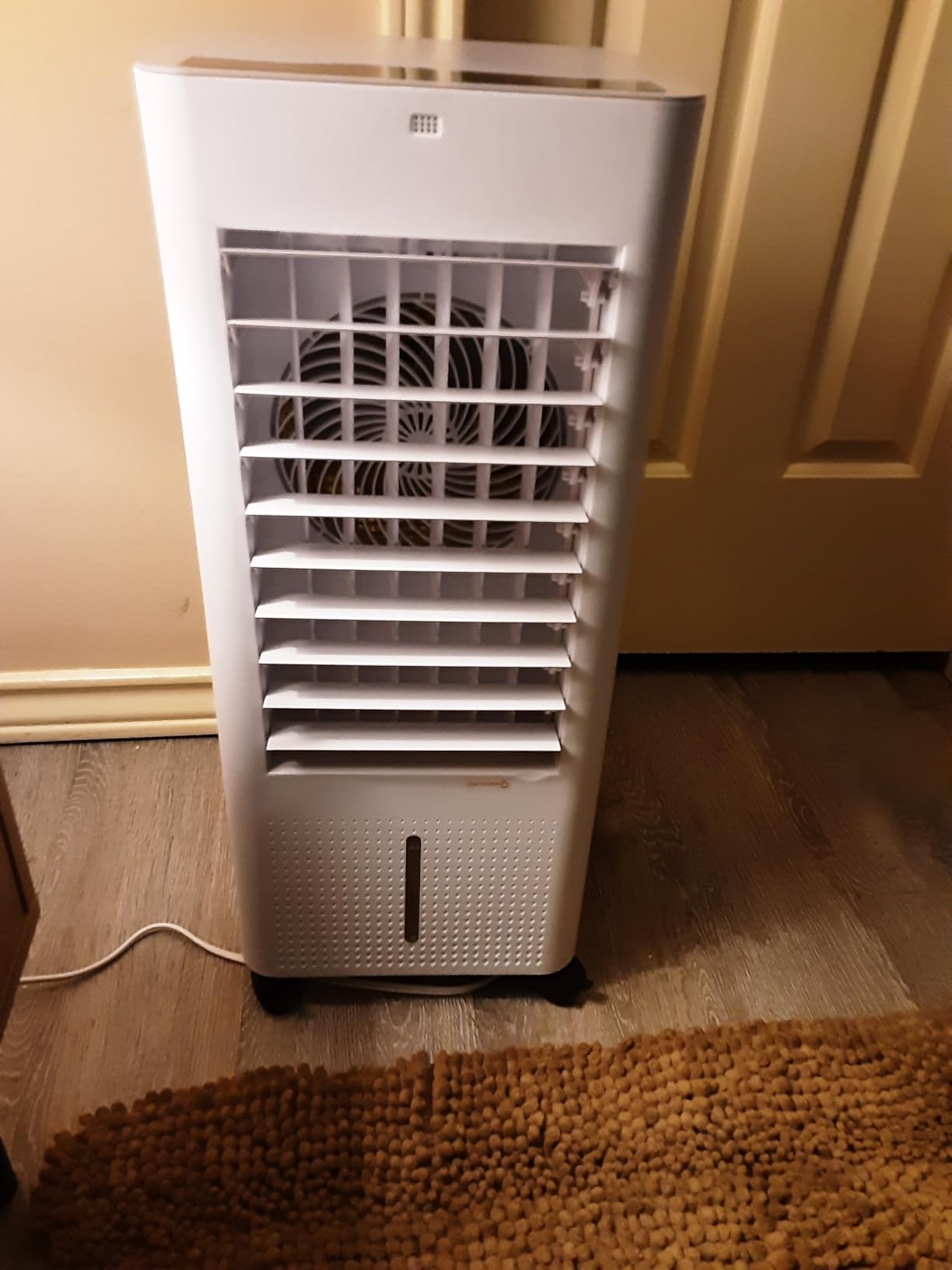
At 10 pounds with a built-in handle and casters, this is the unit you carry to the patio instead of wheeling to it. It is genuinely small at 8 by 10 by 25 inches, which means it works on an apartment balcony, a patio table, or a camping setup where floor space is measured in inches.
The control set is unusually rich for the size. Three speeds, four modes including sleep and cool air, an 80 degree automatic horizontal swing with manual vertical louver adjustment, a 12 hour timer, a remote and a top touch panel. Owners report that both the remote and the panel work reliably, and that the louver blades behind the front panels circulate air more evenly than a fixed grille.
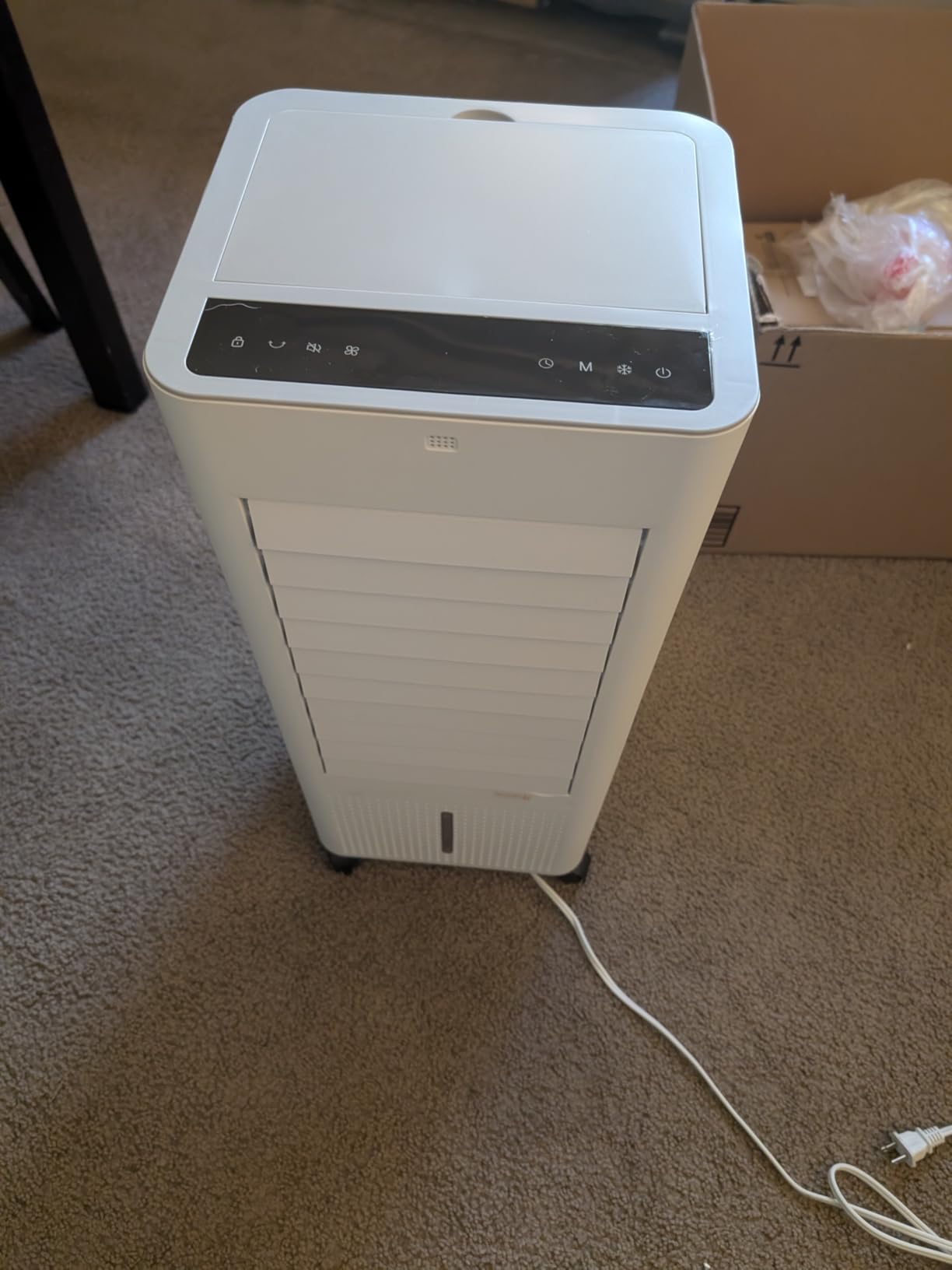
Now the honesty part. This listing has a small rating sample, and the 4.7 average reflects very few buyers, so treat it as a signal of a new product rather than a proven one. Owners describe it accurately as a capable personal cooler, and they are equally clear that it is a fan with a water reservoir rather than a true air conditioner.
Real cooling depends on rotating frozen ice packs, and without them the output is close to room temperature. The 2.1 gallon tank means frequent refills, and the water level indicator is hard to read in low light, which is a real issue on a patio after sunset.
Where a 10 pound cooler actually makes sense
There are patio jobs where portability beats output. A small balcony with no floor space, a table-top spot at a barbecue, a patio where the only flat surface is a narrow ledge, or a rental where you want something you can carry down two flights of stairs. In those cases a 10 pound unit with a handle is the difference between using a cooler and storing one.
The child lock matters too in a family patio, and the sleep mode plus 12 hour timer make it usable overnight in a bedroom or office when the weather turns.
Who should skip this one
Skip it if you want to cool a space rather than a person, because nothing in this design points at area cooling. Skip it if you dislike constant ice pack rotation, which is the entire cooling mechanism. And skip it if you want to make a purchase decision on review volume, because five ratings is not enough history to be confident in long-term reliability.
8. Cajun Kooling CK4500-S – Best for All-Day Outdoor Parties
Cajun Kooling CK4500-S Evaporative Air Swamp Cooler – 32 Gal Tank – High Power 4500CFM – Variable Speeds – 1200 Sq Ft Coverage – Side Open Access – Outdoor Cooling – Patios, Barns, Events, Restaurants
4500 CFM
1200 sq. ft.
32 gal tank
8-10 hr runtime
40 ft throw
65 dB
Pros
- 32 gallon tank runs 8 to 10 hours between fills
- Pump low-water shutoff protects internal parts
- Latching side panel makes adding ice simple
- External screens block dust bugs and pet fur
- Air throw reaches about 40 ft
Cons
- Most expensive unit in the group
- Heavy at 84 lb even with locking wheels
- Loud at 65 dB on higher settings
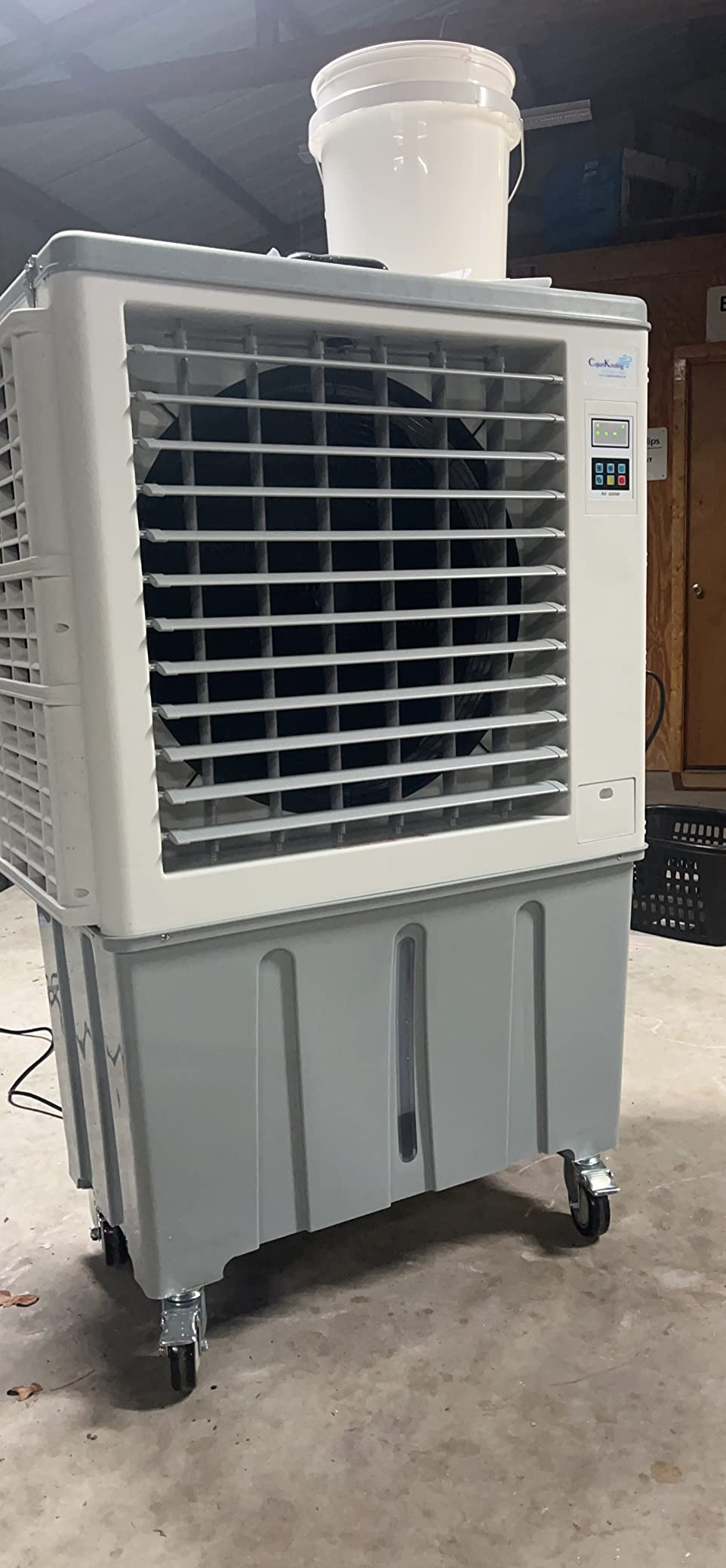
If your patio plans involve hours rather than evenings, the reservoir decides the purchase. A 32 gallon tank with a float valve runs 8 to 10 hours between fills, which means a full day of summer entertaining without anyone carrying a watering can. No other unit on this page approaches that.
It is also the only one here built with outdoor permanence in mind. The housing is UV-resistant, non-injected plastic with coated internal metal parts, and the manufacturer calls out resistance to salt air and hard water, which are exactly the conditions that destroy cheap housings within a season. External screens protect the cooling pads from dust, pollen, insects and pet fur, which matters on a patio where a dog lives.
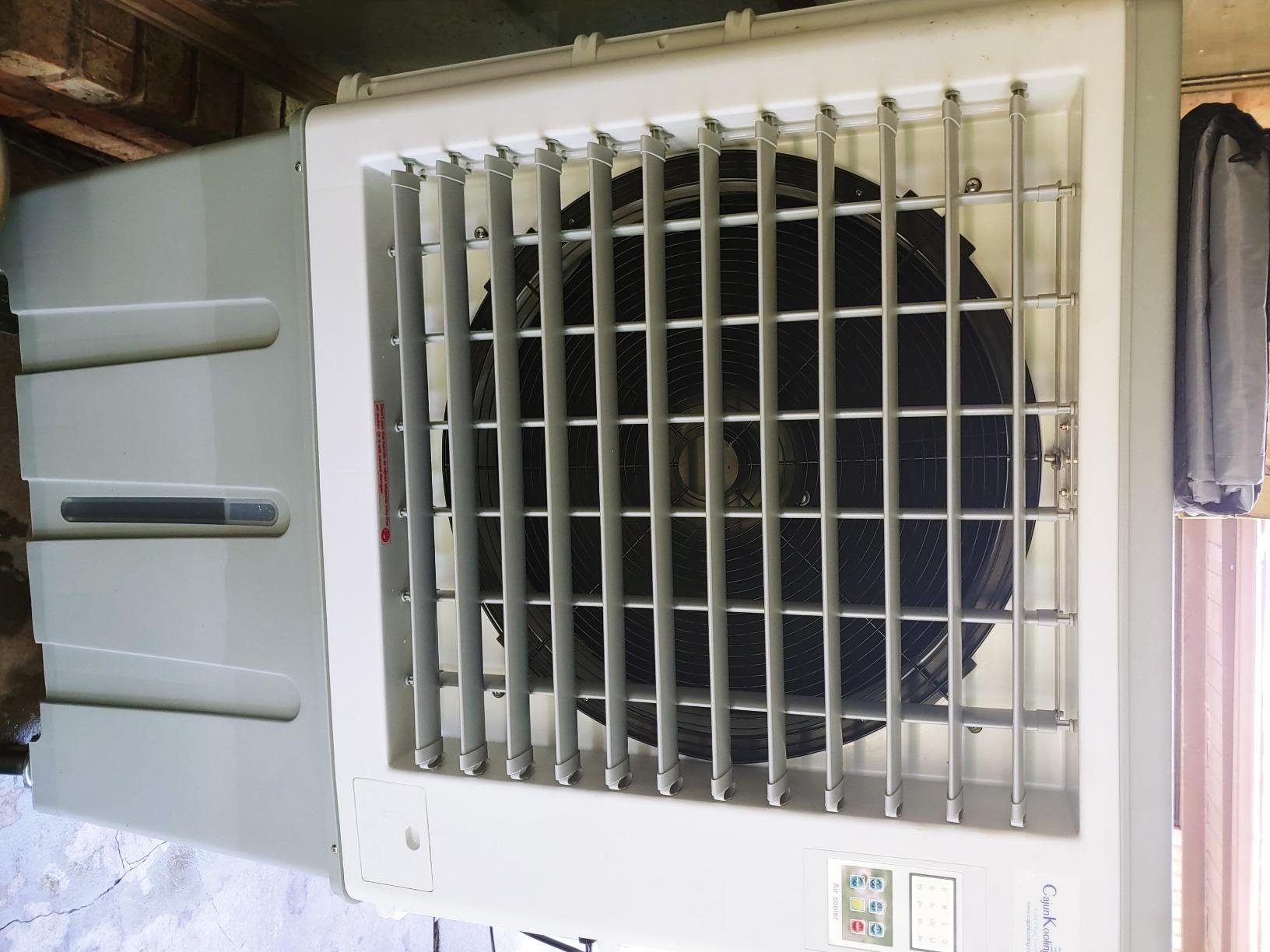
The latching side panel is a small design decision with a large effect. You can drop ice into the unit without opening the body or disturbing the airflow path, and the pump shut-down valve activates when water runs low, so the pump protects itself. For a unit this size running for a full day, that feature removes the most common failure mode in the category.
Owners rate it highly, with 86 percent five-star ratings, and the buyer base skews commercial: restaurant patios, outdoor events, barns. The two-part horizontal louvers throw air up and down at once with a stated reach of about 40 feet, which is the number that makes it work for a long table rather than a small seating circle.
Outdoor permanence versus portability
At 84 pounds this is not a unit you carry around, but the locking wheels and the side panel mean it can be rolled along a patio or onto a flatbed without disassembly. That is the correct trade for a permanent outdoor installation, and it is the reason commercial buyers choose this class over a residential tower.
If you rent, or your patio use is seasonal, an 84 pound unit that stays outside year-round is the wrong shape of purchase. The UV-resistant construction and external pad screens only pay off if the unit actually lives outdoors.
Who should skip this one
Skip it if you want a modest summer purchase for a 400 square foot patio, because 4500 CFM and a 32 gallon reservoir is far more capacity than that space can use. Skip it if noise matters, because 65 dB is a real presence at a dinner table. And skip it if you intend to move it around, because the weight works against every casual repositioning.
9. VEVOR 1400 CFM – Budget Pick for a Small Patio
VEVOR Evaporative Air Cooler,1400 CFM 11X31 inch Air Cooler,3 Speeds Cooler Portable Air Conditioner,Energy-Saved Swamp Cooler for party,pool and patio,5 Gal Water Tank & 550 Sq.Ft…
1400 CFM
550 sq. ft.
5 gal tank
72 deg swing
60 W
13.4 lb
Pros
- Lowest cost in the group and only 60 W of power draw
- Light at 13.4 lb with a top-fill lid
- Mechanical buttons stay legible with long use
- Brass adapter accepts a garden hose for continuous fill
- Water shortage protection pauses the pump when dry
Cons
- Lowest rating here at 3.7 out of 5
- Only 1400 CFM and 550 sq. ft. claimed coverage
- Single-sided pad gives weaker air than three-sided units
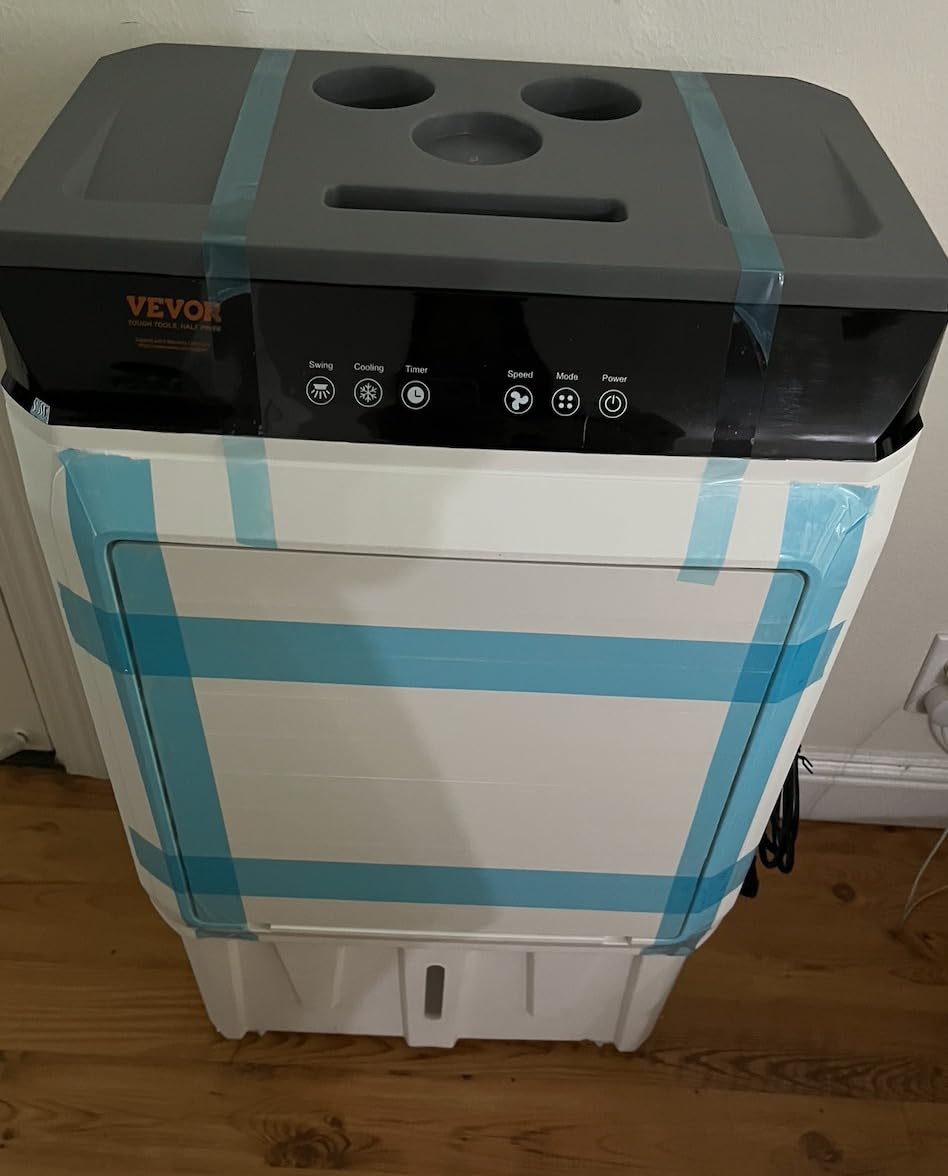
The VEVOR is the entry point, and its appeal is straightforward: 60 watts of power draw, 13.4 pounds, a 5 gallon top-fill tank and a brass adapter that accepts a garden hose for continuous fill. For a 500 square foot patio corner or a covered seating area where you want a breeze, it is enough.
Water shortage protection pauses the operation when the tank runs dry, which is a safety feature most units in this price range skip. The 72 degree automatic oscillation with manual vertical louver adjustment spreads what air it does move across a reasonable arc, and the mechanical buttons are a practical choice that owners specifically praise because they stay legible after months of use, unlike touch panels.
Now the parts you should weigh before buying. It carries the lowest rating on this page at 3.7, with a large share of reviews noting that 1400 CFM and a single-sided high-density pad deliver airflow closer to fan level than to cooler level. Owners treat it as a budget personal cooler, not a patio solution for a group.
The single-sided cooling pad is the mechanical reason. Three-sided intake designs like the Hessaire MC37M pull dry air across a much larger evaporation surface, and the difference shows up in the output you can feel. The two included ice packs melt quickly and add little.
When 1400 CFM is genuinely enough
A balcony, a small apartment patio, a covered bench spot, a garage corner, or a camping setup where the priority is a breeze at a power budget. At 60 watts, this is the cheapest unit here to run by a wide margin, and if you connect a hose with the brass adapter you can leave it all afternoon without touching it.
It is also the easiest unit on the page to store between seasons, which matters if your patio use is a few evenings a month rather than every day.
Who should skip this one
Skip it if you are seating four or more people and expecting everyone to feel the cooling, because the honest coverage is a personal zone. Skip it if you are disappointed by units that feel like a fan, because that is the most common review theme. And skip it if you already know your patio humidity runs high, because at that humidity level this capacity and this pad design will underdeliver badly.
10. Uthfy 6000 CFM – Best for Quiet Operation
Uthfy 6000 CFM Swamp Cooler Air Conditioner, Outdoor Evaporative Air Cooler with 13.5 Gal Water Tank, Remote, 120° Oscillation, 12H Timer, 47″ Portable AC with Copper Motor for Patio, Garage
6000 CFM claimed
1300 sq. ft.
13.5 gal tank
45 dB
250 W
remote
Pros
- Quietest rated unit on the page at 45 dB
- Remote with 3 modes 3 speeds and a 12 hour timer
- Front hose port for hands-free continuous fill
- Copper motor and four lockable wheels
- Arid-climate buyers report a 10 degree drop
Cons
- Lowest rating here at 3.3 with 25 percent one-star reviews
- Claimed 6000 CFM widely seen as overstated
- Ice packs melt in 5 to 10 minutes in warm air
At 47 inches tall with a rated 45 dB, this is the quietest unit on the page, and for a covered patio where conversation matters, that number is the headline feature. The remote reaches 26 feet and carries three modes, three speeds and a 12 hour timer, so you control the unit from a chair rather than from the unit.
The water system is well designed for long evenings. A 13.5 gallon tank plus a front hose port means hands-free continuous filling, four lockable 360 degree wheels and two reinforced handles make it manageable despite the height, and the copper motor is cited for lower energy use, longer life and stronger airflow at 250 watts.
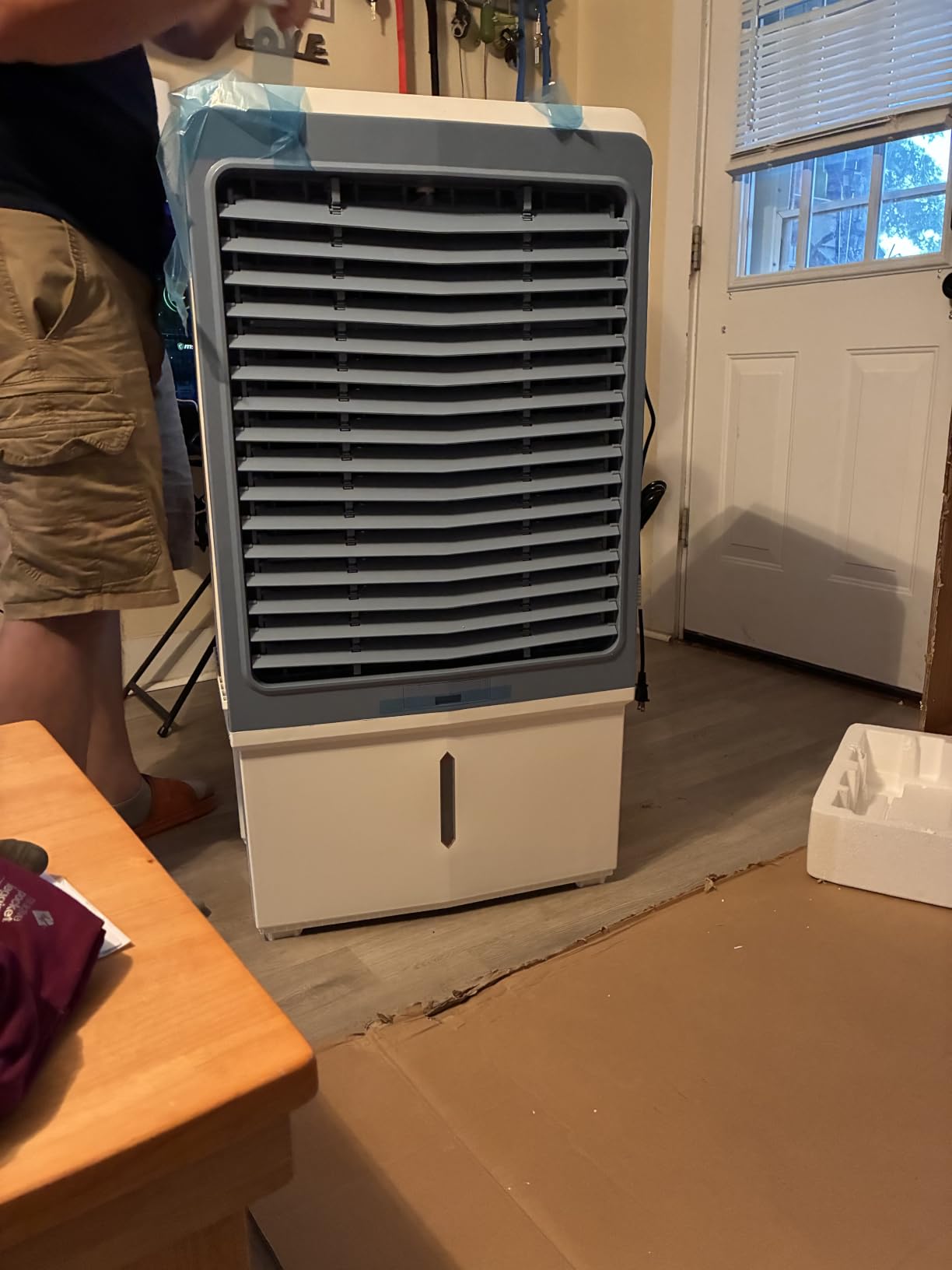
The reviews split sharply, and you should know both halves. Buyers in genuinely arid climates like the quiet operation, the remote and a reported 10 degree indoor drop when the unit is started early. A large group of other buyers considers the advertised 6000 CFM far overstated, with airflow felt as weak past about 15 feet, and the 3.3 rating with 25 percent one-star reviews is the result.
Practical cautions: ice packs melt in roughly 5 to 10 minutes in warm air and add little, water consumption is around 2 gallons per 2 hours, and there are reports of pump failure within a couple of days on some units. In a humid climate this model is worse than useless, because it adds moisture to air that is already saturated.
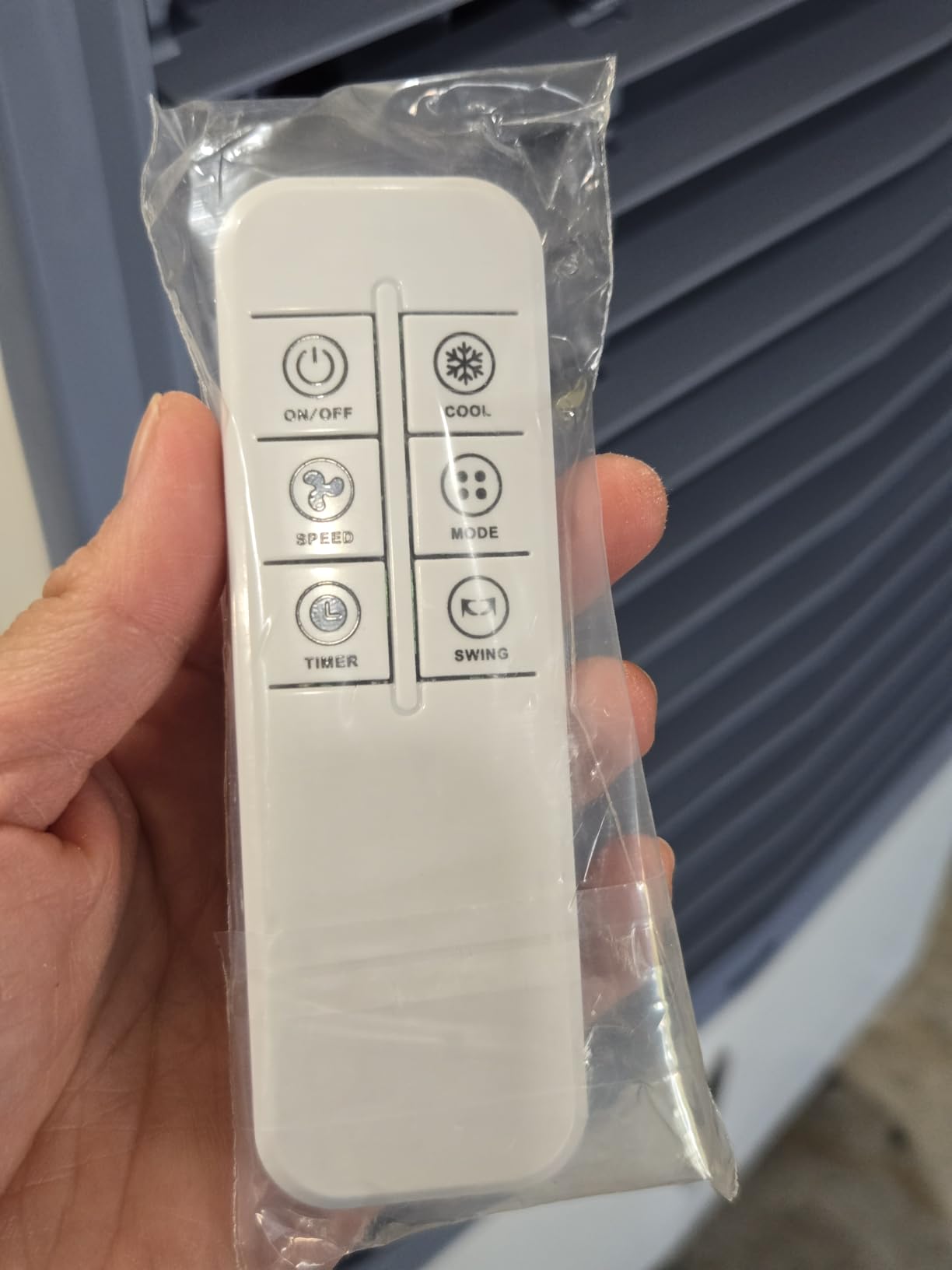
Why the low noise rating is worth checking
Manufacturer noise ratings are measured at a specific speed, and comparing them across brands is imperfect. Even so, a 45 dB rating on a 47 inch, 250 watt unit is unusual, and owner comments about quiet running line up with it. If your patio is enclosed on two sides with hard surfaces that reflect sound, quietness is worth as much as airflow.
The same 15 foot practical throw mentioned in reviews is worth weighing against the coverage claim. A 6000 CFM number that feels weak at 15 feet is a marketing figure, and the pattern of one-star reviews here is largely about exactly that gap.
Who should skip this one
Skip it if you are buying on airflow claims, because the gap between the 6000 CFM figure and the felt performance is the dominant complaint. Skip it if you will store water in it for long stretches without changing it, because high consumption plus small reliability margin is a bad combination. And skip it anywhere above 60 percent relative humidity.
How to Place an Evaporative Cooler on a Patio
Placement determines more of your result than the model does. An evaporative cooler needs a steady supply of dry outside air, and on a patio the geometry of your space is what supplies or denies it.
Follow these five steps:
Put it in shade. Direct afternoon sun on a black or dark housing raises the intake air temperature and cuts the temperature drop you get from the pad. Shade also slows pad degradation over a season.
Give it a cross-ventilation path. Place the unit outside or at the edge of the covered area, angled so it draws from the open side rather than from a wall. An open door or window on the far side of the patio lets the cooled air move out and pulls more dry air in behind the unit.
Aim for your seating, not the middle of the patio. Air throw on most of these units is 10 to 20 feet, and the usable zone is a cone rather than a circle. Put the table 8 to 12 feet in front of the louvers, not 30.
Route the hose along a wall, not across the deck. If you are using continuous fill, run the hose where nobody walks and where the connection stays above any splash line. Leaving a garden hose across a patio is the fastest way to have someone trip.
Plan power before you fill the tank. Use a GFCI-protected outlet, and place the unit so the plug and any connection point sit away from where water splashes and where children and pets can reach them. If the outlet is far, that is a strong argument for a battery-powered unit on this list.
One more practical note. Where you place the unit matters more in open-air spaces than under a roof, because an open deck has no walls to keep the cooled air in front of the fan. On a fully open deck, position the unit at the upwind edge rather than the middle.
Outdoor Safety, Maintenance and Off-Season Storage
Running an electric appliance next to a reservoir of water on a patio is a reasonable thing to be cautious about, and the precautions are straightforward.
Electrical safety. Use a GFCI-protected outlet, which is designed to trip when current finds an unintended path to ground. The OEMTOOLS 23969 on this list ships with a GFCI plug fitted, and the rest can be used with a GFCI outlet or an adapter. Keep the cord, the plug and any hose connection off the ground and away from splash zones, and never run a unit in rain or under a sprinkler head.
Leaving a unit on overnight. This is the question patio owners ask most, and the answer depends on the unit. Units with a pump low-water shutoff, such as the Cajun Kooling CK4500-S, and units with water shortage protection, such as the VEVOR, are designed to run unattended. Units without a cutoff, such as the Hessaire MC37M, should not be left running with a finite tank unless you are certain the float valve holds.
Water changes and odor. Tank water left standing develops an odor in roughly three weeks, which is the most common complaint category in owner reviews. Empty the tank between uses rather than topping it off, and rinse it before refilling.
Hard water and mineral scale. In hard-water areas, scale builds on the cooling media and in the pump. A monthly rinse of the pad with a mild solution and a full dry cycle between uses slows this considerably. Pads in hard-water regions also need replacing more often than in soft-water areas, and that replacement is the main ongoing consumable cost of the category.
Algae and mold. Constantly wet media in warm conditions grows algae. Running the unit with an empty tank for a short period to let the pad dry, and storing it drained and open to the air, prevents most of it. Owners who store the unit with water in it over winter are the ones who deal with smell and biofilm the following summer.
Off-season storage. Drain the reservoir completely, disconnect the power, let the pad dry for a day or two, cover the unit loosely so airflow is not blocked, and store it indoors if you can. Leaving a plastic-bodied unit outside through a wet winter is what cracks housings and kills float valves, and it is the single biggest reason units in this category fail on a second season.
Keeping the patio cold-adjacent also means keeping the drinks cold, and our best hard coolers roundup covers the long-duration side of that, while backpack coolers cover the trips to the store mid-party.
Evaporative Cooler vs Misting Fan vs Outdoor AC vs Shade
The most common question we see about patios is not which cooler is best, it is whether a cooler is the right category at all. Here is how the options compare.
Evaporative cooler — Best for dry climates, drops air temperature, needs a water supply and dry outside air, no exhaust hose, very low power draw, adds humidity. Not for humid regions.
Misting fan — Best for immediate, intense relief over a small area such as a dining table or a pool lounger. Works in humidity because it cools skin rather than air, but it does not lower the air temperature of your patio and it wets down everything nearby.
Portable air conditioner — The only option that actually dehumidifies and cools enclosed air. Requires a hot exhaust hose through a window or a door, which makes it impractical for an open patio and workable for a closed sunroom.
Shade sail or pergola — The only option that reduces the heat going in rather than trying to remove heat already there. It works in every climate and costs nothing to run, but it is passive and does nothing after sunset.
Ceiling fan — Moves air across skin, which raises the effective comfort temperature without changing the air temperature. Excellent alongside any of the above, useless alone in peak heat.
If your humidity is above 60 percent, the practical order is shade first, then a ceiling fan, then a misting line at the seating area, and skip the evaporative cooler entirely. If your humidity is below 30 percent, an evaporative cooler is the most effective option in the list by a wide margin.
Frequently Asked Questions
Will an evaporative cooler work in high humidity?
Only below roughly 60 percent relative humidity. An evaporative cooler removes heat by evaporating water into the incoming air, so once the air is close to saturated there is little capacity left to absorb more moisture. Above that threshold the unit becomes a fan that blows slightly damp air, and in humid regions it can make the space feel worse rather than better.
At what humidity do evaporative coolers stop working?
Around 60 percent relative humidity. Below 40 percent, most units deliver a drop of roughly 15 to 25 degrees across the pad. Between 40 and 60 percent, expect closer to 5 to 15 degrees. Above 60 percent, expect no meaningful temperature drop at all.
Will a swamp cooler work in 100 degree weather?
Yes, but with a smaller temperature drop. The unit still evaporates water effectively in hot air, yet the incoming air is already very hot, so the cool air it produces is only 15 to 25 degrees below an already high number. Many owners find morning and evening use gives the best result at peak summer temperatures.
Is there a difference between a swamp cooler and an evaporative cooler?
No. The two terms refer to the same appliance. A swamp cooler is the common name, and evaporative cooler is the technical term for a device that cools air by passing it through a water-wetted pad. A direct evaporative cooler adds moisture to the air, while an indirect one uses a separate air stream so humidity is not added.
Are evaporative coolers safe to use outdoors?
Yes, provided you use a GFCI-protected outlet, keep the plug and power cord away from water and splash zones, and never run the unit in rain. Choose a unit with a pump low-water shutoff or water shortage protection if you plan to leave it running unattended, and drain and store it dry between seasons to prevent algae and scale.
How loud is an evaporative cooler?
The units on this page range from 45 dB to 68 dB. Below 45 dB is near conversation level and works well on a covered patio. Between 50 and 60 dB is noticeable but usually masked by outdoor ambience. Above 65 dB you will be talking over it at the table, so place those units away from where people dine.
How long does an evaporative cooler last on a full tank?
It depends on tank size and how often you add ice. On this page, the 2.1 gallon unit needs frequent refills, the 10.3 and 11 gallon units run several hours, and the 32 gallon tank runs 8 to 10 hours between fills. A continuous garden hose connection with a float valve removes the question entirely.
What is a downside of evaporative cooling?
It raises humidity, which is uncomfortable or unhealthy in already humid air. It also requires a constant water supply and a steady flow of dry outside air, and it cannot dehumidify. Square-footage coverage claims describe a footprint the unit can influence rather than an area where the temperature drop is felt.
Bottom Line: The Best Evaporative Coolers for Patios in 2026
For most covered patios in a dry climate, the Hessaire MC37M is the best evaporative cooler for patios because its airflow, tank size and three-panel intake match the most common residential patio size band, and the garden hose adapter solves the refills that bother owners of smaller units. Go bigger with the OEMTOOLS 23969 if your patio runs past 700 square feet, go wider with the Uthfy 4800 CFM if the seating area wraps around an L-shaped space, and go quieter with the Cajun Kooling CK4500-S if you want a unit that stays outside all day.
Check your afternoon humidity before you buy anything on this list. Under 60 percent relative humidity these units earn their water bill. Over that line, put your money into shade and a misting line at the table instead.