
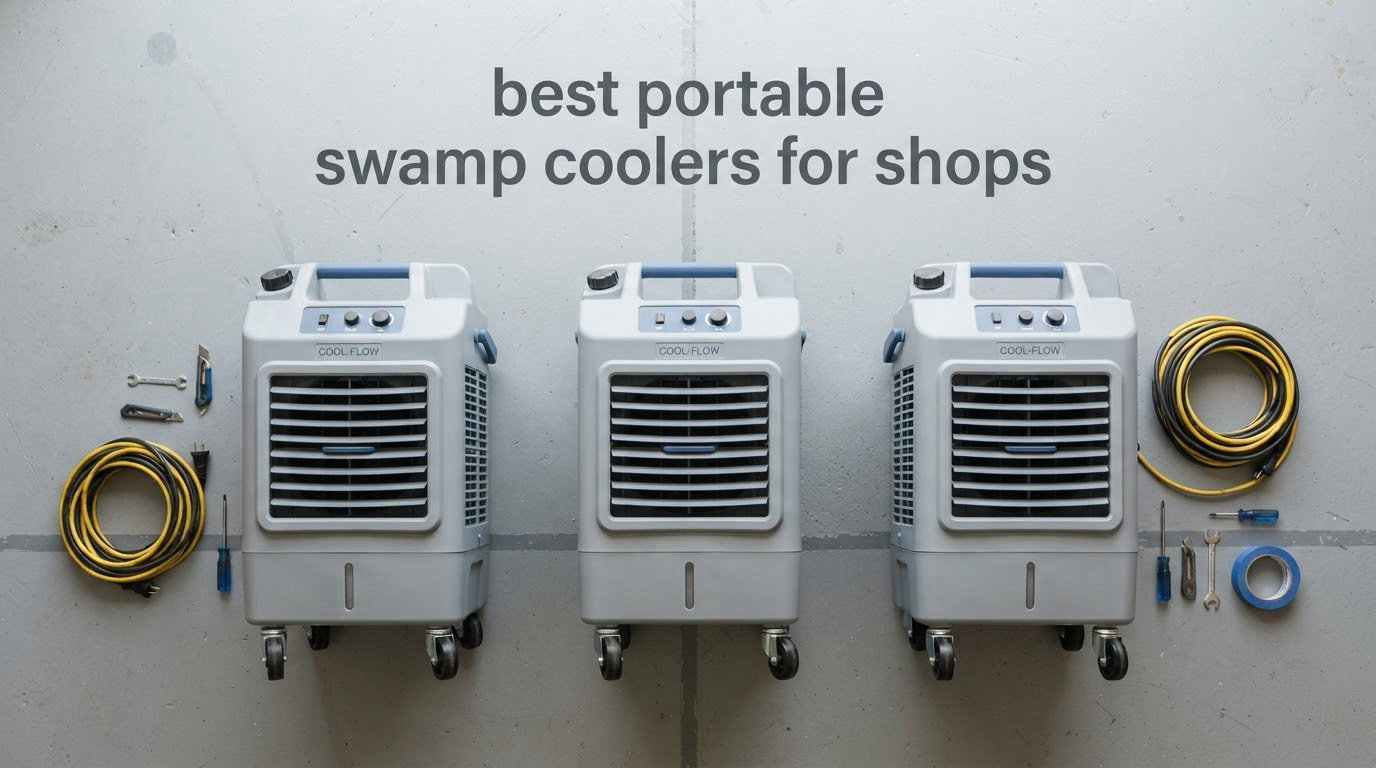
The best portable swamp coolers for shops are not the same machines that top patio roundups, and the difference comes down to one thing: whether the unit can move air through a working space for a full shift. Our pick for most shops is the Hessaire MC37V — 3,100 CFM, a 10.3-gallon tank, 250 watts, and a 4.6 rating across 325 reviews, the strongest combination of airflow and owner history in this group.
That matters because a shop is a hard room to cool. A garage has a rolling steel door and a concrete slab, often no operable window, and hours of accumulated sawdust in the air. The unit also has to survive eight or ten hours of running, which is a different requirement than keeping a patio comfortable through dinner.
Over the past few months we worked through the current crop of portable evaporative coolers with shops specifically in mind: airflow in CFM, how long a tank lasts per fill, watts drawn, weight when casters are fighting a shop floor, and what happens to wood and steel in the added moisture. We also read the long-running shop forums, where the same three objections surface every time — no exhaust path, added humidity, and a fan that competes with the dust collector.
Below is what we found, ranked for shop use. If you want the short version before the details: the MC37V is the one to buy for a typical two-car workshop, the Cajun Kooling CK4500-S is the answer when your shift is genuinely long, and the Uninex KoolZone is the pick for anyone whose humidity numbers make evaporative cooling a losing bet.
Table of Contents
Shop Reality Check: Can a Swamp Cooler Cool a Closed Space?
Yes, a portable swamp cooler can cool a garage or workshop, but only in dry air and only if the air can move out of the room. It pulls air through water-soaked cooling pads and blows the cooled air back into the space, so it lowers temperature rather than just moving heat. In a sealed room with no exhaust path, the cooled air recirculates, humidity climbs, and the temperature gain disappears within an hour.
Set expectations honestly. Shop owners on the woodworking forums are not describing a 25-degree drop. The phrase that keeps coming up is getting the space down to non-death temps, which in practice means the difference between a shop you can work in for six hours and one you cannot. One r/phoenix owner put it plainly: a swamp cooler can cool the garage to non-death temps, but it will be humid and you need good airflow out, and he would still recommend a mini-split for his own space.
That is a fair summary of the whole category. A swamp cooler is a ventilation-dependent comfort tool for dry climates, not a replacement for refrigeration. Treat it that way and it will serve you well for years.
Top 3 Portable Swamp Coolers for Shops

Those three cover the majority of real shop situations. The MC37V is the balanced all-rounder, the MC37M carries the deepest review history in the category, and the CK4500-S solves the tank-refill problem that ends most units in week three.
All 8 Portable Swamp Coolers Compared in 2026
| Product | Specifications | Action |
|---|---|---|
 Hessaire MC37V Hessaire MC37V |
|
Check Latest Price |
 Uthfy 40 Inch 4800 CFM Uthfy 40 Inch 4800 CFM |
|
Check Latest Price |
| Cajun Kooling CK4500-S |
|
Check Latest Price |
 Hessaire DC18 Hessaire DC18 |
|
Check Latest Price |
 DEWALT DXACN01B DEWALT DXACN01B |
|
Check Latest Price |
 Hessaire MC37M Hessaire MC37M |
|
Check Latest Price |
 OEMTOOLS 23968 OEMTOOLS 23968 |
|
Check Latest Price |
 Uninex KoolZone N407-TC Uninex KoolZone N407-TC |
|
Check Latest Price |
Specs tell you what a machine can do. They do not tell you whether your shop has the airflow path it needs, which is why the sizing and humidity sections below matter as much as the table.
1. Hessaire MC37V: Best Overall Swamp Cooler for a Working Shop
MC37V MOBILE EVAPORATIVE COOLER
3100 CFM
950 sq ft
10.3 gal tank
250 watts
Pros
- 3100 CFM covers up to 950 sq ft
- Three speeds plus oscillating louvers
- Included float adapter allows continuous hose fill
- Four locking casters roll it across a shop floor
Cons
- Loud on the high setting
- Full tank lasts about four hours
- Needs daily draining to control scale
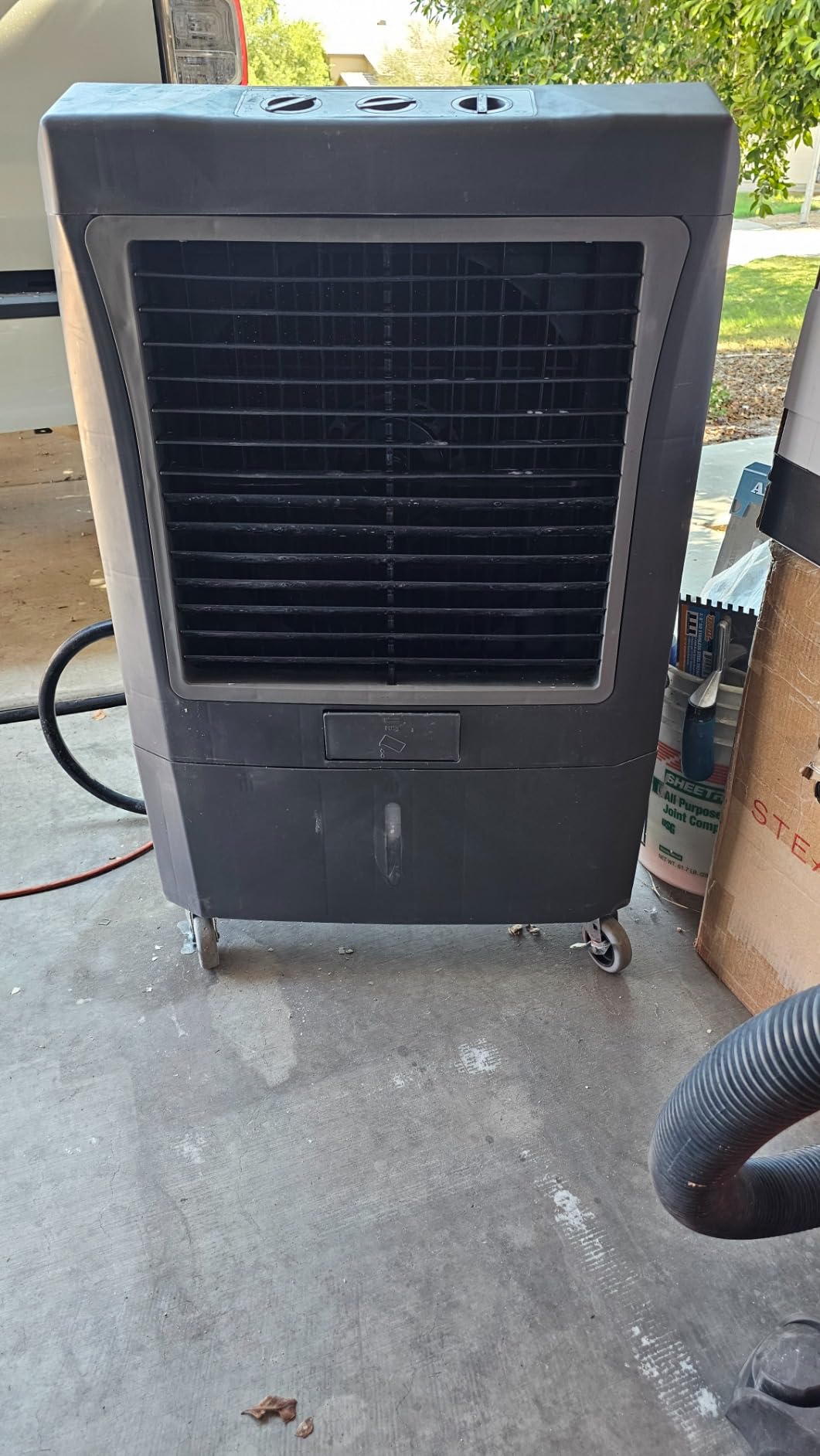
The MC37V is the unit we keep coming back to because it does the unglamorous things right. Three fan speeds, oscillating louvers, and 3,100 CFM of airflow put real cooling across the 950 square feet the manufacturer claims, and the three-sided rigid high-density pads give it more evaporative surface than most competitors at this output level.
For shop work, the casters matter more than the spec sheet suggests. Four heavy duty locking casters mean you can roll it out of the way when the table saw comes up, then reposition it at the sanding station in ten seconds without unplugging anything.
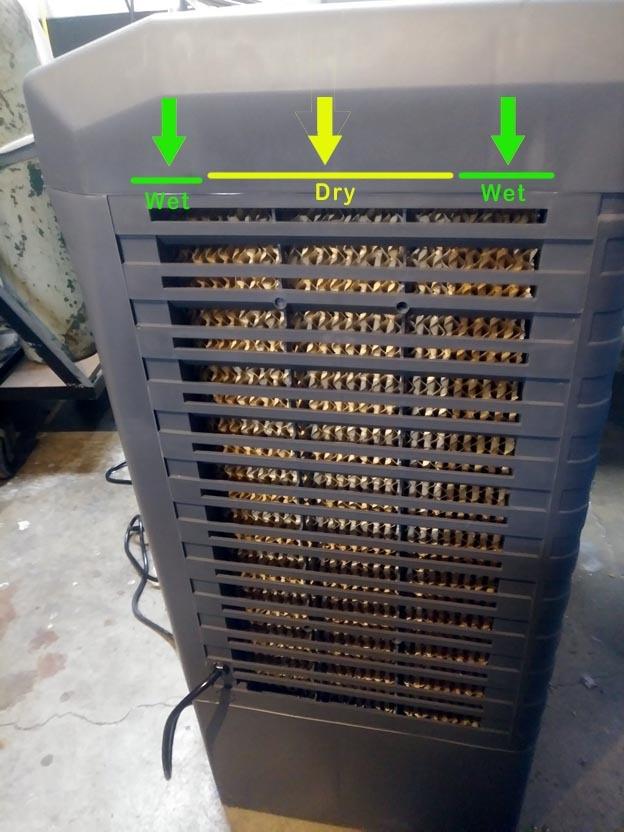
The included float adapter is the feature that separates it from most competitors. Attach a household hose and it runs continuously, which removes the single most common reason owners give up on a swamp cooler mid-shift. Reviewers also report stainless steel screws and no rust after years of service, which matters in a space with steel benches and cast iron tooling.
It draws 250 watts and ships with three simple rotary controls for fan, pump, and oscillation. There is no remote and no digital display, and at high speed it is genuinely loud — a buyer who works next to a running dust collector will feel that immediately.
What the four-hour tank actually means for a shift
A full 10.3-gallon tank runs roughly four hours on continuous operation. Over a standard working day that is two refills, which is manageable but not invisible. The hose adapter turns that into a non-issue if you can reach a spigot, which most shops can.
If your shop is genuinely two people working eight hours and you refuse to run a hose, the CK4500-S in position three solves the problem with a 32-gallon tank instead.
Where this cooler falls short
It is loud on the high setting, and owners consistently report needing to drain and clean the tank daily to keep mineral scale off the pads. In a dusty shop the pads will need more attention than in a house, so budget fifteen minutes at the end of each day.
It is also a plastic-bodied unit at 40 pounds, so it is portable but not something you carry up stairs every day. For a fixed shop floor, that is a fair trade.
2. Uthfy 40-Inch 4800 CFM Swamp Cooler: Best for Raw Airflow
Uthfy 40″ 4800 CFM Swamp Cooler, Large Evaporative Cooler with 11 Gal Water Tank, 3 Speeds, 120° Oscillation, 3 Ice Packs, Metal Frame Portable Air Conditioners for Outdoor, Patio, Shop, Yard, Factory
4800 CFM
970 sq ft
11 gal tank
200 watts
Pros
- Highest CFM in this group at 4800120 degree oscillation
- Includes 3 ice packs and an ice curtain
- Four caster wheels
- two lockable
Cons
- Long tail of 1 and 3 star reviews
- Iron frame adds weight
- Output falls off in humid air
On raw air volume the Uthfy leads this group, pushing 4,800 CFM across up to 970 square feet on just 200 watts. That combination makes it the most efficient mover of air per watt here, and for a large shop with an open bay door it genuinely moves the air.
The 120-degree oscillation and triple air intake panels spread that volume across the working area rather than concentrating it in one blast. Buyers in dry-climate garage and warehouse settings single out the airflow number as the reason they are satisfied.
The 11-gallon tank is the second largest of the evaporative models here, and it ships with three ice packs plus a 4-in-1 composite ice curtain for pushing delivered air temperature lower. Four 360-degree caster wheels, two of them lockable, make it easy to move between work areas, and there is no window installation or hose hookup required.
Power is the other headline. At 200 watts it moves more air than anything else in the list, which is a genuine advantage in a hot shop where electrical circuits are already shared with a compressor or dust collector.
Where the raw airflow earns its place
If your shop has a large opening — an up-and-over door, a wide side door, or a covered porch you can run it out onto — this is the unit that will move enough air to matter. A shop with a 950 square foot footprint and a high ceiling is exactly the case it fits.
The iron frame is a genuine positive here. It is heavier than a plastic-bodied cooler of similar output, but it does not flex or creak when you roll it across a concrete floor, and it carries a one year manufacturer warranty.
Where the review record gives us pause
The rating is 4.0 across 103 reviews, and the distribution has a long tail of 3-star and 1-star feedback that mentions uneven build and weaker-than-expected cooling. A solid five-star core sits alongside that tail, which tells you the unit performs well when set up correctly.
As with every evaporative cooler, output drops in humid air. If your shop reads above 70 percent relative humidity on a July afternoon, the airflow advantage does not translate into a temperature advantage.
3. Cajun Kooling CK4500-S: Best for a Full 8 to 10 Hour Shift
Cajun Kooling CK4500-S Evaporative Air Swamp Cooler – 32 Gal Tank – High Power 4500CFM – Variable Speeds – 1200 Sq Ft Coverage – Side Open Access – Outdoor Cooling – Patios, Barns, Events, Restaurants
4500 CFM
32 gal tank
400 watts
8-10 hours per fill
Pros
- 32 gal tank runs 8-10 hours per fill
- Latching side panel accepts ice
- Pump shut-down valve protects internal parts
- External screens block dust and debris
Cons
- 84 pounds is heavy to reposition
- 65 dB is loud indoors
- Only 26 reviews of long-term history
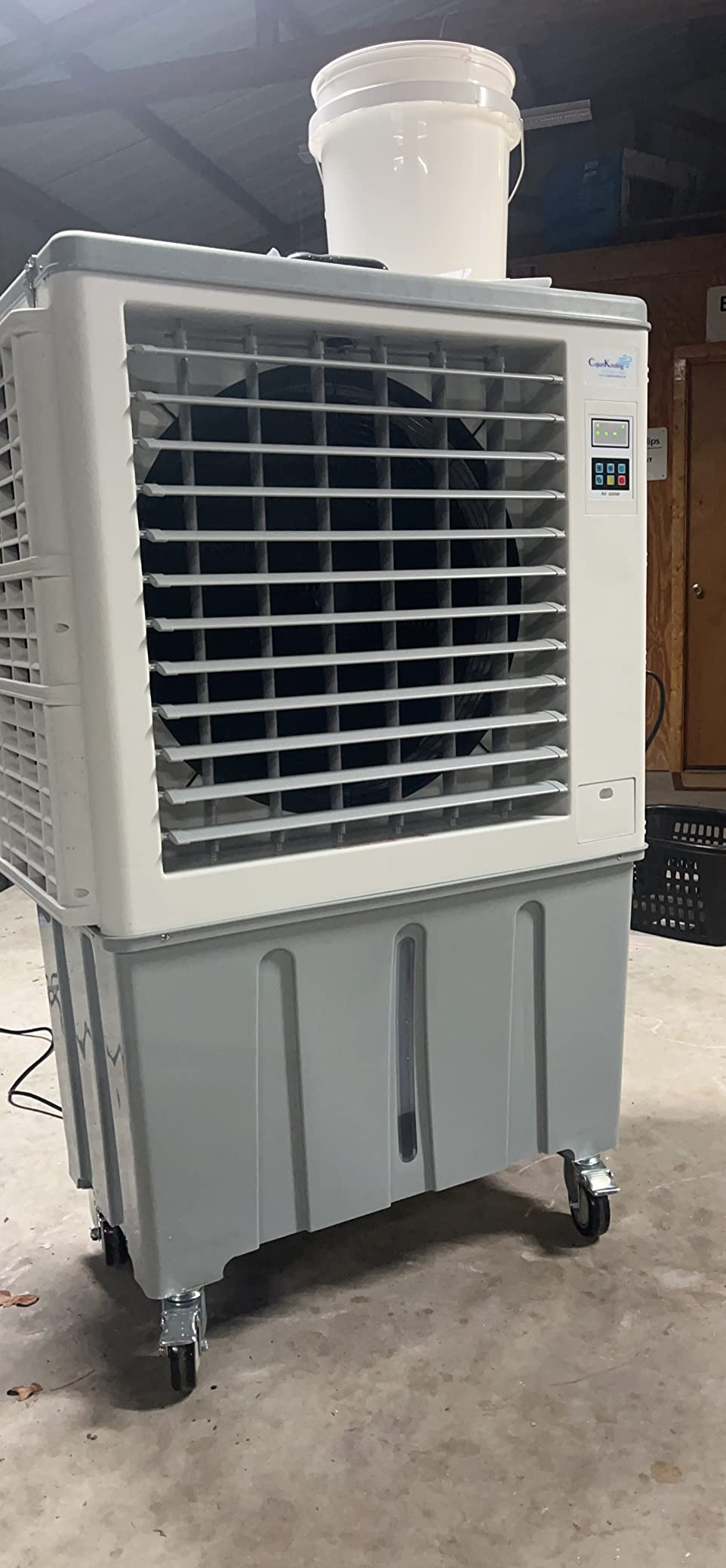
The CK4500-S solves the problem that ends most portable evaporative coolers in a working environment: refilling. Its 32-gallon reservoir is by far the largest tank in this group, rated by the manufacturer to run 8 to 10 hours per fill, which means one fill covers a full shift in most shops.
That also supports a hose attachment with a float valve for continuous flow, so an owner who prefers not to touch it during the day can plumb it in and forget it. The 4,500 CFM output covers up to 1,200 square feet, and the air drive reaches about 40 feet from the unit.
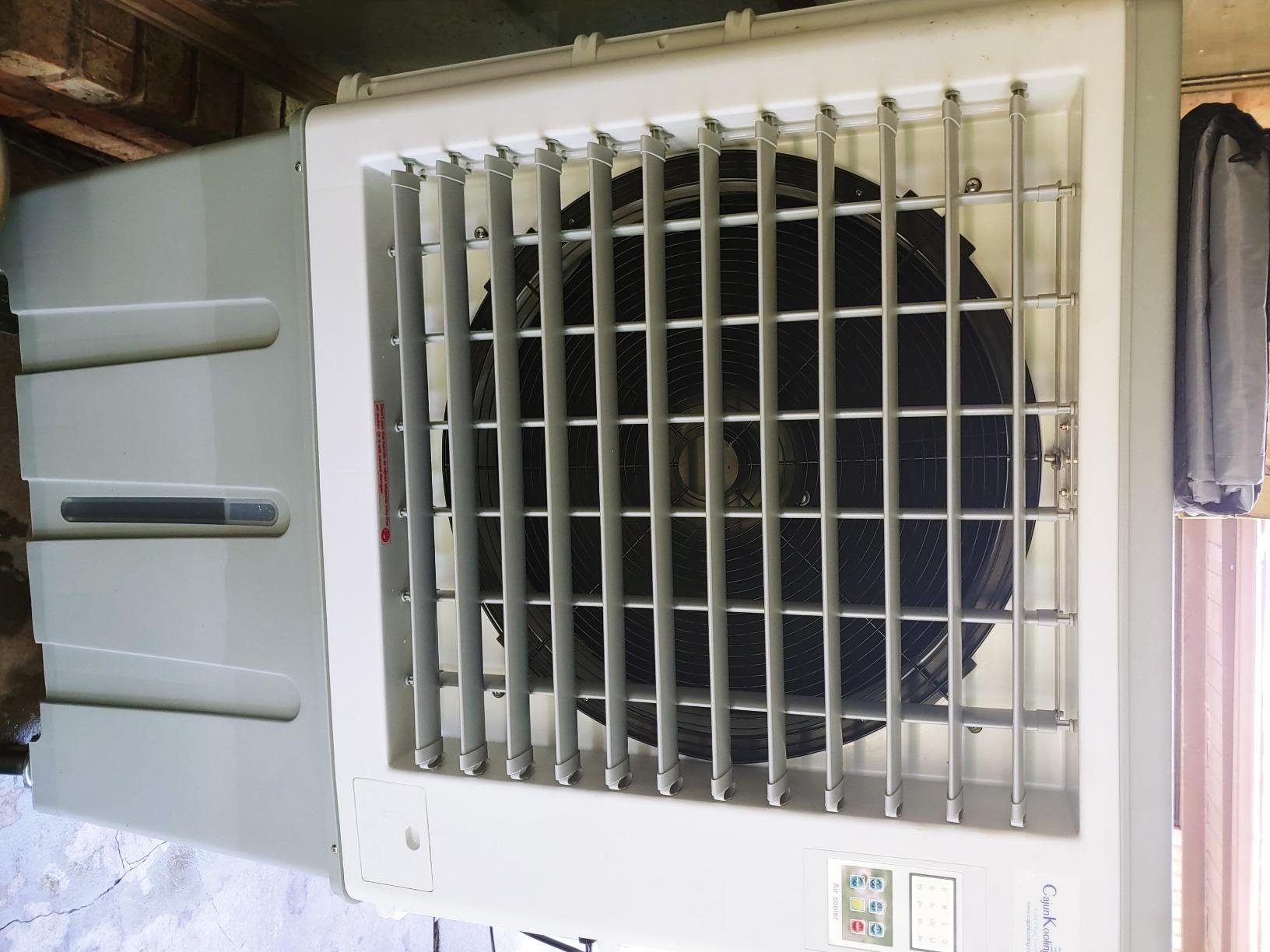
Several details show this was designed for commercial spaces rather than living rooms. A latching side panel lets you add ice to the water for extra cooling. A pump shut-down valve protects internal parts when the water gets low. External screens keep dust, pollen, bugs, and pet hair off the cooling pads, which in a sawdust environment is more than a nicety.
Controls are remote, with three speeds, oscillation, and a 1 to 8 hour auto-off timer. The internal metal parts are coated against salt, hard water, and limestone build-up, and the case is UV-resistant for outdoor use.
Why a 32-gallon tank changes shop behaviour
Refill frequency over a long workday determines whether a unit gets used or abandoned. A 10.3-gallon tank means two refills; a 2.8-gallon battery unit means a dozen. Once you are topping up a small reservoir every forty minutes, the cooler stops being a comfort tool and becomes a chore.
The 32-gallon reservoir also lets you load ice without draining first, which is how you push delivered air lower in a sealed space. That is the single most effective trick for a closed shop.
What the weight and noise cost you
At 84 pounds with 400 watts, this is the heaviest evaporative unit here and it draws more power than the other seven combined in a typical comparison. It has lockable wheels, but repositioning it is a two-person job if you are crossing thresholds.
The 65 dB rating is high for an indoor workspace where you also need to hear a router or a radio. And with only 26 customer reviews, the durability record is thin — the 4.6 average is strong, but it rests on a handful of owners.
4. Hessaire DC18: Best for Mobile and Battery-Powered Work
Hessaire DC18 Mobile Evaporative Cooler
900 CFM
300 sq ft
2.8 gal tank
18V and 20V tool battery
Pros
- Runs on any 18V or 20V tool battery
- Includes 115V AC adapter for fixed use
- Quiet relative to its output
- Easy to refill
Cons
- High water use per hour
- Output falls off above 60 percent humidity
- 42 pounds is awkward to move
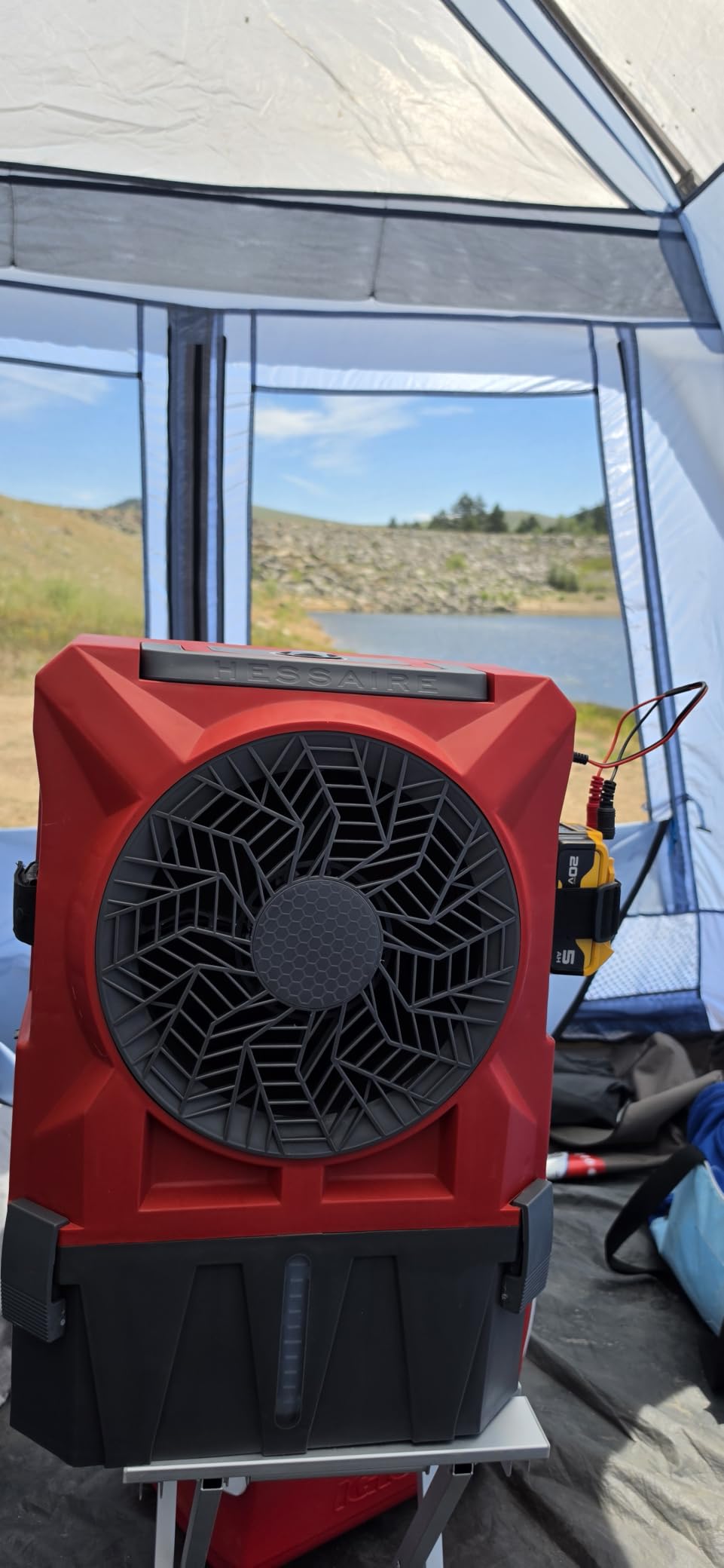
The DC18 is a different category of product. Instead of needing a dedicated outlet, it runs on any 18V or 20V tool battery, which means it works on a truck bed, a job site, a boat, or anywhere in a shop where pulling a cord to the nearest machine is inconvenient. It also ships with a 115V AC adapter for fixed-station use.
At 900 CFM it covers roughly 300 square feet, which is a single working position rather than a whole shop. Owners running it in un-airconditioned automotive shops report it is enough to keep a working position bearable, and it is quiet relative to the volume of air it produces.
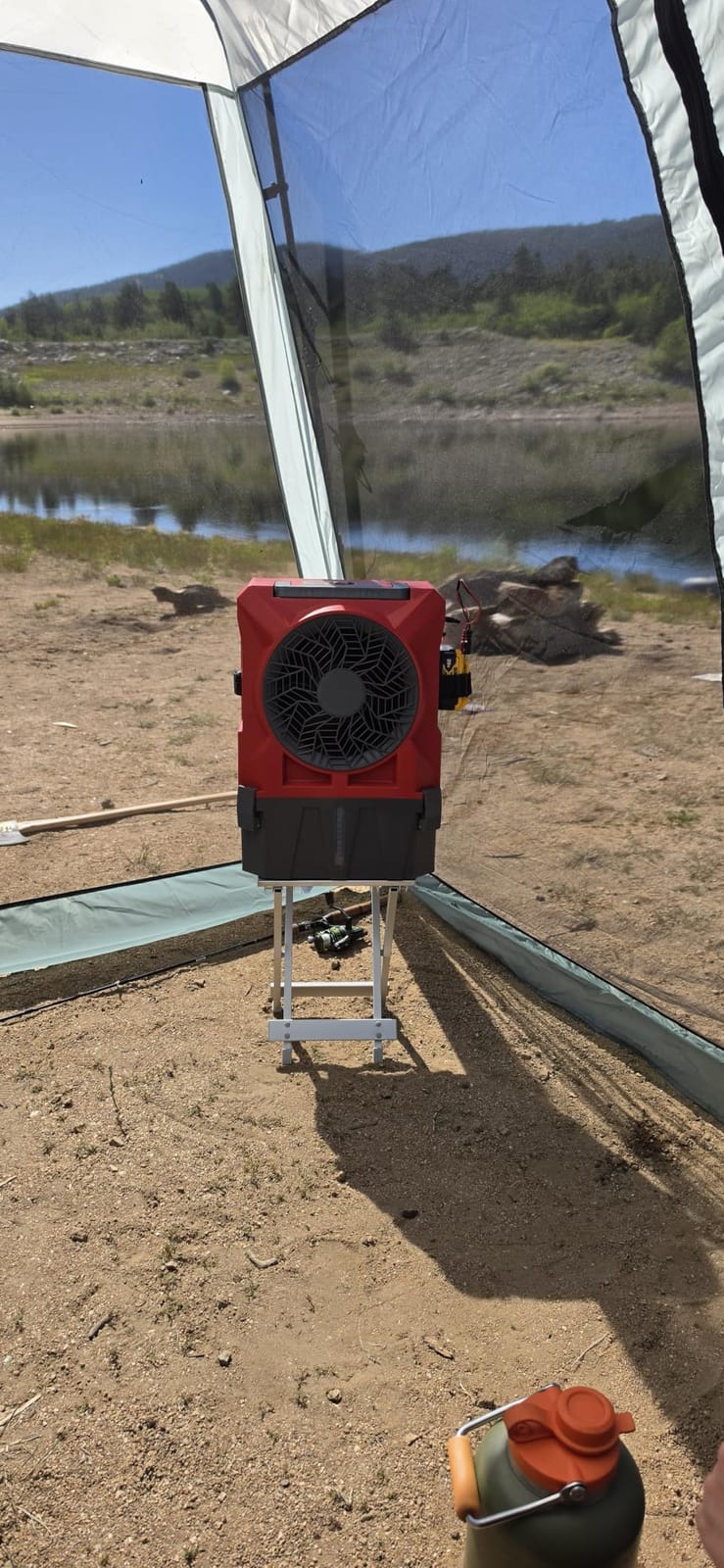
Setup is fast: fill the 2.8-gallon reservoir, seat the battery, and go. That matters for tradespeople who are not installing equipment, they are deploying it. The manufacturer is explicit that this is not an air conditioner and reduces heat stress rather than chilling a room.
It works with all major 18V and 20V tool battery platforms, so if you already own packs, there is nothing extra to buy beyond the cooler itself.
Best used at one station, not across a floor
Think of the DC18 as personal cooling at a bench or a truck rather than room cooling. Three hundred square feet of coverage is roughly a single work zone, and that is exactly the situation it handles well without any installation.
For a shop where a specific operator works a fixed spot through a hot shift, this is more practical than a 3,100 CFM unit they would have to keep out of the way of the saw.
Where it will disappoint
It uses a fair amount of water per hour, so it needs regular refilling during a long shift. Evaporative performance falls off sharply once relative humidity climbs past roughly 60 percent, which is a lower ceiling than the larger units tolerate.
At 42 pounds it is awkward to move and store despite the portable form factor. Battery is not included, a small share of buyers received units that did not function, and the included AC adapter output does not match the battery ceiling stated in the manual.
5. DEWALT DXACN01B: Best for Tool Battery Owners Who Want an Ice Chest Too
DEWALT Evaporative Air Cooler Portable Air Conditioner DXACN01B (Tool Only)
8 gal ice chest
20V battery
120 min cordless
ice to 53.6F
Pros
- Doubles as an 8-gallon ice chest
- Digital display shows output air temperature
- Turbo Cool mode drives output to about 53.6F
- Stows hoses and connectors inside the body
Cons
- Tool only
- battery and charger sold separately
- Only 21 reviews
- Short cordless runtime
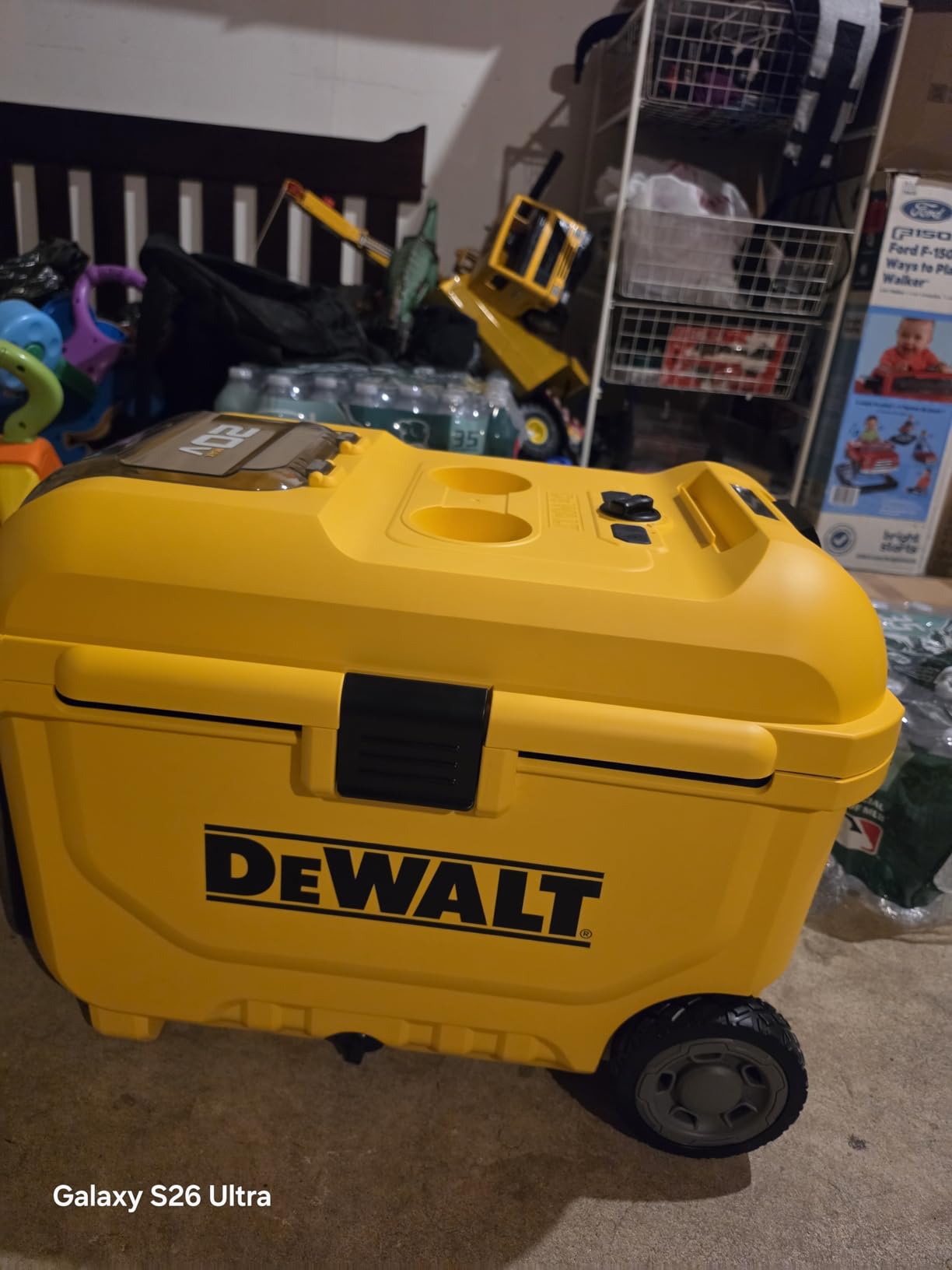
The DXACN01B is less a swamp cooler and more a dual-purpose job site appliance. It cools air by blowing across ice and water in an 8-gallon tank, which means the same box holds your cold drinks, and on a hot job site that is genuinely the more valuable half of the proposition.
It runs cordless on a DEWALT 20V battery for up to 120 minutes, so you can move it with the rest of your tools without a cord. A digital display shows the real-time output air temperature, which is unusual at this level and lets you confirm the thing is actually doing something.
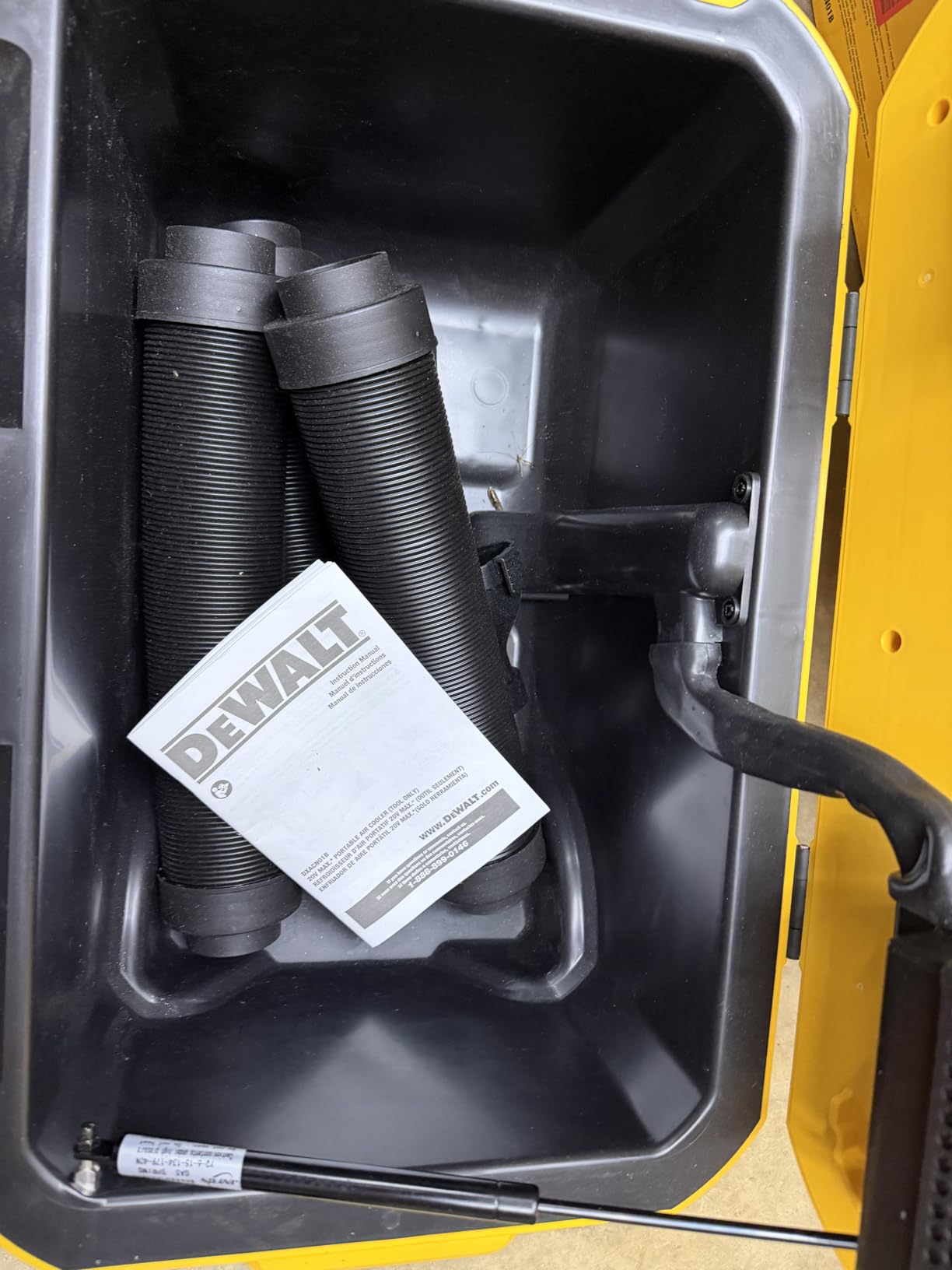
Turbo Cool mode drives the output down to about 53.6F when you need the cold hard. The chassis carries integrated wheels, a heavy duty handle, a cup holder, a phone tray, and a USB charging port, and the three air extension hoses, the air hose connector, the 3-way connector, and an ice pack all store inside the body.
Setup is genuinely simple: fill with ice and water, connect the hoses, install the battery, select a speed. No assembly.
Why ice beats pads in a hot vehicle or a tent
Evaporative pads need dry air and airflow to work well. In a hot, humid truck bed or a tent with the sun on it, the combination fails, and ice does not. Loading ice into an 8-gallon tank creates a cold source that blows air several degrees below ambient regardless of the humidity outside.
That is why this unit makes more sense for mobile work than a conventional evaporative cooler, and why owners tend to describe it in terms of the ice chest function first.
Where it falls short indoors
It ships as tool only, so the 20V battery and charger are sold separately, and that changes the economics for anyone who is not already committed to the platform. The 120 minutes of cordless runtime limits it to shorter work sessions on battery power.
With 21 reviews and 4.0 average, and roughly a fifth of ratings at 3 stars, several buyers question how much actual cooling they get for the money. For a fixed shop floor, one of the mains-powered units will serve you better.
6. Hessaire MC37M: Best Value for Long Working Days
Hessaire MC37M Indoor or Outdoor Portable Oscillating Evaporative Swamp Air Cooler for 950 Square Feet of Space with Water Reservoir
3100 CFM
950 sq ft
10.3 gal tank
276 watts
Pros
- Deepest review history in this category
- Four fan settings plus two evaporation settings
- 8-hour timer matches a working shift
- Owners report 15-20 degrees of perceived relief
Cons
- Noisy even on low
- Adds humidity in enclosed rooms
- Open tank sloshes when moved
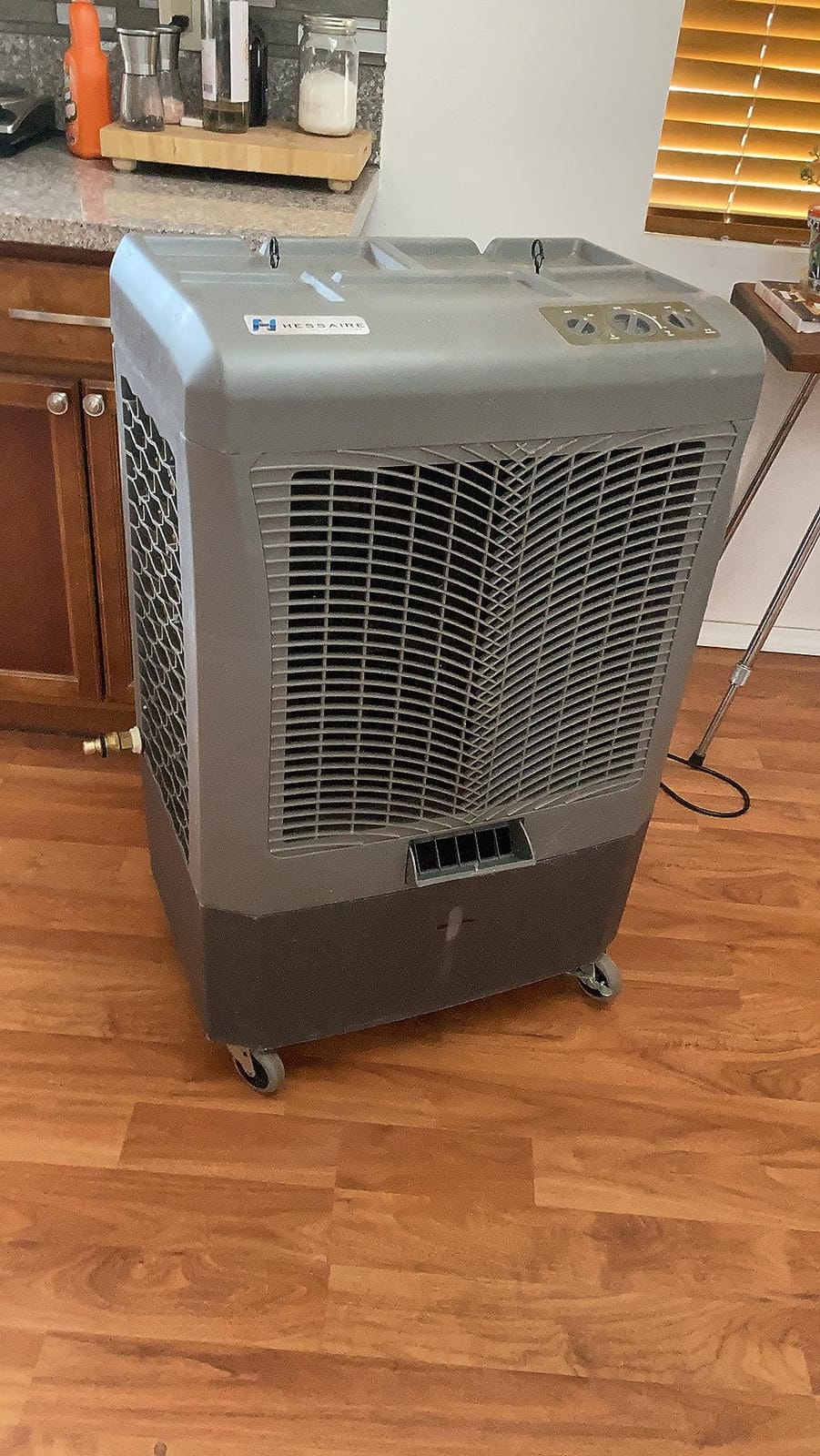
The MC37M is the version of the MC37V formula aimed squarely at people who use it all day. It shares the 3,100 CFM output and 950 square foot coverage, the 10.3-gallon reservoir with manual fill and a garden hose adapter, and the same three-sided pad layout, but it adds controls that matter across a shift.
You get four fan-only settings, two evaporation settings, oscillating vents, and an 8-hour timer. The timer is the underrated one: set it to your workday and the unit runs out and stops without anyone remembering to switch it off.
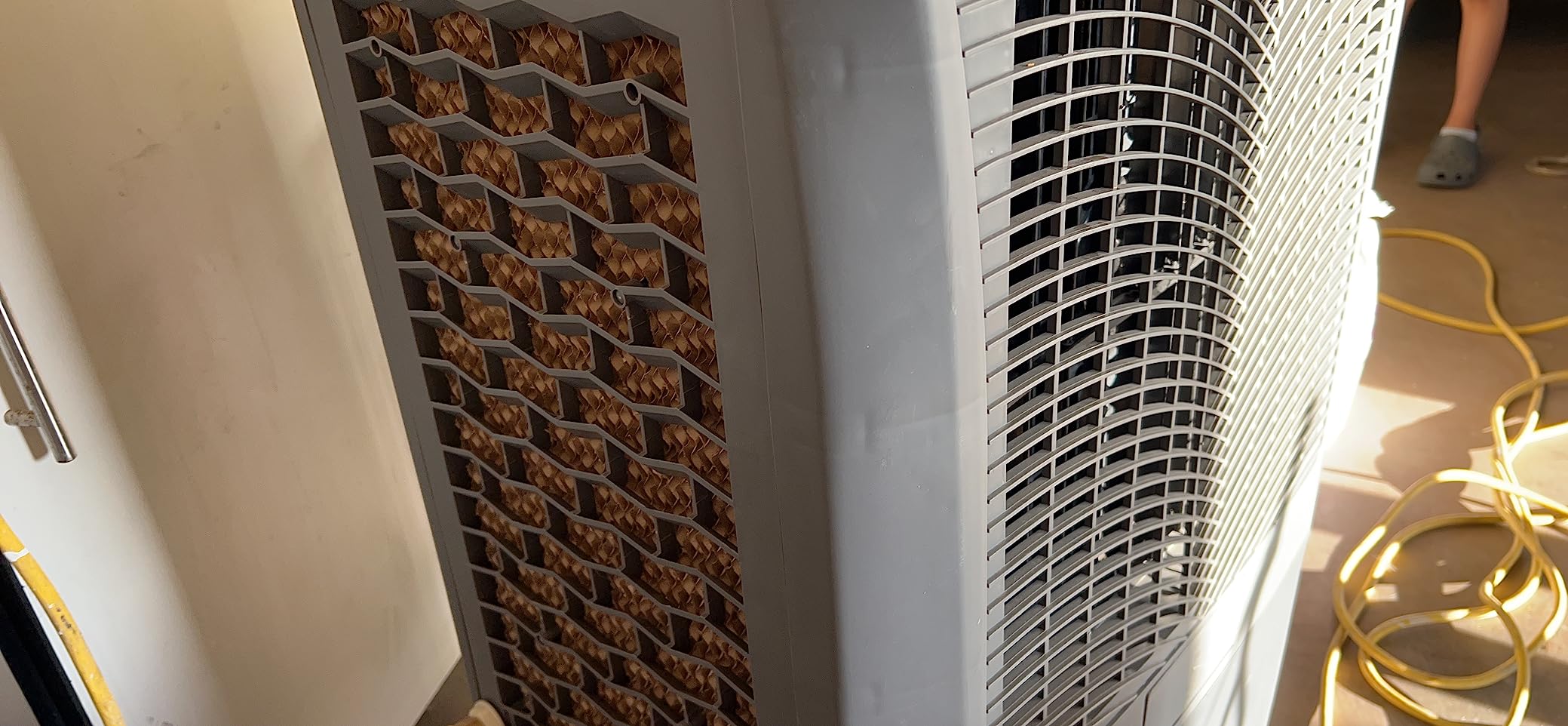
The 553 reviews at a 4.3 average make it the most-proven unit in this group, with a 70 percent five-star share. Owners across the US and Canada run it on porches, decks, patios, garages, and man caves, and several report a year or more of regular use without failure. On r/hvacadvice, a 3,100 CFM unit of this class is reported as cooling the space well so far for home use.
Owners in humid coastal cities report it makes 95 to 100F days bearable, and one Florida owner puts 30 pounds of ice in the tank and gets output close to what a compressor unit delivers. That is a real pattern, not a marketing claim, and it is why the 8-hour timer and 10.3-gallon tank pair well.
What a deeper review history is worth
Four hundred more reviews than the MC37V means we can see the failure modes instead of guessing at them. They are consistent: noise, added humidity in enclosed rooms, and tank maintenance. Nothing structural. The stainless hardware and the general absence of corrosion complaints are also consistent across owners.
For a shop owner committing several hundred dollars for a decade of use, that evidence matters more than any single specification.
Where the closed-room problem bites hardest
Every humid-climate reviewer stresses the same thing: it adds moisture, so an enclosed garage needs a window and a supplemental fan to vent. The open top tank also sloshes when the unit is moved, and one owner reported a flood after leaving a hose feed connected overnight.
It is noisy even on the low setting, comparable to an aircraft cabin, and it needs periodic vinegar treatment to control algae and scale in the reservoir.
7. OEMTOOLS 23968: Best Purpose-Built for Garages and Workshops
OEMTOOLS 23968 3-Speed Portable Swamp Cooler 3100 CFM 10.3-Gal. Water Tank
3100 CFM
950 sq ft
10 gal tank
250 watts
Pros
- High-density media panels with 80 percent more surface area
- UL GFCI plug for shop safety
- Tool tray and casters for workshop use
- UV-resistant resin body
Cons
- 68 dB is the loudest in this group
- Knob controls with no remote or display
- Only 69 reviews
The OEMTOOLS 23968 is the only unit in this group that was designed for a garage first rather than adapted to one. The tool tray and integrated casters are not decorative: they exist because the machine lives next to a workbench, and the manufacturer markets it explicitly as the garage-friendly option.
The cooling specification is 3,100 CFM across up to 950 square feet, driven by a three-speed 1/5 HP motor. The high-density media panels are rated at 80 percent more evaporation surface area than standard density panels, which is the number that determines how much actual cooling comes off the pads.
Two safety details set it apart in a working shop. It ships with a UL GFCI plug, which matters when you are running a wet appliance within reach of a dusty floor and a power tool, and the body is UV-resistant resin rather than a thin plastic shell.
A patented axial propeller handles air distribution, with oscillation for even coverage across the working area. The 10-gallon reservoir and 250-watt draw sit in the middle of this group, with a 1.3 amp draw on 115 volts.
Why GFCI and a tool tray beat a remote control
In a garage, the questions that matter are electrical safety and where to put the wrench. A GFCI plug protects against the one failure mode a wet appliance can create, and a tool tray means the machine has a place to live that is not the middle of the sawdust pile.
It measures 45 by 28 by 17 inches and weighs 41.3 pounds, so it is taller than most of its competitors and will not fit under a low bench. Plan the footprint.
Where it falls short
At 68 dB, it is the loudest rating in this group, and noise is a genuine constraint when you are running a table saw or a dust collector at the same time. It also has knob controls only, with no remote and no digital readout.
With 69 reviews it is less proven than the two Hessaire units, and like every evaporative cooler here, it loses effectiveness in humid conditions.
8. Uninex KoolZone N407-TC: Best for Shops Where Humidity Wins
Uninex KoolZone N407-TC Mobile Spot Cooler Indoor Outdoor
8920 BTU
0.7 ton
22 dB
9.22 SEER
Pros
- Refrigeration based so it dehumidifies
- 22 dB is the quietest in this group
- ETL and California Energy Standards certified
- Drain tank empties about every five hours
Cons
- Spot cooling only
- short air throw
- 3.9 rating from 19 reviews
- 88 pounds with a corded supply
The Uninex KoolZone is not an evaporative cooler, and we include it because the honest answer for a humid shop is a different machine. It uses R410A refrigerant and delivers 8,920 BTU of cooling at 0.7 tons, which means it actually dehumidifies while it cools rather than adding moisture to the room.
That single design difference makes it the only unit in this roundup that works reliably in the Gulf states, the deep South, or any shop where summer relative humidity regularly sits above 70 percent. Everything else on this list becomes ineffective at that number.
The efficiency figure supports the case. A 9.22 SEER with a built-in evaporator that removes most of the condensate means the drain tank empties roughly every five hours, and the machine is ETL certified and California Energy Standards certified to ASHRAE Standard 128-2001.
It is also the quietest unit here by a wide margin at 22 dB, which matters if you are trying to work next to it. Wheels let you move it between workstations.
Spot cooling is a real limit, not a marketing term
Reviews split along a clear line. Buyers who set it up to cool one defined zone — a desk, a basement exercise room, a single bench position — find it quiet, effective, and easy to run. Buyers expecting to cool an open shop floor come away disappointed, because the air throw is short and weak.
One Texas industrial buyer found the airflow too weak to relieve bench workers in an open shop, and the expandable vent on the discharge was described as feeling flimsy. Plan it as a three-to-four-foot bubble around one position.
What you give up for that humidity tolerance
At 88 pounds on a 120-volt corded supply, it needs a dedicated outlet nearby, and at 3.9 across 19 reviews it has the lowest rating and the thinnest evidence base in the group. That is a small sample, and we would want more history before recommending it as a primary shop cooler.
Used as targeted bench cooling in a humid shop, though, it is the only thing here that reliably does the job.
How to Size a Swamp Cooler for Your Shop
Size on airflow, not on the square footage printed on the box. That number assumes an open, well-ventilated space with low humidity, and a shop is none of those things. A more useful approach is to work backward from the opening you have available to exhaust air.
The common rule of thumb for a residential room is roughly 20 CFM per square foot of floor area, applied only to the area you want directly cooled. For shops, treat that figure as a starting point and reduce your expectation, because your exhaust path will never be as free-flowing as an open patio.
Worked examples, using the square footage of the zone you want to keep bearable:
- 20 by 20 shop, 400 sq ft zone: about 8,000 CFM theoretical, which no portable unit reaches. In practice a 3,100 CFM machine positioned 6 to 10 feet from the work position is the realistic answer.
- 20 by 30 shop, 600 sq ft zone: 3,100 CFM covers a defined half of the room. A 4,500 to 4,800 CFM unit covers more of it.
- 25 by 35 shop, 875 sq ft zone: this is where the 950 square foot coverage claims start to make sense, and where the 1,200 square foot CK4500-S earns its place.
- 30 by 50 shop, 1500 sq ft and up: a single portable unit will not do this. You need two machines positioned at opposite ends, or you need to move to a ducted commercial system.
Position matters as much as volume. A 3,100 CFM unit ten feet from the bench where you actually stand will outperform the same unit across the room, because the cooling is a directed stream, not a room-wide effect.
If you are also upgrading dust collection this year, our guide to the best dust collectors for woodworking shops covers the airflow planning that has to happen alongside a cooling install.
Humidity and Ventilation: The 60 to 70 Percent Ceiling
A swamp cooler stops delivering useful cooling when relative humidity reaches roughly 60 to 70 percent, because evaporation slows as the air approaches saturation. Below that range you get a real temperature drop. Above it you mostly move humid air around, and in a closed room the humidity climbs until performance is close to zero.
This is the make-or-break question for a shop, and the reason to check your local humidity data before buying anything on this list. A Texan in an r/woodworking thread put it bluntly: about half the state is too humid for a swamp cooler to have any serious positive effect. A binderplanet.com owner described the same performance cliff differently — works great until the humidity kicks up.
Where the air is dry, a closed room is the second problem. A swamp cooler is not an air conditioner; it has no exhaust. It cools the air and pushes it back into the same room, so the only way temperature falls is if warmer air is allowed to leave. Without a path out, the room stagnates, and in at least one documented case on chameleonforums.com, filling a unit with water and ice made the room hotter than the neighbouring rooms.
To make a closed shop work, do these four things:
- Open one door and one window on opposite sides. Cross-ventilation is the cheapest fix and the most effective. Even a screen door counts as an opening.
- Add an exhaust fan if no window exists. A window fan set to exhaust in an upper wall removes more warm, moist air than a second floor fan adds.
- Aim the outlet at the work position, not at the ceiling. You want the cooled stream on skin, not on the ceiling joists.
- Keep a hygrometer on the bench. If it climbs past 70 percent, the cooler is now a humidifier. Add ventilation or shut it off.
Planning the layout of the space around airflow will save you a lot of trial and error. Our guide to hydraulic presses for shops covers the same bench-clearance logic that shop layouts share.
What Added Humidity Does to Wood, MDF and Metal Tools
This is the concern that comes up most often in shop forums, and it deserves a straight answer rather than a reassurance. A swamp cooler raises relative humidity in the space it occupies, and humidity is what causes swelling, warping, mold, and corrosion. The question is how much, and for how long.
The honest answer is that it depends almost entirely on local ambient humidity, which is exactly why the forum reports seem to contradict each other. A sawmillcreek.org owner reports running a swamp cooler in a workshop for about 25 years with no rust on any tools, attributing it to the low humidity of the area. A shop owner on hobby-machinist.com, speaking from direct experience, said the opposite and would not recommend using one in a shop. Both are describing real conditions.
Here is how we think about the risk for common shop materials:
- MDF and particleboard: the most vulnerable. These engineered sheets absorb moisture at the edges and swell noticeably above roughly 60 percent relative humidity. If your shop is full of MDF, a swamp cooler needs an aggressive exhaust plan, not an optional one.
- Solid lumber: more forgiving. Properly acclimated hardwood tolerates short periods of elevated humidity, but unfinished stock stacked against an exterior wall is where movement starts.
- Plywood and OSB: edge swelling and delamination at sustained high humidity, particularly if it is stored flat on the floor rather than on dunnage.
- Finished work and spray finishes: the most expensive mistake. Keep finished pieces off the floor, away from the discharge side, and ideally in a separate room.
- Steel tools and hardware: rust risk rises with sustained humidity. A shop owner on sawmillcreek.org is the counterexample that proves it is not inevitable. Storing blades in wall-mounted cabinets, keeping them off concrete, and running a dehumidifier in humid months handles it.
Our practical advice: check your summer humidity numbers first, run a hygrometer through one full week, and only then commit. If your shop sits above 60 percent outdoors most afternoons in July, the evaporative category is the wrong one and you should look at the refrigeration option or a ducted system instead.
One more environmental note. Shops in hot climates often have serious heat stress, and getting a space to survivable levels is a worker-safety matter rather than a comfort one. We covered the related gear side of heat and cold management in our picks for the best hard coolers for working outdoors.
Maintenance in a Dusty Shop and Winter Storage
Sand, concrete dust, metal shavings, and clay dust load cooling pads faster than household dust does, and a clogged pad is the number one cause of a swamp cooler that stopped working. A fifteen-minute weekly routine keeps output where it should be.
- Rinse the pads weekly. Pull the tank, tip the pads, and run clean water through until it runs clear. Sawdust mats on the media surface and blocks evaporation fast.
- Scrub the tank monthly. A stiff brush and a little vinegar handle mineral scale and the biofilm that grows in warm standing water. Owners consistently report this as the maintenance step that makes the biggest difference.
- Check the casters and the pad frame. Locking casters take a beating on concrete. A quarter-turn check every few weeks is cheap insurance.
- Watch the water line in dusty conditions. Sawdust settles into the reservoir and raises evaporation, so top-ups happen sooner than the manufacturer runtime suggests.
- Verify the GFCI before humid season. If your unit has one, test it. If it does not, that is a genuine reason to choose a different model.
For winter shut-down, the risk is the water left in the reservoir and the pump. Drain the tank completely, run the pump and fan for fifteen minutes with an empty tank to clear the lines, wipe the pads, and store the unit upright in an unheated space where it will not freeze. Do not leave it plumbed to a hose.
For a shop that already has cold-weather logistics figured out, our backpack cooler picks cover the same dry and cold-weather transport problem from a different angle.
Running Cost: Swamp Cooler vs Window AC vs Mini-Split
Running cost is where evaporative coolers win decisively, and it is worth doing the math for your own shift rather than trusting a general claim. The comparison below uses the rated wattage of the units in this roundup over a 10-hour working day.
- Uthfy 4800 CFM at 200 watts: 2.0 kWh per shift.
- Hessaire MC37V at 250 watts: 2.5 kWh per shift.
- OEMTOOLS 23968 at 250 watts: 2.5 kWh per shift.
- Hessaire MC37M at 276 watts: 2.76 kWh per shift.
- Cajun Kooling CK4500-S at 400 watts: 4.0 kWh per shift.
- Uninex KoolZone at 937 watts: 9.4 kWh per shift.
A window AC or a mini-split for the same shop typically runs in the range of 1,000 to 1,500 watts when running, so the evaporative units use a fraction of the electricity over a full day, and the refrigeration spot cooler lands in the same range as a window unit.
There is a second cost that a watt comparison hides: water. An evaporative cooler can consume several gallons over a long shift, and if your shop water is metered that shows up. It is still far cheaper than the electricity difference, but it is not zero, and in some municipalities evaporative coolers are required to use recirculated water rather than a once-through supply.
For shop owners, the third number matters most: how much you can actually work before heat stress stops you. If the swamp cooler keeps two people productive for six extra hours a day at a fraction of the power, the payback is usually quick regardless of the unit cost.
When to Skip the Swamp Cooler
There are four situations where buying an evaporative cooler for a shop is a mistake, and we would rather say so than take the sale.
First, if your summer humidity regularly sits above 70 percent. Check a weather service humidity figure for your area before anything else. Below that threshold, none of this matters.
Second, if the shop has no air path in or out and you are not willing to create one. Without ventilation the unit does nothing useful and adds moisture. An exhaust fan installation is a small cost compared with a cooler that does not work.
Third, if you store moisture-sensitive material. A shop full of MDF, plywood, and finished work is a poor candidate for a unit that raises humidity all summer.
Fourth, if you need genuine cooling rather than heat relief. If the goal is a room at 72F, none of these units will get there. A ducted mini-split, a packaged air conditioner, or the Uninex spot cooler at a single bench are the correct answers, and the Uninex is included on this list precisely because it is the honest option for a humid shop.
A shop owner on hobby-machinist.com, after trying it, said the experience was enough that he would not recommend a swamp cooler in a shop. Treat that as a warning about the closed and humid case, not as a verdict on the category in dry air.
Frequently Asked Questions
Do portable swamp coolers actually work?
They work well in dry air with an open exhaust path, and poorly in both of the opposite conditions. A fan draws room air through wet cooling pads, water evaporates into the airstream and lowers its temperature, and the cooled air is pushed back into the space. That only reduces the room temperature if warmer air can leave and be replaced. In a closed shop with no opening, humidity climbs until the cooling effect disappears.
Can a swamp cooler cool a garage?
Yes, provided the garage is dry and you can move air out of it. Open the garage door and one window on opposite sides, or add an exhaust fan, then position the unit so its outlet aims at your work position. Realistic expectations are non-death temps, the point where you can work for a full shift, rather than a 25-degree drop.
How humid is too humid for a swamp cooler?
Roughly 60 to 70 percent relative humidity is the ceiling. Below that range evaporation runs fast and you get meaningful cooling. Above it, the pads cannot evaporate enough water to cool the airstream meaningfully, and in a closed space the unit effectively becomes a humidifier. If your shop reads above 70 percent on a July afternoon, choose a refrigeration-based cooler instead.
Will a swamp cooler work in 100 degree weather?
High temperature itself is not the limit, humidity is. An evaporative cooler can handle extreme heat as long as the air is dry, and it will pull several more degrees out of a 100F day in a low-humidity region. The same unit in a humid region at 100F may deliver almost nothing. Check the humidity figure, not the temperature figure.
At what temperature does a swamp cooler become ineffective?
There is no fixed temperature cutoff, which is the most common misconception. The limit is relative humidity and available airflow, not the thermometer reading. A 95F day at 20 percent humidity can produce strong cooling, and a 90F day at 75 percent humidity can produce almost none. Ice added to the tank lowers output temperature further regardless of outside humidity.
What size swamp cooler do I need for my garage?
Size on airflow rather than the square footage on the box, and aim for the zone you need cooled rather than the whole building. A 3,100 CFM unit placed six to ten feet from your bench will beat the same unit pushed against a far wall. A 400 square foot zone, a 20 by 20 shop, is realistically served by one 3,100 CFM unit. A 25 by 35 shop at 875 square feet wants a 4,500 CFM class unit, and anything above 1,500 square feet needs two machines or a ducted system.
Is a swamp cooler better than a window AC for a workshop?
For a dry-climate shop that mainly needs heat relief, yes. An evaporative cooler draws 200 to 400 watts against the 1,000 to 1,500 watts a window unit typically uses, so over a 10-hour shift the difference is roughly 2 to 4 kWh against 10 to 15 kWh. A window AC also removes humidity and produces genuinely cold air, which a swamp cooler never will. If you need the room below 80F, buy the AC.
What are the downsides of using a swamp cooler in a shop?
It adds humidity, which can swell MDF and plywood, affect unfinished lumber, and raise rust risk on steel tools. It needs a vent-free exhaust path or it stops working. It is noisy on high settings, which competes with power tools and dust collection. It needs weekly pad rinsing and monthly tank scrubbing to control scale and biofilm. And it will not cool a room below roughly the outdoor dry-bulb reading, so it is never a replacement for refrigeration.
Final Verdict for Shop Owners
The best portable swamp coolers for shops are the ones you can run all day without babysitting. Our pick for most workshops is the Hessaire MC37V — 3,100 CFM, a 10.3-gallon tank that can be plumbed to a hose, locking casters, and a 4.6 rating from 325 owners who mostly use it exactly the way you would.
Pick the MC37M instead if you want the deeper owner history, the 8-hour timer, and the extra control settings. Go with the Cajun Kooling CK4500-S if your shift runs the full 8 to 10 hours and you refuse to refill a tank mid-afternoon. Choose the Uthfy 4800 CFM when you have a large opening and need maximum air movement on the lowest draw in the group.
For mobile or battery work, the Hessaire DC18 runs on the tool batteries you already own, and the DEWALT DXACN01B doubles as an 8-gallon ice chest for job sites. The OEMTOOLS 23968 is the one built for a garage floor, with a GFCI plug and a tool tray. And if your humidity numbers say evaporative cooling is a losing bet, the Uninex KoolZone is the only unit here that dehumidifies while it cools.
Before any of that matters, check two numbers. Know your summer relative humidity, and know how much air you can move out of the space. Get those right and one of these eight will keep your shop workable through the hottest weeks of the year.