
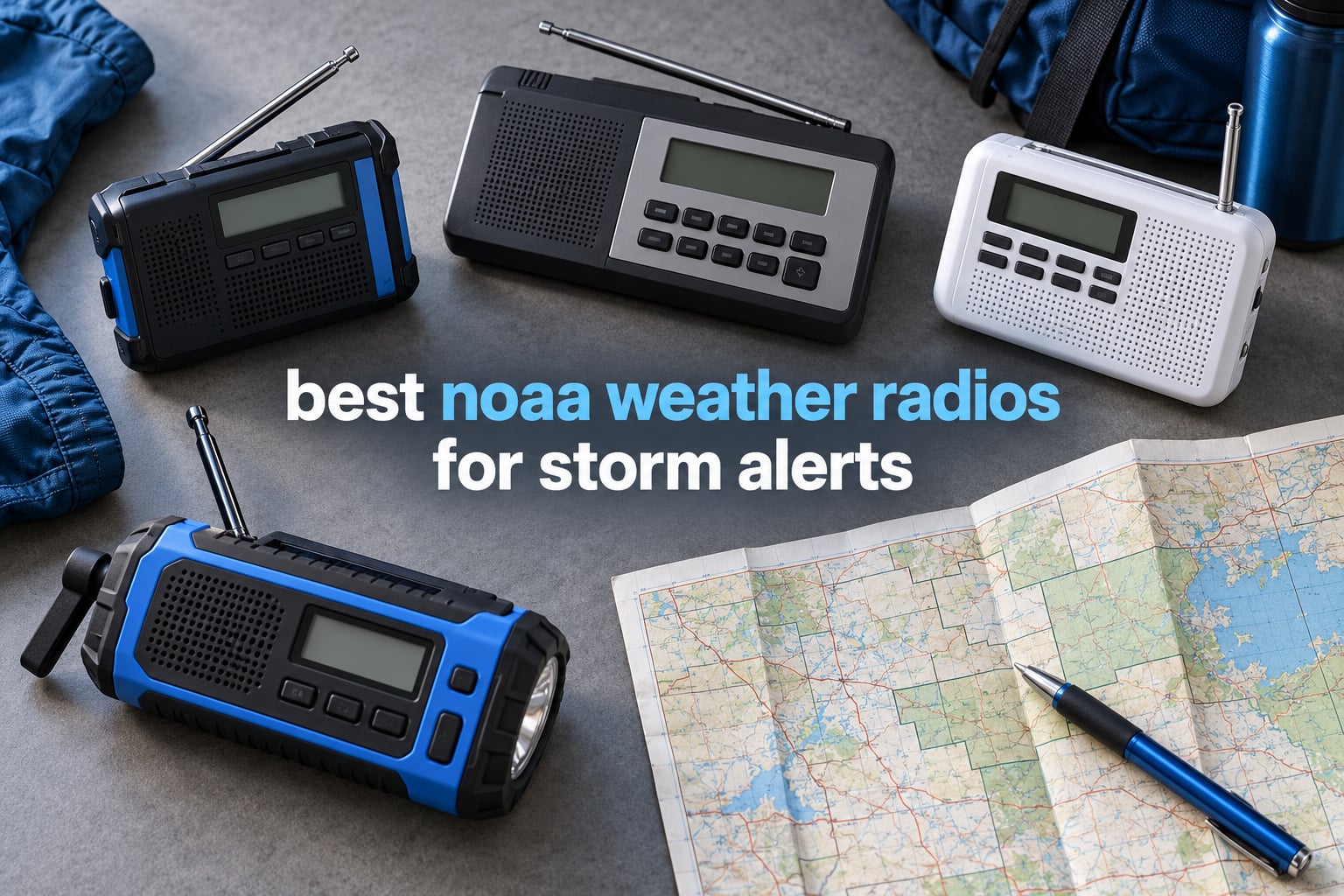
The best NOAA weather radios for storm alerts are the only storm warning devices that keep working when your phone does not. Cell towers go down, batteries die, and push notifications stop arriving exactly when a tornado is closing on your county. A NOAA weather radio receives government broadcasts directly from a National Weather Service transmitter, so it sounds the alert regardless of what the grid, the carrier or your app is doing.
We spent 2026 season comparing ten of the most popular models in this category, from desktop models with county-level alert filtering to hand-crank portables built for a go-bag. Along the way we paid close attention to the detail that decides whether a radio is usable or ignored: S.A.M.E. programming, the six-digit county code that tells the radio to sound off for your area and stay quiet for everyone else. Only two of the ten radios here can do that filtering.
This guide is written for households in tornado, hurricane and flash-flood country, plus the RV, boat, cabin and farm users who need the same warnings without a cell signal. If you are still working out what a NOAA radio actually is, start below. If you already know and want the short answer, the top three picks below are where to start. For a wider look at home alerting gear, our emergency weather radio guide for the home covers the accessories that pair well with these units.
Table of Contents
Top 3 NOAA Weather Radios for Storm Alerts Right Now
Three models stand out for 2026. The FosPower A1 leads on power redundancy and review volume, the Midland WR120B is one of only two radios here that filters alerts down to your county, and the RunningSnail MD-088s is the most compact entry point for a first-time buyer.

FosPower Solar Hand Crank NOAA Radio
- Hand crank
- solar and AAA power
- 7400mWh power bank
- AM/FM plus NOAA
- Warranty is limited lifetime

Midland WR120B NOAA Alert Radio
- S.A.M.E. county programming
- Up to 25 counties
- 60 plus hazard types
- AC power with AAA backup

RunningSnail Hand Crank NOAA Radio
- Three power sources
- 2000mAh phone charger
- Retractable antenna
- Lightweight pocket size
Quick Overview: Every NOAA Radio We Tested in 2026
All ten radios below receive the National Weather Service broadcast band. The table shows what each one does about power, alerting and portability, so you can narrow the field before reading the full reviews.
| Product | Specifications | Action |
|---|---|---|
| FosPower Solar Hand Crank NOAA Radio |
|
Check Latest Price |
| RunningSnail Hand Crank NOAA Radio |
|
Check Latest Price |
| Midland WR120B NOAA Alert Radio |
|
Check Latest Price |
 Raynic 5000mAh Solar Crank Radio Raynic 5000mAh Solar Crank Radio |
|
Check Latest Price |
 Kaito KA500 5-Way Solar Radio Kaito KA500 5-Way Solar Radio |
|
Check Latest Price |
 Eoxsmile 12000mAh NOAA Radio Eoxsmile 12000mAh NOAA Radio |
|
Check Latest Price |
 Leaton 10000mAh NOAA Radio Leaton 10000mAh NOAA Radio |
|
Check Latest Price |
 Midland WR400 Deluxe NOAA Radio Midland WR400 Deluxe NOAA Radio |
|
Check Latest Price |
 Uniden BC365CRS 500 Channel Scanner Uniden BC365CRS 500 Channel Scanner |
|
Check Latest Price |
 C.Crane CC Pocket NOAA Radio C.Crane CC Pocket NOAA Radio |
|
Check Latest Price |
1. FosPower Solar Hand Crank NOAA Radio – Best All-Round Portable
FosPower NOAA Emergency Weather Radio A1 7400mWh Solar Hand Crank (Orange)
7400mWh power bank
Hand crank, solar and AAA power
2 watt speaker
NOAA plus AM/FM
Pros
- Three power sources including hand crank and solar panel
- 7400mWh power bank charges a phone during an outage
- Two light sources including a 4-LED reading light
- Compact and water resistant
- Limited lifetime warranty
Cons
- Analog tuner with no frequency display
- No S.A.M.E. county programming so alerts cover neighbouring counties
The FosPower A1 is the radio I hand to friends who want one device that covers the whole list. It takes a hand crank, a solar panel and four AAA batteries, which means the power question stops being a question. Roughly 75% of its reviews are five-star, and with more than 37k reviews behind it, the reported complaints cluster on one limitation rather than a pattern of failures.
Model FOSPWB-2376 measures 6.2 by 2.1 by 2.9 inches and weighs 310 g, so it fits a kitchen counter, a desk drawer or a pack without thinking about it. The 2 watt speaker is genuinely loud enough to wake someone in a sleeping room, which is the entire point of owning one.
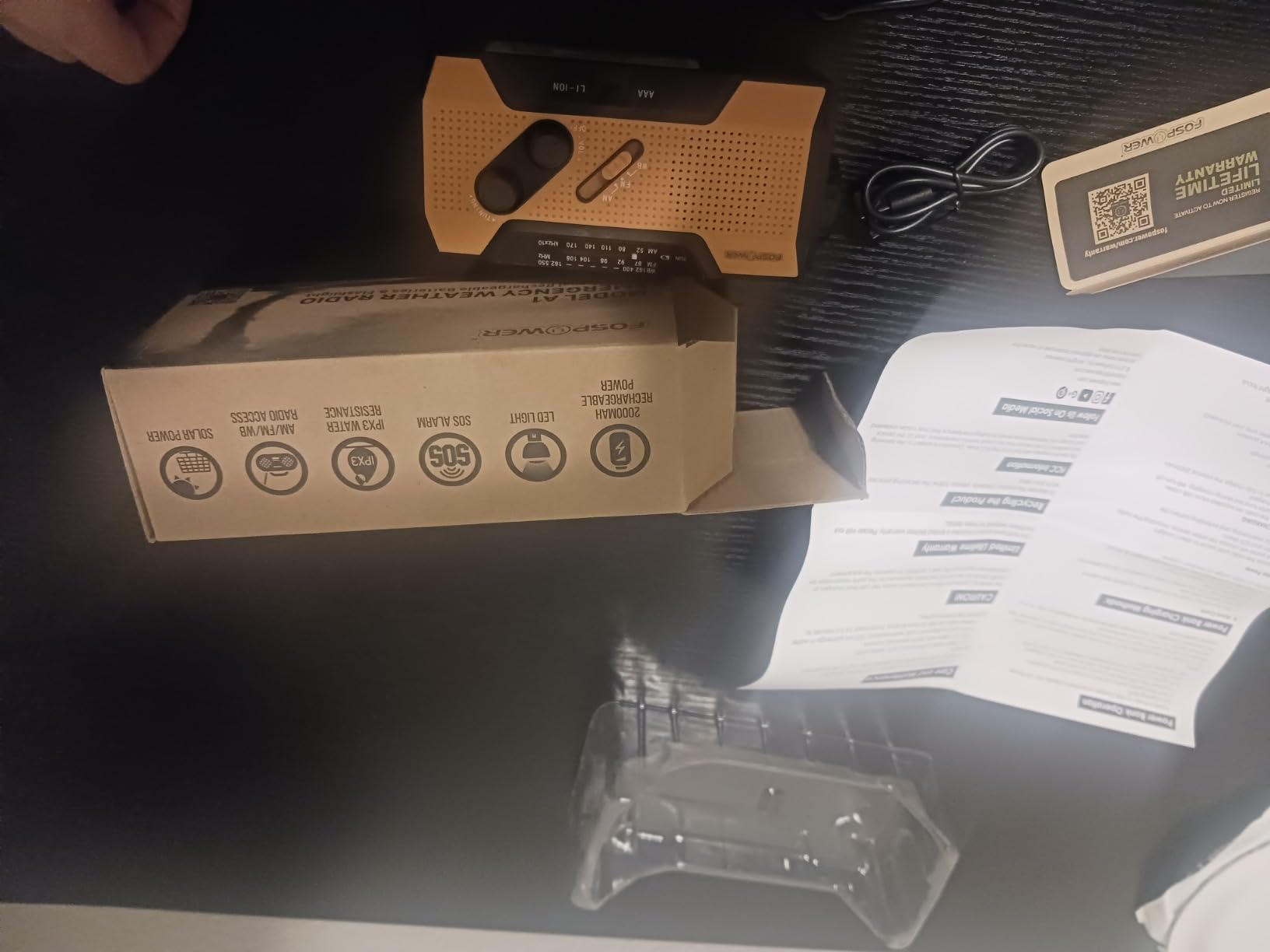
The 7400mAh battery doubles as a power bank, and the USB C port charges a phone when the grid is down. That single feature changes the economics of a weekend outage more than any other spec on this list. The 4-LED reading light and 1W flashlight cover the two most common household needs after the siren: seeing and being seen.
The catch is filtering. There is no S.A.M.E. decoding here, so when a neighbouring county issues a warning your radio sounds off too. On the first alert night that is fine. By the fourth week it is the reason owners start ignoring the siren, which defeats the purpose entirely.
Who the FosPower A1 suits best
It suits anyone who wants a single box that covers power, light and phone charging with no subscription and no wiring. Put it in the hallway, charge a phone through it during an outage, and the alarm volume carries to a bedroom down the hall.
It also suits RV and boat users who need one waterproof-ish unit rather than a desktop receiver and a separate battery pack. Water resistance and the compact footprint handle a wet glove compartment without special handling.
Where the FosPower A1 falls short
Buy it as a backup, not as your only warning system, if you live somewhere alerts are frequent. Without county filtering you will get warnings for areas you do not care about, and that is the fastest way to develop alert fatigue.
The analog tuner also means no visible frequency readout, so you cannot confirm at a glance which NOAA channel the radio locked onto. If you want to verify reception and identify the station by number, that matters.
2. RunningSnail Hand Crank NOAA Radio – Best Starter Kit
Hand Crank Radio with LED Flashlight,2000mAh NOAA AM FM Emergency Radio
2000mAh internal battery
Hand crank, solar and internal
3 watt speaker
Retractable antenna
Pros
- Affordable dedicated emergency radio
- Lightweight at 7.84 ounces
- Three power sources including hand crank and solar
- Charges a phone over USB during an outage
- Retractable antenna helps weak-signal reception
Cons
- No S.A.M.E. county programming
- 2000mAh battery gives limited phone-charging capacity
The RunningSnail MD-088s is the first emergency radio I recommend to a first-time buyer. It is the most affordable dedicated model in the group, and roughly 73% of its 23k reviews are five-star, which is a strong signal for a product this inexpensive.
At 5 by 1.8 by 2.4 inches and 7.84 ounces, it disappears into a drawer and weighs nothing in a go-bag. The three-watt speaker is rated higher than the FosPower’s two watts, which is the more useful number when the unit is across the house at night.
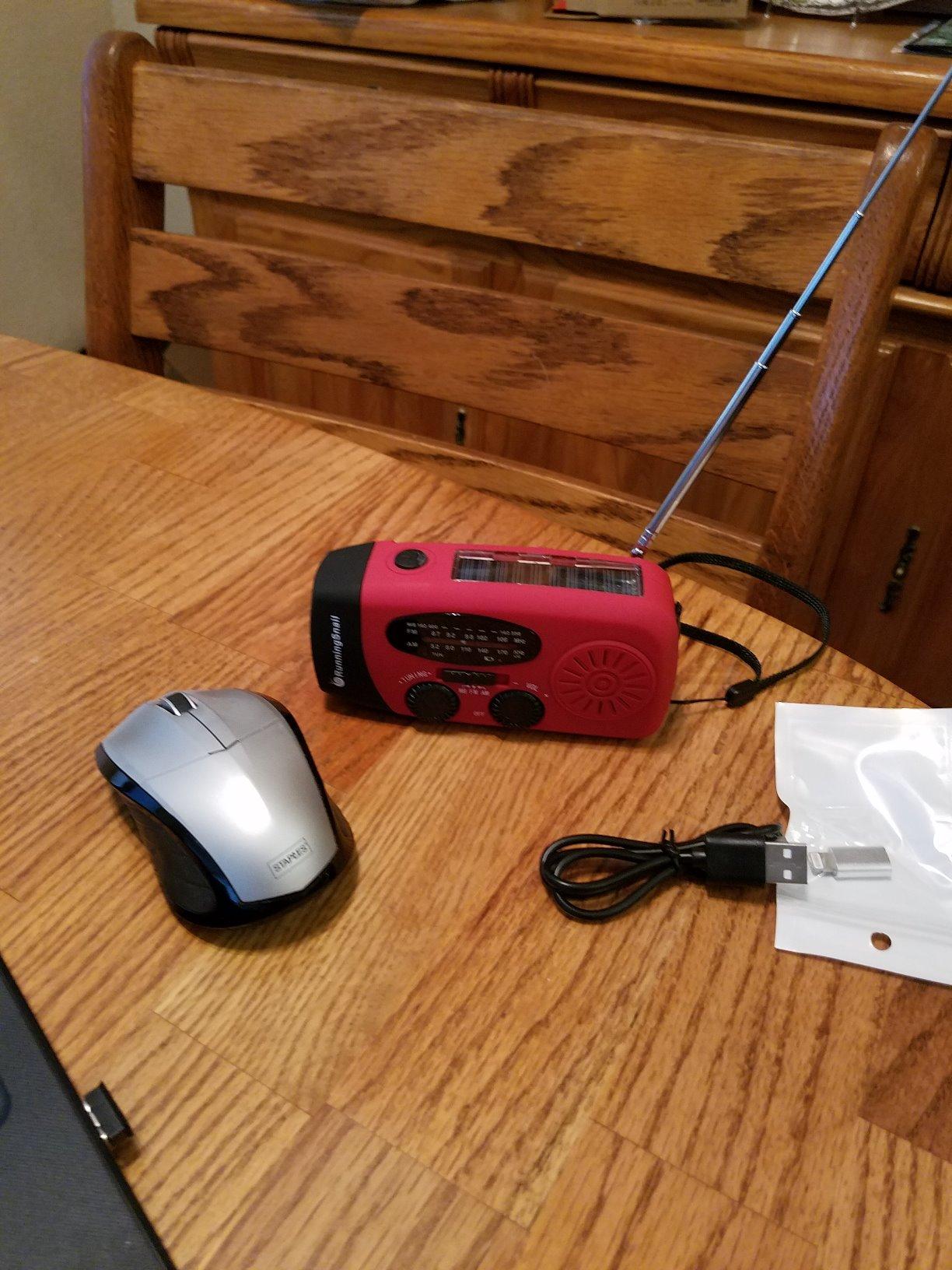
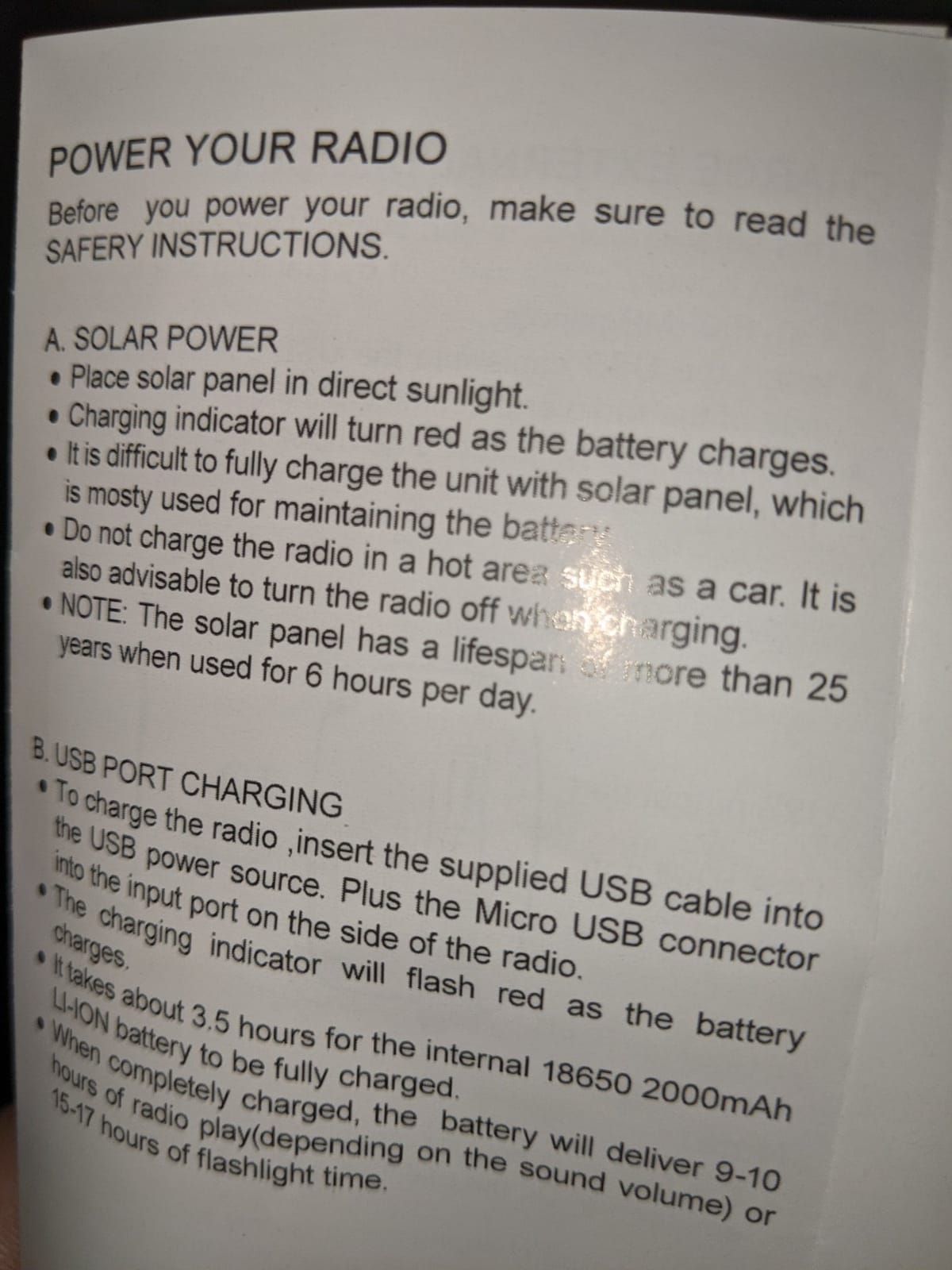
The retractable antenna is the quiet strength here. NOAA transmitters are line-of-sight, and extending the antenna measurably improves reception in a concrete home or a cabin with metal roofing. The 2000mAh internal battery also charges a phone over USB, though only a fraction of a full charge on most phones.
Water repellent rather than rated for immersion, so treat it as a rain-tolerant travel radio rather than something for a wet truck bed. The one-year manufacturer warranty is the shortest here, which is normal at this tier.
Who the RunningSnail MD-088s suits best
It suits a first-time buyer who wants to find out whether a weather radio earns a permanent spot on the nightstand before spending on a desktop model. It also suits campers, hikers and anyone packing a go-bag by weight.
For a car, a fishing boat or a weekend cabin, this is the honest choice. There is no programming to do, so it works the minute you open the box.
Where the RunningSnail MD-088s falls short
Like the FosPower, it cannot filter by county, so you will hear warnings from neighbouring areas. In a quiet rural county that is a minor annoyance. In a busy metropolitan warning area it becomes daily noise.
The 2000mAh battery is the limit on its phone-charging role. It will bring a phone back to life for messages and one call, not for a full day of navigation. Plan it as a top-up, not a replacement.
3. Midland WR120B – Best NOAA Radio for County-Only Alerts
Midland – WR120B – NOAA Emergency Weather Alert Radio
S.A.M.E. for up to 25 counties
60 plus hazard types
AC power with 6 AAA backup
Backlit LCD
Pros
- S.A.M.E. county programming removes irrelevant alerts
- Loud enough to wake sleepers
- Automatic weekly self-test confirms reception
- Runs on AC power with AAA battery backup
- Clear LCD readable in low light
Cons
- S.A.M.E. codes do not work outside the US and Canada
- Cord and plug feel inexpensive
- Batteries deplete quickly when running unplugged
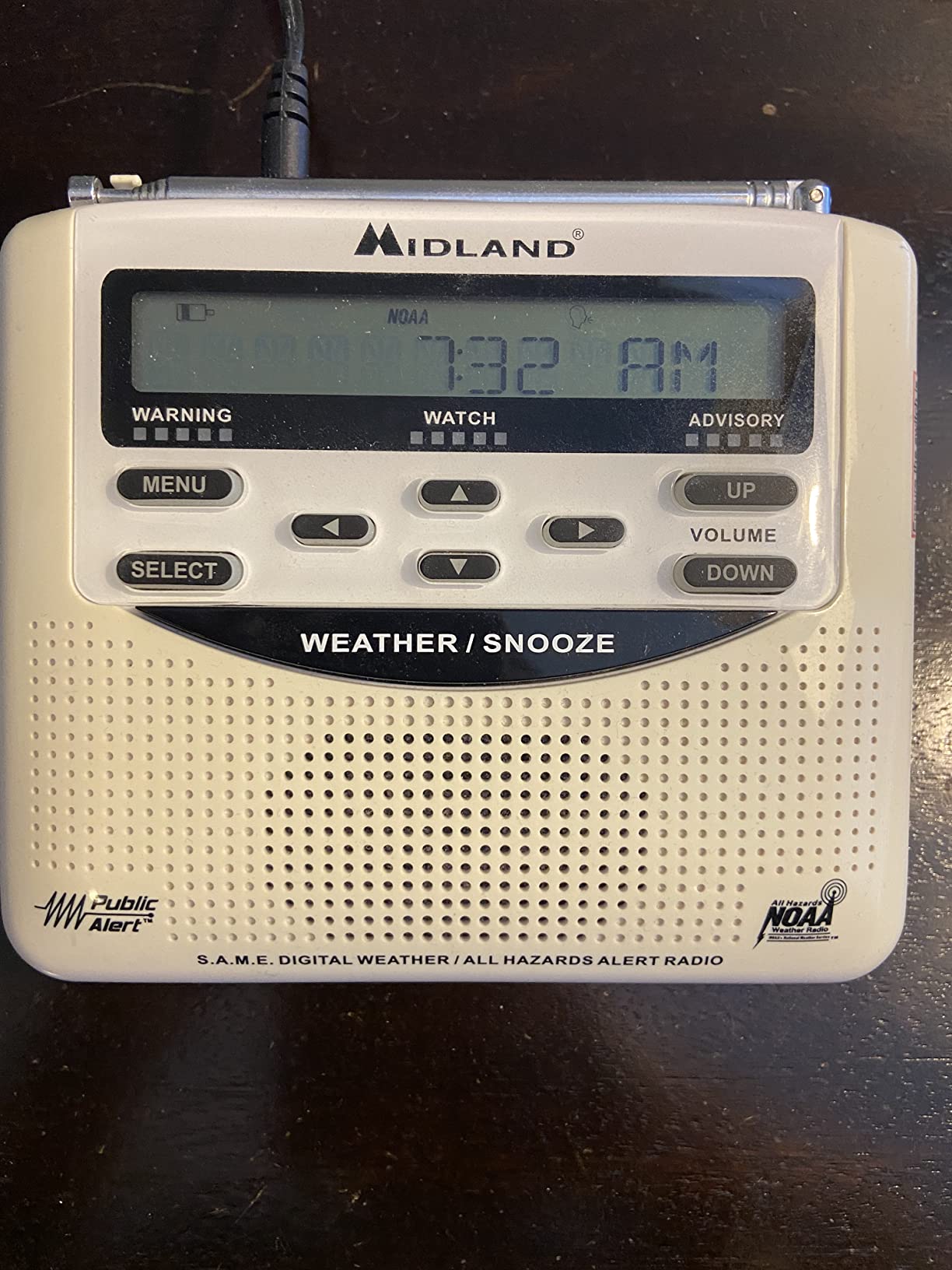
The Midland WR120B is the answer for anyone whose real problem is alert fatigue. It stores your county code and only wakes for your area, so you stop hearing warnings for counties 40 miles away. For about 76% five-star ratings across 24k reviews, it draws consistent owner praise.
It covers more than 60 hazard types with colour-coded indicators and a severity display, and it holds up to 25 programmable counties. That 25-slot capacity covers a home, a cabin and a second county for family in another part of the state.
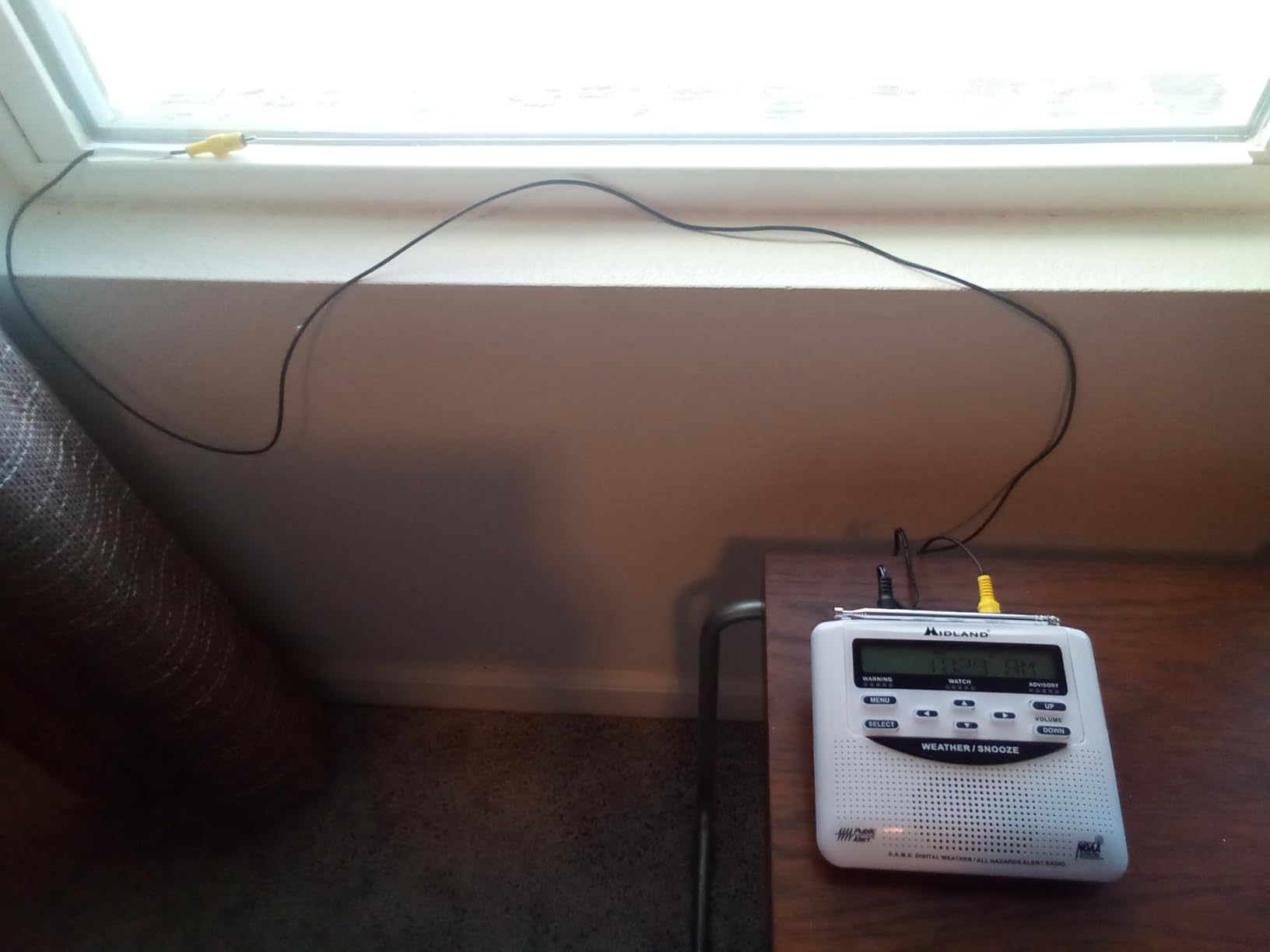
The weekly self-test is a genuinely useful feature and most owners miss it. The National Weather Service broadcasts a test alert on a schedule, and this radio confirms receipt out loud, which turns a hidden failure into something you can hear about before the storm season. The continuous backlighting keeps the display readable in a dark bedroom.
Owners report reception that held up inside a steel tornado shelter, which is a meaningful data point for anyone who lives in a reinforced safe room. Backup power comes from six AAA cells, so a grid failure does not silence it.
Who the Midland WR120B suits best
It suits anyone who wants warnings for their household only, especially in counties that issue a lot of routine flood and wind advisories. Program one code and the siren means something again.
It also suits households that want a loud bedroom alarm with no phone nearby. For sound to carry through a sleeping house, a dedicated speaker like this beats a phone on silent more reliably.
Where the Midland WR120B falls short
It is a North American device. The S.A.M.E. codes and alert scheme do not function outside the US and Canada, so it is not a travel radio for other countries.
The six AAA cells drain quickly when the unit is unplugged, and the cord and plug feel inexpensive. Neither is a deal breaker, but both are fair warnings about the difference between this and a receiver built for permanent installation.
4. Raynic CR1009Pro – Best NOAA Radio for Lighting and SOS Signalling
Raynic Emergency Radio, 5000mAh/18500mWh Weather Radio, Solar Hand Crank Radio with AM/FM/SW/NOAA Alert, Cell Phone Charger, Headphone Jack, Flashlight and SOS Siren
5000mAh power bank
Auto-scans alerts in standby
3W flashlight plus 2.5W lamp
SOS siren with red flasher
Pros
- Automatic NOAA alert scanning while in standby
- 5000mAh battery doubles as a phone power bank
- Very bright flashlight and reading lamp
- Headphone jack allows quiet night listening
- Light enough for hiking or a go-bag
Cons
- Solar panel and hand crank maintain charge rather than recharge it
- Not waterproof despite outdoor marketing
- Short telescopic antenna limits reception
- No S.A.M.E. county programming
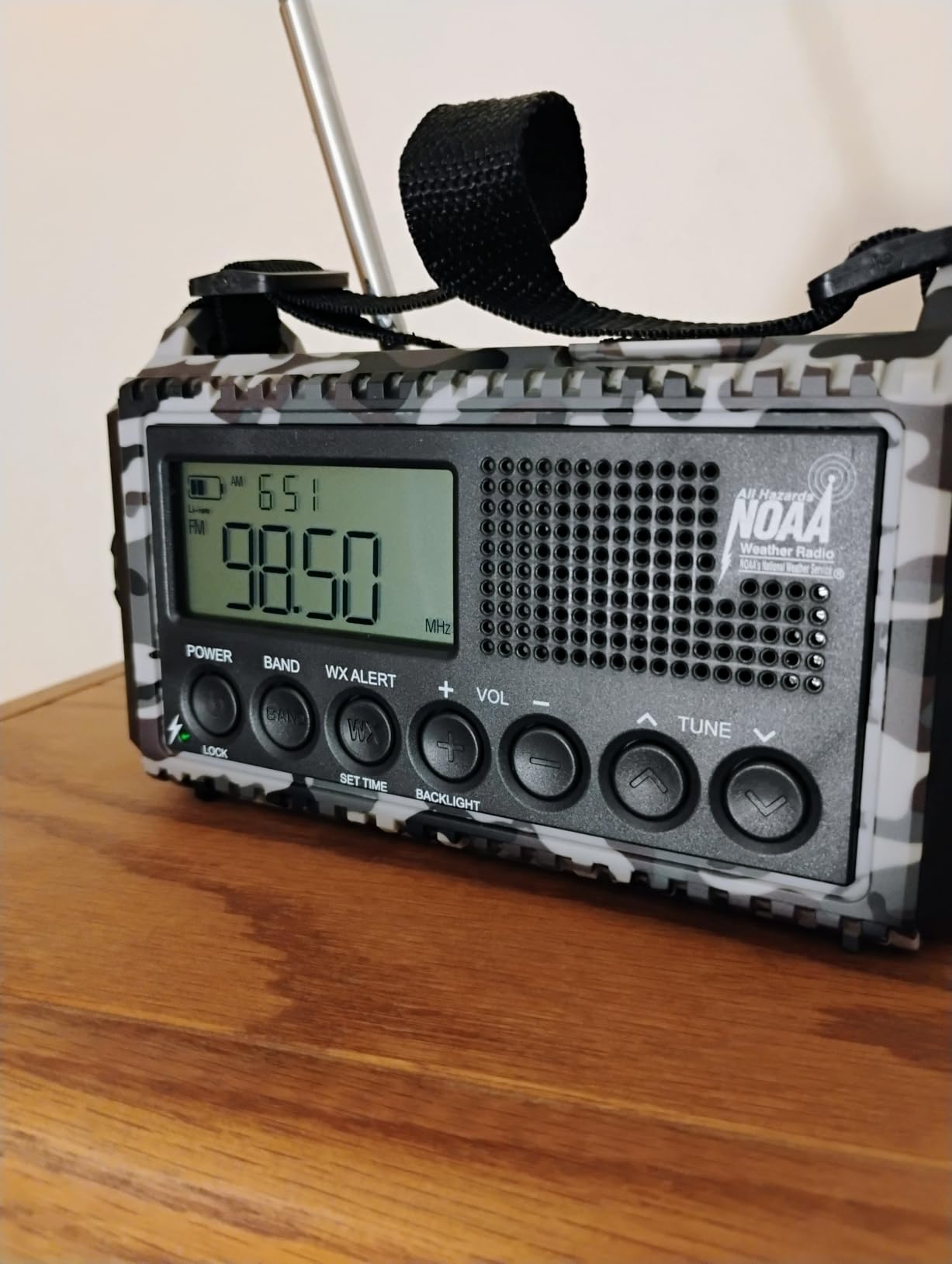
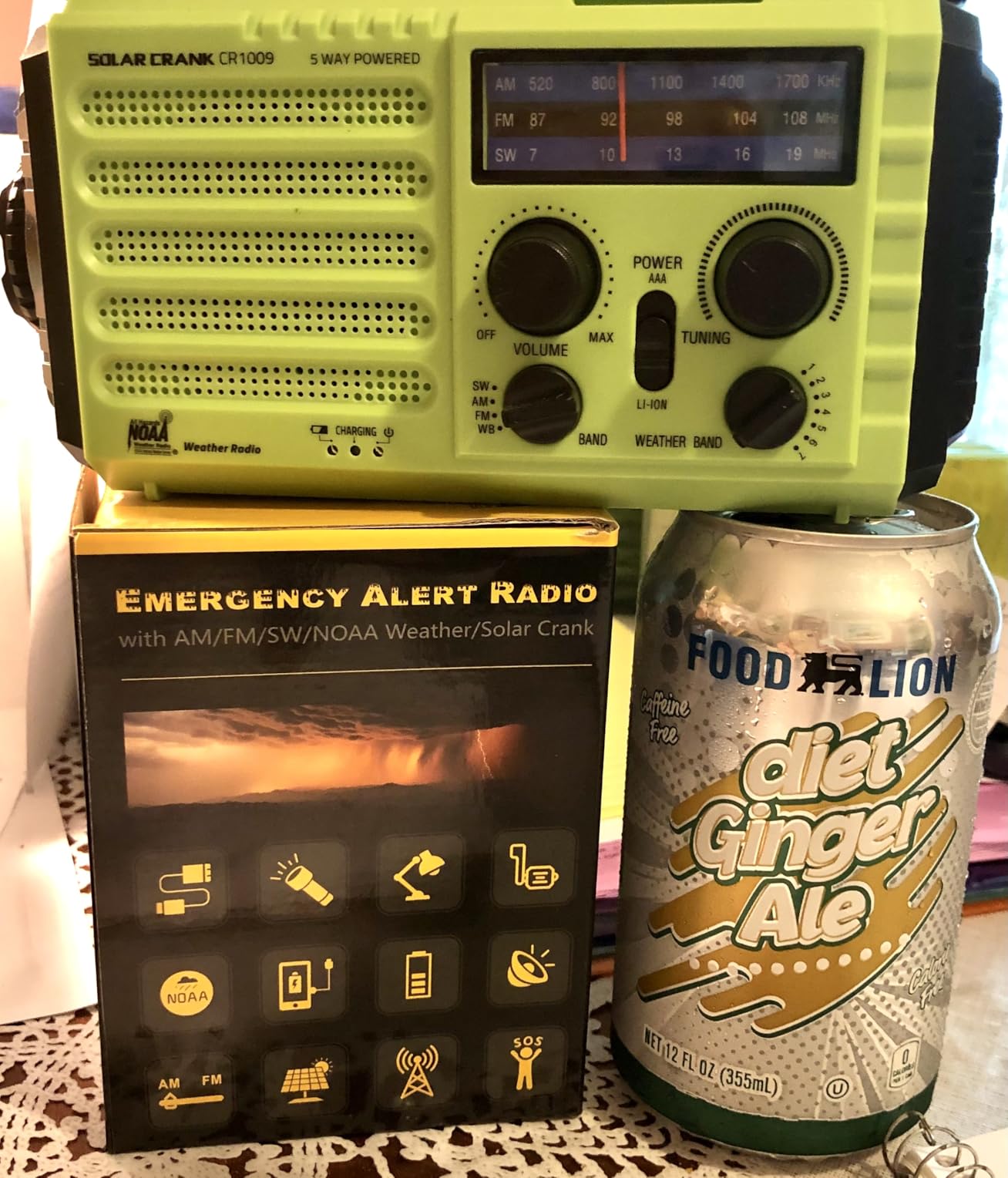
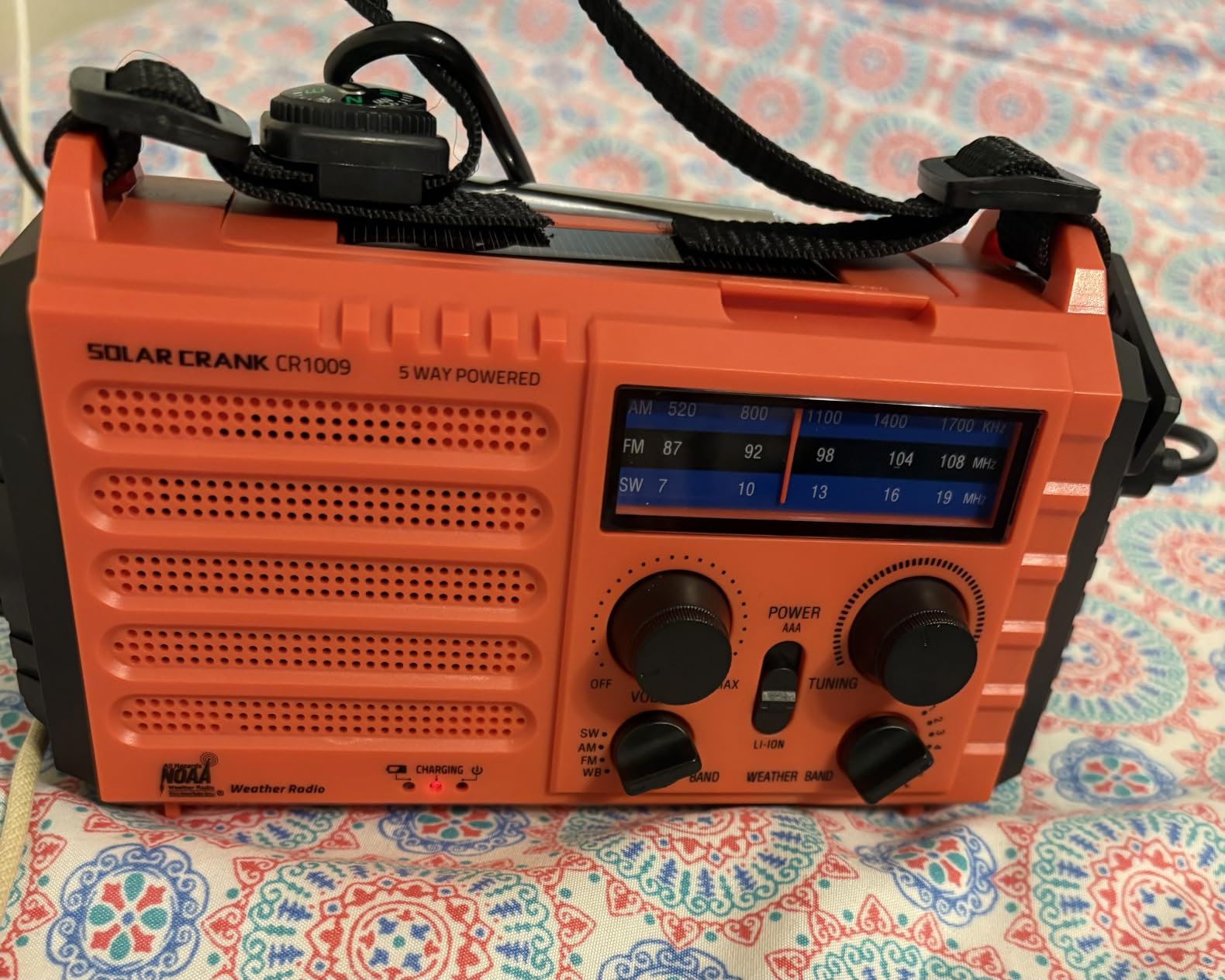
The Raynic CR1009Pro is the most rounded package among the portables that lack county filtering. It auto-scans for emergency and weather alerts on power-up and again in standby, so you are not required to sit on a NOAA channel manually. About 73% of its 20k reviews are five-star.
Its 5000mAh battery is twice the capacity of the FosPower, which matters if the outage lasts more than a day. The large HD LCD shows the tuned frequency digitally and includes a dimmer and power-save mode for overnight use.
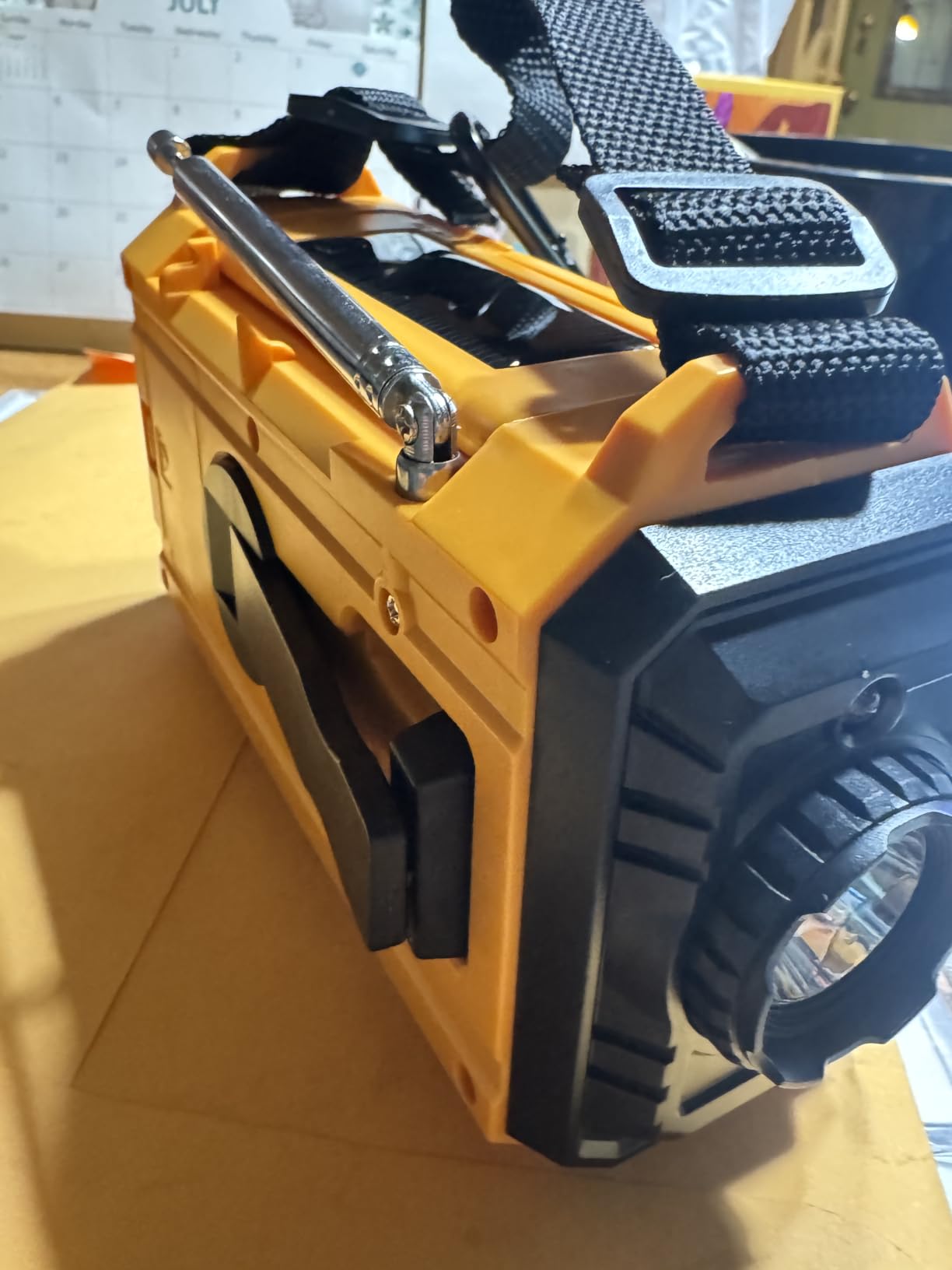
The lighting is the standout. A 3 watt super-bright flashlight plus a 2.5 watt reading lamp covers a room, not just a book page, and the SOS button triggers a loud alarm with a flashing red light. That red flasher is a partial answer for deaf and hard of hearing users, though a purpose-built strobe accessory does the job better.
A 3.5mm headphone jack adds something most competitors skip. Plugging in earbuds lets a light sleeper monitor the radio without the siren, which is a sensible night-time arrangement.
Who the Raynic CR1009Pro suits best
It suits households that want one device to cover alerts, lighting, phone charging and a beacon. The compass and carabiner also make it a reasonable hiking and camping companion.
It also suits anyone who cannot hear a siren reliably, because the red SOS flasher gives a visual signal alongside the audio. Pair it with our digital radios for seniors guide if the household includes a hard of hearing adult.
Where the Raynic CR1009Pro falls short
Do not rely on the solar panel or hand crank to recharge the battery. Owners report they maintain charge rather than meaningfully top it up. Treat the 5000mAh cell and the USB C port as the real power sources.
The short telescopic antenna limits reception compared with the Kaito’s 14.5 inch whip, and the listing implies more water resistance than the unit delivers. There is also no S.A.M.E. filtering, so expect neighbouring county alerts.
5. Kaito KA500 – Best NOAA Radio for Shortwave and Long-Reach Reception
Kaito KA500 5-way Powered Solar Power,Dynamo Crank, Wind Up Emergency AM/FM/SW/NOAA Weather Alert Radio with Flashlight,Reading Lamp and Cellphone Charger, Yellow
Five power sources
AM, FM, shortwave plus 7 NOAA
14.5 inch telescopic antenna
Replaceable NiMH pack
Pros
- Two-band shortwave coverage beyond other budget radios
- 14.5 inch telescopic antenna with signal indicator
- Replaceable NiMH battery pack extends service life
- Loud speaker with tuning signal-strength display
- Water-resistant impact-resistant ABS housing
Cons
- NOAA alerts limited to the USA and Canada
- Bulkier body than compact crank radios
- Analog dial tuning with no display
The Kaito KA500 wins the reception argument on antenna design. Its 14.5 inch telescopic whip is far longer than the stub antennas fitted to the other portables, and it comes with an LED signal-strength indicator so you can tune by eye until the bars come up. BushcraftUSA members name Kaito alongside Midland as a trusted name in this category.
Five power sources cover a hand crank, solar panel, a three-AA compartment, a 5V USB input and an AC/DC input. The replaceable NiMH battery pack is the detail that matters most here, because it means the unit is repairable rather than disposable.
Two-band shortwave is an extra capability few models in this group offer. For a household that wants one device for NOAA, AM/FM and general news during a wide-area disaster, that is a real advantage rather than a novelty.
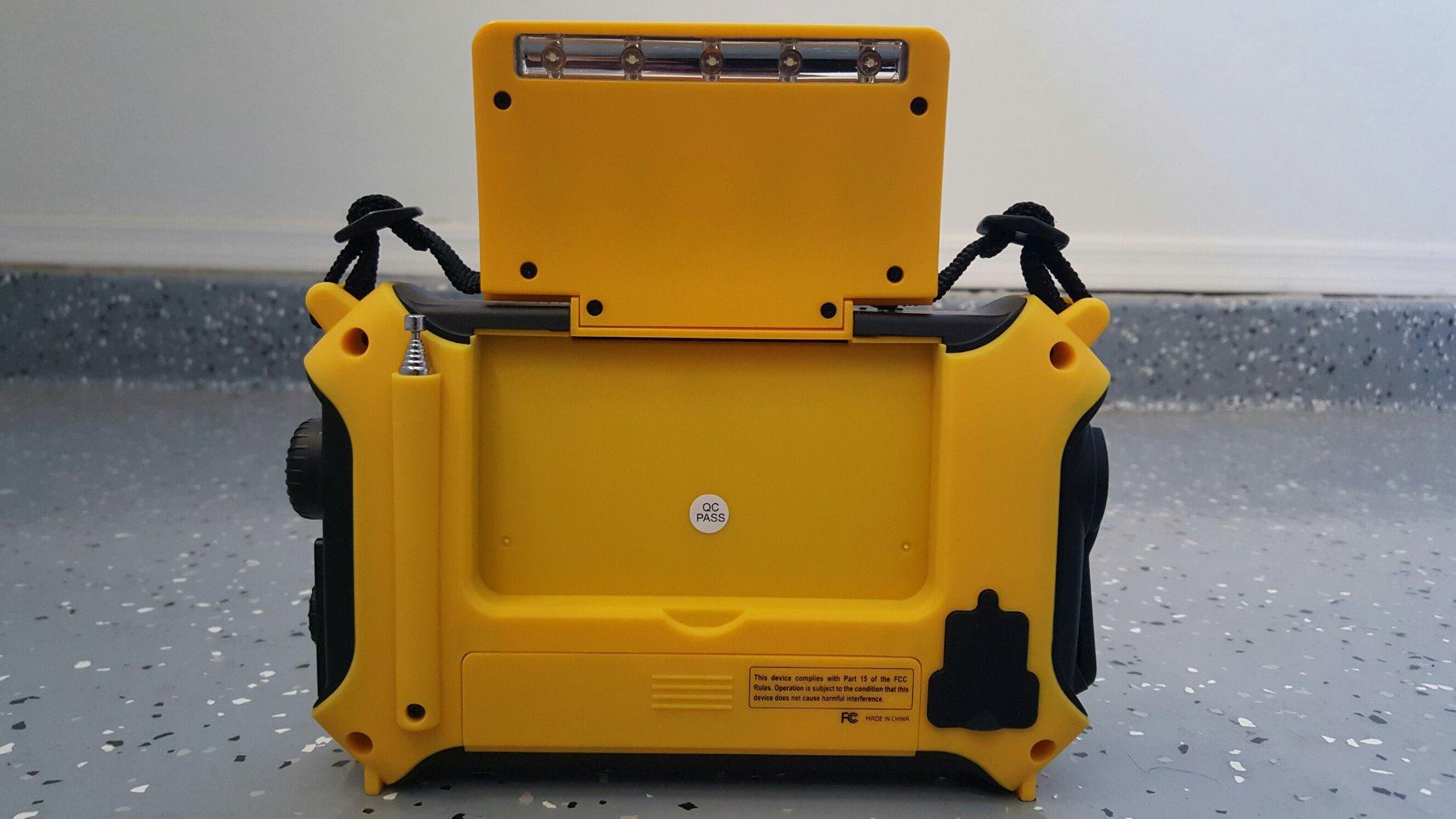
Lighting covers the bases with a 5-LED reading lamp, a flashlight and a red SOS beacon. USB output charges mobile devices, and the impact-resistant ABS housing has survived drops in owner reports. About 74% of 13k reviews are five-star.
Who the Kaito KA500 suits best
It suits people in low-signal country: rural homes, cabins, valleys, boats and RV parks where the nearest NOAA transmitter is far away. Long antenna equals better odds of decoding a weak digital alert header.
It also suits anyone who wants NOAA plus shortwave news in one unit, and anyone who prefers a replaceable battery over a sealed internal cell.
Where the Kaito KA500 falls short
At 8.3 by 2.3 by 5.3 inches it is the largest portable here, and it does not fit a jacket pocket. If you want a radio that lives in a go-bag rather than on a shelf, the size is a compromise.
NOAA alerts and the PEAS alert system are limited to the USA and Canada. Tuning is by analog dial with no frequency display, so there is no way to confirm at a glance which NOAA channel you are on.
6. Eoxsmile CR1009ultra – Best NOAA Radio for Battery Capacity
Eoxsmile NOAA Emergency Weather Radio Hand Crank Solar 12000mAh Battery
12000mAh battery
50 plus hours of FM playback
Smart standby auto-scan
Siren plus red strobe
Pros
- Largest internal battery in the group at 12000mAh
- Smart standby re-scans NOAA stations on a timer without draining the cell
- Digital display shows battery
- time
- frequency and alert status
- Long-throw 3W flashlight plus 2W reading lamp
- Runs from an AC adapter while still monitoring alerts
Cons
- Alerts do not interrupt AM or FM listening
- Built-in lithium battery is not user replaceable
- AAA backup cells drain while the lithium cell is in use
- Weak AM reception with no automatic gain control
The Eoxsmile CR1009ultra carries a 12000mAh battery, roughly 44400mWh, and that is the largest cell in this group by a wide margin. Owners quote 50 plus hours of FM playback on a charge, which covers an extended outage without a wall outlet.
The smart standby mode re-scans all seven NOAA channels after a timer rather than sitting on one frequency. That keeps monitoring active while letting the radio idle between scans, which is the behaviour you want from a device that has to stay alert for three days.
Six power sources include a hand crank, solar panel, Type-C cord, AC adapter, the internal cell and three AAA backups. A loud siren with a red strobe fires on a weather alert, and the 3 watt flashlight reaches about 70 metres with a 2 watt lamp covering roughly 20 square metres.
The digital LCD is unusually informative, showing battery level, time, tuned frequency and alert status on one screen. A 16-level volume control and a child lock round out a feature set that is unusual at this end of the market. Roughly 74% of 12k reviews are five-star.
Who the Eoxsmile CR1009ultra suits best
It suits households preparing for multi-day outages, and anyone who treats their phone battery as the scarce resource during a storm. The capacity is enough to charge a phone properly, not just wake it up.
It also suits anyone who wants a visual alert alongside audio. The red strobe on activation gives deaf and hard of hearing users a signal the ear cannot catch.
Where the Eoxsmile CR1009ultra falls short
Alerts only sound in standby or when the Alert function is enabled. They do not interrupt AM or FM playback, so do not assume a loud siren if the radio is tuned to a music station.
The internal lithium battery is not user replaceable, AAA backup cells drain while the lithium cell is in use, and the listing’s waterproof claim is not borne out by owners. Device charging is slow at 1A, and a full USB-C recharge takes roughly 16 hours.
7. Leaton xsy-330 – Best NOAA Radio for Outdoor Spray and Rain
Leaton Hand Crank Emergency Radio, NOAA Weather Radio AM/FM,10000mAh
10000mAh battery
IPX6 splash resistance
3 mode flashlight
Manually tuned NOAA
Pros
- 10000mAh battery offers genuine phone-charging capacity
- IPX6 resistance handles spray and splashing
- Large controls that are easy to operate in the dark
- 3 mode flashlight with SOS signalling plus reading lamp
- Solar
- hand crank and USB-C charging options
Cons
- No S.A.M.E. and no automatic alerts so NOAA must be tuned by hand
- No headphone jack
- No shortwave band
- Cannot charge more than one device at a time
The Leaton xsy-330 is the only model here with a stated IPX6 water resistance rating, which is what makes it workable for a porch, a boat deck, a farm building or a job site. About 76% of its 5222 reviews are five-star, a solid rate on a smaller review base.
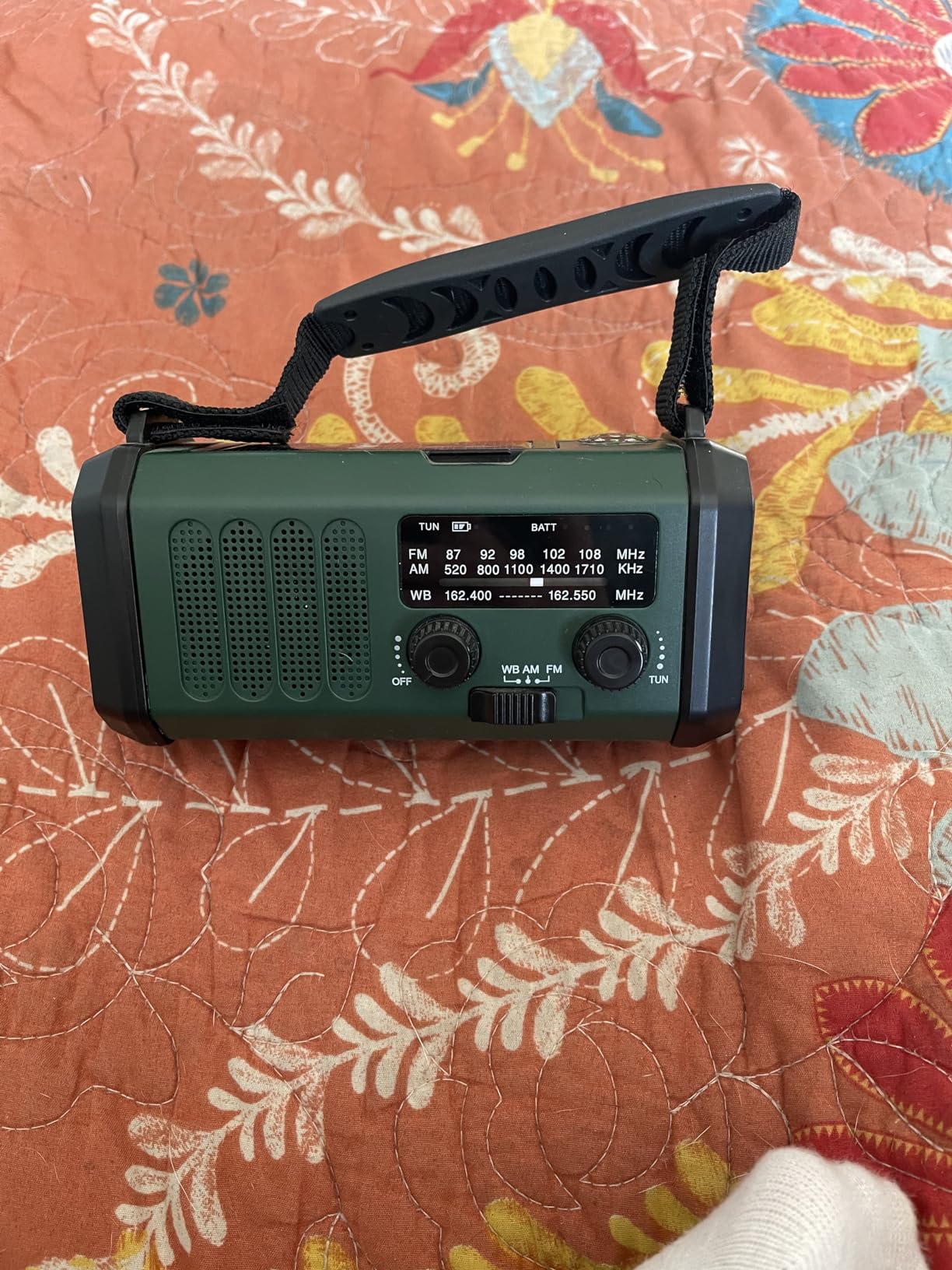
At 600 g and 6.3 by 3.5 by 3.1 inches, it is one of the heavier portables here, and that weight is the trade for the sealed shell and the large controls. The oversized buttons are genuinely easy to find and press in the dark, which helps older users.
The 10000mAh internal battery delivers 5V at 1A, enough for roughly one to one and a half full phone charges on a current handset. Owners also note that about a minute of cranking yields 15 to 20 minutes of listening, which is a usable emergency ratio.
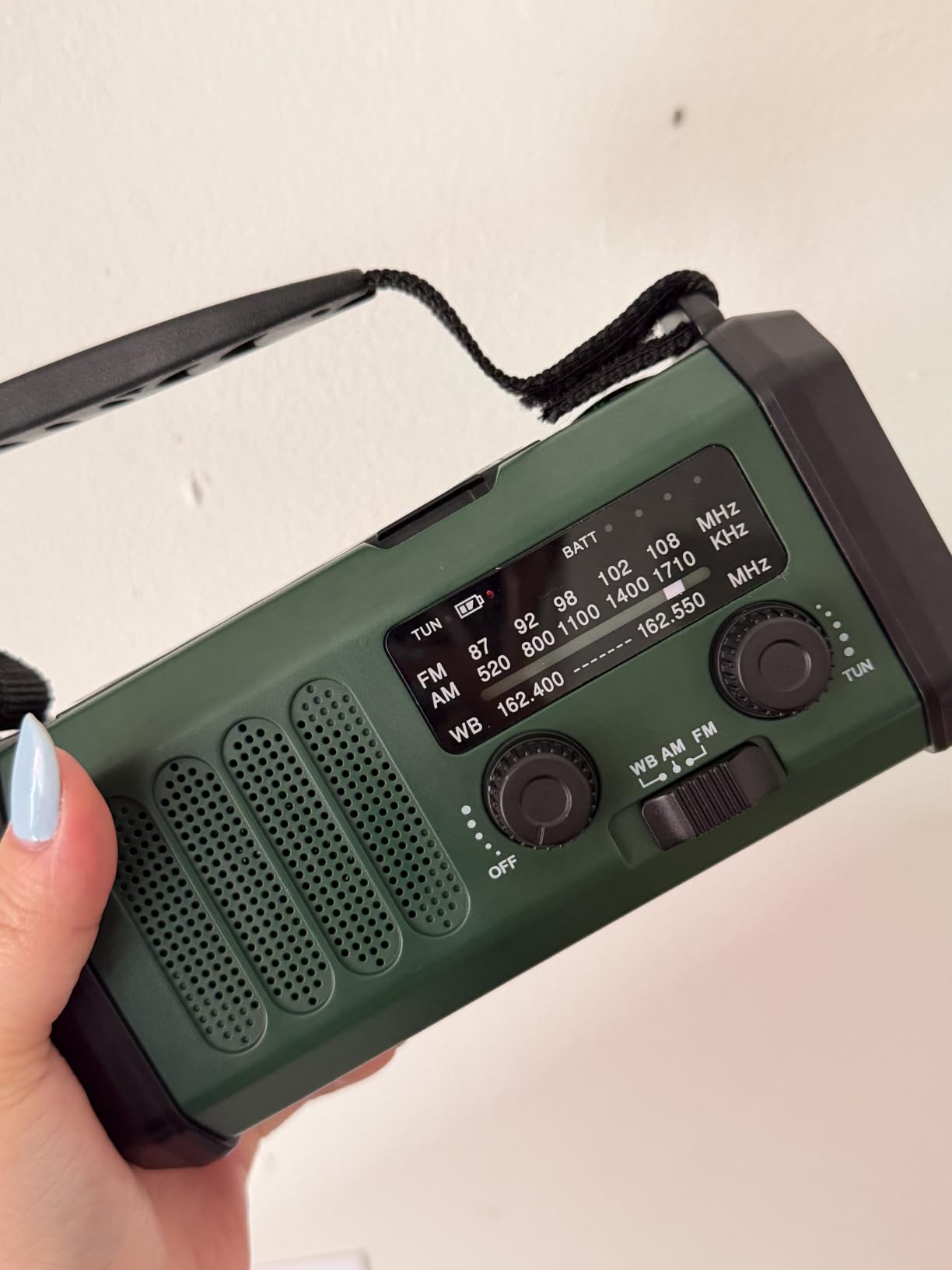
A built-in compass, a three-mode flashlight with high, low and SOS settings, and a 1.3 watt reading lamp complete a sensible outdoor kit. The NOAA band here runs 162.400 to 162.550 MHz alongside AM and FM.
Who the Leaton xsy-330 suits best
It suits anyone who needs a radio that survives rain, spray and dust: dockworkers, farm hands, construction crews, campers and boaters. The IPX6 rating is a real specification, not a marketing line.
It also suits households with older adults who struggle with small buttons. The controls here are the largest in the group by a clear margin.
Where the Leaton xsy-330 falls short
NOAA stations must be tuned manually because there is no S.A.M.E. and no automatic alert capability. If you tune to the wrong channel, a real warning will not wake you, and that is the most serious limitation in this roundup.
There is no headphone jack, no shortwave band, and only one device can charge at a time. The one-year warranty is standard but not generous.
8. Midland WR400 Deluxe – Best NOAA Radio for a Bedroom Alarm Clock Setup
Midland – WR400 Weather Radio Deluxe – NOAA Emergency Alert Scanner – Home Use with Battery Backup – Local County Programming Over 80 Emergency Voice Flashing Alerts – Alarm Clock AM/FM Radio
S.A.M.E. for up to 25 counties
85 dB siren with LED flasher
80 alert types including AMBER
AC power with 4 AA backup
Pros
- Automatically overrides AM or FM playback for hazards
- 80 alert types with per-county S.A.M.E. filtering
- Very loud 85 dB siren plus visible LED flasher
- Menu-driven county selection needs no code lookup
- Large display shows warning
- watch and advisory status
Cons
- Initial programming takes time and the printed instructions are confusing
- Expired alerts are erased and cannot be reviewed later
- Alert tone volume can be hard to raise
- USB charging output limited to 1A
- Not water resistant
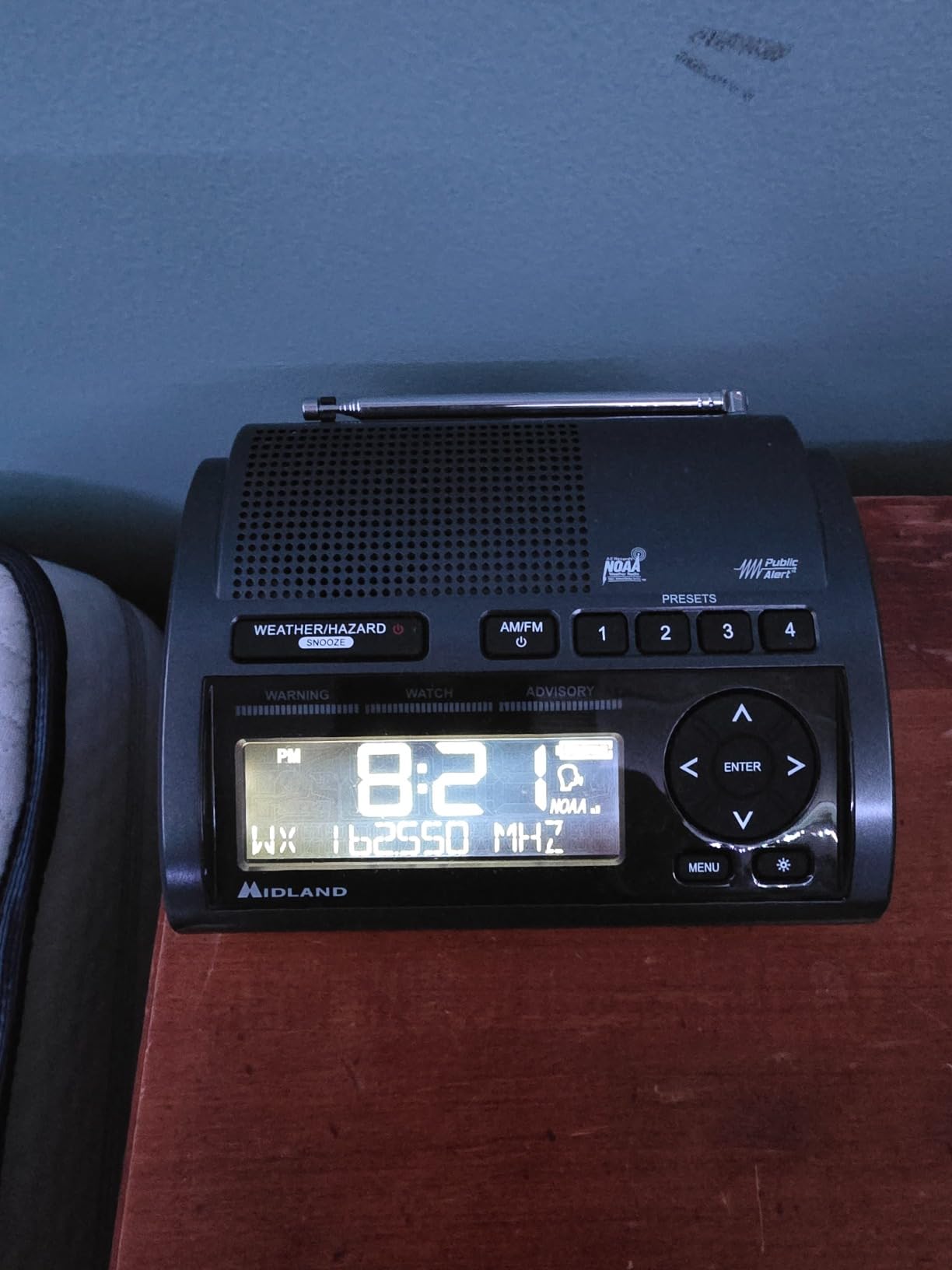
The Midland WR400 packs the most features into a desktop receiver here, and the right choice when the alarm clock and the weather radio are the same object. It carries an 85 dB siren, an LED flasher, and an alarm clock with snooze alongside the AM/FM radio. That combination is what makes it the bedroom unit.
It also raises the alert-type ceiling to 80 selectable types, including AMBER alerts, with digital S.A.M.E. programming for up to 25 counties. It scans for the strongest signal across 10 weather channels, which reduces the chance of sitting on a weak transmitter.
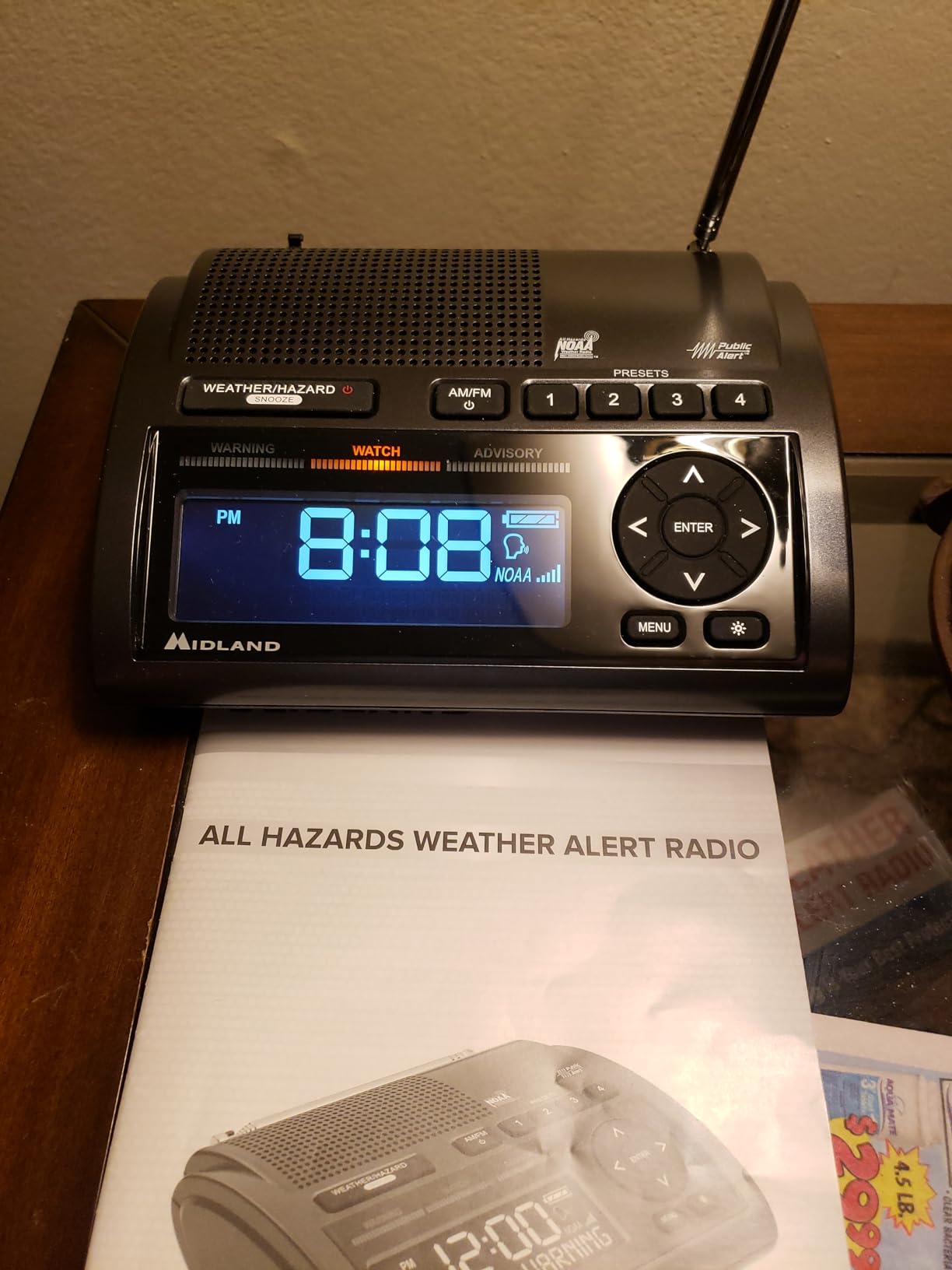
The automatic switch from AM or FM to all-hazard alerts is the feature I value most. If you are listening to a morning radio programme and a warning is issued for your county, the radio interrupts itself instead of waiting for you to change stations.
Menu-driven county selection means you pick your area from a list rather than hunting down a six-digit code, which removes the single biggest setup hurdle. USB output is present for charging a device, backed up by four AA cells. About 73% of 4634 reviews are five-star.
Who the Midland WR400 suits best
It suits households that want one bedside device handling wake-up calls, music, emergency alerts and amber alerts. The snooze function and backlit LCD make it a genuine alarm clock rather than a radio with a beeper.
It also suits anyone who travels between counties regularly, since 25 memory slots cover far more ground than most competitors offer.
Where the Midland WR400 falls short
Programming takes time and the printed instructions are confusing, so budget an unhurried evening with a phone nearby to look up your code. Owners report this as the most common source of frustration.
Expired alerts are erased rather than stored, so there is no alert history to review afterwards. The USB output is capped at 1A, which charges a phone slowly, and the unit is not water resistant.
9. Uniden BC365CRS – Best NOAA Radio for Multi-Band Scanning
Uniden BC365CRS 500 Channel Scanner and Alarm Clock, Snooze, FM Radio, Weather Alerts, Search Bands used for Aviation, Railroad, Marine, Non-Digital Police/Fire/Public Safety transmissions and more
500 channels in 10 banks
Weather, marine and aviation presets
Checks priority channels every 2 seconds
3 AA clock backup
Pros
- The only unit in the group that also monitors aviation
- marine and public safety bands
- Priority channels checked every two seconds
- Fm radio and alarm clock in one desktop unit
- Backlit display and tactile keypad for night use
- Generous 500 channel capacity across 10 banks
Cons
- Analog only so digital trunked police and fire systems are missed
- No channel names and no CTCSS or DCS squelch
- Built-in speaker is weak and thin
- Programming manual is unclear
- FM reception and scan-list tuning are limited
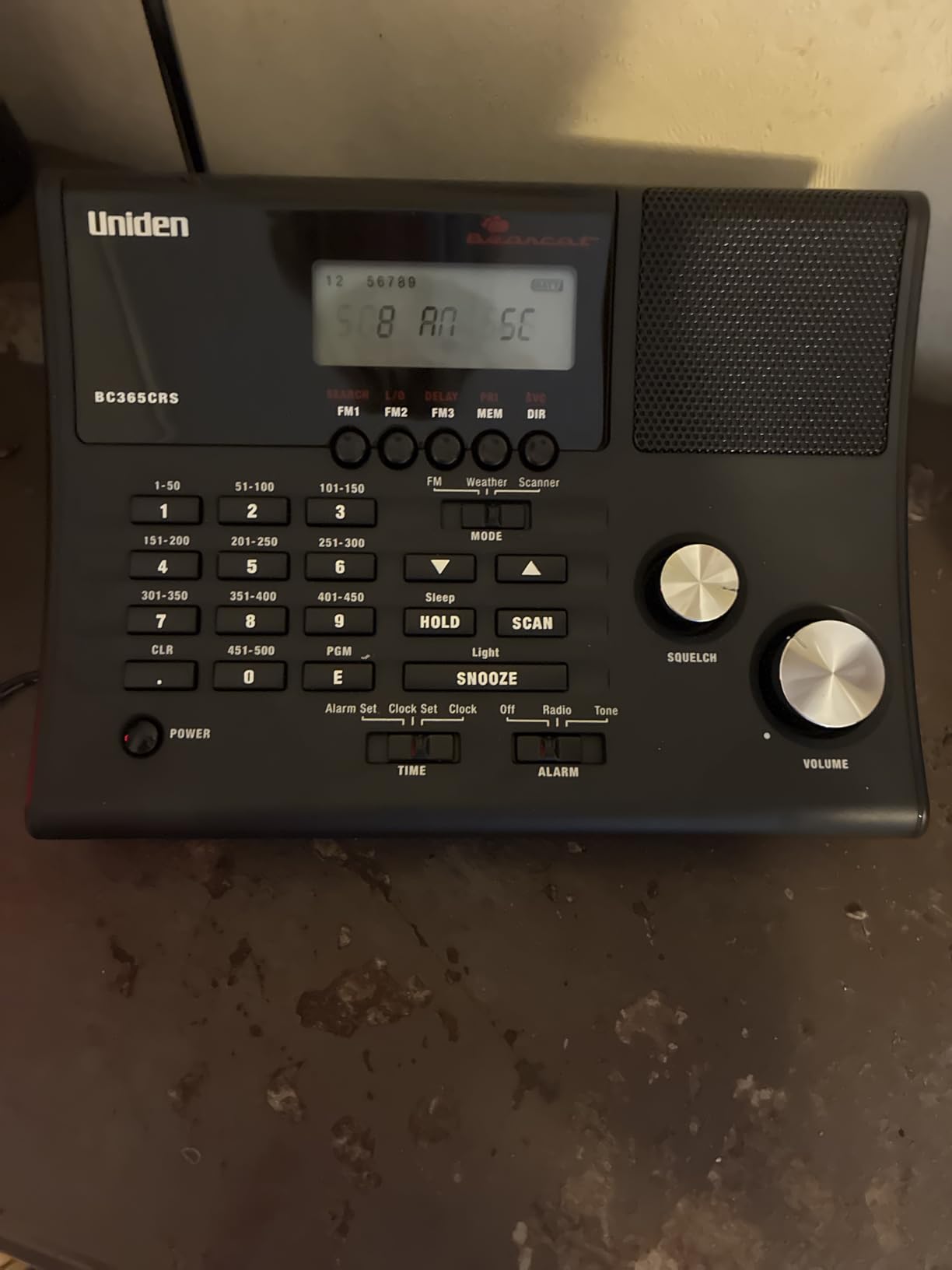
The Uniden BC365CRS is a scanner with weather alerts attached, not a weather radio with extras. It monitors 500 conventional analog channels in 10 banks, with pre-set search groups for police and fire, weather, marine, aircraft, amateur radio and railroad. For a reader who wants to follow an incident as it develops, that is the whole value proposition.
Priority with Do Not Disturb checks priority channels every two seconds, so a high-priority frequency is not delayed by a long scan cycle. Thirty FM presets, an alarm clock with snooze, a sleep timer and a backlit LCD round out the desktop functions.
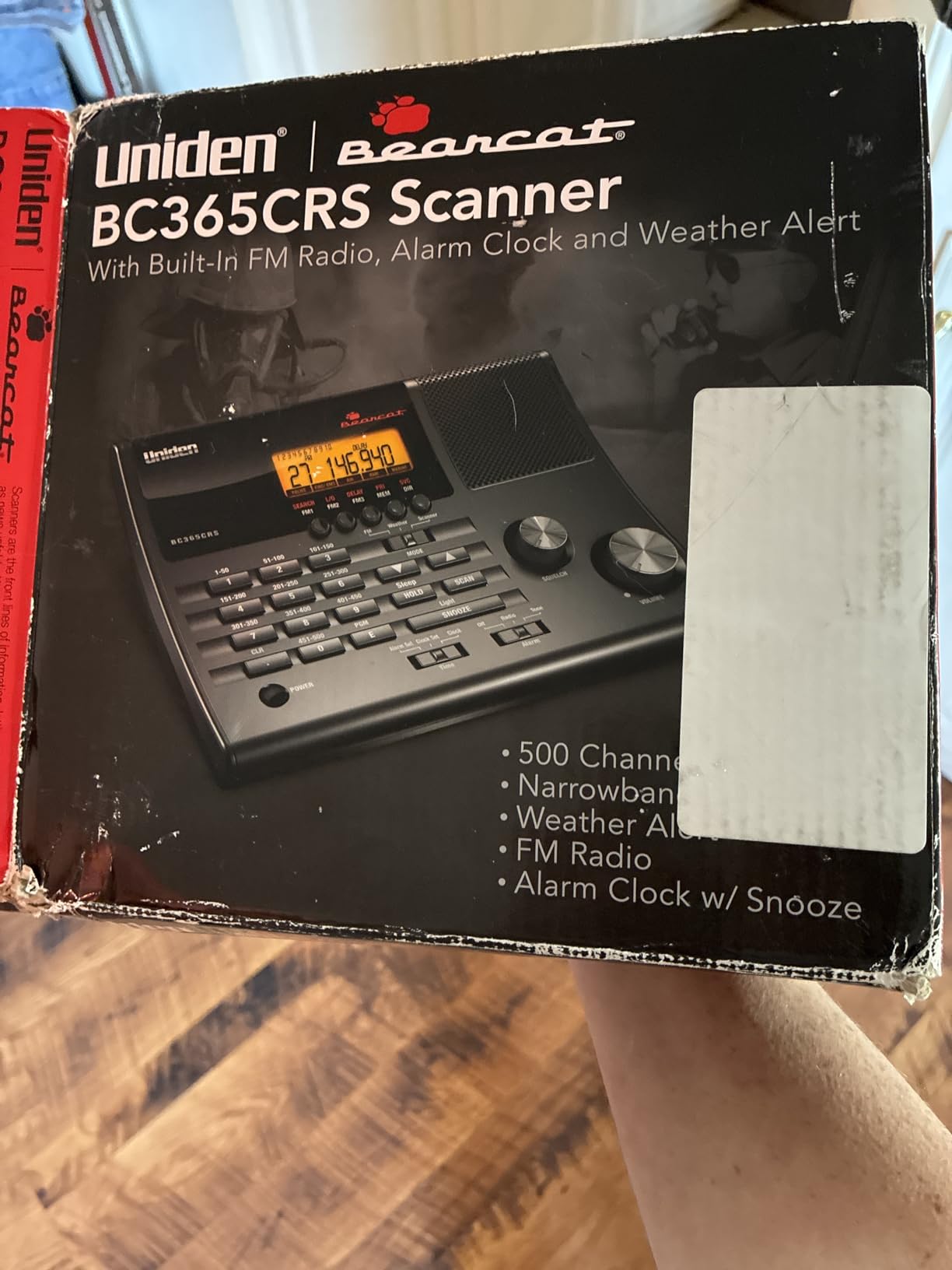
This is the lowest-rated pick at 4.2, with 66% five-star and 10% one-star ratings. The critical reviews concentrate in three places: it is analog only, it has no channel names or CTCSS and DCS squelch, and the built-in speaker sounds thin and quiet. Power is corded electric with three AA cells for the clock backup.
For weather alerts specifically, that thin speaker works against it. A storm radio that cannot be heard across a bedroom is the wrong tool, whatever else it does well.
Who the Uniden BC365CRS suits best
It suits listeners who want to monitor marine, aviation, railroad and public safety traffic alongside weather, especially boaters and people who live near an airport or rail corridor. Nothing else in this group covers those bands.
It also suits a monitoring hobby rather than a purely safety-focused need, where the 500-channel capacity and priority scanning are the point of the purchase.
Where the Uniden BC365CRS falls short
It is analog only, so it cannot receive digital trunked police and fire systems, which is how most urban departments now transmit. That is a hard limit, not a firmware limitation.
No channel names, no squelch control, a weak speaker and an unclear programming manual round out the drawbacks. If you want one device for storm warnings alone, a dedicated NOAA radio does this job better and sounds louder.
10. C.Crane CC Pocket – Best Pocket NOAA Radio for Reception Quality
C. Crane CC Pocket AM FM and NOAA Weather Radio with Clock and Sleep Timer
Pocket format at 4 ounces
AM, FM plus NOAA band
5 one-touch presets
Clock, alarm and sleep timer
Pros
- Genuinely pocket-sized at 4 ounces
- Selectivity and sensitivity well above typical pocket radios
- Five one-touch memory presets
- Clock
- alarm
- sleep timer and backlight for bedside use
- Works with the included earbuds for private listening
Cons
- AA batteries only with no crank
- solar or charging
- No S.A.M.E. programming and no automatic alert tone
- Very low 0.5 watt speaker output
- AA cells need regular replacement
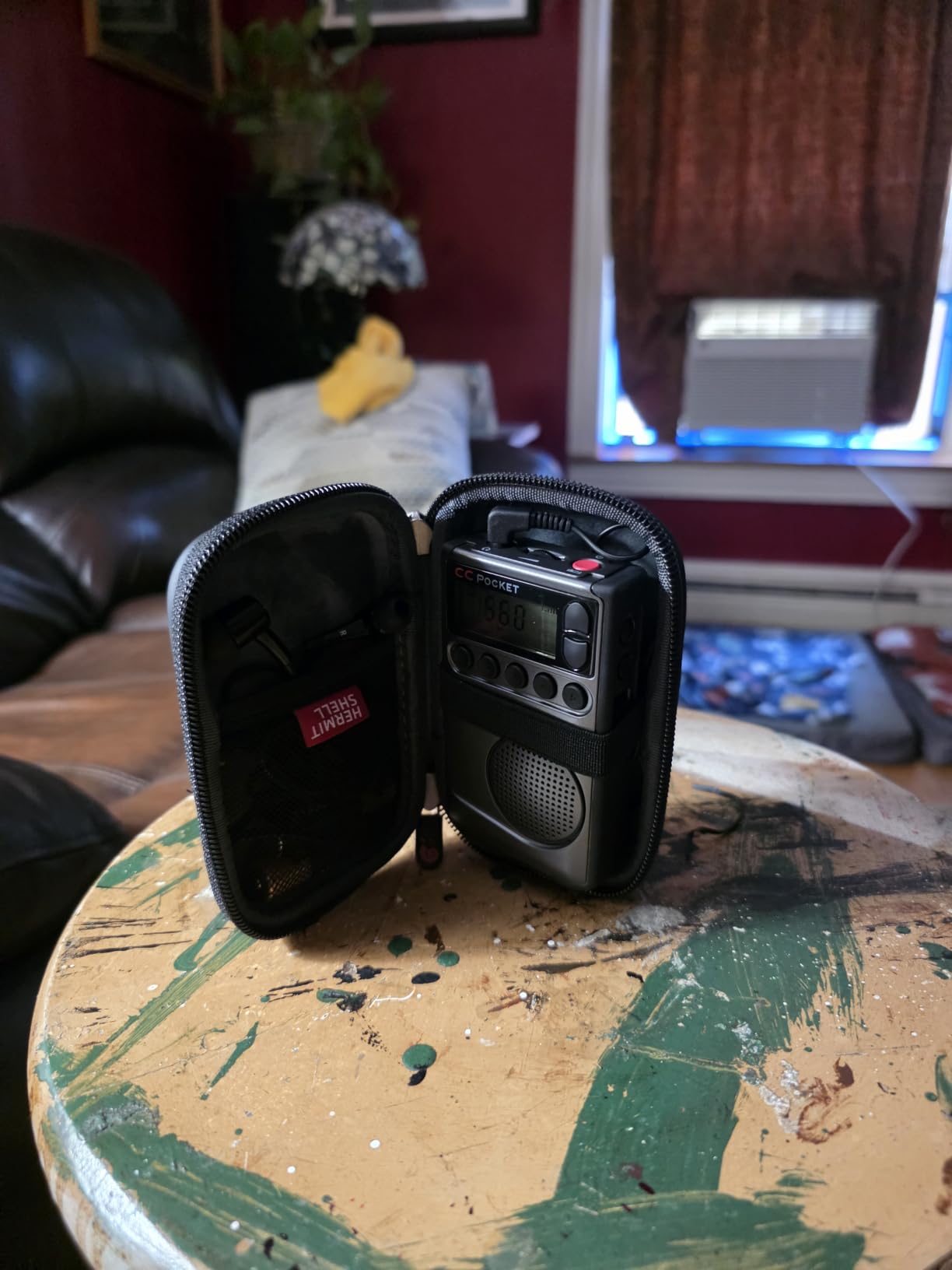
The C.Crane CC Pocket is the smallest unit here at 2.5 by 1 by 4.25 inches and 4 ounces, and it also happens to have the best reception relative to its size. owners single out selectivity and sensitivity as noticeably better than typical pocket radios, which is exactly what a weak NOAA signal needs.
It runs AM, FM and the NOAA weather band, with five one-touch memory presets. A clock, alarm, sleep timer and backlight make it usable on a nightstand, and the supplied earbuds give you private listening when the 0.5 watt speaker is not enough.
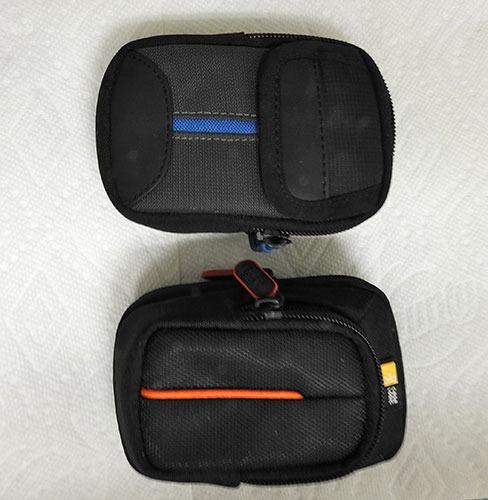
The removable belt clip is the detail that keeps it in a pocket rather than a drawer. For shift workers, delivery drivers and anyone who wants alerts on their body rather than in another room, that is the entire design brief.
Two AA cells are the only power source. There is no hand crank, no solar panel and no charging, so battery discipline becomes your responsibility. About 71% of 2850 reviews are five-star.
Who the C.Crane CC Pocket suits best
It suits people who want alerts on their body. A belt-clipped radio that weighs four ounces is something you will actually keep switched on, which is the behaviour that matters most in this category.
It also suits a traveller or a camper who wants one small device for NOAA, AM and FM without a charging routine. The sleep timer and alarm make it reasonable for light overnight use with earbuds.
Where the C.Crane CC Pocket falls short
Two AA batteries and no alternative power source. When the cells die during an extended outage, this radio is finished, so carry a spare set in the same bag.
There is no S.A.M.E. programming and no automatic alert tone, and the 0.5 watt speaker is the quietest in this group. It alerts on whatever channel it is tuned to, which means it must already be sitting on a NOAA frequency.
How to Program Your S.A.M.E. County Code in Five Steps
S.A.M.E., or Specific Area Message Encoding, is the system that lets a radio ignore warnings for other counties. Every alert broadcast starts with a digital header carrying the six-digit FIPS code of the affected area, and your radio compares that header against the codes you saved. Only the two Midland models in this roundup can do that comparison automatically.
- Find your county FIPS code using the National Weather Service county lookup, or use your state and county name to retrieve the six-digit code.
- Power the radio on and locate the S.A.M.E. or County Code option in the setup menu. On the Midland WR120B and WR400 it sits behind the Menu button.
- Enter the six-digit code one digit at a time, then confirm. Repeat for any secondary county you want covered, such as a cabin or a parent’s house.
- Set your alert type preferences while you are in the menu. Choose which hazard types break through and which stay muted, then save.
- Run the radio’s test or alert function and confirm that the siren sounds for your test code and stays quiet for a neighbouring county code.
Do step five even if the manual says it is unnecessary. A mis-keyed digit is the most common reason a programmed radio stays silent during a real warning, and the test takes two minutes.
If you cannot find a model that filters alerts, at least turn off the ones you do not need. Owners on weather forums describe the weekly National Weather Service test alert as the first thing that makes them unplug a radio, and a radio you have muted entirely is worse than no radio at all.
How to Choose a NOAA Weather Radio in 2026
Most buyers choose on price or on siren volume and miss the three decisions that determine whether they keep the radio switched on: county filtering, power independence and alert-type control. Work through these six questions before you buy, and the choice becomes obvious.
Does it filter to your county?
This is the single most important question and the one the top-ranking forum thread keeps asking. A radio that alerts for every county in range will warn you for counties you have no connection to, and after a few weeks of that you start ignoring the sound. Only the Midland WR120B and WR400 in this group store county codes, with up to 25 slots each.
How many power sources does it have?
A desktop radio on AC power with AAA backup covers the common outage. A portable with a hand crank, a solar panel and a USB input covers the scenario where the outage lasts days. The FosPower, RunningSnail, Raynic, Kaito, Eoxsmile and Leaton all offer multiple sources.
Owners on RV forums make a practical point worth repeating: an expensive setup with a big antenna may work only slightly better than a modest portable radio placed well. Placement matters more than specification.
Can you choose which alert types sound?
Some radios carry a menu of selectable hazard types. The WR400 offers 80, the WR120B covers more than 60. Where no menu exists, the practical fix is to place the radio where you can hear it and accept that it will not filter.
How loud is it, and can you hear it where you sleep?
Published alarm figures range from a low 0.5 watt speaker on the C.Crane pocket model to an 85 dB siren on the WR400. Volume alone does not help if the radio sits in a room nobody enters at night. Put the radio where the sound can reach the bedroom, or pair it with an earbud or speaker solution.
What happens for deaf and hard of hearing users?
An audible-only warning is not a warning. The Raynic and Eoxsmile units include flashing red alert lights, and a bed-shaker or strobe accessory paired with a S.A.M.E.-capable radio is the dependable setup. Our guide to digital radios for seniors covers the alerting side more broadly.
Where will you put it?
Concrete, rebar and foil-backed insulation are brutal on NOAA signals. Start on an upper floor near a window, test by listening for the weekly test alert, and move the radio until you can hear it clearly. Avoid basements, garages and interior rooms with no exterior wall.
For homes that also track conditions indoors, our weather station roundup for homes covers temperature and pressure instruments. If barometric pressure shifts already give you trouble, the barometric pressure and migraine explainer is worth a read.
NOAA Radio Troubleshooting: False Alarms, Beeping and Dead Zones
Most complaints about weather radios come down to four predictable causes: unprogrammed county codes, the National Weather Service weekly test alert, building materials blocking the signal, and expired backup batteries. All four are fixable in under an hour.
Why is my NOAA weather radio beeping on its own? The National Weather Service broadcasts a weekly test alert to verify the network, and a properly programmed radio sounds off for it. If the beep is short and repeats on the same day each week, that is the test. If the beeping is continuous or random, check for an unprogrammed radio with no county code, because it is alerting on every broadcast in range.
Why does it alert for places I do not care about? That is the no-S.A.M.E. behaviour working as designed. Either program your county code on a model that supports it, or accept the noise and keep the volume low enough that you still sleep.
How do I reset it? Remove the backup batteries and unplug the AC adapter, then hold the power or volume button while pressing reset on the base or case for about ten seconds. Leave it unplugged for a full hour, reinstall fresh cells, and reprogram your county code. Programming is lost during a reset, so keep your code written down somewhere outside the radio.
Why is reception bad? Signal attenuation from concrete and metal is the usual answer. Move the radio to an upper floor near an exterior wall, extend any telescopic antenna fully, and rotate it. If a siren sounds but no voice follows, the digital header decoded while the audio did not, which points to a marginal signal rather than a fault.
Siren sounds, no voice? That is a signal strength problem. Change location before you assume the radio is defective, and check that you are not one county too far from the nearest transmitter.
Finally, replace backup cells at the start of every storm season. Owners report flat or corroded cells as the cause of more silent radios than any hardware fault, and a battery installed a year ago is a battery you cannot count on.
Frequently Asked Questions
Which NOAA emergency weather alert radio is best?
The Midland WR120B is the best all-round choice because it is one of the few units here that programs your county code, which stops irrelevant alerts. The Midland WR400 adds more alert types, a louder 85 dB siren and an alarm clock. For a portable, the FosPower A1 gives you hand crank, solar and AAA power with a 7400mWh phone charger.
Can I get a NOAA Weather Radio for free?
There is no free NOAA weather radio available from the National Weather Service. The broadcasts are free to receive with no subscription or account, but the receivers are consumer products you purchase. Many public libraries, emergency management offices and utility companies lend or distribute them during preparedness seasons, so check locally before buying.
Do weather radios work when power and internet are out?
Yes, that is the design goal. A radio with hand crank, solar panel or battery backup keeps receiving National Weather Service broadcasts through an extended outage, and no cell signal or internet connection is required. A desktop model on AC power alone will stop when the grid fails, so keep its backup cells fresh or add a portable unit as a backup.
Is it worth having a weather radio?
Yes, if you live in an area that gets tornadoes, hurricanes or flash floods. Phone alerts depend on cell towers, carrier data and app notifications, all of which can fail during a power outage or when towers are overloaded. A NOAA radio receives government broadcasts directly from a transmitter, so it keeps warning you when nothing else does.
Why is my NOAA weather radio beeping?
A short beep on the same day each week is the National Weather Service weekly test alert, which a properly programmed radio sounds to confirm it still receives transmissions. Continuous or random beeping usually means the radio has no county code programmed and is responding to broadcasts for other areas. Check your S.A.M.E. settings and the test schedule.
How do I reset my NOAA weather radio?
Remove the backup batteries and unplug the AC adapter, then hold the power or volume button while pressing the reset control on the base or case for roughly ten seconds. Leave the unit unplugged for a full hour, reinstall fresh cells and reprogram your county code. Programming is erased during a reset, so keep your six-digit FIPS code written down.
Why is my NOAA Weather Radio getting bad reception?
Concrete, rebar and foil-backed insulation are the usual causes, along with being placed in a basement or an interior room. Move the radio to an upper floor near an exterior wall, extend any telescopic antenna fully and rotate it until the weekly test alert is clearly audible. If the siren sounds with no voice after it, the signal is marginal rather than the radio being faulty.
Final Verdict on the Best NOAA Weather Radios for 2026
The FosPower A1 is our top pick among the best NOAA weather radios for storm alerts, because three independent power sources and a 7400mWh phone charger mean it keeps working long after the grid does, and its review history across tens of thousands of owners reflects that reliability. If alerts fatigue you more than outages do, choose the Midland WR120B instead, since its S.A.M.E. programming is the only thing that makes a siren worth listening to again.
Buy one radio, program the county code today, and run the test alert once a month so the first time it sounds for real, it is not the first time you have heard it work. Our home emergency radio guide covers the pairing gear that fills the rest of a kit.