
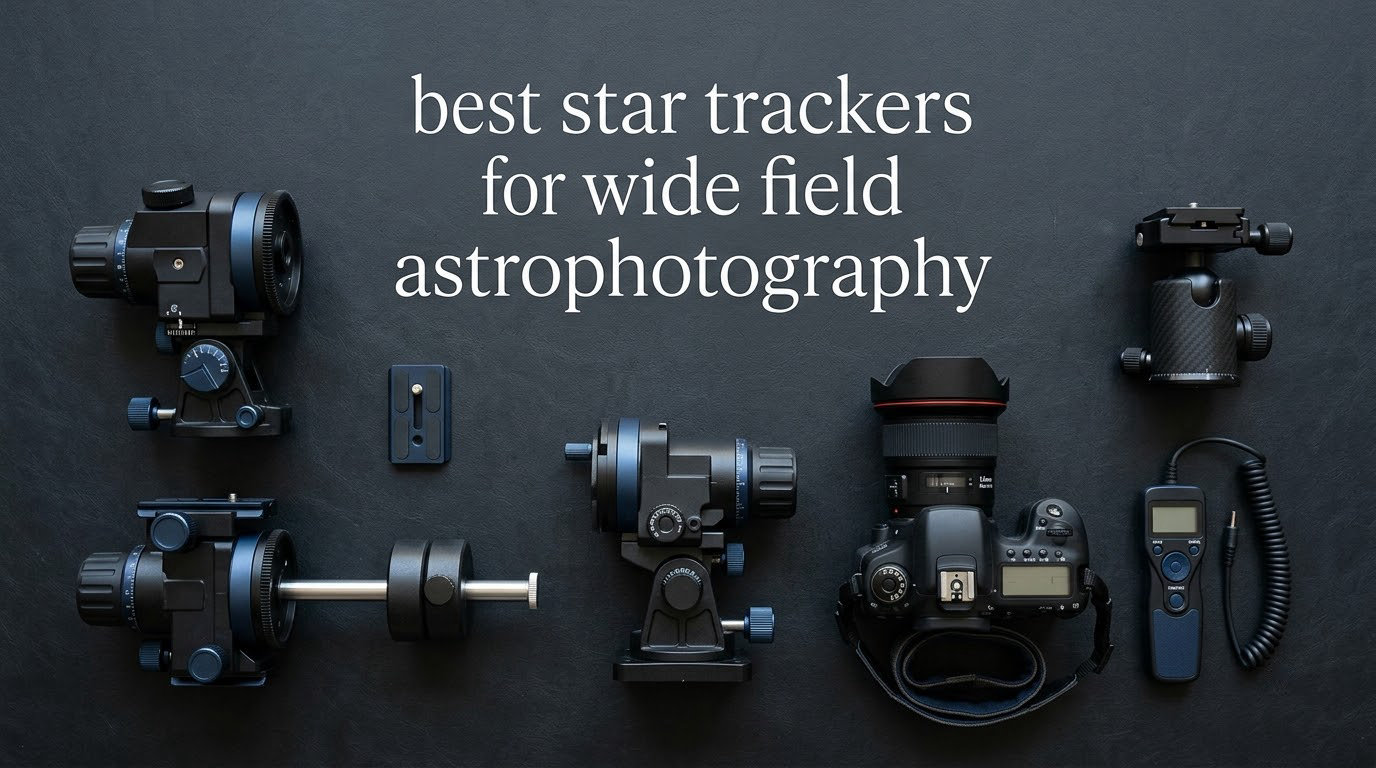
Put a camera on a fixed tripod, point it at the Milky Way, and open the shutter for thirty seconds. What comes back is a set of short dashes instead of stars. That is the Earth’s rotation writing itself into your frame, and it is the single reason people buy a star tracker for the first time.
A star tracker is a small motorised mount that turns your camera westward at the sidereal rate, matching the rate at which the sky appears to move overhead. Once its axis is aimed at the celestial pole by polar alignment, stars record as points for as long as your batteries and your patience hold out. For wide field work with a 14-24mm lens, that is the difference between a snapshot of the Milky Way and a foreground-blended nightscape where the galactic core sits crisply over a ridge line.
This guide covers the best star trackers for wide field astrophotography available right now, from ultralight travel heads you can pack in a camera bag to complete dual-axis GoTo kits that point themselves at targets. We looked at payload against real-world rigs, polar alignment methods, battery options and the tracking rates that matter for landscape work. Where a mount has a known failure point, we name it. The comparisons are based on published specifications and the pattern of what owners actually report after a season of nights out.
The one practical note before we start: we never quote prices here, because they change daily. The buttons below take you to the current listing. If you are cataloguing frames in camp rather than at home, a rugged laptop built for field work handles the culling step without a warm room.
Table of Contents
Top 3 Star Tracker Picks for Wide Field in 2026
Before the full list, these are the three that do the most for the least fuss in wide field work. Each of them tracks a camera and a fast lens without complaint, and each has an owner base large enough that the quirks are well documented rather than surprising.

Star Adventurer 2i Pro Pack
- Proven 2-3 minute tracking
- Ball head and tripod friendly
- Deluxe equatorial wedge included
- Auto-guiding port


Star Adventurer GTi Kit
- Full GoTo equatorial head
- Tripod and pier included
- 5 lb counterweight
- Bright built-in polar scope
The 2i Pro Pack earns the top slot on evidence rather than novelty. It is the most widely used tracker in this group by a wide margin, its tracking is reported as solid at two to three minute exposures, and the deluxe wedge it ships with removes the accessory shopping that catches out first-time buyers. The SkyGuider Pro is the one to buy if you want metal instead of plastic and do not need GoTo pointing. The GTi kit is the answer for anyone who is done star-hopping and wants the whole chain in one box.
Best Star Trackers for Wide Field Astrophotography in 2026
All eight mounts below are capable of tracking a mirrorless or DSLR body with a fast wide lens. They differ in how much they ask of you before that happens. Five are bare heads that bolt onto a ball head and a tripod you already own. Three are complete systems with the tripod in the box, and one of those is a manual German equatorial designed for telescopes that can take a motor drive. The last is a compact unit built around variable tracking speeds for time-lapse work.
Our picks, in order: the Star Adventurer 2i Pro Pack as the best overall for wide field, the iOptron SkyGuider Pro as the best value, the Star Adventurer GTi Kit as the best complete package, the Explore Scientific iEXOS-100-2 for dual-axis GoTo on a smaller budget, the Celestron CG-4 for telescope work, the iOptron SkyTracker Pro for the tightest travel budget, the Star Adventurer Mini for the smallest pack size, and the Vixen POLARIE U for time-lapse and right-ascension guiding.
| Product | Specifications | Action |
|---|---|---|
| Sky-Watcher Star Adventurer 2i Pro Pack |
|
Check Latest Price |
| iOptron SkyGuider Pro |
|
Check Latest Price |
| Sky-Watcher Star Adventurer GTi Kit |
|
Check Latest Price |
 Explore Scientific iEXOS-100-2 Explore Scientific iEXOS-100-2 |
|
Check Latest Price |
 Celestron CG-4 Celestron CG-4 |
|
Check Latest Price |
 iOptron SkyTracker Pro iOptron SkyTracker Pro |
|
Check Latest Price |
 Sky-Watcher Star Adventurer Mini Sky-Watcher Star Adventurer Mini |
|
Check Latest Price |
 Vixen POLARIE U Vixen POLARIE U |
|
Check Latest Price |
1. Sky-Watcher Star Adventurer 2i Pro Pack – the most proven wide-field tracker
Sky-Watcher Star Adventurer 2i Pro Pack (S20512)
Motorised portable tracking platform
Built-in Wi-Fi with SAM Console app
Deluxe equatorial wedge base
Auto-guiding port
Pros
- Proven 2-3 minute sub exposures with pinpoint stars
- Deluxe wedge included so no extra alignment base is needed
- Reliable app control over long sessions
- Long AA battery life
- Light and compact for travel nightscapes
Cons
- Needs a genuinely rigid tripod
- Heavy telephoto glass needs a separate counterweight
- App is basic compared with GoTo systems
- A small number of reports of erratic drive behaviour
The Star Adventurer 2i is the tracker I recommend to anyone starting wide field imaging, and the reason is simple: it is the least surprising. Owners report two to three minute exposures producing sharp pinpoint stars at focal lengths from 135mm out to 300mm, which is well past what most people ever need with a 14mm lens. The motor does one job quietly and the rest of the night is spent on your own technique.
Battery life is the quiet hero. One owner logged roughly forty hours of shooting from a single set of cells, which means a full winter of sessions without a charging cable. Internal lithium packs are more convenient, but cold mornings drain them faster, and AA cells you can swap in the field are worth their weight in a bag.
The deluxe equatorial wedge in the Pro Pack is the piece most people underestimate. Without a proper wedge, the head cannot reach the pole and you are aligning by eye at whatever latitude you happen to be at. With it, the polar alignment becomes a two-minute job using the built-in scope and its illuminator, which is the difference between a 20-second exposure ceiling and a three-minute one on a given night.
What the 2i is genuinely good at
This is the tracker to buy if your rig is a mirrorless body with a 14-20mm lens and you want two-minute sky exposures to blend with a foreground shot. The auto-guiding port is there if you later add a small refractor and want the option, and the app control lets you change tracking speed or start a time-lapse sequence without walking back to the tripod.
Reviewers repeatedly describe alignment as easy once practised. The illuminated polar scope is the reason, and if you keep the small illuminator adapter in a side pocket of your camera bag you will not lose it, because losing it is the most common owner complaint about small parts on this mount.
Where it falls down for wide field
Light-weight camera tripods are not rigid enough. A gust or a footstep writes straight into a two-minute frame, and owners blame the motor when the tripod is the culprit. If you already own a decent travel tripod, use it; if not, that tripod is part of the cost of this tracker, not an optional extra.
Balancing is fiddly with heavy telephoto glass without an additional counterweight. The companion app is described as basic and lacking features, so do not expect GoTo behaviour or guided-stacking automation from it. A small number of owners also report erratic drive motor behaviour or a mount dead on arrival, so keep your retailer’s return window in mind.
2. iOptron SkyGuider Pro – the best value all-metal tracker
iOptron SkyGuider Pro Camera Mount Full Package
All-metal body for minimal vibration
2.2 lb mount head
Up to 11 lb payload
20 hour internal rechargeable battery
Pros
- All-metal construction and brass worm drive for smooth tracking
- 2.2 lb head packs into a camera bag
- Integrated dark-field illuminated polar scope
- Reported 2-3 minute subs with lenses up to 500mm
- Excellent value for a first tracker
Cons
- No GoTo
- targets must be found manually
- Short 8 inch counterweight bar
- Polar scope often arrives out of collimation
The SkyGuider Pro is the one I keep coming back to as the value pick. At 2.2 pounds for the head, with an all-metal body and a brass worm drive, it is a step up in material quality from plastic-bodied travel trackers without moving into the weight class where travel becomes a problem. The drive is smooth and low-jitter, which is what you feel as consistent star shape across a session.
Owners who master the alignment report sharp two-minute sub-exposures with lenses up to 500mm, and the integrated AccuAlign dark-field illuminated polar scope is genuinely quick to dial in. The dark-field feature matters more than it sounds. A lit reticle against a bright sky is nearly invisible; a dark-field scope lets you see the reticle against a dark sky, so alignment takes minutes rather than a frustrating half hour.

The internal rechargeable battery is rated at up to twenty hours of operation at 20C, and reviewers cite fifteen to twenty hours in practice. That figure is measured at room temperature, so expect less on a cold winter night, but twenty hours of internal power still covers a normal session with margin.
Why this one earns its place in the middle of the list
For a wide field nightscape rig of, say, a 20mm lens on a lightweight body, this is more tracker than you need, and that is the point. Owners who outgrew their first head describe it as bulletproof, working reliably even in cold conditions. The metal body dissipates heat and does not flex the way a plastic shell can, which keeps stars round over long sequences.
It also converts cleanly. When the 14mm wide field phase ends and you want to shoot a small refractor, the same base, wedge and ball head are already in your hands.
What to know before you buy it
There is no GoTo. You find targets yourself, which costs time on every session and is a real consideration if you are not comfortable navigating the sky. The included 8 inch counterweight bar is short and may not balance heavy telephoto DSLR combinations, and in some configurations the counterweight is sold separately.
Owners also report the polar scope frequently arriving out of collimation, needing adjustment with a hex key that is not included. Budget five minutes and a small hex key set for that. A sturdy tripod is mandatory and not supplied, so factor that into the system.
3. Sky-Watcher Star Adventurer GTi Kit – the complete GoTo package
Sky Watcher Sky-Watcher Star Adventurer GTI Mount Kit with Counterweight, CW bar, Tripod, and Pier Extension – Full GoTo EQ Tracking Mount for Portable and Lightweight Astrophotography
Full GoTo equatorial mount head
Tripod with pier extension
Built-in illuminated polar scope
5 lb counterweight and bar
Pros
- Everything in one box
- including tripod and counterweight
- GoTo removes manual star-hopping
- Built-in illuminated polar scope
- Built-in WiFi for phone control
- Two-year warranty
Cons
- Heaviest and bulkiest kit here at 26 pounds
- Not a packable travel rig
- GoTo accuracy still depends on polar alignment
- Smartphone required for GoTo control
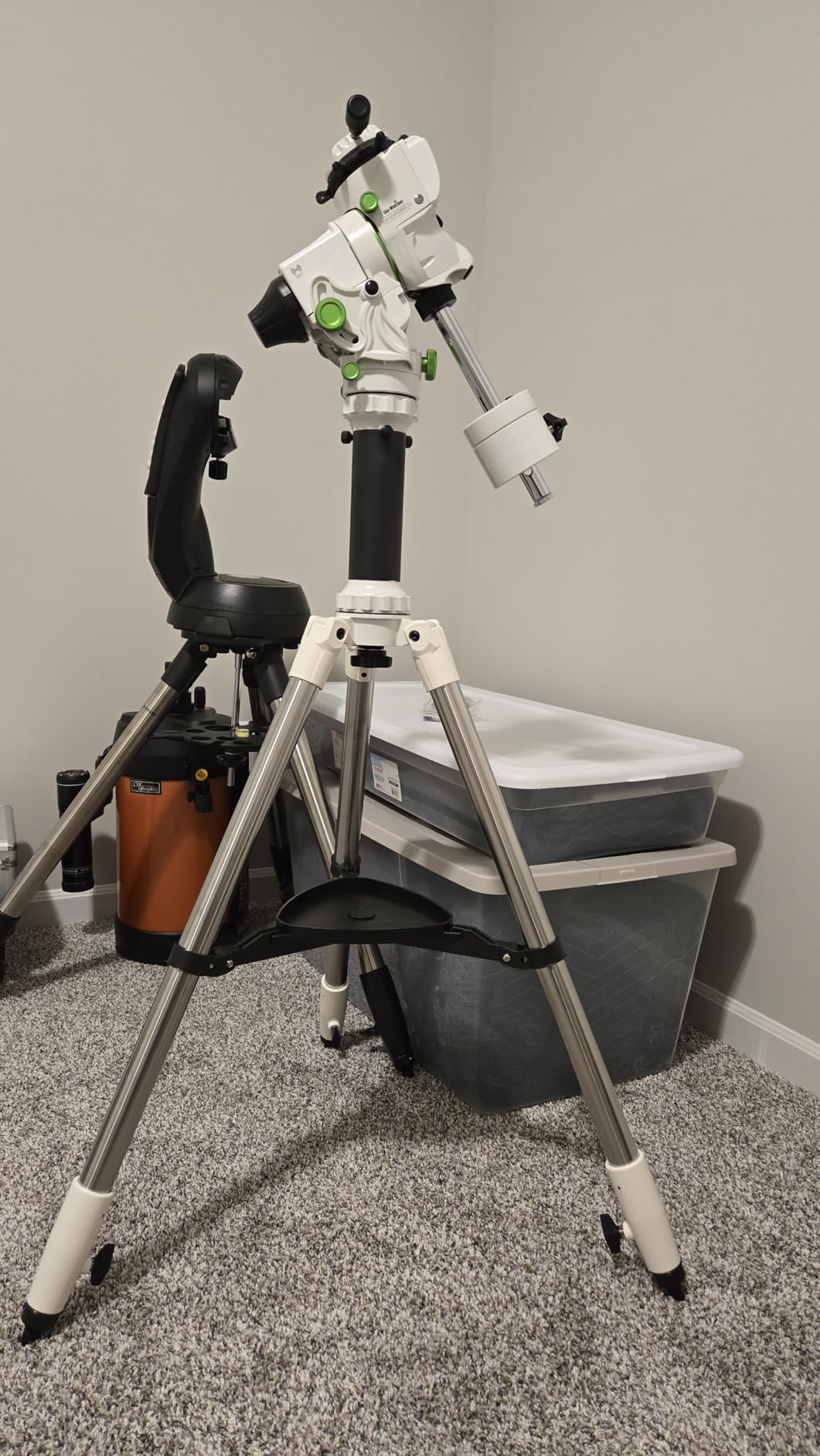
The GTi kit answers a problem every other tracker on this list creates. Buy a bare head and you still need a wedge, a counterweight bar, a counterweight, a ball head and a tripod that can take the load. The most repeated complaint across forums is buying the head alone and discovering the accessory list afterwards. This kit puts the whole chain in the box, including a tripod with a pier extension and a 5 lb counterweight.
What you get in exchange for the bulk is GoTo. A dual-axis equatorial head slews to a named target after a two-star alignment, which means a session can start on the object rather than on a star-hop through the finder. For someone who is not yet confident navigating the sky, that removes the single biggest source of wasted evenings.
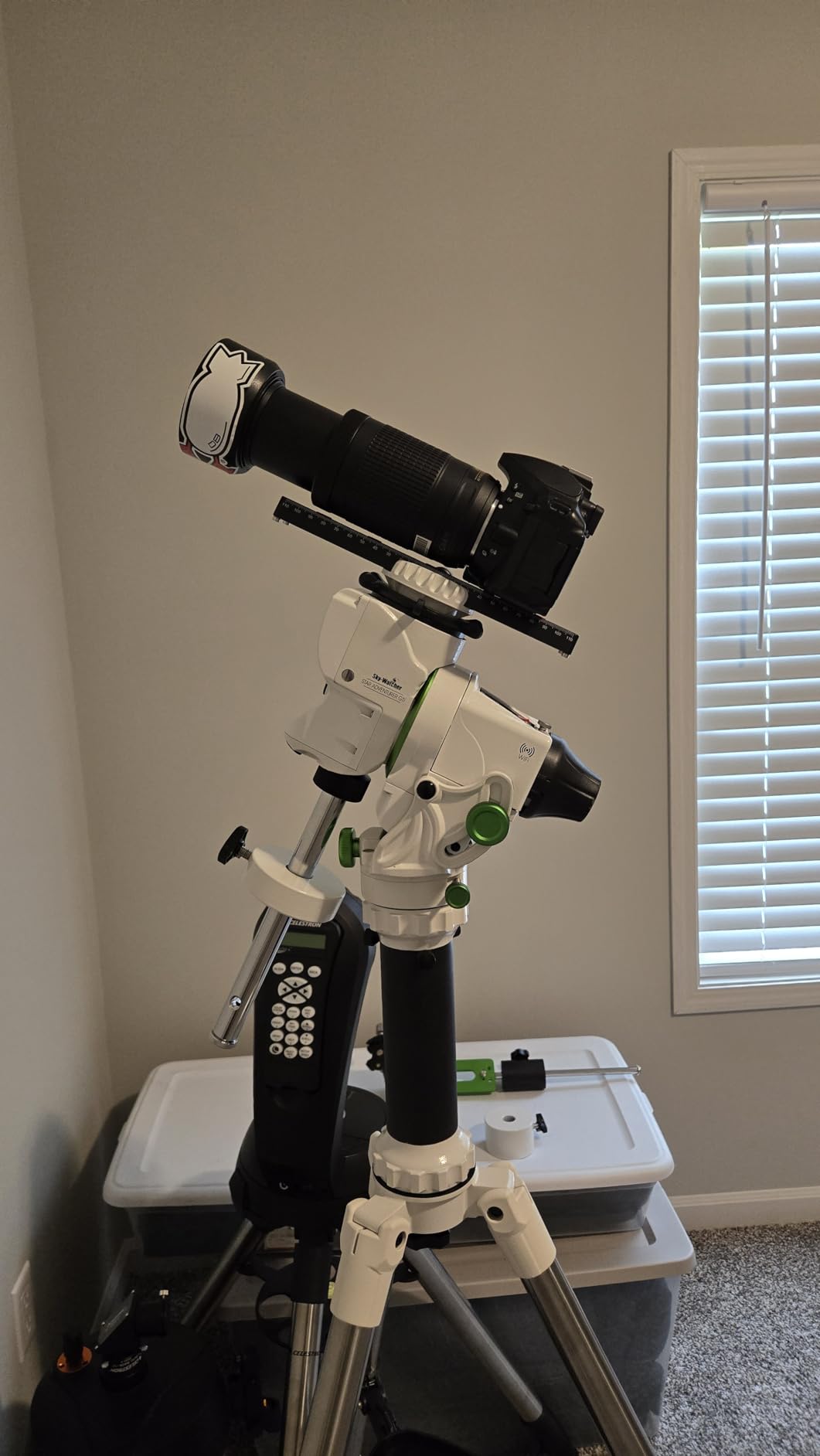
The head is 26 pounds with the tripod, which is the reason this is not first. For a car-camping or garden setup it is irrelevant. For a night at a remote site walked in across rough ground, it is a different proposition entirely.
What the GTi kit does that the others do not
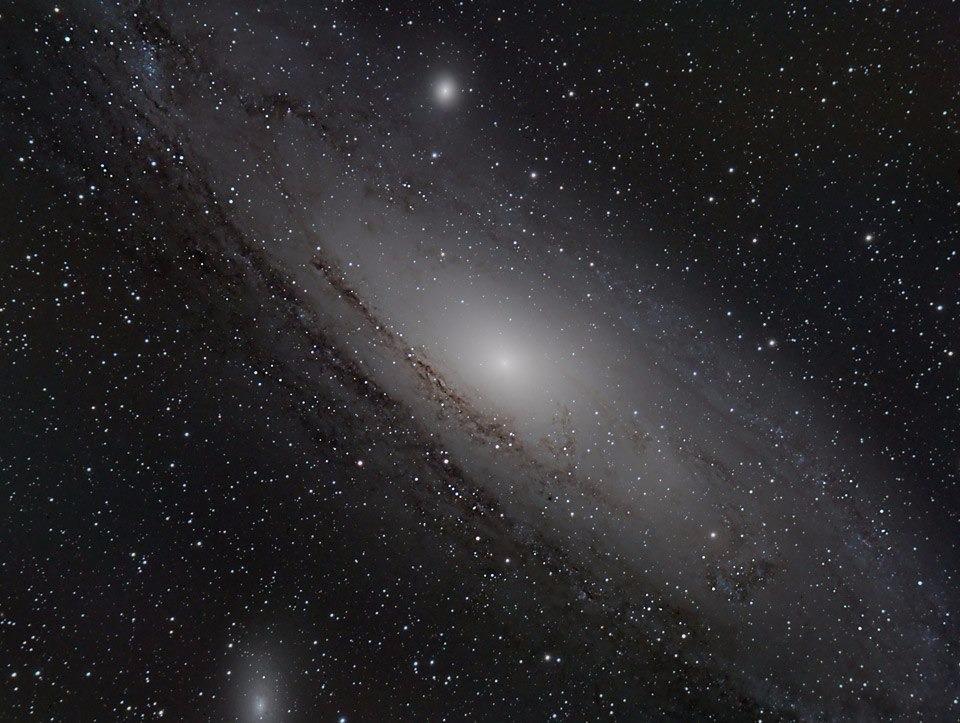
Point-and-shoot framing. Once the kit is aligned, choosing a target is a job on your phone rather than a job on the sky. That also makes it the easiest of the eight to hand to somebody else in your household who wants to take a picture of the Andromeda galaxy without learning polar alignment first.
It is also the most straightforward route into small-refractor imaging later, because the payload, the counterweight bar and the tripod are all sized for a tube. If you are unsure whether wide field is where you will stop, this is the least likely purchase to become obsolete.
Where the kit does not suit you
Backpacking. At 26 pounds this is not a travel rig, and pairing it with a lightweight travel tripod defeats the point of the sturdy legs. It is also the largest purchase in this guide, which matters if you were planning to spend on a lens instead.
Do not assume GoTo fixes alignment. Owners note that pointing accuracy still depends on correct polar alignment, so the same discipline applies. And the phone requirement is real. There is no physical hand controller in the box, so if your phone dies at 2am the mount stops being easy.
4. Explore Scientific iEXOS-100-2 – dual-axis GoTo on a smaller budget
iEXOS-100-2 PMC-Eight Equatorial Tracker System Tripod and Mount for Astrophotography with WiFi and Bluetooth Compatible
PMC-Eight eight-CPU control system
Clutched dual-axis worm gears
ExploreStars GoTo app
Tripod included
Pros
- True dual-axis RA and Dec tracking
- GoTo and control through the ExploreStars app
- Clutched axes make balancing fast
- Tripod included in the system
- Quiet precision stepper belt drives
Cons
- Lowest average rating among the eight at 3.9 stars
- Heavier and bulkier than travel trackers
- App-driven GoTo has a learning curve
- Some reports of alignment and motor consistency issues
The iEXOS-100-2 is the only mount here that pairs genuine dual-axis tracking and GoTo with a tripod in the same box. A single-axis tracker corrects right ascension and lets declination drift, which shows up as field rotation over long sequences; a dual-axis head corrects both, and on a fast wide lens at two minutes that difference is small but real.
The PMC-Eight system runs eight independently operating CPUs, and the axes are clutched on both right ascension and declination, so you can rebalance a rig without loosening bolts in the dark. The polar alignment sight hole runs through the RA axis, which means you align without a separate polar scope and without buying one.
At 3.9 stars with thirteen percent one-star reviews, the reviews are polarised: some owners love the feature set, others hit motor, alignment or quality-control problems. That pattern usually means a good design with inconsistent assembly, so the return policy matters more here than elsewhere on the list.
Where this mount earns its slot
If your wide field work will eventually include a small refractor, dual-axis correction and GoTo pointing both keep paying back. And because the app handles the GoTo sequence, the learning curve is spent once rather than every night. For a beginner who finds manual star-hopping genuinely disorienting, that is worth a great deal.
The belt drives are also quiet, which matters more than it sounds if you are working in a campsite where a humming motor attracts attention, or shooting next to someone sleeping.
Where it does not suit you
It is heavier and bulkier than the portable trackers, so it loses the argument for travel and backpacking. The GoTo is app-driven, so a tablet or phone is required and there is a learning curve on top of polar alignment. Some users report alignment and motor consistency issues, and the distribution of ratings suggests those reports cluster rather than spread.
At the 84 review mark it is among the least-proven mounts in this group, and I would treat it as a calculated choice rather than the safe one. Pair it with a manual aiming method as a backup for the first few sessions.
5. Celestron CG-4 – the steel-tripod telescope workhorse
Celestron CG-4 Manual German Equatorial Mount with Steel Tripod
Stainless steel tripod, 1.75 inch legs
20 lbs payload capacity
Manual slow-motion on both axes
Adjusts 33-47 inch height
Pros
- Rock-solid steel tripod that minimises vibration
- Highest payload here at 20 lbs for real imaging trains
- Fine manual slow-motion controls on both axes
- Classic German equatorial design
- Adjustable height range
Cons
- Manual mount
- tracking needs a motor drive added separately
- Heavier and less portable than travel trackers
- Polar alignment is manual and needs practice
- One-year warranty
The CG-4 is the odd one out in this roundup, and it earns its place on stability rather than portability. The stainless steel tripod with 1.75 inch diameter legs is a very rigid support, and rigidity is the failure point that most often gets blamed on the tracker. If you are building a rig that will carry a real telescope rather than a camera, this is the base you want underneath it.
Payload is 20 lbs, the highest quoted in this group, and the manual slow-motion controls on both axes let you centre a target slowly under a decent finder without disturbing the balance. The latitude settings are adjustable, and the tripod height ranges from 33 to 47 inches, which covers both a small refractor and a camera sitting low near grass for a foreground composition.
It is important to be clear about what this is. The CG-4 as listed is a manual mount. It has no motor and no tracking; it accepts a motor drive, and that accessory is a separate purchase.
What the CG-4 does better than anything else here
It does not shake. Steel legs of this diameter, combined with the mount’s mass, resist the wind and footfall that flex lighter tripods into two-minute frames. If you have ever blamed a tracker for elongated stars and then changed nothing else, this is the component that was actually wrong.
The 20 lb rating also means the head stays in the lower half of its capacity with a typical imaging train, and mount performance is consistently better when it is not working at its ceiling.
Where it is the wrong purchase
If you want to photograph the Milky Way next weekend, this is not the answer. It weighs 12.5 lbs for the mount and tripod, it needs a motor drive before it tracks at all, and its one-year warranty is shorter than the two years offered by several trackers here.
Polar alignment is manual, so it needs a dark sky and practice. For the wide field nightscapes this guide is about, that is effort spent on a capability you can buy ready-made elsewhere on this list.
6. iOptron SkyTracker Pro – the ultralight budget pick
iOptron SkyTracker Pro Camera Mount with Polar Scope, Only
6.6 lbs payload capacity
3.3 lbs total weight
Four tracking rates
Rechargeable internal battery
Pros
- Lightest and most affordable dedicated tracker here
- Owners report 60-second to 5-minute exposures
- Integrated rechargeable battery
- Half-sidereal rate for landscape foregrounds
- Polar scope and padded bag included
Cons
- 3 kg payload means heavy telephoto glass needs the counterweight kit
- Supplied dovetail is not Arca-Swiss compatible
- Swivel head cushion slips under heavy loads
- Ball head and tripod sold separately
The SkyTracker Pro is the answer when the budget is the deciding factor rather than a preference. It weighs 3.3 pounds including the padded bag, charges over micro USB to 80 percent in five hours, and carries a 6.6 lb payload. That is enough for a mirrorless body with a 20mm lens, which is exactly the wide field use case.
Owners report successful 60-second to 5-minute exposures with pinpoint stars, which is more than a tracker this size has any right to deliver. Four tracking speeds are offered: 1X sidereal, half-sidereal, solar and lunar. The half-sidereal rate is the underrated one for wide field work, because it deliberately keeps foregrounds sharp while allowing the sky to drift slightly, which is a legitimate stylistic choice for landscape astrophotography.
Many small alignment knobs on the base make polar alignment quick to dial in, and the flat base works with any tripod that does not have a fixed index mark engraved for polar north.

What makes this the budget pick rather than a compromise
It has a polar scope in the box. That single inclusion removes the most common extra cost on a first tracker, and a scope with a usable reticle is what turns alignment from guesswork into a repeatable two-minute job.
At 3.3 pounds it is the tracker to take on a hike. If your wide field work happens at sites you walk to rather than drive to, the weight saving compounds across every trip and eventually matters more than any tracking refinement.
Where the budget shows
The 3 kg payload rating is a hard ceiling for heavy telephoto zooms, and the optional counterweight kit exists because of that. The supplied dovetail base is not Arca-Swiss compatible, and some owners find the base unstable with larger loads. The rubber cushion at the swivel head also slips when the load gets heavy.
A ball head is typically purchased separately, as is any counterweight. And the flat base will not fit tripods with a fixed index mark for polar north, so check your tripod before you commit.
7. Sky-Watcher Star Adventurer Mini – the smallest travel tracker
Sky-Watcher Star Adventurer Mini – Motorized DSLR Night Sky Tracking Mount For Nightscapes, Time-lapse, and Panoramas
1.5 lb head in aluminium
Accepts any ball head
AA power up to 24 hours plus USB
Polar scope with illuminator
Pros
- Extremely light at 1.5 lbs for travel nightscapes
- Works with the ball head and tripod you already own
- Illuminated polar scope included
- AA compartment plus 5V USB external power
- Brass and aluminium gearing for smooth tracking
Cons
- 6.6 lb payload limits it to lighter DSLR and mirrorless bodies
- One-star review share of 12 percent is among the highest here
- Requires a separate ball head and sturdy tripod
- Ball-head adapter adds height to the stack
At 1.5 pounds the Star Adventurer Mini is built explicitly around a rig you already own. It attaches to any ball head through the included adapter, so your existing tripod does the work, and the included polar scope and illuminator mean alignment is not a separate purchase either.
Power is unusually flexible. A built-in AA battery compartment runs up to twenty-four hours, and a 5V mini-USB input lets you run it from a power bank in the cold when internal cells would be the weak link. The brass and aluminium gearing is a genuine step up in smoothness from plastic gear trains at this size.
It also supports smartphone control through the SynScan app on Android and iOS, which covers time-lapse sequences and speed changes without a physical controller.
The catch is the payload. At 6.6 lbs it is limited to lighter DSLR and mirrorless bodies, which is fine for a 14mm lens on a small sensor and not fine at all for a full-frame body with fast glass. The included ball-head adapter also adds height to the stack, which you will feel when composing a low foreground.
Who this tracker is built for
The traveller. If your imaging happens at sites reached on foot, or in a car with a small boot, the Mini is the difference between carrying your kit and choosing not to. The 1.5 pound head leaves room in the bag for a second lens, a power bank and a headlamp, and if you shoot through the night a field watch with a luminous dial is easier to read than a phone screen at 2am.
It is also a good second tracker. Plenty of people keep one at home for nightscapes and use a larger head for the deep-sky work they move to later.
Where it will disappoint you
The one-star share of twelve percent is among the highest in this group, which hints at occasional quality variation rather than a design problem. If you are buying this as a one-off purchase, read the recent negative reviews for the failure pattern you would actually not tolerate.
Because it needs a separate ball head and a sturdy tripod, it is not cheaper to assemble than a complete kit. It is smaller, which is a different benefit. If you are not travelling, the Star Adventurer 2i in position one is the same family of mount with a much larger evidence base behind it.
8. Vixen POLARIE U – the cleanest time-lapse and guiding option
Vixen POLARIE U Star Tracker
0.58 kg tracking platform
Five variable tracking speeds
ST4 autoguiding port on RA
4 AA or USB Type-C power
Pros
- Smallest and lightest mount here at 1.28 lbs
- Five variable speeds for nightscapes and landscape work
- ST4 autoguiding port permits guided corrections
- Smartphone shutter release for interval shooting
- Runs on four AA cells or USB Type-C
Cons
- Autoguiding port works in RA only
- Small payload for a long lens
- Manual language coverage is not guaranteed
- Needs a separate ball head and tripod
The POLARIE U is the smallest and lightest mount here at 0.58 kg, and it is the one I would pick for star-trail sequences rather than stills. Five variable tracking speeds mean you can dial the rate to hold foregrounds sharp while letting the sky streak, which is a much more precise control than a single sidereal and half-sidereal pair.
It also has a genuine ST4 autoguiding port, and this is the one tracker on the list where that is a real differentiator rather than a checkbox. Guided tracking lets an autoguider measure drift and send correction pulses, which on a single-axis mount means right ascension only. Declination is not corrected, so field rotation still accumulates on long sequences, but for a two-minute wide field frame the result is measurably tighter than unguided.
The rating distribution is the cleanest in this guide: 63 percent five-star, 24 percent four-star, and zero one-star reviews. It is also the only mount here with no documented quality-control complaints, though at 36 reviews the sample is the thinnest on the list.
What makes the POLARIE U different from the other trackers here
The variable speed control is the honest answer. For star trails, an interval of movement in the tracked axis is the whole point, and five speeds give you a genuine range rather than a sidereal and a half-speed compromise.
It is also the smallest complete answer to wide field tracking. At under 1.3 pounds with a ball head, it is a real option for hiking-in sites, and the ST4 port means it can grow into guided work without being replaced.
Where it is the wrong tool
The payload is small compared with the larger equatorial mounts here, so long lenses are out of scope. The autoguiding port works in RA only, so if you are stacking deep-sky frames expecting corrected field rotation you will not get it from this mount.
A separate ball head and tripod are required, and the manual’s English coverage is not guaranteed. If you want a heads-up display from the last owner, the Star Adventurer 2i in position one has a far larger owner base to draw on.
How to Choose a Wide Field Star Tracker
Most people buy a tracker in the wrong order. They pick the head first, then discover the tripod will not take it, the wedge is a separate purchase, and the exposure they wanted was never achievable with the lens they own. Work through these six points in order and the purchase makes itself.
Work out your max exposure before you buy anything
The 500 rule divides 500 by your focal length in millimetres to get an exposure in seconds. On a full frame body, 14mm gives about 36 seconds, 20mm gives 25 seconds, and 24mm gives about 21 seconds. The 400 rule is the same calculation with 400 instead of 500, and it is a more honest number because it was derived to include real lens distortion and modern high-resolution sensors rather than just star movement.
The NPF rule is the accurate version. It accounts for aperture, pixel pitch and the declination of the target, which means the same lens pointed at the celestial pole and pointed at the celestial equator will tolerate different exposure lengths. A fast 14mm at f/1.8 will not hold the same time as a 14mm at f/4, and the NPF calculation reflects that. On an APS-C body, divide the result by the crop factor, which means a 20mm behaves like roughly 32mm in full frame terms.
Here is why the order matters. A 14mm lens on a fixed tripod is already good to about 20 seconds before stars start to elongate visibly. So a tracker is not about rescuing a 20-second exposure, it is about unlocking the minute and two exposures that reveal faint nebulosity and let you blend a tracked sky with a foreground. If your target is only 20 seconds, you do not need a tracker. If it is two minutes, almost anything on this list will do it, and the decision moves to payload, weight and alignment convenience.
Read payload capacity as an optimistic number
Quoted payload is a laboratory figure measured under ideal conditions with a balanced load. The most repeated complaint in every forum thread about these mounts is the same one: people run a rig at or near the rated capacity and conclude the motor is faulty when the motor is almost never the problem.
Add up your own rig honestly. Body, lens, dovetail plate, lens rings, counterweight, guide scope and any guiding accessories all count, and all of them sit further from the axis than the number on the box assumes. Keep the total in the lower half of the quoted rating. Owners also report that tracking degrades when batteries are near the end of their life, even under a load the mount is rated for, so treat a tired cell as a real load increase.
The tripod and head are part of the same mechanical chain
This is the most-missed selection criterion in the entire category, and only one of the competitors we studied mentions it. A gust, a footstep, or wind passing through a leg writes directly into a two-minute frame as star trailing. The tracker is at fault only because it is the component the photographer looks at afterwards.
For a bare head, you need a tripod with leg stiffness appropriate to the load and a ball head with a clutch that holds position. The CG-4 with its stainless steel legs is the clearest example in this guide of buying stability rather than portability. For a head that accepts your own ball head, the requirement is a tripod you already trust, not the lightest one you can find. If your all-nighters are wrecking your sleep schedule, our guide to the best sleep trackers for adults is the least glamorous fix for a rough season.
Single axis, dual axis, and when guiding starts to matter
Most trackers here are single-axis. They correct right ascension only, and declination drift shows as field rotation that grows over a sequence. For a single two-minute wide field frame, that is usually invisible. For a two-hour run of stacked frames, it accumulates and the stack gets harder to align.
A dual-axis mount corrects both, which is why the iEXOS-100-2 and the GTi kit are worth considering if you plan to stack heavily. A guider port is a middle path. The 2i, the SkyGuider Pro and the POLARIE U all accept an autoguider, and the POLARIE U’s ST4 port is the cleanest implementation of the three. Guiding on a wide field lens is usually unnecessary; guiding earns its keep once you pass 200mm or start stacking.
Power source and cold weather behaviour
Internal rechargeable batteries are convenient and are the reason the SkyGuider Pro can quote twenty hours of operation. They also become the weak link on a cold winter night, because cold reduces the available output of a lithium pack and the mount will report low voltage earlier than you expect.
AA cells are less elegant and more recoverable. You can carry a second set and swap mid-session. The Star Adventurer 2i’s roughly forty-hour figure on one set of cells, the Mini’s twenty-four hour AA compartment and the POLARIE U’s four-AA or USB Type-C option all reward that approach. If you shoot in winter, an external power bank feeding a USB input is the most resilient option, and it is why the Mini and the POLARIE U accept USB power at all.
What the tracker price does not include
For bare heads, expect to buy a wedge or base for polar alignment, a ball head, a tripod, and possibly a counterweight bar and counterweight. The Star Adventurer 2i Pro Pack and the GTi kit are the two that reduce this list, and that is a large part of why they rank where they do. It is the single most common cost overrun reported by first-time buyers, and the reason a higher-cost complete kit can be the cheaper path overall.
A small power bank and a spare set of cells complete the picture. Everything else, from a red flashlight to a dew heater for long autumn nights, is optional and can wait until you know what your actual workflow is.
Frequently Asked Questions
What is the best star tracker for astrophotography?
For wide field work with a 14-24mm lens, the Sky-Watcher Star Adventurer 2i Pro Pack is the best overall choice. It is the most widely used tracker in its class, owners report 2-3 minute exposures producing pinpoint stars, and the Pro Pack includes the deluxe equatorial wedge most people otherwise buy separately. The iOptron SkyGuider Pro is the best value option, with an all-metal body and integrated illuminated polar scope. Choose the Star Adventurer GTi kit if you want GoTo pointing and a tripod in the box.
Do you need a star tracker for astrophotography?
Only if you want exposures longer than about 20 seconds. A fixed tripod gives wide-angle Milky Way shots a 20-second ceiling before stars visibly elongate, so if that is enough for your intended result, a tracker is optional. Once you want one or two minute exposures to reveal faint nebulosity or to blend a tracked sky with a foreground, a tracker is the only practical way there, because stacking untracked short frames cannot recover the signal a long exposure collects.
What is a good budget star tracker for astro photography?
The iOptron SkyTracker Pro is the strongest budget pick: 3.3 pounds total, a 6.6 lb payload, four tracking rates including half-sidereal for foreground work, and a polar scope included in the box. Owners report 60-second to 5-minute exposures. Budget for a ball head and a tripod separately, and expect heavy telephoto glass to need the optional counterweight kit. It suits a mirrorless body with a fast wide lens and little else.
What is the 500 rule in astrophotography?
The 500 rule is a quick estimate of the longest exposure before stars trail visibly. Divide 500 by the focal length in millimetres to get seconds. On a full frame camera, 14mm gives roughly 36 seconds, 20mm about 25 seconds, and 24mm about 21 seconds. On an APS-C body, divide by the crop factor. It is a starting point only, because it ignores lens distortion, sensor resolution and how far the target sits from the celestial pole.
What is the 400 rule in astrophotography?
The 400 rule is the same calculation as the 500 rule with 400 instead of 500, and it gives a shorter, more realistic result. On full frame, 20mm gives 20 seconds and 14mm gives about 29 seconds. It was derived to account for real lens distortion and modern high-resolution sensors, so it matches what you actually see in the field more closely than the original 500 figure. For a first attempt at wide field, work from the 400 rule and shorten from there.
Which Sky-Watcher tracker is best for wide field?
For most wide field nightscape work, the Star Adventurer 2i Pro Pack is the better pick, because it takes any ball head, carries a generous payload, runs on easily replaced AA cells and has the largest owner base of any tracker here. The Star Adventurer GTi kit is the better choice if you want GoTo pointing and want the tripod and counterweight included rather than assembled separately. The Star Adventurer Mini is the lightest option for sites you walk to.
Do I need an autoguider with a star tracker?
Not for wide field work with a 14-24mm lens. At two-minute exposures, a well-polar-aligned single-axis tracker holds pinpoint stars on its own, which is why most of the trackers in this guide carry an optional guide port rather than requiring one. Guiding starts to earn its keep past roughly 200mm or when you stack many frames, because declination drift on a single-axis mount is not corrected and accumulates as field rotation over a long sequence.
Conclusion
For most people shooting wide field, the Sky-Watcher Star Adventurer 2i Pro Pack is the best star tracker for wide field astrophotography on the market. It tracks well, it mounts on the ball head you already own, and the Pro Pack’s deluxe wedge removes the most common first purchase mistake. If you want metal and can accept manual target finding, the iOptron SkyGuider Pro is the smarter buy, and if you want GoTo pointing without assembling a system, the GTi kit is the complete answer.
Work out your exposure ceiling with the 400 rule first, keep your real rig weight in the lower half of any quoted payload, and treat the tripod as part of the purchase. Get those three right and almost any of these eight will produce sharp stars. Check the current listings through the buttons above, and remember that prices change daily.