
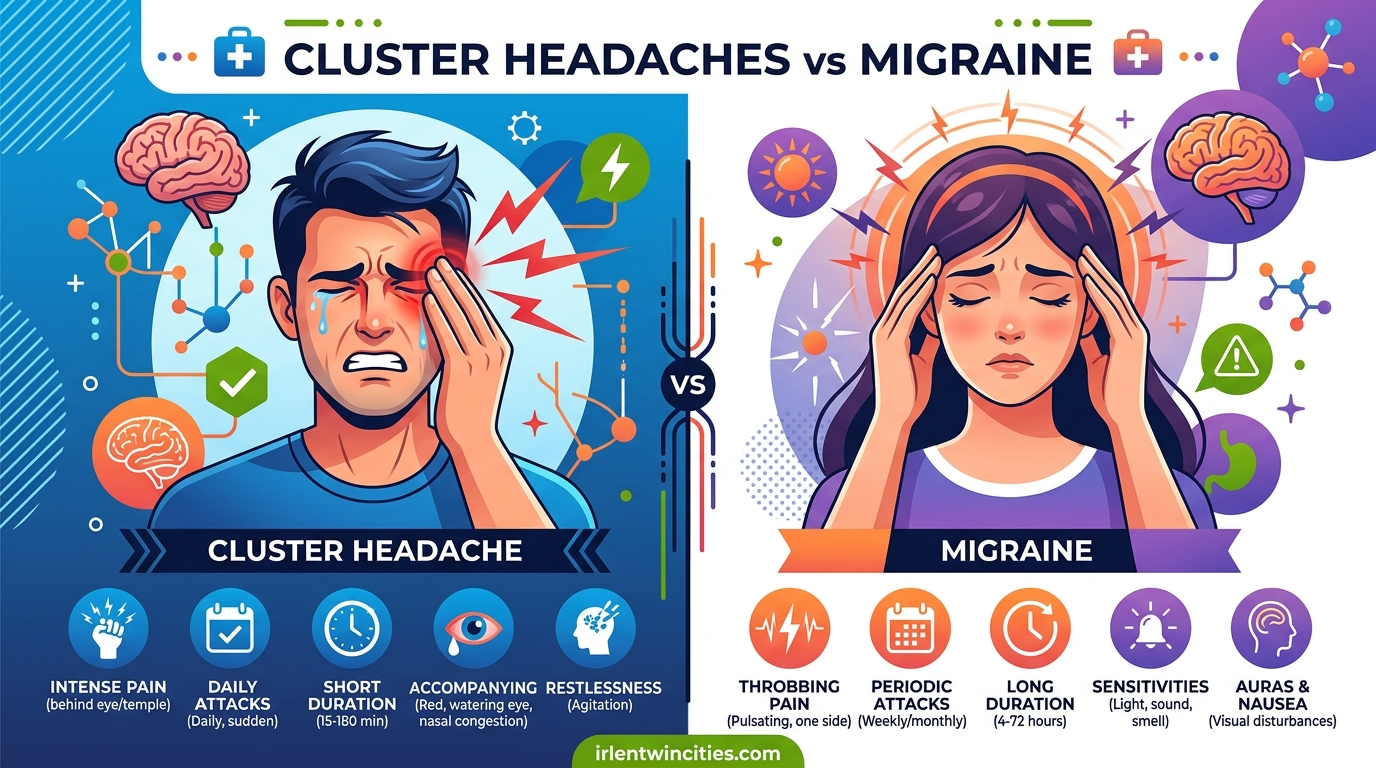
Cluster headaches and migraines are both severe headache disorders, but they differ dramatically in pain quality, duration, and associated symptoms. Migraines typically produce a throbbing or pulsating pain that can last from 4 to 72 hours, often accompanied by nausea and sensitivity to light and sound. Cluster headaches, in contrast, deliver an excruciating sharp or stabbing pain focused around or behind one eye, lasting only 30 to 90 minutes but occurring multiple times per day in cyclical patterns.
If you are trying to distinguish between these conditions in 2026, understanding these fundamental differences is the first step toward getting proper treatment. The distinction matters because each condition requires different emergency interventions, and misdiagnosis can lead to years of unnecessary suffering.
Table of Contents
Cluster Headaches vs Migraine: Pain Characteristics
The quality and location of pain provide the most immediate clues for telling these conditions apart. Both cause severe head pain, but the sensation, focus, and behavior during attacks are distinctly different.
Migraine Pain: Throbbing and Pulsating
Migraine pain is typically described as throbbing, pulsating, or pounding. It often builds gradually over 30 minutes to an hour before reaching peak intensity. The pain commonly affects one side of the head initially, though it can spread to both sides or shift sides between attacks.
Most migraine sufferers experience pain across the temple, forehead, or behind the eye, but it rarely stays confined to just the orbital area. The sensation feels like a heartbeat amplified inside your skull, with each pulse bringing a fresh wave of discomfort. This throbbing pain responds moderately to movement changes, sometimes easing slightly when lying down in a dark room.
Cluster Headache Pain: Sharp, Stabbing, and Burning
Cluster headache pain is qualitatively different. Patients describe it as sharp, stabbing, piercing, or burning. The intensity peaks within 5 to 10 minutes of onset, reaching levels many patients rate as 10 out of 10. This pain centers almost exclusively around, behind, or near one eye, giving cluster headaches their alternative name: orbital headaches.
The nickname “suicide headache” exists for a reason. During my research for this article in 2026, I encountered numerous patient accounts describing the pain as feeling like a hot poker being driven through the eye socket or an ice pick twisting behind the orbital bone. The pain is so severe that some patients have reported contemplating suicide during attacks, hence the grim moniker that has persisted in medical literature and patient communities.
Pain Intensity Comparison
While both conditions cause significant disability, cluster headaches are widely regarded as the most painful headache disorder known to medicine. The pain is not just severe, it is explosive and overwhelming. Studies using pain scales consistently show cluster headaches scoring higher than migraines, kidney stones, and even childbirth in some patient reports.
Migraines, while debilitating, rarely reach the same peak intensity. A severe migraine might reach 7 or 8 out of 10 on a pain scale. A cluster headache routinely hits the maximum 10 out of 10. The difference is not just intensity but also the nature of the suffering. Cluster pain feels violent and piercing, while migraine pain feels oppressive and exhausting.
Duration and Frequency: How Long Each Attack Lasts
Beyond pain quality, the timing patterns of these headaches provide clear diagnostic signals. Understanding how long attacks last and how often they occur helps distinguish between the two conditions.
Attack Duration: Hours vs Minutes
Migraine attacks persist for extended periods. Untreated, a typical migraine lasts between 4 and 72 hours, with most falling in the 4 to 24 hour range. The pain may fluctuate in intensity during this time, sometimes improving briefly before worsening again. This prolonged duration is one reason migraines cause such significant disruption to work, family life, and daily functioning.
Cluster headaches are brief but intense. Each individual attack typically lasts between 30 and 90 minutes, with 45 to 60 minutes being most common. The pain rises rapidly to peak intensity, maintains that peak for most of the attack duration, then drops off almost as quickly as it began. This short duration might sound like relief, but the frequency and cyclical nature of cluster periods make them equally disruptive.
Frequency and Pattern Differences
Migraine frequency varies widely among sufferers. Some experience episodic migraines, defined as fewer than 15 headache days per month. Others have chronic migraine, with 15 or more headache days per month, at least 8 of which are migraine. Attacks may be triggered by specific factors like hormones, weather changes, stress, or certain foods, or they may occur without clear triggers.
Cluster headaches follow a much more predictable and rigid pattern. During a cluster period, which typically lasts 6 to 12 weeks, patients experience 1 to 8 attacks per day, often at the same times each day. Many report attacks occurring like clockwork, often waking them from sleep 90 minutes after falling asleep. This circadian rhythm association suggests involvement of the brain’s hypothalamus, which regulates sleep-wake cycles.
The Concept of Cluster Periods
Perhaps the most distinctive feature of cluster headaches is their clustering pattern. Patients experience active periods (cluster periods) alternating with remission periods. During remission, which may last months or years, the patient is completely headache-free. When a new cluster period begins, attacks resume with full intensity.
Approximately 80 to 90 percent of cluster headache sufferers have episodic cluster headache, with remission periods lasting at least a month between cluster periods. The remaining 10 to 20 percent have chronic cluster headache, where remissions last less than a month or never occur at all. This pattern of cyclical clustering is unique among headache disorders and rarely seen in migraine.
Associated Symptoms: Beyond the Pain
The symptoms that accompany head pain provide additional distinguishing features. These associated symptoms are often what patients notice first when trying to identify their condition.
Autonomic Symptoms in Cluster Headaches
Cluster headaches are classified as trigeminal autonomic cephalalgias (TAC), a family of headache disorders characterized by prominent autonomic nervous system symptoms on the same side as the pain. These symptoms develop during or just before the attack and may persist briefly afterward.
The most common autonomic symptoms include tearing or redness of the eye on the affected side, nasal congestion or runny nose, eyelid drooping or swelling, and forehead or facial sweating. Some patients also experience pupil constriction on the affected side. These symptoms occur because the trigeminal nerve activation triggers reflex pathways in the parasympathetic nervous system.
Migraine Associated Symptoms
Migraines have their own constellation of associated symptoms, though different from cluster headaches. Nausea occurs in about 90 percent of migraine attacks, with vomiting affecting roughly 70 percent of sufferers. Photophobia (sensitivity to light) and phonophobia (sensitivity to sound) are so common that they are part of the formal diagnostic criteria. Many patients also experience osmophobia, sensitivity to smells.
Visual disturbances known as aura occur in 25 to 30 percent of migraine sufferers. These typically develop over 5 to 20 minutes and may include flashing lights, zigzag patterns, blind spots, or temporary vision loss. Aura symptoms usually resolve before or as the headache begins. Aura is rare in cluster headaches.
Behavior During Attacks: Restlessness vs Stillness
Perhaps the single most telling behavioral difference is how patients act during an attack. This distinction is so reliable that headache specialists often use it as a diagnostic shortcut.
During a migraine attack, most patients seek stillness and darkness. They want to lie down in a quiet, dark room and avoid any movement or stimulation. Physical activity typically worsens the pain, so patients remain as motionless as possible. This desire for stillness is so characteristic that its absence might prompt a doctor to reconsider the diagnosis.
Cluster headache patients display the opposite behavior. They are often restless, agitated, and unable to stay still. Many pace back and forth, rock back and forth, or bang their heads against walls. This restlessness reflects the overwhelming intensity of the pain and the body’s attempt to find any position that might offer relief. One patient in an online forum described it as feeling like your head is trapped in a vice while someone is stabbing your eye, making lying still impossible.
Understanding the Causes and Triggers
While the exact causes of both conditions remain partially mysterious, research in 2026 and recent years has identified key mechanisms and triggering factors that differ between the two.
What Causes Cluster Headaches?
Cluster headaches involve activation of the hypothalamus, a small region at the base of the brain that controls circadian rhythms, sleep cycles, and autonomic functions. Imaging studies show increased activity in the posterior hypothalamus during cluster attacks, explaining the clockwork regularity of attacks and the autonomic symptoms that accompany them.
The trigeminal nerve, responsible for sensation in the face and eye, also plays a central role. When activated, it releases substances that cause inflammation and pain around the eye and temple while triggering the autonomic reflexes that produce tearing, nasal symptoms, and eye changes.
Cluster headaches affect men more than women at a ratio of about 3 to 1, though this gap has narrowed in recent years as recognition of cluster headaches in women has improved. Smoking is strongly associated with cluster headaches, with many patients being current or former heavy smokers.
What Causes Migraines?
Migraines involve the trigeminovascular system, a network connecting the trigeminal nerve to blood vessels in the brain and meninges. When activated, this system releases inflammatory substances that cause blood vessel dilation and inflammation, producing the throbbing pain characteristic of migraine.
Cortical spreading depression, a wave of electrical silence moving across the brain surface, explains the visual aura experienced by some migraine sufferers. This phenomenon can be visualized on specialized brain scans during migraine attacks.
Genetics play a stronger role in migraine than in cluster headaches. Migraines run in families, with first-degree relatives of migraine sufferers having a 2 to 3 times increased risk. Women are affected 2 to 3 times more often than men, and hormonal factors, particularly estrogen fluctuations, significantly influence migraine patterns.
Trigger Comparison
Both conditions have triggers, but the patterns differ. Alcohol, particularly red wine, is a potent trigger for cluster headaches during active periods but not during remission. Nitroglycerin, a medication used for heart conditions, can also trigger attacks. Strong smells, bright light, and heat sometimes trigger attacks as well.
Migraine triggers are more varied and individual. Common triggers include hormonal changes (menstruation, ovulation, pregnancy), certain foods (aged cheeses, processed meats, chocolate, alcohol), weather changes, stress, sleep disruptions, bright lights, loud sounds, and strong smells. Many migraine patients can identify specific triggers through keeping headache diaries.
Treatment Approaches: Emergency Interventions vs Daily Management
Treatment strategies differ significantly because the conditions require different acute interventions and preventive approaches. Understanding these differences is crucial for effective management.
Acute Treatment for Cluster Headaches
The gold standard acute treatment for cluster headaches is high-flow oxygen therapy. Inhaling 100 percent oxygen at 12 to 15 liters per minute through a non-rebreather mask can abort an attack within 15 minutes for approximately 70 percent of patients. This treatment is so effective and specific to cluster headaches that response to oxygen is sometimes used as a diagnostic confirmation.
Sumatriptan injections are another mainstay of acute cluster treatment. The injectable form works faster than tablets and can stop an attack within 10 to 15 minutes. Nasal spray formulations of sumatriptan or zolmitriptan provide alternatives for patients who prefer to avoid injections.
Because attacks are brief but severe, oral medications are generally too slow for cluster headache treatment. The medication needs to work within minutes, not hours.
Acute Treatment for Migraines
Triptans are also first-line treatments for moderate to severe migraines, but the formulations and timing differ. Sumatriptan tablets, rizatriptan orally disintegrating tablets, and other oral formulations are effective because migraines last long enough for oral absorption. Triptan nasal sprays and injections are available for faster relief when needed.
Non-steroidal anti-inflammatory drugs (NSAIDs) like ibuprofen or naproxen, sometimes combined with caffeine, provide relief for mild to moderate migraines. Acetaminophen is less effective but may help some patients. Anti-nausea medications like metoclopramide or prochlorperazine address the gastrointestinal symptoms that accompany migraines.
Ergot alkaloids such as dihydroergotamine represent another option, particularly for migraines lasting more than 24 hours or those unresponsive to triptans. Newer classes of medications available in 2026, including CGRP receptor antagonists (gepants) and ditans, offer alternatives for patients who cannot use triptans.
Preventive Strategies
Prevention is essential for both conditions but approached differently. For episodic cluster headaches, preventive treatment is typically started at the beginning of a cluster period and continued until remission is achieved, then tapered off. Verapamil, a calcium channel blocker, is the most commonly used preventive medication for cluster headaches. Lithium, topiramate, and corticosteroids (for transitional treatment) are other options.
Galvanic vestibular stimulation and non-invasive vagus nerve stimulation devices provide non-pharmacological preventive options for some cluster headache patients. Occipital nerve stimulation and deep brain stimulation of the hypothalamus are surgical options for refractory chronic cluster headaches.
Migraine prevention involves daily medication taken continuously, not just during headache periods. Options include beta-blockers like propranolol, anticonvulsants like topiramate or valproate, CGRP monoclonal antibodies (erenumab, fremanezumab, galcanezumab, eptinezumab), and oral CGRP antagonists (atogepant, rimegepant). OnabotulinumtoxinA injections every 12 weeks are approved for chronic migraine.
Lifestyle modifications help both conditions. Regular sleep schedules, stress management, hydration, and avoiding known triggers form the foundation of headache prevention for migraine and cluster sufferers alike.
When Emergency Treatment Is Needed
Cluster headaches sometimes require emergency department visits when attacks are particularly severe or when home treatments fail. Patients benefit from knowing what to tell emergency providers. Clearly stating “I have cluster headache and need high-flow oxygen” often results in faster appropriate treatment than vague descriptions of severe head pain.
Migraines rarely require emergency care unless they represent a first severe headache (to rule out stroke or bleeding), last more than 72 hours (status migrainosus), or are accompanied by neurological symptoms different from the patient’s typical pattern. Knowing the difference helps patients seek appropriate care without unnecessary emergency visits.
Diagnosis and Common Misdiagnosis Patterns
Getting the correct diagnosis can take years for both conditions, but cluster headaches are particularly prone to misdiagnosis. Understanding the diagnostic criteria and common pitfalls helps patients advocate for themselves.
Diagnostic Criteria for Cluster Headache
Formal diagnostic criteria require at least five attacks with severe unilateral orbital, supraorbital, or temporal pain lasting 15 to 180 minutes when untreated. Attacks must be accompanied by at least one autonomic symptom on the same side (tearing, redness, nasal congestion, eyelid swelling, forehead sweating) or a sense of restlessness or agitation. Attacks must occur at frequencies between one every other day and eight per day during cluster periods.
Headache specialists may diagnose based on history alone, but imaging (MRI or CT) is often performed to rule out structural causes like tumors or vascular abnormalities that could mimic cluster headaches.
Diagnostic Criteria for Migraine
Migraine diagnosis requires at least five attacks lasting 4 to 72 hours with at least two of the following characteristics: unilateral location, pulsating quality, moderate to severe intensity, or aggravation by routine physical activity. Additionally, the attack must be accompanied by nausea or vomiting, or photophobia and phonophobia.
These formal criteria help distinguish migraine from tension-type headaches and other headache disorders. Many patients receive a diagnosis based on clinical history without needing imaging studies, though imaging may be performed if red flags are present.
What Gets Mistaken for Cluster Headaches?
Cluster headaches are frequently misdiagnosed, leading to years of inappropriate treatment. Common misdiagnoses include sinusitis, particularly because of the nasal symptoms that accompany attacks. Patients may undergo unnecessary sinus surgery before the correct diagnosis is made. Dental problems are another common misdiagnosis, with some patients having multiple teeth extracted unnecessarily because pain radiates to the jaw or teeth.
Trigeminal neuralgia sometimes gets confused with cluster headaches because both cause severe facial pain. However, trigeminal neuralgia produces brief, electric shock-like pains triggered by touch or movement, quite different from the sustained orbital pain of cluster headaches.
Migraines can sometimes be mistaken for cluster headaches if the migraine is unilateral and severe, but the duration, associated symptoms, and behavioral differences (restlessness vs stillness) help distinguish them.
Can You Have Both Cluster Headaches and Migraines?
Yes, some patients experience both conditions, though this is relatively uncommon. Having both conditions complicates diagnosis and treatment because attacks can overlap or be confused with one another. Patients with both conditions may have trouble distinguishing which type of attack is occurring, particularly if they have severe migraines that approach cluster-like intensity.
Research suggests that a small percentage of cluster headache patients, perhaps 10 to 15 percent, also have migraine. When both conditions coexist, each needs to be treated according to its specific requirements, which can complicate medication choices and lifestyle management.
Cluster Headache vs Migraine Comparison Table
| Feature | Cluster Headache | Migraine |
|---|---|---|
| Pain Quality | Sharp, stabbing, piercing, burning | Throbbing, pulsating, pounding |
| Duration | 30-90 minutes per attack | 4-72 hours per attack |
| Frequency | 1-8 attacks daily during cluster periods | Variable (few per month to daily in chronic cases) |
| Location | Unilateral, around/behind one eye | Unilateral or bilateral, temple/forehead |
| Peak Intensity | Reaches 10/10 within 5-10 minutes | Builds gradually, typically 7-8/10 maximum |
| Autonomic Symptoms | Tearing, red eye, nasal congestion, eyelid swelling (same side as pain) | Rare or mild; occasional eye redness |
| Nausea/Vomiting | Occasional but not defining | Common (90% nausea, 70% vomiting) |
| Light Sensitivity | Photophobia may occur but less prominent | Photophobia and phonophobia are defining features |
| Behavior During Attack | Restless, pacing, agitated, unable to stay still | Seeking stillness, lying down in dark quiet room |
| Acute Treatment | High-flow oxygen (12-15 L/min), sumatriptan injection | Triptan tablets, NSAIDs, anti-nausea medication |
| Pattern | Cyclical cluster periods with remissions | Continuous with episodic or chronic patterns |
| Gender Ratio | Men affected 3:1 over women | Women affected 2-3:1 over men |
| Aura | Rare | Occurs in 25-30% of sufferers |
Frequently Asked Questions
Is a migraine or cluster headache worse?
Cluster headaches are generally considered more painful than migraines. While both conditions cause severe pain, cluster headaches reach maximum intensity (10/10 on pain scales) within minutes and are often called ‘suicide headaches’ due to their extreme severity. Migraines typically reach 7-8/10 maximum and last longer but with somewhat lower peak intensity. However, chronic migraines can be equally disabling due to their frequency and duration.
What gets mistaken for cluster headaches?
Cluster headaches are commonly misdiagnosed as sinusitis, dental problems, or trigeminal neuralgia. The nasal congestion and tearing symptoms often lead to unnecessary sinus surgery. Pain radiating to the jaw or teeth may result in unnecessary dental procedures. Some patients undergo multiple tooth extractions or sinus operations before receiving the correct diagnosis. Migraines can also be mistaken for cluster headaches if they are severe and unilateral.
Can you have both cluster headaches and migraines?
Yes, approximately 10 to 15 percent of cluster headache patients also experience migraines. Having both conditions complicates diagnosis and treatment because attacks can overlap or be confused with each other. Each condition requires different treatments, so accurate identification of which type of attack is occurring is essential for selecting the appropriate intervention. Patients with both conditions should work with headache specialists to develop comprehensive management plans.
Why are cluster headaches called suicide headaches?
Cluster headaches earned the nickname ‘suicide headaches’ because the pain is so excruciating that some patients have reported contemplating suicide during attacks. The pain peaks at maximum intensity within minutes and feels like a hot poker or ice pick through the eye socket. While this nickname reflects the severity of suffering, it is important to note that effective treatments exist, and proper diagnosis leads to appropriate interventions that can make the condition manageable.
How long do cluster headaches last compared to migraine?
Individual cluster headache attacks last 30 to 90 minutes, while migraine attacks last 4 to 72 hours. However, cluster headaches occur in cyclical periods (clusters) lasting weeks to months, with 1 to 8 attacks per day. Migraines may occur episodically or chronically but do not typically follow the strict cyclical pattern of cluster headaches. During active cluster periods, the cumulative pain burden can equal or exceed that of chronic migraines despite shorter individual attacks.
What treatment is best for cluster headache vs migraine?
Cluster headaches respond best to high-flow oxygen therapy (12-15 liters per minute) and sumatriptan injections for acute attacks. Verapamil is the most common preventive medication. Migraines respond to oral triptans, NSAIDs, anti-nausea medications, and newer CGRP antagonists. Migraine prevention involves daily medications like beta-blockers, anticonvulsants, or CGRP monoclonal antibodies. The key difference is that cluster headaches require faster-acting treatments due to their brief but intense nature.
When to Seek Medical Help
If you experience severe headaches that match either of these descriptions, consulting a healthcare provider is essential. Both conditions are treatable, but they require different approaches, and misdiagnosis is common.
Seek immediate medical attention if you experience a sudden “thunderclap” headache that peaks within seconds to a minute, headache accompanied by fever and stiff neck, new neurological symptoms like weakness or confusion, headache following head injury, or a new severe headache pattern in someone over 50. These could indicate serious conditions requiring emergency treatment.
For established headache patterns, keep a headache diary noting timing, duration, associated symptoms, triggers, and what treatments helped. This information helps healthcare providers make accurate diagnoses and develop effective treatment plans.
Conclusion: Cluster Headaches vs Migraine Key Differences
Cluster headaches and migraines are distinct conditions requiring different treatments. In 2026, our understanding of these conditions continues to improve, leading to better diagnostic tools and more effective therapies. Cluster headaches deliver sharp, stabbing pain around one eye for 30 to 90 minutes, multiple times daily in cyclical patterns, with autonomic symptoms and restlessness. Migraines produce throbbing pain lasting 4 to 72 hours, often with nausea and light sensitivity, with patients seeking stillness and darkness.
The distinction matters because cluster headaches respond to oxygen therapy and fast-acting injections, while migraines are treated with oral triptans and preventive medications. Understanding these cluster headaches vs migraine differences empowers you to seek appropriate care and advocate effectively for proper diagnosis and treatment.