
Every parent of an autistic child knows the moment. You announce it is time to leave the park, and what follows is a storm of distress that seems to come from nowhere. Or you ask your child to get ready for school, and they freeze, overwhelmed by the multiple steps ahead. These are not behavior problems. They are communication gaps between what a child can process and what the world demands. Visual schedules autistic kids can rely on bridge that gap, turning chaos into something manageable.
I have spent years working with families who were exhausted from daily battles over routines. The transformation I see when visual schedules enter the picture is remarkable. A child who once screamed through every morning transition begins checking their schedule independently. Parents report feeling like they have their child back, not because the autism has changed, but because the environment finally makes sense to them. In this guide, you will learn exactly how visual schedules help autistic children cope, why they work so effectively, and how to implement them in ways that build trust and independence rather than compliance.
Table of Contents
What Are Visual Schedules?
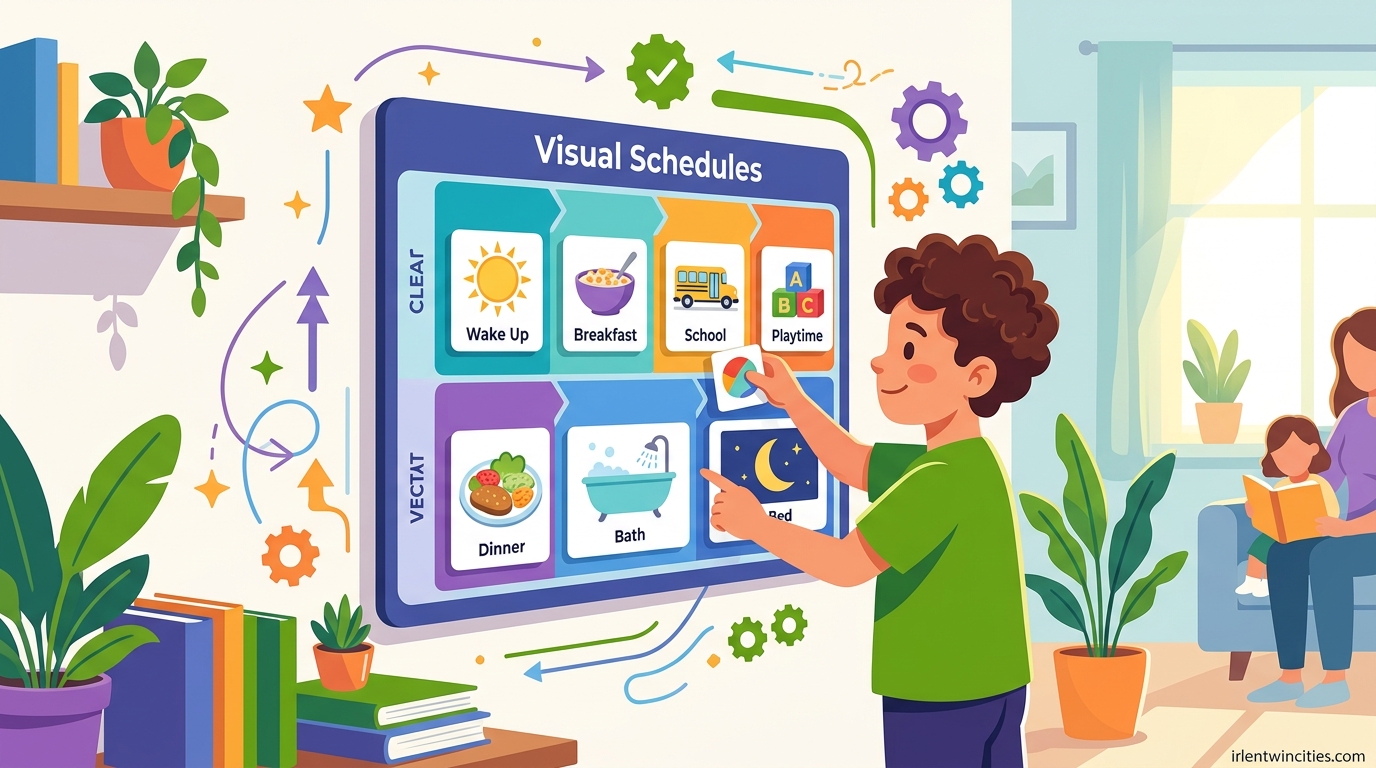
Visual schedules are tools that use pictures, symbols, words, or physical objects to communicate the sequence of upcoming activities or events. Unlike verbal instructions, which disappear the moment they are spoken, visual schedules provide information that stays available. An autistic child can look at their schedule as many times as needed, processing the information at their own pace without the pressure of immediate response.
These tools range from simple to complex depending on the child’s needs. A toddler might use a First-Then board showing just two activities. An older child might have a detailed written schedule broken into morning, afternoon, and evening blocks. The core principle remains consistent. Visual schedules make time and sequence concrete rather than abstract.
The concept aligns with neurodiversity-affirming practices. Rather than forcing autistic children to adapt to neurotypical communication styles, visual schedules meet them where they are. They honor the visual processing strengths many autistic children possess while reducing the cognitive load of translating verbal language into action.
Why Visuals Work Better Than Words Alone
Spoken language is fleeting. When you say, “We are going to have lunch, then do homework, then go to the store,” those words vanish immediately. For a child who processes information more slowly, who struggles with working memory, or who finds auditory input overwhelming, verbal instructions create anxiety rather than clarity.
Visuals remain. A child can check their schedule, put the finished activity in a “done” envelope, and see clearly what comes next. This predictability allows their nervous system to settle. They are no longer bracing for surprises because the information is always available, always reliable, always the same.
How Visual Schedules Help Autistic Kids Cope
Visual schedules help autistic kids cope by addressing the core challenges many face with predictability, transitions, and executive functioning. When a child knows what to expect, their anxiety decreases dramatically. When they can anticipate transitions before they happen, meltdowns become less frequent. When they can check their schedule independently, they build genuine autonomy rather than dependence on adult prompts.
The coping benefits extend across multiple domains of a child’s life. Parents consistently report that visual schedules reduce the daily friction that was draining their family’s energy. Teachers note that children using visual schedules participate more fully in classroom activities. Therapists observe that children make faster progress on goals when their environment supports their processing needs.
Anxiety Reduction Through Predictability
Autistic nervous systems often process uncertainty as threat. When a child does not know what is coming next, their body may respond with the same physiological reactions others feel in genuinely dangerous situations. Heart rate increases. Cortisol spikes. The child enters a state of hypervigilance that makes calm participation impossible.
Visual schedules provide the predictability that soothes this response. A parent from a forum I follow described the change in her seven-year-old son after introducing a morning schedule. Before, every school morning ended in tears. After three weeks with a visual schedule, he began checking it himself and moving through his routine without prompts. She called it “magic,” but it is not magic. It is nervous system regulation made accessible.
Supporting Emotional Regulation
Emotional regulation is the ability to manage emotional responses to situations. Many autistic children struggle with this skill not because they lack capacity, but because they are constantly managing overwhelm from an unpredictable world. Visual schedules reduce that baseline overwhelm, freeing up cognitive resources for emotional processing.
When a child can see that a preferred activity follows a less preferred one, they can tolerate the difficult task better. When they know exactly when a transition will happen, they can prepare emotionally rather than being caught off guard. Over time, this consistent support helps children internalize regulation strategies that last a lifetime.
Executive Functioning Support
Executive functioning includes skills like planning, task sequencing, time management, and working memory. These are areas where many autistic children need support. Visual schedules externalize these functions, providing a scaffold that allows children to succeed while their skills develop.
A schedule breaks a complex routine into manageable steps. Instead of facing the overwhelming command to “get ready for bed,” a child sees individual steps: put on pajamas, brush teeth, use the bathroom, read a book. Each step is concrete and achievable. The child experiences success at each point, building confidence for tackling bigger challenges.
Types of Visual Schedules
Visual schedules come in many formats, and the best choice depends on your child’s age, processing style, and specific needs. Some children respond best to physical objects they can manipulate. Others prefer digital apps they can carry on a tablet. The goal is matching the format to the child, not forcing the child to adapt to a predetermined format.
Object Schedules
Object schedules use physical items to represent activities. A spoon might represent mealtime. A small toy car might represent an outing. These work exceptionally well for young children or those who do not yet connect pictures to their meanings. The child can hold the object, carry it to the activity location, and place it in a “finished” container when done. This tactile element reinforces the connection between the schedule and real life.
Picture and Photo Schedules
Picture schedules use drawings or photographs to represent activities. Many parents take photos of their child actually doing the activities, which makes the connection even clearer. These schedules can be arranged on a strip, in a book, or on a board. As the child completes each activity, they remove the picture and place it in a designated “all done” pocket or box.
Icon and Symbol Schedules
Icon schedules use standardized symbols like those from the Boardmaker software or other visual symbol systems. These work well for children who have learned symbol meaning and can generalize across contexts. Icons are clean and simple, reducing visual clutter that might overwhelm some children. They also transition well between home and school settings where similar symbol systems may be in use.
Written Word Schedules
For children who read, written word schedules provide the same predictability without the need for pictures. These can look like simple lists or more detailed planners. Even children who read fluently may benefit from color-coding or simple formatting that makes the schedule easy to scan quickly. Written schedules work well for older children and teens who might feel self-conscious using picture-based tools in public.
Digital and Tablet-Based Schedules
Digital visual schedules represent an important evolution in this space. Apps like Goally provide portable, flexible scheduling that can be updated on the go. Parents in online forums consistently mention these tools as game-changers for community outings where paper schedules get lost or damaged. Digital schedules can include timers, audio prompts, and reward systems built right in. They offer privacy for older children who prefer not to display their support needs publicly.
First-Then Boards
First-Then boards are the simplest form of visual schedule, showing just two activities. The format is explicit: first we do this, then we do that. These work beautifully for children who are new to schedules, who are very young, or who need immediate clarity about the next reinforcer. A First-Then board might show “first homework, then iPad.” The child can see clearly that the preferred activity follows the required one, increasing cooperation and reducing negotiation.
Key Benefits of Visual Schedules for Autistic Children
The benefits of visual schedules extend far beyond simply “keeping a child on track.” When implemented with a neurodiversity-affirming approach, they become tools for genuine growth, trust-building, and autonomy. Let me break down the key benefit areas that matter most to families.
Reducing Anxiety Through Predictability
Predictability is not a luxury for many autistic children. It is a nervous system need. Visual schedules provide the structure that allows a child’s body to shift from defense mode into learning mode. When a child knows exactly what is happening and when, they stop expending energy on vigilance and can engage more fully with their environment.
This predictability also creates opportunities for positive experiences. A child who trusts their schedule can enjoy the current activity more fully because they are not worrying about what comes next. They can be present rather than anxious. Over time, this builds a foundation of safety that supports exploration and growth.
Building Independence and Autonomy
Traditional approaches often create dependence on adult prompts. A child waits for a parent to tell them what to do next, developing a pattern of prompt dependence that limits their autonomy. Visual schedules flip this dynamic. The child checks their schedule independently and initiates the next activity themselves.
This independence builds genuine self-esteem. A child who can manage their own routine experiences themselves as capable. They internalize the message that they can handle their day, that they do not need constant adult direction to function. For parents, this means less nagging and more space for positive interaction.
Supporting Emotional Regulation
Emotional regulation skills develop best when a child is not in a constant state of overwhelm. Visual schedules reduce that overwhelm by making the environment more manageable. They also provide concrete tools for handling difficult moments. A child can look at their schedule and see that a challenging activity has a clear end point. They can use the schedule to anticipate and prepare for transitions.
Some families add emotion regulation strategies right into their visual schedules. A schedule might include “take a break” as a legitimate activity, teaching children that managing their energy is a normal part of the day. This integration of regulation support into routine structure is powerful for long-term skill development.
Improving Executive Functioning
Executive functioning challenges affect many autistic children. They may struggle to sequence tasks, manage time, hold multiple steps in mind, or initiate activities. Visual schedules provide external support for all of these functions. The schedule shows the sequence so the child does not have to remember it. It breaks time into visual chunks. It provides clear cues for initiation.
Importantly, this support does not create dependence when implemented thoughtfully. As children internalize routines, they often need the schedule less. Some transition to more minimal prompts or internalized checklists. The schedule serves as a scaffold that supports growth rather than a permanent crutch.
Creating School-to-Home Continuity
One gap I consistently see in existing resources is the lack of attention to consistency between school and home. Many children use visual schedules successfully at school but struggle at home, or vice versa. Creating continuity between these environments multiplies the benefits.
When schools and families use similar visual schedule formats, children experience the world as more coherent and predictable. They can generalize skills across contexts. Parents should ask about their child’s school schedule system and consider mirroring it at home. Even using similar language or symbols helps. This continuity is particularly important during transitions like the start of a new school year or when moving between educational settings.
How to Implement Visual Schedules for Children with Autism
Implementing visual schedules effectively requires thoughtful planning and consistent follow-through. Rushing the process or abandoning it too early are common mistakes. The following eight steps provide a framework for successful implementation that builds lasting skills.
Step 1: Assess Your Child’s Current Level. Start by observing what your child already understands. Do they respond to objects? Pictures? Written words? Match the schedule format to their current abilities rather than pushing them toward a more advanced format prematurely.
Step 2: Choose Your Format. Based on your assessment, select the schedule type that fits your child. Consider portability needs, durability, and ease of updating. Many families start with simple First-Then boards before moving to longer schedules.
Step 3: Involve Your Child in Creation. When possible, let your child help create their schedule. They might choose the pictures, help arrange the order, or select the container for finished items. This investment increases buy-in and makes the schedule feel like theirs rather than something imposed.
Step 4: Start With One Routine. Do not try to schedule an entire day immediately. Choose one routine, like morning preparation or bedtime, and implement the schedule there first. Build success in one area before expanding.
Step 5: Teach the System Explicitly. Show your child how to use the schedule. Demonstrate checking it, completing an activity, and moving the marker to “done.” Practice together without pressure. Make it clear that the schedule is a tool to help, not a test to pass.
Step 6: Be Consistent. Use the schedule every time for the target routine. Inconsistency undermines trust. If the schedule is only used sometimes, children learn that it is not reliable, and anxiety returns.
Step 7: Fade Prompts Gradually. Initially, you may need to prompt your child to check their schedule frequently. Gradually reduce these prompts as your child internalizes the habit. The goal is independent use, not permanent dependence on adult cues.
Step 8: Expand and Adapt. As your child masters one routine, gradually expand the schedule to include more of their day. Update the format as their skills grow. A schedule should evolve with your child rather than staying static.
Tips for Making Visual Schedules Work
Even with a solid implementation plan, challenges arise. These tips address common issues and help you optimize your visual schedule system for long-term success.
Make It Portable
Life happens outside the home. A schedule that only exists on a wall in the kitchen cannot support your child at the grocery store or during a visit to grandparents. Create portable versions using small binders, laminated cards on rings, or digital apps. Many parents find that having a “home base” schedule and a “go” schedule works well.
Handle Schedule Changes Gracefully
Changes happen. Therapists cancel. Weather disrupts plans. Handling these changes well is a skill worth teaching explicitly. When a change is necessary, use a specific marker, like a red card or a “change” symbol, to indicate the substitution. Preview changes as early as possible. Acknowledge that changes are hard while maintaining confidence that your child can handle them with support.
Keep It Child-Centered
The schedule should serve your child, not your convenience. Include their preferences and needs. Build in breaks, sensory activities, and preferred items. A schedule that is all demands and no joy will face resistance. Balance is key.
Avoid Common Mistakes
Do not use the schedule as a threat. Removing schedule privileges as punishment undermines the trust the schedule is meant to build. Do not overload the schedule with too many items. Keep it manageable. Do not ignore your child’s feedback. If they resist the schedule, investigate why rather than forcing compliance. The resistance is information about what needs adjustment.
Troubleshoot Proactively
If a schedule stops working, investigate before abandoning it. Has the format become too simple or too complex? Are there environmental changes affecting your child? Has the routine itself changed, making the schedule inaccurate? Sometimes a small adjustment restores effectiveness.
Consider Digital Options for Older Children
School-age children and teens may resist picture-based schedules as “babyish.” Digital options provide age-appropriate alternatives. They also offer features like timers and checklists that support executive functioning in ways paper cannot. The privacy of a tablet or phone may also appeal to teens who want their support tools to be invisible to peers.
Frequently Asked Questions
What is the best age to start visual schedules?
You can start visual schedules at any age. Object schedules work for toddlers as young as 18 months. Picture schedules work for preschoolers. Written schedules work for school-age children who read. Even teens and adults benefit from visual scheduling systems. The key is matching the format to the individual’s developmental level, not their chronological age.
Do visual schedules work for nonverbal children?
Visual schedules often work exceptionally well for nonverbal children. Object schedules and picture schedules do not require verbal skills. In fact, visual schedules can support communication development by giving nonverbal children a way to understand and anticipate their day without relying on language processing.
How do I handle unexpected schedule changes?
Use a specific change marker, like a red card with the word change or a special symbol. Introduce the change as early as possible. Acknowledge that changes are difficult while expressing confidence that your child can handle it. Some families keep a few flexible activity cards ready for unexpected situations.
Can older kids and teens benefit from visual schedules?
Absolutely. Older children and teens often benefit from written schedules, digital apps, or planner-based systems. Visual schedules support executive functioning and reduce anxiety at any age. For teens, digital options provide privacy and age-appropriate presentation that respects their growing independence.
What if my child resists using a visual schedule?
Resistance is information. Investigate why. Is the format wrong for their processing style? Is the schedule too demanding? Does it need more preferred activities? Involve your child in modifying the system. Sometimes starting with just a First-Then board reduces overwhelm. Build from success rather than forcing compliance.
Conclusion
Visual schedules autistic kids can rely on are more than organizational tools. They are bridges to understanding, safety, and independence. By making time and sequence visible, these supports reduce the anxiety that so many autistic children carry through their days. They build trust between children and the adults who care for them. They create space for growth by removing unnecessary obstacles.
The journey to effective visual scheduling takes patience and observation. Start simple. Stay consistent. Listen to your child’s feedback and adjust accordingly. Whether you choose object schedules for a toddler, picture boards for a preschooler, or a digital app for a teen, the principles remain the same. Meet your child where they are. Honor their processing needs. Build autonomy rather than dependence.
If you are just beginning, pick one routine and try a simple First-Then board this week. Watch how your child responds. Celebrate small wins. Over time, you may find that visual schedules do not just help your child cope with daily demands. They help your whole family breathe easier, connect more deeply, and move through life with greater confidence and joy.