
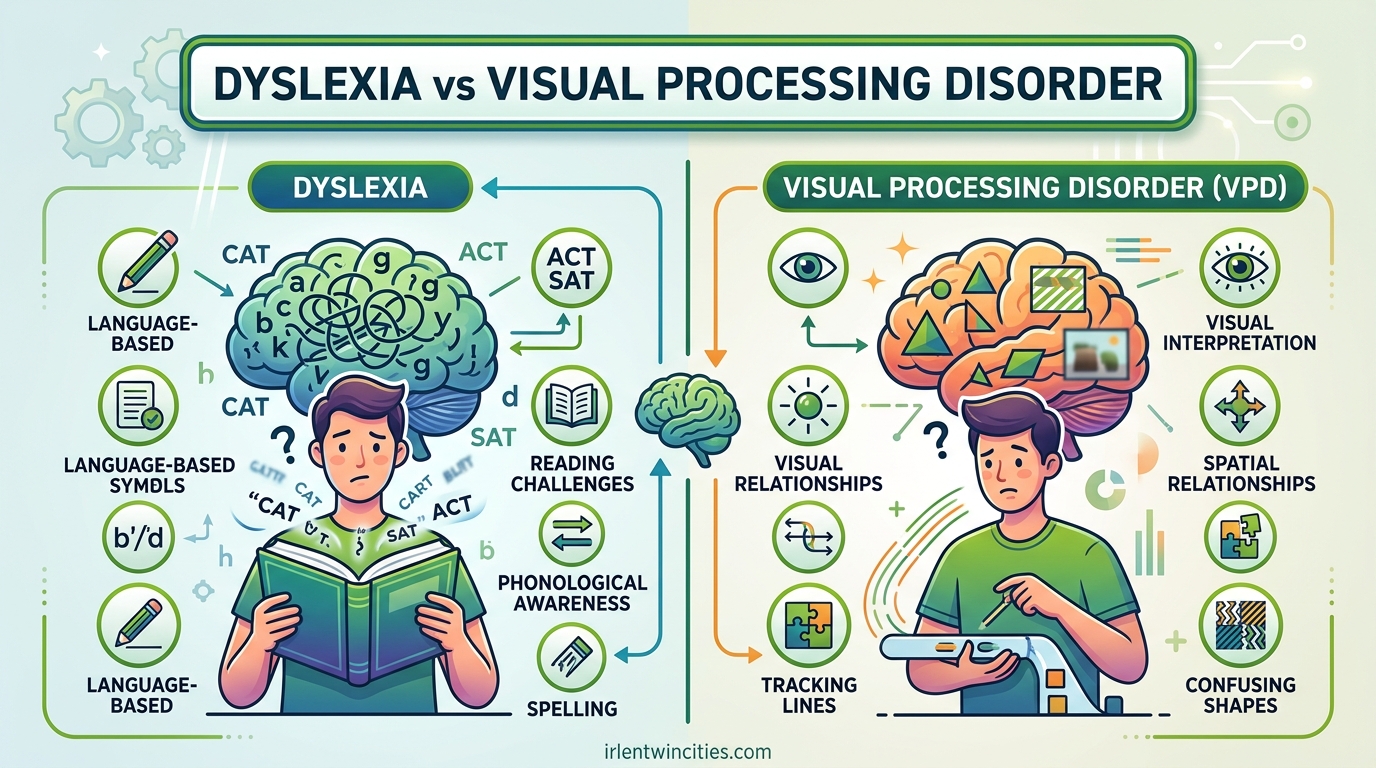
Watching your child struggle with reading can feel overwhelming. You might wonder if it’s dyslexia, a vision problem, or something else entirely. Understanding the difference between dyslexia and visual processing disorder is the first step toward getting your child the right help.
Dyslexia and visual processing disorder (VPD) often look similar on the surface. Both cause reading difficulties, frustration with schoolwork, and academic struggles. However, they stem from completely different causes and require different interventions. Knowing dyslexia vs visual processing disorder characteristics can save years of misdiagnosis and wrong treatments.
In this guide, I will walk you through exactly how to tell these two conditions apart. We will explore the root causes, specific symptoms to watch for, and when to seek professional assessment. By the end, you will have a clear framework for understanding what your child might be experiencing.
Table of Contents
What Is Dyslexia?
Dyslexia is a learning disability that affects how the brain processes language. Specifically, it involves difficulties with phonological processing, which is the ability to connect letters to their corresponding sounds. This is not a vision problem. The eyes work fine; the issue lies in how the brain interprets and manipulates sounds and symbols.
Children with dyslexia have trouble with phonemic awareness, meaning they struggle to identify and work with individual sounds in words. They might have difficulty breaking down the word “cat” into its three separate sounds: /c/, /a/, /t/. This foundational skill is essential for reading, so challenges here create a cascade of reading difficulties.
The condition runs in families and affects approximately 10-20% of the population. Dyslexia has nothing to do with intelligence. Many brilliant, creative thinkers have dyslexia. The brain simply processes language differently, which creates challenges with traditional reading instruction methods.
What Is Visual Processing Disorder?
Visual processing disorder involves difficulties in how the brain interprets visual information coming from the eyes. This is fundamentally different from vision problems like nearsightedness or farsightedness. A child can have 20/20 vision yet still struggle with visual processing. The eyes see clearly, but the brain cannot properly make sense of what it sees.
VPD affects various aspects of visual perception, including the ability to discriminate between similar-looking letters (like b and d), remember visual sequences, or coordinate eye movements for tracking across a line of text. The brain struggles to process spatial relationships, visual patterns, and symbolic representations.
This condition often goes undiagnosed because standard eye exams do not test for visual processing skills. An ophthalmologist checks eye health and acuity, but not how the brain processes visual input. This gap in testing leads many children to be mislabeled as having dyslexia or simply being lazy or inattentive.
Dyslexia vs Visual Processing Disorder: Key Differences
Understanding the core distinction between these conditions comes down to where the breakdown occurs. Dyslexia is primarily an auditory-language processing issue. VPD is a visual-spatial processing issue. Both affect reading, but for completely different neurological reasons.
Here is a clear comparison to help you understand the differences:
| Characteristic | Dyslexia | Visual Processing Disorder |
|---|---|---|
| Primary Cause | Phonological processing deficits (sound-letter connection) | Visual-spatial processing deficits (brain interpretation of visual info) |
| Root of the Problem | Language processing areas of the brain | Visual processing pathways in the brain |
| Letter Reversals | Common in early readers, persists in older children | Very common; may see letters move, blur, or double |
| Reading Errors | Guessing words based on first letter or context; skipping small words | Skipping lines, losing place, words appearing to swim or fade |
| Spelling Patterns | Phonetic but incorrect spellings; trouble with irregular words | Poor spatial awareness; letters crowded or poorly spaced |
| Writing Issues | Organizational difficulties; trouble getting ideas on paper | Poor handwriting despite good fine motor skills; spacing problems |
| Primary Intervention | Structured literacy, Orton-Gillingham approach | Vision therapy, visual-motor integration exercises |
| Who Diagnoses | Neuropsychologist, educational psychologist, reading specialist | Developmental optometrist, neuropsychologist |
I have spoken with many parents over the years who spent months or even years doing phonics-based interventions with minimal results. Their children turned out to have visual processing issues that phonics drills could not address. The reverse also happens. A child with true dyslexia will not improve with vision therapy alone. Proper diagnosis matters enormously.
Signs Your Child May Have Dyslexia
Look for these specific indicators that point toward dyslexia rather than a visual processing issue:
Phonological Warning Signs:
- Difficulty rhyming words or playing with sounds in language
- Trouble learning letter names and their corresponding sounds
- Struggling to blend sounds together to form words
- Difficulty segmenting words into individual sounds
- Poor working memory for sequences (trouble recalling days of the week, months, counting)
Reading and Spelling Patterns:
- Reading is slow and labored, with lots of guessing
- Omits, substitutes, or adds small words when reading aloud
- Spelling is phonetic but incorrect (“sed” for “said”)
- Difficulty with sight words that cannot be sounded out
- Avoids reading or becomes anxious when asked to read
Family History:
- Relatives who struggled with reading or were diagnosed with dyslexia
- Parents or siblings with similar learning patterns
Children with dyslexia often compensate by developing strong contextual guessing skills. They might appear to read well when text has pictures or context clues, but struggle significantly with isolated words or nonsense words. This pattern strongly suggests phonological processing issues rather than visual ones.
Signs Your Child May Have Visual Processing Disorder
These indicators suggest visual processing difficulties that go beyond typical reading challenges:
Visual Perception Issues:
- Complains that letters move, blur, or appear double on the page
- Reports that words swim, fade, or shimmer when reading
- Difficulty distinguishing between similar-looking letters (b/d, p/q, m/n)
- Problems with visual closure (recognizing objects or letters when partially hidden)
- Trouble with figure-ground discrimination (finding specific information on a busy page)
Tracking and Movement:
- Frequently skips lines or loses place when reading
- Uses finger or bookmark to keep place despite being old enough to track without aids
- Words appear to run together without clear spacing
- Eye fatigue, headaches, or rubbing eyes after short reading sessions
- Avoids reading or becomes tired quickly
Writing and Spatial Issues:
- Poor handwriting despite adequate fine motor skills
- Inconsistent spacing between letters and words
- Difficulty staying within lines on paper
- Letters may be different sizes or floating above/below the baseline
One parent I spoke with described their child seeing “two balls” when only one object existed. Another noted their daughter could draw detailed pictures but wrote letters that crowded together illegibly. These real experiences illustrate how VPD manifests differently than dyslexia.
Can a Child Have Both Conditions?
Yes, a child can have both dyslexia and visual processing disorder simultaneously. This complicates diagnosis and treatment, but understanding the possibility is crucial. When both conditions exist, addressing only one will leave significant gaps in the child’s reading ability.
Research suggests that a notable percentage of children with reading difficulties have co-existing conditions. A child might struggle with both phonological processing AND visual perception. In these cases, a comprehensive assessment that evaluates both language and visual processing is essential.
When both conditions are present, interventions need to target both areas. This might mean combining structured literacy instruction with vision therapy or visual accommodations. It requires coordination between different professionals, but the results are worth the effort.
When and How to Seek Professional Assessment
If you suspect your child has either condition, early assessment is critical. The longer a child struggles with the wrong intervention, the more frustrated they become. Academic gaps widen, and self-esteem suffers. Here is how to navigate getting proper help:
Start with a Comprehensive Eye Exam:
Schedule an exam with a developmental optometrist, not just a standard optometrist or ophthalmologist. Developmental optometrists specifically evaluate visual processing skills, eye tracking, and eye teaming. They look beyond 20/20 vision to assess how the visual system functions during reading and close work.
Educational Evaluation:
A neuropsychologist or educational psychologist can assess phonological processing, working memory, and reading skills. They typically administer tests like the CTOPP (Comprehensive Test of Phonological Processing) to evaluate sound-based skills. This evaluation identifies dyslexia and other learning disabilities.
Red Flags That Warrant Immediate Assessment:
- Your child is significantly behind peers in reading despite normal intelligence
- Reading struggles persist after six months of targeted intervention
- Your child expresses frustration, anxiety, or avoidance around reading
- There is a family history of dyslexia or reading difficulties
- Your child reports visual symptoms (letters moving, blurring, double vision)
Parents often tell me they feel overwhelmed not knowing where to turn. The path forward starts with trusting your observations. You know your child better than anyone. If something feels off about their reading development, pursue answers. The right diagnosis changes everything.
Frequently Asked Questions
Is it dyslexia or visual processing disorder?
What eye condition mimics dyslexia?
Is visual processing disorder the same as dyslexia?
Is VPD a learning disability?
How do I know if my child has a visual processing disorder?
How do you know if your child has a processing disorder?
Conclusion
Understanding dyslexia vs visual processing disorder is not just academic terminology. It represents the difference between years of frustrating interventions and targeted support that actually works. The right diagnosis opens doors to appropriate treatment, whether that is structured literacy instruction, vision therapy, or a combination of both.
Trust your instincts as a parent. If your child struggles with reading despite normal intelligence, something is going on. The patterns you observe at home matter. Take notes on specific symptoms, talk to teachers, and pursue professional assessment. The earlier you identify the root cause, the sooner your child can access the help they need.
Remember, neither condition is a reflection of intelligence or potential. Both dyslexia and visual processing disorder are manageable with proper support. Your advocacy and persistence will make the difference in your child’s educational journey and self-confidence.