
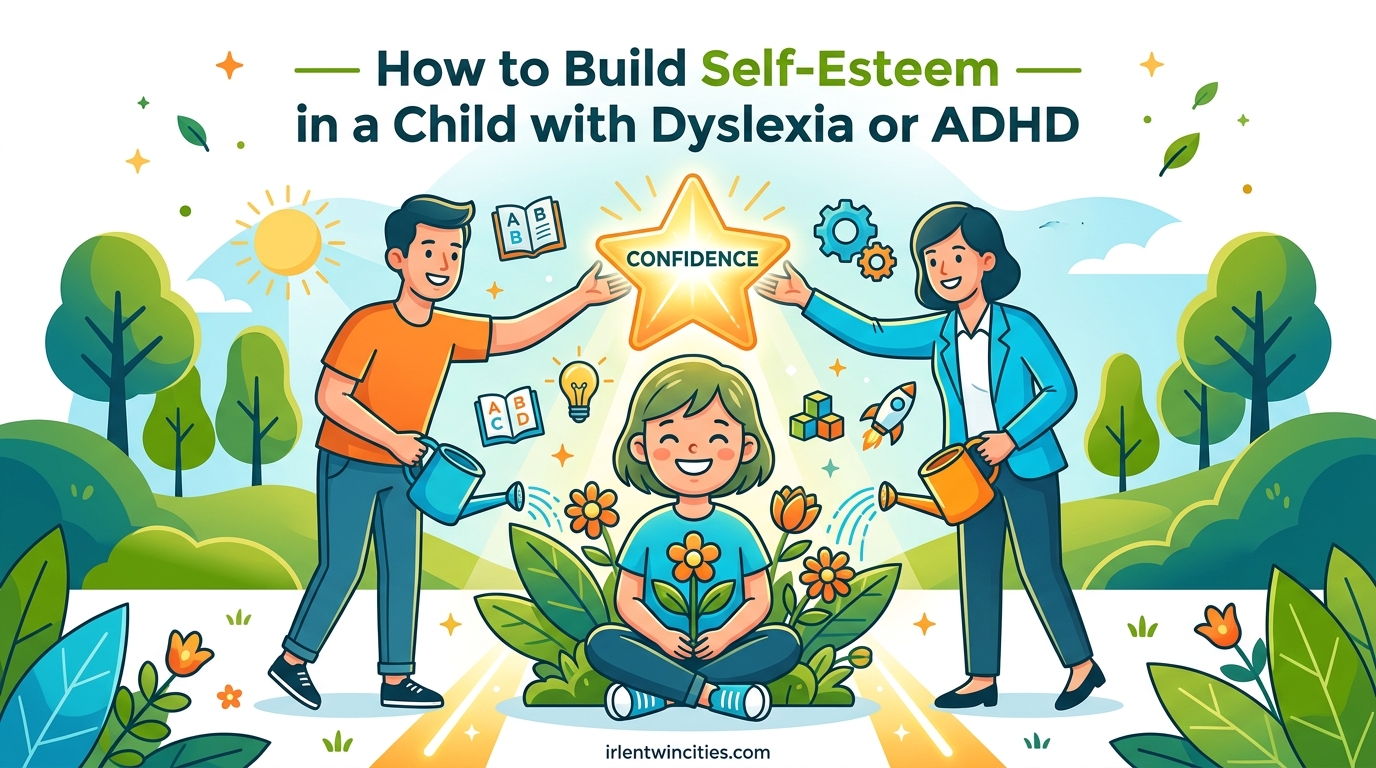
Your child comes home from school, throws their backpack on the floor, and mutters those heartbreaking words: “I’m stupid.” As a parent of a child with dyslexia or ADHD, you’ve probably heard some version of this before. Hearing your child internalize their struggles as a reflection of their worth is one of the most painful experiences a parent can face.
I’ve worked with hundreds of families navigating this exact challenge over the past decade. The good news is that self-esteem can be built, strengthened, and protected—even when your child faces daily academic struggles that their peers don’t experience.
This guide will walk you through exactly how to build self-esteem in a child with dyslexia or ADHD using proven strategies that address the unique challenges neurodivergent children face. You’ll learn specific scripts to respond to negative self-talk, discover how to shift from praising outcomes to praising effort, and find age-specific guidance for supporting your child from elementary school through the teenage years.
Table of Contents
Understanding How Dyslexia and ADHD Affect Self-Concept
Before diving into strategies, it’s important to understand why children with learning differences are particularly vulnerable to low self-esteem. Traditional school environments are designed for neurotypical learners, which means children with dyslexia and ADHD face constant small failures throughout their day.
Think about it from your child’s perspective. They might struggle to decode a simple sentence while their classmates breeze through chapter books. They may forget their homework for the third time this week despite their best intentions. They might blurt out answers in class and get corrected by the teacher. These moments accumulate into a narrative that says: “Something is wrong with me.”
The Daily Challenges That Erode Confidence
Children with dyslexia often experience reading as a exhausting decoding exercise rather than an enjoyable activity. They see peers finish assignments in half the time. They may be pulled out of class for special services, which can feel stigmatizing even when well-intentioned.
For children with ADHD, the challenges are different but equally damaging to self-worth. Their brains are wired for interest-based learning, not importance-based learning. They may hear “pay attention” or “stop being disruptive” dozens of times per day. Over months and years, this constant correction shapes their self-concept.
Warning Signs of Low Self-Esteem in Children
Watch for these red flags that your child’s self-esteem needs support:
They make negative statements about their intelligence or abilities. “I’m dumb,” “I can’t do anything right,” or “Everyone else is smarter than me” become regular refrains.
They avoid challenges or give up quickly. You might hear “This is too hard” before they’ve really tried, or they may refuse to attempt new activities where they might fail.
They become withdrawn or show signs of anxiety about school. A child who used to be enthusiastic may start complaining of stomachaches on school mornings or resisting homework with increasing intensity.
They compare themselves unfavorably to peers constantly. They notice differences and interpret them as personal failures rather than different learning profiles.
Strategy 1: Respond to Negative Self-Talk with Specific Scripts
When your child says “I’m stupid,” your heart breaks. But responding effectively in these moments is one of the most powerful tools you have for building self-esteem. The key is having specific, practiced responses ready.
Here’s a table of common negative statements children make and exactly what you can say in response:
| When Your Child Says… | Try Responding With… |
|---|---|
| “I’m stupid.” | “You’re not stupid. Your brain just learns differently, and that takes more effort sometimes. I see how hard you try.” |
| “I can’t do this.” | “You can’t do this YET. Let’s break it down into smaller pieces. What part feels hardest right now?” |
| “Everyone else gets this but me.” | “Everyone has different strengths. Some things come easier to others, but you have gifts they don’t have. Let’s talk about what you’re great at.” |
| “School is impossible for me.” | “School IS hard for you right now, and that’s frustrating. But hard doesn’t mean impossible. Remember when [specific past success] felt impossible too?” |
| “I’m bad at everything.” | “That sounds really hard to feel. Let’s make a list together of things you’re good at. I can think of three right now: [specific strength], [specific strength], and [specific strength].” |
| “I hate myself.” | “I love you completely, exactly as you are. You’re good, kind, and worthy of love regardless of grades or test scores. Let’s talk about what’s making you feel this way.” |
The goal isn’t to dismiss your child’s feelings or immediately fix the problem. Validation comes first. When you acknowledge that school IS hard for them and that their feelings make sense, you build trust. Only then can you guide them toward a different perspective.
Reframing the Narrative Together
After validating their feelings, help your child reframe the situation. Instead of arguing with their self-assessment, introduce the concept of “learning differences” rather than “learning disabilities.”
Try saying: “Your brain is like a smartphone with different apps. Your creativity app and your problem-solving app are super strong. Your reading app needs more updates and practice. That’s not bad—it just means we need different tools to help that app run smoothly.”
This metaphor helps children understand that their struggles are about brain wiring, not character flaws or lack of effort.
Strategy 2: Praise Effort and Process, Not Just Results
The research on growth mindset by Dr. Carol Dweck has transformed how we think about praise. For children with learning differences, this shift is absolutely critical. When you praise only results, children with dyslexia or ADHD will rarely feel successful because traditional academic results come harder to them.
Instead, focus on what researchers call “process praise.” This means noticing and commenting on the strategies, effort, persistence, and approaches your child uses—not just the outcomes.
What Process Praise Sounds Like
Here are specific examples of how to shift your language:
Instead of: “You got an A! You’re so smart!”
Try: “You got an A! I saw you studying for 20 minutes each night this week. That consistent practice really paid off.”
Instead of: “Great job finishing your homework!”
Try: “You stuck with that math homework even when it got frustrating. I noticed you took a break and came back to it. That shows real persistence.”
Instead of: “I’m proud you read that whole book!”
Try: “I noticed you used your finger to track the words when it got hard. That’s a smart strategy, and it helped you finish the chapter.”
Building Growth Mindset Language at Home
Create a family culture where challenges are normalized. Share your own struggles and how you work through them. When you make a mistake, narrate your thinking: “Oops, I burned dinner. That’s frustrating, but I’m going to figure out what went wrong and try a different temperature next time.”
Introduce the word “yet” into your family’s vocabulary. “I can’t do this” becomes “I can’t do this yet.” “I don’t understand” becomes “I don’t understand yet.” This small word carries enormous power because it implies growth is possible.
Strategy 3: Identify and Build on Strengths
Children with dyslexia and ADHD often have remarkable strengths that get overlooked in traditional school settings. Your job as a parent is to help your child discover, develop, and take pride in these abilities.
Dr. Edward Hallowell, a psychiatrist specializing in ADHD, often says that ADHD comes with a ” Ferrari engine for a brain but with bicycle brakes.” The challenge isn’t lack of capability—it’s channeling that capability effectively.
Common Strengths of Dyslexic Children
Many dyslexic children show exceptional abilities in spatial reasoning, big-picture thinking, creativity, and problem-solving. They often excel at building, designing, storytelling, and understanding complex systems. Famous dyslexics include entrepreneurs like Richard Branson, scientists like Einstein, and artists like Picasso.
Common Strengths of Children with ADHD
Children with ADHD often demonstrate high creativity, enthusiasm, resilience, and the ability to think outside the box. They may be excellent at hands-on activities, creative pursuits, sports, and anything that captures their interest. When engaged, they can show remarkable focus and persistence.
Creating a Strengths Inventory
Sit down with your child and create a list of things they’re good at. Don’t limit this to academics. Include character traits, hobbies, social skills, and physical abilities. Post this list somewhere visible.
When your child faces a reading struggle, you can reference this list: “Reading is hard right now, and that’s real. Remember, you’re also the kid who can build incredible Lego structures and make everyone laugh. You’re more than your reading score.”
Strategy 4: Create Opportunities for Mastery
Mastery experiences—moments when your child accomplishes something through effort and practice—are the building blocks of self-esteem. For children who struggle in school, it’s essential to create these opportunities outside of academics.
The key is finding activities where your child can experience progress, improvement, and eventually competence. This doesn’t mean pushing them to be the best. It means helping them feel the satisfaction of getting better at something through their own effort.
Extracurricular Activities That Build Confidence
Not all activities are created equal for children with learning differences. Look for pursuits that play to their strengths and offer concrete skill progression.
Martial arts is often excellent for children with ADHD. It channels energy, teaches self-control, and has clear belt progression that rewards consistent effort. The structure and ritual can be calming.
Art, music, and creative activities allow dyslexic children to excel in visual-spatial or creative domains. Many dyslexics are naturally artistic and find relief in expressing themselves non-verbally.
Sports and physical activities can build confidence through physical mastery. Individual sports like swimming, rock climbing, or track allow children to compete against themselves and see personal improvement.
Coding and robotics often appeal to neurodivergent children because they involve logical, systematic thinking. Many children with ADHD thrive in coding because it combines creativity with clear rules.
Start With Interest, Not Achievement
Dr. Hallowell emphasizes the importance of starting with connection and play, not achievement pressure. When your child is interested in something, they’re more likely to persist through challenges. Follow their interests, even if they seem unusual or unimportant to you.
If your child loves video games, that’s not necessarily a problem to solve. Many video games build problem-solving skills, spatial reasoning, and persistence. The key is balancing screen time with other activities and using gaming interests to connect with your child.
Strategy 5: Foster Deep Family Connection
At the heart of self-esteem is belonging. Children need to know they are loved and accepted unconditionally, separate from their achievements or struggles. For children who face daily challenges at school, home needs to be a sanctuary of acceptance.
This doesn’t mean lowering expectations or removing all structure. It means ensuring your child knows your love is constant, regardless of grades, reading levels, or behavior challenges.
The Power of Special Time
Set aside dedicated one-on-one time with your child regularly. This isn’t homework time or correction time—it’s connection time. Let your child choose the activity. Your full attention, without phones or distractions, sends a powerful message about their worth.
Even 15 minutes daily can make a significant difference. One parent I worked with called this “special time” and found that conflicts decreased dramatically when this connection was prioritized.
Creating Family Rituals
Rituals and traditions create a sense of belonging and security. These can be simple: Friday pizza nights, Sunday morning pancake breakfasts, bedtime reading rituals, or weekly family meetings where everyone shares something they’re proud of.
Include your child in meaningful contributions to the family. Even young children can set the table, help with pets, or contribute ideas for family activities. Feeling needed builds self-worth.
Handling Sibling Dynamics
Siblings of children with learning differences sometimes feel overlooked or resentful about the attention their brother or sister receives. They may not understand why accommodations are made or why homework takes longer.
Have honest conversations with siblings about learning differences in age-appropriate language. Explain that everyone has different strengths and challenges. Create one-on-one time with each child so no one feels left out.
Strategy 6: Advocate at School with Confidence
Your child’s school experience significantly impacts their self-esteem. When teachers understand and accommodate your child’s learning differences, school becomes a place of growth rather than constant struggle. Advocacy is not about making excuses—it’s about ensuring your child can demonstrate their true abilities.
Understanding IEPs and 504 Plans
If your child has a formal diagnosis, they may qualify for an Individualized Education Program (IEP) or a 504 Plan. These documents outline specific accommodations your child is entitled to receive.
An IEP is for children who need special education services. It includes specific learning goals and is reviewed annually. A 504 Plan provides accommodations for children who don’t need specialized instruction but do need support to access the general curriculum.
Common accommodations include extended time on tests, reduced homework loads, access to audiobooks, seating near the teacher, movement breaks, and use of assistive technology.
Building Positive Teacher Relationships
Approach teachers as partners, not adversaries. Start the year with a brief meeting to share your child’s strengths, challenges, and what strategies work at home. Teachers appreciate parents who communicate proactively.
Share your child’s strengths inventory with teachers. When educators see children as more than their deficits, they’re better able to support and encourage them.
If you encounter resistance, stay focused on your child’s needs. Document what works and what doesn’t. You are your child’s most important advocate, and your persistence matters.
Age-Specific Strategies for Building Self-Esteem
The strategies above apply broadly, but how you implement them should shift as your child develops. What’s effective for a 7-year-old may backfire with a 15-year-old.
Elementary Age (Ages 5-10): Building the Foundation
At this stage, focus on helping your child understand their learning difference in simple, positive terms. Use concrete examples and visual aids. Books like “The Don’t-Give-Up Kid” or “Thank You, Mr. Falker” can help children see themselves in stories of success.
Create visual reminders of their strengths. A “strengths chain” where you add a link for each thing they’re good at can be powerful. Keep praise immediate and specific.
Be cautious about pulling children out of class for services. While necessary, it can feel stigmatizing. Talk with your child about why they get extra help and frame it positively: “You get special reading time with Mrs. Smith to help your brain learn in the way that works best for you.”
Middle School (Ages 11-13): Navigating Transitions
Middle school is often when self-esteem challenges intensify. Multiple teachers, locker combinations, changing classes, and social pressure create a perfect storm for children with executive function challenges.
During these years, help your child develop self-advocacy skills. Teach them to speak with teachers about their needs, request accommodations, and explain their learning differences to peers. Role-play these conversations.
Watch for social isolation. Middle school peer groups form quickly, and children who struggle academically may be excluded. Facilitate social connections through structured activities where shared interests create bonds.
Teenage Years (Ages 14-18): Independence and Identity
Teenagers with learning differences face a unique challenge: developing independence while still needing accommodations. Many resist using supports because they don’t want to appear different from peers.
Respect their growing autonomy while maintaining necessary scaffolding. Involve teenagers in IEP meetings and decision-making about accommodations. Let them practice explaining their learning differences to others.
Focus conversations on future possibilities, not just current struggles. Talk about successful adults with dyslexia and ADHD. Help them see their learning difference as one aspect of who they are, not their defining characteristic.
Be alert for signs of depression or anxiety, which are more common in teenagers with learning differences. If you notice withdrawal, significant mood changes, or declining self-care, seek professional support.
When Nothing Seems to Work: Handling Setbacks
Some days, despite your best efforts, your child will still feel defeated. They’ll resist your encouragement, refuse to use their accommodations, or spiral into negative self-talk that you can’t interrupt. This is normal, but it’s exhausting.
Remember that building self-esteem is not linear. Your child may make progress for months, then have a difficult teacher or academic setback that sends them spiraling. This doesn’t mean you’ve failed or that your strategies aren’t working.
What to Do on Bad Days
When your child is in the depths of negative self-talk, sometimes the best thing you can do is simply be present. You don’t have to fix it. Say: “I can see you’re really struggling right now. I’m here with you, and I love you no matter what.”
After the storm passes, revisit the conversation. Ask: “What would have been helpful when you were feeling that way?” This empowers your child to think about coping strategies and communicates that their input matters.
Recognizing When to Seek Professional Help
While low self-esteem is common in children with learning differences, sometimes professional support is needed. Consider seeking help from a child psychologist if:
Your child’s negative self-talk persists for weeks despite your interventions. They’re withdrawing from activities they used to enjoy. You notice signs of depression, anxiety, or thoughts of self-harm. School refusal becomes a pattern rather than an occasional bad day. Their struggles are significantly impacting family functioning.
Therapy can help children develop coping skills, process difficult emotions, and build resilience. Look for therapists who specialize in working with neurodivergent children and who use evidence-based approaches like cognitive-behavioral therapy.
Navigating Extended Family and Social Challenges
Not everyone in your child’s life will understand learning differences. Grandparents may say “He just needs to try harder.” Family friends may compare your child unfavorably to siblings or cousins. Handling these situations requires grace and firmness.
Educating Extended Family
Provide family members with simple explanations of your child’s learning difference. You might say: “Sarah has dyslexia, which means her brain processes reading differently. She works twice as hard as other kids to read, and she needs different tools to be successful.”
Set clear boundaries around comments. If a relative makes dismissive remarks, address it directly but kindly: “I know you want to help, but comments about trying harder actually make him feel worse. What helps is acknowledging how hard he does try.”
Handling Bullying and Social Exclusion
If your child experiences bullying related to their learning differences, take it seriously. Document incidents, communicate with school administration, and support your child in developing social skills and friendships.
Role-play responses to teasing. Teach your child to use self-advocacy language: “I have dyslexia, which means I learn differently. That doesn’t mean I’m stupid.” Help them identify allies and safe spaces at school.
Parent Self-Care: You Can’t Pour From an Empty Cup
Supporting a child with learning differences is emotionally demanding. You grieve the journey you expected while navigating one you didn’t plan for. You advocate, worry, and pour energy into strategies that don’t always show immediate results.
Your emotional well-being directly impacts your child’s. When you’re depleted, you have less patience for the reframes, the praise, and the connection time that builds their self-esteem.
Building Your Support Network
Connect with other parents who understand. Facebook groups, local support groups, and online forums can provide validation, practical advice, and the comfort of knowing you’re not alone.
Consider working with a therapist yourself if you’re struggling with anxiety, grief, or overwhelm. Many parents of children with learning differences benefit from processing their own emotions about their child’s diagnosis.
Setting Realistic Expectations
You cannot protect your child from every struggle, fix every bad day, or guarantee their self-esteem. What you can do is show up consistently, love them unconditionally, and model the resilience you want them to develop.
Celebrate small victories—not just your child’s, but your own. You handled a homework meltdown with patience. You advocated effectively in an IEP meeting. You connected with your child over something they love. These moments matter.
Frequently Asked Questions
Are ADHD and dyslexia linked?
ADHD and dyslexia are separate conditions, but they frequently co-occur. Research suggests that approximately 30-50% of children with dyslexia also have ADHD, and vice versa. Both conditions involve differences in brain structure and function, particularly in areas related to processing information and executive function. While having one increases the likelihood of having the other, they are distinct diagnoses with different primary symptoms and treatment approaches.
What causes low self-esteem in children?
Low self-esteem in children develops from a combination of factors. For children with learning differences, repeated academic struggles and negative feedback are major contributors. Constant comparison to peers, perfectionism, bullying or social exclusion, criticism from adults, and unrealistic expectations can all erode self-worth. Family dynamics and genetic predisposition to anxiety or depression also play roles. Children internalize messages about their capabilities and worth based on their daily experiences and how adults respond to their struggles.
What is the 10 3 rule for ADHD kids?
The 10 3 rule is a strategy for helping children with ADHD manage focus and energy. The rule suggests 10 minutes of focused work or activity followed by 3 minutes of movement or break time. This pattern aligns with the attention span and neurological needs of many children with ADHD, who often struggle to maintain focus for extended periods. The movement breaks help regulate energy and can actually improve overall productivity and reduce frustration during homework or classroom activities.
What are the 5 C’s of self-esteem?
The 5 C’s of self-esteem provide a framework for building confidence in children: Competence (feeling capable and skilled), Confidence (belief in one’s abilities), Connection (positive relationships and belonging), Character (developing values and integrity), and Contribution (making a meaningful impact). For children with learning differences, focusing on these areas—particularly competence through non-academic strengths, connection through family and friends, and contribution through meaningful family roles—can build self-worth independent of school performance.
What should I do when my child refuses to use their accommodations?
When children resist accommodations, especially teenagers, start with a conversation about why. They may feel stigmatized, different from peers, or believe accommodations are unfair advantages. Validate their feelings while explaining that accommodations simply level the playing field—like glasses for someone who needs vision correction. Involve them in choosing which accommodations to use and when. For older children, let them take the lead in advocating for their needs with teachers. Sometimes taking a temporary break from certain accommodations, while monitoring progress, can help children recognize their value.
How do I help my child explain dyslexia or ADHD to their friends?
Help your child develop simple, confident language to explain their learning difference. For younger children: My brain learns reading differently, so I use special tools to help me. For older children: I have dyslexia, which means I’m really good at [strength] but reading takes more effort for me. I use audiobooks and extra time to show what I know. Role-play these conversations at home so your child feels comfortable. Emphasize that learning differences are common and nothing to be ashamed of. Some families find it helpful to share books about famous people with learning differences to normalize the experience.
Conclusion: Building Self-Esteem Is a Journey, Not a Destination
Learning how to build self-esteem in a child with dyslexia or ADHD is one of the most important things you can do as a parent. The strategies in this guide—from responding to negative self-talk with specific scripts, to praising effort over results, to creating opportunities for mastery—provide a roadmap for supporting your child’s developing sense of self-worth.
Remember that progress isn’t linear. There will be setbacks, bad days, and moments when you wonder if anything you’re doing is making a difference. Trust the process. The daily work of connection, validation, and strength-building compounds over time.
Your child is more than their reading level, test scores, or report card comments. They are creative, capable, and worthy of love exactly as they are. By consistently showing up with patience, advocacy, and unconditional acceptance, you’re giving them the foundation they need to thrive—not just in school, but in life.
The journey of raising a child with learning differences is challenging, but it’s also filled with unique joys and discoveries. Celebrate the small victories. Find community with other parents who understand. And remember that you are exactly the parent your child needs.