
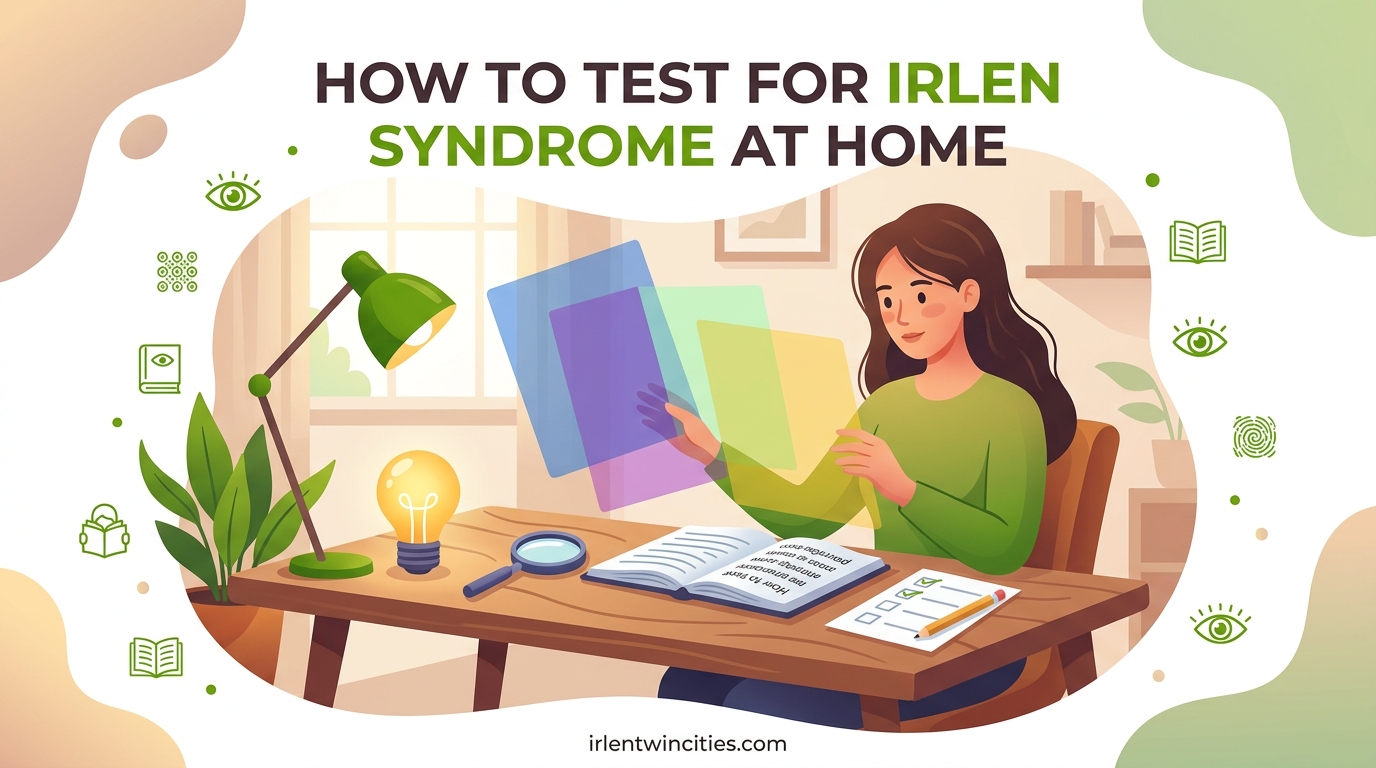
Do you find yourself re-reading the same sentence three times because the words seem to shift on the page? Maybe fluorescent lights at work give you headaches that no pain reliever touches. You have had your eyes checked, maybe even gotten new glasses, but something still feels off when you read or work on screens.
I spent three years squinting at spreadsheets before I realized my issue was not my prescription. It was how my brain processed the light coming through my perfectly functional eyes. That is the core of Irlen Syndrome, a perceptual processing disorder that affects how your brain interprets visual information.
Learning how to test for Irlen Syndrome at home is the critical first step. This guide walks you through a complete self-assessment process you can do today. You will learn what symptoms to watch for, how to conduct simple at-home tests, and when professional screening becomes necessary.
Table of Contents
What is Irlen Syndrome?
Irlen Syndrome is a perceptual processing disorder affecting how your brain interprets specific wavelengths of light. Also called Scotopic Sensitivity Syndrome or Meares-Irlen Syndrome, it is not a vision problem that standard eye exams detect. Your eyes can be perfectly healthy while your brain struggles to process the visual input they receive.
The condition creates a kind of visual static or interference. Certain light frequencies, particularly from fluorescent bulbs, bright screens, or high-contrast black-and-white text, trigger symptoms that range from annoying to debilitating. Think of it like a radio slightly out of tune. The signal comes through, but with noise that makes it hard to focus on the content.
Researcher Helen Irlen first identified this condition in the 1980s while working with college students who struggled with reading despite normal intelligence and vision. She discovered that colored filters could eliminate the perceptual distortions these students experienced. Today, spectral filters remain the primary treatment, customized to each person’s specific wavelength sensitivity.
The condition often coexists with other learning and attention challenges. Many people with dyslexia, ADHD, or autism spectrum conditions also have Irlen Syndrome. However, it is a distinct condition requiring its own assessment and treatment approach.
Signs and Symptoms That Suggest You Should Test at Home
Before diving into specific testing methods, you need to know what symptoms indicate Irlen Syndrome might be affecting you. These symptoms fall into distinct categories that paint a clearer picture of your visual processing experience.
Reading and Text Perception Issues
When reading becomes a struggle despite good vision and education, Irlen Syndrome could be the culprit. Look for these specific text-related symptoms.
Words may appear to move, shake, or shimmer on the page. The text might blur or fade in and out of focus. Some people see rivers of white space running between lines of text. Others report that letters seem to swap positions or disappear entirely.
Reading speed often suffers. You might read slowly, lose your place frequently, or need to use your finger to track lines. Skipping lines or re-reading the same line multiple times is common. Reading comprehension drops because so much mental energy goes into simply seeing the words correctly.
Some people see halos around words or experience crowding where letters seem to run together. The page may appear too bright, creating glare that makes reading uncomfortable or impossible after short periods.
Light Sensitivity and Environmental Triggers
Light sensitivity, or photophobia, represents one of the most telltale Irlen Syndrome symptoms. The wrong lighting conditions can trigger immediate discomfort or gradual fatigue.
Fluorescent lights cause particular problems. Many sufferers report headaches, eye strain, or fatigue within minutes of entering fluorescent-lit spaces. Bright sunlight, glare from snow or water, and bright screens also trigger symptoms.
Some people find themselves squinting or closing one eye to see comfortably. Others prefer dim lighting for reading when others need bright lamps. Car headlights at night may create starburst effects or painful glare that makes night driving stressful.
Strip lighting in offices, flickering from old bulbs, and bright white backgrounds on screens commonly trigger discomfort. You might find yourself adjusting screen brightness constantly or wearing sunglasses indoors.
Physical Symptoms and Discomfort
The physical toll of Irlen Syndrome extends beyond your eyes. Many sufferers experience symptoms they never connect to visual processing until they learn about this condition.
Headaches and migraines frequently accompany reading or screen work. These often start as eye strain that builds into tension headaches or full migraines. The pain typically localizes around the eyes, forehead, or temples.
Fatigue hits quickly during visual tasks. Reading for twenty minutes might exhaust you the way an hour of physical labor exhausts others. Some people feel sleepy or drowsy when reading, not because the content is boring but because their brain works overtime processing the visual input.
Nausea, dizziness, or general discomfort during visual tasks occurs for some sufferers. Neck and shoulder tension from adopting awkward reading positions to see better also causes problems. Rubbing your eyes frequently or closing them to rest during reading sessions suggests visual stress.
Depth Perception and Spatial Awareness
Less commonly discussed but equally important are depth perception and spatial awareness difficulties. These symptoms often surprise people who had no idea they connected to Irlen Syndrome.
Judging distances while driving, particularly when reversing or parallel parking, may feel harder than it should. Sports involving balls, like tennis or baseball, present challenges because tracking moving objects becomes difficult. Walking down stairs or judging curb heights creates uncertainty.
Some people report feeling clumsy, bumping into doorframes, or knocking things over because their spatial judgment seems slightly off. Difficulty catching objects or poor hand-eye coordination despite normal motor skills can indicate visual processing issues affecting depth perception.
How to Test for Irlen Syndrome at Home: Step-by-Step Method
Now that you understand the symptoms, let us walk through a practical at-home testing process. This method takes about thirty minutes and requires minimal supplies you likely already own or can obtain cheaply.
Remember, this self-test screens for symptoms. It does not provide a diagnosis. Three or more positive indicators suggest you should pursue professional Irlen screening, but only a certified Irlen diagnostician can confirm the condition and determine your optimal spectral filter.
Step 1: Prepare Your Testing Environment
Gather your materials first. You will need a book or magazine with standard black text on white paper, a computer or tablet, and several colored transparent sheets or overlays if available. Colored file folders, cellophane wrappers, or even tinted plastic report covers can work for preliminary testing.
Choose a well-lit room with both natural and artificial light options. You want to test under different lighting conditions since Irlen Syndrome symptoms often vary with light type. Set up a comfortable reading position at a normal distance, about fourteen to sixteen inches from your eyes.
Remove distractions. Turn off notifications, ensure comfortable seating, and prepare to focus for about ten minutes per test section. Have a notebook ready to record your observations for each test condition.
Step 2: The Colored Overlay Test
If you have access to colored transparent sheets, this test provides immediate visual feedback. Even without formal overlays, you can use this modified approach.
Place your reading material on a flat surface under consistent lighting. Read a paragraph normally and note any discomfort, distortions, or difficulty. Rate your comfort on a scale of one to ten.
Now place a colored sheet over the text and read the same or similar material. Try different colors if available. Common helpful colors include blue, green, rose, purple, and yellow, though individual responses vary dramatically.
Notice whether specific colors reduce glare, stop text movement, or make reading more comfortable. Does the page appear less bright? Do words seem more stable? Does your reading speed improve? Record which colors, if any, help and rate your comfort again.
Without colored sheets, test different lighting conditions. Try reading near a window, under warm incandescent light, and under cool fluorescent light. Note which lighting feels most and least comfortable for sustained reading.
Step 3: The Light Sensitivity Test
This test evaluates how different light sources affect your visual comfort and performance. You will need about ten minutes and access to different lighting environments.
Start by reading under bright fluorescent light if available. Note the time you start and any symptoms that develop. Watch for eye strain, headache onset, text distortions, or general discomfort. Stop if significant symptoms develop and record how long you lasted comfortably.
Move to natural light or warm incandescent lighting. Read the same material for the same duration. Compare your comfort level. Many Irlen Syndrome sufferers notice dramatic differences between fluorescent and other light types.
Test screen sensitivity by working on your computer or tablet under different conditions. Try with maximum brightness, minimum brightness, and night mode or blue light filters enabled. Note which settings feel most comfortable for your eyes and reduce strain fastest.
Step 4: The Reading Comfort Test
This test focuses specifically on reading performance and comfort without any special tools.
Read a full page of text in a book or article, timing yourself. Count how many times you lose your place, re-read lines, or feel the need to stop and rest your eyes. Rate your comprehension by summarizing what you read.
Pay attention to physical sensations. Do your eyes feel strained? Does your head start hurting? Do you feel drowsy or mentally fatigued? Note any visual distortions you experience, even if you think they are normal.
Compare reading on white paper versus cream or off-white paper if available. Many Irlen sufferers find stark white backgrounds particularly uncomfortable. Test reading black text on white versus other color combinations if you have access to colored paper or digital color adjustments.
Step 5: Record Your Observations
Documentation matters for determining your next steps. Create a simple record of your testing results.
List each test you performed and your subjective experience. Note specific colors that helped, lighting types that triggered symptoms, and reading conditions that felt most comfortable. Include time estimates for how long you could read before discomfort developed.
Count any significant positive findings. If you noticed substantial improvement with colored overlays, major discomfort under fluorescent lights, or significant reading difficulties, these all count as positive indicators.
Take this record to a professional screening if your results suggest Irlen Syndrome. It helps diagnosticians understand your specific symptom profile and can speed the assessment process.
Irlen Syndrome Self-Test Questionnaire
Alongside the practical tests above, this questionnaire helps identify symptoms you might have normalized over years. Answer each question honestly based on your typical experience, not occasional bad days.
Reading and Perception Questions
Do you skip lines or lose your place when reading?
Do words ever appear to move, shake, or shimmer on the page?
Do you need to re-read text multiple times to understand it?
Do you avoid reading because it gives you a headache or makes you tired?
Does text appear to blur or fade in and out of focus?
Do you see rivers of white running down the page between lines of text?
Do letters ever seem to double, swap positions, or disappear?
Do you read much more slowly than others or than you would like?
Do you prefer reading in dim light when others want it brighter?
Light Sensitivity Questions
Do fluorescent lights bother you or give you headaches?
Do you feel uncomfortable or get headaches in bright sunlight?
Do you find yourself squinting or closing one eye to see comfortably?
Do computer screens or tablets bother your eyes more than they should?
Do car headlights at night create uncomfortable glare or starbursts?
Do you prefer to wear sunglasses even when others do not need them?
Does bright snow or water glare cause you discomfort or pain?
Physical Symptoms Questions
Do you get headaches, eye strain, or fatigue from reading?
Do you feel sleepy or drowsy when reading?
Do you rub your eyes frequently during or after visual tasks?
Do your eyes feel dry, gritty, or uncomfortable during computer work?
Do you develop neck or shoulder tension when reading?
Do you feel nauseous or dizzy during extended visual tasks?
Depth Perception and Spatial Questions
Do you have trouble judging distances when driving, particularly reversing?
Do you struggle with parallel parking or tight maneuvering?
Do you sometimes feel clumsy, bumping into doorframes or furniture?
Do sports involving tracking moving balls feel difficult for you?
Do you have trouble catching objects or with hand-eye coordination?
Scoring Your Results
Count your “yes” answers. Three or more positive responses indicate Irlen Syndrome may be affecting you. The more yes answers you have, the stronger the likelihood.
Questions about reading difficulties and light sensitivity carry particular weight. If you answered yes to several questions in those categories, professional screening becomes especially important.
Remember, this questionnaire screens for symptoms. It does not diagnose Irlen Syndrome. A professional assessment determines whether your symptoms stem from this condition and identifies the specific treatment you need.
Understanding Your Self-Test Results
Self-testing provides valuable information, but interpreting results correctly guides your next steps effectively.
If you scored three or more yes answers, or noticed significant improvements with colored overlays during testing, Irlen Syndrome likely contributes to your visual difficulties. This warrants professional screening with a certified Irlen diagnostician.
One or two symptoms might indicate other vision issues, stress, or temporary factors. Consider whether your symptoms persist across different situations and over time. Temporary eye strain differs from chronic visual processing problems.
Self-testing cannot determine your optimal spectral filter. That requires professional assessment with specialized equipment. The color that helped during your at-home test provides a starting point, but precise tinting makes the difference between partial relief and full symptom elimination.
When to Seek Professional Irlen Screening
Self-testing identifies potential Irlen Syndrome, but professional screening confirms it and determines treatment. Knowing when to move from home testing to professional help matters.
Seek professional screening if your self-test showed three or more positive symptoms. If colored overlays helped during testing, professional spectral filter determination can provide even better results. When reading difficulties, headaches, or light sensitivity significantly impact your work, school, or daily life, professional help becomes essential.
Children struggling with reading despite normal intelligence and education particularly benefit from screening. Early identification prevents years of academic frustration and self-doubt. Adults who have struggled with reading or light sensitivity their whole lives also gain tremendous benefit from diagnosis and treatment.
Find certified Irlen screeners and diagnosticians through the official Irlen.com website. Proper certification ensures your assessor has completed rigorous training in Irlen Method protocols. Avoid practitioners offering Irlen screening without proper credentials.
How Professional Irlen Testing Differs from Standard Eye Exams
Many people with Irlen Syndrome receive perfect results from standard eye exams. Understanding why helps explain the need for specialized assessment.
Standard eye exams test visual acuity, eye health, and refractive errors. They check whether your eyes focus light correctly on your retinas. These exams answer whether you need glasses or contacts for clear vision.
Irlen Syndrome is not an eye problem. It is a brain problem. Your eyes see fine, but your brain processes certain light wavelengths incorrectly. Standard eye exams cannot detect this perceptual processing issue because they do not test how your brain interprets visual input.
Professional Irlen screening specifically tests for perceptual distortions and light sensitivity. Screeners use colored overlays and spectral filters during assessment to identify which wavelengths cause problems and which filters eliminate symptoms.
If you have 20/20 vision but reading still feels uncomfortable, Irlen screening addresses what your eye doctor cannot see.
What to Expect During a Professional Irlen Assessment
Knowing what happens during professional screening reduces anxiety and helps you prepare effectively.
The assessment begins with a detailed history covering your symptoms, when they started, and how they affect your daily life. Your self-test results provide valuable information here.
Screening proceeds through systematic testing with colored overlays. The screener presents text under different colored filters, noting which colors reduce your symptoms. This process identifies your specific color sensitivity profile.
If screening indicates Irlen Syndrome, you proceed to diagnostic testing with a certified Irlen diagnostician. Diagnosticians use specialized equipment to determine your precise spectral filter across hundreds of color combinations.
The process takes one to two hours for screening, longer for full diagnosis. You leave with a specific color prescription for tinted lenses or overlays that match your unique needs.
Costs vary but typically range from $100 to $200 for screening and $300 to $500 for full diagnostic assessment. Some insurance plans cover testing, though many classify it as educational rather than medical.
FAQ
How do you test for Irlen Syndrome?
Testing begins with a self-assessment questionnaire covering reading difficulties, light sensitivity, and physical symptoms. Score three or more positive answers and you should pursue professional screening. A certified Irlen screener then tests you with colored overlays to identify beneficial colors. If needed, a diagnostician determines your precise spectral filter using specialized equipment.
How much does an Irlen Syndrome test cost?
Self-testing at home is free using questionnaires and simple colored overlay tests. Professional screening typically costs $100 to $200. Full diagnostic assessment with precise spectral filter determination ranges from $300 to $500. Some insurance plans may cover portions of testing, though coverage varies significantly.
Is Irlen Syndrome like ADHD?
Irlen Syndrome and ADHD are distinct conditions, though they often coexist. Both can cause attention and concentration difficulties, but through different mechanisms. ADHD is a neurodevelopmental disorder affecting executive function. Irlen Syndrome is a perceptual processing disorder affecting visual input. Some people diagnosed with ADHD actually have Irlen Syndrome causing their attention problems. Proper diagnosis matters because treatments differ completely.
What age does Irlen Syndrome appear?
Irlen Syndrome is present from birth but often identified when children start intensive reading instruction, typically ages six to eight. Some people remain undiagnosed until adulthood, struggling with reading and light sensitivity their whole lives before learning about Irlen Syndrome. The condition does not develop later in life, though symptoms may become more noticeable with increased reading or screen demands.
How do you tell if you have Irlen Syndrome?
Look for key symptoms including text that appears to move or blur, light sensitivity particularly to fluorescent lights, headaches or eye strain from reading, and difficulty maintaining your place while reading. Take a self-test questionnaire counting yes answers to symptom questions. Three or more positive responses suggest professional screening is warranted. Only a certified Irlen diagnostician can confirm the diagnosis.
Can adults be diagnosed with Irlen Syndrome?
Yes, adults can absolutely be diagnosed with Irlen Syndrome. Many adults discover they have the condition after years of struggling with unexplained reading difficulties, headaches, or light sensitivity. Adult diagnosis often brings profound relief, explaining lifelong challenges that standard eye exams never resolved. Treatment with colored overlays or spectral filters works equally well for adults and children.
Conclusion
Learning how to test for Irlen Syndrome at home empowers you to identify a condition that affects millions yet remains widely misunderstood. The step-by-step testing method and questionnaire in this guide provide a solid starting point for understanding your visual processing experience.
Remember that self-testing screens for symptoms rather than providing a diagnosis. Three or more positive indicators mean you should pursue professional screening with a certified Irlen diagnostician. The right colored spectral filter can eliminate years of reading frustration, headaches, and light sensitivity.
If your self-test results suggest Irlen Syndrome, take the next step. Visit Irlen.com to find certified screeners and diagnosticians in your area. The 2026 version of yourself deserves comfortable reading and clear vision.