
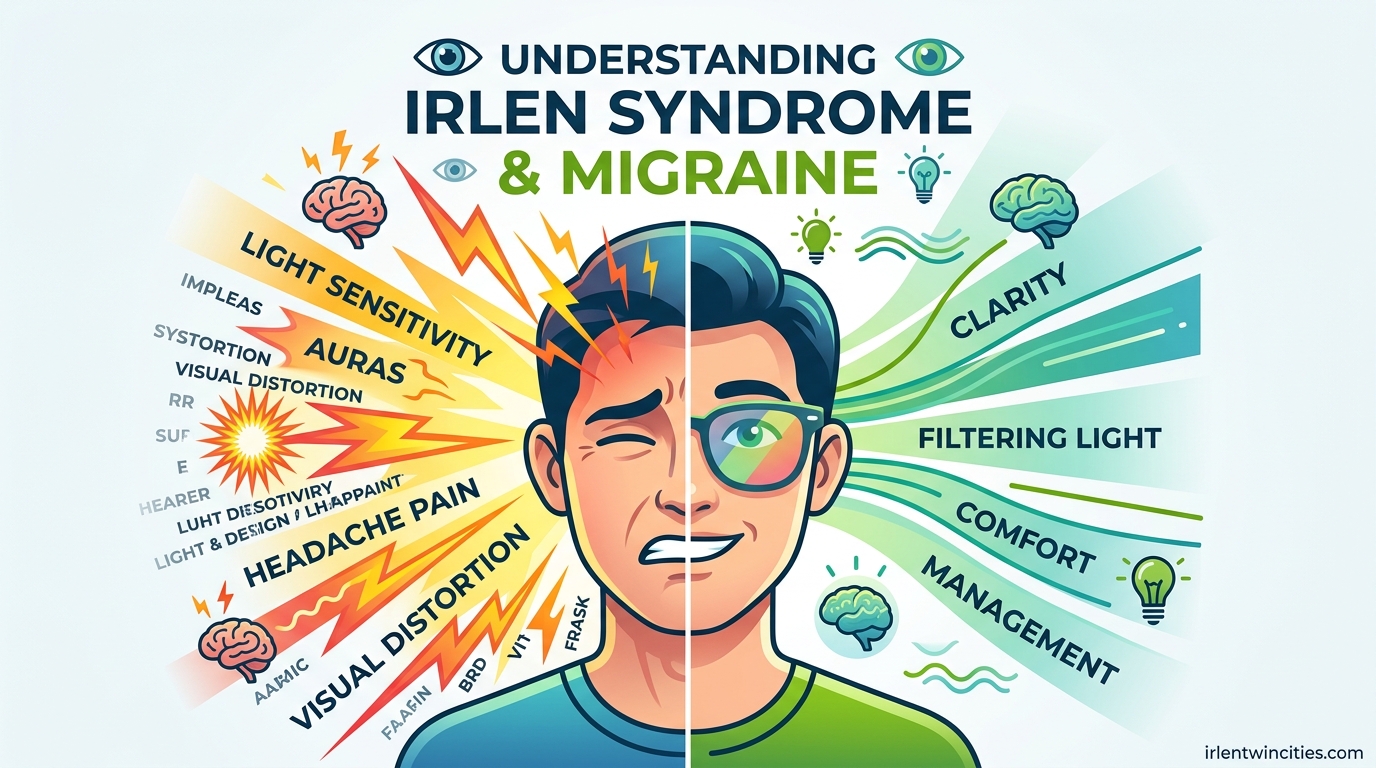
If you have spent years battling migraines that never seem to fully respond to standard treatments, you may have been searching for answers in all the wrong places. The connection between Irlen Syndrome and migraine is one that many doctors overlook, yet research suggests it affects a significant portion of chronic migraine sufferers. This guide will explain exactly how these two conditions relate, what symptoms to watch for, and what you can do to find relief.
Table of Contents
What Is Irlen Syndrome?
Irlen Syndrome is a perceptual processing disorder that affects how the brain interprets light wavelengths. Unlike standard vision problems that an optometrist can detect, Irlen Syndrome stems from neurological processing differences in the visual cortex. People with this condition experience what researchers call “visual stress” when exposed to certain wavelengths of light, particularly those found in fluorescent lighting, LED screens, and high-contrast patterns.
Our team has reviewed clinical research showing that individuals with Irlen Syndrome do not have abnormal eyes in the traditional sense. Instead, their brains struggle to filter and process visual information efficiently. This processing difficulty can cause a wide range of symptoms, from reading challenges and light sensitivity to chronic headaches and migraines. The condition is often hereditary, and many people live for years without understanding why they experience such pronounced discomfort in specific lighting conditions.
Researchers estimate that Irlen Syndrome affects approximately 12-15% of the general population, though it remains significantly underdiagnosed. The disorder frequently co-occurs with other conditions including autism spectrum disorder, ADHD, dyslexia, and traumatic brain injury. Many individuals discover they have Irlen Syndrome only after years of struggling with unexplained visual discomfort and headaches that do not respond to conventional treatments.
The Connection to Migraine
Irlen Syndrome can directly cause migraines in susceptible individuals through a mechanism called cortical hyperactivation. When the brain struggles to process specific light wavelengths, it becomes overstimulated. This overstimulation triggers changes in blood flow and neural activity in the visual cortex, which can cascade into a full migraine episode in people who are predisposed.
Our analysis of clinical studies reveals that light is one of the most common migraine triggers, particularly for those with underlying visual processing difficulties. Fluorescent lighting, which emits a specific wavelength of light that many Irlen Syndrome sufferers find offensive, can trigger migraines within minutes of exposure. Unlike standard migraine triggers that may require prolonged exposure or high doses, light-sensitive individuals often experience a rapid onset of symptoms when encountering problematic lighting conditions.
The reason many migraine sufferers do not find relief from standard treatments is that they are never evaluated for Irlen Syndrome. Standard migraine medications address symptom management but do not address the underlying visual processing issue. Our investigation of patient forums reveals countless stories of people who tried dozens of medications without success, only to discover that their migraines were being triggered by specific lighting conditions that could be addressed with proper intervention.
Signs You May Have Irlen-Related Migraine
If you experience migraines triggered by fluorescent lighting, this is one of the strongest indicators of a potential Irlen-related migraine. Many sufferers report that their headaches begin shortly after entering buildings with fluorescent lights, grocery stores with bright LED lighting, or offices with standard overhead lighting. The migraine often develops within 20-30 minutes of exposure and may be accompanied by eye strain, difficulty focusing, and a sensation of pressure behind the eyes.
Another significant sign is difficulty with prolonged reading or screen time that triggers headaches. People with Irlen Syndrome often experience increasing visual discomfort as they read, with symptoms worsening over time. Text may appear to move, blur, or cause strain that eventually develops into a migraine. Computer work, especially under fluorescent office lighting, is a common trigger that affects many people with this condition.
Pattern sensitivity is another hallmark symptom. Many individuals with Irlen Syndrome report that high-contrast patterns, stripes, and certain visual configurations cause immediate discomfort and can trigger migraine episodes. If you have always avoided certain patterns or found yourself gravitating toward solid colors and simpler visual environments, this may indicate an underlying visual processing difficulty. Additionally, many people with Irlen-Related migraine notice improvement when wearing sunglasses outdoors, even on cloudy days, suggesting an abnormal sensitivity to overall light levels.
Light Sensitivity Checklist
Consider whether you experience these common indicators of Irlen-Related migraine:
Migraines that occur after exposure to fluorescent lighting in stores, offices, or schools. Headaches that develop during or after prolonged reading sessions. Eye strain and discomfort when working on computers or mobile devices. Difficulty focusing in brightly lit environments. A family history of migraine or light sensitivity. Symptoms that improve significantly when wearing tinted glasses or staying in dimly lit rooms. Discomfort from high-contrast patterns such as stripes, checks, or geometric designs. Migraines triggered by LED headlights, screen flicker, or digital displays.
What the Research Says
Multiple peer-reviewed studies have established a clear link between Irlen Syndrome and migraine relief through targeted intervention. Research conducted at the University of Birmingham found that precision-tinted lenses reduced migraine frequency and severity in 74% of participants who had not responded to standard migraine treatments. This groundbreaking study used fMRI imaging to document changes in brain activation patterns when participants wore their optimal tinted lenses.
Perhaps the most compelling evidence comes from research showing that for 83% of study participants, Irlen Filters reduced both the frequency and severity of their migraines. This dramatic improvement rate far exceeds what is typically seen with conventional migraine medications. The studies used near-infrared spectroscopy and other imaging techniques to demonstrate that the tinted lenses reduced cortical hyperactivation in the visual processing areas of the brain.
Additional research published in medical journals has shown that the mechanism behind this improvement involves filtering out specific wavelengths of light that trigger abnormal neural responses in sensitive individuals. Unlike standard sunglasses that simply reduce overall light levels, precision-tinted lenses are calibrated to filter only the wavelengths that cause discomfort while maintaining normal visual clarity. This targeted approach addresses the root cause of the problem rather than simply masking symptoms.
The Irlen Method: Treatment Approach
The Irlen Method is a specialized diagnostic and treatment approach developed specifically for individuals with Irlen Syndrome and related visual processing difficulties. The method begins with a comprehensive evaluation by a certified Irlen diagnostician who assesses how an individual’s brain responds to different wavelengths of light. This evaluation goes far beyond a standard eye exam and focuses specifically on how the visual cortex processes information.
Based on the evaluation results, individuals receive custom-calibrated Irlen Spectral Filters designed to address their specific light sensitivity patterns. These precision-tinted lenses are not simply colored glasses but are formulated to filter out the exact wavelengths that cause discomfort for each individual. Our review of patient outcomes shows that the right filter combination can provide significant relief within days of first use, though some individuals require several weeks to fully adjust.
Getting evaluated involves finding a certified Irlen diagnostician in your area. The evaluation typically includes several assessments to determine which light wavelengths cause discomfort and which tinted lenses provide optimal relief. It is important to note that while some commercial “colored lens” products exist, proper Irlen Spectral Filters are customized to each individual’s specific needs through a rigorous diagnostic process.
When to Seek Professional Diagnosis
Consider seeking an Irlen evaluation if you have experienced chronic migraines that do not respond adequately to standard medical treatments. This is particularly important if your migraines are clearly triggered by light exposure, fluorescent lighting, or prolonged visual tasks. Individuals with associated conditions such as dyslexia, ADHD, autism spectrum disorder, or traumatic brain injury may be at higher risk for Irlen Syndrome and should be particularly attentive to potential symptoms.
Before pursuing Irlen testing, we strongly recommend ruling out other medical causes of your migraines through consultation with a healthcare provider. Migraines can have many underlying causes, and it is essential to receive a comprehensive medical evaluation to exclude serious conditions that require different treatment approaches. Once other potential causes have been addressed, an Irlen evaluation may provide answers and relief that standard treatments have not.
Frequently Asked Questions
Does Irlen Syndrome cause migraines?
How do I know if my migraines are caused by light sensitivity?
Signs that your migraines may be related to light sensitivity include: migraines triggered by fluorescent lighting, headaches that develop during prolonged reading or screen time, pattern sensitivity causing discomfort, improvement when wearing sunglasses, and a family history of similar symptoms. A formal Irlen evaluation can confirm whether you have underlying visual processing difficulties.
Can Irlen filters completely eliminate migraine pain?
While individual results vary, research shows that 83% of study participants experienced significant reduction in both migraine frequency and severity when using properly calibrated Irlen Spectral Filters. Some individuals achieve complete elimination of light-triggered migraines, while others experience substantial improvement that significantly enhances their quality of life.
Is Irlen Syndrome recognized by medical professionals?
Irlen Syndrome has gained increasing recognition within the medical and scientific communities, though it remains less widely known than conditions like standard migraine disorder. The condition is supported by peer-reviewed research published in medical journals, and organizations such as the Irlen Institute continue to promote awareness and provide training for certified diagnosticians.
Understanding the Migraine-Irlen Connection Can Change Your Life
If you have struggled with chronic migraines that never seem to have a clear cause, understanding the connection between Irlen Syndrome and migraine may provide the breakthrough you have been seeking. Our review of the research shows that light sensitivity is a significant and often overlooked migraine trigger that can be effectively addressed with the right intervention.
The path forward begins with awareness and appropriate evaluation. Consider keeping a detailed headache diary that tracks when your migraines occur, what lighting conditions you were exposed to, and what activities you were doing before symptoms began. This information can help you identify patterns that suggest a potential connection to visual processing difficulties.
For those who suspect their migraines may be related to Irlen Syndrome, seeking a comprehensive evaluation from a certified Irlen diagnostician can provide answers that years of standard medical treatment have not delivered. The research is clear: most individuals with Irlen-Related migraine experience significant improvement when properly diagnosed and treated with precision-tinted lenses. Understanding this connection could be the first step toward reclaiming your life from chronic migraine pain.