
Your three-year-old just read the cereal box aloud. Without ever being taught. Friends call her gifted. Family members are amazed. But something feels off. She reads the words perfectly, yet seems disconnected from their meaning. Should you be celebrating or concerned?
Many parents find themselves in this exact situation. Early reading can signal exceptional giftedness. It can also indicate hyperlexia, a neurodevelopmental difference that deserves attention. Understanding the distinction between hyperlexia vs early reading is the first step toward getting your child the right support.
In this guide, I will walk you through everything parents need to know. We will explore what hyperlexia actually is, how it differs from typical precocious reading, and the specific warning signs that warrant professional evaluation. Whether your child is simply gifted or showing signs of hyperlexia, this information will help you make informed decisions about their development.
Table of Contents
What Is Hyperlexia?
Hyperlexia is a learning difference characterized by an intense fascination with letters and words, coupled with the ability to read at an exceptionally early age. Most hyperlexic children begin reading before age three, often as young as 18 months, without any formal instruction. They essentially teach themselves to decode written language while their spoken language skills may still be developing.
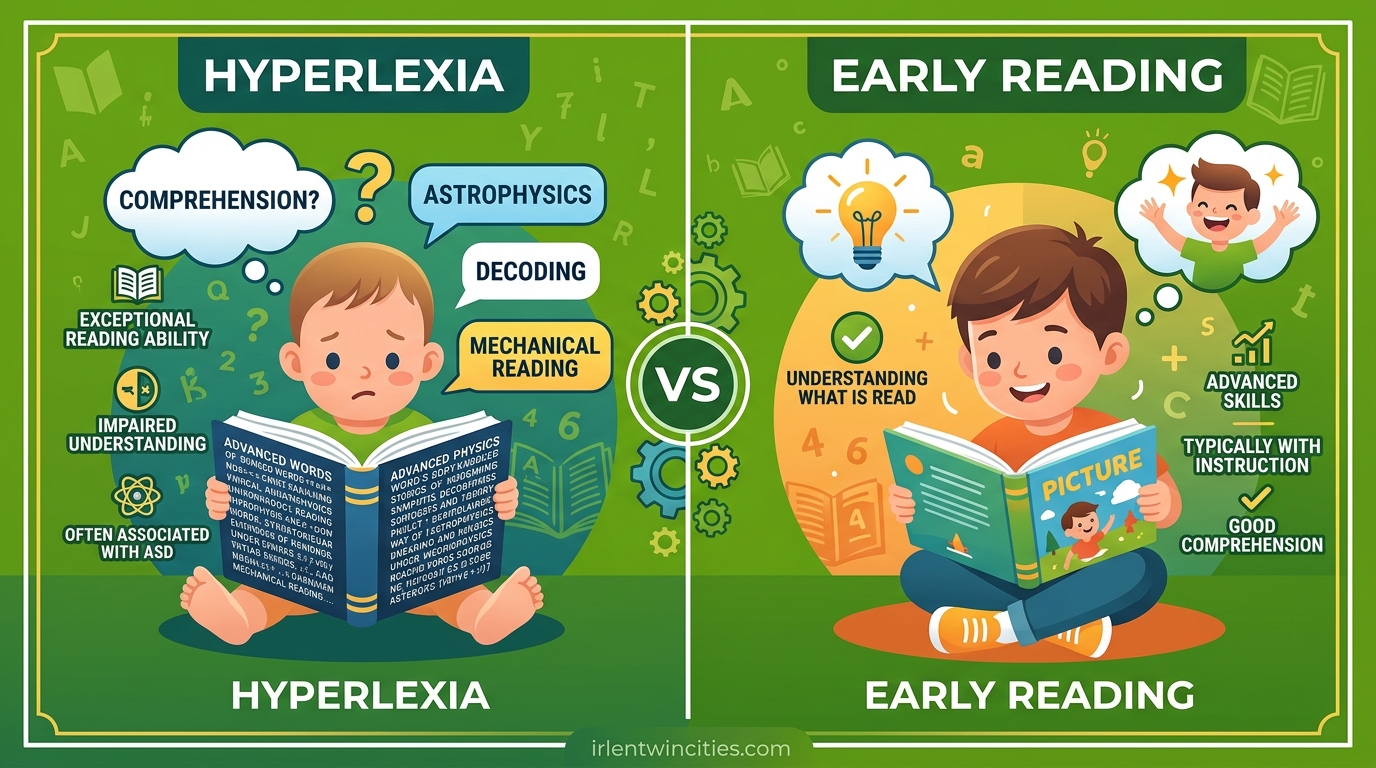
The defining feature of hyperlexia is the stark gap between word-reading ability and reading comprehension. A hyperlexic child might read fluently at a sixth-grade level while understanding text at a preschool level. This comprehension discrepancy separates hyperlexia from typical early reading and creates unique challenges for parents and educators.
Research from the Cleveland Clinic and other medical institutions recognizes hyperlexia as a distinct phenomenon. While not officially listed as a separate diagnosis in the DSM-5, it is well-documented in developmental literature. The term was first coined in 1967 by Norman E. Silberberg and Margaret C. Silberberg, who identified this specific pattern of early reading with comprehension deficits.
The Core Characteristics
Several key traits define hyperlexia in children. First, there is an intense, almost obsessive interest in letters, numbers, and written words from a very young age. Second, the child demonstrates advanced word-level decoding skills, often reading words they have never been taught. Third, and most importantly, there is a significant gap between their ability to read words and their ability to understand what those words mean.
Additional characteristics frequently include echolalia, which is the repetition of words or phrases heard from others. Many hyperlexic children also show gestalt language processing patterns, learning whole phrases or scripts rather than building language word by word. These communication patterns often coexist with the advanced reading ability.
Age of Onset
Most children with hyperlexia begin showing their intense interest in letters between 12 and 24 months of age. Self-taught reading typically emerges between 18 months and 3 years. This is significantly earlier than typical early readers, who might start reading around age 4 or 5 with some parental guidance.
The early emergence without instruction is a key differentiator. A typical precocious reader might start at age 3 or 4 after being read to frequently and showing interest. A hyperlexic child often starts before age 2, frequently teaching themselves letter sounds and word recognition without any structured teaching.
Hyperlexia vs Early Reading: 10 Key Differences
Parents often struggle to distinguish between a gifted early reader and a hyperlexic child. Both groups read earlier than expected. Both may be labeled as bright or advanced. However, the underlying mechanisms and accompanying characteristics differ significantly. Understanding these differences helps determine when concern is warranted.
1. How Reading Was Learned
Typical early readers usually develop their skills through exposure and some instruction. Parents read to them regularly, they attend preschool programs, and they gradually pick up reading skills. The process is supported by their environment.
Hyperlexic children teach themselves to read with minimal or no instruction. They may figure out letter-sound correspondences independently, often before they can hold a conversation. This self-taught reading ability appears almost spontaneously.
2. Age of Onset
Precocious readers typically begin reading around age 3 to 5. While this is earlier than the national average of age 6, it follows a recognizable developmental trajectory.
Hyperlexic children often begin reading before age 2, sometimes as early as 18 months. This extreme precocity, combined with self-teaching, is a significant red flag for hyperlexia.
3. Comprehension Levels
Gifted early readers generally understand what they read. Their comprehension keeps pace with their decoding ability. They can answer questions about stories and connect reading to real-world experiences.
Hyperlexic children typically show poor reading comprehension relative to their decoding skills. They may read complex words flawlessly while failing to grasp simple sentences. This comprehension discrepancy is perhaps the most telling sign of hyperlexia.
4. Intensity of Interest
Typical early readers enjoy books and reading. They may choose books as a preferred activity among many interests.
Hyperlexic children often display an obsessive, all-consuming interest in letters and written words. They may fixate on street signs, license plates, and packaging. This intense interest in letters goes beyond normal childhood curiosity.
5. Language Development
Precocious readers typically have advanced spoken language skills that parallel their reading ability. Their vocabulary and sentence structure are sophisticated for their age.
Hyperlexic children often show delayed or atypical language development. They may read at a much higher level than they can speak or understand spoken language. Echolalia and scripted language are common.
6. Social Interaction Patterns
Gifted early readers generally engage in typical social interaction. They make eye contact, respond to their names, and engage in reciprocal play with peers.
Many hyperlexic children show differences in social engagement. They may prefer solitary reading over social play. Eye contact might be limited, and reciprocal conversation skills may lag behind reading skills.
7. Reading as Coping Mechanism
Typical early readers read for pleasure and learning. They choose books because they enjoy stories or want information.
Hyperlexic children often use reading as a coping mechanism or escape. They may retreat into books during stressful situations or become distressed when separated from written materials. Written language serves a regulatory function.
8. Learning Style
Precocious readers are often gestalt learners who understand context and meaning. They grasp the big picture and learn holistically.
Hyperlexic children are frequently detail-oriented learners who focus on individual parts rather than wholes. They may decode words mechanically without integrating meaning. This piecemeal approach to learning extends beyond reading.
9. Repetitive Behaviors
Typical early readers may have favorite books they request repeatedly. This is normal childhood behavior.
Hyperlexic children often engage in more extensive repetitive behaviors beyond reading. They may line up letters, recite alphabet sequences obsessively, or show rigid adherence to reading routines. These repetitive patterns resemble those seen in autism spectrum disorder.
10. Diagnostic Considerations
A precocious reader typically shows no concerning developmental differences. Their early reading is part of a generally advanced developmental profile.
Hyperlexic reading often coexists with other neurodevelopmental differences. The combination of early reading with comprehension deficits, social differences, and repetitive behaviors may indicate autism spectrum disorder or related conditions requiring evaluation.
Understanding the Three Types of Hyperlexia
Dr. Darold Treffert, a leading researcher in savant syndrome and hyperlexia, classified hyperlexia into three distinct types. Understanding these types helps parents and professionals determine the appropriate level of concern and intervention needed.
Hyperlexia Type I: Neurotypical Early Readers
Type I hyperlexia describes neurotypical children who simply read early. These children have no developmental concerns, no autism spectrum characteristics, and no comprehension deficits. They are genuinely gifted readers who happen to develop this skill before their peers.
These children read early because they are bright and have been exposed to rich literacy environments. Their reading comprehension matches their decoding ability. They show no other developmental differences. This is the type of early reading that warrants celebration, not concern.
If your child reads early but shows typical social development, age-appropriate communication, and good comprehension, they likely fall into Type I. Continue supporting their reading development while ensuring they have well-rounded experiences.
Hyperlexia Type II: Autism-Linked Hyperlexia
Type II hyperlexia occurs in children with autism spectrum disorder. These children demonstrate the classic hyperlexic triad: early self-taught reading, intense fascination with letters, and significant comprehension deficits. Their hyperlexia is part of their autism profile.
Research suggests that approximately 84% of children with hyperlexia are on the autism spectrum. Type II represents the most common presentation of hyperlexia. These children require autism-specific interventions alongside support for their reading comprehension challenges.
Signs of Type II include all the typical hyperlexic characteristics combined with clear autism traits. These may include limited eye contact, delayed reciprocal communication, repetitive behaviors beyond reading interests, and challenges with social interaction. Early autism evaluation is essential for these children.
Hyperlexia Type III: Transient Autistic-Like Symptoms
Type III is perhaps the most complex and least understood category. These children show autistic-like symptoms and hyperlexia in early childhood but appear to outgrow the autism characteristics as they develop. Their prognosis is generally better than Type II.
Children with Type III hyperlexia may present similarly to Type II in early years. They show early reading, comprehension difficulties, and some autistic-like behaviors. However, by age 5 or 6, many of these concerns resolve. Social skills develop, communication improves, and the autism-like presentation fades.
Some researchers debate whether Type III represents a distinct category or simply reflects the natural variation in early childhood development. What matters for parents is recognizing that early autistic-like symptoms do not always predict long-term outcomes. Early intervention remains important regardless of eventual type classification.
Hyperlexia and Autism: Understanding the Connection
The relationship between hyperlexia and autism spectrum disorder is well-established but often misunderstood. Parents frequently ask whether hyperlexia automatically means autism. The answer is nuanced and important for proper understanding.
The Statistical Connection
Research indicates that approximately 84% of children with hyperlexia also meet criteria for autism spectrum disorder. This strong association means that hyperlexia should trigger consideration of autism evaluation. However, it also means that 16% of hyperlexic children are not autistic.
The co-occurrence makes sense when considering the shared characteristics. Both hyperlexia and autism involve intense, focused interests. Both can include repetitive behaviors and atypical language development. The detail-oriented processing style seen in hyperlexia mirrors the processing differences often observed in autism.
Can Hyperlexia Exist Without Autism?
Yes, hyperlexia can exist without autism. Type I hyperlexia describes neurotypical early readers who show no developmental concerns. Additionally, some Type III children may not ultimately receive autism diagnoses despite early concerns.
However, the presence of hyperlexia warrants careful evaluation. Even if a child is not autistic, the comprehension deficits and atypical language patterns associated with hyperlexia deserve professional attention. Speech therapy and educational support may be beneficial regardless of autism status.
Co-Occurring Traits to Watch For
Several characteristics commonly appear alongside hyperlexia in children who are on the autism spectrum. Echolalia, the repetition of heard phrases, is very common. These children may recite entire movie scripts or book passages without fully understanding the content.
Gestalt language processing is another frequent co-occurrence. Rather than building language word by word, these children learn whole chunks of language. They may speak in memorized phrases rather than generating original sentences. This processing style affects both spoken and written language comprehension.
Repetitive behaviors beyond reading are also common. Children may line up objects, insist on specific routines, or show intense fascination with patterns and systems. These behaviors, combined with hyperlexia, strengthen the indication for autism evaluation.
Warning Signs: When to Be Concerned About Early Reading
Not all early reading warrants concern. Many children are simply gifted and develop reading skills ahead of schedule. However, certain warning signs suggest that early reading may indicate hyperlexia or an underlying neurodevelopmental difference requiring evaluation.
Parent Checklist: 10 Warning Signs
Consider seeking professional evaluation if your child shows multiple signs from this checklist. One or two signs may simply represent normal variation. Several signs together warrant attention.
One, your child began reading before age 2 without being taught. Extreme precocity combined with self-teaching is a significant indicator.
Two, there is a noticeable gap between reading ability and comprehension. Your child can read complex words but cannot answer simple questions about what they read.
Three, your child shows an obsessive, all-consuming interest in letters and words. They prefer letters over toys, people, or typical childhood activities.
Four, language development seems delayed or atypical compared to reading ability. They may read fluently while speaking in simple phrases or showing echolalia.
Five, social engagement is limited or different from peers. Your child may avoid eye contact, not respond to their name consistently, or prefer solitary reading to social play.
Six, your child uses reading as an escape or coping mechanism. They retreat into books when stressed or become distressed when reading materials are unavailable.
Seven, repetitive behaviors extend beyond reading interests. They may line up letters, recite sequences obsessively, or insist on rigid routines.
Eight, your child processes language in chunks or scripts rather than word by word. They quote extensively from books or media without original generation.
Nine, there is limited pretend play or imaginative play. Your child may focus on reading letters rather than engaging in creative play scenarios.
Ten, sensory sensitivities or differences accompany the early reading. Over or under-sensitivity to sounds, textures, or lights often co-occurs with hyperlexia.
Age-Specific Red Flags
For children under 2, watch for letter fixation before meaningful speech development. If your 18-month-old knows the alphabet but does not use words communicatively, this discrepancy matters.
Between ages 2 and 3, notice whether reading advances while communication stalls. A child reading simple books at 2.5 years but not combining words in conversation shows an important skill imbalance.
By ages 3 to 4, comprehension should keep pace with decoding. If your child reads chapter books but cannot summarize a picture book in their own words, the gap has persisted too long.
When to Seek Professional Evaluation
Trust your parental instincts. If something feels off about your child’s development, seek evaluation even if you cannot articulate specific concerns. Parents are often the first to notice subtle developmental differences.
Seek immediate evaluation if your child shows multiple warning signs, particularly comprehension deficits combined with social differences. Early intervention has the greatest impact when started before age 5.
Consult your pediatrician as a starting point. They can refer you to appropriate specialists including developmental pediatricians, child psychologists, or speech-language pathologists. Multi-disciplinary evaluation provides the most comprehensive picture.
How Hyperlexia Is Diagnosed
There is no single test for hyperlexia. Diagnosis involves comprehensive evaluation by professionals who understand this specific phenomenon. The process examines reading ability, language development, cognitive functioning, and behavioral characteristics.
The Evaluation Process
Evaluation typically begins with a detailed developmental history. Parents provide information about when reading emerged, how it developed, and what other skills were present or absent at different ages. This history helps professionals understand the child’s trajectory.
Standardized testing assesses reading ability, including both word recognition and comprehension. Tests measure whether decoding skills exceed what would be expected for the child’s age and whether comprehension lags behind decoding. The size of this gap is diagnostically significant.
Speech and language evaluation examines communication skills, including expressive language, receptive language, and pragmatic language use. Echolalia, gestalt processing, and other atypical patterns are documented.
Professionals Involved
Developmental pediatricians specialize in evaluating neurodevelopmental differences. They can assess overall development and determine whether autism spectrum disorder or other conditions are present alongside hyperlexia.
Speech-language pathologists evaluate communication skills in depth. They assess reading comprehension, spoken language, and the relationship between these abilities. They often lead intervention planning.
Child psychologists conduct cognitive and behavioral assessments. They measure intelligence, identify learning patterns, and evaluate for co-occurring conditions. Their input helps differentiate Type I, II, and III presentations.
Diagnostic Considerations
Hyperlexia itself is not a standalone diagnosis in the DSM-5. Instead, it is recognized as a characteristic that may accompany autism spectrum disorder or other neurodevelopmental conditions. The formal diagnosis focuses on the underlying condition while acknowledging the hyperlexic presentation.
Despite not being a separate diagnosis, recognizing hyperlexia matters for intervention planning. Children with hyperlexia need specific approaches that address their comprehension deficits while leveraging their reading strengths.
Intervention and Support for Hyperlexic Children
Children with hyperlexia benefit from targeted interventions that address their unique learning profile. The goal is not to suppress their advanced reading ability but to build comprehension and communication skills that match their decoding prowess.
Speech Therapy Approaches
Speech-language therapy is often the primary intervention for hyperlexic children. Therapists work on building comprehension skills, moving beyond word-level reading to meaning-making. They use the child’s reading strength as a bridge to improve overall language.
Therapists may focus on breaking gestalt language patterns into flexible, generative language. They help children move from scripted phrases to original communication. Visual supports and structured approaches often work well with hyperlexic learners.
Comprehension strategies are taught explicitly. Children learn to identify main ideas, make inferences, and connect text to their experiences. These skills do not develop automatically for hyperlexic readers and require direct instruction.
Educational Accommodations
Schools can provide accommodations that support hyperlexic students. Extended time for reading comprehension tasks acknowledges that decoding speed exceeds understanding. Alternative assessment formats may better demonstrate true knowledge.
Visual supports help hyperlexic children connect written words to meaning. Graphic organizers, pictures, and visual schedules bridge the gap between their reading ability and comprehension. Multi-sensory approaches engage different learning pathways.
Social skills instruction may be needed, particularly for Type II hyperlexia. Group activities, peer modeling, and explicit teaching of social rules help children apply their cognitive skills to social situations.
Supporting Comprehension at Home
Parents can support comprehension development through daily activities. Discuss books after reading them, asking questions that go beyond literal recall. Connect stories to real-life experiences your child has had.
Use your child’s letter interest as a teaching tool. If they love spelling, work on spelling words that represent concepts they need to learn. Channel their strength toward building comprehension.
Balance reading time with other activities. While it is tempting to let a child who loves reading do so for hours, ensure they also engage in physical play, social interaction, and creative activities. Well-rounded development remains the goal.
Working With Schools
Advocate for your child by sharing information about hyperlexia with teachers. Many educators are unfamiliar with this specific learning profile. Provide resources and explain your child’s unique combination of strengths and challenges.
Request appropriate evaluations for special education services if needed. An IEP or 504 plan can formalize accommodations that support your child’s learning. Document your concerns and your child’s needs clearly.
Build a collaborative relationship with school staff. Regular communication helps ensure that home and school approaches are consistent. Share what works at home and ask what works at school.
Frequently Asked Questions
When do kids with hyperlexia start reading?
Most children with hyperlexia begin showing interest in letters before age 2 and start reading between 18 months and 3 years. This is significantly earlier than typical early readers, who usually begin around age 3 to 5. The self-taught nature of hyperlexic reading, combined with this early onset, distinguishes it from normal precocious reading development.
Can a child have hyperlexia and not be autistic?
Yes, a child can have hyperlexia without being autistic. Approximately 16% of children with hyperlexia are not on the autism spectrum. Type I hyperlexia describes neurotypical children who simply read early with no developmental concerns. However, the strong association between hyperlexia and autism means that evaluation is recommended when hyperlexia is suspected, even if autism is not eventually diagnosed.
Is hyperlexia high IQ?
Hyperlexia is not necessarily associated with high IQ. While some hyperlexic children have average or above-average intelligence, many have cognitive profiles that vary across domains. The defining characteristic is the discrepancy between reading decoding skills and comprehension, not overall intelligence level. Some hyperlexic children score in the gifted range on certain assessments while showing delays in other areas.
Is hyperlexia considered gifted?
Hyperlexia is not the same as giftedness, though the two can be confused because both involve early reading. True giftedness involves advanced development across multiple domains with comprehension matching or exceeding reading ability. Hyperlexia involves a specific splinter skill in reading with relative deficits in comprehension. A gifted early reader understands what they read, while a hyperlexic child may read fluently without understanding.
At what age does hyperlexia usually appear?
Hyperlexia typically appears between 18 months and 3 years of age. Parents often report their child showing intense interest in letters as early as 12 to 18 months. Self-taught reading usually emerges shortly after, with many hyperlexic children reading simple words before their second birthday. This is significantly earlier than typical early reading development.
What is the prognosis for hyperlexic children?
The prognosis varies by hyperlexia type. Type I children develop typically with excellent long-term outcomes. Type II children, who are autistic, can achieve good outcomes with appropriate early intervention and ongoing support. Type III children often show significant improvement in autistic-like symptoms by early school years. Early intervention, particularly before age 5, is associated with better outcomes across all types.
How is hyperlexia different from dyslexia?
Hyperlexia and dyslexia are essentially opposites in terms of reading development. Hyperlexia involves precocious, often self-taught reading with comprehension deficits. Dyslexia involves difficulty learning to read despite normal intelligence and instruction. Hyperlexic children read early and easily but do not understand well. Dyslexic children struggle to decode but may understand well once they overcome reading barriers. Both conditions benefit from specialized educational approaches.
Should I be worried if my 3-year-old reads early?
Early reading at age 3 does not automatically warrant concern. Many children are simply gifted and develop reading skills naturally. Be concerned if early reading is accompanied by comprehension deficits, limited social engagement, repetitive behaviors, or atypical language development. The key question is whether your child understands what they read and shows typical development in other areas. Consult your pediatrician if you have concerns.
Conclusion: Trust Your Instincts and Take Action
Understanding the difference between hyperlexia vs early reading empowers you to make informed decisions about your child’s development. Early reading itself is not the problem. It is a remarkable ability that can indicate giftedness, advanced cognitive development, or simply an enriched home environment.
Concern is warranted when early reading exists alongside comprehension deficits, atypical language development, or social differences. The key is the pattern of strengths and challenges, not the reading ability itself. Trust your instincts as a parent. You know your child better than anyone.
If you recognize multiple warning signs in your child, take action. Consult your pediatrician, request evaluations, and advocate for support. Early intervention makes the greatest difference when started before age 5. The goal is not to stop your child from reading but to ensure they understand, communicate, and connect with the world around them.
For parents concerned about reading-related challenges, understanding conditions like Irlen syndrome may also provide valuable insights. Visual processing differences can affect how children engage with written text, and addressing these underlying factors supports overall reading development.
Remember that children with hyperlexia can thrive. With appropriate support, they leverage their remarkable reading ability while building comprehension, communication, and social skills. Your awareness and advocacy set the foundation for their success.