
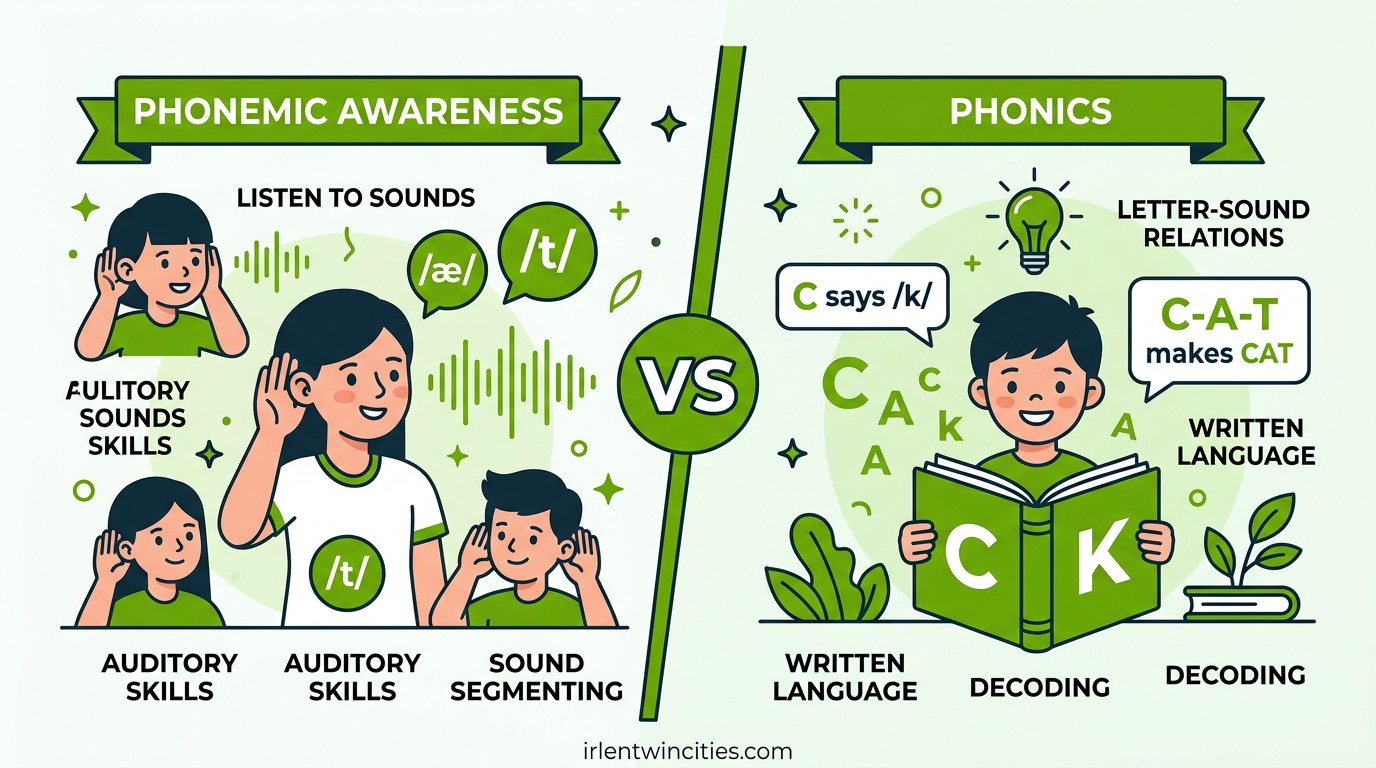
If you have ever wondered what the difference is between phonemic awareness vs phonics, you are not alone. I speak with parents and teachers every week who mix up these two foundational reading skills. They are related, but they are not the same thing. Understanding the distinction matters because it changes how we teach children to read.
Phonemic awareness and phonics both help children become readers, but they work in completely different ways. Phonemic awareness is about listening and manipulating sounds in spoken words. Phonics connects those sounds to written letters on a page. Both are essential, but they serve different purposes in reading development.
In this guide, I will break down each skill, explain how they differ, and show you exactly why children need both. I will also address the question I hear most often: which one should come first?
Table of Contents
What Is Phonemic Awareness?
Phonemic awareness is the ability to hear, identify, and manipulate individual sounds in spoken words. It is an auditory and oral skill that has nothing to do with letters or reading yet. When a child has strong phonemic awareness, they can do things like tell you the first sound in “cat” (/k/), blend three separate sounds together to form a word, or swap the /p/ in “pat” with /c/ to make “cat.”
The term phoneme refers to the smallest unit of sound in a language. English has about 44 phonemes, and each one is represented by one or more letters. Phonemic awareness training helps children notice these sounds before they ever connect them to print.
This skill falls under the broader category of phonological awareness, which includes awareness of larger sound units like syllables, onsets and rimes, and word families. Phonemic awareness is the most specific level. It zeroes in on individual phonemes.
Key phonemic awareness skills include:
- Phoneme isolation: identifying the first, middle, or last sound in a word
- Phoneme blending: putting sounds together to form a word
- Phoneme segmenting: breaking words apart into their individual sounds
- Phoneme manipulation: changing, adding, or removing sounds to make new words
Why Phonemic Awareness Matters
Research from the National Reading Panel found that phonemic awareness instruction significantly improves reading ability in children. This is especially true for children in kindergarten through second grade. The skill serves as a strong predictor of reading success later on.
Children who struggle with phonemic awareness often have difficulty decoding words when they start reading. They may memorize words by sight but cannot sound out new ones. This is exactly what many forum discussions reveal: parents notice their children can read familiar words but completely fall apart when faced with an unknown word.
Phonemic awareness develops naturally in many children through exposure to language and wordplay, nursery rhymes, and songs. However, some children need explicit instruction in these skills before they can move on to reading. Without targeted activities, these children may enter kindergarten without the oral foundation they need for phonics instruction.
What Is Phonics?
Phonics is the method of teaching readers to connect sounds with letters or letter patterns. While phonemic awareness works with spoken sounds alone, phonics bridges the gap between oral language and written text. It teaches children the relationship between graphemes (written letters) and phonemes (spoken sounds).
A grapheme is the written representation of a phoneme. The letter “c” represents the /k/ sound in most cases. The letter combination “ea” can represent the /ee/ sound as in “bean.” Phonics instruction teaches these correspondences systematically and explicitly.
Key phonics skills include:
- Letter-sound correspondence: knowing which sound each letter makes
- Decoding: using letter-sound knowledge to read unfamiliar words
- Encoding: using letter-sound knowledge to spell words
- Syllable types: understanding patterns like CVC (consonant-vowel-consonant) and silent e
The Four Types of Phonics Approaches
Phonics instruction is not one-size-fits-all. There are four main approaches teachers and curricula use:
- Systematic phonics: teaching all letter-sound correspondences in a structured sequence
- Incidental phonics: introducing sounds as they appear in texts naturally
- Analogy phonics: using word families and onsets/rimes to figure out new words
- Embedded phonics: teaching sounds within the context of reading and writing activities
The National Reading Panel recommends systematic phonics instruction because it produces the strongest reading and spelling gains. Balanced literacy approaches often downplay this systematic element, which is a common complaint in teacher forums. Many educators have noticed that children taught with balanced literacy struggle when they encounter words that do not follow common patterns.
Phonemic Awareness vs Phonics: Key Differences
The differences between phonemic awareness vs phonics come down to modality, focus, and purpose. Here is how they compare:
Modality: Phonemic awareness is auditory and oral. Children work with sounds they hear and say. Phonics is visual and written. Children work with letters they see and write.
Focus: Phonemic awareness focuses on sounds in spoken words, regardless of how those words are spelled. Phonics focuses on the relationship between sounds and their written counterparts.
Purpose: Phonemic awareness builds the oral foundation for reading. It helps children become aware that words are made of sounds. Phonics builds on that foundation to connect those sounds with letters on a page.
When it develops: Phonemic awareness typically develops between ages 3 and 6, even before formal reading instruction. Phonics instruction usually begins in kindergarten or first grade when children have letter recognition.
Instructional approach: Phonemic awareness is taught through oral activities like sound games, rhyming exercises, and blending tasks. Phonics is taught through letter tiles, word building, and text-based reading activities.
Understanding these differences helps explain why children who skip phonemic awareness often struggle with phonics later. They are trying to connect letters to sounds they have not yet learned to hear and manipulate.
How Phonemic Awareness and Phonics Work Together
Think of phonemic awareness and phonics as two links in the same chain. The National Reading Panel identified both as essential components of reading instruction, and they work best when taught together in a structured way.
Scarborough’s Reading Rope, a model from the International Dyslexia Association, illustrates this connection beautifully. The rope shows that reading comprehension comes from two major strands: word recognition and language comprehension. Phonemic awareness and phonics fall under word recognition, working alongside fluency and vocabulary.
Here is the typical progression. First, children develop phonemic awareness through listening activities and oral language games. They learn to hear and manipulate sounds. Then, phonics instruction introduces the written letters that represent those sounds. Children practice connecting what they hear with what they see on the page.
This is why balanced literacy approaches that skip explicit phonemic awareness often fail struggling readers. The oral foundation is missing. Children try to learn letter-sound correspondences before they can reliably hear and manipulate the sounds those letters represent.
The Science of Reading movement has brought this research to the forefront. Structured literacy curricula now emphasize systematic phonics instruction built on a foundation of phonemic awareness. Both skills are non-negotiable for building strong readers.
When to Teach Each Skill
The question I hear most often is: what comes first, phonemic awareness or phonics? The answer is clear from decades of research. Phonemic awareness comes first, and it should begin in preschool or kindergarten.
Research shows that phonemic awareness instruction is most effective when it occurs before or alongside phonics instruction. Trying to teach phonics without phonemic awareness is like building a house on sand. The foundation is weak.
Typical development timeline:
- Ages 3-4: Work on rhyming, syllable awareness, and gross sound manipulation
- Ages 4-5: Focus on individual phoneme isolation, blending, and segmenting
- Ages 5-6: Begin systematic phonics instruction once phonemic awareness is established
- Ages 6+: Continue phonics instruction while building fluency and comprehension
Not sure if your child needs intervention? Watch for these warning signs. Children who cannot rhyme by age 4, who struggle to blend simple words like “b-a-t,” or who have difficulty segmenting words into sounds may need extra support. Early intervention is critical because the window for building these foundational skills closes around age 7 or 8.
For classroom integration, aim for 5-10 minutes of phonemic awareness activities daily during the preschool and kindergarten years. Once children know letter names and sounds, introduce systematic phonics for 20-30 minutes daily. The two should be woven together as children progress and become more confident readers.
FAQ
Is phonics the same as phonemic awareness?
No, they are different skills. Phonemic awareness is the ability to hear and manipulate sounds in spoken words. Phonics is the method of teaching how those sounds connect to letters in written words. Phonemic awareness is auditory and oral; phonics is visual and written. Both are essential for reading, but they serve different purposes in reading development.
What are the four types of phonics?
The four main types of phonics approaches are systematic phonics (structured sequence of all letter-sound correspondences), incidental phonics (sounds introduced as they appear naturally in texts), analogy phonics (using word families and onsets/rimes to figure out new words), and embedded phonics (teaching sounds within the context of reading and writing activities). Systematic phonics instruction produces the strongest reading and spelling gains according to the National Reading Panel.
Can phonics help with dyslexia?
Yes, phonics instruction is particularly important for children with dyslexia. Many students with dyslexia have difficulty with the phonemic awareness component of reading, which makes phonics instruction essential. Systematic, explicit phonics intervention is one of the most effective approaches for struggling readers with dyslexia. Special education teachers often emphasize phonemic awareness training as a critical first step for these students.
What comes first, phonics or phonemic awareness?
Phonemic awareness comes first. Children should develop strong phonemic awareness skills in preschool and kindergarten before beginning phonics instruction. The typical progression is: ages 3-4 focus on rhyming and syllable awareness, ages 4-5 focus on phoneme isolation and manipulation, and ages 5-6 begin systematic phonics once phonemic awareness is established. Skipping this sequence often leads to reading difficulties because children try to connect letters to sounds they have not yet learned to hear reliably.
Conclusion
Understanding the difference between phonemic awareness vs phonics is essential for anyone teaching or raising children to read. Phonemic awareness builds the oral foundation. Phonics builds the bridge to written text. Both are critical, and they must be taught in the right sequence.
Start with phonemic awareness activities in the preschool years. Move to systematic phonics once children can hear and manipulate sounds reliably. Children who skip this sequence often struggle as readers, and the gaps are hard to close later.
Whether you are a parent working with your child at home, a teacher planning your literacy block, or someone curious about how reading develops, the research is clear. Phonemic awareness and phonics work together like two sides of the same coin. Give children both, in the right order, and they will become readers.