
As a parent, watching your child struggle in school is one of the hardest things you’ll face. You’ve probably heard terms like “IEP” and “504 plan” thrown around in meetings or conversations with teachers. Maybe the school has suggested one option, but something doesn’t feel quite right. I’ve been there – that pit in your stomach wondering if you’re making the right choice for your child’s future.
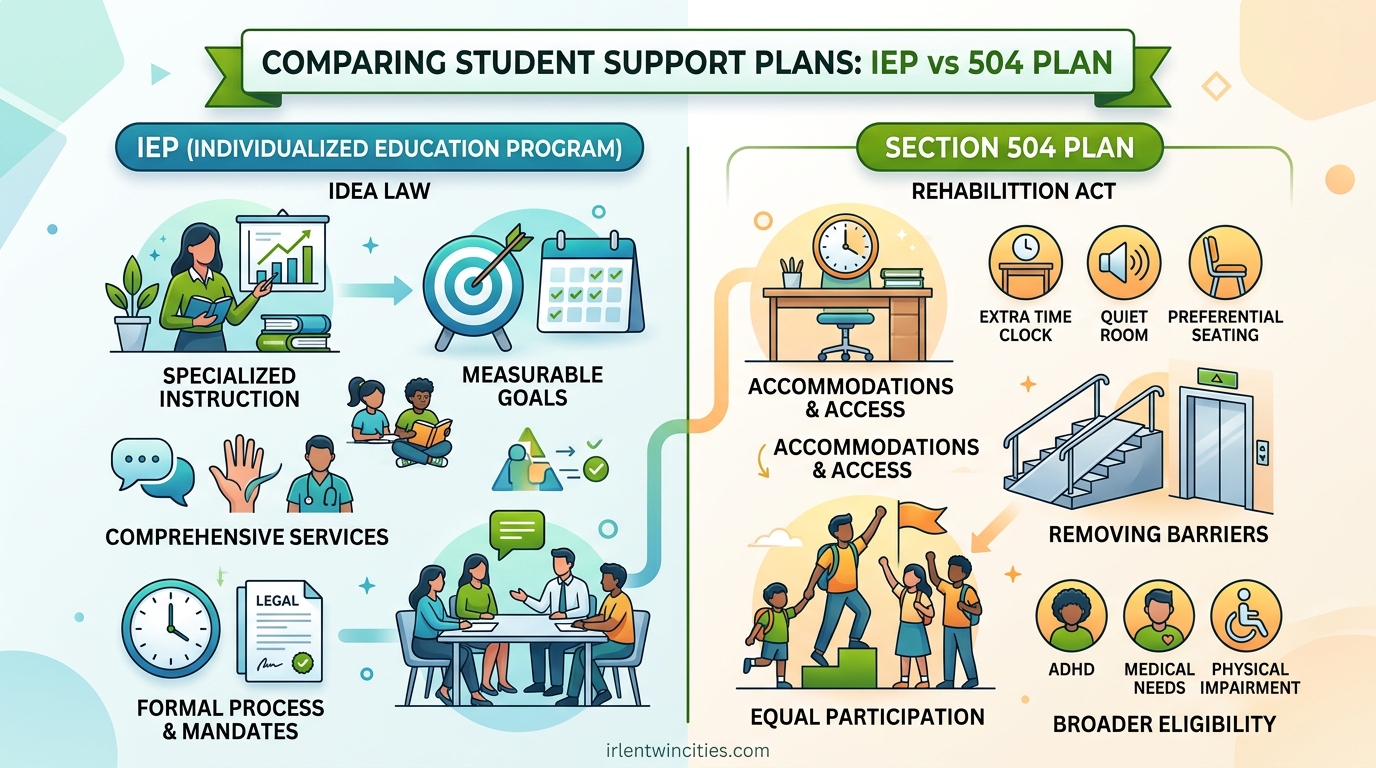
Here’s the honest truth: the difference between an IEP vs 504 plan comes down to one critical factor – specialized instruction. An IEP provides specialized instruction and related services under special education law, while a 504 plan provides accommodations to remove barriers in general education. This distinction determines everything from what services your child receives to your legal rights as a parent.
In this guide, I’ll walk you through exactly what each plan offers, who qualifies, and how to figure out which one your child actually needs. No legal jargon, no confusion – just clear information to help you advocate for your child.
Table of Contents
Quick Overview: IEP vs 504 Plan at a Glance
Before diving into the details, let’s look at the fundamental differences between these two plans. Understanding this comparison will help you navigate conversations with your school district more confidently.
| Feature | IEP (Individualized Education Program) | 504 Plan |
|---|---|---|
| Governing Law | IDEA (Individuals with Disabilities Education Act) | Section 504 of the Rehabilitation Act |
| Type of Law | Federal special education law with funding | Civil rights law prohibiting discrimination |
| Primary Purpose | Provide specialized instruction and related services | Provide accommodations to access general education |
| Who Qualifies | Students with disabilities affecting educational performance who need specialized instruction | Students with disabilities affecting major life activities (including learning) |
| What’s Included | Measurable goals, progress monitoring, related services, specialized instruction | Accommodations and modifications to access general education curriculum |
| Funding | Federal and state special education funds | No additional federal funding |
| Accountability | Strict procedural safeguards, annual reviews, due process rights | Less formal, fewer procedural requirements |
| Team | IEP team with specific required members | 504 coordinator, smaller team |
Understanding the Legal Framework: IDEA vs Section 504
The laws behind IEP vs 504 plan create different rights and obligations. Let me break this down without the legal jargon that usually confuses parents.
IDEA (Individuals with Disabilities Education Act) is federal special education law. It provides funding and requires schools to offer specialized instruction to eligible students. Under IDEA, your child has the right to FAPE – a Free Appropriate Public Education. This means the school must provide specially designed instruction to meet your child’s unique needs, at no cost to you. The law also requires placement in the LRE (Least Restrictive Environment), which means your child should learn alongside typical peers to the maximum extent appropriate.
Section 504 is a civil rights law. It prohibits discrimination against individuals with disabilities in programs receiving federal funding. Unlike IDEA, it doesn’t provide additional funding for schools. Its purpose is to level the playing field – ensuring your child can access the same education as their peers through accommodations and modifications. Think of it like a wheelchair ramp: it doesn’t change what’s inside the building, but it ensures your child can get in the door.
This difference matters because special education law (IDEA) comes with stronger legal protections and procedural safeguards for your child. Civil rights law (Section 504) focuses on preventing discrimination but provides fewer enforceable rights. When schools recommend a 504 plan instead of an IEP, it’s worth understanding whether this recommendation truly serves your child’s needs or reflects other priorities.
The Critical Difference: Specialized Instruction vs Accommodations
This is where most parents get confused, and it’s the most important distinction in the IEP vs 504 plan debate. Let me make this crystal clear.
Specialized instruction (IEP only) means teaching is adapted to how your child learns. This could include a reading specialist using a different method to teach decoding, a special education teacher modifying math curriculum to build foundational skills, or small group instruction targeting specific learning gaps. The key is that someone is actively teaching your child differently than the general education approach.
Accommodations (504 focus) remove barriers to learning but don’t change what’s being taught. Examples include extended time on tests, preferential seating, audio books, or breaks during long tasks. Your child receives the same curriculum as their peers, but the way they access it is adjusted.
Here’s why this distinction matters so much: if your child has learning gaps and needs different instruction to catch up, accommodations alone won’t help. They’ll still have access to the curriculum, but they won’t receive the targeted teaching they need to close those gaps. I’ve talked to many parents who watched their child struggle for years with a 504 plan, only to discover they qualified for an IEP with specialized instruction all along.
Who Qualifies? Eligibility Requirements Explained
Eligibility criteria differ significantly between IEP vs 504 plan, and understanding these differences helps you advocate effectively for your child.
IEP Eligibility: To qualify for an IEP, your child must have one of the 13 disability categories defined by IDEA and need specialized instruction. These categories include specific learning disabilities (like dyslexia or dyscalculia), speech or language impairment, autism, emotional disturbance, intellectual disability, other health impairment (which covers ADHD), and several others. Importantly, having a diagnosis alone doesn’t guarantee eligibility – the disability must adversely affect educational performance, and your child must need specialized instruction to benefit from education.
504 Eligibility: The threshold is broader. Your child must have a physical or mental impairment that substantially limits one or more major life activities, including learning. Major life activities include things like reading, concentrating, thinking, communicating, and walking. Unlike IEP eligibility, there’s no requirement that the disability affects educational performance – your child could be a straight-A student and still qualify for a 504 plan if they have a disability affecting a major life activity.
This is where the “good grades” misconception comes in. Many parents are told their child doesn’t qualify for support because they’re doing well academically. But for 504 plans, academic success doesn’t disqualify your child. A student with excellent grades but severe anxiety that impacts school attendance could qualify for a 504 plan. Similarly, a student with ADHD who compensates for their symptoms with hours of homework each night might qualify for accommodations to level the playing field.
What’s Actually in Each Plan? Components Breakdown
When you sit down to create either plan, you’ll see different components reflecting each law’s purpose. Understanding what goes into an IEP vs 504 plan helps you know what to ask for in meetings.
IEP Components: An IEP is a detailed document with several required parts. It includes present levels of academic achievement and functional performance – basically, where your child is right now. Then it lists measurable annual goals with specific objectives to track progress. The IEP specifies how much time your child will spend in special education vs general education settings (the LRE determination). It outlines related services like speech therapy, occupational therapy, or counseling. It includes accommodations and modifications for classroom instruction and testing. It details how progress will be measured and reported to you. And it includes transition planning starting at age 16.
504 Plan Components: A 504 plan is typically less formal and less detailed. It focuses primarily on accommodations and modifications your child needs to access general education. This might include things like preferential seating, extended time on tests, access to a quiet space for tests, permission to record lectures, or assistive technology. Some 504 plans include related services if needed, but this varies by district. Unlike IEPs, 504 plans don’t require measurable goals or progress monitoring, though many districts include these elements anyway.
The team composition also differs. An IEP team must include specific members: you (the parent), at least one general education teacher, at least one special education teacher, a district representative who can commit resources, someone who can interpret evaluation results, and when appropriate, your child. A 504 team is smaller and more flexible – typically you, a 504 coordinator, and relevant teachers. This difference in team structure reflects the different levels of oversight and accountability.
IEP vs 504 Plan: Which Does My Child Need?
Now for the question that brought you here. Let me give you a framework for thinking about this decision, based on what I’ve learned from special education professionals and other parents who’ve navigated this process.
Your child likely needs an IEP if:
- They have significant learning gaps (more than 1-2 years behind in reading, writing, or math)
- They need someone to teach them differently – not just accommodate how they learn
- They need related services like speech therapy, occupational therapy, or specialized reading intervention
- Progress monitoring shows they’re not making adequate progress with current supports
- Teachers report they need substantial modifications to curriculum or instruction
- They have a diagnosis that typically requires specialized instruction (like specific learning disability, intellectual disability, or autism)
Your child may do well with a 504 plan if:
- They’re learning at grade level but need accommodations to access the curriculum
- They have a physical or medical condition that requires school adjustments (like diabetes, epilepsy, or mobility issues)
- They have ADHD or anxiety that impacts school functioning but they can learn from standard instruction with supports
- They need specific environmental changes (seating, breaks, quiet space) but not different teaching methods
- They’re achieving at or near grade level with current supports
Red flags your current plan isn’t working:
- Your child continues to fall behind despite accommodations
- Teachers report they can’t meet your child’s needs with current supports
- Your child shows increasing frustration, anxiety, or school avoidance
- Progress reports show minimal growth toward goals
- Your child spends excessive time on homework or requires parent tutoring to keep up
Can you have both an IEP and a 504 plan? The short answer is no – a child receives either special education services (IEP) or general education with accommodations (504). However, everything that’s in a 504 plan can be included in an IEP. Many special education professionals I’ve talked to recommend pushing for an IEP if your child qualifies, because it provides more comprehensive support and stronger legal protections.
How to Request an Evaluation: Step-by-Step Process
If you’re unsure whether your child needs an IEP vs 504 plan, requesting an evaluation is the right first step. Here’s how to navigate this process effectively.
Step 1: Document your concerns. Before reaching out to the school, gather concrete examples of your child’s struggles. This might include work samples showing below-grade-level performance, teacher comments about classroom challenges, copies of homework that took excessive time to complete, or notes about behavioral or emotional concerns at home. The more specific your documentation, the stronger your case.
Step 2: Submit a written request. While you can mention concerns verbally, a written request triggers the school’s legal timeline. Send a letter or email to your child’s principal or the school’s special education director. State clearly that you’re requesting an evaluation to determine if your child qualifies for special education services (IEP) or accommodations (504). Include specific examples of your concerns. Ask about the evaluation timeline and next steps. Keep a copy of this request – start a file for all your documentation.
Step 3: Understand the timeline. Once you submit written consent for evaluation, the school typically has 60 days to complete assessments and hold an eligibility meeting. (This varies slightly by state, so ask about your specific timeline.) During this period, the school will conduct various assessments – academic achievement tests, cognitive processing measures, classroom observations, and feedback from teachers. You may also be asked to provide medical documentation if your child has a diagnosis.
Step 4: Prepare for the eligibility meeting. Before the meeting, ask for copies of all evaluation reports so you can review them. Bring your own documentation of concerns. Consider bringing a support person – a spouse, friend, or parent advocate. Prepare questions in advance: What disability category does my child qualify under? What are the specific areas of need? What services and supports are recommended? How will progress be measured? Don’t be afraid to ask for clarification if you don’t understand something – this is your child’s education, and you have the right to understand every recommendation.
What if the school denies your request? You have options. The school must provide written notice of their decision with an explanation. If you disagree, you can request an independent educational evaluation at district expense. You can also request mediation or file a due process complaint. Many parents find success when they come prepared with documentation and clearly articulate their child’s needs.
Common Myths About IEPs and 504 Plans
Let me address some misconceptions that keep parents from getting their children the support they need. I’ve heard these repeatedly in parent forums and support groups.
Myth: “Good grades mean my child doesn’t qualify.” False. For 504 plans specifically, academic achievement doesn’t disqualify your child. If a disability affects a major life activity (like concentrating, reading, or attending school), they may qualify for accommodations regardless of grades. I’ve worked with families whose straight-A students received 504 plans for anxiety, ADHD, or medical conditions that impacted school functioning.
Myth: “An IEP label will follow my child forever.” False. IEPs are reviewed annually and your child is re-evaluated every three years. If services are no longer needed, the IEP can be discontinued. Conversely, if your child initially has a 504 but needs more support later, they can be evaluated for an IEP. These plans are designed to be responsive to changing needs, not permanent labels.
Myth: “A 504 is better because it’s less stigmatizing.” This depends on your child’s needs. While 504 plans are less visible, they also provide fewer services and legal protections. If your child needs specialized instruction to make progress, choosing a 504 to avoid stigma may actually disadvantage them. The right plan is the one that provides the support your child needs – not the one that feels more comfortable on paper.
Myth: “The school knows best which plan my child needs.” Schools have budget constraints and staffing limitations that influence their recommendations. While many educators genuinely want to help your child, districts sometimes recommend 504 plans because they’re less expensive and require fewer resources than IEPs. You are your child’s best advocate. If you feel the recommended plan doesn’t meet their needs, you have the right to ask questions, request additional evaluations, or disagree with the team’s recommendation.
Frequently Asked Questions
How do I know if my child needs an IEP or 504?
The key difference is whether your child needs specialized instruction (IEP) or just accommodations (504). If your child has learning gaps more than 1-2 years behind grade level, needs different teaching methods to learn, or requires related services like speech therapy, they likely need an IEP. If they’re learning at grade level but need environmental adjustments like extended time or preferential seating, a 504 may be sufficient. When in doubt, request a comprehensive evaluation to determine eligibility for both.
Why do schools push for 504 instead of IEP?
Schools often recommend 504 plans because they’re less expensive and require fewer resources. IEPs come with federal funding but also strict procedural requirements, specialized instruction from certified staff, and comprehensive services. 504 plans provide accommodations within general education without additional funding. While many educators genuinely want to help, districts face budget pressures that influence recommendations. If you feel a 504 doesn’t meet your child’s needs, you have the right to request an IEP evaluation and advocate for the services your child requires.
Is it better to have a 504 or IEP?
Neither is inherently better – it depends on your child’s needs. An IEP provides specialized instruction, related services, measurable goals, and stronger legal protections. A 504 provides accommodations to access general education without modifying how curriculum is taught. If your child needs different instruction to learn, an IEP is typically better. If they only need environmental adjustments, a 504 may be sufficient. Everything in a 504 can be included in an IEP, but an IEP provides additional services and accountability that many families find valuable.
Can you have an IEP and a 504 at the same time?
No, a student receives either special education services (IEP) or general education with accommodations (504). However, this doesn’t mean you’re missing out – everything that could be in a 504 plan can be included in an IEP. An IEP provides accommodations PLUS specialized instruction and related services. Many special education professionals recommend qualifying for an IEP if eligible, because it offers more comprehensive support and stronger legal protections than a 504 plan alone.
What if the school denies my evaluation request?
If the school denies your request, they must provide written notice explaining their decision. You have several options: (1) Request an independent educational evaluation at district expense, (2) Request mediation to resolve disagreements, (3) File a due process complaint for a hearing, or (4) Provide additional documentation showing your child’s needs and request reconsideration. Many parents find success when they come prepared with concrete examples of their child’s struggles, teacher documentation, and medical or psychological evaluations supporting their concerns.
Deciding between IEP vs 504 plan feels overwhelming, but you don’t have to figure it out alone. The most important thing you can do is trust your instincts about your child’s needs and advocate persistently for the support that will help them thrive.
Remember: if your child needs specialized instruction to make progress, an IEP provides legal protections, measurable goals, and related services that a 504 plan cannot offer. If they only need accommodations to access general education, a 504 may be sufficient. Either way, documenting your concerns, requesting evaluations in writing, and asking informed questions will help ensure your child gets the support they need.
You know your child better than anyone. Trust that knowledge, ask hard questions, and keep advocating until their needs are met. Your persistence will make the difference in their educational journey.