
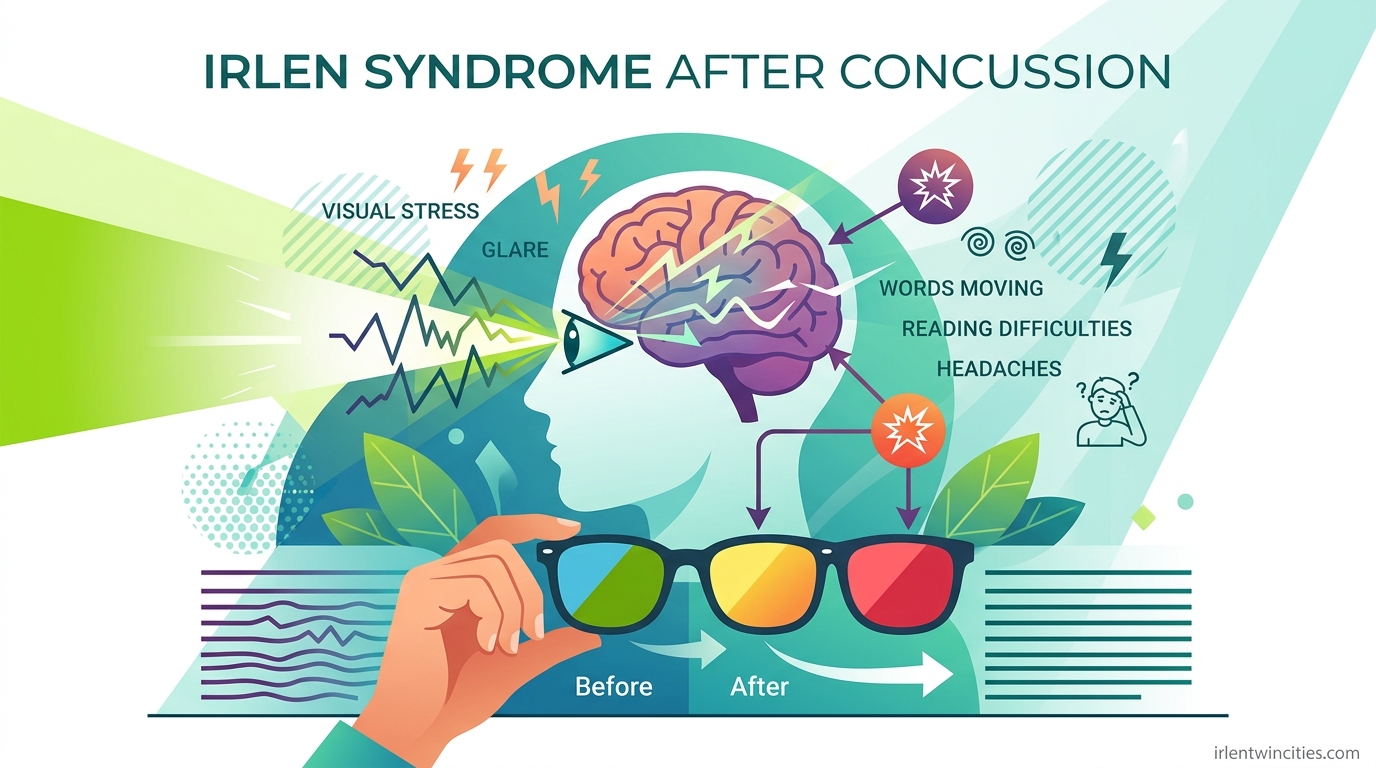
If you have recovered from a concussion or traumatic brain injury (TBI) but still struggle with light sensitivity, headaches that will not go away, or reading difficulties that make school or work feel impossible, you are not alone. Our team has spent years talking to TBI survivors who describe the same frustrating pattern: the initial injury healed, but the visual and perceptual problems remained. After seeing countless patients dismissed by doctors who did not understand what was happening, we discovered that many of these lingering symptoms point to a specific condition called Irlen Syndrome. This article explains what Irlen Syndrome is, why it often appears after a concussion or TBI, and what you can do about it.
Table of Contents
What Is Irlen Syndrome After a Concussion or TBI?
Irlen Syndrome is a perceptual processing disorder that affects how the brain interprets light wavelengths. The condition was originally identified by Helen Irlen in the 1980s and has since been recognized as a common underlying cause of light sensitivity, reading difficulties, and visual discomfort that does not improve with standard treatments. For many people, the condition appears or worsens after a head injury, including concussions, whiplash, or more severe traumatic brain injuries.
When someone develops Irlen Syndrome after a TBI, it means the brain’s visual pathway has become sensitive to certain wavelengths of light. This is not a problem with the eyes themselves but rather with how the central nervous system processes visual information. The brain becomes overstimulated by specific colors or light frequencies, leading to a range of symptoms that can significantly impact daily life. According to research from the Irlen Institute, this is not a rare occurrence. An estimated 30-35% of individuals who sustain a traumatic brain injury will experience light-based visual processing problems that could be alleviated with the right intervention.
Our understanding of this connection comes from decades of research, including a landmark study by Dr. Tosta that documented how brain injury can trigger or amplify these perceptual difficulties. The study found that 35% of TBI sufferers experienced substantial difficulties with light sensitivity, strain and fatigue, and reading problems that responded positively to color intervention. This research established what many clinicians now see in their practices: head injuries do not just cause physical damage. They can fundamentally alter how the brain processes sensory information, including light.
The Connection Between TBI and Irlen Syndrome
When the brain experiences trauma from a concussion or other head injury, the visual processing centers can become disrupted. Unlike a broken bone that heals over weeks, the brain’s neural pathways may remain sensitive long after the initial injury. This is because the injury affects the photoreceptive cells and the visual pathway itself, changing how the brain receives and interprets light signals.
One reason this connection is so common relates to how we process light. The visual pathway runs through a significant portion of the brain, meaning an injury to almost any area can affect visual processing. When this pathway becomes dysregulated, the brain may struggle to filter out certain wavelengths of light, leading to the characteristic symptoms of Irlen Syndrome. The result is that everyday environments that never caused problems before fluorescent lighting, computer screens, sunlight, or even the contrast between white paper and black text can suddenly become intolerable.
The good news is that this connection also means there is an effective treatment available. Unlike many post-concussion symptoms that doctors simply monitor and manage, Irlen Syndrome can be directly addressed through the use of Irlen Spectral Filters. These are specially tinted lenses that filter specific wavelengths of light, reducing the strain on the brain and allowing it to function more normally. This is not just theory. Research published by the Southern Institute for Developmental and Clinical Education documented that 70% of TBI patients who were screened for Irlen Syndrome were found to be good or excellent candidates for spectral filter intervention, with significant improvements reported across multiple measures.
Signs You Might Have Irlen Syndrome After a Head Injury
Distinguishing between general post-concussion symptoms and Irlen Syndrome specifically can be challenging, but there are characteristic signs that suggest you may benefit from Irlen testing. The most common indicator is persistent light sensitivity that does not improve with time or standard treatments. If fluorescent lights, sunlight, or even driving at night have become difficult or impossible months or years after your injury, this is a strong signal that Irlen Syndrome may be involved.
Reading difficulties are another hallmark symptom. Many TBI survivors with Irlen Syndrome describe words that appear to move on the page, blur together, or become unreadable after just a few minutes of reading. This goes beyond normal eye strain. It is a perceptual issue where the brain cannot maintain focus on text without significant fatigue. We have heard from countless survivors who pushed through school or work for years, not realizing that their reading struggles had a specific biological cause that could be addressed.
Headaches and migraines triggered by visual stimuli are also common. Unlike tension headaches that build gradually, these headaches often begin shortly after exposure to problematic light sources. Bright fluorescent lights, glossy paper, striped patterns, or even the contrast of a whiteboard can trigger immediate discomfort or full migraines. These are not psychological symptoms. They are real physiological responses to the brain’s inability to process certain visual inputs correctly.
Other symptoms to watch for include difficulty with depth perception, trouble focusing on near tasks, eye strain that does not resolve with rest, and general fatigue in visually demanding environments. Many survivors also report that their symptoms fluctuate throughout the day depending on lighting conditions, stress levels, and how much visual work they have done. This pattern of sensitivity to specific visual triggers is a key distinguishing factor between Irlen Syndrome and other post-concussion issues.
How Irlen Spectral Filters Help After Brain Injury
Irlen Spectral Filters work by filtering specific wavelengths of light that cause overstimulation in the brains of those with Irlen Syndrome. Unlike regular tinted glasses that simply reduce overall brightness, spectral filters are precision-matched to each individual’s unique pattern of light sensitivity. The goal is not to block light but to remove the specific frequencies that cause the brain to work harder than it should.
When the correct filter is applied, many survivors report immediate and dramatic improvements. Headaches that have persisted for months or years may diminish within days. Reading tolerance increases dramatically, with many patients going from unable to read for more than ten minutes to reading for hours without discomfort. Light sensitivity that made outdoor activities or fluorescent office environments unbearable often reduces significantly. This happens because the filter removes the offensive wavelengths of light, allowing the brain to function without the constant strain it has been experiencing.
The mechanism behind this improvement relates to how the brain heals. By reducing the sensory load on the visual system, spectral filters create conditions where the brain can function more normally. This is not a cure for the underlying injury, but it is a highly effective management strategy that many patients describe as life-changing. The Irlen Institute notes that filtering offensive wavelengths of light allows the brain to function more normally and helps it heal. For TBI survivors who have tried numerous other treatments without success, this approach often provides the first real relief they have experienced.
Improvements reported by TBI survivors using spectral filters include reduced headaches and migraines, improved reading speed and comprehension, better tolerance of fluorescent lighting and screens, decreased light sensitivity when driving, improved concentration and attention, and reduced overall fatigue in visually demanding situations. These are not marginal improvements. For many patients, the change is profound enough to allow them to return to work, complete their education, or resume activities they had abandoned due to their symptoms.
What to Do Next: Testing and Treatment Options
If you recognize the symptoms described in this article, the first step is to seek a proper evaluation for Irlen Syndrome. Unlike standard eye exams that assess visual acuity and eye health, Irlen testing specifically evaluates how your brain processes light and whether you would benefit from spectral filters. This testing is typically conducted by a certified Irlen diagnostician who has been trained to identify the specific wavelength sensitivities that characterize the condition.
When looking for a provider, start by visiting the official Irlen Institute website to find a certified diagnostician in your area. Not all eye care professionals are trained in Irlen Syndrome assessment, so it is important to verify credentials before scheduling. The testing process usually involves a comprehensive assessment that includes identifying which light wavelengths cause discomfort and determining the optimal filter color and density for your specific needs.
While you are waiting for evaluation and treatment, there are strategies that can help manage symptoms. The 20-20-20 rule is a simple technique that can reduce eye strain: every 20 minutes, look at something 20 feet away for 20 seconds. Reducing time spent under fluorescent lights when possible, using natural light instead of harsh artificial lighting, taking frequent breaks from screen work, and wearing sunglasses outdoors can all help reduce the sensory load on your visual system. However, these coping strategies are temporary measures. They do not address the underlying sensitivity the way spectral filters do.
For those in recovery who are trying to return to learn or return to work, addressing Irlen Syndrome can be a critical factor in success. Many academic and workplace accommodations exist for individuals with light sensitivity and visual processing issues. Once you have a diagnosis and spectral filters, you can advocate for appropriate accommodations such as adjusted lighting, extended time for reading-intensive tasks, or permission to use your filters during exams and meetings.
Frequently Asked Questions
Can TBI cause Irlen Syndrome?
Yes. Research shows that 30-35% of individuals with traumatic brain injuries experience light-based visual processing problems consistent with Irlen Syndrome. Head injuries can disrupt the visual pathway, making the brain sensitive to specific wavelengths of light. This connection is well-documented in medical literature and is a recognized outcome of concussions and more severe TBIs.
How long does a TBI take to heal?
Recovery from a TBI varies significantly depending on the severity of the injury. Mild concussions may heal within weeks to months, while more severe injuries can take years. However, some symptoms, including Irlen Syndrome-related visual processing issues, may persist long after the initial injury. Unlike bones, the brain does not fully heal in a predictable timeframe, and some neural pathways may remain sensitive indefinitely without intervention.
What is the 20 20 20 rule for concussions?
The 20-20-20 rule is a simple eye care practice that can help reduce eye strain. Every 20 minutes, look at something 20 feet away for 20 seconds. This gives your eyes a chance to relax from close-up work and can reduce fatigue associated with visual processing difficulties after a concussion. While it does not treat Irlen Syndrome directly, it can provide temporary relief from eye strain.
Will I ever fully recover from post-concussion syndrome?
Many people do recover fully from post-concussion syndrome, but recovery timelines vary widely. Some symptoms may resolve within months, while others persist for years. The key is identifying and treating all underlying conditions. If Irlen Syndrome is a factor, spectral filters can significantly reduce symptoms and improve quality of life, even if other post-concussion symptoms remain.
Can MRI show old brain injury?
MRIs typically detect structural damage and may not show old brain injuries that occurred months or years ago, especially if the injury was mild. Even when MRI results come back normal, individuals can still experience significant visual processing issues from Irlen Syndrome. This is why Irlen testing focuses on functional assessment of how your brain processes light, not just structural imaging.
If you are living with persistent symptoms after a concussion or TBI, do not give up hope. Irlen Syndrome is a recognized condition with an effective treatment approach. Our team has worked with survivors who spent years struggling before finding the right diagnosis, and we know how much of a difference the correct intervention can make. You deserve to live without constant headaches, light sensitivity, and reading difficulties. The first step is understanding what you are dealing with, and now you have that knowledge. Take the next step and seek evaluation from an Irlen-certified diagnostician to find out if spectral filters could help you regain quality of life after your injury.