
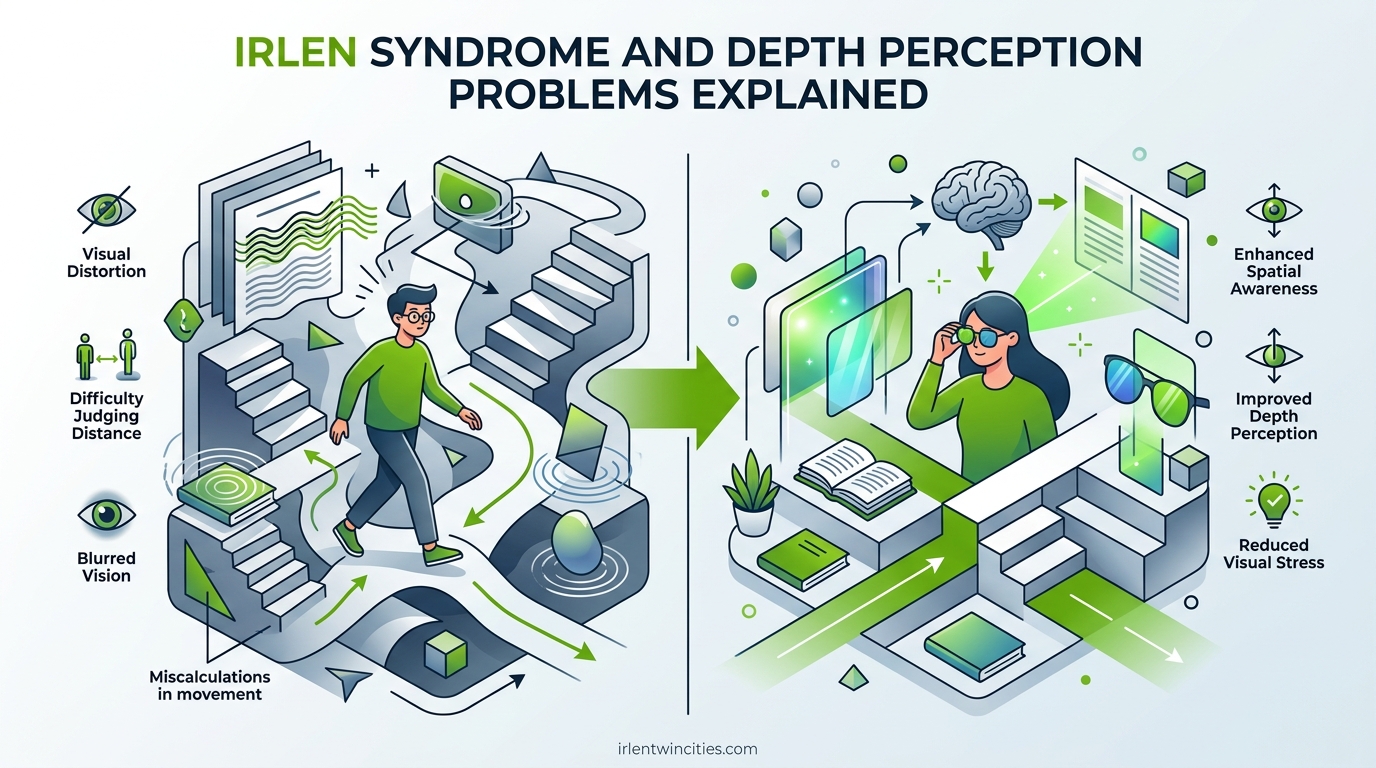
Irlen Syndrome is a perceptual processing disorder that affects the way your brain processes visual information, and for many people, this includes significant depth perception problems that can impact daily life in surprising ways. When the brain struggles to process certain light wavelengths efficiently, it creates a cascade of symptoms that extend far beyond simple reading difficulties.
In this guide, I’ll explain exactly how Irlen Syndrome affects depth perception, why this happens at the neurological level, and what you can do about it. Whether you’re experiencing unexplained clumsiness, difficulty with stairs, or problems judging distances, understanding this connection is the first step toward finding relief.
Table of Contents
What Is Irlen Syndrome
Irlen Syndrome is a perceptual processing disorder characterized by the brain’s difficulty in processing specific light wavelengths and visual stimuli. It is not an optical problem, meaning standard eye exams typically reveal normal 20/20 vision. Instead, this condition stems from how the brain interprets the visual information it receives.
Also known as Scotopic Sensitivity Syndrome or Meares-Irlen Syndrome, this condition affects approximately 12-14% of the general population and up to 46% of individuals with reading difficulties or learning disabilities. The prevalence is significant enough that researchers have been studying it since the 1980s, yet many people remain undiagnosed.
Understanding Perceptual Processing Disorder
A perceptual processing disorder occurs when the brain cannot properly organize, interpret, or make sense of sensory information. With Irlen Syndrome specifically, the brain overreacts to certain types of light, particularly fluorescent lighting and high-contrast visual environments. This overreaction creates visual stress that manifests in multiple ways.
The brain’s visual processing system involves complex pathways that interpret color, contrast, motion, and spatial relationships. When these pathways are affected by Irlen Syndrome, the result is a distorted or incomplete interpretation of the visual world. Think of it as a computer struggling to render graphics properly, the information is there, but the processing creates errors.
The Role of Light Sensitivity
Light sensitivity is one of the hallmark symptoms of Irlen Syndrome, and it plays a direct role in depth perception problems. When certain light wavelengths reach the retina, the brain processes them inefficiently, creating a visual environment that appears unstable or distorted.
Fluorescent lights are particularly problematic because they emit light in irregular patterns that the brain must work harder to process. This extra processing effort diverts cognitive resources away from other visual tasks, including the complex calculations required for accurate depth perception.
How Irlen Syndrome Affects Depth Perception
Irlen Syndrome creates depth perception problems through a specific mechanism involving how the brain processes visual input for spatial awareness. When your brain is working overtime to filter problematic light wavelengths, it has fewer resources available for processing depth cues.
Depth perception relies on multiple visual cues working together: binocular disparity (differences between what each eye sees), motion parallax (how objects appear to move as you move), texture gradients, and relative size comparisons. Irlen Syndrome can disrupt any or all of these processing systems.
Why Depth Perception Becomes Compromised
The connection between Irlen Syndrome and depth perception problems comes down to visual stress. When the brain encounters light wavelengths it struggles to process, it creates a state of constant low-level visual stress. This stress manifests as eye strain, fatigue, and most importantly for depth perception, difficulty maintaining stable visual attention on spatial relationships.
Research suggests that individuals with Irlen Syndrome experience what researchers call “visual distortions” where flat surfaces may appear to have depth, or conversely, three-dimensional objects may look unnaturally flat. These distortions directly impact the brain’s ability to calculate distances accurately.
Additionally, poor depth perception in Irlen Syndrome often stems from tracking difficulties. When your eyes struggle to track moving objects smoothly, your brain receives incomplete information about where objects are in space relative to your position.
The Connection Between Print Instability and Spatial Perception
One fascinating aspect of Irlen Syndrome is how print instability relates to broader spatial perception issues. Many people with this condition report that text on a page appears to move, shimmer, or exist at different depth planes. This same instability extends to how they perceive the physical environment.
When text appears to float or shift on the page, it indicates that the brain’s spatial mapping system is compromised. This same compromised system affects how you perceive stairs, curbs, doorways, and moving objects in your environment.
Signs and Symptoms of Depth Perception Problems
Recognizing depth perception problems associated with Irlen Syndrome requires understanding the specific ways these symptoms manifest in daily life. Many people attribute these issues to general clumsiness without realizing there’s an underlying neurological cause.
Physical Clumsiness and Spatial Awareness
People with Irlen Syndrome often report bumping into door frames, misjudging the position of furniture, or knocking objects over regularly. This isn’t mere clumsiness, it’s the brain receiving inaccurate information about where objects are in space.
One forum participant described it perfectly: “I feel like my body is slightly wider than it actually is. I constantly misjudge whether I can fit through spaces.” This phenomenon reflects the brain’s inaccurate spatial mapping system at work.
Stair and Escalator Difficulties
Stairs represent one of the most common challenges for people with Irlen Syndrome and depth perception problems. Many individuals report that stairs appear flat or that they cannot judge the height of individual steps accurately.
Escalators can be particularly disorienting because the moving steps combined with fluorescent lighting in many public spaces create a perfect storm of visual triggers. People often describe feeling like the floor is moving even after they’ve stepped off, or experiencing vertigo-like sensations.
Patterned carpets and tiled floors can also create visual confusion. Tight repeating patterns often appear to move or shimmer, making it difficult to judge where the actual floor surface is.
Sports and Physical Activity Challenges
Ball sports become particularly challenging when depth perception is compromised. Catching, hitting, or tracking moving objects requires precise spatial calculations that the Irlen-affected brain struggles to perform consistently.
Many parents report that their children with undiagnosed Irlen Syndrome avoid sports or are always the last picked for teams. The child isn’t uncoordinated, their brain simply isn’t receiving accurate information about where the ball is in space.
Activities requiring fine motor coordination, such as threading a needle or pouring liquid without spilling, can also be frustratingly difficult.
Driving Concerns and Safety
Driving represents perhaps the most significant safety concern related to Irlen Syndrome depth perception problems. Judging distances to other vehicles, estimating closing speeds, and navigating parking spaces all require accurate depth perception.
Many adults with Irlen Syndrome report anxiety around driving, particularly at night or in bright sunlight. The glare from headlights or sunlight can trigger visual distortions that make it nearly impossible to judge distances accurately.
Some individuals describe difficulty with lane positioning or feeling like their vehicle is wider than it actually is, similar to the spatial awareness issues mentioned earlier.
Daily Life Impact of Irlen Syndrome Depth Perception Problems
Beyond the obvious physical challenges, Irlen Syndrome and associated depth perception problems create a cascade of effects that touch every aspect of daily life. Understanding these impacts helps explain why proper diagnosis and treatment are so important.
Reading and Learning Difficulties
While not directly a depth perception issue, reading difficulties often coexist with spatial perception problems. When text appears unstable or moves on the page, the brain expends enormous energy just trying to maintain a stable visual field.
This visual fatigue then compounds any depth perception problems because the brain has fewer cognitive resources available for spatial processing. Students may find themselves exhausted after relatively short reading sessions.
Work Environment Challenges
Modern workplaces are often challenging environments for people with Irlen Syndrome. Fluorescent lighting, computer screens, and open office plans with high visual activity can all trigger symptoms.
Computer use is particularly problematic because screens emit light directly, and the high contrast of text on white backgrounds creates visual stress. People often report headaches, eye strain, and difficulty with depth perception when switching between the screen and the physical environment.
Social and Emotional Effects
Living with undiagnosed Irlen Syndrome and depth perception problems takes an emotional toll. Children may be labeled as clumsy, careless, or uncoordinated. Adults may develop anxiety around driving or navigating unfamiliar spaces.
The frustration of knowing you’re trying your best while your body seems to betray you creates genuine psychological stress. Many people report relief upon diagnosis simply because they finally have an explanation for experiences they’ve had their entire lives.
Who Is Affected by Irlen Syndrome
Irlen Syndrome affects a surprisingly large portion of the population, yet it remains significantly underdiagnosed. Understanding the risk factors and prevalence can help identify who might benefit from screening.
Prevalence Statistics
Research indicates that Irlen Syndrome affects approximately 12-14% of the general population. Among individuals with reading difficulties or learning disabilities, that number jumps to 46%. These statistics suggest that millions of people may be living with undiagnosed Irlen Syndrome and related depth perception problems.
The condition appears to affect all ages, from young children to adults. While some people notice symptoms from early childhood, others may develop symptoms later in life, particularly after head injuries or increased exposure to fluorescent lighting environments.
Hereditary Factors
Irlen Syndrome appears to have a genetic component. Family history is one of the strongest predictors of the condition. When one family member is diagnosed, it’s common to find that siblings, parents, or children also have symptoms.
If you have a family history of reading difficulties, light sensitivity, or complaints about fluorescent lighting, this increases the likelihood that depth perception problems may be related to Irlen Syndrome.
Connection to Autism and ADHD
Irlen Syndrome is not autism or ADHD, but it frequently coexists with both conditions. Research suggests that up to 50% of individuals on the autism spectrum may also have Irlen Syndrome. Similarly, many people with ADHD find that treating visual processing problems helps with attention and focus.
The overlap occurs because all these conditions involve how the brain processes information. When visual input is distorted or stressful, it creates additional cognitive load that can exacerbate attention difficulties or sensory sensitivities.
How Irlen Syndrome Differs From Similar Conditions
One reason Irlen Syndrome remains underdiagnosed is that its symptoms overlap with several other conditions. Understanding these differences is crucial for proper diagnosis and treatment.
Irlen Syndrome vs Dyslexia
While both conditions cause reading difficulties, they have different underlying causes. Dyslexia is a language-based learning disability affecting how the brain processes written language. Irlen Syndrome is a visual processing disorder affecting how the brain interprets light and visual stimuli.
The key difference lies in the scope of symptoms. Dyslexia primarily affects reading and language processing. Irlen Syndrome affects all visual processing, including depth perception, light sensitivity, and spatial awareness. Interestingly, many people have both conditions, and treating the Irlen Syndrome component can significantly improve reading comfort even when dyslexia remains.
Irlen Syndrome vs ADHD
ADHD is a neurodevelopmental disorder characterized by difficulties with attention, hyperactivity, and impulsivity. Irlen Syndrome can mimic some ADHD symptoms because visual stress makes it difficult to concentrate. However, the root causes are different.
If attention problems are primarily related to visual discomfort, treating the Irlen Syndrome may significantly improve focus without ADHD medication. Many parents report that their “ADHD” children become calm and focused once their visual processing issues are addressed.
Is Irlen Syndrome a Visual Impairment
No, Irlen Syndrome is not a visual impairment in the traditional sense. Standard eye exams will typically show normal visual acuity (20/20 vision is common). The problem is not with the eyes themselves but with how the brain processes the information the eyes collect.
This distinction is important because it explains why glasses or contact lenses don’t correct Irlen Syndrome symptoms. The eyes are working perfectly. The brain needs support in processing what the eyes see.
Is Irlen Syndrome Considered a Disability
Whether Irlen Syndrome qualifies as a disability depends on context and severity. In educational settings, it may qualify for accommodations under learning disability provisions. In workplace settings, it may be covered under disability discrimination laws if it significantly impacts job performance.
The important point is that Irlen Syndrome creates genuine functional limitations. Depth perception problems can affect safety, work performance, and quality of life. These limitations deserve recognition and accommodation.
Treatment and Management Options
The good news is that Irlen Syndrome and associated depth perception problems can be effectively managed. While there is no “cure,” proper treatment can dramatically reduce or eliminate symptoms.
Can an Eye Doctor Fix Depth Perception Problems
Standard eye doctors (optometrists and ophthalmologists) cannot diagnose or treat Irlen Syndrome using conventional methods. Because this is a brain-based processing problem rather than an optical issue, it requires specialized assessment.
However, some optometrists now offer Irlen screening as an additional service. The key is finding a practitioner specifically trained in perceptual processing disorders. Regular vision therapy may help some symptoms but typically doesn’t address the light sensitivity core of Irlen Syndrome.
The Irlen Method and Colored Filters
The primary treatment for Irlen Syndrome involves precision-tinted colored overlays or lenses. The Irlen Method uses a detailed assessment process to determine the exact color wavelength that filters out the problematic light affecting an individual’s brain.
These colored filters work by blocking the specific light wavelengths that trigger visual stress. Once those wavelengths are filtered, the brain can process visual information normally, and depth perception typically improves dramatically.
Treatment is highly individualized. The specific color needed varies from person to person. Some need rose or purple tints, others need blue or green. The assessment process determines the precise wavelength filter needed for optimal results.
Environmental Modifications
While colored filters address the core problem, environmental changes can provide additional relief. Replacing fluorescent lighting with full-spectrum or incandescent alternatives reduces visual stress significantly.
Computer screen adjustments, including reducing brightness, using blue light filters, and changing background colors from white to soft pastels, can help. Some people find that simply wearing a hat or visor indoors reduces the light reaching their eyes and improves comfort.
Coping Strategies for Daily Life
For depth perception problems specifically, several practical strategies can improve safety and confidence. Taking extra time when navigating stairs, using handrails consistently, and being particularly cautious in unfamiliar environments helps prevent accidents.
Many people find that dimming lights or wearing lightly tinted glasses even before formal diagnosis helps with spatial awareness. Avoiding patterned carpets and high-contrast environments when possible can also reduce depth perception difficulties.
Frequently Asked Questions
Can an eye doctor fix depth perception?
Standard eye doctors typically cannot fix Irlen Syndrome-related depth perception problems because this condition is not an optical issue. The problem lies in how the brain processes visual information, not with the eyes themselves. However, specialists trained in the Irlen Method can assess and treat the condition using precision-tinted colored filters that help the brain process visual stimuli correctly.
Is Irlen Syndrome autism?
No, Irlen Syndrome is not autism. They are separate conditions with different causes. However, they frequently coexist, with research suggesting up to 50% of individuals on the autism spectrum also having Irlen Syndrome. Both conditions involve sensory processing differences, but Irlen Syndrome specifically affects visual processing and light sensitivity while autism is a broader neurodevelopmental condition.
Is Irlen Syndrome like ADHD?
Irlen Syndrome is not ADHD, though the two conditions can appear similar. Both can cause attention difficulties and restlessness. However, Irlen Syndrome symptoms stem from visual stress and light sensitivity, while ADHD is a neurodevelopmental disorder affecting executive function. Some individuals diagnosed with ADHD may actually have undiagnosed Irlen Syndrome, and treating the visual processing issues can significantly improve focus and attention.
Is Irlen Syndrome a visual impairment?
Irlen Syndrome is not a visual impairment in the traditional sense. Standard eye exams typically show normal 20/20 vision because the eyes themselves work correctly. Instead, Irlen Syndrome is a perceptual processing disorder affecting how the brain interprets visual information. This distinction is important because it explains why glasses or contact lenses don’t resolve Irlen Syndrome symptoms.
How do people with Irlen Syndrome see the world?
People with Irlen Syndrome often perceive the world as visually unstable or distorted. Text may appear to move, shimmer, or exist at different depth planes. Fluorescent lights can be painful or create visual noise. Patterns may appear to move or pulsate. Depth perception can be compromised, making stairs, curbs, and moving objects difficult to judge. Many describe the experience as seeing the world through a filter of visual stress that requires constant effort to interpret.
Is Irlen Syndrome considered a disability?
Whether Irlen Syndrome qualifies as a disability depends on severity and context. In educational and workplace settings, it may qualify for accommodations if it significantly impacts learning or job performance. The depth perception problems, light sensitivity, and reading difficulties can create genuine functional limitations that affect safety, productivity, and quality of life. Many jurisdictions recognize perceptual processing disorders under disability discrimination and accommodation laws.
Conclusion
Irlen Syndrome and depth perception problems are closely connected through the brain’s struggle to process specific light wavelengths efficiently. This perceptual processing disorder affects millions of people, often going undiagnosed for years while individuals attribute their symptoms to clumsiness, anxiety, or other conditions.
The key takeaway is that depth perception problems associated with Irlen Syndrome are real, measurable, and treatable. If you recognize yourself in the symptoms described here, whether it’s difficulty with stairs, trouble judging distances while driving, or general spatial awareness challenges, consider seeking an Irlen screening.
With proper assessment and the right colored filters, most people experience significant improvement in depth perception and overall visual comfort. Understanding Irlen Syndrome is the first step toward seeing the world more clearly and navigating it with confidence.