
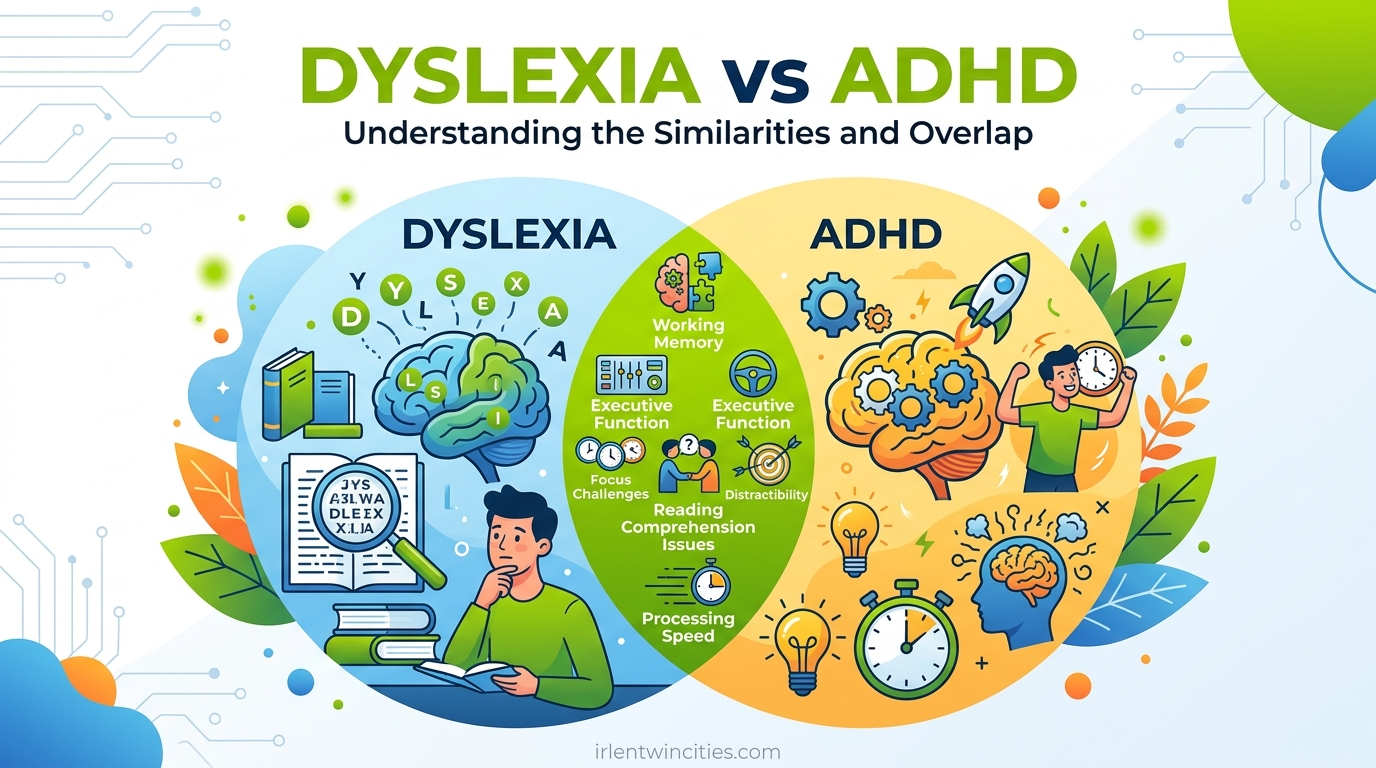
About 3 in 10 people with dyslexia also have ADHD. This striking statistic reveals why so many families and individuals struggle to understand exactly what challenges they face. Dyslexia vs ADHD is not an either-or question for millions of people.
Both conditions are distinct neurodevelopmental disorders. Yet they share enough overlapping symptoms that distinguishing between them requires careful evaluation. Understanding the similarities and overlap between dyslexia and ADHD matters because proper diagnosis leads to the right support.
Children and adults with both conditions face amplified learning challenges. Educators, parents, and healthcare providers need clear guidance on how these conditions interact. This guide breaks down the science, the statistics, and the real-world implications of living with one or both conditions.
Table of Contents
What Is Dyslexia
Dyslexia is a language-based learning disability that affects reading, spelling, and writing. It stems from difficulties with phonological processing, which is the ability to recognize and manipulate sounds in spoken language. People with dyslexia often read slowly and make frequent errors despite normal intelligence and education.
The International Dyslexia Association defines dyslexia as a specific learning disability that is neurobiological in origin. It is characterized by difficulties with accurate and fluent word recognition and by poor spelling and decoding abilities. These difficulties typically result from a deficit in the phonological component of language.
Reading challenges in dyslexia go beyond simply mixing up letters. Individuals struggle to connect sounds with letters, which makes sounding out words difficult. They may read words correctly one moment and incorrectly the next, showing inconsistent performance that puzzles teachers and parents.
Writing difficulties often accompany reading problems. Spelling becomes a significant hurdle because it requires the same phonological skills that are impaired. Many people with dyslexia avoid writing tasks or develop compensatory strategies like using simpler words to avoid spelling mistakes.
Importantly, dyslexia is not related to vision problems or low intelligence. The brain processes language differently in people with dyslexia, creating a gap between their potential and their academic performance in reading-related tasks.
What Is ADHD
Attention-Deficit/Hyperactivity Disorder (ADHD) is a neurodevelopmental condition affecting attention, impulse control, and activity levels. The DSM-5 recognizes three presentations: predominantly inattentive, predominantly hyperactive-impulsive, and combined type.
Core symptoms include difficulty sustaining attention, easily becoming distracted, and trouble organizing tasks and activities. People with ADHD may appear forgetful in daily activities and frequently lose necessary items like keys, phones, or school materials.
Hyperactivity manifests as excessive fidgeting, difficulty staying seated, and feeling restless even when sitting still is expected. Impulsivity shows up in interrupting conversations, difficulty waiting turns, and making quick decisions without considering consequences.
The inattentive presentation often goes undiagnosed in children who are not disruptive. These individuals may sit quietly but struggle to focus on lessons or complete assignments. Adults with this presentation frequently describe a lifetime of being told they were not trying hard enough.
Executive function deficits lie at the heart of ADHD. These higher-level cognitive skills include planning, prioritizing, initiating tasks, and regulating emotions. When executive function is impaired, everyday demands become overwhelming.
How Dyslexia and ADHD Co-Occur: The Statistics
Research consistently shows substantial overlap between these conditions. Approximately 30% of individuals with dyslexia also meet criteria for ADHD. Conversely, an estimated 25% to 40% of people with ADHD also have dyslexia.
This bidirectional relationship means neither condition predicts the other perfectly. Having one increases the odds of having both, but many people have only dyslexia or only ADHD. The comorbidity rates are significantly higher than chance would predict.
Scientists have identified shared genetic factors that may explain part of the overlap. Both conditions run in families, and having a first-degree relative with either condition increases risk for both. Heritability estimates for ADHD range from 70% to 80%, while dyslexia shows heritability around 50% to 70%.
The high co-occurrence rate matters for treatment planning. Interventions that help dyslexia, such as structured literacy instruction, do not address ADHD symptoms. Similarly, ADHD medications improve attention but do not fix phonological processing deficits.
Overlapping Symptoms Between Dyslexia and ADHD
Understanding where these conditions overlap helps explain why misdiagnosis happens. Both conditions affect school and work performance in ways that look similar on the surface. Deeper evaluation reveals different underlying causes for shared surface symptoms.
| Symptom Area | Dyslexia | ADHD | Overlap Notes |
|---|---|---|---|
| Inattention | During reading tasks specifically | Across all settings and tasks | Both appear distracted during reading |
| Reading Difficulties | Phonological processing deficit | Comprehension from distractibility | Both read slowly with poor comprehension |
| Writing Challenges | Spelling and organization errors | Poor planning and completion | Both produce messy, incomplete work |
| Forgetfulness | Instructions involving reading | All verbal instructions | Both miss important details |
| Task Avoidance | Reading and writing tasks | Tasks requiring sustained effort | Both resist homework and studying |
| Organization Problems | Written materials and notes | All belongings and schedules | Both lose items and miss deadlines |
Inattention in Both Conditions
A child who cannot focus during reading time might have ADHD affecting all attention. Or they might have dyslexia making reading so exhausting that their attention drifts specifically during literacy tasks. The behavior looks identical to a casual observer.
ADHD-related inattention is global and consistent across settings. Dyslexia-related inattention is context-specific, appearing primarily during reading, writing, or other language-heavy tasks. Evaluators must observe behavior across multiple contexts to distinguish primary from secondary attention problems.
Reading Challenges Comparison
People with dyslexia struggle to decode words because of phonological processing deficits. They labor over sounding out words and often guess based on context or first letters. Reading fluency remains poor even after years of practice.
People with ADHD may read words accurately but lose their place frequently. They might skip lines, re-read the same sentence multiple times, or finish a page realizing they absorbed nothing. Their decoding is intact but their sustained attention is not.
When both conditions coexist, reading becomes a double burden. The individual must fight both poor phonological skills and wandering attention. Progress in reading interventions may be slower than expected because attention problems interfere with practice.
Writing Difficulties
Dyslexia creates spelling errors through poor sound-symbol mapping. Students write phonetically, spelling words as they sound rather than following standard patterns. They may also struggle to organize written thoughts because reading difficulties limit exposure to written language structures.
ADHD affects writing through executive dysfunction. Students start essays without planning, lose track of their main point, and fail to edit their work. They may write quickly and messily, producing content that is disorganized rather than mechanically flawed.
Having both conditions produces writing that is both poorly spelled and poorly organized. The student cannot hear the sounds in words and cannot structure their thoughts on paper. This combination frustrates students and teachers who see potential that written work does not reflect.
Key Differences: How to Tell Dyslexia and ADHD Apart
While overlapping symptoms create confusion, the root causes differ fundamentally. Understanding these distinctions helps identify which condition, or combination, is present. Evaluators look for patterns of strengths and weaknesses rather than isolated symptoms.
Core Deficit Differences
Dyslexia is primarily a language processing disorder. The core deficit involves phonological awareness, rapid naming, and verbal working memory. Intelligence in non-verbal areas often remains strong, creating a significant discrepancy between reading ability and overall cognitive potential.
ADHD is primarily an executive function and self-regulation disorder. The core deficits involve attention regulation, impulse control, and motor activity management. Intelligence is typically distributed across domains, with the gap appearing between potential and realized performance in all areas.
Symptom Consistency Patterns
Dyslexia symptoms are specific to language-based tasks. An individual with pure dyslexia can focus intently on mathematics, art, or hands-on activities. Their attention problems appear only when language processing demands exceed their capacity.
ADHD symptoms are pervasive across settings and activities. The person struggles with attention whether reading, playing sports, or watching a movie. Hyperactivity and impulsivity appear in school, at home, and in social situations.
Response to Intervention
Reading interventions targeting phonological awareness help dyslexia. Systematic, explicit instruction in sound-letter relationships produces measurable gains when dyslexia is the primary concern. Structured literacy approaches address the specific deficit underlying reading struggles.
ADHD symptoms may improve with behavioral strategies, environmental modifications, and medication. Stimulant medications help approximately 70% of people with ADHD regulate attention and impulse control. These treatments do not improve phonological processing.
Diagnostic Considerations and Evaluation
Accurate diagnosis requires comprehensive evaluation that goes beyond observing surface symptoms. Checklists and brief screenings cannot reliably distinguish between dyslexia, ADHD, and comorbid presentations. Professional assessment is essential for proper identification.
Why Misdiagnosis Happens
Evaluators sometimes confuse the conditions because behavioral symptoms overlap significantly. A child who cannot complete reading assignments may be labeled inattentive when the root cause is dyslexia. Conversely, a child with ADHD may be assumed to have reading difficulties when their decoding skills are actually intact.
The direction of misdiagnosis often follows the evaluator’s specialty. Psychologists focused on attention may over-identify ADHD. Reading specialists may attribute all struggles to dyslexia. Neither perspective captures the full picture when both conditions are present.
Comprehensive Testing Components
Proper evaluation for both conditions should include cognitive testing, academic achievement assessment, and attention measures. Phonological processing tests specifically identify dyslexia by measuring sound manipulation skills. Continuous performance tests measure sustained attention and impulse control for ADHD diagnosis.
Multi-session testing is often recommended because fatigue affects both conditions. Performance in the morning may differ from afternoon sessions. Multiple testing sessions also allow evaluators to observe consistency of symptoms across time.
When to Seek Evaluation
Consider comprehensive evaluation when reading struggles persist despite intervention, when attention problems appear in multiple settings, or when family history includes either condition. Early diagnosis allows for accommodations and interventions that prevent secondary emotional and academic problems.
Adults who struggled in school without explanation, who suspect they were missed diagnoses, or who notice their children showing similar patterns should also seek evaluation. Diagnosis at any age opens doors to support and understanding.
Genetic and Neurological Factors
Both dyslexia and ADHD have strong genetic components that help explain their frequent co-occurrence. Family studies show that having a first-degree relative with either condition increases the likelihood of having both. Twin studies demonstrate heritability patterns that inform our understanding of risk.
Heritability and Family Patterns
Children with one parent who has dyslexia have a 40% to 60% chance of developing the condition. When both parents have dyslexia, that risk rises to 80% or higher. ADHD shows similar patterns, with heritability among the highest of any behavioral condition.
Shared genetic risk factors may underlie the high comorbidity rate. Studies have identified common gene variants that affect both conditions. These genetic findings suggest that dyslexia and ADHD exist on a spectrum of neurodevelopmental differences with overlapping biological bases.
Brain Differences
Neuroimaging studies reveal distinct but sometimes overlapping brain differences in each condition. Dyslexia is associated with reduced activation in left hemisphere regions responsible for language processing, particularly the temporoparietal area involved in mapping sounds to letters.
ADHD shows differences in prefrontal cortex activation and connectivity, affecting executive function and attention networks. The basal ganglia and cerebellum also show structural and functional differences in individuals with ADHD.
When both conditions are present, brain imaging sometimes shows both patterns. The combination creates a unique neurobiological signature that underscores why treatment must address both sets of symptoms for optimal outcomes.
Living with Both Dyslexia and ADHD
Having both conditions creates challenges that exceed the sum of individual difficulties. As one community member noted, living with dyslexia and ADHD is exhausting and challenging. The combination affects school, work, relationships, and self-esteem in profound ways.
Amplified Learning Challenges
Reading interventions require sustained attention and consistent practice. When ADHD makes both attention and consistency problematic, progress slows significantly. Students may become frustrated with interventions that should help because their attention problems prevent full engagement.
Academic tasks demand both language skills and executive function. Essays require planning thoughts, organizing ideas, and spelling words correctly. Each step is compromised when both conditions are present, producing work that reflects neither the student’s knowledge nor their effort.
Treatment and Accommodation Strategies
Effective treatment for comorbid dyslexia and ADHD requires addressing both conditions simultaneously. ADHD medication may improve focus enough to benefit from reading intervention. Structured literacy instruction provides the phonological training needed for reading development.
Accommodations that help include extended time for tests, quiet testing environments, text-to-speech software, and graphic organizers for writing. Breaking large assignments into smaller steps with frequent check-ins helps compensate for executive function deficits.
Adults in the workplace benefit from similar accommodations under the Americans with Disabilities Act. Assistive technology, written instructions instead of verbal only, and flexible deadlines can make employment sustainable and successful.
Frequently Asked Questions
How are dyslexia and ADHD similar?
Dyslexia and ADHD share several surface symptoms including inattention during tasks, reading difficulties, writing challenges, forgetfulness, and organization problems. Both conditions are neurodevelopmental disorders that often first appear in childhood. They can co-occur in the same individual, with about 30% of people with dyslexia also having ADHD, and 25-40% of people with ADHD also having dyslexia.
What is the 30% rule in ADHD?
The 30% rule refers to the finding that approximately 30% of individuals with dyslexia also have ADHD. This statistic highlights the significant overlap between the two conditions. The rule serves as a reminder that when dyslexia is diagnosed, screening for ADHD should be considered, and vice versa, due to the high comorbidity rates.
What is the 24 hour rule for ADHD?
The 24-hour rule in ADHD refers to the diagnostic criterion that symptoms must be present in multiple settings for at least six months to qualify for a diagnosis. Some interpretations extend this to note that ADHD symptoms affect functioning consistently over time, not just in isolated incidents. This persistence requirement helps distinguish ADHD from temporary attention difficulties caused by stress or other factors.
How to tell if it’s ADHD or dyslexia?
The key distinction lies in the consistency and context of symptoms. ADHD symptoms appear across all settings and activities, including non-academic situations like social gatherings or hobbies. Dyslexia symptoms are specific to language-based tasks and disappear during non-reading activities. Testing can confirm the diagnosis: phonological processing deficits indicate dyslexia, while sustained attention problems across domains indicate ADHD. Comprehensive evaluation by a professional is recommended when either condition is suspected.
Dyslexia vs ADHD: Key Takeaways for 2026
Understanding the relationship between dyslexia and ADHD helps individuals, families, and educators provide appropriate support. The high co-occurrence rate of 30% means that anyone diagnosed with one condition should be screened for the other.
Key differences in root causes matter for treatment selection. Dyslexia requires structured literacy intervention targeting phonological processing. ADHD responds to behavioral strategies, environmental modifications, and sometimes medication. When both conditions coexist, treatment must address both sets of needs.
Comprehensive evaluation by qualified professionals remains the gold standard for distinguishing these conditions. Brief screenings and single-symptom checklists cannot reliably separate dyslexia from ADHD or identify comorbid presentations.
If you or your child struggles with reading, attention, or both, seek professional assessment. Proper diagnosis opens doors to accommodations, interventions, and understanding that can transform educational and life outcomes. The path to support begins with accurate identification of what challenges are present.