
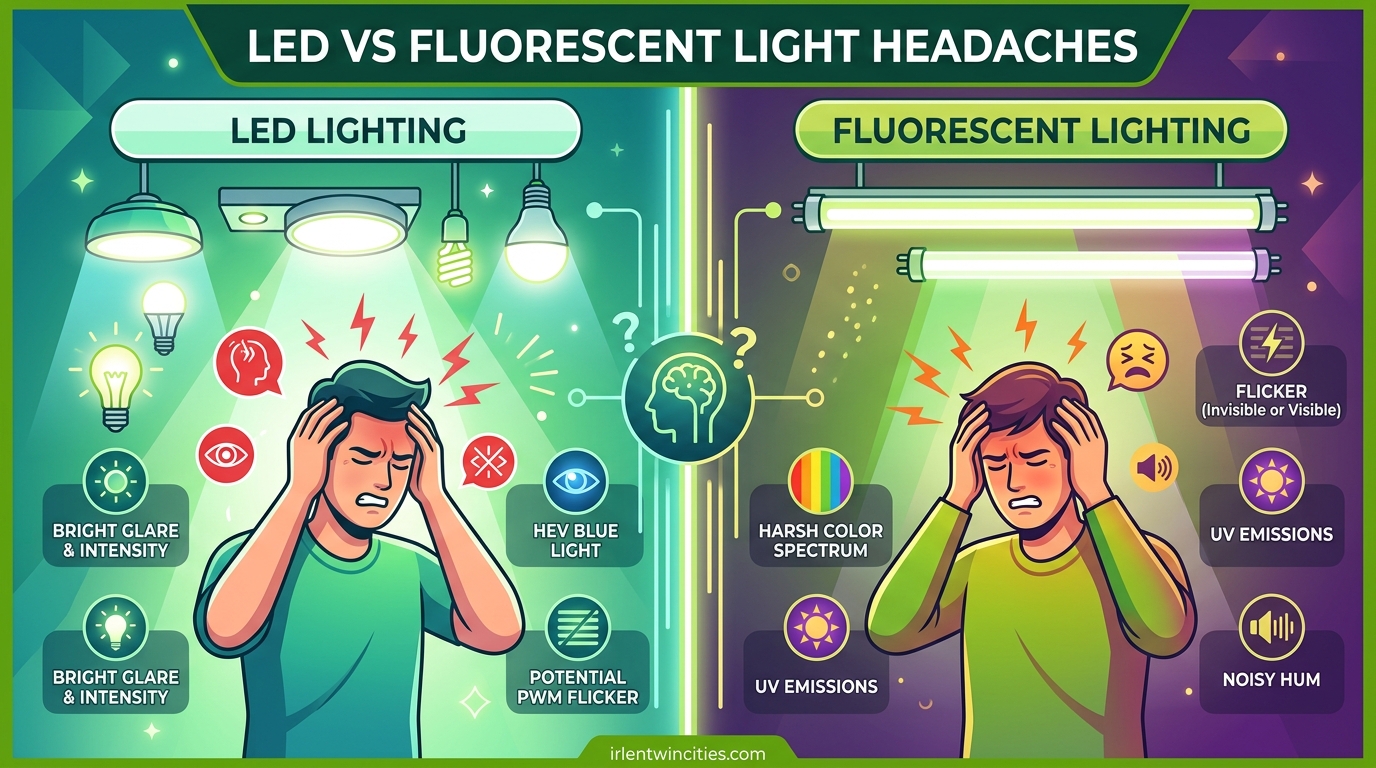
Both LED and fluorescent lights can trigger headaches and migraines, though they affect people through different mechanisms. LED lights emit concentrated blue light wavelengths that activate light-sensitive cells in the eye, while fluorescent lights produce invisible pulsing at 60Hz that the brain detects even when your eyes cannot. Neither is definitively worse for everyone. Individual sensitivity, headache type, and exposure duration determine which causes more problems for you.
If you have ever left an office with a pounding headache or felt eye strain after hours under bright overhead lights, you are not alone. Our team has researched the science behind light-induced headaches for 2026, analyzing studies from Harvard Medical School, the French health agency ANSES, and renowned vision researcher Arnold Wilkins. This guide will help you understand which lighting type poses the bigger risk for your specific situation.
Table of Contents
LED vs Fluorescent Light: Which Is Worse for Headaches?
The honest answer is that both LED and fluorescent lights can trigger headaches, but they do so differently. LED lights often cause more immediate discomfort due to high concentrations of blue light in the 415-455nm range. Fluorescent lights create problems through rapid invisible pulsing that stresses the visual system over time.
Research from the French Agency for Food, Environmental and Occupational Health & Safety (ANSES) found that LED lights can have significant photobiological risks due to their blue light content. Meanwhile, studies by Arnold Wilkins at the University of Essex revealed that LED flicker, even when invisible to conscious perception, can trigger headaches and eye strain.
Your personal headache profile matters here. People with migraine disorders often find fluorescent lights more triggering due to the pulsing effect. Those with general light sensitivity or tension-type headaches may struggle more with the intensity and blue light concentration of LEDs. Office workers frequently report that long days under fluorescent tubes lead to end-of-day headaches, while LED screen users experience more immediate eye strain.
How Blue Light Wavelengths Trigger Headaches
Blue light wavelengths between 415 and 455 nanometers penetrate deep into the eye and activate intrinsically photosensitive retinal ganglion cells, or ipRGCs. These specialized cells send signals directly to brain regions that control pain perception, circadian rhythms, and pupil dilation. When overstimulated, they can trigger headache responses.
LED lights emit a higher proportion of blue light compared to fluorescent bulbs. While fluorescent lights produce a broader spectrum, they still contain significant blue light components that affect sensitive individuals. The concentrated spike in blue wavelengths from LEDs explains why many people find them harsher and more headache-inducing, especially cool white or daylight temperature LEDs.
The ANSES report highlighted that chronic exposure to high-intensity blue light from LEDs may contribute to eye strain, visual discomfort, and headache disorders. This is particularly concerning given the widespread adoption of LED lighting in homes, offices, and especially in digital screens that we hold close to our faces for hours daily.
The Hidden Danger: Flickering and Pulsing
Here is what most people do not realize about modern lighting. LED lights flicker at high frequencies, typically at twice the alternating current rate. In North America, this means LEDs flicker at 120Hz, creating a strobe-like effect that your brain perceives even when your eyes cannot consciously detect it. This invisible flicker is a major headache trigger for susceptible individuals.
Fluorescent lights pulse at 60Hz, synchronized with the electrical grid. This pulsing is also invisible to direct perception, but your visual system processes it constantly. Research by Arnold Wilkins demonstrated that this flicker creates measurable stress on the visual cortex. The brain works overtime to compensate for the rapid light variations, leading to fatigue, eye strain, and eventually headaches.
The flicker issue is worse with cheaper LED bulbs and older fluorescent fixtures. High-quality LEDs with proper drivers can reduce flicker significantly. However, even premium LEDs cannot eliminate it entirely. For people with migraine disorders, this constant subliminal flickering is like a drumbeat of visual stress that can build toward a full migraine attack.
Understanding Photophobia and Light Sensitivity
Photophobia is the medical term for light sensitivity, defined as an abnormal sensitivity to light that causes discomfort or pain. It is not a fear of light as the name might suggest, but rather a heightened response to light stimuli that affects the nervous system. Over 40 health conditions are associated with photophobia, including migraine, tension-type headache, cluster headache, concussion, and meningitis.
When you have photophobia, your visual system overreacts to light input. Normal lighting levels become painful. The cone-driven pathways in your eyes send exaggerated signals to the thalamus and trigeminal nerve, which processes sensory information including pain. This explains why bright or flickering lights can trigger or worsen headaches in sensitive individuals.
Both LED and fluorescent lights pose challenges for people with photophobia. The blue light from LEDs activates pain pathways directly. The pulsing of fluorescent lights creates a repetitive stress signal. If you find yourself squinting in normal office lighting, feeling immediate discomfort under bright LEDs, or needing to wear sunglasses indoors, you may have undiagnosed photophobia contributing to your headaches.
Types of Headaches Triggered by Artificial Light
Understanding which headache types lighting triggers can help you identify your specific triggers. Here are the main categories:
Migraine attacks are the most common light-triggered headaches. Photophobia is a hallmark symptom of migraine, present in over 80% of migraine sufferers. Both LED and fluorescent lights can trigger migraine attacks, with fluorescent pulsing often cited as a more frequent trigger in office environments. Once a migraine begins, light exposure intensifies the pain, creating a vicious cycle.
Tension-type headaches can also result from artificial lighting, though the mechanism differs. Eye strain from poor lighting leads to muscle tension around the eyes, forehead, and neck. This tension spreads, creating the characteristic band-like pressure of tension headaches. LED screens at incorrect brightness levels are particularly notorious for causing this eye-strain-to-tension pathway.
Cluster headaches, while less common, show strong associations with light sensitivity. During cluster periods, sufferers often cannot tolerate any bright light. The intense, stabbing pain of cluster headaches can be triggered or worsened by both LED and fluorescent exposure.
Why LED Headlights and Screens Can Be Worse
Car LED headlights have become a significant source of complaints from headache and migraine sufferers. Forum discussions on Reddit’s migraine community frequently mention LED headlights as a major trigger for night driving pain. The intense, focused beam of LED headlights creates glare that overwhelms the visual system, especially for people already sensitive to light.
Smartphone and computer screens compound the problem through proximity and duration. We hold these devices close to our faces for hours each day. The blue light concentration from LED-backlit screens is higher than overhead lighting because the light source is directly facing the eyes. Research shows that extended screen exposure correlates with increased headache frequency and severity.
OLED screens offer a potential alternative. Unlike LED-backlit LCD screens, OLED pixels emit their own light without a constant backlight. This eliminates some of the flicker issues associated with LED screens. However, OLED screens still emit blue light, so they are not a complete solution for light-sensitive individuals.
Prevention Tips: How to Reduce Headaches from LED and Fluorescent Lights
You can take practical steps to reduce light-induced headaches without living in darkness. Here are evidence-based strategies:
Choose warm white LED bulbs over cool white or daylight versions. Warm white LEDs, rated at 2700K to 3000K color temperature, contain significantly less blue light in the problematic 415-455nm range. This simple switch can reduce eye strain and headache triggers for many people.
Consider FL-41 tinted lenses for protection in unavoidable bright environments. These rose-tinted lenses filter out the specific blue-green wavelengths that trigger headaches and migraines. Research from Harvard Medical School and multiple headache clinics supports their effectiveness. They are available as prescription lenses, non-prescription glasses, or clip-ons.
Install light filters or covers over fluorescent fixtures in your workplace. Magnetic or snap-on filters diffuse the light and reduce glare without requiring fixture replacement. Some filters specifically target the blue light spectrum while maintaining adequate illumination for work tasks.
Adjust your screen settings. Enable night mode or blue light filters on all devices, especially in the evening. Reduce screen brightness to match ambient lighting rather than using maximum brightness. Position screens to avoid glare from overhead lights or windows.
Take regular breaks using the 20-20-20 rule. Every 20 minutes, look at something 20 feet away for 20 seconds. This gives your eye muscles a break from the constant focusing required for screen work and reduces cumulative eye strain that leads to headaches.
Request workplace accommodations if office lighting triggers your headaches. Options include desk lamp substitution for overhead lighting, permission to wear tinted glasses, or relocation to areas with natural light exposure. Many employers are legally required to provide reasonable accommodations for migraine and light sensitivity under disability accommodation laws.
Green Light: A Potential Relief Option
While blue light triggers headaches, research suggests green light might do the opposite. A 2026 study from Harvard Medical School found that narrow-band green light at specific wavelengths (around 520nm) actually reduced headache pain in migraine sufferers. Unlike other light colors, green light appeared to calm rather than activate pain pathways.
The mechanism involves how different wavelengths affect the thalamus and trigeminal nerve. Green light generates smaller electrical signals in the neurons associated with migraine pain. Some researchers are developing green light therapy lamps specifically for migraine relief, though this remains an emerging field.
While you should not expect green light to eliminate migraines entirely, incorporating green-tinted lighting or spending time in environments with dominant green wavelengths may provide some relief. This research offers hope for a future where lighting not only avoids triggering headaches but actively helps prevent them.
FAQ
Is LED or fluorescent light better for migraines?
Neither is definitively better for all migraine sufferers. LEDs emit more concentrated blue light that triggers pain pathways directly. Fluorescent lights pulse at 60Hz, creating invisible flicker that stresses the visual system. Individual sensitivity varies. Some find warm white LEDs tolerable, while others do better with filtered fluorescent lighting. Experiment to find what works for your specific triggers.
What causes photophobia?
Photophobia results from abnormal light sensitivity where the visual system overreacts to normal light levels. Over 40 health conditions cause photophobia, including migraine, tension-type headache, cluster headache, concussion, and meningitis. The condition involves overactivation of intrinsically photosensitive retinal ganglion cells and exaggerated signaling through cone-driven pathways to pain-processing brain regions.
How to prevent headaches from LED lights?
Use warm white LED bulbs (2700K-3000K) instead of cool white. Enable blue light filters on devices. Wear FL-41 tinted lenses in bright environments. Take regular screen breaks using the 20-20-20 rule. Adjust screen brightness to match ambient light. Position screens to avoid glare. Consider workplace accommodations like desk lamps or light filters if overhead LEDs trigger your headaches.
Can LED lights cause migraines?
Yes, LED lights can trigger migraines in susceptible individuals. The blue light wavelengths (415-455nm) activate pain pathways in the brain. High-frequency flicker from LED drivers, though invisible, stresses the visual cortex. LED screens held close to the face are particularly problematic due to proximity and extended exposure. Warm white LEDs and blue light filters can reduce but not eliminate this risk.
Why do fluorescent lights give me headaches?
Fluorescent lights pulse at 60Hz, creating invisible flicker that your brain detects even when your eyes cannot. This constant pulsing stresses the visual system and can trigger headaches, especially in people with migraine disorders or light sensitivity. The effect worsens with age as the eye’s natural filtering decreases. Magnetic ballasts in older fluorescent fixtures create more pronounced flickering than modern electronic ballasts.
Are warm white LEDs better than cool white for headaches?
Yes, warm white LEDs (2700K-3000K) are generally better for headache sufferers than cool white (5000K-6500K). Warm white contains significantly less blue light in the problematic 415-455nm range that triggers pain pathways. Cool white and daylight LEDs mimic noon sunlight with high blue content, making them more likely to cause eye strain and headaches during extended exposure.
What is the best lighting for migraine sufferers?
The best lighting varies by individual, but general recommendations include: warm white LED or incandescent bulbs at 2700K, natural daylight exposure when possible, task lighting rather than overhead fluorescent, green-tinted light therapy for some individuals, and filtered or diffused light to reduce glare. FL-41 tinted lenses can make existing lighting more tolerable. Avoid direct exposure to unfiltered LED or fluorescent sources.
Conclusion
Both LED and fluorescent lights can trigger headaches and migraines, though they work through different biological mechanisms. LEDs challenge us with concentrated blue light wavelengths and high-frequency flicker. Fluorescent lights stress our visual systems with their characteristic 60Hz pulsing. The question of which is worse depends entirely on your individual sensitivity, headache type, and exposure patterns.
Understanding LED vs fluorescent light headaches empowers you to make informed choices about your lighting environment. Start with simple changes like switching to warm white LEDs, enabling blue light filters on your devices, and taking regular breaks from screen work. If headaches persist, consider FL-41 tinted lenses and workplace accommodations.
The research from 2026 continues to evolve, with promising developments in green light therapy and improved LED driver technology that reduces flicker. Until lighting technology catches up with our biological needs, awareness and proactive management remain your best tools for reducing light-induced headaches.