
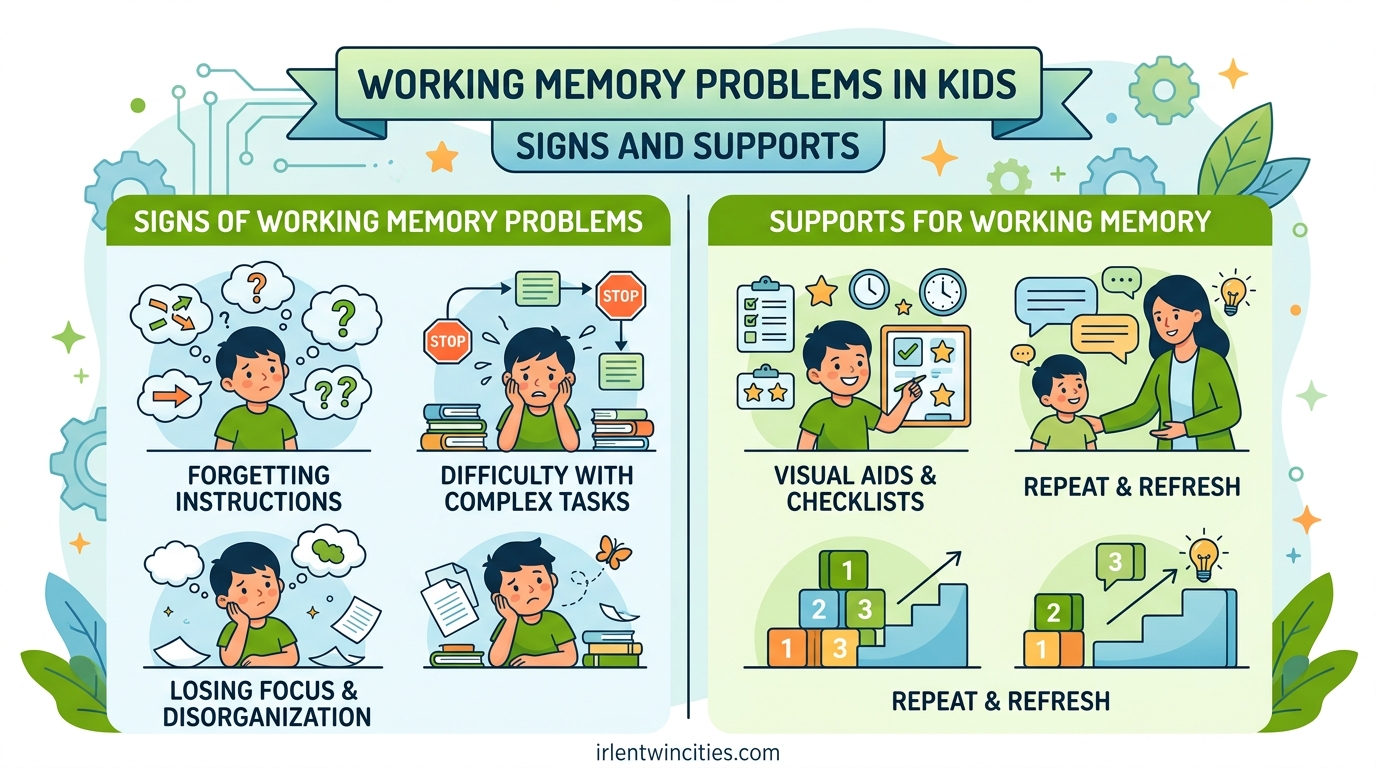
You ask your child to put on their shoes, grab their backpack, and meet you at the door. Five minutes later, they are standing in the hallway, one shoe on, staring at the wall. They have completely forgotten what comes next. If this scene plays out in your home daily, you might be dealing with working memory problems in kids.
I have spent years working with families who feel frustrated and confused when their bright, capable children struggle with seemingly simple tasks. Working memory issues are more common than many parents realize, affecting approximately 10% of all children and up to 50% of kids with learning disabilities. The good news is that with the right supports, children can thrive.
This guide will walk you through everything you need to know about working memory problems in kids. You will learn how to spot the signs at home and school, understand the impact on learning, and discover practical strategies that actually work. Whether you are just starting to suspect something is different about your child or you are looking for better ways to help, this information is for you.
Table of Contents
What Is Working Memory and Why Does It Matter
Working memory is your brain’s temporary holding system. Think of it as a mental workspace where information is stored, processed, and used for immediate tasks. Unlike long-term memory, which stores facts and experiences indefinitely, working memory holds information just long enough to use it.
When your child follows directions, solves a math problem, or reads a sentence, they rely on working memory. It allows them to hold one piece of information in mind while working with another. Without adequate working memory capacity, even simple tasks become overwhelming.
How Working Memory Differs From Short-Term Memory
Many parents confuse working memory with short-term memory, but they are not the same thing. Short-term memory simply stores information briefly. Working memory actively manipulates that information.
For example, remembering a phone number long enough to dial it uses short-term memory. Solving a math word problem in your head requires working memory because you must hold the numbers, remember the operations, and track your progress simultaneously.
Children with weak working memory often have decent short-term memory. They can repeat what you just said but struggle to act on it. This distinction matters because it explains why your child might seem to understand instructions yet fail to follow through.
The Connection to Executive Function
Working memory is one of three core components of executive function, along with cognitive flexibility and inhibitory control. Executive function acts as the brain’s management system, coordinating thoughts and actions to achieve goals.
When working memory is weak, the entire executive function system suffers. Kids struggle to plan, organize, start tasks, and follow through to completion. This is why working memory problems often look like laziness or defiance when they are actually neurological challenges.
Signs of Working Memory Problems at Home
Home is where working memory challenges often first become noticeable. Daily routines and family interactions reveal patterns that teachers might not see. Here are the most common signs parents report.
Daily Routine Struggles
Kids with working memory issues get stuck in simple routines. Morning and bedtime become battlegrounds because children cannot remember the sequence of tasks. You might find your child brushing their teeth, then wandering into the kitchen in pajamas having forgotten to get dressed.
These children often need constant reminders for basic self-care. They start tasks enthusiastically but trail off midway, distracted by something else, unable to recall what they were doing. Parents describe it as having to be their child’s external brain.
Following Multi-Step Directions
When you say, “Go upstairs, get your blue folder, and bring it to me,” your child makes it upstairs, then stands there confused. They might return empty-handed or bring the wrong item entirely.
Researchers find that children with working memory deficits can typically hold only one or two steps in mind at once. Anything beyond that disappears before they can act on it. This is not about hearing or understanding. They genuinely cannot retain the information long enough to execute it.
Task Completion Issues
Unfinished projects litter the house. Half-folded laundry, partially set tables, and abandoned drawings tell the story of a child who starts strong but loses track. Working memory keeps the goal in mind while the child works. When it fails, motivation evaporates because the purpose is forgotten.
Parents often describe their child as having “no follow-through.” The reality is more nuanced. These kids want to complete tasks. Their brains simply cannot maintain the mental representation of the finished goal while managing the steps to get there.
Signs of Working Memory Problems at School
Classrooms place heavy demands on working memory. Following directions, taking notes, and completing assignments all require holding and manipulating information. Teachers may notice patterns parents do not see.
Classroom Behavior Indicators
Teachers often report that these children seem inattentive or off-task. In reality, they have forgotten what they are supposed to be doing. They might ask the same question repeatedly because the answer did not stick the first time.
Copying from the board is particularly challenging. The child must look up, read information, hold it in mind, look down, find their place, and write. Each transfer risks information loss. By the time they look down, the words have vanished from memory.
Participation patterns can also signal issues. Kids with working memory problems may avoid raising their hands because they cannot hold their thought while waiting to be called on. They often forget what they wanted to say by the time the teacher turns to them.
Academic Performance Signs
Working memory affects every academic subject. In reading, children forget the beginning of a sentence by the time they reach the end, making comprehension impossible. In math, they lose track of where they are in a multi-step problem.
Written work suffers particularly. Organizing thoughts, remembering spelling rules, managing handwriting, and maintaining grammar simultaneously exceeds working memory capacity. These kids often produce far less written work than their peers despite having good ideas.
Test performance may not reflect true knowledge. Children who understand material during instruction draw blanks during assessments because the context and supports are gone. They know the information but cannot retrieve it under working memory load.
Social Interaction Challenges
Working memory affects social skills too. Following conversation threads, remembering social rules, and keeping track of game rules all require mental workspace. Kids may struggle to maintain friendships because they forget plans, lose track of turns, or miss social cues.
Playground conflicts often stem from working memory issues. A child might forget the rules of a game mid-play, frustrating peers who think they are cheating. They might promise to do something, then genuinely forget, appearing unreliable to friends.
Is It Working Memory Problems or ADHD
The overlap between working memory problems and ADHD confuses many parents. Understanding the relationship helps you advocate effectively for your child.
ADHD and working memory deficits frequently co-occur. Research suggests that 85% of children with ADHD have measurable working memory weaknesses. However, a child can have working memory problems without having ADHD.
The key difference lies in attention versus retention. ADHD primarily involves difficulty regulating attention and impulse control. Working memory problems involve difficulty holding and using information. A child with pure working memory issues can focus fine but forgets what they are focusing on. A child with ADHD might remember the task but cannot stay focused on it.
Many children have both conditions, making it harder to tease apart the root causes of struggles. Professional evaluation can clarify the picture and guide intervention choices. Understanding the specific profile helps teachers and parents choose the right supports.
How Working Memory Problems Impact Learning
Working memory is the engine of learning. When it sputters, academic progress stalls across all subjects. Understanding these impacts helps explain your child’s struggles.
Reading Comprehension Effects
Reading requires holding information in mind while processing new text. By the end of a paragraph, the reader must remember the beginning to understand the whole. Children with working memory deficits often decode words accurately but retain nothing of what they read.
Comprehension strategies like visualization and summarizing depend on working memory. These children struggle to create mental pictures while reading because the words themselves consume all available mental resources. They cannot summarize because they have already forgotten the content.
Many bright children with working memory issues learn to read early but hit a wall around third grade. This is when reading shifts from decoding to comprehension, and working memory demands increase dramatically.
Math Difficulties
Math is especially working-memory intensive. Even basic arithmetic requires holding numbers in mind while operating on them. Word problems add another layer, requiring children to hold the scenario, relevant numbers, and the question simultaneously.
Children with weak working memory often excel at math facts but struggle with problem-solving. They cannot hold the problem context while performing calculations. Multi-step algorithms exceed their capacity, leading to careless errors even when they understand the concepts.
Mental math is nearly impossible for these children. They need paper to externalize their thinking because their internal workspace is too limited. This is not a math disability but a working memory bottleneck.
Written Expression Challenges
Writing is among the most cognitively demanding academic tasks. It requires simultaneously generating ideas, organizing them, translating thoughts into words, spelling correctly, using grammar, and managing handwriting or typing.
Children with working memory deficits often produce simplistic writing not because they lack ideas but because they cannot manage the multiple demands. They write short, simple sentences to reduce cognitive load. Complex vocabulary and varied sentence structures disappear under pressure.
These kids benefit enormously from external supports like graphic organizers, word banks, and voice-to-text tools. These tools offload working memory demands so creativity and knowledge can flow.
Working Memory Support Strategies That Work
Fortunately, working memory can be supported through environmental changes and skill building. These strategies reduce demands and build capacity over time.
Reducing Cognitive Load
The most effective intervention is reducing how much information your child must hold in mind. Break complex tasks into single steps. Give one direction at a time. Remove distractions that compete for mental resources.
Create simple environments with clear surfaces and organized spaces. Visual clutter increases cognitive load for everyone but especially for children with working memory challenges. A tidy room supports a tidy mind.
Minimize multitasking. Working memory is a limited resource that depletes with use. After school, these children need downtime before homework because their mental batteries are drained from the day.
Building Routines and Systems
Routines turn working memory tasks into automatic habits. Once a sequence becomes routine, it no longer requires active memory. This frees capacity for other demands.
Create consistent morning and evening routines with visual checklists. Post the sequence where your child can see it. Eventually, they will internalize the pattern, but the external support remains available on difficult days.
Use consistent locations for belongings. Shoes always go by the door. Homework lives in the same folder. Reducing the need to remember where things are preserves working memory for more important tasks.
Visual Supports and Memory Aids
Externalize memory whenever possible. Visual schedules, graphic organizers, and written directions transform working memory tasks into recognition tasks, which are easier.
Teach your child to use visual anchors. Sticky notes, color-coding, and visual timers make time and tasks concrete. These tools serve as external working memory, holding information the brain cannot.
Encourage note-taking strategies even for simple tasks. A child who writes down the page number will find their place faster than one who tries to remember it. Early use of these compensatory strategies builds independence.
Breaking Tasks Into Chunks
Chunking is the practice of grouping information into manageable units. Teach your child to tackle big assignments in small pieces. A ten-problem worksheet becomes five sets of two problems with breaks between.
Preview complex tasks before starting. Walk through the steps together verbally. This creates a mental roadmap that helps your child navigate without getting lost midway. The preview reduces novelty, which taxes working memory heavily.
Celebrate completion of chunks, not just full tasks. These children need frequent success experiences to maintain motivation. Breaking tasks builds both accomplishment and momentum.
Technology Tools
Modern technology offers powerful working memory support. Voice-to-text eliminates the handwriting bottleneck. Digital organizers keep tasks visible. Reminder apps serve as prosthetic memory.
Text-to-speech tools allow children to listen while reading, reducing the working memory load of decoding. Calculator apps free mental resources for problem-solving rather than calculation.
Not all screen time is equal. Evaluate apps based on whether they support or strain working memory. Games that require holding multiple rules or strategies simultaneously may frustrate rather than help.
When to Seek Professional Help
Some working memory challenges warrant professional evaluation. Knowing when to seek help ensures your child gets appropriate support.
Consider evaluation if your child’s struggles significantly impact academic performance despite classroom accommodations. If grades do not reflect apparent capability, underlying issues may need identification.
Seek help when daily functioning is affected. Children who cannot complete basic self-care independently, who meltdown from memory overload, or who show signs of anxiety about forgetting need support beyond what parents can provide.
Neuropsychological evaluation provides the clearest picture of working memory capacity. School psychologists can conduct screenings, but comprehensive assessment by a specialist offers detailed information about strengths and weaknesses.
Speech-language pathologists, educational therapists, and occupational therapists all work with working memory issues. The right professional depends on your child’s specific profile and primary areas of difficulty.
Supporting Parents Through the Journey
Parenting a child with working memory challenges is exhausting. The constant reminding, the repeated frustration, and the worry about your child’s future take a toll. You need support too.
First, release the guilt. Working memory problems are neurobiological, not caused by parenting. Your child is not forgetful because you remind them too much or too little. Their brain works differently, and that is nobody’s fault.
Explain working memory to family members who see your child as lazy or uncaring. Simple analogies help. Compare working memory to a computer’s RAM. When RAM is low, the system slows and crashes. This is not a character flaw.
Connect with other parents who understand. Online forums and local support groups provide validation and practical advice. Sometimes just knowing you are not alone makes the daily struggles more bearable.
Practice self-care deliberately. You cannot pour from an empty cup. The energy required to support a child with working memory deficits is significant. Protect your own mental health so you can be the parent your child needs.
Frequently Asked Questions
How to support a child with poor working memory?
Break tasks into single steps, use visual checklists, create consistent routines, and reduce distractions. Externalize memory with written directions, graphic organizers, and reminder apps. Give one instruction at a time and allow processing time between steps.
What are the signs of poor working memory?
Children with poor working memory forget multi-step directions, lose their place in tasks, struggle to complete routines, and have difficulty following conversations. They may seem inattentive, ask the same questions repeatedly, and produce less written work than peers despite understanding material.
How do I improve my working memory?
While working memory capacity is largely fixed, strategies can maximize its efficiency. Practice chunking information, use visualization techniques, minimize multitasking, and get adequate sleep. For children, focus on teaching compensatory strategies like note-taking, using external memory aids, and breaking complex tasks into manageable steps.
Does good working memory mean no ADHD?
No, working memory and ADHD are related but distinct. Many children with ADHD have working memory weaknesses, but a child can have strong working memory and still have ADHD if they struggle with attention regulation and impulse control. Conversely, a child can have working memory deficits without having ADHD. Comprehensive evaluation helps clarify the specific profile.
Conclusion
Working memory problems in kids are challenging but manageable with the right understanding and supports. By recognizing the signs early, implementing practical strategies, and seeking professional help when needed, you can help your child thrive.
Remember that your child is not lazy, stubborn, or uncaring. Their brain simply processes information differently. With external supports, routine structures, and patient guidance, children with working memory deficits can achieve academic success and build confidence.
The journey requires persistence and advocacy, but you do not walk it alone. Connect with professionals, other parents, and resources that understand working memory challenges. Your child has gifts and potential that working memory issues cannot diminish. With your support, they will find their path to success in 2026 and beyond.