
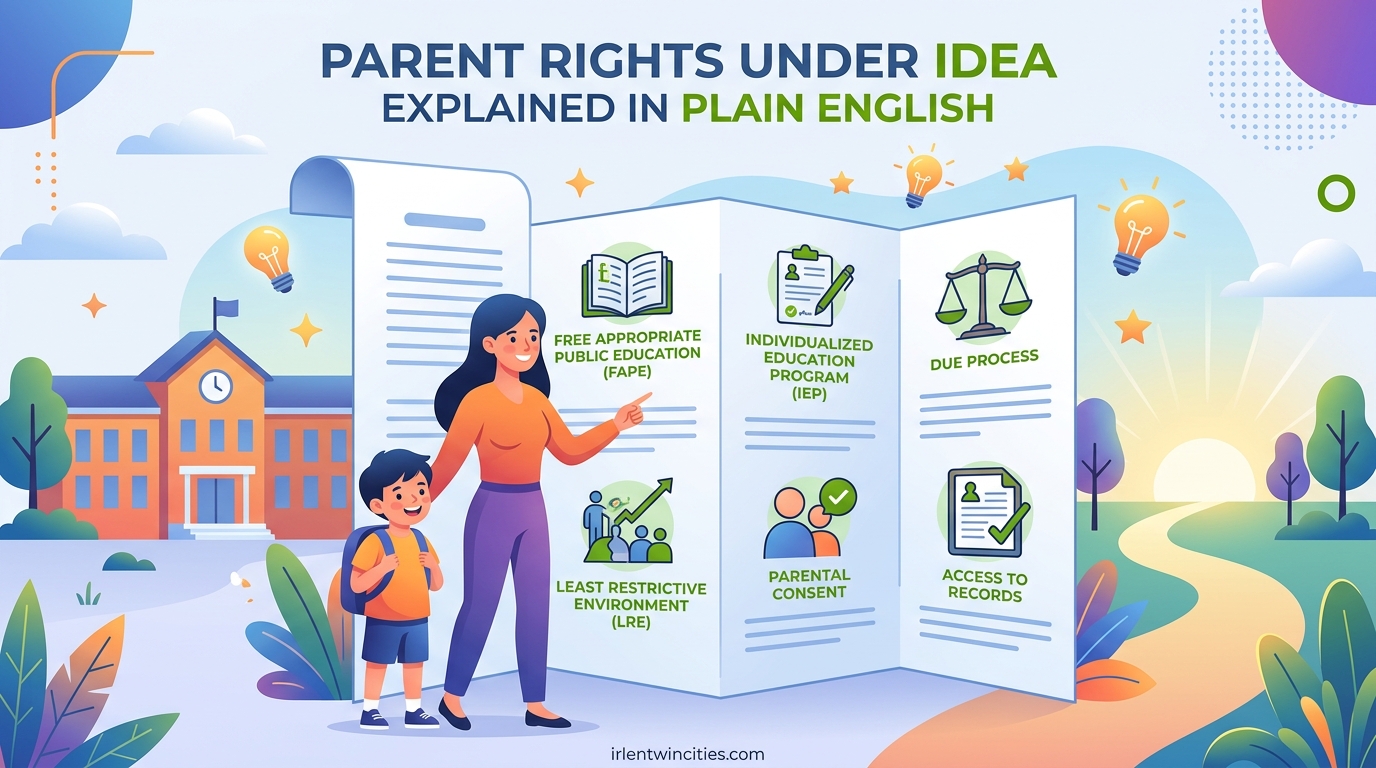
If you’re a parent navigating the special education system, you’ve probably encountered a document called “Procedural Safeguards” that reads like it was written by lawyers for lawyers. You’re not alone in feeling overwhelmed. Understanding your parent rights under IDEA doesn’t require a law degree, and knowing these rights can change everything for your child’s education.
The Individuals with Disabilities Education Act (IDEA) gives you specific legal rights to ensure you’re an equal partner in your child’s education. These aren’t just formalities, they’re powerful tools designed to protect your child and ensure your voice is heard. Let me break down what these rights actually mean in plain English, without the legal jargon that makes most parents’ eyes glaze over.
Table of Contents
Understanding IDEA Basics in Plain English
IDEA is a federal law that guarantees children with disabilities receive a free appropriate public education (FAPE). This means schools must provide specialized instruction and services at no cost to you, tailored specifically to meet your child’s unique needs. The law recognizes that you are your child’s most important advocate, which is why it gives you specific rights to participate in decisions about their education.
Under IDEA, a “parent” includes more than just biological or adoptive parents. It also encompasses legal guardians, grandparents or stepparents acting in a parent’s role, foster parents (if state-authorized), and surrogate parents appointed by schools when no parent is available. This broad definition ensures that someone with a meaningful relationship to the child can always exercise these rights.
The law is built around six foundational principles, but the one that matters most for you right now is this: you are not just an observer in your child’s education. You are an equal member of the team, with legal protections to ensure your input isn’t just heard, it must be considered. These parent rights under IDEA exist precisely because schools sometimes forget this partnership model, and you need tools to advocate effectively.
Your Core Parent Rights Under IDEA
Let’s get specific about what you can actually do under the law. These aren’t theoretical concepts, they’re actionable rights you can exercise starting today. Here are the core protections IDEA gives you, translated into what they mean for real-life situations.
Right to Receive Notice of Your Procedural Safeguards
Schools must give you a written explanation of your rights at least once a year, plus whenever you request it, your child is referred for evaluation, or you file a due process complaint. This document, often called the “Procedural Safeguards Notice,” must be in your native language whenever possible.
In practice: If you’ve never received this notice, or if it’s been more than a year, you can request it from your school’s special education director. Don’t let anyone tell you it’s not important, this document is your roadmap to everything else we’re discussing.
Right to Participate in All Decisions
You have the right to be part of every meeting where your child’s special education services are discussed, evaluated, or changed. This includes IEP meetings, evaluations, and placement decisions. The school must schedule these at times you can actually attend, and they must provide interpreters if you need them.
In practice: If the school schedules an IEP meeting when you can’t make it, tell them immediately. They’re required to reschedule. You can also invite anyone you want to these meetings, an advocate, a friend, or a relative, and the school must allow them to participate.
Right to Prior Written Notice
Before the school can make significant changes to your child’s identification, evaluation, placement, or services, they must provide you with written notice explaining exactly what they propose or refuse to do. This notice must be provided in your native language and must explain why they’re making the decision.
In practice: If your child’s services are being reduced or changed without you receiving written explanation beforehand, this is likely a violation. The school can’t make major changes and tell you about it later, the notice must come first.
Right to Give or Withhold Informed Consent
The school needs your written permission before conducting your child’s first evaluation, reevaluating your child (with some exceptions), or placing your child in special education for the first time. Importantly, you can also refuse consent without your child losing other educational services.
In practice: Never feel pressured to sign something you don’t fully understand. You can take documents home to review them before signing. If a school official says you “have to sign now,” that’s a red flag, you always have the right to time to consider.
Right to Independent Educational Evaluation (IEE)
If you disagree with the school’s evaluation of your child, you have the right to obtain an independent evaluation at public expense (meaning the school pays for it). The school must either pay for the IEE or request a due process hearing to prove their evaluation was appropriate.
In practice: Many parents don’t know about this right, but it’s one of the most powerful tools in your toolkit. If you think the school missed something or got it wrong, you can request an IEE in writing and the school must respond with either payment or a hearing.
Right to Access All Educational Records
You can inspect and review all of your child’s educational records within 45 days of your request. This includes evaluation reports, IEP documents, progress reports, disciplinary records, and communications between school staff about your child. Schools must provide copies if you request them, and they can’t charge you so much that it prevents access.
In practice: Always make records requests in writing, and be specific about what you want. For example: “Please provide all evaluation reports, IEP documents, progress notes, and emails between staff discussing [child’s name] from [date range].”
Right to Confidentiality
Schools must protect your child’s educational records from unauthorized disclosure. They need your permission before sharing personally identifiable information with anyone outside the school system, with some exceptions (like school officials with legitimate educational interests).
In practice: If you learn that school staff are discussing your child’s disability or services with people who don’t need to know, this may be a confidentiality violation. Your child’s special education status should be handled with discretion.
Right to Dispute Resolution
If you disagree with the school about your child’s services, IDEA provides formal ways to resolve conflicts: mediation (where a neutral third party helps you reach agreement), due process hearing (like a trial where an impartial hearing officer decides), and complaint procedures (where you can report violations to the state education agency).
In practice: Most parents don’t realize they have these options. If the school refuses necessary services or violates your rights, you don’t have to just accept it. You can pursue mediation, file a due process complaint, or submit a state complaint, and each option has different timelines and procedures.
Procedural Safeguards Explained: Your Protection Toolkit
Procedural safeguards are the legal protections that ensure you can meaningfully participate in your child’s education. Think of them as rules that schools must follow to prevent them from making arbitrary decisions without you. These safeguards exist because parents historically were excluded from decisions about their children’s education, and the law recognized this needed to change.
The purpose of procedural safeguards is threefold: to protect your rights and your child’s rights, to ensure you have a voice in every decision, and to provide ways to resolve disagreements when they occur. Without these safeguards, schools could make unilateral decisions about evaluations, placements, and services without any parent input or recourse.
Here’s what every parent should know: procedural safeguards aren’t just technicalities, they’re practical tools. The right to prior written notice means you can’t be blindsided by changes. The right to participate means you can’t be shut out of meetings. The right to an IEE means you can challenge assessments you disagree with. These aren’t abstract concepts, they’re actionable protections you can use right now.
Common violations include schools failing to provide procedural safeguards notice, making changes without prior written notice, denying IEE requests without following proper procedures, and conducting evaluations without consent. If any of these happen to you, document everything and consider your dispute resolution options.
How to Exercise Your Rights in Real Life
Understanding your rights is one thing, exercising them effectively is another. Here’s practical guidance on using these rights in common situations you’re likely to encounter.
Preparing for IEP Meetings
Before any IEP meeting, request all relevant records and evaluation reports in writing at least a week ahead. Review the current IEP, progress reports, and any proposed changes. Write down your concerns, questions, and goals for the meeting. Consider bringing an advocate or support person, and notify the school if you plan to record the meeting (check your state’s laws on recording conversations).
What Not to Say in IEP Meetings as a Parent
Avoid agreeing to anything you don’t fully understand. Never sign an IEP at the meeting if you need time to review it at home. Don’t accept “we don’t do that here” as a final answer. Don’t let yourself be intimidated by the number of school professionals present. Don’t waive your rights without understanding exactly what you’re giving up. Instead, use phrases like “I need time to consider this,” “Can you show me where that’s in writing,” and “I’d like that request documented in the IEP.”
How to Request an IEE Step-by-Step
First, review the school’s evaluation report carefully and identify specific areas where you disagree. Then, write a letter to the special education director stating that you disagree with the evaluation and are requesting an independent educational evaluation at public expense. The school must either provide you with information about how to obtain an IEE at public expense or request a due process hearing to prove their evaluation was appropriate. Keep copies of all correspondence and follow up if you don’t receive a response within the required timeline (usually 5-10 business days).
Documenting Conversations and Decisions
After every phone call, meeting, or conversation with school staff, send a follow-up email summarizing what was discussed, what was agreed to, and what next steps were identified. Use language like “This email is to confirm our conversation on [date] in which we discussed…” This creates a paper trail that can be invaluable if disputes arise later.
When and How to Escalate Concerns
If you’re not getting results through informal communication, it’s time to escalate. Start by putting your concerns in writing to the special education director. If that doesn’t work, contact your state’s Parent Training and Information Center for guidance. For significant violations or disputes, consider filing a state complaint or requesting mediation. Due process is typically the last resort, but sometimes necessary when other options fail.
IDEA vs Section 504: Why It Matters
Many parents wonder why schools sometimes suggest a Section 504 plan instead of an IEP. Here’s the plain truth: Section 504 has fewer requirements and funding obligations for schools. A 504 plan provides accommodations but doesn’t require specialized instruction, progress monitoring, or the robust procedural safeguards that IDEA guarantees. Under IDEA, schools must provide more comprehensive services and follow stricter procedural rules.
That said, 504 plans aren’t bad, they’re just different. They’re appropriate for students who need accommodations but don’t require specialized instruction. The key is understanding which law better protects your child. If your child needs specially designed instruction, IDEA typically provides more comprehensive services and stronger parent rights. If the school is pushing 504 but you believe your child needs more, you have the right to request an IDEA evaluation and refuse consent for a 504-only plan.
Common Mistakes Parents Make (And How to Avoid Them)
Many parents inadvertently weaken their position by making common mistakes. Signing IEP documents at meetings without taking time to review them at home is probably the number one error. You always have the right to take documents home and consider them carefully before signing.
Another frequent mistake: not making requests in writing. If it’s not documented, it didn’t happen as far as dispute resolution is concerned. Always submit evaluation requests, records requests, and concerns in writing, and keep copies for your files.
Don’t agree to anything you don’t understand in meetings. School professionals may use jargon or pressure you to decide quickly. You have the right to pause, ask for clarification, and take time to consider proposals. “I need to think about this” is a completely acceptable response.
Finally, don’t waive your rights without understanding the consequences. Schools may ask you to sign waivers or agreements that limit your ability to advocate for your child. Never waive anything without fully understanding what you’re giving up and why the school is requesting it.
Frequently Asked Questions About Parent Rights Under IDEA
What rights do parents have under IDEA?
Parents under IDEA have the right to participate in all decisions about their child’s education, receive prior written notice of changes, give or withhold consent for evaluations and services, access all educational records, obtain independent educational evaluations, and resolve disputes through mediation or due process. These rights ensure parents are equal partners in the special education process.
What is the definition of a parent under IDEA?
Under IDEA, a parent includes biological or adoptive parents, legal guardians, grandparents or stepparents acting in a parental role, foster parents (if state-authorized), and surrogate parents appointed by schools when no parent is available. This broad definition ensures someone with a meaningful relationship to the child can always exercise these rights.
What do parents’ rights really mean?
Parents’ rights under IDEA mean you are legally guaranteed an equal voice in decisions about your child’s education. These rights protect you and your child from arbitrary school actions, ensure you receive proper notice and information, and give you tools to advocate effectively when schools don’t meet their obligations. You are not just an observer, you are an equal member of the team.
Why do schools push 504 instead of IEP?
Schools may recommend Section 504 instead of IDEA because 504 plans have fewer requirements, less funding obligation, and don’t require progress monitoring or specialized instruction. However, 504 plans also provide fewer services and weaker procedural safeguards. If your child needs specially designed instruction, IDEA typically offers more comprehensive support and stronger parent rights.
What is the purpose of procedural safeguards?
Procedural safeguards protect parent and child rights under IDEA by ensuring schools follow proper procedures, provide adequate notice, obtain informed consent, and allow meaningful parent participation. These safeguards give parents tools to advocate effectively, including the right to access records, obtain independent evaluations, and resolve disputes through formal processes like mediation and due process.
What not to say in an IEP meeting as a parent?
Avoid agreeing to anything you don’t fully understand. Never sign documents at the meeting if you need review time. Don’t accept “we don’t do that here” without question. Don’t let yourself be intimidated by professionals. Don’t waive rights without understanding consequences. Instead use phrases like “I need time to consider,” “Can you show me that in writing,” and “I’d like this documented.”
What is the FAPE provision of IDEA?
FAPE stands for Free Appropriate Public Education.
- Free means no cost to parents.
- Appropriate means education tailored to the child’s unique needs.
- Public means provided by or paid for by the public school system.
- Education includes specially designed instruction and related services.
FAPE is the foundation of IDEA, guaranteeing children with disabilities receive educational opportunities that meet their individual needs.
Can I refuse special education services for my child?
Yes, parents can refuse special education services for their child. Under IDEA, you have the right to withhold consent for initial evaluations and initial placement in special education. However, schools may still suspect your child needs services and could pursue due process to override your refusal in some circumstances. Additionally, refusing services doesn’t eliminate your child’s right to general education accommodations under Section 504.
Conclusion: Knowledge Is Your Most Powerful Tool
Understanding your parent rights under IDEA transforms you from a passive observer into an active advocate for your child. These rights aren’t just technicalities, they’re powerful protections designed to ensure your child receives the education they deserve and your voice is heard in every decision. You are not being difficult by exercising these rights, you’re being the parent your child needs.
Remember that you’re not alone in this journey. There are Parent Training and Information Centers in every state ready to help, advocacy organizations like Understood.org and Wrightslaw offer valuable resources, and communities of parents who understand exactly what you’re going through. When you know your rights and use them confidently, schools take notice and children benefit.
The most important thing is this: don’t be afraid to ask questions, request things in writing, take time before signing, and advocate assertively for your child. Your parent rights under IDEA exist precisely because the law recognizes that you are your child’s best advocate. Use them.