
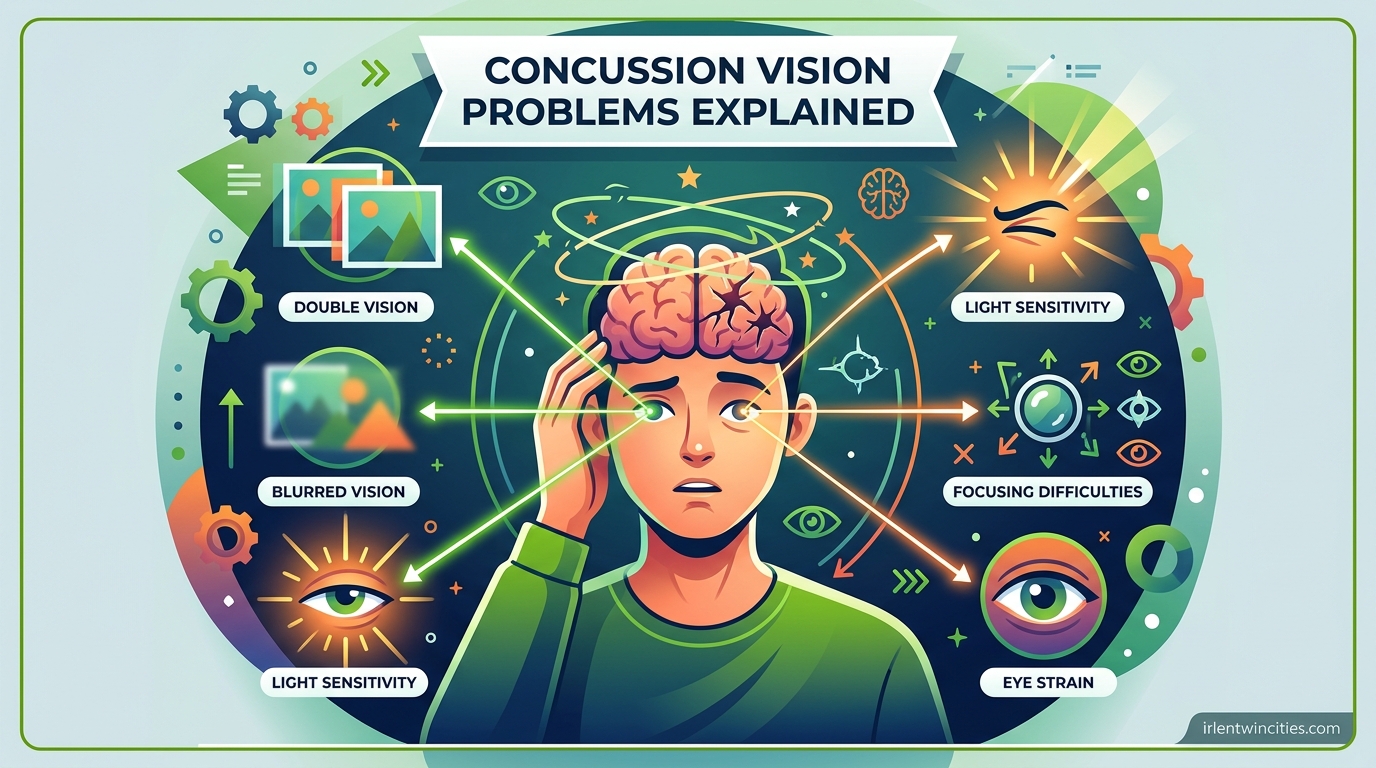
Post-concussion vision problems affect up to 90% of people who experience a traumatic brain injury, yet many patients leave their doctor’s office confused when standard eye exams come back normal. I have worked with countless individuals struggling to read, drive, or work on computers after a head injury, and I understand how frustrating it can be when your vision feels fundamentally different but medical tests show nothing wrong.
These vision problems are not issues with your eyes themselves. Instead, they are dysfunctions in how your brain processes visual information after the trauma of a concussion. Understanding what is happening and why is the first step toward finding the right treatment and getting your life back.
In this guide, I will explain exactly why concussions cause vision problems, what symptoms to watch for, how long recovery typically takes, and the treatment options that actually work. I have gathered insights from medical research, clinical practice, and real patient experiences from forums and support groups to give you a complete picture of what to expect and how to move forward.
Table of Contents
Why Concussions Cause Vision Problems
A concussion disrupts the delicate communication between neurons and blood vessels in your brain, a process called neurovascular coupling. This disruption means brain cells cannot get the oxygen and nutrients they need to function properly, even when the blood flow itself appears normal on standard scans.
Several key brain regions control different aspects of vision, and a concussion can damage any or all of them. The occipital lobe at the back of your brain processes what you see. The parietal lobe helps with spatial awareness and eye coordination. The frontal lobe manages attention and visual decision-making. Even the brainstem plays a role in basic eye movements.
When these areas are injured, the result is post-concussion vision problems that no standard eye exam will detect. Your eyes can be perfectly healthy, yet you experience blurry vision, double vision, or an inability to focus. This is why so many patients feel dismissed when their eye doctor says everything looks fine while they struggle to read a book or look at a screen.
The visual system is one of the most complex networks in the brain, with over 50% of neural pathways involved in vision processing in some way. A concussion does not need to cause bleeding or structural damage to create significant visual dysfunction. The metabolic and chemical disruptions alone are enough to throw this sensitive system off balance for weeks or months.
Common Post-Concussion Vision Problems
After a concussion, you might experience a wide range of visual symptoms. Some appear immediately after the injury, while others develop gradually over days or weeks. Here are the most common conditions I see in patients recovering from head trauma.
Convergence Insufficiency
Convergence insufficiency is the reduced ability to turn both eyes inward to focus on near objects like reading material or your phone. It is one of the most common visual dysfunctions seen after concussion, affecting up to 50% of patients in some studies.
With convergence insufficiency, you might notice words blur or double when you try to read. You may find yourself covering one eye to make text clearer. Many patients report that reading for more than a few minutes triggers headaches, eye strain, or a feeling of pressure behind the eyes.
People with this condition often say they feel like they are looking through someone else’s eyes. The disconnect between what your eyes see and what your brain processes can create a surreal, disorienting sensation that adds to the distress of other concussion symptoms.
Accommodative Dysfunction
Accommodative dysfunction occurs when the focusing system of your eyes stops working properly. Normally, your eye muscles automatically adjust the lens shape to see clearly at different distances. After a concussion, this reflex can become sluggish, inaccurate, or completely unreliable.
You might find it hard to shift your focus from your computer screen to a document on your desk. The adjustment that once happened instantly now takes several seconds or never completes. Some patients describe a lag or delay when looking up from their phone to see across the room.
This problem often accompanies convergence insufficiency, creating a double burden for reading and close-up work. The combination makes returning to school or an office job particularly challenging without proper treatment.
Oculomotor Dysfunction
Oculomotor dysfunction refers to problems with eye tracking and movement control. Your eyes constantly make tiny movements called saccades when reading, or smooth pursuits when following moving objects. A concussion can disrupt these precise motor patterns.
If you have oculomotor dysfunction, you might lose your place constantly while reading. Words may seem to jump or swim on the page. Following a moving target like a ball in sports becomes difficult or impossible. Some patients notice their eyes feel jerky or uncoordinated when they try to scan a room.
These tracking problems extend beyond reading and sports. Simple daily activities like driving, where you must constantly shift gaze between instruments and the road, become exhausting and potentially dangerous.
Photophobia and Light Sensitivity
Photophobia, or light sensitivity, is one of the most debilitating post-concussion vision problems. Bright lights, fluorescent lighting, and screens can trigger immediate pain, headaches, or overwhelming fatigue. Many patients describe the sensation as having their brain squeezed when exposed to light.
Screen intolerance is particularly frustrating in our digital world. I have worked with patients who can only tolerate 5 to 10 minutes on a computer or phone before symptoms hit. They describe eye strain, brain fog, dizziness, and a crushing fatigue that forces them to stop whatever they are doing.
Natural sunlight can be just as problematic. Many concussion survivors resort to wearing sunglasses indoors and outdoors, even in relatively dim environments. The light sensitivity often persists long after other concussion symptoms have resolved, creating significant barriers to normal life.
Visual Processing Issues
Visual processing problems occur when your brain misinterprets the signals coming from healthy eyes. You might see perfectly on an eye chart but struggle to make sense of complex visual scenes. Motion can feel overwhelming. Busy patterns or crowded spaces create disorientation.
Some patients report seeing floaters, visual snow, or static after a head injury. These visual disturbances often do not fully resolve, though they may become less noticeable over time. The brain can learn to filter them out, but this adaptation takes months in many cases.
Depth perception issues are also common. You might misjudge distances, bump into door frames, or feel unsteady in open spaces. These problems connect closely to the balance and dizziness issues that frequently accompany post-concussion syndrome.
How Long Do Post-Concussion Vision Problems Last
The timeline for recovery varies significantly from person to person, but understanding the typical phases can help set realistic expectations. Many patients want a straightforward answer about when they will be back to normal, and while I cannot predict your exact recovery, the general patterns are well established.
During the acute phase, which covers the first two weeks after injury, vision problems often appear or worsen. This is when you should be resting and protecting your brain from additional strain. Some symptoms may actually improve on their own during this window as the initial inflammatory response subsides.
The subacute phase spans weeks two through six. By this point, any symptoms that remain are unlikely to resolve without intervention. Research suggests that approximately 40% of concussion patients will have persistent vision problems beyond this period if they do not receive targeted treatment.
Symptoms lasting beyond six weeks enter the persistent phase. At this stage, post-concussion vision problems are unlikely to improve significantly without professional help. The good news is that neuro-optometric rehabilitation and vision therapy can still be highly effective even months or years after the initial injury.
Several factors influence how long your recovery will take. Age plays a role, with younger patients often healing faster. The severity of the original concussion matters, as does whether you have had previous head injuries. Your visual demands also affect recovery. Someone who needs to read and use computers for work will notice problems more than someone with less visual demand.
Warning Signs: When to Seek Emergency Care
While most post-concussion vision problems are not life-threatening, certain symptoms require immediate medical attention. Knowing the difference between emergency, urgent, and non-urgent symptoms can save your vision and potentially your life.
Seek emergency care immediately if you experience sudden vision loss in one or both eyes, a severe headache that does not respond to medication, repeated vomiting, seizures, or weakness or numbness on one side of your body. These could indicate bleeding in the brain or other serious complications that require immediate intervention.
Urgent symptoms that need prompt evaluation within 24 to 48 hours include rapidly worsening vision, new double vision in someone over 50, severe eye pain, or a noticeable increase in light sensitivity accompanied by fever. These issues may not be emergencies, but they should not wait for a routine appointment.
Non-urgent symptoms still deserve professional care, but they can typically wait for a scheduled appointment with the appropriate specialist. Gradual blurring, mild eye strain with reading, occasional double vision that resolves with rest, and mild light sensitivity fall into this category.
I always recommend trusting your instincts. If something feels seriously wrong, it is better to be evaluated and told you are fine than to wait and risk permanent damage. The medical system is there for exactly these situations.
Treatment Options for Post-Concussion Vision Problems
The right treatment can make a dramatic difference in recovery from post-concussion vision problems. I have seen patients go from unable to work to fully functional within months of starting the appropriate therapy. Here are the main treatment approaches available in 2026.
Neuro-Optometric Rehabilitation
Neuro-optometric rehabilitation is a specialized field of optometry focused on treating visual dysfunction caused by brain injury. Unlike standard eye care, this approach addresses the neurological aspects of vision rather than just the optical components.
A neuro-optometrist conducts extensive testing that goes far beyond reading an eye chart. They evaluate eye teaming, tracking, focusing, visual processing speed, and how your visual system integrates with balance and spatial awareness. This comprehensive assessment reveals problems that standard exams miss entirely.
Based on the findings, the neuro-optometrist designs a customized treatment program. This might include therapeutic lenses, prism glasses, in-office vision therapy, and home exercises. The goal is to retrain the neural pathways involved in vision, helping your brain adapt and heal through neuroplasticity.
Finding a qualified neuro-optometrist can be challenging. Look for practitioners who list neuro-optometric rehabilitation or vision therapy as specialties. Organizations like the Neuro-Optometric Rehabilitation Association maintain directories of trained providers.
Vision Therapy Exercises
Vision therapy consists of progressive exercises designed to improve specific visual skills. These are not simple eye exercises like looking around a room. They are targeted, science-based activities that challenge and retrain your visual system.
Common exercises for post-concussion patients include Brock string training for convergence, prism flippers to improve focusing flexibility, and computerized programs that track eye movements during reading tasks. Each exercise targets a specific dysfunction identified during your evaluation.
One important reality I need to share: vision therapy often makes symptoms worse before they get better. This is known as Herz’s law in rehabilitation circles. The brain is being challenged in new ways, and that can temporarily increase headaches, eye strain, or fatigue. This does not mean the therapy is failing. It typically means the exercises are appropriately challenging your system.
Consistency matters more than intensity. Short daily practice sessions usually produce better results than occasional long sessions. Most patients need 12 to 24 weeks of therapy, though complex cases may require longer treatment.
Prism Glasses and Tinted Lenses
Therapeutic lenses can provide immediate symptom relief while you work on underlying rehabilitation. Prism glasses bend light in ways that reduce the effort your eyes must expend to work together. This can instantly eliminate double vision or reduce eye strain during reading.
FL-41 tinted lenses specifically help with light sensitivity and photophobia. These rose-colored filters block the wavelengths of light most likely to trigger migraine and post-concussion symptoms. Many patients report dramatic improvement in their ability to tolerate fluorescent lighting and screens.
Other tints and coatings can address specific problems. Blue-blocking filters help with screen intolerance. Polarized lenses reduce glare that triggers symptoms outdoors. A neuro-optometrist can determine which optical solutions match your particular needs.
Keep in mind that lenses manage symptoms but do not cure the underlying dysfunction. They are valuable tools that let you function while undergoing therapy, but most patients should not rely on them as the sole treatment.
Self-Help Strategies and the 20/20/20 Rule
While professional treatment is essential for significant vision problems, self-help strategies play an important supporting role. The 20/20/20 rule is a simple technique that helps reduce eye strain during recovery.
Every 20 minutes, look at something 20 feet away for at least 20 seconds. This gives your focusing muscles a break and prevents the cumulative fatigue that worsens post-concussion symptoms. Set a timer on your phone or use browser extensions that remind you to take these breaks.
Other helpful strategies include using dark mode on devices, increasing text size and contrast, adjusting ambient lighting to match screen brightness, and taking frequent brief rest periods rather than pushing through symptoms. Many patients find audiobooks and voice-to-text software invaluable for maintaining productivity while healing.
Pacing is crucial. Trying to push through visual tasks despite symptoms typically prolongs recovery. Learning to stop before symptoms become severe helps your brain heal faster.
Why Standard Eye Exams Miss Post-Concussion Vision Problems
One of the most frustrating experiences for concussion survivors is being told their eyes are healthy while they struggle with daily visual tasks. I hear this story constantly from patients who felt dismissed or told their problems were psychological. Understanding why this happens can help you advocate for proper care.
A standard eye exam focuses primarily on eye health and visual acuity. The doctor checks for diseases like glaucoma and macular degeneration. They determine if you need glasses to see clearly at distance and near. They do not typically evaluate how well your eyes work together, track moving objects, or process complex visual information.
The eye chart used in standard exams tests only one small aspect of vision. You can have 20/20 eyesight and still have severe convergence insufficiency, tracking problems, or visual processing dysfunction. The eye chart simply does not test those functions.
A neuro-optometrist performs completely different testing. They measure eye teaming with specialized prism tests. They evaluate tracking using devices that follow eye movements during reading. They assess focusing flexibility by measuring how quickly and accurately your eyes can shift focus between distances.
If you suspect post-concussion vision problems, ask your doctor for a referral to a neuro-optometrist or vision therapy specialist. You can also search for doctors through the College of Optometrists in Vision Development or the Neuro-Optometric Rehabilitation Association. Bring a list of your specific symptoms to the appointment. The more detail you provide, the better they can target their testing.
Important Considerations for Daily Life
Post-concussion vision problems affect nearly every aspect of daily life. Beyond the medical treatment, you need practical strategies for navigating work, school, driving, and other essential activities.
Driving Safety
Driving with untreated post-concussion vision problems can be dangerous. The combination of focusing issues, tracking problems, light sensitivity, and depth perception errors creates significant risk. I strongly recommend avoiding driving until you have been evaluated and cleared by a specialist.
Specific warning signs that you should not drive include double vision at any distance, inability to tolerate headlights at night, losing your place when scanning between instruments and the road, or significant light sensitivity that forces you to squint. These symptoms indicate your visual system is not ready for the complex demands of driving.
Even after symptoms improve, consider a formal driving evaluation if you have any lingering concerns. Some rehabilitation centers offer specialized assessments that test reaction time, visual processing speed, and the ability to handle complex visual scenarios safely.
Workplace and School Accommodations
Returning to work or school with post-concussion vision problems requires accommodations. Most employers and educational institutions are legally required to provide reasonable adjustments for medical conditions, though you may need documentation from your healthcare provider.
Common accommodations include extended time for reading tasks and tests, permission to use text-to-speech software, access to printed materials in large font or high contrast, reduced screen time requirements, and modified lighting in your workspace. Some patients benefit from scheduled rest periods during the day.
Communicate openly with supervisors, teachers, or disability services offices about your needs. Explain that your vision issues are neurological rather than optical. Many people understand eye muscle problems better than brain processing issues, so using clear language helps.
Children and Academic Performance
Children with post-concussion vision problems face unique challenges in school. Vision provides approximately 80% of the information we take in during learning activities, so even subtle visual dysfunction can dramatically impact academic performance.
Parents and teachers might notice a child avoiding reading, losing their place frequently, rubbing their eyes, or having trouble copying from the board. Academic performance may drop suddenly after a head injury, even if the child appears physically recovered. Behavior problems can emerge as frustration builds.
Early intervention is particularly important for children because untreated vision problems can interfere with reading development and school confidence. A pediatric neuro-optometrist can provide age-appropriate testing and treatment. Schools can implement accommodations like allowing extra time, providing written notes, or permitting audio books instead of text reading.
Watch for signs that a child is struggling visually even if they do not complain. Children often do not realize their vision is abnormal, or they may not have the vocabulary to describe what they are experiencing. Changes in academic performance, reading avoidance, or headaches during schoolwork all warrant evaluation.
Frequently Asked Questions About Post-Concussion Vision Problems
Why did my vision just get suddenly worse after a concussion?
Vision typically worsens after a concussion due to disruption in neurovascular coupling, which affects how brain cells receive oxygen and nutrients. The trauma damages communication between neurons in visual processing areas like the occipital and parietal lobes. Even though your eyes themselves may be healthy, the brain’s ability to interpret visual signals becomes impaired, leading to symptoms like blurriness, double vision, and light sensitivity.
What is post-concussion syndrome?
Post-concussion syndrome refers to the collection of symptoms that persist for weeks or months after a concussion. It includes headaches, dizziness, fatigue, cognitive difficulties, and vision problems that continue beyond the typical recovery window. When these symptoms last longer than expected, doctors diagnose post-concussion syndrome and typically recommend specialized treatment rather than waiting for spontaneous recovery.
What is the 20 20 20 rule for concussions?
The 20/20/20 rule is a simple strategy to reduce eye strain during concussion recovery. Every 20 minutes, look at something 20 feet away for at least 20 seconds. This gives your focusing muscles a rest and prevents the cumulative fatigue that worsens post-concussion symptoms. Setting a timer or using browser extensions can help you remember to take these breaks throughout the day.
How long does post-concussion vision syndrome last?
Post-concussion vision problems often follow a three-phase timeline. During the acute phase (first 2 weeks), symptoms appear or worsen. In the subacute phase (2-6 weeks), about 40% of patients continue having problems. Beyond 6 weeks, symptoms typically persist without treatment, though neuro-optometric rehabilitation can be effective even months or years after injury. Recovery time varies based on age, injury severity, and visual demands.
Can a concussion permanently affect your vision?
Most post-concussion vision problems are not permanent when properly treated. While some symptoms like floaters or visual snow may persist, functional issues such as convergence insufficiency, accommodative dysfunction, and tracking problems typically respond well to neuro-optometric rehabilitation. Without treatment, symptoms can become chronic, but modern vision therapy techniques can help even years after the original injury.
Can your eyesight get better after a concussion?
Yes, eyesight and visual function can improve significantly after a concussion with appropriate treatment. Neuro-optometric rehabilitation uses neuroplasticity, the brain’s ability to reorganize and form new connections, to retrain visual pathways. Vision therapy exercises, therapeutic lenses, and proper pacing of visual activities all contribute to recovery. Many patients return to normal or near-normal function within 3 to 6 months of starting treatment.
Conclusion
Post-concussion vision problems are common, treatable, and far more complex than standard eye exams can detect. If you are struggling with vision changes after a head injury, know that your symptoms are real, they have a physiological basis, and effective treatment options exist.
The key is finding the right specialist who understands the neurological nature of these problems. A neuro-optometrist can identify the specific dysfunctions affecting your vision and design a targeted rehabilitation program. With proper treatment, most patients experience significant improvement within months.
Do not let normal eye exam results discourage you from seeking help. Trust your experience, advocate for yourself, and take the next step toward recovery by scheduling an evaluation with a vision therapy specialist in your area.