
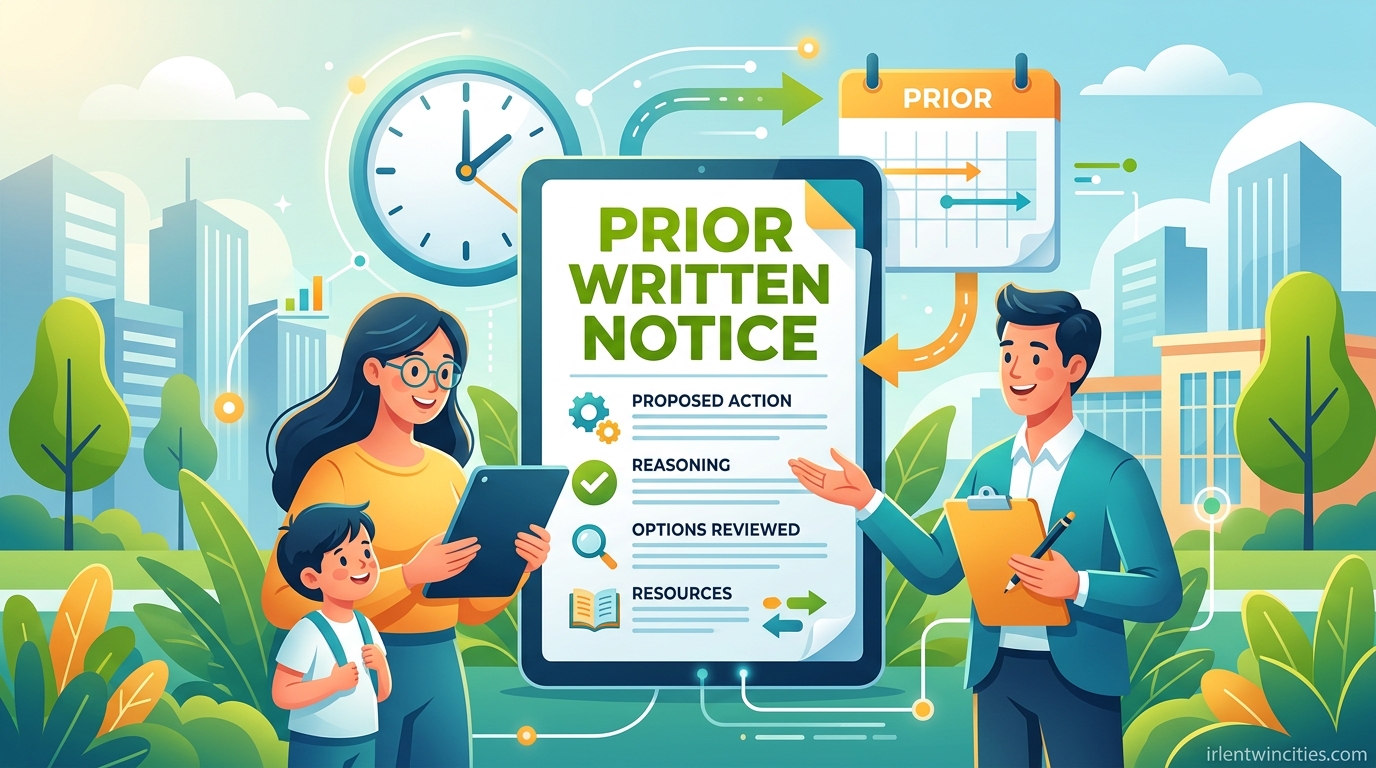
As a parent navigating the special education system, you have more rights than you might realize. One of the most powerful tools in your advocacy arsenal is Prior Written Notice (PWN), yet many parents have never heard of it until they need it most.
I’ve seen too many families miss opportunities to build crucial documentation because schools didn’t volunteer this important notice. Understanding prior written notice PWN when and how to use it can mean the difference between having a paper trail that supports your child’s needs and leaving decisions to chance.
In this guide, I’ll explain exactly what PWN is, when schools must provide it, and give you practical language to request it effectively. You’ll learn how to use this legal requirement to strengthen your advocacy and protect your child’s educational rights.
Table of Contents
What is Prior Written Notice (PWN)?
Prior Written Notice (PWN) is a written explanation that schools must provide parents whenever they propose or refuse to make changes to a child’s special education services. Under the Individuals with Disabilities Education Act (IDEA), specifically 34 CFR 300.503, schools are legally required to document in writing any proposed or refused actions affecting your child’s identification, evaluation, educational placement, or provision of Free Appropriate Public Education (FAPE).
Think of PWN as the school’s way of putting their decisions and reasoning in writing before taking action. It’s not just a formality—it’s a legal protection that creates a documented record of exactly what the school wants to do, why they want to do it, and what information they used to make that decision.
Prior written notice PWN is different from other notices you might receive from schools. A meeting notice simply tells you when an IEP meeting is scheduled. A progress report updates you on your child’s goals. But PWN specifically addresses proposed or refused changes to your child’s special education program and must include specific elements that meeting notices and progress reports don’t require.
What makes prior written notice PWN so powerful is that it forces schools to articulate their reasoning and the data behind their decisions. This documentation becomes invaluable if you need to challenge those decisions later through dispute resolution or due process.
When is Prior Written Notice Required?
Many parents assume PWN is only needed when schools want to make major changes like moving a child to a different classroom or school. But prior written notice PWN is required in far more situations than most realize. Under IDEA, schools must provide PWN whenever they propose or refuse to initiate or change the following four areas:
1. Identification of your child as a child with a disability
This includes situations where the school proposes to evaluate your child for special education eligibility, or when they refuse your request for evaluation. I’ve worked with families who were told “we don’t think your child needs testing” without any written explanation—that’s a violation of prior written notice PWN requirements.
2. Evaluation of your child
Prior written notice PWN is required whenever the school proposes to conduct an evaluation or reevaluation, or when they refuse your request for additional testing. This includes initial evaluations, triennial reevaluations, and any additional assessments you request between regular evaluation cycles.
3. Educational placement
Any proposed change to where your child receives services requires prior written notice PWN. This includes moving from general education to special education settings, changing classrooms, transferring schools, or adjusting the amount of time spent in different environments. What many parents don’t realize is that refusals to change placement also require PWN—if you request a more inclusive setting and the school refuses, they must provide prior written notice explaining why.
4. Provision of Free Appropriate Public Education (FAPE)
This broad category covers any proposed or refused changes to the services and supports your child receives. Prior written notice PWN is required for changes to speech therapy minutes, modifications to accommodations, additions or reductions in paraprofessional support, and any other service changes. It also applies to refusals—if you request an additional service and the school says no, they must provide PWN explaining their refusal.
A crucial aspect of prior written notice PWN that many parents miss is that it applies to BOTH proposals AND refusals. Schools often remember to provide PWN when they want to make changes, but “forget” when refusing parent requests. Both require the same written notice.
Here’s what many parents don’t realize: when schools say they’ll “table” a discussion or decision for later, that’s actually a refusal requiring prior written notice PWN. “Tabling” your request for extended school year services or additional evaluation is a refusal to act now, and the school must provide written notice explaining why they’re not moving forward.
The 7 Required Elements of Prior Written Notice
Not just any written communication counts as proper prior written notice PWN. IDEA specifies exactly what must be included. A complete PWN must contain all seven of these elements:
1. Description of the action proposed or refused
The school must clearly state what specific action they’re proposing or refusing. Vague statements like “changing services” don’t meet prior written notice PWN requirements. Instead, it should specify exactly what’s changing: “reducing speech therapy from twice weekly to once weekly” or “refusing request for additional occupational therapy evaluation.”
2. Explanation of why the school is proposing or refusing the action
This is where schools must articulate their reasoning. Under prior written notice PWN requirements, they can’t just say “we don’t think it’s necessary.” They must explain their specific rationale, such as “based on classroom observations and current progress data, the student is making adequate progress with current service levels.”
3. Description of each evaluation procedure, assessment, record, or report the school used as a basis for the proposed or refused action
This element requires schools to cite the specific data behind their decision. For prior written notice PWN to be complete, the school must list exactly what information they used. This might include “classroom observations by the special education teacher,” “speech-language evaluation conducted March 2025,” “current IEP progress reports,” or “psychological evaluation from January.”
4. Description of other options considered and why those options were rejected
This is often the most incomplete element I see on prior written notice PWN forms. Schools must document that they considered alternatives to their proposed action and explain why those alternatives weren’t chosen. For example, if proposing to reduce paraprofessional support, they should explain why maintaining current support wasn’t chosen or why other support models weren’t selected.
5. Description of other factors relevant to the school’s proposal or refusal
This catch-all category allows schools to include any other relevant information. For prior written notice PWN, this might include “student’s recent behavioral incidents in the classroom,” “parent concerns expressed at last IEP meeting,” or “teacher reports of student progress.”
6. Statement that parents have procedural safeguards and how to obtain a copy
Every prior written notice PWN must inform parents of their procedural safeguards rights and explain how to get a complete copy of those safeguards. This is typically done by including a standard statement and providing the procedural safeguards document.
7. Sources for parents to contact for assistance in understanding procedural safeguards
The final element requires schools to provide contact information for resources that can help parents understand their rights. For prior written notice PWN, this typically includes contact information for the state’s Parent Training and Information Center (PTI), local advocacy organizations, or state education agency special education division.
When reviewing prior written notice PWN from your school, check that all seven elements are addressed. Incomplete PWN is one of the most common violations I see—schools might include the action and explanation but skip the other options considered or fail to cite specific evaluation data used.
Understanding the Implementation Date on PWN
One of the most critical elements of prior written notice PWN is the implementation date—the date when the proposed action will take effect. This date matters immensely for your rights and your child’s services.
The implementation date on prior written notice PWN tells you exactly when changes will happen. More importantly, it triggers timeline protections for parents. If you disagree with the proposed action, you have time to request dispute resolution or file for due process before the implementation date arrives.
This connects to the “stay put” provision—one of the most powerful protections in special education law. “Stay put” means that while you’re in dispute resolution over prior written notice PWN, your child’s current placement and services remain unchanged. But this protection depends on timing; if you don’t act before the implementation date, you may lose your ability to maintain the status quo while disputing the change.
I’ve seen situations where parents received prior written notice PWN with an implementation date that had already passed. This is a serious violation. When the implementation date on your PWN has already come and gone, the school has effectively made changes without proper notice or opportunity for you to exercise your rights. If this happens, document the discrepancy immediately and consider filing a compliance complaint.
Common implementation date mistakes I see on prior written notice PWN include dates that are too soon (giving parents insufficient time to respond), dates that have already passed when the notice is received, or vague dates like “immediately” or “next school year” without specific dates.
How to Request Prior Written Notice from Your School
Many parents don’t realize they can and should request prior written notice PWN. You don’t have to wait for the school to volunteer it. Here’s a step-by-step approach to effectively requesting PWN:
Step 1: Know when to ask
Request prior written notice PWN whenever the school proposes or refuses changes to your child’s services, placement, evaluation, or eligibility. Be especially alert during IEP meetings, when discussing service changes, or when receiving verbal information about decisions affecting your child.
Step 2: Make your request clearly and in writing
While schools may provide verbal responses to your questions, prior written notice PWN must be in writing to meet legal requirements. When a school tells you they can’t provide a service or want to change something, respond with a clear request: “Please put that in writing on a Prior Written Notice form.”
Step 3: Use specific language
Here’s language you can use to request prior written notice PWN effectively:
“Thank you for that explanation. I’d like to receive that decision on a Prior Written Notice form so I have complete documentation of the proposed action and the reasoning behind it.”
“I understand you’re recommending this change. Please provide me with Prior Written Notice that includes the specific data and evaluation reports supporting this recommendation.”
“If you’re refusing my request for [additional evaluation/service change], please document that refusal on a Prior Written Notice form so I understand the rationale and can review my options.”
Step 4: Follow up in writing
After verbal conversations, send an email confirming your understanding and requesting prior written notice PWN: “Following our conversation today about [topic], please send me Prior Written Notice documenting the school’s decision to [propose/refuse] [specific action]. I’d like to receive this within the next week.”
Step 5: Document if the school refuses
If the school won’t provide prior written notice PWN despite your request, document this. Send a written note: “On [date], I requested Prior Written Notice regarding [decision]. I was informed that [name] would not provide this notice. Please provide written confirmation of why Prior Written Notice is not being provided in this situation.”
Email is generally acceptable for requesting prior written notice PWN, but follow up with written documentation if needed. Some parents prefer sending requests via certified mail to create a clear paper trail, especially if the school has been reluctant to provide proper notice in the past.
Common Scenarios Where You Need PWN
Understanding when prior written notice PWN applies helps you advocate more effectively. Here are common scenarios where PWN is required but often overlooked:
Placement Changes: Any change to where your child receives services requires prior written notice PWN. This includes moving from a general education classroom to a resource room, changing schools, or adjusting the percentage of time in different settings. I’ve seen schools make placement changes over the summer and inform parents by letter—that letter must meet all prior written notice PWN requirements or it’s a violation.
Service Reductions: When schools propose reducing services, they must provide prior written notice PWN. This includes decreasing speech therapy minutes, reducing paraprofessional support, or shortening counseling sessions. What many parents don’t realize is that schools sometimes propose service reductions based on budget constraints rather than student needs—proper PWN helps reveal this.
Evaluation Request Denials: If you request an additional evaluation and the school refuses, they must provide prior written notice PWN explaining why. I’ve worked with families who were told “we don’t think more testing is needed” without any written documentation. That refusal requires a complete PWN including what data the school used to make that decision.
Eligibility Determinations: When schools determine a child is or isn’t eligible for special education services, prior written notice PWN is required. This includes both initial eligibility determinations and decisions to exit a child from special education services. Exiting decisions are especially critical—proper PWN ensures families understand the reasoning and can challenge the decision if needed.
Extended School Year (ESY) Decisions: Whether a school proposes or refuses ESY services, prior written notice PWN must be provided. I’ve seen many schools send home a simple form stating “your child doesn’t qualify for ESY” without proper notice. That refusal requires complete PWN including the data used to make that determination.
Accommodation Modifications: Changes to 504 plans or IEP accommodations require prior written notice PWN. This includes removing accommodations, adding new ones, or modifying existing accommodations. Sometimes schools make accommodation changes informally—”we’ll try this different approach”—but those changes require proper notice.
“Tabling” Requests: When schools say they’ll “table” a discussion or decision, that’s actually a refusal requiring prior written notice PWN. I’ve seen many schools use tabling as a tactic to avoid providing written notice. “We’ll table the request for assistive technology and revisit it next fall” is a refusal to act now, and it requires complete PWN.
What to Do If You Disagree with the PWN
Receiving prior written notice PWN with a decision you disagree with can feel overwhelming, but you have options. The first thing to understand is your “stay put” rights. As long as you request dispute resolution or file for due process before the implementation date on the PWN, your child’s current services and placement remain unchanged while the dispute is resolved.
Your options for disagreeing with prior written notice PWN include:
Informal Resolution: Start by requesting another meeting to discuss your concerns. Sometimes sharing additional information or clarifying misunderstandings can resolve the issue without formal dispute resolution.
Mediation: Mediation is a voluntary process where you and the school meet with a neutral third party to try to reach agreement. It’s less adversarial than due process and can preserve relationships while addressing disagreements about prior written notice PWN.
Due Process Hearing: You have the right to request a formal due process hearing where an impartial hearing officer decides the dispute. This is a more formal legal process, and the prior written notice PWN documentation becomes crucial evidence. The hearing officer will review whether the school followed proper procedures and made appropriate decisions.
State Complaint: You can file a complaint with your state education agency alleging violations of special education law. This is particularly appropriate if the prior written notice PWN itself is incomplete or if the school failed to provide required notice.
The prior written notice PWN you received becomes valuable documentation in any dispute. It shows exactly what the school proposed or refused, their reasoning, and the data they used. If the PWN is incomplete or the reasoning is weak, that strengthens your position. I always advise parents to carefully review PWN for missing elements or vague explanations—these deficiencies can support your case.
Timeline matters when disagreeing with prior written notice PWN. Most states have specific deadlines for requesting dispute resolution or filing due process (typically within one to two years of the decision, but some states have shorter timelines). Check your procedural safeguards document for specific timelines in your state, and act before the implementation date to preserve stay put protections.
Frequently Asked Questions About Prior Written Notice
What are the 7 elements of a prior written notice?
The 7 required elements of prior written notice under IDEA are:
- Description of the action proposed or refused
- Explanation of why the action is proposed or refused
- Description of each evaluation procedure, assessment, record, or report used as a basis for the action
- Description of other options considered and why they were rejected
- Description of other factors relevant to the proposal or refusal
- Statement that parents have procedural safeguards and how to obtain them
- Sources for parents to contact for assistance understanding procedural safeguards
What is the prior written notice?
Prior Written Notice (PWN) is a written explanation that schools must provide parents whenever they propose or refuse to initiate or change a child’s identification, evaluation, educational placement, or provision of FAPE under IDEA. It’s a legal requirement that creates documentation of school decisions and the reasoning behind them.
What does PWN mean in an IEP?
In an IEP context, PWN stands for Prior Written Notice. It’s the formal written notice schools must provide when proposing or refusing changes to a child’s special education services, placement, evaluation, or eligibility. PWN documents exactly what action is being taken, why, what data supports the decision, and informs parents of their rights.
Why is prior written notice more than just a formality?
Prior written notice is more than a formality because it creates a documented paper trail of school decisions and refusals, forces schools to articulate their reasoning and cite supporting data, provides essential documentation if parents need to challenge decisions through dispute resolution or due process, and ensures transparency in special education decision-making. PWN is a powerful advocacy tool that protects parent rights.
How to request a prior written notice?
To request prior written notice, clearly ask the school in writing:
“Please provide Prior Written Notice documenting this decision.”
Use specific language like:
“I’d like to receive that decision on a Prior Written Notice form so I have complete documentation of the proposed action and the reasoning behind it.”
Follow up verbal conversations with email requests, and document if the school refuses to provide proper notice.
How long does a school have to provide prior written notice?
IDEA requires schools to provide prior written notice “a reasonable time” before acting. While “reasonable time” isn’t precisely defined in federal law, most states interpret it as enough time for parents to understand the decision and consider their options—typically at least 5–10 school days before implementation. Check your state’s specific timeline requirements in your procedural safeguards document.
Can prior written notice be emailed?
Yes, prior written notice can be emailed to parents. Schools may send PWN electronically as long as parents have access to email and have consented to electronic communication. However, if you request a hard copy, the school must provide one. Keep email copies of all PWN for your records, and request printed copies if needed for official purposes.
Is prior written notice required for 504 plans?
Prior written notice as defined under IDEA is specifically for special education services under IEPs. However, Section 504 has its own notice requirements. While 504 plans don’t require the same 7-element PWN form, schools must still provide notice to parents before making significant changes to 504 plans. The requirements may vary by district and state, so check your local 504 policies.DEVELOPER MODE
Using Prior Written Notice as Your Advocacy Tool
Understanding prior written notice PWN when and how to use it transforms you from a passive participant to an active advocate in your child’s education. PWN isn’t just paperwork—it’s protection. It ensures transparency, creates documentation, and gives you the information you need to make informed decisions about your child’s special education services.
Remember that you have the right to request prior written notice PWN whenever the school proposes or refuses changes affecting your child. Don’t accept verbal explanations or casual conversations as adequate notice. Request proper PWN that includes all seven required elements, and use that documentation to build your understanding of the school’s decisions and your advocacy strategy.
When you receive prior written notice PWN, review it carefully. Check that all seven elements are included. Look for specific data citations rather than vague references. Note whether other options were considered and why they were rejected. This information helps you understand the school’s thinking and identify weaknesses you can address through advocacy or dispute resolution.
Prior written notice PWN is your right under IDEA. Use it proactively to ensure schools communicate clearly and completely about decisions affecting your child’s education. Build your documentation file with every PWN you receive, and don’t hesitate to request proper notice when it’s missing or incomplete.
By understanding and exercising your right to prior written notice PWN, you create the paper trail that strengthens your advocacy and protects your child’s educational rights. It’s one of the most powerful tools available to parents in the special education process—now you know how to use it.