
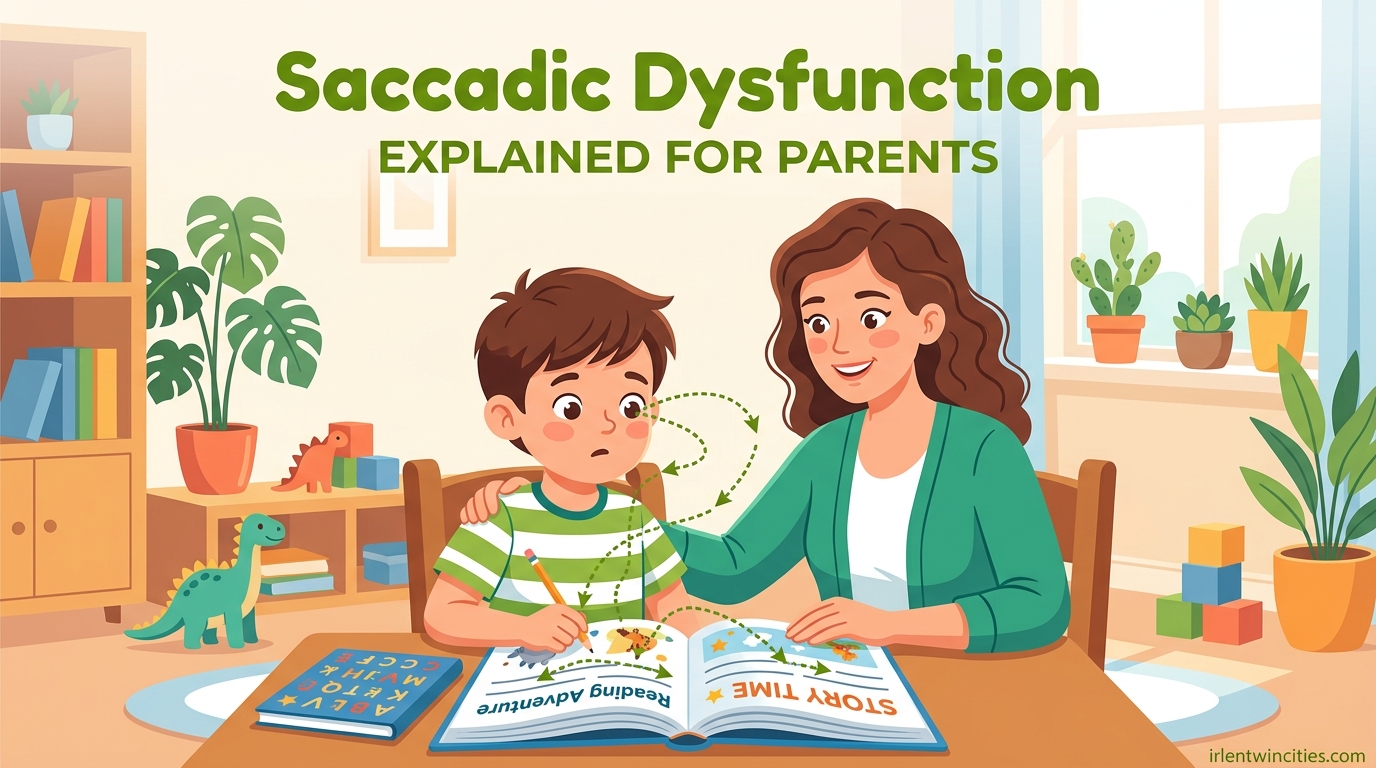
Your child is bright, curious, and capable. They follow conversations perfectly and understand complex ideas when you explain them aloud. Yet when it comes to reading, they struggle to get through a single page without losing their place, skipping words, or complaining that the letters seem to move around on the page.
As a parent, you might have wondered if they are just being lazy, if they have dyslexia, or if there is something else going on entirely. The truth might surprise you: your child could have saccadic dysfunction, a vision condition that affects how the eyes move when tracking across a page or shifting focus between objects.
Saccadic dysfunction is a condition where the eyes make inaccurate, poorly coordinated movements when shifting focus from one point to another. This has nothing to do with intelligence or effort. Children with this condition often have perfect 20/20 vision when tested on an eye chart, yet struggle tremendously with reading and visual tasks.
In this guide, we will explain everything parents need to know about saccadic dysfunction in 2026. You will learn what saccades are, how to spot the signs in your child, how this condition impacts learning, and what you can do to help. Our team has researched the latest information and gathered insights from parents who have walked this path before you.
Table of Contents
What Are Saccadic Eye Movements?
Saccades are the rapid, jerky movements your eyes make dozens of times per minute to shift your gaze from one point to another. Think of them as the quick jumps your eyes perform when you look from your phone to your child across the room, then back to your coffee cup on the table.
These movements are essential for daily life. Every time you scan a room, read a sentence, or watch traffic while driving, your eyes are performing saccades. A typical reader makes 3 to 5 saccades per second while reading, with each movement lasting only 20 to 200 milliseconds.
Your brain controls these movements through a complex coordination between your eyes and your visual cortex. When working properly, saccades are precise and efficient, landing exactly where you intend to look. The eyes overshoot or undershoot their target by only tiny fractions of a degree, making reading smooth and effortless.
The Difference Between Saccades and Pursuits
It is helpful to understand that your eyes perform two main types of movements. Saccades are the quick jumps between fixed points, while pursuits are the smooth tracking movements you use when following a moving object, like watching a bird fly across the sky.
Both systems work together to give you a complete picture of your environment. When either system is not working properly, everyday tasks become much more challenging. Children with saccadic dysfunction can often track moving objects just fine but struggle when they need to jump their eyes from word to word on a page.
Signs Your Child May Have Saccadic Dysfunction
Recognizing saccadic dysfunction in your child requires watching for specific patterns of behavior, not just one isolated incident. Many of these signs are easy to dismiss as laziness or lack of interest, but they actually point to a genuine neurological vision issue.
From our research into parent forums and discussions with vision specialists, we have identified the most common warning signs that parents notice first.
Reading-Related Symptoms
The most obvious signs appear during reading activities. Children with saccadic dysfunction often lose their place frequently, even when using a finger to track. They may skip words entirely, particularly small words like “the,” “and,” or “of.”
You might notice them rereading the same line multiple times, or their reading speed might be significantly slower than their classmates despite normal intelligence. Many parents report their child uses a finger to track words long after peers have stopped this behavior, often feeling self-conscious about it at school.
Another telltale sign is poor reading comprehension despite being able to decode individual words. This happens because so much mental energy goes into just moving the eyes across the page that little brain power remains for understanding what was read.
Classroom and Homework Difficulties
Copying from the board or from a book to paper becomes a major challenge. Your child might take significantly longer than classmates to copy notes, often missing information because they cannot efficiently shift their gaze between the source and their paper.
Homework sessions may turn into battles. Many parents in online forums describe their children actively avoiding reading assignments or becoming irritable and exhausted after just 15 minutes of visual work. This is not defiance. It is genuine visual fatigue.
Your child might also struggle with visual scanning tasks like finding a specific item in a cluttered picture or completing word search puzzles. These activities require the same saccadic skills that reading demands.
Physical and Behavioral Signs
Watch for complaints of headaches, eye strain, or fatigue that worsen as the day progresses. Many parents notice their child becomes more irritable or has behavioral difficulties in the afternoon after hours of visual work at school.
Some children develop unusual head positions while reading, such as tilting their head or covering one eye. Others might hold books extremely close to their face or far away, trying to compensate for their eye movement difficulties.
Sports performance can also be affected. Children with saccadic dysfunction may struggle with ball sports that require rapid eye movements to track the ball, judge distances, or coordinate hand-eye responses.
Signs That Need Prompt Attention
While most saccadic dysfunction is developmental and not an emergency, certain symptoms warrant immediate evaluation. Contact a healthcare provider promptly if your child experiences sudden onset of these symptoms after a head injury, double vision, severe headaches with vomiting, or any loss of vision.
These could indicate more serious neurological issues that require urgent medical attention rather than routine vision therapy.
How Saccadic Dysfunction Affects Reading and Learning
To understand why saccadic dysfunction creates such significant learning challenges, imagine trying to read while the words on the page constantly shift position or blur during each eye movement. This gives you a glimpse into what children with this condition experience every day.
When a child with healthy saccades reads, their eyes jump smoothly from word to word, landing precisely on each target. The brain suppresses visual input during each jump to prevent blurring, then processes the new image when the eyes land. This happens so quickly that reading feels effortless.
The Reality of Reading with Impaired Saccades
Children with saccadic dysfunction experience a very different reality. Their eyes might undershoot the target word, requiring a second or third attempt to land correctly. Alternatively, they might overshoot and have to backtrack. These errors are called hypometria and hypermetria.
The result is that words seem to jump around on the page. A sentence like “The cat sat on the mat” might be processed as “The cat… cat sat… on the… the mat” with repeated words and confusion about sequence. The brain expends enormous energy just keeping the eyes on track, leaving little capacity for comprehension.
Children often describe text as “swimming,” “moving,” or “jumbling together.” Some say they see double or that words appear to overlap. These are not excuses. They are accurate descriptions of a genuine visual processing problem.
Academic Consequences Beyond Reading
The impact extends far beyond reading scores. Children with saccadic dysfunction often appear to have attention problems because they cannot keep up with visual information presented in classrooms. They might miss instructions written on the board, fall behind during timed tests, or avoid participating in activities that require visual tracking.
Over time, this creates a cycle of academic struggle and diminishing confidence. Children begin to believe they are not smart or capable, when in reality, they simply need support for their visual system. This is why proper identification and intervention are so crucial.
The ADHD Connection
One of the most important topics for parents to understand is the connection between saccadic dysfunction and ADHD. Research shows significant overlap between these conditions, with many children carrying both diagnoses.
Children with ADHD often do show atypical eye movement patterns. Their saccades may be less accurate, show increased latency (delayed start), or have difficulty inhibiting movements when they should hold their gaze steady. However, not every child with saccadic dysfunction has ADHD, and not every child with ADHD has saccadic problems.
The critical point is that purely visual attention problems can look identical to behavioral attention problems. A child who cannot track text efficiently will appear inattentive, fidgety, or avoidant during reading tasks. Before accepting an ADHD diagnosis, parents should consider whether a comprehensive vision evaluation might reveal saccadic dysfunction as a contributing factor.
In some cases, treating the underlying vision problem reduces or eliminates the attention difficulties entirely. In other cases, both conditions exist and both require treatment. Either way, understanding the full picture helps you make better decisions for your child.
What Causes Saccadic Dysfunction in Children?
Understanding the causes of saccadic dysfunction can help parents release any guilt they might feel and focus on solutions. This condition is not caused by parenting choices, screen time limits, or how much you read to your child.
Developmental Factors
The most common cause is simply developmental delay in the neurological systems that control eye movements. Just as some children walk or talk later than others, some children take longer to develop mature saccadic control. The neural pathways connecting the eyes to the brain areas responsible for movement coordination need time to fully mature.
For many children, these systems catch up naturally with age and practice. For others, targeted intervention through vision therapy provides the stimulation needed to develop these pathways fully.
Head Injury and Concussion
Post-concussion syndrome frequently includes saccadic dysfunction as one of its symptoms. Even mild head injuries can disrupt the delicate coordination between the eyes and brain. If your child experienced a head injury and subsequently developed reading or attention difficulties, saccadic dysfunction may be the culprit.
The good news is that post-concussion saccadic problems often respond very well to rehabilitation and vision therapy, sometimes resolving completely with proper treatment.
Neurological and Genetic Conditions
Certain neurological conditions are associated with saccadic dysfunction. These include autism spectrum disorders, cerebral palsy, and various genetic conditions affecting neurological development. Children with these conditions often benefit significantly from vision therapy as part of their overall treatment plan.
It is important to note that saccadic dysfunction is not limited to children with these conditions. Many otherwise typically developing children experience isolated saccadic problems without any other neurological concerns.
Differentiating from Dyslexia
Parents often wonder whether their child has dyslexia or saccadic dysfunction. These conditions can coexist, but they are distinct. Dyslexia is primarily a language-based learning difference affecting phonological processing, while saccadic dysfunction is a vision-based motor control problem.
A child with pure saccadic dysfunction might sound out words perfectly but struggle with the physical act of moving across the page. A child with pure dyslexia might track words smoothly but struggle to decode them. Comprehensive evaluation can distinguish between these possibilities and guide appropriate intervention.
Treatment Options and Vision Therapy
The encouraging news for parents is that saccadic dysfunction is highly treatable. Unlike structural eye problems that require surgery, saccadic dysfunction responds well to non-invasive therapies that retrain the brain-eye connection.
Vision Therapy Overview
Vision therapy is a structured program of visual activities designed to improve the coordination between the eyes and brain. Think of it as physical therapy for the visual system. A trained optometrist or vision therapist guides your child through progressive exercises that strengthen saccadic accuracy, speed, and efficiency.
Typical programs last 3 to 6 months, with weekly in-office sessions supplemented by daily home exercises. The duration varies based on severity and consistency with home practice. Most children see noticeable improvements within the first month of treatment.
Professional Testing Methods
When you seek evaluation, the eye care professional may use several specific tests to assess saccadic function. The NSUCO Oculomotor Test examines eye movement skills in a clinical setting. The Developmental Eye Movement (DEM) test measures how quickly and accurately a child can perform the visual scanning patterns needed for reading.
The King-Devick Test is another assessment tool that evaluates saccadic speed and accuracy through a timed number-naming task. These tests provide objective measurements of your child’s visual skills and help track improvement over time.
Home Exercises Parents Can Do
While professional vision therapy offers the most comprehensive treatment, there are activities parents can do at home to support visual development. The Hart Chart Saccades exercise involves calling out letters from a grid arranged at different distances, encouraging accurate saccadic jumps.
Saccade Sticks, which are simply sticks with targets at different distances, can be used to practice rapid shifts of focus. Simple activities like having your child follow a penlight as you move it between two fixed points can also help.
Remember that these home activities supplement but do not replace professional vision therapy for children with significant dysfunction. Think of them as exercises that strengthen skills between therapy sessions.
When Glasses Help vs. When Therapy Is Needed
Standard prescription glasses correct refractive errors like nearsightedness or farsightedness, but they do not fix saccadic dysfunction. If your child has 20/20 vision, glasses will not solve their eye movement problems.
However, some children have both refractive errors and saccadic dysfunction. In these cases, glasses may be a necessary first step, but vision therapy remains essential for addressing the movement problems specifically. Your eye care professional can determine whether your child needs one or both interventions.
Practical Tips for Parents: Supporting Your Child at Home and School
While you pursue professional evaluation and treatment, there are immediate steps you can take to support your child. These practical strategies can reduce frustration and help your child succeed academically while their visual system develops or receives therapy.
Reading Strategies That Help
Encourage the use of a finger or bookmark under the current line of text. Many children resist this because they feel babyish, but reassure them that plenty of adults use trackers too. A simple index card with a window cut out can also help isolate one line at a time.
Break reading assignments into smaller chunks with breaks in between. Five minutes of reading followed by a one-minute movement break prevents the visual fatigue that leads to meltdowns. Audio books can be a valuable supplement, allowing your child to access grade-level content while building their visual reading skills separately.
Printed materials often work better than screens for children with saccadic dysfunction. The contrast and stability of ink on paper can be easier to process than backlit screens. When screen use is necessary, increase font size and use high-contrast color schemes.
Classroom Accommodations to Request
Talk to your child’s teacher about accommodations that can make a significant difference. Having a copy of notes rather than copying from the board eliminates a major source of visual stress. Preferential seating near the front reduces the distance eyes must travel.
Extra time on tests and assignments acknowledges that visual scanning takes longer for your child. Access to audio materials for content-heavy subjects ensures your child can keep up with learning while working on visual skills separately.
Printed handouts with larger fonts and generous spacing between lines reduce the density of visual information. Double-spacing and larger margins make a surprisingly big difference for children with tracking difficulties.
When to Seek Professional Help
If you have noticed multiple signs of saccadic dysfunction in your child, schedule a comprehensive eye examination with a developmental optometrist or vision therapist. Standard school vision screenings and basic eye exams often miss this condition because they test visual acuity but not eye movement skills.
Routine evaluation is appropriate when your child shows consistent reading struggles, visual fatigue, or the signs described in this article. Urgent evaluation is needed only if symptoms appeared suddenly after head trauma or if visual symptoms are accompanied by severe headaches, vomiting, or neurological changes.
Trust your parental instincts. If you sense something is not right with your child’s visual processing, pursue answers. Early intervention prevents the academic and emotional fallout that often accompanies undiagnosed saccadic dysfunction.
Frequently Asked Questions About Saccadic Dysfunction
What is saccadic dysfunction?
Saccadic dysfunction is a condition where the eyes make inaccurate, poorly coordinated movements when shifting focus from one point to another. These rapid eye movements, called saccades, should land precisely on targets. When they undershoot, overshoot, or show poor coordination, reading and visual tasks become difficult. This condition affects the neurological control of eye movements, not the structure of the eyes themselves.
How do deficits with performing saccades cause difficulty with reading?
Reading requires the eyes to make 3 to 5 precise jumps per second between words. When saccades are impaired, the eyes may land on the wrong word, skip words entirely, or require multiple attempts to reach the target. This makes text appear to jump or blur. Children must use enormous mental effort just to track across the page, leaving little energy for understanding what they read. The result is slow reading, poor comprehension, and significant visual fatigue.
Do people with ADHD move their eyes a lot?
People with ADHD often show atypical saccadic eye movement patterns. Research shows they may have increased latency in starting eye movements, reduced accuracy in landing on targets, and difficulty inhibiting unwanted saccades when they should maintain steady gaze. However, the relationship is complex. Some children diagnosed with ADHD actually have undiagnosed saccadic dysfunction causing attention-like symptoms. A comprehensive vision evaluation can help determine if visual problems contribute to attention difficulties.
What is involuntary eye rolling upward in children?
Involuntary upward eye rolling, also called ocular tics or oculogyric crises, differs from saccadic dysfunction. While saccadic dysfunction involves inaccurate voluntary eye movements, involuntary eye rolling represents uncontrolled movements that may indicate neurological issues, medication side effects, or tics. If your child shows involuntary eye rolling, especially if accompanied by other symptoms like neck twisting or behavioral changes, consult a pediatrician or neurologist promptly rather than a vision therapist.
Can saccadic dysfunction be outgrown?
Some children do develop more mature saccadic control naturally as they grow, particularly those with developmental delays as the underlying cause. However, many children benefit significantly from vision therapy to accelerate this development. Without intervention, children may develop coping strategies but continue to struggle with reading efficiency and visual fatigue. Professional evaluation can determine whether your child needs active treatment or monitoring while waiting for natural development.
How is saccadic dysfunction diagnosed?
Diagnosis requires testing beyond standard eye charts. Developmental optometrists use specific assessments like the NSUCO Oculomotor Test, Developmental Eye Movement (DEM) test, and King-Devick Test. These measure saccadic accuracy, speed, and consistency. The testing is non-invasive and takes about 30 minutes. Your child will be asked to look between targets, name numbers in sequences, or follow moving lights while the examiner observes eye movement patterns.
Conclusion
Saccadic dysfunction is a treatable vision condition that affects how children move their eyes when reading and performing visual tasks. It has nothing to do with intelligence, effort, or parenting quality. Children with this condition are often bright, capable, and eager to learn, but they struggle because their visual system does not support their academic goals.
If you recognize the signs described in this guide in your child, take heart. In 2026, parents have more resources than ever to help children with vision-based learning challenges. Vision therapy offers proven results, and the accommodations we discussed can provide immediate relief while treatment progresses.
The most important step is getting proper evaluation from a developmental optometrist who understands saccadic dysfunction. Standard eye exams miss this condition, but targeted testing reveals it clearly. With diagnosis comes understanding, and with understanding comes the ability to help your child thrive. Your advocacy and support can transform your child’s academic experience and restore their confidence in their own abilities.