
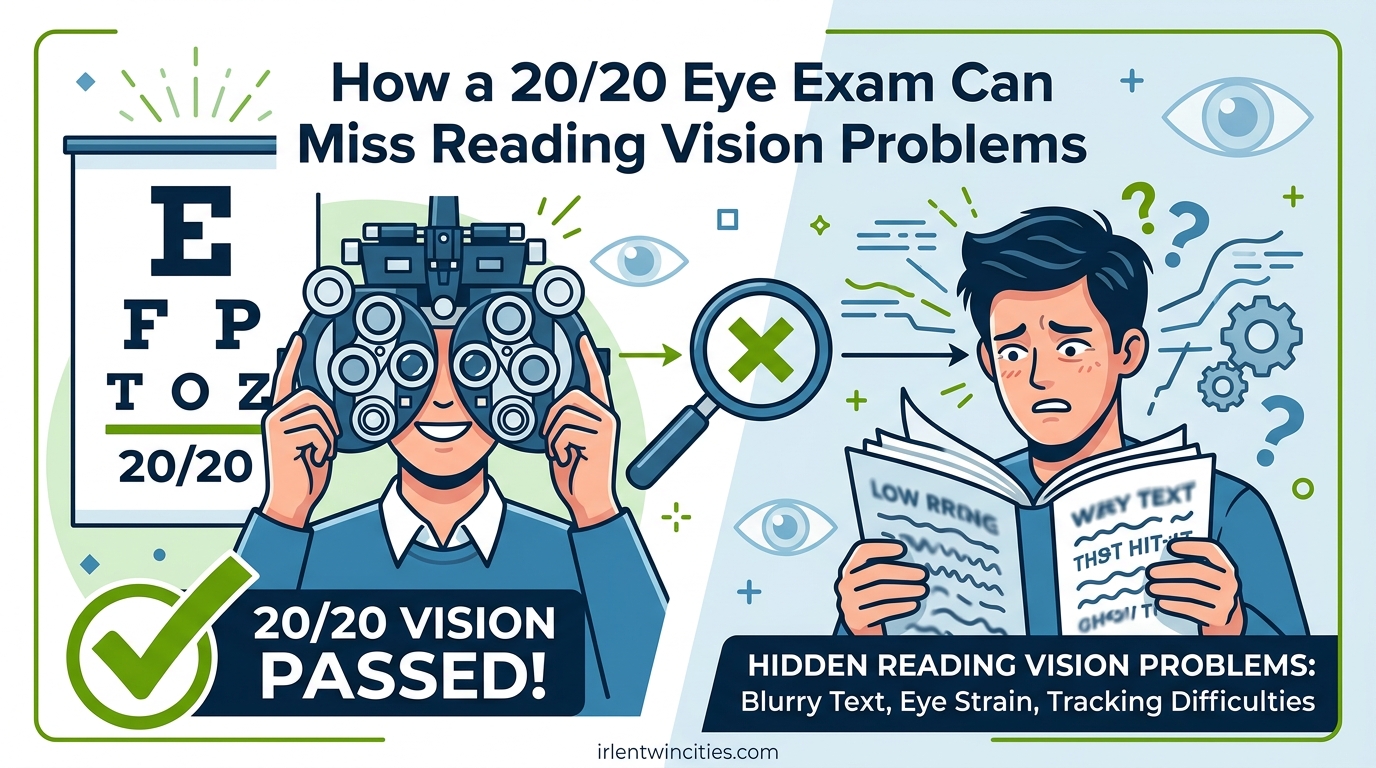
Your child came home from school with a note saying they passed the vision screening with flying colors. The report shows 20/20 vision. Yet every night, homework turns into a battlefield of frustration, tears, and “I can’t do this.” You wonder if they’re just being lazy, or if something else is going on.
After 15 years of working with families at our Irlen diagnostic center, I have seen this scenario hundreds of times. Parents arrive feeling confused, guilty, and desperate for answers. Their child has “perfect” vision according to every test they’ve taken. But something invisible is blocking their ability to read, learn, and succeed.
The truth that shocks most parents: a 20/20 eye exam only measures one small piece of the vision puzzle. It tests how clearly your child sees a chart on a wall 20 feet away. It tells you almost nothing about how their eyes work when reading a book 12 inches from their face. In this guide, I will explain exactly what standard eye exams miss, why these hidden vision problems devastate reading ability, and what you can do to finally get answers.
Table of Contents
What 20/20 Vision Actually Measures (and What It Doesn’t)
When an eye doctor says someone has 20/20 vision, they are only describing visual acuity at a distance. The term comes from the Snellen eye chart test developed in the 1860s. If you can read the letters designed for a person with normal vision at 20 feet, you have 20/20 vision.
Visual acuity measures the sharpness or clarity of your eyesight when looking at stationary objects far away. It tests whether light focuses properly on your retina. It identifies refractive errors like nearsightedness, farsightedness, and astigmatism that glasses or contacts can correct.
What 20/20 vision does NOT measure could fill a book. It does not test how well your eyes work together as a team. It does not measure your ability to track moving text across a page. It cannot detect problems with focusing flexibility or depth perception. Most importantly for reading struggles, it completely misses functional vision disorders that affect how the brain processes what the eyes see.
Dr. Kellye Knueppel, a developmental optometrist who has studied this issue extensively, explains that 20/20 testing “only measures what you can see at a distance, not what you can understand or process from what you see up close.” This distinction matters enormously for children in school, where 80% of learning happens through visual pathways.
Why Standard Eye Exams Miss Reading Vision Problems
School vision screenings create a false sense of security for millions of parents every year. These quick checks typically involve reading letters from a chart while standing 20 feet away. The entire test takes less than five minutes. If your child can identify the letters, they pass. No further testing happens.
The gap between this screening and real-world reading demands is staggering. When a child reads, their eyes must complete a complex series of tasks simultaneously. Both eyes need to point at the exact same spot on the page. They must track smoothly from left to right, then quickly return to the next line. The focusing system must adjust constantly as the child looks from book to board and back again. None of these skills get tested during a standard screening.
Research from the National Center for Children’s Vision and Eye Health reveals that approximately 25% of children have a vision problem that affects their ability to learn. School screenings miss the majority of these cases because they were never designed to catch functional vision disorders. They were created to identify children who need glasses for distance vision, period.
Another limitation: children learn to compensate. A bright child with eye teaming problems may squint, tilt their head, or use one eye more than the other without realizing it. They might memorize the chart during screenings. Some children with tracking issues simply guess at letters based on context clues. The screening gives them a passing grade while their underlying vision problem continues sabotaging their reading development.
Vision Problems That 20/20 Testing Cannot Detect
Understanding the specific conditions that standard eye exams miss helps explain why so many children struggle despite having “perfect” vision. These functional vision problems affect how the eyes and brain work together during reading tasks.
Convergence Insufficiency: When Eyes Won’t Team Together
Convergence insufficiency affects up to 13% of the population, making it one of the most common yet undiagnosed vision disorders. This condition occurs when the eyes cannot maintain proper alignment when looking at near objects like books or screens.
A child with convergence insufficiency sees double or blurry text when trying to read. Their brain receives conflicting images from each eye and struggles to merge them into one clear picture. To compensate, they may cover one eye, tilt their head constantly, or avoid reading altogether. Standard eye exams test each eye separately, so this binocular vision problem remains invisible.
Eye Tracking Problems: The Invisible Reading Barrier
Reading requires precise eye movements called saccades, quick jumps from one word to the next followed by brief fixations. A typical reader makes 3-4 saccades per second while processing text. Children with tracking problems lose their place constantly, skip lines, or reread the same line multiple times without realizing it.
Parents often describe children with tracking issues as “careless” readers who skip small words or add words that aren’t there. The child isn’t being careless. Their eyes literally cannot follow the text in an organized way. Standard 20/20 testing presents single large letters at a distance, which masks these saccadic dysfunction problems.
Focusing and Accommodation Disorders
The eye’s lens must change shape constantly during a school day. It relaxes to see the whiteboard across the room, then tenses to focus on a textbook inches away. This flexibility, called accommodation, allows smooth transitions between distances.
Children with focusing problems experience eye strain, headaches, and blurred vision after short periods of reading. One parent on Reddit described their frustration: “My son has 20/20 vision but his eyes ‘lose focus’ while reading. The school said his vision was fine. It took us two years to find out he had an accommodation problem.”
Irlen Syndrome and Scotopic Sensitivity
Irlen Syndrome represents one of the most overlooked causes of reading difficulty. This perceptual processing disorder affects how the brain interprets visual information, particularly high-contrast patterns like black text on white paper. The brain becomes overstimulated by certain light wavelengths, creating perceptual distortions that have nothing to do with visual acuity.
People with Irlen Syndrome see text that shifts, swirls, or creates halos on the page. Words may appear to move, fade in and out, or double. The page becomes a source of physical discomfort rather than information. Standard eye exams cannot detect Irlen Syndrome because the eyes themselves function normally. The problem exists in how the brain processes the visual signal.
At our center, we regularly see children and adults who have struggled for years despite multiple eye exams showing 20/20 vision. After proper screening for scotopic sensitivity and the application of precision-tinted overlays or lenses, reading transforms from torture into an accessible activity. This condition remains absent from standard eye exams because it requires specialized perceptual testing that most optometrists do not perform.
7 Warning Signs Your Child’s Reading Struggle Is Actually a Vision Problem
Parents know their children better than any screening test. These observable behaviors often indicate a functional vision disorder even when eye charts show perfect results:
1. Skipping Words or Lines While Reading
Children with tracking problems frequently lose their place on the page. They skip small words like “the” and “and” or entire lines of text. When asked to read aloud, they sound disconnected because they’re not actually seeing all the words in sequence.
2. Using a Finger to Keep Place
While finger tracking helps beginning readers, older children who must use their finger to avoid losing their place likely have a tracking or convergence problem. The finger becomes a necessary anchor because their eyes cannot maintain position independently.
3. Complaining of Headaches or Eye Pain
Frequent headaches during or after reading indicate eye strain from compensating for vision problems. The extra effort required to keep images single, clear, and stable exhausts the visual system. Many parents dismiss these complaints until vision improves and the headaches mysteriously vanish.
4. Avoiding Reading or Homework Battles
A child who used to enjoy books but now resists reading may have developed vision problems that make the activity uncomfortable. The avoidance is protective, not defiant. As one mother shared, “My daughter was diagnosed with ADHD, but the medication didn’t help. Turns out she had Irlen Syndrome and reading literally hurt her eyes.”
5. Rubbing Eyes Excessively
Frequent eye rubbing during or after reading suggests visual fatigue. The eyes work harder than they should to maintain clear, single vision. Rubbing temporarily stimulates tear production and provides brief relief from the strain.
6. Taking Unusually Long to Complete Assignments
Children with undetected vision problems read significantly slower than peers. They re-read sections multiple times to comprehend, take frequent breaks to rest their eyes, or spend extra time decoding words their eyes did not capture correctly the first time.
7. Poor Reading Comprehension Despite Strong Oral Skills
When a child discusses topics intelligently but cannot answer questions about what they just read, suspect a vision problem. They may expend so much energy getting their eyes to work that no cognitive resources remain for understanding. The decoding consumes everything.
The Hidden Connection Between Vision Problems and ADHD Misdiagnosis
The symptoms of functional vision disorders and Attention Deficit Hyperactivity Disorder overlap dramatically. Both can cause difficulty concentrating, avoiding close work, appearing inattentive, and showing frustration with academic tasks. This overlap leads to misdiagnosis with serious consequences.
Multiple parents in online forums describe heartbreaking journeys. One father wrote: “My son can’t read because his eye tests were useless. They said 20/20 vision, no problems. But his eyes shake when he tries to focus. He’s been on ADHD medication for two years and it never helped because his problem is vision, not attention.”
Vision-based attention problems stem from physical discomfort. A child whose eyes hurt, see double, or lose their place every few seconds will naturally look away from their work. They fidget because sitting still intensifies the visual strain. They appear inattentive because reading requires exhausting effort. These behaviors look like ADHD to teachers and even some doctors.
Before accepting an ADHD diagnosis, parents should insist on a comprehensive vision evaluation including binocular vision testing, accommodation assessment, and tracking evaluation. Vision therapy or corrective lenses can resolve attention problems that medication never could. The Children and Adults with Attention-Deficit/Hyperactivity Disorder organization now recognizes vision problems as a condition that can mimic or exacerbate ADHD symptoms.
What to Ask For at Your Child’s Next Eye Exam
Not all eye exams are created equal. A basic vision screening checks one thing: distance acuity. A comprehensive eye exam evaluates the entire visual system. Knowing the difference empowers you to request appropriate testing.
When scheduling an appointment, specifically request a comprehensive eye exam that includes testing for learning-related vision problems. Ask whether the doctor performs binocular vision testing, accommodation assessment, and ocular motility evaluation. These terms signal that you understand the limitations of basic screenings.
Look for a developmental optometrist or a pediatric optometrist with specific training in functional vision disorders. Organizations like the College of Optometrists in Vision Development maintain directories of doctors who specialize in these evaluations. Regular optometrists focus primarily on eye health and refractive errors. Developmental optometrists examine how the entire visual system supports learning and daily activities.
During the appointment, describe specific symptoms your child experiences while reading. Mention skipping words, losing place, headaches, or avoidance behaviors. Ask the doctor to test near vision skills specifically, not just distance acuity. If your child shows signs of light sensitivity or text distortion, inquire about Irlen Syndrome screening.
Questions to ask before leaving the appointment: Did you test how my child’s eyes work together when reading? Did you check their focusing ability at near distances? Did you evaluate eye tracking movements? If the answer to any question is no, you may need a referral to a specialist who performs these assessments.
Frequently Asked Questions
Can I have 20/20 vision and still need readers?
Yes, absolutely. 20/20 vision only indicates that you can see clearly at a distance of 20 feet. Many people with 20/20 distance vision struggle with near tasks like reading. Presbyopia, which typically begins around age 40, affects near focusing ability regardless of distance acuity. Additionally, functional vision problems like convergence insufficiency affect near vision while leaving distance vision intact. Reading glasses, vision therapy, or specialized treatments may be necessary even with perfect distance vision.
What is the eye condition that makes it hard to read?
Multiple vision conditions affect reading despite normal acuity. Convergence insufficiency prevents eyes from working together at near distances. Accommodative dysfunction limits the eye’s ability to change focus. Ocular motor dysfunction disrupts smooth eye tracking across text. Irlen Syndrome and scotopic sensitivity cause perceptual distortions that make text unstable or uncomfortable. These functional vision disorders require specialized testing beyond standard eye charts to diagnose.
Can an eye test detect an aneurysm?
A comprehensive eye exam can sometimes detect signs of serious health conditions including aneurysms, though this is rare. Swelling of the optic nerve or specific patterns of bleeding in the retina may indicate increased intracranial pressure from an aneurysm or other neurological issues. However, standard 20/20 vision screenings and basic eye exams are not designed as diagnostic tools for aneurysms. If you experience sudden severe headaches, vision changes, or neurological symptoms, seek emergency medical care immediately rather than waiting for a routine eye appointment.
Why does my child skip words when reading despite having 20/20 vision?
Word skipping typically indicates an eye tracking or convergence problem, not an acuity issue. Children with saccadic dysfunction cannot make the precise eye movements required to move smoothly from word to word. Their eyes jump inaccurately, landing on the wrong spot or missing words entirely. Convergence insufficiency can also cause this symptom when the brain suppresses input from one eye to avoid double vision. A developmental optometrist can diagnose these tracking and teaming problems through specialized testing not included in standard vision screenings.
How is Irlen Syndrome different from other vision problems?
Irlen Syndrome differs from refractive errors and binocular vision disorders because it involves the brain’s processing of visual information rather than the eyes’ ability to see. While standard vision problems affect how clearly or comfortably the eyes capture images, Irlen Syndrome affects how the brain interprets certain visual patterns, particularly high-contrast black text on white paper. Symptoms include text that appears to move, swirl, create halos, or produce physical discomfort. Irlen Syndrome requires specialized perceptual testing and is treated with precision-tinted overlays or lenses rather than traditional glasses or vision therapy.
Conclusion: From Frustration to Answers
Understanding how a 20/20 eye exam can miss reading vision problems changes everything for struggling families. That simple screening only measures distance visual acuity. It remains silent about eye teaming, tracking, focusing, and perceptual processing. The 25% of children with vision problems affecting learning deserve comprehensive evaluations that examine the entire visual system.
If your child has 20/20 vision but still struggles with reading, trust your observations over a screening result. The warning signs you notice at homework time tell a more complete story than any eye chart. Request a comprehensive evaluation from a developmental optometrist who tests functional vision skills. Explore whether Irlen Syndrome or other perceptual processing disorders might contribute to the difficulty.
Most functional vision problems respond well to treatment once identified. Vision therapy strengthens weak visual skills. Specialized lenses can stabilize text and reduce perceptual distortions. With proper support, children who once avoided books can become confident readers. The first step is recognizing that 20/20 vision and reading vision are not the same thing, and the standard eye exam was never designed to tell the whole story.