
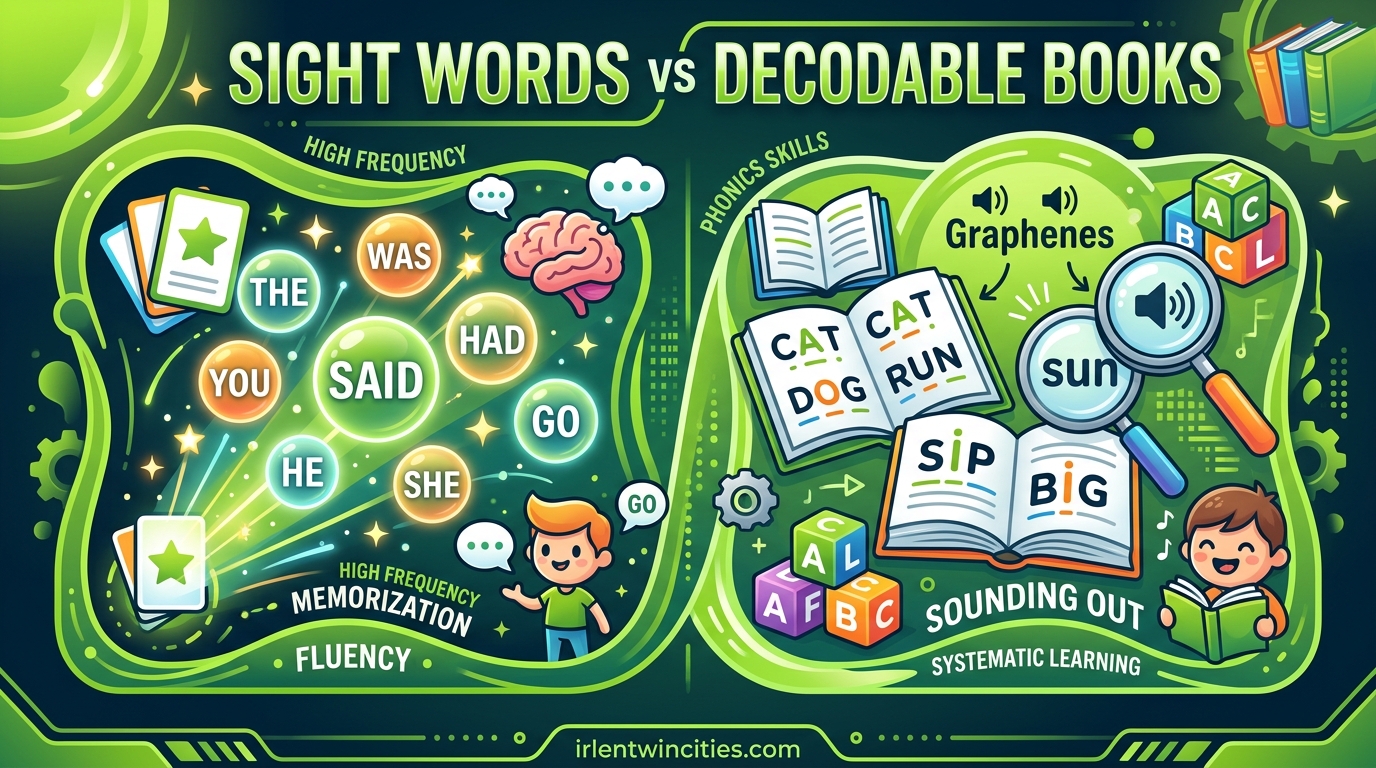
Decodable books should come first for beginning readers. Research from the Science of Reading consistently shows that children learn to read most effectively when they start with phonics-based decodable books that let them sound out words using letter-sound knowledge. While sight words have their place in reading instruction, starting with memorization-heavy approaches can create habits that actually hinder long-term reading development.
I have worked with families navigating early reading instruction for over a decade, and the confusion around sight words versus decodable books remains one of the most common questions I hear from parents. The conflicting advice from schools, online resources, and well-meaning relatives leaves many caregivers unsure about the best path for their child.
This guide explains the difference between these two approaches, what the research actually says about teaching reading, and exactly how to sequence instruction so your child builds a strong foundation. By the end, you will understand why starting with decodables creates confident, independent readers and when sight words fit into the picture.
Table of Contents
What Are Sight Words?
Sight words are high-frequency words that appear often in written English, traditionally taught as whole words to be recognized instantly without sounding them out. Words like “the,” “was,” “said,” and “what” appear on most sight word lists because they show up repeatedly in early reader books and texts.
The traditional definition taught that sight words could not be sounded out using standard phonics rules. Educators using this approach would have children memorize these words through flashcards, repetition, and visual recognition drills. The goal was automatic recognition so young readers could focus on comprehension rather than decoding every single word.
Common Sight Word Lists
The Dolch sight word list includes 220 words divided by grade level from preschool through third grade. Dolch words cover 50 to 75 percent of the words found in children’s books and 50 percent of words in writing for adults. The Fry sight word list expands this to 1,000 words organized by frequency of use in reading materials.
Kindergarten sight words typically include: a, and, away, big, blue, can, come, down, find, for, funny, go, help, here, I, in, is, it, jump, little, look, make, me, my, not, one, play, red, run, said, see, the, three, to, two, up, we, where, yellow, you.
The Problem With Traditional Sight Word Instruction
While memorizing high-frequency words seems logical, research reveals significant problems with this approach when used as the primary reading method. Children taught primarily through sight word memorization often develop guessing habits, relying on the first letter and overall word shape rather than processing each sound in sequence.
When I observe struggling readers, I frequently notice they look at a word like “horse” and guess “house” because both start with h and have a similar visual shape. This happens because their brains were trained to recognize whole-word patterns rather than connect individual letters to specific sounds. The result is a child who appears to read simple books but cannot tackle new words independently.
What Are Decodable Books?
Decodable books are texts written so that the majority of words can be sounded out using phonics skills a child has already been taught. These books follow a controlled vocabulary that aligns with explicit phonics instruction, gradually introducing new letter-sound correspondences as children master previous patterns.
A true decodable book for a beginning reader might contain mostly consonant-vowel-consonant (CVC) words like “cat,” “sit,” and “mop.” As children learn digraphs like “sh” and “ch,” the books incorporate those patterns. The progression follows a scope and sequence that builds systematically from simple to complex.
How Decodable Books Work
The magic of decodable books lies in their alignment with what scientists call the alphabetic principle: the understanding that letters represent specific sounds, and those sounds blend together to form words. When a child encounters “mat” in a decodable book, they can apply their knowledge that m says /m/, a says /a/, and t says /t/ to successfully read the word independently.
This successful decoding creates what researchers call orthographic mapping, the mental process where the brain connects the pronunciation, spelling, and meaning of a word into permanent memory. When children decode words repeatedly, those words eventually become part of their sight vocabulary through authentic learning rather than rote memorization.
Examples of Decodable Book Series
Several publishers create quality decodable book series for home and classroom use. Bob Books remain one of the most recognizable series, starting with simple CVC patterns and gradually adding complexity across multiple boxed sets. The books feature simple line drawings and controlled text perfect for absolute beginners.
Other popular options include the Primary Phonics series from Educators Publishing Service, the Decodable Readers from Flyleaf Publishing, and the Half-Pint Readers designed specifically for struggling readers. Many Orton-Gillingham based programs also include their own decodable readers aligned with their teaching sequences.
What Makes a Book Truly Decodable
Not every early reader book marketed as decodable actually follows the principles. A truly decodable text should contain at least 80 to 90 percent words that match the specific phonics skills the child has learned. If a “decodable” book for CVC readers contains words like “friend,” “bear,” or “was,” it defeats the purpose by forcing children to guess or rely on pictures.
Parents should examine books carefully. Look at the text without pictures and ask whether your child could read most words using only their letter-sound knowledge. If not, the book is not truly decodable for their current skill level.
Sight Words vs Decodable Books: The Key Differences
Understanding the fundamental differences between these approaches helps explain why the research so strongly favors starting with decodables. The two methods represent entirely different philosophies about how children learn to read.
| Feature | Sight Word Approach | Decodable Book Approach |
|---|---|---|
| Core Method | Memorize whole words visually | Sound out words using letter-sound knowledge |
| Starting Point | High-frequency word lists | Simple letter-sound patterns (CVC words) |
| Reading Strategy | Recognition and guessing from context | Left-to-right decoding, blending sounds |
| New Words | Requires explicit teaching of each word | Can be read independently once pattern is learned |
| Research Support | Minimal in isolation | Strong support from Science of Reading |
| Long-term Impact | Risk of guessing habits | Builds independent word attack skills |
The Three-Cueing System Problem
Many schools still use the three-cueing system, which teaches children to guess unknown words using three sources of information: meaning (what would make sense?), syntax (what would sound right?), and visual (what does the word look like?). This approach aligns with sight word instruction and leveled readers.
Research has thoroughly debunked this method. When children learn to use picture clues and context to guess words, they bypass the critical work of connecting sounds to letters. This creates what parents in forums describe: children who can “read” a familiar book by memorizing and guessing but cannot read the same words when they appear in new contexts or without pictures.
Memory vs Decoding: How the Brain Learns Words
The human brain can only hold a limited number of arbitrary visual symbols in memory through rote memorization. Children taught through pure sight word methods often hit a wall around second or third grade when the number of words they need to recognize exceeds what visual memory can handle.
Decoding creates an entirely different learning pathway. When children sound out words, they engage phonological processing, connecting sounds to spellings in a way that creates permanent neural connections. This orthographic mapping allows readers to add new words to their sight vocabulary automatically and indefinitely.
What the Science of Reading Tells Us
The Science of Reading refers to the comprehensive body of research from cognitive science, neuroscience, and educational psychology about how humans learn to read. This research, spanning decades and thousands of studies, has reached clear conclusions about effective reading instruction.
Orthographic Mapping: The Key to Word Recognition
Scientists now understand that skilled reading happens through a process called orthographic mapping. This is the brain’s ability to connect the pronunciation of a word, its spelling, and its meaning instantly and permanently. Children do not learn words by storing visual snapshots; they learn by connecting phonemes (sounds) to graphemes (letters).
For orthographic mapping to occur, children need proficiency in two areas: phonemic awareness (the ability to hear and manipulate sounds in spoken words) and knowledge of letter-sound correspondences (phonics). Decodable books directly support both prerequisites by giving children the opportunity to practice connecting sounds to letters in real words.
The Role of Systematic Phonics
The National Reading Panel’s landmark 2000 report analyzed over 100,000 reading studies and concluded that systematic phonics instruction produces significant benefits for students in kindergarten through sixth grade. The report found that explicit instruction in letter-sound correspondences helps all children learn to read more effectively, with especially strong benefits for struggling readers.
Subsequent research has only strengthened these findings. In 2026, reading researchers universally agree that some children may learn to read with minimal phonics instruction, but systematic phonics helps all children learn more efficiently and creates the foundation needed for reading complex texts later.
Structured Literacy vs Balanced Literacy
The debate between phonics and whole language has evolved into the distinction between structured literacy and balanced literacy. Structured literacy follows the Science of Reading, emphasizing explicit, systematic phonics instruction with decodable texts. Balanced literacy attempts to combine multiple approaches, often relying heavily on leveled readers and three-cueing strategies.
Schools and districts across the country are shifting toward structured literacy approaches in response to research. Several states have passed legislation mandating phonics-based instruction, and curriculum companies are rapidly producing new decodable book series to meet growing demand.
Which Should Come First? Our Recommendation
Start with decodable books. The evidence is clear that children learn to read most effectively when they begin with texts that let them apply phonics knowledge. This approach builds the foundational skills that make sight word recognition meaningful rather than arbitrary.
Why Decodables Come First
Beginning readers need to understand that print represents spoken language through a code they can crack. Decodable books teach this fundamental concept from day one. Every time a child successfully sounds out “cat” or “jump,” they reinforce that letters have predictable sounds and that reading is an accessible, logical process.
Starting with sight words sends a different message: reading is about memorizing arbitrary symbols. Children who start this way often develop anxiety around new words because they have no strategy for tackling unfamiliar text. They feel dependent on adult help because they lack the tools to read independently.
When and How to Introduce Sight Words
This does not mean sight words have no place in reading instruction. High-frequency words are essential for fluency, and some words have irregular spellings that require special attention. The difference is in timing and method.
After children have established basic decoding skills through decodable books, introduce high-frequency words using phonics-based methods whenever possible. Teach words like “the” by explaining that th says a specific sound and e is unstressed in this word. These words become “heart words” or “trick words” that children study explicitly while continuing their decoding work.
By fourth or fifth grade, most children should have developed a robust sight vocabulary of thousands of words through orthographic mapping. These are not words they memorized from flashcards but words they decoded so many times that recognition became automatic.
Balancing Both Approaches
The healthiest reading instruction includes both approaches in proper proportion. Use decodable books for the bulk of early independent reading practice. Teach high-frequency words explicitly using phonics explanations where possible. Use authentic literature for read-alouds to build vocabulary and comprehension, removing the pressure for children to read texts beyond their decoding ability.
This balanced approach respects what research tells us about word learning while honoring the joy and meaning-making that make reading worthwhile. Children need systematic phonics to crack the code and rich text experiences to fall in love with books.
Practical Guide for Parents and Teachers
Applying the research to real reading sessions requires practical strategies. Here is how to implement a phonics-first approach at different ages and stages, along with warning signs to watch for.
Age and Grade-Level Recommendations
Ages 4 to 5 (Preschool): Focus on phonemic awareness without letters. Play rhyming games, clap syllables, and practice identifying beginning sounds in spoken words. Read aloud extensively. Introduce letter names and sounds informally through alphabet books and environmental print. Do not push formal reading yet unless the child shows clear interest and readiness.
Kindergarten: Begin systematic phonics instruction teaching letter-sound correspondences explicitly. Start with short vowel CVC patterns (consonant-vowel-consonant words like cat, sit, mop). Use decodable books that contain only letters and sounds already taught. Introduce a few high-frequency words like “the” and “a” using phonics explanations. Expect children to read slowly and sound out most words.
First Grade: Continue phonics progression through consonant blends, digraphs, and long vowel patterns. Decodable books should match the complexity of phonics lessons, gradually adding more high-frequency words. By mid-year, most children should read simple sentences with increasing fluency. Continue using decodables for independent reading while reading richer texts aloud.
Second Grade and Beyond: Transition gradually from strictly controlled decodables to more natural texts as phonics knowledge expands to include complex vowel patterns, multisyllabic words, and morphology. Many children are ready to move away from pure decodables by second grade, though struggling readers benefit from continued decodable practice longer.
Signs Your Child Is Ready to Transition
Watch for these indicators that your child may be ready to move beyond strictly decodable books:
- They can decode new words confidently using letter-sound knowledge without guessing.
- They recognize common spelling patterns automatically without sounding out each letter.
- They self-correct when they make reading errors by looking at letters rather than guessing.
- They read with reasonable fluency, pausing only at genuinely new or complex words.
- They show interest in books beyond their current decodable level.
Remember that transition happens gradually, not overnight. Children may read decodables independently while exploring harder texts with adult support. Follow their lead while ensuring they have sufficient success to maintain confidence.
Common Mistakes to Avoid
After talking with hundreds of parents and observing classroom instruction, I have identified recurring mistakes that undermine reading progress:
Mistake 1: Letting Children Guess from Pictures When a child encounters an unknown word, many adults encourage looking at the picture. This teaches the three-cueing habit that research warns against. Instead, prompt: “Look at the letters. What sound does each letter make?” Only use pictures to confirm meaning after the word is decoded.
Mistake 2: Pushing Too Early Some children are not ready for formal reading at age four or five, and that is developmentally normal. Forcing instruction before a child has the necessary phonemic awareness and attention span creates frustration and negative associations with reading.
Mistake 3: Over-Reliance on Memorization Parents often feel proud when their child memorizes a stack of sight words. While this shows a good memory, it does not indicate reading development. Check whether your child can read those same words in a new context or blend sounds in unfamiliar words.
Mistake 4: Ignoring the School Method If your child’s school uses balanced literacy while you teach phonics at home, the conflict confuses children. Communicate with teachers about the Science of Reading, or at minimum explain to your child that different adults may use different strategies and why you focus on sounding out words.
Mistake 5: Abandoning Decodables Too Soon Parents sometimes feel decodable books are “too easy” or “boring” and rush children into harder texts. This creates the guessing habit. Allow children ample time to master each phonics level before advancing. Confidence and automaticity matter more than reading level numbers.
Frequently Asked Questions
Should you teach phonics or sight words first?
Teach phonics first. Research from the Science of Reading consistently shows that children build stronger reading foundations when they begin with systematic phonics instruction using decodable books. Once children understand how letters represent sounds, introduce high-frequency words using phonics-based explanations. Starting with sight word memorization creates guessing habits that hinder long-term reading development.
When to stop using decodable texts?
Most children are ready to transition away from strictly decodable books by second grade, though struggling readers may benefit from continued decodable practice longer. Signs of readiness include: decoding new words confidently using letter-sound knowledge, recognizing spelling patterns automatically, self-correcting errors by looking at letters, and reading with reasonable fluency. Transition gradually while ensuring children maintain confidence and success.
What order to teach kids to read?
Start with phonemic awareness activities in preschool, focusing on rhyming, syllables, and beginning sounds. In kindergarten, begin systematic phonics with letter-sound correspondences and CVC (consonant-vowel-consonant) words. Progress through consonant blends, digraphs, and long vowel patterns in first grade. Use decodable books that match your child’s current phonics knowledge throughout this progression. Introduce high-frequency words alongside phonics using phonics-based explanations. Read aloud rich, complex texts throughout to build vocabulary and comprehension.
When should kids start reading sight words?
Introduce high-frequency words after children have established basic decoding skills, typically mid-kindergarten or later. Teach them as ‘heart words’ or ‘trick words’ using phonics explanations where possible. For example, explain that ‘the’ has the th sound followed by a schwa sound. Avoid pure memorization approaches. By teaching sight words phonetically when possible and only after children understand the alphabetic principle, you create lasting word recognition rather than temporary memorization.
Does Orton Gillingham use sight words?
Yes, the Orton-Gillingham approach includes high-frequency words, but teaches them explicitly using multisensory methods and phonics explanations whenever possible. Orton-Gillingham refers to these as ‘red words’ or ‘heart words’ because parts of the word follow phonics rules while other parts need to be ‘learned by heart.’ This approach aligns with the Science of Reading by acknowledging that some words have irregular spellings while still connecting them to phonics knowledge rather than pure visual memorization.
What should parents know about decodable books?
Decodable books contain mostly words that follow phonics rules your child has already learned. Look for books where at least 80 to 90 percent of words match your child’s current skills. The text should make sense without relying on pictures. Decodable books build confidence by allowing children to read independently using their letter-sound knowledge rather than guessing. Popular series include Bob Books, Primary Phonics, and Flyleaf Readers. Use them for independent reading practice while continuing read-alouds with richer texts.
What is the difference between sight words and decodable words?
Sight words are traditionally taught as whole words to be memorized visually, often because they are high-frequency or have irregular spellings. Decodable words follow regular phonics patterns and can be sounded out using letter-sound knowledge. The key difference is teaching approach: sight words rely on visual memory and context clues, while decodable words are processed through phonological mapping. Research shows that most words eventually become ‘sight words’ through orthographic mapping after sufficient decoding practice, making them permanently recognizable without conscious effort.
Conclusion
Sight words versus decodable books is not an either-or question when you understand the Science of Reading. The research clearly points to starting with decodable texts that let children apply phonics knowledge, building the neural pathways for orthographic mapping that create permanent word recognition.
High-frequency words matter, but they should be taught after children understand the alphabetic principle and using phonics-based methods whenever possible. This approach produces confident readers who can tackle new words independently rather than anxious guessers dependent on context and pictures.
As you guide your child through sight words vs decodable books instruction, trust the process of systematic phonics. The slow, careful work of sounding out words in decodable books creates the foundation for a lifetime of reading success. Your patience now builds the skills that will serve your child through every chapter book, textbook, and professional document they encounter in the decades ahead.