
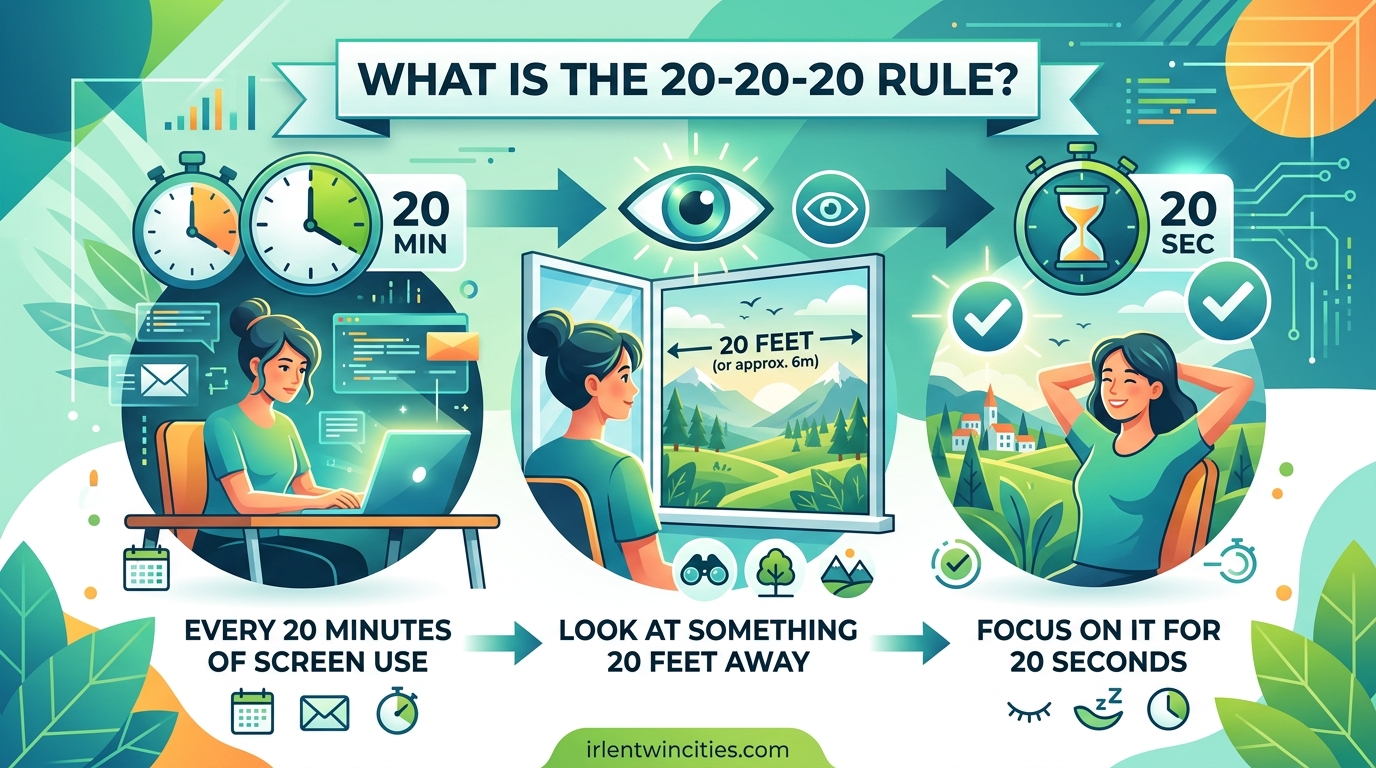
The 20-20-20 rule is a simple eye care technique designed to reduce digital eye strain from prolonged screen use. Every 20 minutes of screen time, you look at something at least 20 feet away for a minimum of 20 seconds. This gives your eyes a chance to reset from the constant near-focus work that defines our modern digital lives.
But does it actually work? The honest answer is that the evidence is mixed, but many eye care professionals still recommend it as a helpful reminder tool. While research shows inconsistent results for measurable physiological changes, countless office workers, gamers, and remote employees report feeling less eye fatigue and fewer headaches when they follow this practice consistently.
Our team has analyzed the latest research on computer vision syndrome and spoken with optometrists about what the 20-20-20 rule can and cannot do for your eye health. In this guide, we will break down the science behind the rule, examine the evidence honestly, and show you exactly how to implement it for maximum benefit.
Table of Contents
What Is the 20-20-20 Rule?
The 20-20-20 rule was first proposed by Dr. Jeffrey Anshel, a California optometrist, in the late 1990s as computer use was becoming ubiquitous in workplaces. The rule states that for every 20 minutes you spend looking at a screen, you should look at something 20 feet away for at least 20 seconds.
Those specific numbers were not chosen through rigorous scientific testing. Instead, they represent practical guidelines that are easy to remember and implement. Twenty minutes represents a reasonable work interval before taking a micro-break. Twenty feet is roughly the distance to the other side of a typical office or room, making it accessible in most environments. Twenty seconds is long enough for your eye muscles to relax but short enough that it does not break your workflow completely.
The rule addresses a fundamental problem of modern life: our eyes were not designed for hours of sustained near-focus work. For most of human history, we looked at things at varying distances throughout the day. Now, many of us stare at screens positioned 20-26 inches from our faces for 8-12 hours daily. This creates what eye care professionals call computer vision syndrome or digital eye strain.
Computer vision syndrome is not a single condition but rather a collection of symptoms that result from prolonged digital device use. The American Optometric Association estimates that 58% of adults experience digital eye strain symptoms, though the actual number may be higher as many people do not recognize mild symptoms or attribute them to other causes.
How Does the 20-20-20 Rule Work?
To understand how the 20-20-20 rule helps, you need to know a bit about how your eyes function during near-focus work. When you look at something close to your face, like a phone or computer screen, a ring of muscle called the ciliary muscle contracts to change the shape of your eye’s lens. This process, called accommodation, allows you to focus clearly on near objects.
When you maintain near focus for extended periods, these ciliary muscles stay contracted. This creates accommodative fatigue, similar to how your legs would feel if you held a squat position for an hour. The 20-20-20 rule forces your eyes to shift to distance vision, which requires those ciliary muscles to relax completely. Looking at something 20 feet away or farther gives your focusing muscles a genuine rest.
The rule also addresses another critical issue: blink rate. Normal human blink rate is about 15-20 times per minute. When we focus on screens, research shows our blink rate drops by 50-66%. We blink only 5-7 times per minute during computer work. This dramatic reduction in blinking prevents the proper distribution of tears across the eye surface, leading to dry eye symptoms and tear film instability.
During those 20-second breaks, you naturally blink more frequently. The act of looking away from your screen removes the visual stimulus that suppresses blinking. Your tear film gets a chance to refresh and stabilize. For people experiencing dry, gritty, or burning eyes after screen sessions, this increased blink rate during breaks can provide real relief.
Additionally, looking at distant objects allows your eyes to align differently. Near work requires converging your eyes inward, which can cause fixation disparity and binocular vision stress over time. Distance viewing lets your eyes return to a parallel resting position, reducing visual discomfort.
Does the 20-20-20 Rule Actually Work? The Evidence
This is the question that brought you here, and we are going to give you an honest answer based on the actual research. The scientific evidence for the 20-20-20 rule is more complicated than most articles suggest. Some studies show benefits, others show minimal effects, and the overall quality of research is limited.
A 2023 systematic review published in the journal Ophthalmic and Physiological Optics examined the evidence behind various interventions for digital eye strain. The researchers found that while taking regular breaks from near work is widely recommended, there is surprisingly little high-quality evidence specifically supporting the 20-20-20 formula over other break schedules. The numbers 20-20-20 originated as practical guidance rather than evidence-based prescription.
However, several individual studies do support components of the rule. A 2020 study in the journal Contact Lens and Anterior Eye measured blink rates and tear film stability in office workers. Participants who took regular 20-second breaks looking at distant objects showed improved tear break-up time and reported less dry eye discomfort compared to those who worked continuously. The improvement was modest but statistically significant.
Research on myopia progression tells a different story. Many people wonder if the 20-20-20 rule can prevent or slow nearsightedness. A 2021 randomized controlled trial following children over two years found that regular breaks from near work did not significantly slow myopia progression when compared to control groups. The protective effect seen in some observational studies may be due to time outdoors (which definitely reduces myopia risk) rather than the break schedule itself.
Workplace intervention studies show more promising results for symptom relief. A 2022 study in Applied Ergonomics followed office workers who implemented the 20-20-20 rule for six weeks. Participants reported 32% reduction in eye strain symptoms and 28% reduction in headache frequency. The researchers noted that compliance was the biggest challenge, but those who consistently followed the rule experienced meaningful subjective improvement.
The honest assessment? The 20-20-20 rule is not a miracle cure backed by overwhelming evidence. However, it is a practical behavioral tool that reminds us to give our eyes periodic rest. The underlying physiology makes sense, many people report subjective benefits, and there is virtually no downside to trying it. Think of it as visual hygiene, similar to brushing your teeth. The specific timing matters less than the habit of regular breaks.
The 20-20-20 Rule and Irlen Syndrome
Here is something you will not find in other articles about the 20-20-20 rule: the connection to Irlen Syndrome and visual stress disorders. At Irlen Twin Cities, we work daily with people whose visual systems process light and contrast differently than typical eyes. For these individuals, the 20-20-20 rule is often necessary but rarely sufficient.
Irlen Syndrome, also known as Meares-Irlen Syndrome or scotopic sensitivity, affects how the brain processes visual information. People with Irlen Syndrome experience visual stress that makes reading and screen work particularly taxing. Symptoms include words that appear to move on the page, headaches, eye strain, and difficulty maintaining concentration during visual tasks.
For someone with Irlen Syndrome, following the 20-20-20 rule provides basic relief but does not address the root cause of their visual discomfort. Their eye strain comes not just from accommodative fatigue and reduced blink rate, but from the brain’s struggle to process the high-contrast, flickering light emitted by digital screens. The 20-20-20 breaks help, but symptoms often persist even with perfect compliance.
If you find that the 20-20-20 rule helps slightly but you still experience significant reading discomfort, light sensitivity, or visual fatigue, consider whether Irlen Syndrome might be contributing. Symptoms often first appear in childhood and may include difficulty with fluorescent lighting, problems tracking text while reading, or eyes that feel tired despite adequate rest. The 20-20-20 rule should be one part of a comprehensive approach that might include colored overlays or lenses specifically prescribed for visual stress.
Symptoms of Digital Eye Strain (Computer Vision Syndrome)
Understanding the symptoms of digital eye strain helps you recognize when the 20-20-20 rule might help. Computer vision syndrome manifests differently in each person, but common symptoms include:
- Dry eyes or watery eyes: Paradoxically, screen time can cause either dryness from reduced blinking or reflex watering as the eyes try to compensate.
- Blurred vision: Temporary blurriness when shifting focus from screen to distance objects is common after prolonged near work.
- Double vision: Difficulty maintaining single vision, especially when tired, can indicate accommodative fatigue.
- Headaches: Forehead and temple headaches often result from eye muscle strain and the slight frowning we do while concentrating on screens.
- Neck and shoulder pain: Poor posture while leaning toward screens creates musculoskeletal symptoms that accompany eye strain.
- Light sensitivity: Increased sensitivity to bright lights or glare after screen sessions.
- Difficulty concentrating: Visual fatigue makes sustained attention harder, leading to decreased productivity.
- Burning or itching eyes: Surface irritation from dry, unstable tear film.
Most of these symptoms are temporary and improve with rest. However, if you experience persistent vision changes, severe headaches, or symptoms that do not resolve after a full night’s sleep, schedule an eye examination. These could indicate underlying conditions that need professional treatment beyond the 20-20-20 rule.
How to Follow the 20-20-20 Rule: Practical Tips
Knowing the rule and following it consistently are different challenges. Here is how to actually implement the 20-20-20 rule in your daily life without it becoming a burden.
Step 1: Set up reminders. The biggest barrier to the 20-20-20 rule is simply forgetting. Your work absorbs your attention, and 20 minutes passes quickly. Use apps like Eye Care 20 20 20 (available for most platforms), set phone timers, or use browser extensions that dim your screen every 20 minutes. Some smartwatches can also be programmed with recurring 20-minute timers.
Step 2: Identify your 20-foot target. Twenty feet is approximately the length of a standard room. Before starting work, identify something at that distance you can look at during breaks. Out a window is ideal because natural light and distant outdoor scenery provide the best visual rest. If you work in a small space, looking across the room at a wall still helps, though outdoor views work better.
Step 3: Actually look at the distant object. This sounds obvious, but many people glance away without really changing their focus. During your 20-second break, consciously notice details of the distant object. If looking outside, identify a tree, building, or cloud and actually observe it. This ensures your ciliary muscles truly relax rather than maintaining near focus on empty space.
Step 4: Blink deliberately. Use the break to blink fully and slowly several times. Complete blinks, where the upper and lower lids meet fully, distribute tears more effectively than the partial blinks we often do during screen work. Some people benefit from practicing “blink exercises” during the 20-second break.
Step 5: Adjust for video calls and meetings. Video calls make the 20-20-20 rule challenging. You cannot look away every 20 minutes while presenting. Try to follow the rule during listening portions. Turn off your camera when possible to take breaks. Schedule back-to-back calls with 5-minute gaps so you can look at distant objects between meetings.
Step 6: Start with reasonable expectations. Do not aim for perfect compliance immediately. Start by following the rule for half your workday. Build the habit gradually. Even partial compliance provides more benefit than abandoning the practice because you cannot do it perfectly.
More Ways to Prevent Digital Eye Strain
The 20-20-20 rule works best as part of a broader visual hygiene approach. Consider these additional strategies to protect your eyes during screen-heavy days.
Optimize your workspace ergonomics. Position your screen 20-26 inches from your eyes with the top of the monitor at or slightly below eye level. This distance reduces accommodative demand and minimizes neck strain. The slight downward gaze position also helps maintain better tear film distribution.
Follow the 20-8-2 rule for overall health. In addition to eye breaks, follow ergonomic guidelines for your body: every 20 minutes, stand for 8 minutes and move for 2 minutes. This addresses the postural problems that often accompany digital eye strain. Combine this with your 20-20-20 eye breaks for efficient multitasking.
Consider artificial tears. Over-the-counter lubricating eye drops can supplement your natural tear film during heavy screen days. Look for preservative-free formulations if you need to use them more than four times daily. Use them before symptoms become severe, as treating dry eyes early prevents a cycle of irritation.
Adjust lighting and screen settings. Match your screen brightness to ambient lighting rather than working in a dark room with a bright screen. Use matte screen protectors to reduce glare. Consider night mode or blue light reduction settings, though evidence for blue light causing eye strain is limited. These settings primarily help with sleep disruption rather than ocular surface issues.
Get regular comprehensive eye exams. Many people work with outdated prescriptions, forcing their eyes to compensate and increasing strain. An annual eye exam ensures your vision correction is current and allows detection of underlying conditions that might be contributing to your symptoms.
Frequently Asked Questions
Is the 20-20-20 rule proven?
The 20-20-20 rule is not proven by large-scale clinical trials, but it is supported by physiological principles and some smaller studies. The specific numbers (20 minutes, 20 feet, 20 seconds) originated as practical guidelines rather than evidence-based prescriptions. However, the underlying concept of taking regular breaks from near work has research support for reducing eye strain symptoms.
Is the 20-20-20 rule good?
Yes, the 20-20-20 rule is generally considered beneficial for most people who experience digital eye strain. While not a miracle cure, it provides regular breaks for your focusing muscles and encourages increased blinking. Many office workers report reduced headaches and eye fatigue when following the rule consistently. There is virtually no downside to trying it.
What happens if you don’t follow the 20-20-20 rule?
Without regular breaks, you may experience increased digital eye strain symptoms including dry eyes, blurred vision, headaches, and difficulty concentrating. Your blink rate drops by 50-66% during screen work, and without breaks to reset, this can cause tear film instability and ocular surface irritation. Over years, excessive near work without breaks may contribute to myopia progression, particularly in children.
How often should you follow the 20-20-20 rule?
You should follow the 20-20-20 rule continuously throughout any extended screen session. The rule suggests taking a 20-second break every 20 minutes of screen use. For an 8-hour workday, this would mean roughly 24 breaks totaling about 8 minutes of rest time. The key is consistency rather than perfect timing.
Can the 20-20-20 rule improve eyesight?
No, the 20-20-20 rule cannot reverse existing vision problems or permanently improve eyesight. It does not reduce myopia, correct astigmatism, or eliminate the need for glasses. The rule helps prevent temporary symptoms of eye strain and may slow myopia progression in children when combined with outdoor time, but it is not a vision improvement program.
Final Thoughts
The 20-20-20 rule represents a simple, free strategy for managing the visual demands of our screen-centered world. Does it work? The evidence suggests it helps many people feel more comfortable during and after computer use, even if the specific formula has not been rigorously validated. The underlying physiology makes sense, and the cost of trying it is essentially zero.
Set realistic expectations. The 20-20-20 rule will not cure myopia, eliminate the need for glasses, or protect you from all eye problems. It is a behavioral tool that reminds us to give our eyes periodic rest. Think of it as one component of visual hygiene, similar to how dental hygiene requires brushing, flossing, and regular checkups.
If you follow the rule consistently for two weeks and notice no improvement in your symptoms, consider consulting an eye care professional. You may have underlying issues like dry eye disease, uncorrected refractive error, or Irlen Syndrome that require specific interventions beyond periodic screen breaks. The 20-20-20 rule is an excellent starting point, but it is not the complete solution for everyone.
Start today. Set a timer for 20 minutes. When it rings, look across the room or out a window for 20 seconds. Notice how your eyes feel. After a week of consistent practice, you might discover that this simple habit becomes one of the easiest health improvements you have ever adopted.