
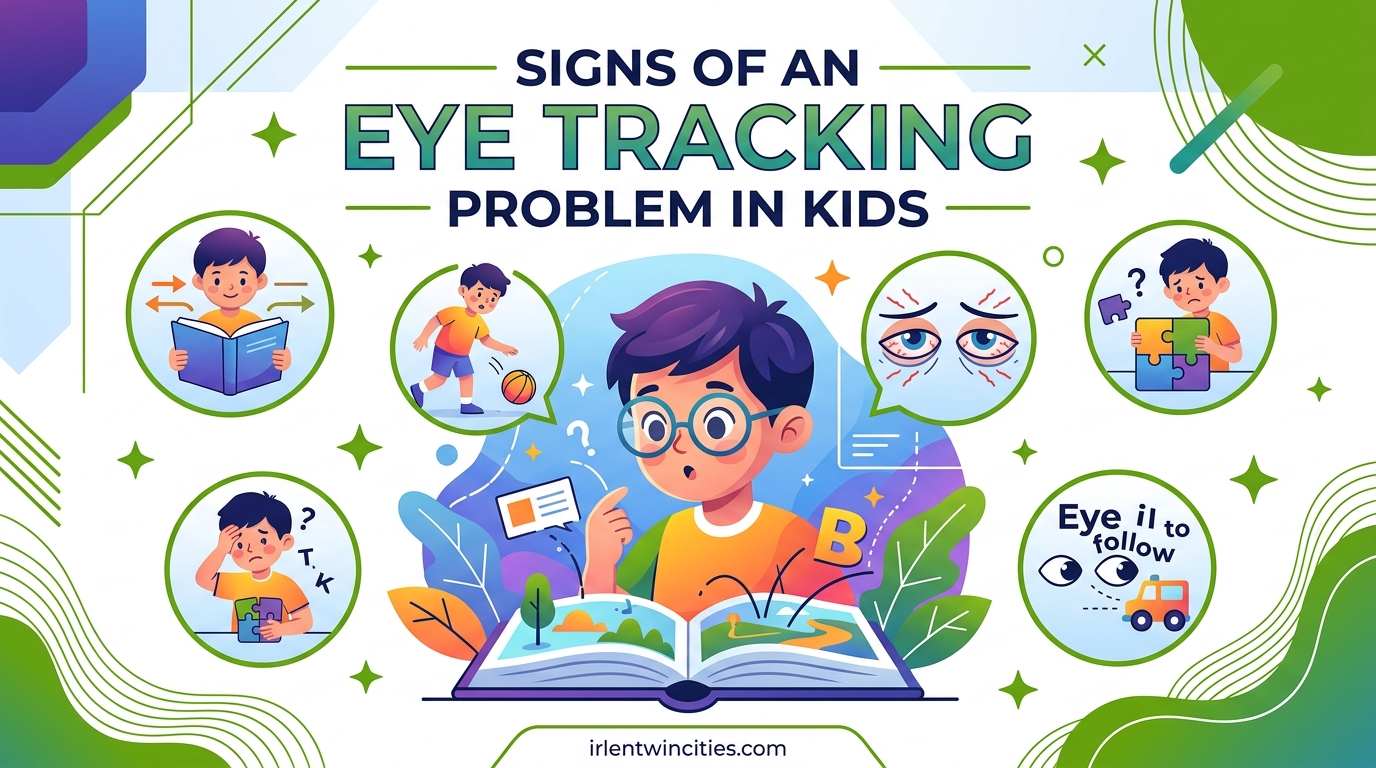
Recognizing the signs of an eye tracking problem in kids can be the key to unlocking your child’s academic potential. Many parents watch their children struggle with reading, lose their place constantly, or avoid homework altogether without realizing the root cause might be vision-related. I have worked with families who spent years thinking their child had a learning disability, only to discover an underlying eye tracking issue that vision therapy could address.
Eye tracking problems affect approximately 25% of children, yet school vision screenings miss these issues entirely. A child can have perfect 20/20 vision and still struggle to move their eyes smoothly across a page. Understanding what to look for empowers you to advocate for your child and seek the right professional help before frustration turns into academic failure.
Table of Contents
What Is Eye Tracking and Why Does It Matter?
Eye tracking refers to your child’s ability to control eye movements precisely when following moving objects or scanning text. This skill involves two distinct types of movements working together: pursuits and saccades. Pursuits are the smooth, continuous movements your eyes make when tracking a moving object like a ball. Saccades are the quick, accurate jumps your eyes make when shifting focus from one point to another, such as moving from word to word while reading.
When these systems function properly, reading feels effortless. Your child’s eyes glide across the page, picking up words in sequence without conscious effort. The visual information flows seamlessly to the brain for processing and comprehension. When tracking is impaired, each word becomes a battle. The eyes may skip lines, jump backward, or struggle to move to the next word, forcing the child to use tremendous mental energy just to see the text correctly.
Poor eye tracking impacts far more than reading ability. Children with tracking difficulties often struggle with sports performance, depth perception, and hand-eye coordination. Copying from the board becomes exhausting as they lose their place repeatedly. Attention span suffers because the visual effort drains mental resources that should go toward understanding content. These challenges frequently lead to misdiagnoses of ADHD or learning disabilities when the real culprit is an undiagnosed vision problem.
Signs of Eye Tracking Problems in Kids
Parents often notice these warning signs gradually, sometimes attributing them to laziness or lack of interest. Here are the specific behaviors that indicate your child may have an eye tracking problem:
1. Frequently loses place when reading. Your child reads the same line twice or skips lines entirely without noticing. They may use a finger to follow text but still struggle to maintain position.
2. Skips words or sentences while reading. Small words like “the,” “and,” or “a” disappear from their reading. This happens because their eyes jump over these words without registering them.
3. Poor reading comprehension despite adequate decoding skills. Your child can sound out words but cannot remember what they just read. The mental effort of tracking consumes cognitive resources needed for understanding.
4. Avoids reading or becomes frustrated during homework. They complain that reading makes them tired, develop headaches, or find excuses to stop after minimal effort.
5. Writes letters, numbers, or words in reverse. Confusing “b” and “d,” “p” and “q,” or writing numbers backward can indicate tracking difficulties affecting visual processing.
6. Reads below grade level despite normal intelligence. Teachers report your child seems bright but cannot demonstrate reading skills matching their capabilities.
7. Tilts head or covers one eye while reading. This compensatory behavior attempts to eliminate double vision or reduce the effort of coordinating both eyes.
8. Complains of headaches, eye strain, or words “moving” on the page. Some children describe text that seems to swim, float, or zoom in and out as their eyes struggle to stabilize the image.
9. Difficulty copying from the board or another paper. They lose their place constantly when shifting gaze between source material and their own paper.
10. Short attention span during visual tasks. Your child concentrates well during hands-on activities but cannot sustain focus for reading or writing assignments.
11. Rubbing eyes frequently or excessive blinking. These physical symptoms indicate eye fatigue from the muscular effort of trying to track properly.
12. Clumsiness or poor sports performance. Difficulty catching balls, judging distances, or coordinating body movements in space can signal tracking deficits.
13. Makes errors when reading aloud that do not match their oral vocabulary. They substitute words, omit endings, or add words that were never on the page.
Age-Specific Warning Signs
Eye tracking problems manifest differently depending on your child’s developmental stage. Knowing age-specific signs helps you identify concerns early and seek appropriate intervention.
Toddlers and Preschoolers (Ages 2-5)
At this stage, tracking problems often appear as developmental delays or atypical behaviors. Watch for difficulty following moving objects with their eyes, such as a toy car rolling across the floor or a balloon floating upward. Your child may seem to lose visual contact with objects that move too quickly or erratically.
Poor hand-eye coordination becomes apparent during stacking toys, puzzles, or ball play. They may struggle to locate objects in a busy visual scene or appear clumsy when reaching for items. Some toddlers with tracking difficulties avoid visually demanding activities like picture books, preferring auditory stories or physical play instead.
Delayed development of pre-reading skills can signal tracking issues. By age four, most children can track a line of print with their finger and recognize simple sight words. If your preschooler cannot follow along when you point to words, or if their eyes seem to dart around rather than focus steadily, consider scheduling a comprehensive eye examination with a developmental optometrist.
School-Age Children (Ages 6-12)
This is when eye tracking problems typically become most apparent because academic demands increase significantly. Reading transitions from learning-to-read to reading-to-learn, and the volume of text multiplies across all subjects.
Children in this age group often develop clever compensation strategies that can mask the underlying problem. They may memorize text rather than truly read it, use context clues to guess at words, or rely heavily on pictures for comprehension. These strategies work in early grades but break down as text complexity increases in third grade and beyond.
Behavioral changes often accompany undiagnosed tracking problems at this age. Homework sessions become battlegrounds filled with tears and frustration. Your child may develop anxiety about school, complain of stomachaches before reading-intensive days, or begin avoiding books altogether. Teachers might report daydreaming, fidgeting, or difficulty staying on task during independent reading time.
Teenagers (Ages 13-18)
By adolescence, many students with untreated tracking problems have developed sophisticated avoidance mechanisms or resigned themselves to academic underperformance. They may gravitate toward audiobooks, video content, or oral presentations while avoiding traditional reading assignments.
Digital device usage complicates tracking issues in teenagers. Extended screen time strains the visual system, exacerbating symptoms like headaches and eye fatigue. Teens often report that text seems to blur or double after prolonged reading, particularly on backlit screens.
Academic consequences become more severe in high school when reading demands intensify across all subjects. Students who previously managed with coping strategies find themselves overwhelmed by textbook reading, standardized tests, and research projects. Some teenagers internalize these struggles as personal failures rather than recognizing them as treatable vision problems.
How Eye Tracking Problems Affect Reading and Learning
The connection between eye tracking and academic performance runs deeper than most parents realize. When a child cannot track efficiently, reading becomes a laborious mechanical process rather than an automatic skill. They expend enormous mental energy just getting their eyes to the right place, leaving little cognitive capacity for comprehension.
Consider what happens during a typical reading session for a child with tracking difficulties. Their eyes might jump from the first word of a sentence to the third, skip the fourth entirely, then backtrack to catch the missed word. This erratic movement disrupts the flow of language, making it impossible to build meaning sentence by sentence. The child reads the words but cannot connect them into coherent thoughts.
Math skills suffer equally from tracking problems. Aligning columns of numbers requires precise vertical eye movements. Copying problems from textbooks demands accurate saccades between the book and worksheet. Word problems become nightmares as children lose their place repeatedly while switching between text and numerical data.
Handwriting and spelling deteriorate because tracking deficits affect visual memory formation. Children cannot mentally picture how words look on the page, making spelling a guessing game. They struggle to proofread their own work because their eyes skip over errors just as they do when reading.
The emotional toll compounds these academic challenges. Children who read poorly develop negative self-concepts as learners. They may act out to avoid reading tasks or withdraw to hide their difficulties. Without proper diagnosis and intervention, these patterns can persist into adulthood, limiting educational and career opportunities.
The Eye Tracking and ADHD Connection
One of the most significant but underrecognized issues in pediatric healthcare is the overlap between ADHD symptoms and eye tracking problems. Research indicates that up to 30% of children diagnosed with dyslexia also have an eye tracking deficit, and the misdiagnosis rates between vision problems and attention disorders are alarmingly high.
The symptoms look remarkably similar on the surface. A child who cannot track properly will fidget, lose focus, avoid sustained attention tasks, and appear disinterested in academic work. They may seem impulsive when they guess at words or skip sections of text. Teachers observe off-task behavior without realizing the child is fighting a physiological battle with their visual system.
Convergence insufficiency represents a specific eye tracking disorder frequently mistaken for ADHD. This condition occurs when the eyes cannot maintain proper alignment at close distances, causing double vision or visual suppression. Children with convergence insufficiency often develop avoidance behaviors around near-work tasks, including reading and writing. Studies have shown that treating convergence insufficiency can reduce ADHD-like symptoms significantly in affected children.
Forum discussions among parents reveal heartbreaking stories of children medicated for ADHD when the real problem was vision-related. One parent shared how their child described words that “zoom in and out” while reading, a classic sign of tracking instability. Another noted how their child became increasingly tired and frustrated as the school day progressed, which aligns perfectly with eye muscle fatigue patterns.
The critical distinction lies in when symptoms appear. Children with pure ADHD typically struggle with attention across all environments and activities. Children with vision-based attention problems show difficulty specifically during visual tasks like reading, writing, or copying from the board while maintaining normal attention during hands-on activities, physical play, or audiobook listening.
School Vision Screening vs. Comprehensive Eye Exam
Many parents assume their child has healthy vision because they passed a school screening. This assumption prevents countless children from receiving necessary treatment. Understanding the difference between these evaluations can save your child years of struggle.
School vision screenings typically test only visual acuity, measuring whether your child can see clearly at a distance of 20 feet. These quick checks use a simple eye chart and may include a basic color vision test. Screenings take approximately 30 seconds per child and identify only the most obvious refractive errors like myopia.
Comprehensive eye examinations performed by developmental optometrists or pediatric ophthalmologists evaluate the entire visual system. These appointments last 45 to 60 minutes and assess eye tracking, focusing ability, eye teaming, and visual processing skills. The examiner observes how your child’s eyes move when following targets, reading text, and shifting focus between distances.
Screenings miss eye tracking problems because they do not test dynamic visual functions. A child can have 20/20 vision and perfect eye health while being unable to track a moving object or read a line of text efficiently. The screening tells you whether your child can see the chart; it reveals nothing about how their eyes perform during academic tasks.
We recommend scheduling a comprehensive eye exam for any child who struggles with reading, shows signs of tracking problems, or has passed a school screening but continues experiencing visual symptoms. Early detection allows for intervention during critical developmental windows when the visual system remains most adaptable.
When to Seek Professional Help
Certain red flags indicate your child needs immediate evaluation by a vision specialist. Do not wait for the next school screening or annual checkup if you observe these warning signs.
Seek professional evaluation promptly if your child complains that words move, float, or appear double on the page. These symptoms suggest serious eye teaming problems that require intervention. Sudden onset of tracking difficulties, particularly after head injury or illness, also warrants immediate assessment.
Schedule an appointment if academic performance declines suddenly or if your child develops school avoidance behaviors. When a previously enthusiastic learner begins resisting reading or homework, vision problems often underlie the change. Persistent headaches during or after reading, especially concentrated around the eyes or forehead, indicate visual strain requiring professional attention.
Look for a developmental optometrist or optometric physician who specializes in pediatric vision care and vision therapy. These professionals receive additional training beyond standard optometry school to diagnose and treat eye tracking problems. They can provide comprehensive evaluations and design vision therapy programs if needed.
Frequently Asked Questions
What causes poor eye tracking in children?
Poor eye tracking results from developmental delays in the neurological connection between the eyes and brain. Some children are born with weaker eye muscle coordination, while others develop tracking problems due to premature birth, developmental disorders, or insufficient visual stimulation during critical early years. The condition is not caused by laziness or lack of intelligence.
What does poor eye tracking look like?
Children with poor eye tracking frequently lose their place when reading, skip words or lines, rub their eyes often, and complain of headaches during visual tasks. They may tilt their head, cover one eye, or use a finger to guide their reading. Some describe words that appear to move, blur, or zoom on the page.
Can eye tracking problems be mistaken for ADHD?
Yes, eye tracking problems are frequently misdiagnosed as ADHD because symptoms overlap significantly. Both conditions cause difficulty sustaining attention, avoiding sustained tasks, fidgeting, and academic underperformance. Children with vision-based attention problems struggle specifically during visual tasks while maintaining normal focus during hands-on activities or audiobooks. A comprehensive eye exam can differentiate between the conditions.
What is the 20-20-20 rule for kids?
The 20-20-20 rule helps prevent eye strain during screen use and reading. Every 20 minutes, your child should look at something 20 feet away for at least 20 seconds. This practice relaxes the focusing muscles and reduces visual fatigue. Encourage regular breaks during homework and limit continuous screen time to protect developing visual systems.
How are eye tracking problems treated?
Vision therapy represents the most effective treatment for eye tracking problems. This specialized program uses exercises and activities to train the eyes and brain to work together more efficiently. Therapy typically occurs weekly over several months, with home exercises to reinforce progress. Some children also benefit from reading lenses or prism glasses that reduce visual stress during treatment.
Conclusion
Recognizing the signs of an eye tracking problem in kids empowers you to advocate effectively for your child’s visual health and academic success. The thirteen warning signs we discussed, from losing place while reading to complaining of moving text, provide clear indicators that warrant professional evaluation. Remember that 20/20 vision does not guarantee proper eye tracking, and school screenings miss these dynamic visual functions entirely.
If you observe multiple signs from this guide in your child’s behavior, schedule a comprehensive eye examination with a developmental optometrist. Early intervention through vision therapy can transform a struggling reader into a confident learner. Do not let an undiagnosed vision problem limit your child’s potential when effective treatment options exist. Trust your parental instincts, take action, and give your child the visual foundation they need to thrive in school and beyond.