
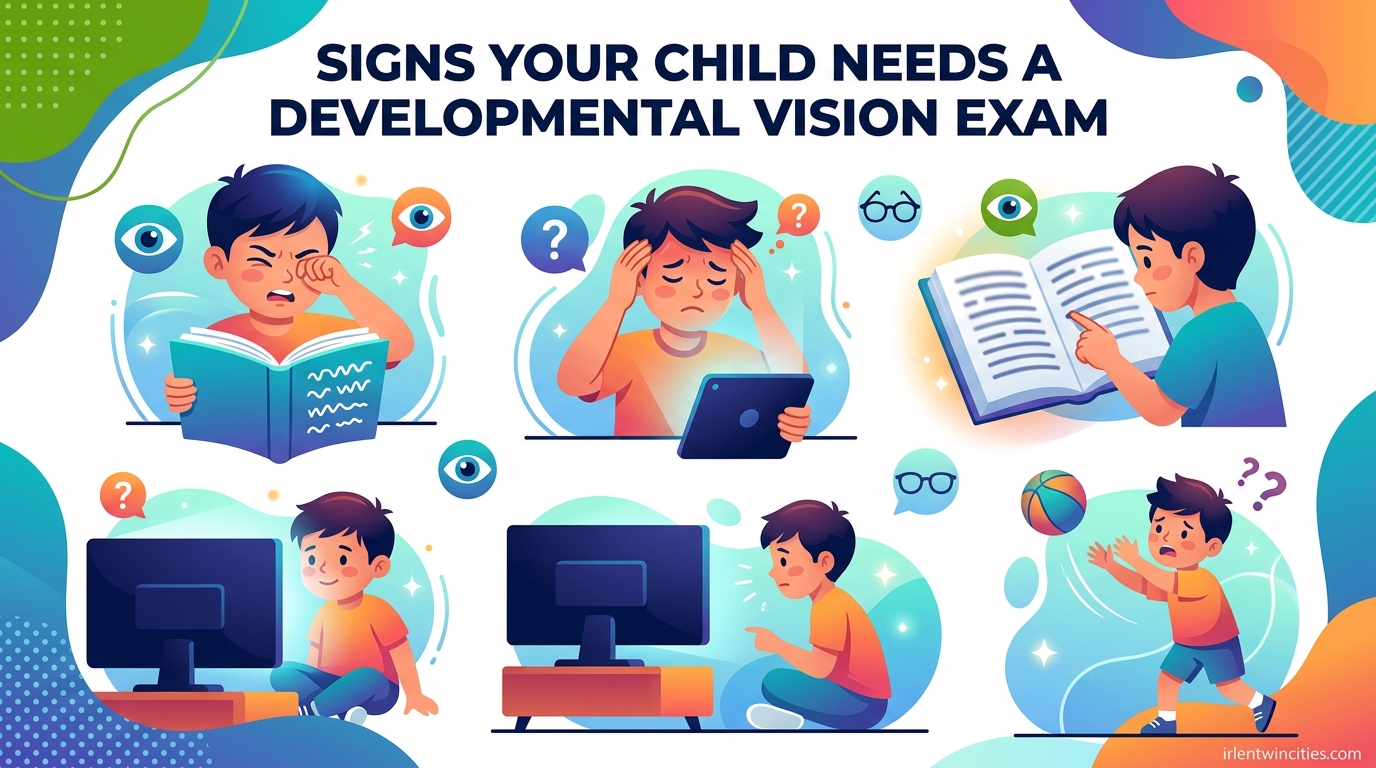
Many parents watch their child struggle with reading, homework, or attention and wonder if something deeper is going on. An estimated 25% of children have an undetected vision problem that affects their ability to learn, and up to 80% of what children learn in school comes through their visual system. Yet standard eye exams often miss the very issues that make school challenging for these kids.
If your child seems bright but struggles academically, a developmental vision exam might reveal what routine screenings cannot. This comprehensive evaluation looks beyond 20/20 vision to examine how well your child’s eyes work together, track text, focus for extended periods, and process visual information.
I have worked with families whose children were labeled as having attention deficits or learning disabilities, only to discover that underlying vision problems were the true culprit. Here are the signs that indicate your child may need a developmental vision exam.
Table of Contents
Behavioral Signs Your Child May Need a Developmental Vision Exam
Children with vision problems often develop compensating behaviors that parents can observe. These behaviors are the body’s way of adapting to visual stress, and they frequently show up during homework, reading, or screen time.
Frequent Eye Rubbing and Squinting
If your child constantly rubs their eyes during or after reading, this could indicate eye strain from focusing difficulties. Squinting often signals that your child is working harder than necessary to see clearly, compensating for blurred vision or poor eye teaming.
Watch for this behavior specifically during close-up tasks. A child with healthy vision should not need to squint at normal reading distances.
Head Tilting or Covering One Eye
Children who frequently tilt their heads or cover one eye while reading may be trying to eliminate double vision. This behavior suggests binocular vision dysfunction, where the eyes do not work together properly as a team.
Your child may not even realize they are doing this. It is worth gently asking why they are covering an eye if you notice the pattern.
Avoiding Visual Activities
When children consistently avoid reading, drawing, or other close work, it may not be laziness. It could be that these activities cause physical discomfort. Children rarely complain about vision problems because they assume everyone sees the same way they do.
One parent on a learning disabilities forum shared that her daughter avoided reading for years, and they later discovered convergence insufficiency was making the words blur and swim on the page.
Learning and Reading Difficulties That Signal Vision Problems
The connection between vision and learning runs deeper than most parents realize. Children need 17 different visual skills to succeed in school, yet standard vision screenings typically check only one: distance visual acuity.
Losing Place While Reading
Does your child use their finger to track words, even in upper elementary grades? Do they lose their place frequently or skip lines without noticing? These are classic signs of tracking problems, where the eyes do not move smoothly across text.
Children with tracking issues often reread the same line or jump ahead, making comprehension nearly impossible. They may read the words correctly but have no idea what the sentence means.
Skipping Words or Lines
Omitting small words like “the,” “and,” or “a” while reading aloud can indicate that the eyes are not working together properly. When eyes jump unevenly, parts of the text get missed entirely.
This symptom frustrates both children and parents. The child knows they are reading poorly, but they cannot explain why it keeps happening.
Poor Reading Comprehension Despite Adequate Decoding
Perhaps your child can sound out words but cannot remember what they read. This disconnect between decoding and comprehension often points to visual processing issues. The brain expends so much energy just managing the visual input that there is little capacity left for understanding.
I have seen children whose reading comprehension improved dramatically after vision therapy addressed underlying eye teaming and tracking problems. The brain was finally free to focus on meaning rather than mechanics.
Difficulty Copying from the Board
Children who struggle to copy notes from a whiteboard may have accommodative dysfunction, meaning their eyes cannot quickly shift focus from near to far. They look up, see blur, look down, try to remember, and miss what the teacher is saying.
Teachers may interpret this as slow processing or inattention, when in fact it is a measurable vision problem.
Attention and Behavioral Signs Often Mistaken for ADHD
One of the most overlooked connections in pediatric health is the overlap between vision problems and attention deficit symptoms. Binocular vision dysfunction (BVD) can produce behaviors that look remarkably like ADHD.
Short Attention Span for Close Work
A child who can play video games for hours but cannot focus on homework for 15 minutes may not have an attention deficit. They may have a vision problem that makes sustained close work physically uncomfortable or cognitively exhausting.
The brain compensates by seeking easier tasks. Video games provide constant visual stimulation and feedback, while reading requires precise eye control that tired or misaligned eyes cannot sustain.
Daydreaming and Restlessness During Visual Tasks
Children whose eyes struggle to team properly may drift off during reading or writing tasks simply because focusing takes too much effort. They fidget, look away, or find excuses to move because their visual system needs a break.
Parents on online forums frequently report that their children were initially evaluated for ADHD, only to discover that vision therapy resolved the behavioral concerns entirely.
Can BVD Be Mistaken for ADHD?
Yes. Research shows that binocular vision dysfunction shares significant symptom overlap with ADHD, including difficulty sustaining attention, avoiding close work, and showing frustration during academic tasks. Some children carry both diagnoses, while others have been misdiagnosed.
A comprehensive developmental vision exam can determine whether vision problems are contributing to or causing attention difficulties. Vision therapy may reduce or eliminate the need for other interventions.
Physical Symptoms and Eye Strain Indicators
Vision problems do not stay invisible forever. Eventually, the physical strain produces symptoms that alert parents something is wrong.
Frequent Headaches, Especially After School
Headaches that consistently appear after school, during homework, or after reading are a red flag. These headaches often result from the constant muscular effort required to maintain focus or eye alignment.
The pattern matters more than the intensity. Even mild headaches that reliably follow visual tasks suggest eye strain.
Complaints of Blurred or Double Vision
If your child reports that words blur, move, or double on the page, take this seriously. Children rarely invent such specific complaints. Double vision especially suggests convergence insufficiency or other binocular vision problems.
Some children describe words as “swimming,” “floating,” or “pulling apart.” These are direct reports of visual stress that a developmental optometrist can measure and treat.
Excessive Blinking and Light Sensitivity
Rapid or excessive blinking can indicate dry eye from reduced blinking during intense concentration, or it can signal neurological responses to visual stress. Light sensitivity, especially fluorescent light sensitivity, may connect to visual processing disorders including Irlen Syndrome.
If your child prefers dim lighting, complains about bright classrooms, or gets headaches under fluorescent lights, this warrants investigation.
Hand-Eye Coordination and Sports Performance Issues
Vision problems extend beyond academics into physical activities. The same visual skills required for reading also support coordination, depth perception, and spatial awareness.
Clumsiness and Poor Spatial Judgment
Children who bump into doorframes, trip over nothing, or misjudge distances may have depth perception issues. Poor eye teaming affects stereoscopic vision, making it difficult to judge where objects are in three-dimensional space.
Sports Performance Below Expectation
If your child struggles to catch balls, judge distances for hitting, or track moving objects visually, underlying vision problems may be the cause. Eye tracking skills developed through reading also support athletic performance.
Vision therapy often improves both academic and athletic outcomes because the same foundational skills support both activities.
When Vision Issues May Point to Irlen Syndrome
Some children experience visual stress that standard vision exams do not detect. These symptoms may indicate Irlen Syndrome, a visual processing disorder affecting light sensitivity and visual contrast.
Light Sensitivity and Reading Stress
Children with Irlen Syndrome often experience discomfort under fluorescent lighting, bright sunlight, or high-contrast environments. They may report that the page “glows,” words “shimmer,” or white paper feels “too bright.”
Unlike developmental vision problems that affect eye movement and teaming, Irlen Syndrome relates to how the brain processes visual information. Both can coexist, and both affect learning.
Differentiating Irlen Syndrome from Developmental Vision Issues
Developmental vision exams assess eye mechanics: how eyes move, focus, and work together. Irlen screening evaluates visual processing: how light and patterns affect the brain. If your child has persistent reading difficulties despite normal eye exams, Irlen Syndrome may be worth investigating.
Many families find that addressing both types of visual challenges produces the best outcomes for struggling learners.
School Vision Screening vs Developmental Vision Exam vs Regular Eye Exam
Parents often assume that passing a school vision screening means their child’s vision is fine. This misconception delays diagnosis and support for countless children. Understanding the differences between these three evaluations helps you advocate effectively for your child.
What School Vision Screenings Actually Check
School screenings typically measure distance visual acuity only, usually at 20 feet. A child reads letters from a chart, and if they reach 20/40 or better, they pass. These screenings miss eye teaming, tracking, focusing, and visual processing issues that directly affect learning.
Research from the College of Optometrists in Vision Development shows that school screenings miss approximately 75% of vision problems that affect learning.
What Standard Eye Exams Cover
Comprehensive eye exams by general optometrists check eye health, refractive errors (nearsightedness, farsightedness, astigmatism), and basic eye alignment. They ensure eyes are healthy and glasses prescriptions are accurate.
However, standard eye exams do not typically evaluate how well eyes track across a page, how quickly they shift focus from board to desk, or how effectively they work together during sustained close work.
What Developmental Vision Exams Evaluate
Developmental vision exams, conducted by specialized optometrists, assess the 17 visual skills required for learning. These include:
- Eye teaming (binocular vision)
- Tracking (smooth pursuit and saccades)
- Accommodation (focusing flexibility)
- Convergence (eyes turning inward for near work)
- Visual processing speed
- Visual memory and form perception
These exams typically take 45-90 minutes and may include specialized equipment to measure eye movements, focusing ability, and depth perception under various conditions.
When to Seek a Developmental Vision Evaluation
Trust your parental instincts. If you observe multiple signs from the categories above, schedule an evaluation regardless of what school screenings have indicated.
Red Flags Requiring Immediate Evaluation
Seek a developmental vision exam promptly if your child experiences double vision, reports words moving on the page, has severe headaches with reading, or shows sudden vision changes. These symptoms suggest specific, treatable conditions that respond well to intervention.
Age Guidelines for Evaluation
The American Optometric Association recommends comprehensive eye exams at 6 months, 3 years, before first grade, and annually thereafter. However, any time you notice learning struggles or the signs described above, an evaluation is appropriate regardless of when the last exam occurred.
Vision development continues through approximately age 8-9, but vision therapy can help at any age.
Finding a Qualified Developmental Optometrist
Look for optometrists certified by the College of Optometrists in Vision Development (COVD) or fellows of the Neuro-Optometric Rehabilitation Association. These specialists have additional training in developmental and functional vision care beyond standard optometry education.
Ask potential providers whether they conduct comprehensive binocular vision evaluations and whether vision therapy is available in their practice.
Frequently Asked Questions
Can BVD be mistaken for ADHD?
Yes, binocular vision dysfunction (BVD) can produce symptoms that closely mimic ADHD, including difficulty sustaining attention, avoiding close work, restlessness during reading, and frustration with homework. Some children have both conditions, while others have been misdiagnosed. A developmental vision exam can determine if vision problems are contributing to attention difficulties.
What is the 20 20 20 rule for kids?
The 20-20-20 rule recommends that children take a 20-second break every 20 minutes to look at something 20 feet away. This practice reduces eye strain from screens and close work by allowing the focusing muscles to relax. Encourage children to set timers during homework and computer use to build this healthy habit.
How to tell if a child has vision issues?
Watch for behavioral signs like eye rubbing, squinting, head tilting, and covering one eye. Learning signs include losing place while reading, skipping words, poor reading comprehension, and difficulty copying from the board. Physical symptoms include headaches after school, complaints of blurred or double vision, and avoiding reading or close work activities.
At what age is a child’s vision fully developed?
A child’s distance vision typically reaches adult levels by age 6-7, but visual skills continue developing through approximately age 8-9. Eye teaming, tracking, and focusing skills develop progressively throughout early childhood. Vision therapy can improve these skills at any age, though earlier intervention often produces faster results.
Do eye tests detect dyslexia?
Standard eye exams do not diagnose dyslexia, which is a language-based learning difference. However, eye exams can detect vision problems that may coexist with or mimic dyslexia symptoms. Some children diagnosed with dyslexia actually have undiagnosed vision problems that contribute to reading difficulties. A comprehensive evaluation should address both visual and educational factors.
What’s the difference between school vision screening and developmental vision exam?
School vision screenings typically check only distance visual acuity using a wall chart, missing approximately 75% of vision problems that affect learning. Developmental vision exams evaluate 17 visual skills including eye teaming, tracking, focusing, and visual processing. These comprehensive exams take 45-90 minutes and assess how the visual system performs during actual learning activities.
Trust Your Instincts and Take Action
If you recognize multiple signs your child needs a developmental vision exam, trust what you are seeing. Parents often detect problems before teachers or doctors do because you observe your child during homework, reading, and daily activities.
The good news is that most developmental vision problems respond well to treatment. Vision therapy, specialized glasses, or simple environmental modifications can transform a struggling learner into a confident student. A comprehensive evaluation with a developmental optometrist provides the clarity you need to support your child effectively.
Do not wait for vision problems to resolve on their own. Early intervention prevents the academic gaps, frustration, and self-esteem damage that often accompany undiagnosed vision issues. Schedule a developmental vision exam and give your child the visual foundation they need to succeed in school and beyond.