
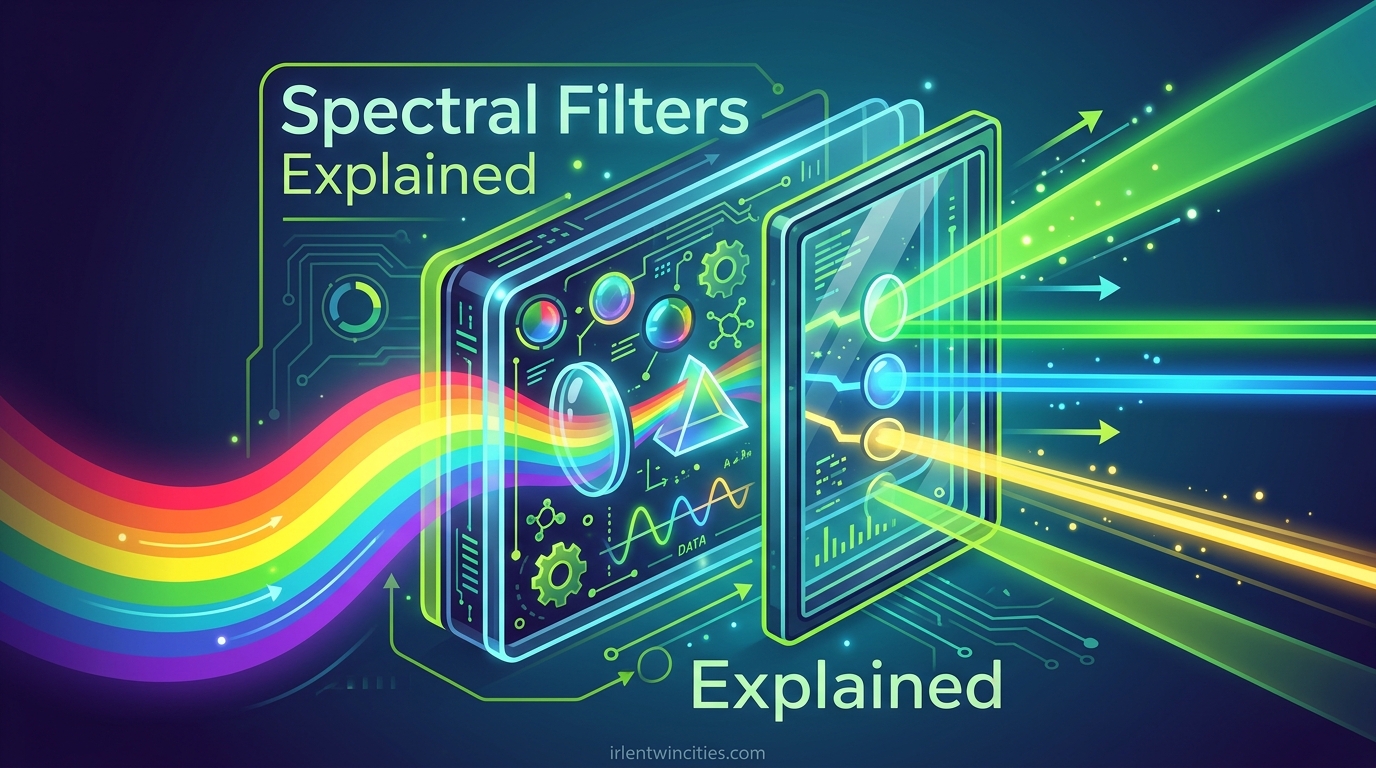
Spectral filters are optical devices that selectively transmit, absorb, or reflect specific wavelengths of light while blocking others. They work by targeting particular wavelengths through two primary mechanisms: absorptive materials that block unwanted wavelengths, and interference coatings that reflect certain wavelengths while allowing target wavelengths to pass through. This precise wavelength targeting makes spectral filters essential tools across scientific imaging, photography, industrial applications, and visual processing interventions like those used for Irlen Syndrome.
In this guide, I will explain exactly how spectral filters target wavelengths and why this matters for both technical applications and everyday visual comfort. You will learn the different types of filters, their key specifications, and how wavelength selection can significantly impact reading and visual processing for individuals with light sensitivity. By the end, you will understand not just the mechanics of spectral filtering, but also its practical implications for human vision and comfort.
Table of Contents
How Do Spectral Filters Work?
Spectral filters operate on the fundamental principle of selective transmission. They allow specific wavelengths of light to pass through while blocking or redirecting others based on their design and materials.
The two main approaches to wavelength targeting are absorptive filtering and interference filtering. Each method achieves the same goal—precise wavelength control—through different physical mechanisms. Understanding both helps explain why certain filters work better for specific applications, including visual processing support.
Absorptive Filters: Blocking Through Absorption
Absorptive filters work by containing materials that absorb specific wavelengths of light while transmitting others. These filters typically use colored glass, dyed polymers, or specially formulated substrates that capture unwanted wavelengths and convert that energy into heat.
The transmission characteristics of absorptive filters depend entirely on the material composition. A blue absorptive filter, for example, contains materials that absorb red and green wavelengths while transmitting blue light. This is the same principle behind the colored overlays used for Irlen Syndrome, which function as passive absorptive filters that reduce specific wavelengths causing visual stress.
Absorptive filters offer excellent stability and consistent performance across different angles of light incidence. They do not suffer from the angle-dependent performance issues that can affect interference filters. However, they typically cannot achieve the extremely narrow wavelength precision that interference filters can provide.
Interference Filters: Reflection-Based Selection
Interference filters use thin-film coating technology to achieve precise wavelength targeting. These filters consist of multiple layers of dielectric materials deposited on a substrate, with each layer having a specific refractive index and thickness.
When light hits an interference filter, some wavelengths undergo constructive interference and pass through, while others experience destructive interference and are reflected away. The coating layers are precisely calculated to target specific wavelengths based on the principles of wave optics. This allows interference filters to achieve extremely narrow bandwidths and sharp transitions between transmitted and blocked wavelengths.
Dichroic filters are a common type of interference filter that reflect unwanted wavelengths rather than absorbing them. This makes them more efficient for high-power applications since reflected light does not heat up the filter. The precision of interference filters makes them ideal for applications like fluorescence microscopy and laser systems where exact wavelength control is critical.
Transmission Curves: Visualizing Wavelength Targeting
Every spectral filter has a characteristic transmission curve that shows which wavelengths it transmits and which it blocks. This graph plots transmission percentage (0-100%) against wavelength (typically measured in nanometers).
A typical transmission curve for a bandpass filter shows low transmission on both ends of the spectrum, rising sharply to high transmission in the middle range, then falling again. The shape of this curve reveals critical information about the filter’s performance, including its center wavelength, bandwidth, and edge steepness. Understanding these curves helps in selecting the right filter for any application, whether scientific research or visual comfort support.
Types of Spectral Filters and Their Wavelength Targeting
Different applications require different approaches to wavelength targeting. Spectral filters come in several fundamental types, each designed to handle wavelength selection in a specific way.
Understanding these filter types helps in choosing the right approach for your specific needs, whether you are working with imaging systems, laser applications, or addressing visual processing concerns.
Bandpass Filters: Selective Wavelength Windows
Bandpass filters transmit a specific range, or “band,” of wavelengths while blocking wavelengths both shorter and longer than this range. They act like a window that only lets through light within a particular spectral region.
The key specifications for bandpass filters include the center wavelength (CWL)—the middle point of the transmitted band—and the full-width at half-maximum (FWHM), which indicates how wide the transmission window is. A narrow bandpass filter might have an FWHM of just 10 nanometers, while a wide bandpass filter could transmit across 100 nanometers or more.
Bandpass filters are essential in fluorescence microscopy, where they isolate specific emission wavelengths from fluorescent dyes. They also play a role in color imaging systems and can be relevant for visual applications where specific wavelength ranges need to be emphasized or de-emphasized for comfort.
Longpass and Shortpass Filters: Edge Filtering
Longpass filters transmit wavelengths longer than a specific cut-on wavelength while blocking shorter wavelengths. Conversely, shortpass filters transmit wavelengths shorter than a cut-off wavelength while blocking longer wavelengths. These filters are sometimes called “edge filters” because they create a sharp transition, or edge, between transmitted and blocked regions.
The cut-on and cut-off wavelengths define where this transition occurs. High-quality edge filters have very steep slopes, meaning the transition from blocking to transmission happens over an extremely narrow wavelength range. This steepness is critical for applications requiring precise separation between adjacent wavelengths.
In photography, longpass filters are commonly used as infrared filters, blocking visible light while transmitting infrared wavelengths. Shortpass filters serve as ultraviolet filters, protecting sensors and eyes from UV radiation while allowing visible light to pass. Both types have applications in machine vision systems and scientific instruments.
Dichroic Filters: Reflection-Based Targeting
Dichroic filters represent a specialized class of interference filters that separate light by reflecting unwanted wavelengths while transmitting the desired wavelengths. Unlike absorptive filters that convert blocked light into heat, dichroic filters redirect that light elsewhere.
These filters consist of multiple thin layers of dielectric materials with different refractive indices. The layer thicknesses are precisely controlled—often to within a few nanometers—to create constructive and destructive interference at specific wavelengths. This design allows dichroic filters to achieve extremely sharp transitions between transmitted and reflected wavelengths.
Dichroic filters are widely used in fluorescence microscopy to separate excitation light from emission light, in projectors to combine or separate color channels, and in architectural lighting to create color effects. Their ability to handle high light intensities without heating makes them valuable for laser applications as well.
Absorptive Filters: Glass and Dye-Based Absorption
Traditional absorptive filters use colored glass or dyed gelatin to achieve wavelength selection. These materials contain compounds that absorb specific wavelengths through electronic transitions within the dye molecules or glass composition.
Colored glass filters offer excellent durability and stability over time. They are relatively inexpensive and perform consistently across a wide temperature range. However, they cannot achieve the narrow bandwidths or sharp cutoffs possible with interference filters. Their transmission characteristics are determined by the bulk material properties rather than surface coatings.
Gelatin and plastic filter materials provide flexibility and lower cost for applications where extreme precision is not required. These are similar in concept to the colored overlays used for Irlen Syndrome, which use dyed plastic materials to selectively absorb wavelengths that cause visual stress for sensitive individuals.
Notch and Multi-Band Filters: Specialized Applications
Notch filters represent a specialized category that blocks a narrow band of wavelengths while transmitting wavelengths both shorter and longer than the blocked region. They are essentially the inverse of bandpass filters.
These filters are particularly useful for blocking specific laser lines or eliminating narrow emission features while preserving the rest of the spectrum. Raman spectroscopy frequently uses notch filters to block the excitation laser wavelength while transmitting the nearby Raman scattering signals.
Multi-band filters can transmit multiple discrete wavelength bands while blocking regions in between. These complex filters enable sophisticated imaging applications where multiple fluorescent signals need to be detected simultaneously. The design of multi-band filters requires advanced coating technologies to achieve precise control over multiple wavelength regions.
Understanding Spectral Filter Specifications
Selecting the right spectral filter requires understanding key technical specifications. These parameters define exactly how a filter will perform and whether it meets the requirements of your specific application.
Whether you are a researcher selecting filters for an instrument or someone exploring visual processing interventions, these specifications determine the effectiveness of wavelength targeting.
Center Wavelength (CWL): The Target Point
The center wavelength represents the midpoint of the spectral band transmitted by a filter. For a bandpass filter, this is the wavelength at the peak of the transmission curve. Manufacturers specify CWL with high precision, often to within a few nanometers.
When selecting a filter, the CWL should align with your target wavelength. For example, if you need to isolate the 520 nm emission from a green fluorescent protein, you would choose a filter with a CWL near 520 nm. The precision of modern coating technologies allows CWL specifications accurate to within 1-2 nanometers for high-end filters.
It is worth noting that CWL can shift slightly with the angle of incidence. As light hits the filter at steeper angles, the effective CWL typically moves toward shorter wavelengths. This effect is more pronounced in interference filters than in absorptive filters.
Full-Width at Half-Maximum (FWHM): Precision Measurement
FWHM describes the width of the transmitted wavelength band. Specifically, it measures the width of the transmission peak at the point where transmission has dropped to half of its maximum value.
A smaller FWHM indicates a narrower, more selective filter. Narrow bandpass filters might have FWHM values of 1-10 nanometers, while wide bandpass filters could range from 50-100 nanometers or more. The choice depends entirely on the application—fluorescence imaging typically needs narrow FWHM to separate closely spaced emission peaks, while general photography might use wider filters.
FWHM is sometimes called “spectral bandwidth” in technical literature. Understanding this specification helps in predicting how much of the spectrum will pass through the filter and whether adjacent wavelengths will be adequately separated.
Optical Density (OD): Blocking Strength
Optical density quantifies how effectively a filter blocks unwanted wavelengths. It is a logarithmic scale where higher OD values indicate stronger blocking. An OD of 1 means 90% blocking (10% transmission), OD 2 means 99% blocking (1% transmission), OD 3 means 99.9% blocking, and so on.
High-quality filters for scientific applications often specify OD 6 or higher in their blocking regions, meaning less than 0.0001% of blocked light gets through. This extreme blocking is essential for detecting weak fluorescence signals against bright backgrounds or for laser safety applications.
The relationship between OD and blocking is logarithmic, so small increases in OD represent dramatic improvements in blocking. Moving from OD 3 to OD 4 improves blocking by a factor of 10, not by 33% as a linear scale might suggest.
Transmission and Blocking Ranges
The transmission range specifies the wavelengths where the filter allows light to pass, while the blocking range indicates wavelengths that are rejected. These ranges are defined by specific transmission percentages—for example, a transmission range might be defined as wavelengths where transmission exceeds 90%.
The transition between transmission and blocking regions is characterized by edge steepness. High-performance filters have very steep edges, transitioning from high transmission to deep blocking over just a few nanometers. This sharp cutoff is crucial for applications requiring clean separation between adjacent spectral features.
For multi-band or notch filters, there may be multiple transmission and blocking ranges. Understanding these ranges helps in predicting filter performance across the full spectrum and in identifying potential issues with out-of-band transmission or incomplete blocking.
Applications of Wavelength-Targeted Filtering
Spectral filters serve critical functions across numerous fields. The ability to precisely target wavelengths enables technologies ranging from medical diagnostics to astronomical observation.
The connection between wavelength filtering and human visual processing represents one of the most personally relevant applications for many readers, particularly those exploring Irlen Syndrome interventions.
Irlen Syndrome and Visual Processing: The Wavelength Connection
Irlen Syndrome, also known as scotopic sensitivity syndrome, is a visual processing disorder where specific wavelengths of light cause visual stress, discomfort, and perceptual distortions. Individuals with this condition often experience symptoms including words that appear to move on the page, glare sensitivity, headaches during reading, and difficulty with sustained visual attention.
The connection to spectral filtering is direct and powerful. Colored overlays and lenses used for Irlen Syndrome function as passive absorptive spectral filters. By selectively blocking the specific wavelengths that trigger visual stress for each individual, these filters can dramatically improve reading comfort, comprehension, and endurance.
Every person with Irlen Syndrome has a unique wavelength sensitivity profile. Through specialized assessment, practitioners determine which specific color (and therefore which specific wavelengths) provide optimal filtering for each individual. Some people benefit from blue or aqua filters that reduce longer wavelengths, while others need yellow or rose tints that filter different portions of the spectrum.
The mechanism involves how filtered light reaches the visual cortex. When problematic wavelengths are removed before they enter the eye, the brain receives visual information without the disruptive signals that cause perceptual distortions. This explains why the right spectral filter can make text immediately more stable, clear, and comfortable to read.
Research has shown that appropriate spectral filtering can improve reading speed, accuracy, and comprehension for individuals with Irlen Syndrome. The filtering does not correct underlying visual acuity issues but instead addresses the neurological processing of visual information, allowing the brain to interpret visual signals more efficiently.
For those experiencing unexplained reading difficulties, visual stress, or discomfort with fluorescent lighting, understanding spectral filtering opens the door to potential interventions. The science of wavelength targeting, applied to human vision, can transform daily activities from a struggle into a comfortable experience.
Scientific and Medical Imaging
Fluorescence microscopy relies heavily on spectral filters to separate excitation light from the much weaker emission signals. Excitation filters target the specific wavelengths needed to stimulate fluorescent dyes, while emission filters isolate the resulting fluorescence. Dichroic mirrors direct the excitation light toward the sample and then separate the emission light for detection.
Flow cytometry uses spectral filters to analyze cells labeled with multiple fluorescent markers. Each marker emits at a different wavelength, and precise filtering allows simultaneous detection of multiple parameters from thousands of cells per second. This technology is fundamental to modern immunology and cancer research.
In medical imaging, spectral filtering enables techniques like optical coherence tomography and certain forms of endoscopy. The ability to target specific wavelengths helps in visualizing different tissue types and detecting abnormalities based on their spectral signatures.
Photography and Astronomy
Photographers use spectral filters creatively and technically. Infrared filters block visible light to create surreal images using only the near-infrared spectrum. Neutral density filters, which uniformly reduce transmission across all wavelengths, allow longer exposures for motion effects. Polarizing filters, though not strictly spectral, work alongside wavelength-selective filters in advanced photography.
Astronomers depend on narrowband filters to observe specific emission lines from distant objects. Hydrogen-alpha filters at 656 nm reveal structures in nebulae that are invisible in broadband light. Oxygen-III and sulfur-II filters target other specific wavelengths, allowing astronomers to create detailed color images of celestial objects and to observe through light pollution.
Solar observation requires extreme spectral filtering, particularly at the hydrogen-alpha wavelength, to safely view the sun’s chromosphere. These filters must achieve both precise wavelength targeting and extremely high optical density to protect observers from dangerous solar radiation.
Industrial and Commercial Uses
Machine vision systems use spectral filters to enhance contrast and eliminate unwanted light. In quality control applications, specific wavelengths can highlight defects or features invisible under white light. For example, infrared filters can reveal subsurface features in semiconductor wafers.
Laser systems require precise filtering for both safety and performance. Safety filters protect operators from laser wavelengths while allowing visible alignment beams to pass. In laser-based measurement systems, filters isolate the measurement signal from ambient light and other interference.
Remote sensing applications, including LIDAR and multispectral imaging, rely on carefully selected spectral filters. These systems often use multiple filters simultaneously to build up spectral signatures of terrain, vegetation, or atmospheric conditions.
Choosing Spectral Filters for Your Needs
Selecting the right spectral filter involves balancing multiple factors. The best choice depends on your specific application, performance requirements, and budget constraints.
Here are practical considerations to guide your selection process, whether you are choosing filters for scientific equipment or exploring options for visual comfort.
First, define your wavelength requirements precisely. Determine the center wavelength you need to target, the acceptable bandwidth, and the wavelengths that must be blocked. For visual processing applications, this often involves working with specialists who can identify your specific wavelength sensitivities.
Consider the trade-off between performance and cost. Premium interference filters with extremely narrow bandwidths and steep edges cost significantly more than basic absorptive filters. For many applications, mid-range options provide adequate performance at reasonable cost.
Account for angle of incidence in your design. If light will hit the filter at angles other than perpendicular, interference filters may show wavelength shifts. Absorptive filters generally maintain consistent performance across angles, making them preferable for some applications.
Evaluate environmental factors including temperature range, humidity exposure, and physical durability. Some high-performance coatings are sensitive to moisture or extreme temperatures. For wearable visual applications, durability and comfort become important considerations alongside optical performance.
Finally, consider consulting with optical specialists or Irlen Syndrome practitioners for personalized guidance. The science of spectral filtering is complex, and expert advice can save time and resources while ensuring optimal results for your specific situation.
Frequently Asked Questions About Spectral Filters
How do spectral filters work?
Spectral filters work by selectively transmitting, absorbing, or reflecting specific wavelengths of light. Absorptive filters contain materials that capture unwanted wavelengths and convert them to heat, while interference filters use thin-film coatings that reflect certain wavelengths through constructive and destructive interference. Both methods allow precise targeting of specific wavelengths for applications ranging from scientific imaging to visual processing support.
How does a wavelength filter work?
A wavelength filter works by allowing specific wavelengths of light to pass through while blocking others. The mechanism depends on the filter type—absorptive filters use materials that physically absorb certain wavelengths, while interference filters use coated layers that reflect unwanted wavelengths based on optical interference principles. The filter’s transmission curve shows exactly which wavelengths pass through and which are blocked.
What are the 4 main types of spectral filters?
The four main types of spectral filters are:
- Bandpass filters — transmit a specific wavelength range while blocking shorter and longer wavelengths
- Longpass filters — transmit wavelengths longer than a cut-on point
- Shortpass filters — transmit wavelengths shorter than a cut-off point
- Dichroic filters — use interference coatings to reflect unwanted wavelengths while transmitting target wavelengths
Additional types include notch filters and absorptive filters for specialized applications.
What is 1310 nm wavelength?
The 1310 nm wavelength is primarily used in fiber optic telecommunications. This near-infrared wavelength falls within a low-loss transmission window of standard silica optical fiber, making it ideal for long-distance communication. It is also used in certain medical and industrial applications, including some laser systems and sensing equipment, though fiber optics represents its most common commercial use.
What is center wavelength in optical filters?
Center wavelength (CWL) is the midpoint of the spectral band transmitted by a filter, representing the peak of the transmission curve. For example, a bandpass filter with 550 nm CWL transmits most strongly at 550 nanometers. Manufacturers specify CWL with high precision, and it serves as the primary reference point for selecting filters to match specific target wavelengths in applications from microscopy to visual processing support.
What does FWHM mean in spectral filters?
FWHM stands for Full-Width at Half-Maximum and measures the width of a filter’s transmitted wavelength band. Specifically, it indicates the wavelength range where transmission remains above half of the peak value. A smaller FWHM means a narrower, more selective filter. For example, a filter with 10 nm FWHM is much more selective than one with 100 nm FWHM, making it suitable for applications requiring precise wavelength isolation.
How do spectral filters help with Irlen Syndrome?
Spectral filters help Irlen Syndrome by selectively blocking the specific wavelengths of light that trigger visual stress and perceptual distortions. Colored overlays and lenses function as absorptive spectral filters tailored to each individual’s unique sensitivity profile. By removing problematic wavelengths before they reach the visual cortex, these filters can stabilize text, reduce glare, eliminate headaches, and significantly improve reading comfort and comprehension for affected individuals.
Can spectral filters improve reading comfort?
Yes, spectral filters can significantly improve reading comfort for individuals with light sensitivity or visual processing disorders like Irlen Syndrome. By filtering specific wavelengths that cause visual stress, these filters can reduce symptoms including moving text, glare sensitivity, and reading-induced headaches. Even individuals without diagnosed conditions sometimes find that certain color tints reduce eye strain during extended reading, particularly under artificial lighting or when working with digital screens.
Conclusion
Spectral filters represent a fascinating intersection of physics and practical application. By understanding how these devices target specific wavelengths through absorption and interference, we gain insight into technologies that shape modern science, photography, medicine, and visual processing support.
The connection between wavelength targeting and human visual comfort deserves particular attention. For individuals with Irlen Syndrome and related visual processing challenges, spectral filtering—delivered through precisely selected colored overlays or lenses—can transform the reading experience from stressful to comfortable. The same principles that enable astronomers to observe distant galaxies and researchers to visualize cellular structures also help people read with greater ease and comprehension.
If you are experiencing unexplained reading difficulties, visual stress, or discomfort with certain lighting conditions, understanding spectral filters may be your first step toward finding relief. Consider exploring Irlen Syndrome assessment options to discover whether wavelength-targeted interventions could improve your daily visual experience. The science is clear, the applications are proven, and the potential benefits are substantial.