
You sit down at your desk with every intention of starting that report. You know exactly what needs to be done. You’ve thought through the steps a dozen times. But your hands don’t move. Your brain feels stuck, like gears that won’t engage. Hours pass, and the shame builds.
If this scenario feels painfully familiar, you are not alone. Task initiation is one of the most misunderstood and frustrating challenges for adults with ADHD. It is not procrastination. It is not laziness. It is a genuine neurological difficulty that affects millions.
This guide will show you proven task initiation strategies for ADHD adults that actually work in real life. These techniques come from both clinical research and the lived experiences of ADHDers who have figured out how to work with their brains instead of against them.
Table of Contents
What Is Task Initiation and Why Does It Feel Impossible with ADHD?
Task initiation is the executive function skill that allows you to start an activity without excessive delay, hesitation, or overthinking. It is the bridge between intention and action. For neurotypical brains, this bridge is short and sturdy. For ADHD brains, it can feel like a mile-wide chasm.
Dr. Russell Barkley, a leading ADHD researcher, identifies task initiation as one of the core executive functions impaired in ADHD. It is not about motivation or willpower. Your brain literally requires more activation energy to get started than a neurotypical brain does.
Think of it like Newton’s first law of motion. An object at rest stays at rest unless acted upon by an external force. For ADHD brains, that external force needs to be much stronger. The internal push that gets others moving simply is not enough for us.
Why ADHD Makes Task Initiation So Difficult
Understanding why starting is hard changes everything. When you know the neurological reasons, you can stop blaming yourself and start using strategies that actually address the root causes.
The Dopamine Deficit
ADHD brains have lower baseline dopamine levels and less efficient dopamine regulation. Dopamine is not just about pleasure. It is the neurotransmitter that drives motivation, reward anticipation, and the ability to initiate action.
Your brain is essentially running a rewards deficit. Boring tasks offer no dopamine hit, so your brain sees no reason to engage. This is why the interest-based nervous system concept matters so much. ADHD brains are motivated by interest, urgency, novelty, and challenge. Not by importance or should.
One Reddit user described it perfectly: “I can hyperfocus for hours on something fascinating, but I cannot start a two-minute email to save my life. The difference is purely dopamine.”
The Wall of Awful
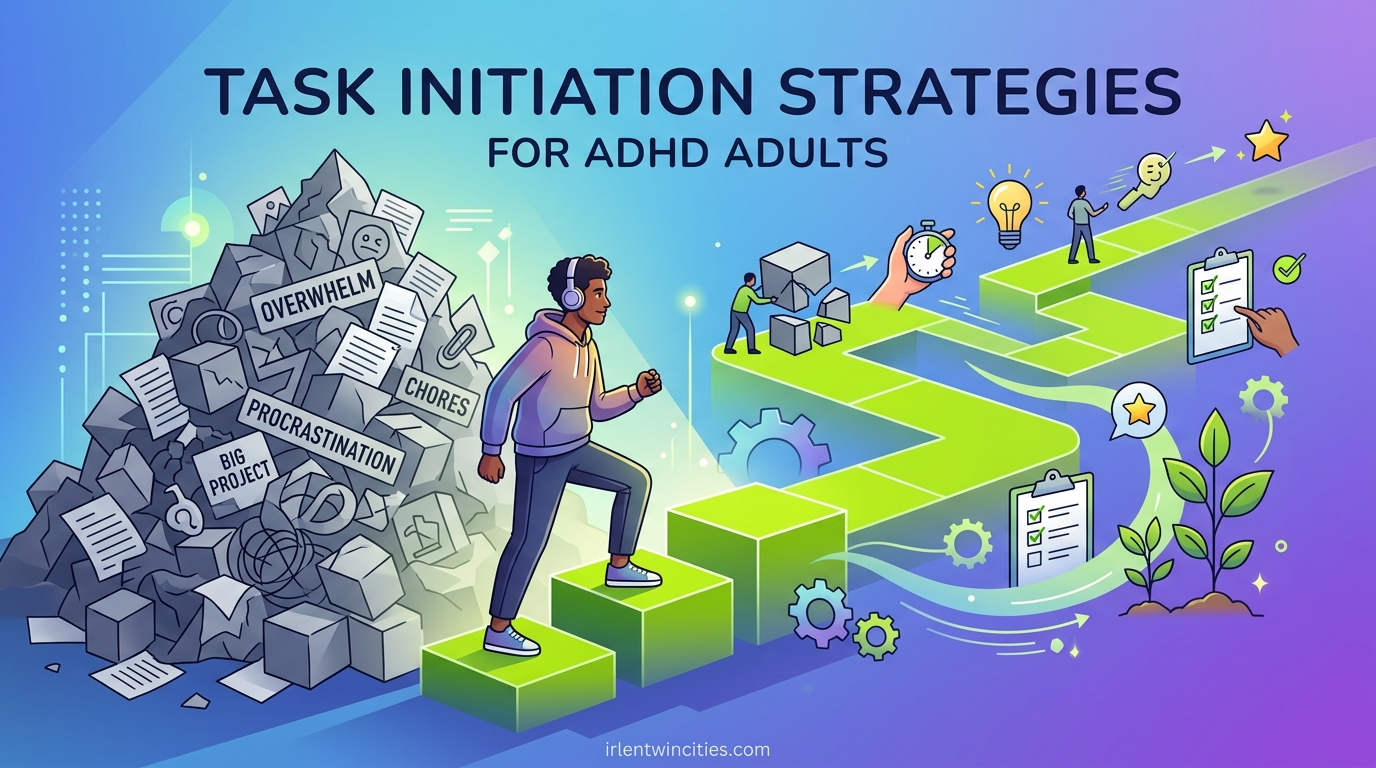
Brendan Mahan, an ADHD educator and coach, coined the term “Wall of Awful” to describe the emotional barrier that builds up around tasks we have avoided. Each time you think about a task and do not do it, you add another brick to the wall. Shame, guilt, and anxiety accumulate.
Eventually, the wall becomes so high that the task feels impossible to start. The emotional weight outweighs the actual difficulty of the task itself. This is why tasks that should take ten minutes can feel like they require superhuman effort.
Breaking through the Wall of Awful requires specific strategies. Willpower alone is not enough. You need tools that lower the emotional barrier and make starting feel safe again.
Time Agnosia and Task Switching
Many adults with ADHD experience time agnosia, sometimes called time blindness. You cannot accurately perceive how long tasks take or how much time has passed. A task that feels like it will take forever might actually take fifteen minutes. But your brain cannot tell the difference.
Task switching adds another layer of difficulty. Transitioning from one activity to another requires significant cognitive energy for ADHD brains. Starting is hard. Stopping to start something else is even harder.
This explains why you can scroll social media for hours but cannot start work. The transition energy required to switch modes feels insurmountable.
Proven Task Initiation Strategies for ADHD Adults That Actually Work
The strategies below are not generic productivity tips. They are specifically designed to address the neurological and emotional barriers that make task initiation difficult for ADHD brains. Use them as a toolkit. Different strategies work for different tasks and different days.
1. Micro-Starts: The Smallest Next Step
Micro-starts are the single most effective task initiation strategy for many ADHD adults. The concept is simple. Break the task down into such a small first step that it feels ridiculous not to do it.
Instead of “write the report,” your micro-start is “open the document and write the title.” Instead of “clean the kitchen,” it is “put one dish in the dishwasher.” Instead of “exercise,” it is “put on your workout shoes.”
The magic of micro-starts is that they bypass the Wall of Awful. They are so small that they do not trigger resistance. Once you complete the micro-step, you often find that continuing feels easier than stopping.
One forum member shared: “I tell myself I only need to do the first tiny thing. Once I start, I almost always keep going. The lie I tell myself is that I can stop after five minutes, but I rarely do.”
2. The 5-Minute Rule
The 5-minute rule is a commitment device. You agree to work on the task for exactly five minutes, with full permission to stop after that. Set a timer. Work for five minutes. Then decide whether to continue.
This works because it lowers the perceived cost of starting. Five minutes feels manageable. It sidesteps the overwhelming feeling that you are committing to hours of misery.
The psychology is clever. Starting is the hardest part. Once you have invested five minutes of effort, the sunk cost effect kicks in. Stopping feels wasteful. Momentum builds. Many ADHD adults find that once the five minutes are up, they want to keep going.
If you truly stop after five minutes, that is also a win. You made progress. You practiced starting. Tomorrow, starting again will be slightly easier.
3. Body Doubling: The Power of Presence
Body doubling means having another person present while you work on a task. They do not need to help with the task. Their mere presence is enough to help your brain engage.
The mechanism is not fully understood, but the effect is real. Having someone else there seems to provide external activation energy. It reduces the feeling of being alone with a dreaded task. It adds social accountability, even if the other person never checks on you.
Body doubling can happen in person or virtually. Virtual body doubling sessions over video call are popular in ADHD communities. You join a session, work on your own tasks while others work on theirs, and the collective energy helps everyone focus.
Some people use body doubling apps or Discord servers. Others arrange regular sessions with friends or accountability partners. The key is finding what works for you and making it a regular practice.
4. Dopamine Stacking
Dopamine stacking means pairing boring tasks with enjoyable elements to increase the dopamine reward. Your brain gets a hit from the enjoyable element, which provides enough activation energy to start the boring task.
Common dopamine stacks include listening to music or podcasts while doing household chores, watching a favorite show while folding laundry, getting a special drink to sip while working, or working in a favorite location like a coffee shop.
The trick is choosing a dopamine source that does not distract from the task. Music without lyrics often works better for writing tasks. Audiobooks work well for physical tasks. Experiment to find your optimal stacks.
Remember that novelty is a dopamine source. Changing your environment, using new tools, or approaching the task differently can provide enough novelty to get started.
5. Externalize the Starting Point
Decision fatigue is real for ADHD brains. Every decision about how to start a task consumes limited executive function resources. By the time you have decided what to do first, you have no energy left to actually do it.
Externalizing the starting point means making the first step obvious and automatic. Create visual cues that tell your brain exactly what to do. Lay out your workout clothes the night before. Keep your medication visible on the counter. Open the document you need to work on before you step away for a break.
Environmental design is powerful. Reduce the distance between you and the starting point. If you want to exercise in the morning, sleep in your workout clothes. If you want to take your vitamins, put them in your coffee mug so you cannot make coffee without moving them.
The goal is to make starting easier than not starting. Friction reduction is key for ADHD task initiation.
6. Make It Interesting
Remember the interest-based nervous system. If a task is boring, your brain will resist it. Find ways to inject interest, novelty, challenge, or urgency into otherwise dull tasks.
Gamification works well for some people. Track streaks. Set personal records. Compete with yourself. Use apps that turn tasks into games.
Novelty injection means approaching the task differently each time. If you usually answer emails at your desk, try doing it from a coffee shop. If you usually clean on Saturdays, try a Wednesday evening instead. Change the music, the location, the order, or the tools.
Challenge can come from time pressure or self-imposed constraints. Can you finish this task in half the usual time? Can you do it while standing? Can you find a more efficient way?
7. Use Visual Timers and Checklists
Time agnosia makes it hard to start tasks because you cannot accurately predict how long they will take. Visual timers like Time Timer show time passing as a colored wedge that shrinks. This externalizes time and makes it concrete.
Seeing that a task will only take fifteen minutes of actual clock time, rather than the hours it feels like it will take, can be enough to get started. The Time Timer and similar visual countdown clocks are popular in ADHD communities for this reason.
Checklists provide external working memory. Instead of holding all the steps in your head, you write them down. Starting becomes simpler because you only need to look at the next item, not hold the entire task in mind.
The satisfaction of checking items off provides small dopamine hits that keep you moving through the list.
How to Break Through Task Paralysis
Task paralysis is the state of knowing exactly what you need to do but being unable to start. Your body feels frozen. Your mind might be racing or completely blank. Hours pass while you sit in place, hating yourself for not moving.
This is different from procrastination. Procrastination involves choosing to do something else instead. Task paralysis is wanting to start but being neurologically unable to.
When you are stuck in paralysis, try these specific techniques:
Name it to tame it. Simply saying out loud “I am experiencing task paralysis” can reduce its power. Acknowledging the state without judgment interrupts the shame spiral.
Change your state. Move your body. Stand up. Walk around. Splash cold water on your face. Physical movement can interrupt the freeze response.
Lower the stakes. Tell yourself you are just going to look at the task, not do it. Or that you are going to do a terrible job on purpose. Anything that reduces the perceived pressure.
Change your environment. Sometimes moving to a different location is enough to break the paralysis. The new environment does not carry the accumulated emotional weight of the space where you have been stuck.
Reach out for body doubling. Text a friend and ask if they can sit with you while you start. Join a virtual body doubling session. The external presence can provide the activation energy you are missing.
One Reddit user described their breakthrough: “I finally realized that when I am paralyzed, I need to ask for help. Not help with the task, just someone to be there while I start. It felt silly at first, but it works every time.”
Task Re-Initiation: Starting Again After Breaks
Here is something most guides miss. Starting a task for the first time is hard. Starting again after a break is often harder.
Task re-initiation is the ability to return to a task after an interruption or break. For ADHD brains, the transition back requires almost as much energy as the original start. This is why many ADHD adults work in marathon sessions, refusing to take breaks because they know they will not be able to start again.
But breaks are necessary. The solution is building re-initiation strategies into your workflow.
Leave a breadcrumb. Before you take a break, write down exactly what you will do when you return. Be absurdly specific. Not “work on the report” but “write the second paragraph of the introduction about customer demographics.” The more specific, the easier re-starting becomes.
Create a ritual. Develop a specific routine for returning to work. Same order of actions, same environment cues, same music. Rituals reduce the decision load and signal your brain that it is time to engage.
Use shorter, more frequent breaks. Instead of one long lunch break, try several five-minute breaks throughout the day. The cost of re-initiation is lower when the break is shorter.
Body double for re-starts. If you know a break is coming, schedule body doubling for the return. Having someone there when you get back makes re-initiation much easier.
Frequently Asked Questions
Why is task initiation so hard with ADHD?
Task initiation is difficult with ADHD due to lower baseline dopamine levels and less efficient dopamine regulation. The ADHD brain requires higher rewards to trigger motivation and action. Combined with executive function impairments, time agnosia, and emotional barriers like the Wall of Awful, starting tasks requires significantly more activation energy than for neurotypical brains.
What are ADHD-friendly ways to start a task?
ADHD-friendly task initiation strategies include micro-starts (breaking tasks into tiny first steps), the 5-minute rule (committing to just five minutes), body doubling (working alongside others), dopamine stacking (pairing boring tasks with enjoyable elements), externalizing starting points (reducing decision fatigue), making tasks interesting through gamification or novelty, and using visual timers to overcome time agnosia.
How do you manage task initiation paralysis when you know exactly what to do?
To break task initiation paralysis, try naming the state out loud to reduce its power, changing your physical state through movement, lowering the stakes by telling yourself you will do a terrible job, changing your environment to escape accumulated emotional weight, or reaching out for body doubling. Task paralysis is a neurological state, not laziness, and often requires external intervention to break.
What helps with task initiation in ADHD?
What helps most varies by individual, but widely effective approaches include body doubling (virtual or in-person), micro-starts and the smallest next step strategy, the 5-minute commitment rule, dopamine stacking with music or enjoyable elements, externalizing decisions through environmental design, and addressing the Wall of Awful by reducing shame and emotional barriers. Many adults with ADHD find combining multiple strategies works best.
Why do people with ADHD struggle with task initiation?
People with ADHD struggle with task initiation because of neurological differences in dopamine regulation, impaired executive function, time agnosia (difficulty perceiving time accurately), and emotional barriers that accumulate around avoided tasks. The ADHD brain is motivated by interest, urgency, novelty, and challenge rather than importance or should, making boring or ambiguous tasks particularly difficult to start.
Conclusion
Task initiation difficulties are not character flaws. They are neurological realities that millions of adults with ADHD navigate every day. Understanding the why behind your struggles is the first step toward finding strategies that work for your brain.
The techniques in this guide have helped countless ADHD adults move from paralysis to progress. Micro-starts, body doubling, dopamine stacking, and the 5-minute rule are not just productivity hacks. They are tools designed specifically for brains that need external activation energy to get moving.
Start with one strategy that resonates with you. Practice it. Notice what works and what does not. Build your personal toolkit over time. With the right approach, task initiation becomes less of a daily battle and more of a manageable challenge you have the tools to overcome.
You now have the strategies. The next step is simply to begin.