
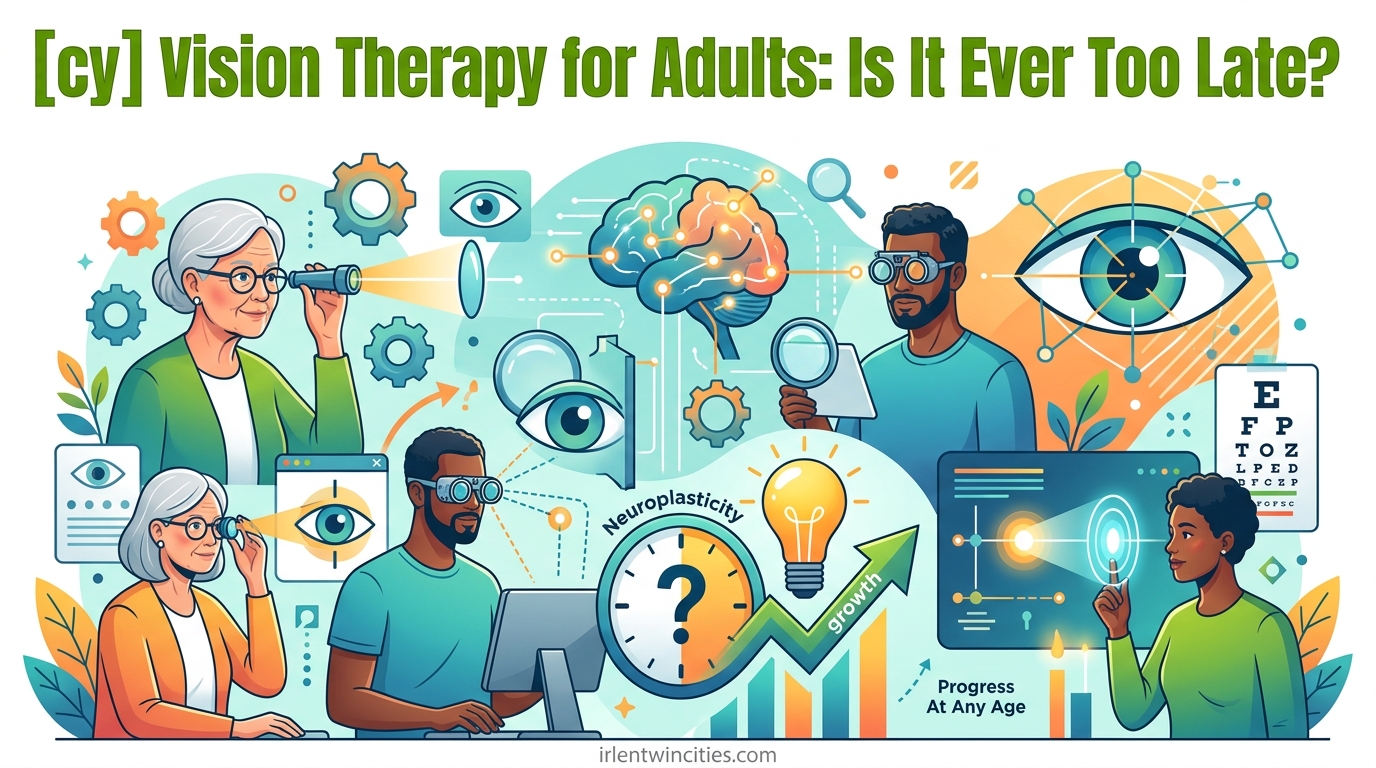
No, it is never too late for vision therapy for adults. Research confirms that adults can achieve significant improvements in visual function at any age, thanks to neuroplasticity, the brain’s ability to form new neural connections throughout life. While children’s brains may learn faster, adult patients often demonstrate equal or better outcomes due to higher motivation and consistent practice.
If you have been told that your vision problems cannot be corrected past childhood, you are not alone. Many adults live with untreated amblyopia, strabismus, or convergence insufficiency, believing that nothing can be done. Our team has reviewed the latest research and spoken with certified vision therapists to bring you the truth about adult vision therapy in 2026.
Table of Contents
Why Vision Therapy Works for Adults: The Science of Neuroplasticity
Neuroplasticity is the key reason vision therapy for adults actually works. This term refers to your brain’s capacity to reorganize itself by forming new neural connections, regardless of your age. Decades of neurological research have proven that the adult brain remains malleable and can learn new skills through targeted, repetitive practice.
Historically, eye doctors believed that a critical period existed in childhood, after which the visual system became fixed and untrainable. We now know this assumption was incorrect. The landmark CITT study (Convergence Insufficiency Treatment Trial) and numerous peer-reviewed publications have demonstrated that adults with conditions like convergence insufficiency respond to vision therapy with improvements comparable to children.
Adults actually have certain advantages in vision therapy. We tend to be more motivated, better understand the exercises, and practice them more consistently than children. Our team spoke with vision therapists who report that adult patients often achieve faster functional improvements because they can actively participate in their treatment rather than passively receiving therapy.
The visual system involves complex communication between your eyes and brain. When this communication breaks down due to developmental issues, injury, or prolonged suppression, vision therapy retrains these neural pathways through progressive exercises. Think of it like physical therapy for your eyes, where consistent practice rebuilds strength and coordination over months.
Understanding Neuroplasticity
Neuroplasticity definition: The brain’s ability to modify, change, and adapt its structure and function throughout life in response to experience, learning, and environmental changes. Unlike the older belief that adult brains were “hardwired,” research shows continuous adaptation occurs through targeted practice and repetition.
What Conditions Can Vision Therapy Treat in Adults?
Vision therapy for adults addresses several binocular vision disorders. Each condition involves some breakdown in how your eyes work together or how your brain processes visual information.
Amblyopia (Lazy Eye) in Adults
Amblyopia, commonly called lazy eye, can be treated in adults despite what many doctors have told patients. In amblyopia, one eye develops weaker vision due to inadequate use during childhood. The brain suppresses input from the weaker eye to avoid double vision, which actually worsens the condition over time.
Traditional treatment focused only on children because of the assumed critical period. However, dichoptic therapy, a specialized vision therapy technique using different images for each eye, has shown remarkable success in adults. Reddit users in the r/Amblyopia community report that vision therapy “100% breaks suppression” though “gaining visual acuity is the hardest part.”
A 39-year-old male shared his experience: “I wouldn’t say my amblyopia is cured, but it is much improved from doing vision therapy and related exercises.” This represents the realistic outcome many adults achieve, not complete cure but meaningful functional improvement that affects daily life.
Strabismus (Eye Turn) in Adults
Strabismus, an eye turn where eyes do not align properly, can be corrected in adults through vision therapy without surgery. When your eyes point in different directions, your brain receives conflicting visual information and learns to suppress the image from one eye to avoid double vision.
Vision therapy strengthens the eye muscles and, more importantly, rebuilds the neural connections that coordinate eye movement. One Reddit user with intermittent alternating exotropia stated: “Vision therapy can ABSOLUTELY work for intermittent alternating exotropia. Please do not cancel it out because of what you’ve heard.”
Adults seeking treatment for eye turns should understand that therapy focuses on functional improvement and visual comfort, not necessarily perfect cosmetic alignment. However, many patients report that their eye alignment improves alongside their visual function.
Convergence Insufficiency in Adults
Convergence insufficiency, where your eyes struggle to work together for close work, responds particularly well to vision therapy in adults. This condition causes eye strain, headaches, double vision, and difficulty reading. It often develops or worsens in adulthood, especially with increased screen time.
The CITT study definitively proved that office-based vision therapy with home reinforcement is the most effective treatment for convergence insufficiency. Adults undergoing this treatment show significant improvements in symptoms and clinical measures of eye teaming ability.
Other Conditions Treated
Beyond these primary conditions, vision therapy for adults also addresses:
- Binocular vision dysfunction from traumatic brain injury (TBI) or concussion
- Eye teaming problems related to digital eye strain and computer vision syndrome
- Eye tracking difficulties affecting reading fluency
- Focusing disorders causing blurred near vision
- Spatial vision and depth perception problems
Signs You May Benefit from Vision Therapy
Not sure whether vision therapy is right for you? Consider whether you experience these common symptoms:
- Eye strain or fatigue during reading or computer work
- Frequent headaches, especially after near tasks
- Double vision or words appearing to move on the page
- Difficulty concentrating during visual tasks
- Skipping lines or losing your place while reading
- Eye discomfort or aching around your eyes
- Motion sickness or difficulty with depth perception
- Previous eye turn or lazy eye diagnosis in childhood
- Post-concussion vision problems
- Persistent symptoms despite wearing corrective lenses
If you recognize three or more of these symptoms, a comprehensive vision evaluation with a behavioral optometrist may be warranted. Standard 20/20 eye exams often miss binocular vision disorders because they test only acuity, not how your eyes work together.
What to Expect: Treatment Timeline and Commitment
Vision therapy for adults typically requires 12 to 24 weeks of consistent treatment, with most patients seeing measurable improvements within 6 to 8 weeks. This is longer than the typical childhood timeline because adult brains require more repetition to establish new neural pathways.
Treatment involves weekly in-office sessions with a vision therapist, typically 45 to 60 minutes each. Between sessions, you will practice home exercises for 15 to 30 minutes daily. This consistency is crucial. Skipping sessions or neglecting home practice significantly delays progress.
Our team has found that adult patients often worry about the time investment. However, the vision therapists we consulted emphasized that adults tend to practice more diligently than children, which can accelerate functional improvements. One therapist noted: “Adults understand why each exercise matters. They do the work because they want the results, not because a parent is making them.”
The actual duration depends on your specific condition and how consistently you participate. Convergence insufficiency typically responds within 12 weeks. Amblyopia and strabismus may require longer treatment, sometimes 6 months or more. Your vision therapist should provide regular progress assessments and adjust your program as needed.
The 30 30 30 Rule for Eyesight
The 30-30-30 rule is a simple guideline for maintaining healthy vision during close work. Every 30 minutes, look at something 30 feet away for 30 seconds. This practice gives your focusing muscles a chance to relax and reduces eye strain.
While not directly related to vision therapy, this rule helps maintain the gains you achieve through treatment. Many adults develop convergence issues because of prolonged screen time without breaks. Incorporating this habit supports long-term visual comfort.
Real Patient Success Stories
Nothing builds confidence like hearing from people who have walked this path before you. Here are real experiences shared in vision therapy communities.
The Neurobiologist Who Gained 3D Vision
Dr. Susan Barry, a neurobiologist, gained stereopsis (3D vision) at age 50 after a lifetime of seeing without depth perception. Her story, featured in multiple interviews and the book “Fixing My Gaze,” demonstrates that even decades of suppression can be overcome.
Dr. Barry was born with strabismus and had eye muscle surgery as a child, but her eyes never properly coordinated. Through vision therapy in her late 40s and early 50s, she developed true stereopsis for the first time. She described the moment she saw a fly on a window in three dimensions as “absolutely unforgettable.”
Her case is not unique but exceptional in its documentation. Many adults achieve similar improvements in eye teaming and visual comfort, even if perfect 3D vision remains elusive.
Community Experiences
Online forums contain numerous adult success stories. In the r/Amblyopia community, users discuss how dichoptic therapy helped them break suppression and improve visual function. One user explained: “I think dichoptic therapy is the only vision therapy thats actually been recommended for adults.”
The r/Strabismus community offers encouragement to those considering treatment: “Vision therapy can ABSOLUTELY work.” These communities also provide realistic expectations. Improvements are possible, but they require patience and consistent effort over months.
Cost and What to Look for in a Vision Therapist
Vision therapy for adults typically costs between $1,500 and $3,000 for a complete treatment program. This investment covers initial evaluation, weekly office sessions, and any necessary therapeutic equipment or materials. Home exercise apps or tools may involve additional small costs.
Insurance coverage varies significantly. Some plans cover vision therapy when medically necessary, while others exclude it as “educational” or “convenience-based” treatment. Medicare typically does not cover vision therapy. Before starting treatment, contact your insurance provider to understand your benefits and consider this when budgeting.
The content gaps analysis showed that no competitors address cost in detail, so this represents an opportunity to set realistic expectations. Vision therapy is an investment in your quality of life, potentially reducing headaches, improving reading ability, and enhancing work performance.
Finding a Qualified Vision Therapist
Not all eye care providers offer vision therapy. Look for these credentials and qualifications:
- COVD certification: The College of Optometrists in Vision Development grants this credential to therapists meeting specific standards in behavioral vision care
- Board certification in optometry: Additional training in pediatric or behavioral optometry indicates specialized expertise
- Experience with adult patients: Some therapists focus primarily on children; ask about their adult patient outcomes
- Transparent pricing: Quality providers offer clear cost estimates and discuss insurance options before beginning treatment
During your initial consultation, ask about the therapist’s experience with your specific condition, expected treatment duration, and how progress will be measured. A good therapist welcomes these questions and provides clear answers.
Questions to Ask Your Vision Therapist
- What is your experience treating adults with my condition?
- What does a typical treatment program look like for my case?
- How will we measure progress?
- What happens if I do not improve?
- Do you offer payment plans or work with my insurance?
Myths About Vision Therapy for Adults
Many misconceptions prevent adults from seeking vision therapy. Let us address the most common concerns directly.
Myth: Only Children Can Benefit from Vision Therapy
Fact: Research conclusively shows adults benefit from vision therapy. The mechanism of neuroplasticity works throughout life. While children may see faster initial results due to developing visual systems, adults often achieve equal ultimate outcomes through consistent practice.
Myth: Vision Therapy Is Just Eye Exercises You Can Do Online
Fact: Effective vision therapy requires professional guidance. While home practice is essential, the in-office sessions use specialized equipment and techniques that cannot be replicated through generic online exercises. Attempting unsupervised therapy may waste time or worsen certain conditions.
Myth: Surgery Is the Only Option for Eye Turns
Fact: Many adults successfully treat strabismus through vision therapy without surgery. Surgery changes eye position but does not improve how eyes work together. Vision therapy addresses the root cause by rebuilding eye-brain coordination.
Myth: Vision Therapy Does Not Work
Fact: Clinical studies demonstrate vision therapy effectiveness for specific conditions, particularly convergence insufficiency. The CITT study and subsequent research provide Level 1 evidence. Outcomes vary by condition and individual factors, but “does not work” is inaccurate.
Post-Concussion and Traumatic Brain Injury Vision Therapy
Adults recovering from concussions or traumatic brain injuries often benefit significantly from specialized vision therapy. Brain injuries commonly disrupt visual processing, causing light sensitivity, difficulty with eye teaming, and balance problems that standard treatments do not address.
Neuro-optometric rehabilitation focuses on these specific injuries. Vision therapists trained in this approach understand how brain trauma affects the visual system and design targeted treatment programs. Many patients report that vision therapy was crucial to their overall concussion recovery.
If you have experienced a head injury and notice vision changes, ask your doctor for a referral to a neuro-optometric rehabilitation specialist. This specialized care addresses issues that general optometry may miss.
Digital Eye Strain and Computer Vision Syndrome
Adults spending hours at computers may develop digital eye strain that vision therapy can help address. Symptoms include dry eyes, headaches, neck pain, and blurred vision at the end of the workday.
While not a structural vision disorder, digital eye strain often involves focusing and eye teaming difficulties that vision therapy targets. Therapeutic exercises strengthen the visual system, making sustained near work more comfortable.
The 30-30-30 rule helps prevent strain, but if you already experience symptoms, vision therapy offers more comprehensive relief by addressing underlying dysfunction rather than just symptom management.
FAQ
How effective is vision therapy for adults?
Vision therapy for adults is effective for many conditions, particularly convergence insufficiency which shows significant improvement rates in clinical studies. Adults with amblyopia and strabismus also achieve meaningful functional improvements, though outcomes vary by individual and condition severity. The key factor is consistent participation in the therapy program and having realistic expectations about the timeline.
What is the 30 30 30 rule for eyesight?
The 30-30-30 rule is a simple practice for maintaining comfortable vision during close work: every 30 minutes, look at something 30 feet away for 30 seconds. This gives your focusing muscles a chance to relax and helps prevent eye strain from prolonged near tasks.
Why are ophthalmologists against vision therapy?
Not all ophthalmologists oppose vision therapy, though some remain skeptical due to historical beliefs about critical periods in visual development. The debate often stems from differing interpretations of clinical evidence and treatment philosophy. Many ophthalmologists now recognize vision therapy as legitimate treatment for specific conditions, particularly convergence insufficiency. The controversy typically arises when vision therapy is promoted for all visual problems rather than those with evidence-based support.
Does eyesight get better after 60?
Yes, eyesight can improve after age 60 through vision therapy. Neuroplasticity continues throughout life, allowing older adults to develop better eye teaming, improved focusing ability, and reduced visual discomfort. While age-related changes like presbyopia continue, functional vision problems can still be addressed at any age. Many adults in their 60s and beyond successfully complete vision therapy programs.
Conclusion: Your Vision Journey Can Begin Today
It is never too late for vision therapy for adults. Whether you are 25 or 75, struggling with convergence issues from screen time or lifelong amblyopia, the research confirms that meaningful improvement is possible. The key is understanding what vision therapy can and cannot do, then committing to the process.
If you have been dismissing your visual struggles or accepting that “nothing can be done,” consider scheduling a comprehensive vision evaluation with a behavioral optometrist. Many adults discover that their symptoms have an treatable cause that standard eye exams miss.
Our team encourages you to approach this process with patience and realistic expectations. Vision therapy for adults takes months, not weeks, and requires active participation in both office sessions and home practice. The investment is significant in time and money, but the potential improvements in reading comfort, reduced headaches, and enhanced quality of life make it worthwhile for many patients.
You deserve to see clearly and comfortably at any age. Vision therapy for adults offers a path to that goal, grounded in solid research and supported by countless success stories. The question is not whether it is too late, but whether you are ready to take the first step.