
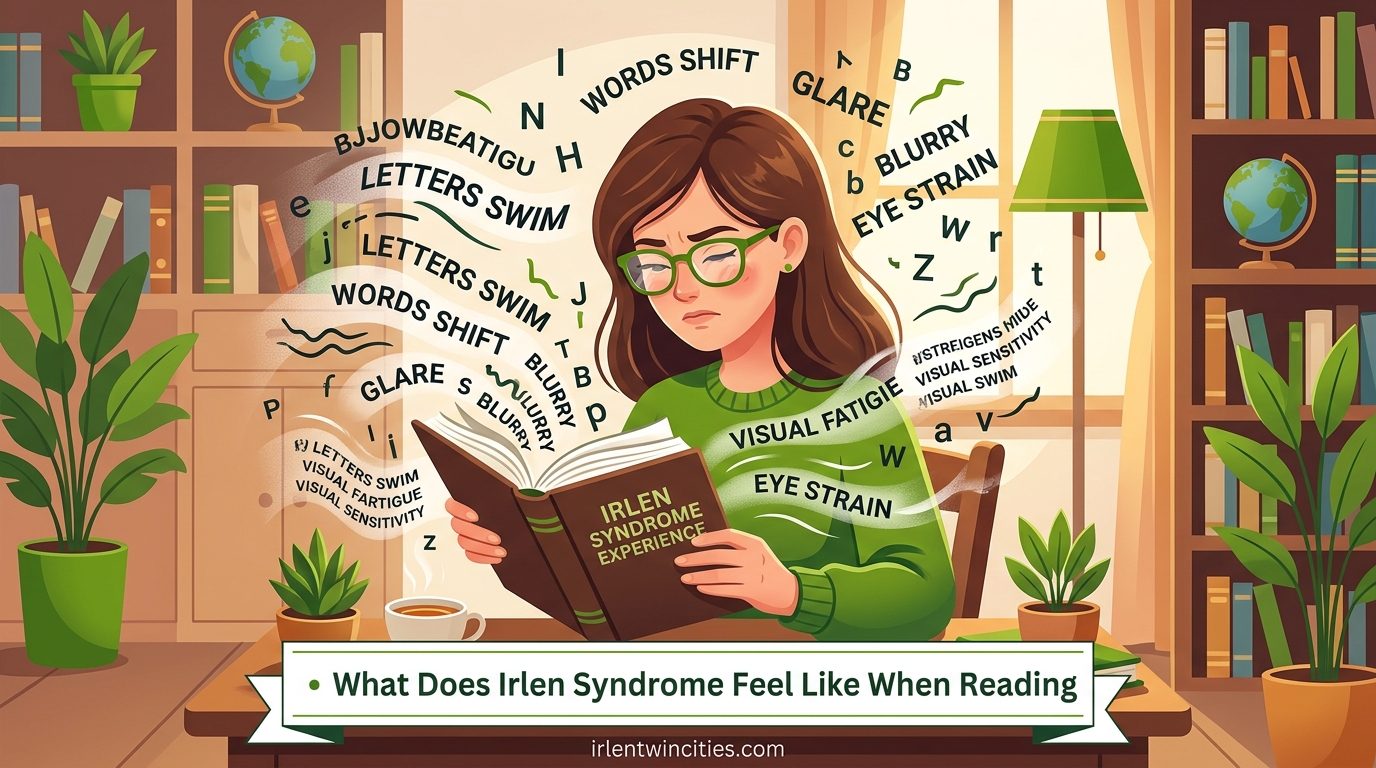
What does Irlen Syndrome feel like when reading? It feels like the words are alive and fighting against you. Letters shimmer, words seem to fall off the page, and reading becomes a physical battle that leaves you exhausted. For millions of people, this is not a rare occurrence but an everyday reality that turns something as simple as reading a book into a draining challenge.
Irlen Syndrome, also called Scotopic Sensitivity Syndrome or Meares-Irlen Syndrome, is a perceptual processing disorder that affects how the brain interprets visual information. It is not a problem with your eyesight. Your eyes can be perfectly healthy, yet the words on a page still refuse to stay still. This condition affects roughly 12-15% of the general population and up to 46% of people with reading difficulties.
Understanding what Irlen Syndrome feels like matters because many people struggle for years without knowing why reading is so hard for them. They blame themselves, thinking they are not trying hard enough or are not as smart as others. The reality is that their brain processes light wavelengths differently, and once recognized, this condition can be addressed with proper treatment.
Table of Contents
What is Irlen Syndrome
Irlen Syndrome is a perceptual processing disorder where the brain has difficulty processing specific wavelengths of light. This creates a filtering problem that causes visual distortions when looking at printed materials, particularly high-contrast items like black text on white paper.
The condition was first identified by Helen Irlen in the 1980s. She discovered that certain colored filters could help people who struggled with reading despite having normal vision. The syndrome goes by several names including Scotopic Sensitivity Syndrome, Meares-Irlen Syndrome, and visual stress. All refer to the same underlying issue of how the brain interprets visual input under certain lighting conditions and contrast levels.
People with Irlen Syndrome often have normal or even excellent vision when tested by an eye doctor. Standard eye exams do not detect this condition because it is not an eye problem. It is a brain processing issue. The visual cortex struggles to process the full spectrum of light efficiently, particularly certain wavelengths that create the distortions people experience when reading.
What Irlen Syndrome Feels Like When Reading
Reading with Irlen Syndrome feels fundamentally different from normal reading. Words do not sit quietly on the page waiting to be decoded. Instead, they move, shimmer, and behave in ways that make the act of reading a physical and mental struggle.
One person described their experience this way: “My particular Irlen Syndrome primarily shows up like 3D rivers popping off the paper or screen between words.” These rivers create channels of movement that pull your eyes away from where they should be focusing. The space between words becomes more prominent than the words themselves, making it nearly impossible to track lines of text.
Another common description involves movement and instability. Words may appear to shake, pulse, or swirl around the page. One forum user explained: “It’s a type of dyslexia where you see background before you see the foreground. It makes words and numbers dance around the screen rather than stay still.” This dancing effect means the text is never stable long enough to read comfortably.
Many people report seeing flashing lights or experiencing a strobing effect when looking at text. The high contrast between black letters and white paper triggers a kind of visual feedback loop that creates these disturbances. Some describe words as appearing to fall off the page or sink into the background, while others see letters that run together or blur at the edges.
The experience varies from person to person, but certain patterns emerge. White paper often creates the most problems because it reflects the maximum amount of light. Fluorescent lighting makes symptoms worse because of the specific wavelengths these lights produce. Computer screens can trigger symptoms due to their backlighting and refresh rates. Many people find themselves constantly adjusting their position, squinting, or looking away to give their eyes a break.
Physical Symptoms During Reading
The visual distortions are only part of the story. Irlen Syndrome creates real physical symptoms that make reading an exhausting activity. These physical effects are what often drive people to seek help, as the discomfort becomes impossible to ignore.
Eye strain is the most common complaint. After even a few minutes of reading, the eyes feel tired, achy, and overworked. This is not the mild fatigue that comes from focusing on any task for a while. It is a deep, uncomfortable strain that builds quickly and takes time to subside. Many people describe it as feeling like their eyes are being squeezed or pressured.
Headaches frequently accompany the eye strain. These headaches often start at the temples or behind the eyes and can develop into full migraines in severe cases. The pain typically worsens the longer you try to read and may persist even after you stop. Some people experience nausea or dizziness along with the headaches, especially when reading under fluorescent lights or looking at computer screens.
General fatigue and sleepiness are also common. Reading requires so much effort and concentration that it becomes physically draining. People report feeling exhausted after reading sessions that should have been manageable. This tiredness is not just mental but physical, as if the body has been working hard even while sitting still.
As one person shared: “Flashing lights, rivers running through words, words moving about the page, eye fatigue and headaches.” These symptoms stack on top of each other, creating a cascade of discomfort that makes reading feel like a punishment rather than a pleasure or a necessary task.
Reading Behaviors That Signal Irlen Syndrome
Beyond the subjective experience of visual distortions and physical symptoms, Irlen Syndrome produces observable reading behaviors. These patterns often reveal the struggle that is happening behind the scenes as the person tries to compensate for what their visual system is doing.
Tracking problems are a major indicator. People with Irlen Syndrome frequently lose their place when reading. They skip words, skip entire lines, or find themselves reading the same line twice without realizing it. The visual distortions make it difficult to move smoothly from the end of one line to the beginning of the next. Many readers develop coping mechanisms like using their finger, a bookmark, or a ruler to keep their place.
Rereading is another common behavior. Because the words are unstable and comprehension suffers, readers often go back and reread the same material multiple times. One person described it this way: “The symptoms of Irlen I experience are losing track when reading, having to read multiple times before I can remember what I have read.” This rereading is not due to lack of attention or focus. It is necessary because the visual information is not being processed correctly the first time through.
Poor comprehension despite adequate intelligence is frustratingly common. People with Irlen Syndrome often understand spoken material perfectly well but struggle to extract meaning from text. The effort required just to see the words correctly leaves little mental energy for understanding what those words mean. Reading becomes decoding rather than comprehending.
Preference for dim lighting or colored overlays is another telltale sign. Many people instinctively discover that reading is easier in certain conditions. They may prefer reading in dim light, which reduces the glare that triggers symptoms. Some find that colored plastic sheets placed over text make an immediate difference. One forum user shared: “For the first time in 30 years I can read!! As long as I read through a pink overlay.” This immediate relief when using colored filters is a strong indicator of Irlen Syndrome.
Avoidance of reading is a behavioral consequence that develops over time. When reading consistently causes headaches, eye strain, and frustration, people naturally start avoiding it. Children may resist reading assignments. Adults may put off paperwork or choose audiobooks over printed books. This avoidance is often misinterpreted as laziness or lack of interest when it is actually a protective response to a genuine physical problem.
How Irlen Syndrome Differs from Dyslexia and ADHD
Irlen Syndrome is often confused with dyslexia and ADHD because all three can cause reading difficulties and academic struggles. However, they are distinct conditions with different underlying causes and different treatment approaches.
Dyslexia is primarily a phonological processing disorder. It affects the ability to connect sounds with letter symbols and to blend sounds into words. People with dyslexia struggle with decoding words and may reverse letters or have difficulty with spelling. Irlen Syndrome, in contrast, is a visual processing issue. The problem is not recognizing what letters represent but seeing those letters clearly and stably in the first place.
The distinction matters because treatments differ. Dyslexia interventions focus on phonics instruction, multisensory learning, and building reading skills through structured literacy programs. Irlen Syndrome responds to environmental modifications, particularly the use of colored overlays or spectral filters worn as glasses or contact lenses. These filters change the wavelength of light reaching the brain and can eliminate the distortions entirely for many people.
ADHD involves difficulties with attention, impulse control, and sometimes hyperactivity. While people with ADHD may struggle to focus on reading, the root cause is neurological attention regulation rather than visual processing. However, Irlen Syndrome and ADHD can coexist, and untreated Irlen Syndrome can mimic or worsen ADHD symptoms. The eye strain and discomfort of trying to read with visual distortions naturally leads to restlessness and difficulty concentrating.
Some people have both Irlen Syndrome and dyslexia or ADHD. When these conditions occur together, addressing the Irlen Syndrome component often makes the other conditions more manageable. Reading becomes less physically taxing, allowing the person to focus their energy on the actual learning tasks rather than fighting to see the page.
Frequently Asked Questions
How does Irlen Syndrome affect reading?
Irlen Syndrome affects reading by creating visual distortions that make text unstable. Words may appear to move, blur, shimmer, or create distracting patterns like rivers between lines. This causes eye strain, headaches, and reading fatigue. Many people lose their place while reading, skip words or lines, and need to reread text multiple times to understand it. The physical effort required to decode unstable text reduces comprehension and makes reading exhausting.
How do you know if you have Irlen Syndrome?
Signs of Irlen Syndrome include words that appear to move on the page, eye strain and headaches when reading, difficulty tracking lines of text, and a preference for dim lighting or colored overlays. If reading consistently causes physical discomfort despite normal vision test results, Irlen Syndrome may be the cause. A proper diagnosis requires screening by a certified Irlen diagnostician who can test for visual perceptual problems and determine if colored filters provide relief.
Is Irlen Syndrome like ADHD?
Irlen Syndrome is not the same as ADHD, though the two can share some surface similarities. ADHD is primarily an attention regulation disorder affecting focus and impulse control. Irlen Syndrome is a visual processing condition where the brain struggles to process certain light wavelengths. However, the discomfort and fatigue from reading with Irlen Syndrome can cause restlessness and difficulty concentrating that mimics ADHD. The conditions can also coexist, and treating Irlen Syndrome may improve focus for those with both conditions.
Is Irlen Syndrome autism?
Irlen Syndrome is not autism, though there is a higher prevalence of Irlen Syndrome among people on the autism spectrum. Both conditions involve sensory processing differences, and many autistic individuals experience visual sensitivities similar to Irlen Syndrome. Research suggests that up to 50% of people with autism may also have Irlen Syndrome or related visual processing difficulties. The two conditions are separate diagnoses, but screening for Irlen Syndrome is often recommended for autistic individuals who struggle with reading or report visual discomfort.
Conclusion
What does Irlen Syndrome feel like when reading? It feels like words are in motion when they should be still. It feels like your eyes are working overtime just to see what is right in front of you. It feels frustrating, exhausting, and often lonely because the struggle is invisible to others.
The good news is that Irlen Syndrome is identifiable and treatable. Understanding that these symptoms have a name and a cause is the first step toward finding relief. Colored overlays, spectral filters, and environmental modifications can transform the reading experience for people with this condition. If you recognize yourself in these descriptions, consider seeking an evaluation from a certified Irlen screener. Reading does not have to be a battle, and with the right support, the words on the page can finally stay still.