
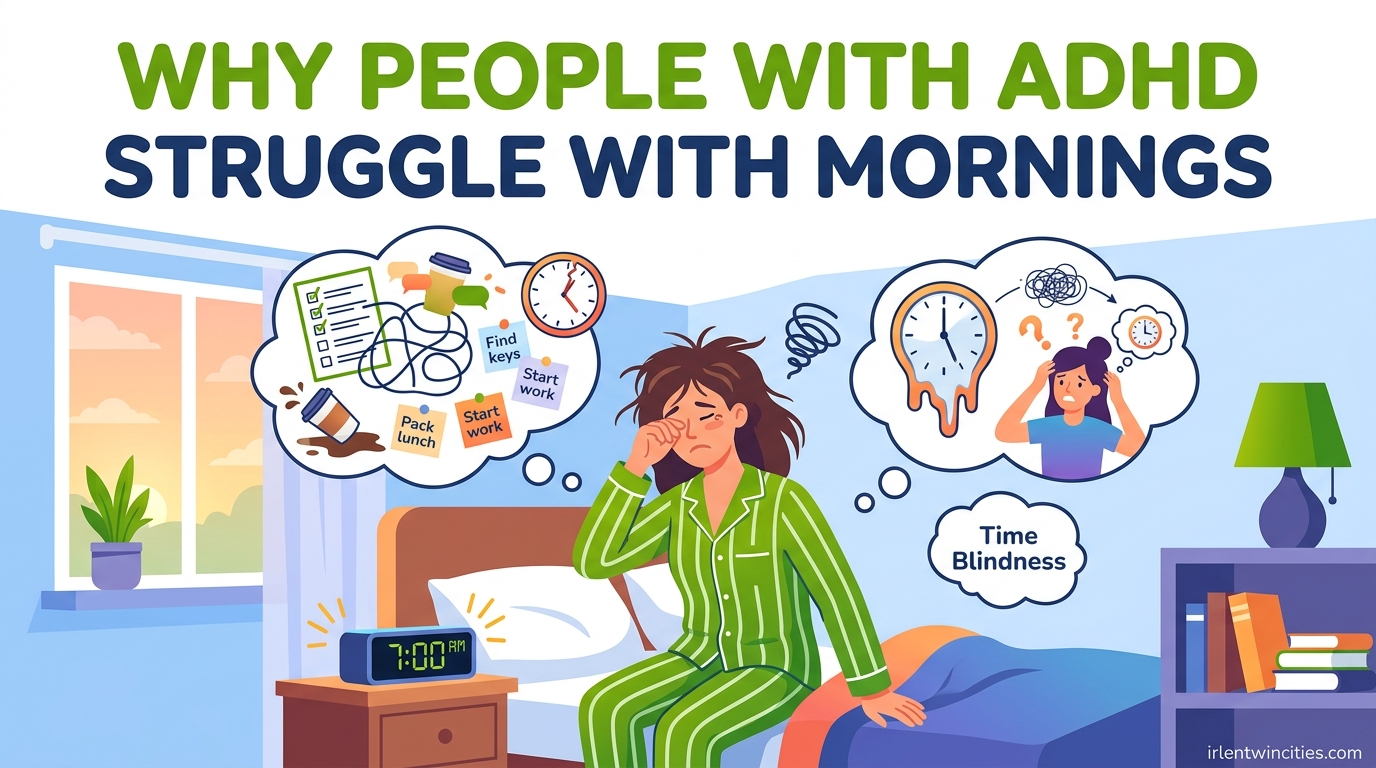
If you have ADHD and mornings feel impossible, you are not lazy. You are not unmotivated. There is a biological reason your brain fights waking up so hard, and understanding that reason changes everything about how you respond to these struggles.
After years of research and countless conversations in ADHD communities, one truth keeps emerging: mornings with ADHD are genuinely harder not because of poor habits, but because of how neurodivergent brains regulate sleep, alertness, and the transition between the two. Research shows that 70-80% of people with ADHD experience significant circadian rhythm disruption. This is not a personality trait. It is measurable neurology.
This guide explains the science behind why people with ADHD struggle with mornings, validates the real exhaustion you feel, and offers strategies that actually work with your brain rather than against it. Whether you are an adult recently diagnosed, a parent supporting a child with ADHD, or someone who has wondered why mornings feel impossible despite genuine effort, this guide is for you.
Table of Contents
Understanding Your Internal Clock: Chronotype and ADHD
Your chronotype is your body’s natural preference for sleep and wake timing. Think of it as your internal timezone. Most people fall along a spectrum from morning larks to night owls, but ADHD brains tend to cluster toward one particular end of that spectrum with remarkable consistency across research studies.
The circadian rhythm is your 24-hour internal cycle that regulates sleep, hormone release, body temperature, and alertness. This rhythm controls when you feel alert, when you feel sleepy, when your body temperature peaks and troughs, and when various hormones are released. In people with ADHD, this rhythm does not follow the typical schedule that work and school demands expect. The mismatch between your internal clock and external obligations is where the morning struggle begins.
Research from chronobiology studies indicates that ADHD brains often show delayed sleep phase patterns. This means your body wants to fall asleep later and wake up later than conventional schedules allow. When you must wake at 6 AM for a 9 AM commitment, your brain is essentially being asked to function in a time zone that does not exist for it. It is like asking someone to perform optimally at 3 AM when their body thinks it is 10 PM.
Many people with ADHD describe not recognizing themselves in the morning. The person who wakes up groggy, irritable, and unable to focus at 7 AM feels like a completely different human being compared to who they become by late morning or early afternoon. This is not metaphor. Their neurology genuinely shifts throughout the day, with optimal cognitive function often occurring in the late morning to evening hours when most traditional schedules have already demanded peak performance.
Sleep Inertia: Why Morning Grogginess Hits Harder with ADHD
Sleep inertia is the transitional grogginess and confusion between sleep and full wakefulness. When you wake up, your brain does not instantly switch from off to on. There is a gradual transition period where cognitive function is temporarily impaired, reaction time is slowed, and decision-making is compromised. Everyone experiences this to some degree.
For people with ADHD, this transition period is significantly longer and more intense than in neurotypical brains. While most people shake off sleep inertia within 15-30 minutes, those with ADHD commonly report taking 2-3 hours to reach moderate functionality. Some report that the fog never fully lifts until noon or later, no matter how much they sleep.
Forum members describe this vividly and consistently. One person shared: “The morning version of me is not allowed to make any decisions because my brain feels extremely foggy and takes three hours to become even moderately functional.” Another wrote: “Waking up groggy and watching content for hours before I can function.” These are not isolated experiences. They represent the norm for many people with ADHD.
The fog during sleep inertia includes difficulty with executive function tasks that would be simple later in the day. Making decisions, organizing thoughts, initiating actions, controlling impulses, and sustaining attention all become nearly impossible during sleep inertia. Your medication might not even work properly during this window because absorption and brain availability are affected by where your neurology is in its sleep-wake cycle.
Imagine trying to have a coherent conversation, make responsible choices, or complete important tasks while feeling like you are underwater. That is the experience of sleep inertia for many people with ADHD. Now imagine being expected to do this every single morning for school, work, or family obligations. The exhaustion this creates goes far beyond physical tiredness.
The Delayed Sleep Phase Connection
Delayed sleep phase syndrome is more than just preferring to stay up late. It is a systematic shift in when your body naturally wants to sleep and wake. For people with ADHD, this delay averages 45-90 minutes behind typical schedules, but often can be much more extreme. Some individuals with ADHD do not feel alert until 10 AM or later, despite needing to function on a conventional schedule.
Many people with ADHD describe a “second wind” pattern. They feel more alert and capable at midnight than at 7 AM. This is not behavioral. It is neurological. Your brain’s peak alertness window might fall between 10 PM and 2 AM, leaving morning hours in a permanent state of low arousal. For these individuals, trying to be functional at 7 AM feels as difficult as a neurotypical person trying to function at 3 AM.
This creates an exhausting cycle that perpetuates itself. You might finally fall asleep at midnight, but have to wake at 6 AM for obligations. Even with good sleep hygiene and genuine effort, forcing yourself into an early schedule means fighting your brain’s fundamental biology every single day. The sleep debt accumulates. The frustration builds. The shame around “not being a morning person” becomes another source of self-criticism.
Compounding this, research suggests that ADHD brains produce melatonin later in the evening than typical brains. Melatonin is the hormone that signals to your body that it is time to sleep. While neurotypical people might feel sleepy around 9-10 PM, those with ADHD often do not feel the pull toward sleep until 12 AM or later. This delayed melatonin release is not something you can willpower your way through. You cannot force your brain to release sleep hormones earlier than it is programmed to do so.
The societal structure makes this particularly cruel. Schools start early. Jobs expect early attendance. Families have morning routines that require adult supervision and participation. None of these structures align with the biology of many people with ADHD, yet we are expected to fit in or be labeled as lazy, unmotivated, or having a bad work ethic.
The Dopamine-Melatonin-Cortisol Connection
ADHD is fundamentally a disorder of dopamine regulation. Dopamine is a neurotransmitter that affects not only attention and focus but also motivation, reward processing, and sleep-wake cycles. When dopamine levels are dysregulated, the cascade of events that should lead to feeling alert and motivated in the morning does not function properly.
In the morning, your body relies on cortisol to help drive wakefulness. Cortisol is a stress hormone that follows a diurnal pattern, naturally rising in the early morning hours to help you feel alert and ready for the day. However, the cortisol rise that typically happens around 6-7 AM may be blunted or delayed in people with ADHD. Your brain is not getting the same neurochemical signal to become alert that neurotypical brains receive.
Meanwhile, the delayed melatonin release mentioned above means that the sleep-promoting hormone is still present in higher levels during morning hours for ADHD brains. You are essentially fighting both directions at once: low wake-driving hormones and high sleep-driving hormones simultaneously. Your brain is getting mixed signals about whether it should be asleep or awake.
This chemical imbalance creates a physiological state where morning alertness is genuinely difficult to achieve regardless of motivation or effort. The frustration of not being able to “just get up” is rooted in measurable neurochemical reality, not personal failing. Every time you berate yourself for struggling with mornings, you are asking your biology to perform in ways it was not designed for.
Understanding this helps explain why common advice fails. Being told to “just try harder” or “set more alarms” or “go to bed earlier” does not address the fundamental neurochemical reality. It is like telling someone with diabetes to “just produce more insulin.” The biological mechanism is not working as expected, and no amount of willpower corrects that.
Why Standard Morning Advice Fails
If you have ADHD, you have probably heard the standard suggestions countless times. Set multiple alarms. Go to bed earlier. Use bright lights. Take cold showers. Practice discipline. Drink coffee faster. These suggestions assume that morning difficulty is a habit problem that can be solved with better routines and more effort.
The problem is that these suggestions address symptoms, not causes. They assume that if you just tried hard enough, you could override your biology. But your biology is not the problem to be overridden. It is the system you are working with, whether you want to or not.
Executive function requires working memory, cognitive flexibility, and inhibitory control. These are all areas where ADHD brains face challenges even under the best conditions. During morning sleep inertia, these functions are temporarily even more impaired. You are asking an already challenged executive function system to operate at its worst time of day.
Setting five alarms does not fix a brain that cannot produce enough dopamine to feel motivated. Going to bed earlier does not fix a brain that cannot fall asleep until its internal clock sends the signal. Taking a cold shower does not fix a brain whose sleep-driving hormones are still elevated. These interventions treat the wrong problem.
When willpower and discipline consistently fail despite genuine effort, the result is shame. People with ADHD often internalize the message that they are lazy or lack self-control. They believe that if they just cared enough or tried harder, they could be morning people like “successful” adults. This shame is one of the most damaging aspects of the morning struggle and is rarely addressed in typical advice articles that double down on the effort narrative.
The truth is that most advice about mornings is written by and for neurotypical brains. The assumption that waking up early is a virtue, that morning people are more disciplined, that you can train yourself to be a morning person if you just want it badly enough, all reflect a fundamental misunderstanding of ADHD neurology.
Practical Strategies That Actually Work
Understanding the biology behind morning struggles is validating, but you still need to function in a world designed for neurotypical schedules. The strategies that work for ADHD brains share a common principle: they work with your biology rather than against it. They do not try to make you into a morning person. Instead, they create conditions that give your ADHD brain its best chance at morning functioning.
Light Exposure Timing
Light is one of the most powerful signals for resetting your circadian rhythm. Your brain uses light exposure to determine what time of day it is and adjust its internal processes accordingly. Using a bright light therapy lamp (10,000 lux) within 30 minutes of waking can help signal to your brain that it is time to be alert, effectively creating an artificial sunrise that tells your neurology the day has started.
Position the lamp at eye level while you drink your morning coffee or eat breakfast. You do not need to stare at it. Just having it in your peripheral vision while you do your morning routine provides the light exposure your brain needs to trigger alertness mechanisms. Consistent timing is key. Using light at the same time daily helps train your rhythm over days and weeks.
This works because light exposure suppresses melatonin production and triggers cortisol release. For ADHD brains with delayed circadian signals, this artificial morning signal can help shift your alertness window earlier over time. It will not fix everything, but it can help create a more workable morning state.
Medication and Food Timing
If you take ADHD medication, timing matters significantly. Many people find that taking medication with a small amount of food and then waiting 20-30 minutes before needing to function allows for proper absorption. One forum member noted that their body does much better with ADHD medication when food is eaten first. This is not universal, but food affects how your body processes and absorbs stimulants.
Talk with your prescribing doctor about medication timing. Some people benefit from taking medication earlier (even before they fully wake up) so that it kicks in around the time they need to function. Others find that a small dose upon waking, followed by their main dose 30 minutes later, helps smooth out the morning transition.
Protein-rich breakfasts provide sustained energy without the crashes associated with sugar-heavy morning meals. Eggs, Greek yogurt, or a protein smoothie can support alertness when combined with proper medication timing. The protein provides amino acids that serve as building blocks for neurotransmitters, including dopamine.
Decision Reduction in the Morning
The most successful real-world strategies from ADHD communities share one core principle. Eliminate decisions from your morning entirely. Pre-decide everything the night before. Lay out clothes, pack bags, set out breakfast items. Your morning self should not need to make choices about anything beyond immediate survival needs.
Some people use phone apps that lock social media until a set time, preventing the scroll trap that consumes morning hours. Others prepare everything needed for the morning routine before sleeping. This approach works because it bypasses the executive function challenges that make morning decisions feel impossible. Decision fatigue hits ADHD brains harder, and morning is already the hardest time for executive function.
One Reddit user described their system: “Morning version of me is not allowed to make any decisions—all pre-decided.” This is not defeatism. It is strategy that respects the real limitations that come with ADHD. The goal is not to overcome your brain. The goal is to work around it.
Create scripts for your morning. Instead of “figure out what to eat,” have the same breakfast every weekday. Instead of “decide what to wear,” have a capsule wardrobe where all combinations work. Instead of “remember what to bring,” have a checklist by the door. Every decision you eliminate is executive function saved for things that actually require it.
Environment Modifications
Your environment either supports or undermines your morning success. Design it deliberately. Place your alarm clock across the room so you must physically get up to turn it off. Keep your phone charger in a bathroom so you must stand to engage with it in the morning. Design your environment so that staying in bed is physically uncomfortable.
Temperature can help too. Some people find that keeping their bedroom slightly cool prevents the sleepy cocoon effect that makes leaving bed difficult. Others find that a slightly warm bath or shower raises their body temperature in a way that feels alerting rather than sedating. Experiment to find what works for your neurology.
Scent is an underutilized tool. Specific scents like peppermint or citrus aromatherapy can signal alertness to your brain. Keep a scented candle or essential oil by your bed. Use strongly-scented toiletries in the morning. Your olfactory system connects directly to areas of your brain that regulate alertness and memory.
Emotional Validation: The Overlooked Piece
Beyond the biology and strategies, there is an emotional toll to morning struggles that rarely gets addressed. The shame of being late, the frustration of needing multiple alarms, the embarrassment of being called lazy, the exhaustion of fighting your own brain every single morning, the self-blame that accompanies every failed attempt to be a “normal” morning person.
Many people with ADHD have internalized negative messages about themselves. They believe they are lazy, unmotivated, selfish, or lacking discipline. They have been criticized by teachers, bosses, partners, and sometimes family members who do not understand that the issue is neurological, not volitional. This chronic shame compounds the actual difficulty of mornings.
Self-compassion is not a luxury when you have ADHD. It is a necessity. Recognizing that your brain works differently and that struggling with mornings is not a moral failing but a biological reality allows you to respond to your challenges with curiosity rather than criticism.
You are not lazy because mornings are hard. You are not bad because you cannot will yourself into being a morning person. You are a person with a brain that has specific needs and limitations, and those needs and limitations deserve accommodation, not condemnation.
When to Seek Professional Support
While understanding the biology behind morning struggles is validating, sometimes the difficulty crosses into territory that needs professional support. Consider seeking help if your morning dysfunction significantly impacts your work, relationships, or daily functioning despite implementing strategies. If you are consistently late, missing obligations, or unable to maintain employment or school attendance due to morning issues, professional support can provide additional tools.
A sleep specialist or psychiatrist familiar with ADHD can evaluate whether underlying sleep disorders are contributing to your morning issues. Conditions like sleep apnea, restless leg syndrome, or other sleep disorders can compound ADHD-related morning difficulties and may be treatable. Additionally, a psychiatrist can assess whether medication timing or dosage adjustments might help.
Therapists specializing in ADHD can help you develop personalized systems and provide cognitive-behavioral strategies specifically designed for executive function challenges. Occupational therapists offer practical adaptations that respect your brain’s needs and help you design environments and routines that work with your neurology rather than against it.
Remember that seeking help is not a sign of weakness. It is a recognition that ADHD is a neurological condition that sometimes requires professional support, much like any other health challenge that affects daily functioning. There is no shame in getting help for a legitimate medical condition.
FAQ
Why are mornings so hard with ADHD?
People with ADHD struggle with mornings primarily due to delayed circadian rhythms (their internal body clock runs 45-90 minutes later) and heightened sleep inertia (morning grogginess that lasts longer and feels more intense). ADHD affects dopamine and melatonin regulation, making early mornings feel biologically unnatural rather than a matter of willpower.
How to avoid ADHD burnout?
Avoid ADHD burnout by setting realistic expectations, using body doubling when possible, taking regular movement breaks, celebrating small wins, and practicing self-compassion. Recognize that fighting your brain’s natural rhythm daily is exhausting. Build rest into your schedule intentionally rather than waiting until you crash.
What can people with ADHD take for energy?
People with ADHD can support morning energy through protein-rich breakfasts, proper medication timing with food, light therapy lamps upon waking, short physical movement bursts, and staying hydrated. Protein and complex carbs provide sustained energy without crashes. Timing medication 30-45 minutes before needed alertness allows for proper absorption.
How to live a happy life with ADHD?
Living a happy life with ADHD involves accepting your brain’s differences rather than fighting them. Build environments that work with your natural tendencies and find communities that understand. Self-advocacy for accommodations at work or school reduces exhaustion. Focus on systems over willpower.
Conclusion: Understanding Why People with ADHD Struggle with Mornings
The struggle with mornings when you have ADHD is real. It is biological. It is not a character flaw or a failure of willpower. Understanding why people with ADHD struggle with mornings is the first step toward responding to these challenges with compassion rather than criticism.
Every strategy that works for ADHD brains works because it respects this fundamental truth. Your brain needs different conditions to function than neurotypical brains do. The adjustments that feel like “cheating” or “special treatment” are actually just environmental modifications that bring your circumstances closer to what your biology requires.
Whether that means using light therapy, timing your medication strategically, eliminating morning decisions, or seeking professional support, you deserve to live a life where your ADHD brain is accommodated rather than constantly criticized. The exhaustion of fighting your own brain every morning does not have to be your permanent reality.
You are not broken. You are not lazy. You are neurodivergent in a world built for neurotypical neurology, and that creates daily challenges that deserve real solutions. Be gentle with yourself on the mornings when nothing works. Try again tomorrow with another strategy. The fact that mornings are hard does not mean you are hard to love or unworthy of success. It just means your brain needs different things than the world assumed it would.