
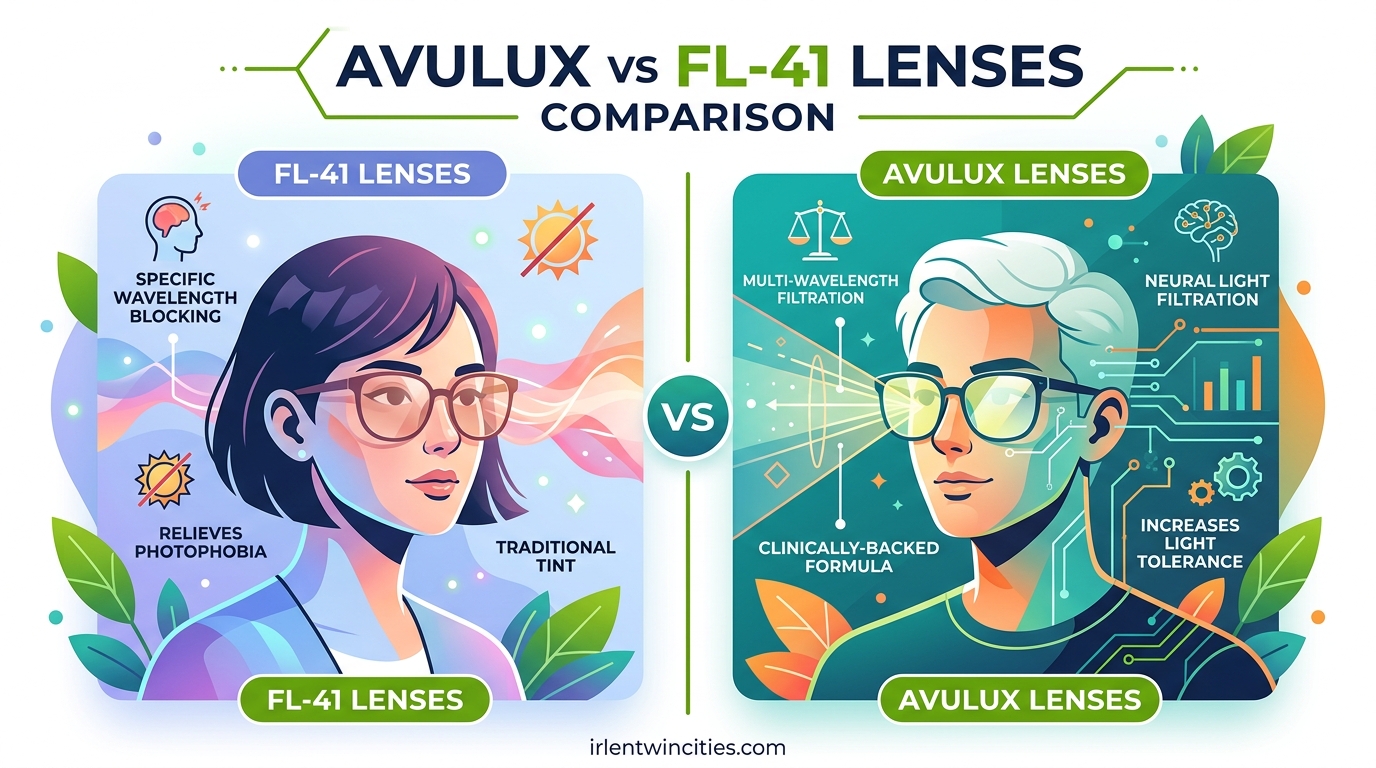
Living with light-triggered migraines means constantly hunting for shadows in a world designed for brightness. I spent three years experimenting with different lens technologies after fluorescent lights at my office started triggering weekly attacks. The Avulux vs FL-41 lenses comparison kept coming up in my research, yet most information came directly from manufacturers with obvious bias.
This guide breaks down exactly how these two precision tinted lens technologies differ. You will learn the specific wavelengths each filters, how they affect color perception, what clinical evidence supports each technology, and which situations favor one approach over the other. By the end, you will have a clear framework for choosing the right lens technology for your specific light sensitivity needs.
Table of Contents
What Are Precision Tinted Lenses for Migraine and Light Sensitivity?
Precision tinted lenses represent a specialized category of eyewear designed to filter specific wavelengths of light that trigger or worsen migraine attacks. Unlike standard sunglasses that simply dim all light, these lenses selectively block problematic wavelengths while allowing beneficial light through. The goal is reducing your trigger load without creating the problems associated with wearing dark lenses indoors.
Light sensitivity, also called photophobia, affects roughly 80% of people who experience migraines. For many, certain wavelengths act as direct triggers. Blue light around 480nm, amber light, and specific red wavelengths commonly cause problems. Meanwhile, research from Harvard Medical School and other institutions has identified green light in the 520-570nm range as potentially soothing for migraine sufferers.
The challenge lies in finding lenses that block the harmful wavelengths precisely without over-filtering the beneficial ones. This is where the technical differences between FL-41 and Avulux become critical. Both technologies attempt to solve this problem, but they approach it with fundamentally different filtering strategies.
FL-41 Lens Technology: The Original Migraine Tint
FL-41 lenses emerged from research conducted at the University of Birmingham in 1991. Researchers were investigating light sensitivity in patients with benign essential blepharospasm, a condition involving involuntary eyelid closure. During these studies, they discovered that a specific rose-tinted lens reduced both light sensitivity and migraine frequency in test subjects.
The FL-41 tint works as a single-band filtering solution. It blocks wavelengths below approximately 530nm while allowing longer wavelengths to pass through. This means it effectively filters blue light and most green light, along with some shorter amber wavelengths. The result is the distinctive pink or magenta appearance that makes FL-41 lenses immediately recognizable.
How FL-41 Handles Different Wavelengths
FL-41 lenses block approximately 80% of blue light in the 480nm range, which aligns well with the wavelengths known to trigger migraine attacks. They also filter roughly 60% of green light transmission. This aggressive green light blocking represents a significant difference from newer technologies.
The tint allows most amber and red wavelengths through with minimal filtering. This creates an interesting trade-off. While FL-41 effectively handles the blue light problem, it may filter out beneficial green light that emerging research suggests could actually help reduce migraine pain.
The Visual Experience of FL-41
Wearing FL-41 lenses transforms how you see the world. Everything takes on a warm, pinkish cast. This color distortion can be jarring initially. Many users report adjusting to the tint within a few days, but the color shift remains constant.
For some activities, this distortion creates practical problems. Photo editing becomes nearly impossible. Matching colors in clothing or decor becomes challenging. Screen work can feel strange as interfaces designed with white backgrounds appear distinctly pink. These limitations do not affect everyone equally, but they represent real constraints for daily use.
Avulux Lens Technology: Multi-Band Precision Filtering
Avulux entered the market as a fundamentally different approach to migraine lens technology. Rather than using a single broad-spectrum tint, Avulux employs patented multi-band precision filtering. This technology specifically targets the wavelengths research identifies as most problematic while deliberately preserving beneficial light.
The development of Avulux focused on identifying exactly which wavelengths trigger migraine attacks versus which ones might actually help. This precision approach resulted in lenses that look nearly neutral gray rather than dramatically tinted. For many users, this visual neutrality represents a significant quality-of-life improvement over traditional migraine tints.
How Avulux Handles Different Wavelengths
Avulux lenses employ a sophisticated filtering strategy that blocks specific wavelength bands while leaving others largely untouched. They filter light in the 470-520nm blue range and the 560-590nm amber to red-orange range. These specific bands align with the wavelengths most commonly implicated in light-triggered migraine attacks.
The critical difference lies in green light handling. Avulux allows approximately 70% of green light in the 520-570nm range to pass through. This contrasts sharply with FL-41, which blocks most green light. The decision to preserve green light transmission connects directly to research on green light therapy for migraine relief.
The Visual Experience of Avulux
Avulux lenses maintain much more natural color perception than FL-41. Rather than bathing everything in pink, these lenses present a neutral gray appearance that distorts colors far less dramatically. Most users report that screens, photos, and daily objects look essentially normal through Avulux lenses.
This neutrality extends to social situations. Many migraine glasses users feel self-conscious wearing obviously tinted lenses in professional or social settings. The near-normal appearance of Avulux lenses reduces this concern significantly. You can wear them in meetings, restaurants, or stores without drawing attention to your condition.
Avulux vs FL-41: Wavelength Blocking Comparison
Understanding the technical differences between these lenses requires examining exactly which wavelengths each technology filters. This comparison reveals why some users prefer one technology over the other based on their specific trigger patterns and visual needs.
| Wavelength Range | FL-41 Blocking | Avulux Blocking | Clinical Relevance |
|---|---|---|---|
| Blue (470-520nm) | ~80% | ~85% | Primary migraine trigger range |
| Green (520-570nm) | ~60% | ~30% | Beneficial soothing wavelengths |
| Amber (570-590nm) | ~20% | ~75% | Secondary trigger for some patients |
| Red (590-700nm) | Minimal | Moderate in 560-590nm | Less commonly problematic |
Blue Light: Similar Protection, Different Approaches
Both technologies handle blue light effectively. FL-41 blocks around 80% of blue wavelengths, while Avulux blocks approximately 85% in the 470-520nm range. For users whose primary triggers are blue light from screens and fluorescent lighting, both lenses provide substantial protection.
The difference lies in precision. FL-41 uses a broad approach that catches blue light but also affects adjacent wavelengths. Avulux targets the specific blue wavelengths most implicated in migraine while leaving nearby beneficial light largely untouched. This precision matters for users who find that complete blue blocking creates its own visual problems.
Green Light: The Critical Difference
The green light handling represents the most significant technical distinction between these technologies. FL-41 was developed before researchers understood green light’s potential benefits for migraine sufferers. It blocks approximately 60% of green light as a byproduct of its blue-blocking design.
Avulux deliberately preserves roughly 70% of green light transmission. This decision reflects research from institutions including Harvard Medical School and the University of Arizona showing that specific green wavelengths may actually reduce migraine pain intensity. By allowing these wavelengths through while blocking triggers, Avulux attempts to provide both protection and potential therapeutic benefit.
Color Perception and Visual Experience
Beyond the technical wavelength specifications, how these lenses affect daily visual experience represents a major differentiator for most users. The color distortion question comes up constantly in forum discussions about migraine glasses.
FL-41 Color Distortion Effects
FL-41’s distinctive pink tint affects everything you see. White surfaces appear distinctly rose-colored. Blues become muted or shift toward purple. Greens take on a yellowish cast. This transformation creates challenges for any activity requiring accurate color perception.
I tested FL-41 lenses for photo editing work and found them completely unusable for color-critical tasks. Matching paint colors, selecting coordinating fabrics, or even choosing ripe produce becomes noticeably harder. Some users adapt by removing the glasses for color-critical moments, though this exposes them to potential triggers.
Avulux Neutral Tint Advantages
Avulux lenses produce a near-neutral gray appearance that maintains far more natural color perception. While not perfectly transparent like clear lenses, the color shift is subtle enough that most daily activities proceed normally. Screen interfaces look essentially correct. Photos display accurately. Color matching remains possible.
This neutrality proves particularly valuable for professionals who need migraine protection without sacrificing visual accuracy. Graphic designers, photographers, architects, and anyone working with color-critical materials report that Avulux allows them to work while wearing protective lenses. FL-41 simply cannot match this capability.
Clinical Evidence and Research
Understanding the clinical support behind each technology helps inform realistic expectations about effectiveness. Both lenses have research backing, though the depth and recency of that research differs significantly.
FL-41 Research History
FL-41 benefits from over three decades of research history. The original 1991 University of Birmingham study established the tint’s effectiveness for blepharospasm and light sensitivity. Subsequent research through the 1990s and 2000s confirmed benefits for migraine prevention, with some studies showing 50% or greater reduction in attack frequency for certain patient populations.
However, much of the FL-41 research used relatively small sample sizes and varied methodologies. The research established that the tint helps many patients, but it did not precisely identify which wavelengths mattered most. Modern understanding of specific migraine-triggering wavelengths has evolved considerably since many of these studies were conducted.
Avulux Clinical Trial Data
Avulux has undergone more recent clinical testing, including a randomized, double-blind, placebo-controlled trial the company completed in 2026. This study specifically tested Avulux against clear placebo lenses in migraine sufferers exposed to light triggers. Participants wearing Avulux reported significantly reduced light sensitivity and migraine symptom severity compared to the placebo group.
The precision of modern Avulux testing reflects evolved understanding of migraine photophobia. Rather than simply testing whether a tint helps generally, researchers could target the specific wavelengths current science identifies as problematic. This creates more relevant clinical evidence for today’s understanding of migraine mechanisms.
Research Limitations
Both technologies face research limitations worth acknowledging. No large-scale head-to-head trial comparing FL-41 directly against Avulux exists. Most available studies test each lens against placebo or no intervention rather than against each other. Individual response to tinted lenses varies enormously based on specific trigger patterns, migraine type, and personal visual processing.
The absence of direct comparative trials means choosing between these technologies requires synthesizing available evidence about wavelength filtering, color perception, and individual needs rather than relying on definitive superiority data.
Use Case Recommendations
Different situations favor different lens technologies. Understanding when each excels helps optimize your light management strategy.
Indoor Lighting and Fluorescent Environments
Fluorescent and LED lighting in offices, schools, and retail spaces represents a primary trigger for many migraine sufferers. Both Avulux and FL-41 provide substantial protection in these environments. FL-41’s aggressive blue and green blocking offers strong protection against the harsh spike in blue wavelengths these lights emit.
Avulux similarly handles indoor lighting effectively while maintaining more natural color perception for reading printed materials, identifying objects, and interacting with screens. For extended indoor use, many users prefer Avulux precisely because the color distortion does not compound the fatigue of long workdays.
Computer and Screen Work
Digital screens emit significant blue light, making them a common migraine trigger. FL-41 provides strong blue blocking for screen protection, but the pink tint dramatically alters how interfaces appear. White backgrounds become rose-colored, which some users find fatiguing during extended sessions.
Avulux offers comparable blue light blocking with minimal color distortion. For users who spend hours daily on computers, this visual neutrality often proves decisive. You can wear migraine glasses continuously without the interface color shifts that FL-41 imposes.
Outdoor Use and Sunlight
Neither Avulux nor standard FL-41 lenses function as sunglasses for bright outdoor use. FL-41 does not provide sufficient light reduction for comfortable outdoor wear in bright conditions. Some manufacturers offer FL-41 with additional darkening for outdoor use, but standard indoor FL-41 lenses remain too light.
Avulux similarly focuses on indoor and moderate lighting conditions rather than bright sun exposure. For outdoor migraine protection, dedicated FL-41 outdoor lenses or standard high-quality sunglasses remain necessary regardless of which indoor technology you choose.
Driving Safety Considerations
Driving represents a specific use case requiring careful consideration. The question of whether you can drive with migraine glasses comes up frequently, and the answer differs by technology.
Avulux explicitly states their lenses are designed for driving use. The neutral gray tint preserves color accuracy needed for traffic signal recognition and road sign reading. The specific wavelength blocking targets migraine triggers without impairing the visual discrimination driving requires.
FL-41 lenses present more complexity for driving. The pink tint can alter traffic light appearance, potentially making certain signal colors harder to distinguish. Some FL-41 providers offer modified versions specifically for driving, but standard FL-41 tints may not meet legal requirements for driving eyewear in all jurisdictions. Check local regulations before driving with any tinted lenses.
Big Box Stores and Shopping
Large retail environments combine multiple migraine triggers: harsh fluorescent lighting, reflective surfaces, visual clutter, and often significant noise. Both lens technologies help manage the lighting component of this trigger load.
Many users report preferring Avulux for shopping precisely because the neutral appearance feels less conspicuous in public spaces. Wearing obviously pink-tinted glasses while navigating crowded stores can feel socially awkward. Avulux provides protection without the visibility that draws questions or stares.
The Green Light Therapy Connection
An emerging area of migraine research connects directly to the wavelength differences between these lens technologies. Understanding this research provides additional context for choosing between them.
Allay Lamp Research and Findings
Researchers at Harvard Medical School and the University of Arizona have investigated green light as a potential migraine therapy. Studies led by Dr. Rami Burstein demonstrated that narrow-band green light at specific wavelengths actually reduced headache intensity in migraine sufferers during attacks. This finding was surprising because it contradicted the assumption that all light worsens migraine.
The research evolved into products like the Allay Lamp, which emits pure narrow-band green light designed to provide relief during migraine attacks. Users report that exposure to this specific green light during an attack can reduce pain levels, offering a non-medication intervention option.
Why Green Light Matters for Migraine
The mechanism behind green light’s beneficial effects involves how different wavelengths activate neural pathways related to migraine pain. The thalamus and associated brain structures process light input differently depending on wavelength. Blue and certain red wavelengths activate pain pathways strongly. Specific green wavelengths produce less activation, potentially even exerting a calming effect.
This research suggests that completely blocking all green light, as FL-41 does, may actually eliminate a potentially beneficial wavelength from reaching the retina. Avulux’s decision to preserve roughly 70% of green light transmission reflects this understanding.
How Avulux Preserves Beneficial Green Wavelengths
Avulux specifically designed their transmission curve to filter the migraine-triggering wavelengths while preserving the 520-570nm green band associated with therapeutic benefits. This precision filtering was not possible with the simpler dye technology used in FL-41 development.
For users interested in both preventing attacks through trigger avoidance and potentially accessing green light’s therapeutic benefits, this wavelength preservation represents a meaningful advantage. The lens provides protection without completely eliminating exposure to wavelengths that may help.
Important Considerations and Warnings
Any tinted lens strategy for migraine management requires understanding potential risks and best practices. These warnings apply regardless of which technology you choose.
Dark Adaptation Risk from Over-Wearing Tinted Lenses
Wearing tinted lenses continuously, even light tints like FL-41 or Avulux, can cause dark adaptation. Your eyes become accustomed to the reduced light levels and may grow more sensitive when you remove the glasses. This creates a dependency cycle where you need the glasses more because you wear them constantly.
Research on dark adaptation suggests that limiting tinted lens wear to genuinely triggering environments, rather than all-day use, helps maintain natural light tolerance. Consider removing migraine glasses during low-risk activities to preserve your eyes’ natural adaptation capabilities.
When to Wear vs Remove Glasses
Strategic use of migraine glasses often proves more effective than constant wear. Put them on when entering fluorescent-lit environments, sitting down for extended screen work, or when you feel early migraine symptoms beginning. Remove them for outdoor walks in natural light, evening hours at home, and situations without known triggers.
This strategic approach reduces dark adaptation risk while maintaining protection where it matters. It also extends the lifespan of your migraine glasses by reducing unnecessary wear.
Transitioning Back to Normal Light Exposure
If you have been wearing tinted lenses extensively, transition gradually back to normal light exposure. Sudden removal after prolonged tinted lens use can feel overwhelming as your eyes readjust. Increase unprotected light exposure gradually over several days.
Some users find that spending time outdoors in natural light, without any tinted lenses, helps recalibrate their light tolerance. Natural light contains the full spectrum in balanced proportions, which may help restore healthy visual processing.
Consulting Healthcare Providers
Migraine glasses represent a management tool, not a cure. Work with your healthcare provider to integrate lens technology into a comprehensive migraine management plan. Medication, lifestyle modifications, trigger identification, and other interventions remain important regardless of which lenses you choose.
An optometrist or neuro-ophthalmologist familiar with light sensitivity can help evaluate whether tinted lenses are appropriate for your specific condition. Some underlying conditions may require different approaches or contraindicate certain tints.
Frequently Asked Questions
Which is better FL-41 tint or Avulux lenses?
Neither technology is universally superior. FL-41 works well for users who need aggressive blue and green blocking and do not mind color distortion. Avulux suits users prioritizing natural color perception, driving safety, and green light preservation. Your specific trigger patterns and lifestyle needs determine which fits better.
Can I drive with Avulux glasses?
Yes, Avulux explicitly designs their lenses for driving use. The neutral gray tint preserves traffic signal color recognition and meets requirements for driving eyewear in most jurisdictions. Always verify local regulations, but Avulux provides safer driving vision than FL-41’s pink tint.
Do FL-41 glasses work for migraines?
FL-41 glasses have decades of research showing they help many migraine sufferers, particularly those with light sensitivity. Studies show 50% or greater reduction in attack frequency for some users. However, individual results vary significantly based on specific trigger wavelengths and migraine type.
Are Avulux glasses covered by insurance?
Insurance coverage for Avulux varies by provider and plan. Some vision insurance plans cover tinted lenses with a medical necessity diagnosis from your doctor. Flexible spending accounts and health savings accounts typically cover prescription migraine glasses. Contact your insurance provider directly to confirm coverage.
What is the difference between FL-41 and Avulux?
The main differences are: wavelength filtering approach (FL-41 uses single-band, Avulux uses multi-band precision), color perception (FL-41 is pink, Avulux is neutral gray), green light handling (FL-41 blocks ~60%, Avulux transmits ~70%), and visual applications (Avulux works for driving and color-critical work better than FL-41).
Which migraine glasses are best for light sensitivity?
The best migraine glasses depend on your specific situation. For aggressive light blocking without concern for color accuracy, FL-41 works well. For balanced protection with natural vision and driving capability, Avulux may suit better. Consider your trigger environments, visual needs, and whether color perception matters for your daily activities.
Conclusion: Choosing Between Avulux and FL-41
The Avulux vs FL-41 lenses comparison ultimately comes down to your priorities. FL-41 offers proven technology with decades of use, aggressive blocking of blue and green light, and the distinctive pink appearance that signals serious migraine protection. Avulux provides precision multi-band filtering, natural color perception, driving safety, and green light preservation that connects to emerging therapeutic research.
For users who need maximum light blocking above all else and do not mind color distortion, FL-41 remains a solid choice. For those who want migraine protection without sacrificing normal visual function, driving capability, and color accuracy, Avulux offers meaningful advantages.
Whichever technology you choose, remember that migraine glasses are one tool in a broader management strategy. Use them strategically to avoid dark adaptation, combine them with other interventions, and work with healthcare providers to optimize your approach to light sensitivity.