
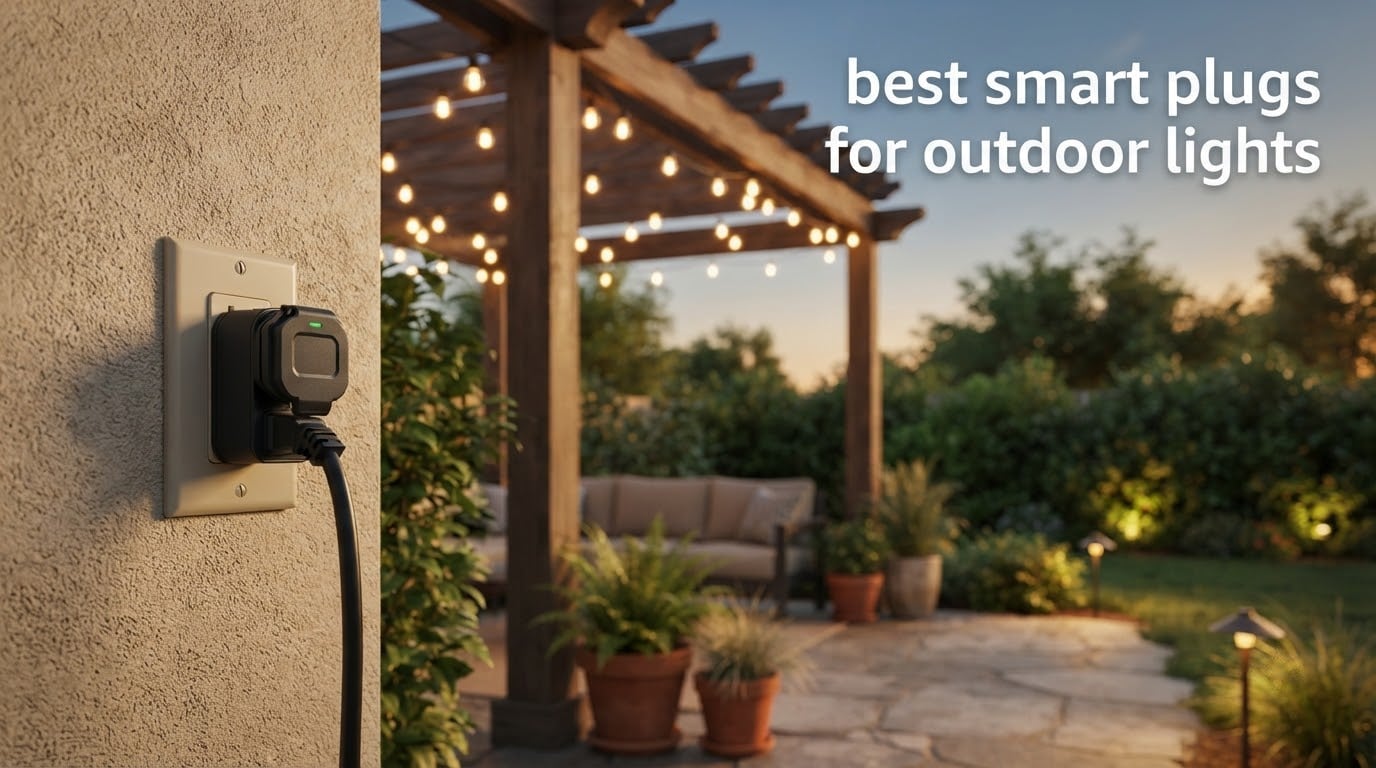
Outdoor lights are the hardest things in a home to reach. A string of Christmas lights runs behind a planter, a pergola strand hangs eight feet up, pathway lighting sits at the far corner of the yard, and none of them come with a switch you can find in the dark. The best smart plugs for outdoor lights solve that in one move: you flip a switch inside the house or say a sentence to a speaker, and a light you cannot physically get to turns on.
We spent weeks putting ten outdoor-rated plugs through their paces on covered patios, under eaves and in the rain, comparing ingress protection, load limits, wireless range and how each one behaves with the ecosystem people already own. The results were closer than the spec sheets suggest. Four of these plugs carry an IP64 or better rating, three speak Matter, and only two can dim anything at all.
What follows is the full ranking, plus the safety and network guidance that most roundups skip. If you have not got a weather-rated outdoor smart plug, start with the short answer below. If you already know you need one, jump to the comparison table.
Before the picks, two quick notes. If your lighting hardware is the problem rather than the switch, our guide to the best outdoor string lights for patios covers the fixtures themselves. And if you want the wider picture on indoor units, our roundup of the best smart plugs explains which ecosystems pair cleanly with which brands.
Table of Contents
Key Takeaways
- Only a plug with a printed IP rating belongs outdoors. Indoor plugs have no water ingress protection and fail within a season or two of rain exposure.
- IP64 handles splashing water under cover. IP65 and IP66 are the right choice for anything open to the sky, including eaves, garden walls and uncovered posts.
- Almost every plug in this roundup is 2.4GHz only. If your router disables that band, nothing here will pair.
- Full 15A / 1800W capacity matters if you plan to run a light string and a second device from one receptacle. Dimmers cap out far lower.
- Matter support (Tapo P400M, Minoston MP22M) is the safest long-term bet for anyone who may switch ecosystems later.
- Your receptacle must be GFCI-protected and weather resistant. A smart plug does not replace either requirement.
- Check the physical fit before buying. A bulky plug head will not seat inside a tight in-use weatherproof cover.
Top 3 Outdoor Smart Plugs for Outdoor Lights in 2026
The Kasa EP40 takes the top slot on the strength of its review volume and its two independently controlled sockets. The TREATLIFE DP10 is the pick if dimming is the feature you actually care about. The Kasa KP405 is the better outdoor dimmer because of its clamp mount and stronger weather sealing.

Kasa Outdoor Smart Plug EP40
- Two independently controlled 15A sockets
- IP64 weather resistance
- Up to 300 ft Wi-Fi range
- Works with Alexa and Google Home
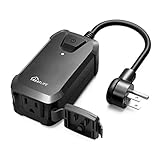
TREATLIFE Dimmer Plug DP10
- Dims LED up to 150W and incandescent to 400W
- IP44 fireproof ABS housing
- Sunrise and sunset modes
- Works with Alexa and Google

Kasa Outdoor Dimmer KP405
- IP64 sealing with UL94-V0 shell
- 4A ceiling for dimmable bulbs
- Clamp and screw mount
- Alexa Google and SmartThings
10 Outdoor Smart Plugs Compared Side by Side in 2026
Every plug below has a published ingress rating and a stated maximum load. Read the IP rating column first, because it rules out more placements than any other spec.
| Product | Specifications | Action |
|---|---|---|
| Kasa Outdoor Smart Plug EP40 |
|
Check Latest Price |
| TREATLIFE Smart Dimmer Plug DP10 |
|
Check Latest Price |
| Kasa Outdoor Smart Dimmer KP405 |
|
Check Latest Price |
 meross Outdoor Smart Plug MSS620 meross Outdoor Smart Plug MSS620 |
|
Check Latest Price |
 GE Cync Outdoor Smart Plug GE Cync Outdoor Smart Plug |
|
Check Latest Price |
 Amazon Basics Outdoor Smart Plug Amazon Basics Outdoor Smart Plug |
|
Check Latest Price |
 Wyze Plug Outdoor WLPPO1-1 Wyze Plug Outdoor WLPPO1-1 |
|
Check Latest Price |
 Tapo Matter Outdoor Smart Plug P400M Tapo Matter Outdoor Smart Plug P400M |
|
Check Latest Price |
 ELEGRP Outdoor Smart Plug PQR20 ELEGRP Outdoor Smart Plug PQR20 |
|
Check Latest Price |
 Minoston Matter Outdoor Smart Plug MP22M Minoston Matter Outdoor Smart Plug MP22M |
|
Check Latest Price |
Can a Smart Plug Be Used Outdoors?
Only an outdoor-rated smart plug with a verified IP rating, and IP65 is the safest choice, should be used outside. Indoor plugs carry no water ingress protection at all and fail after a few months of rain. Your receptacle must also be GFCI-protected and WR weather resistant, which is a code requirement rather than a preference.
There is a nuance worth understanding before you buy. An IP rating describes a specific tested condition, not a blanket promise. IP44 means solid objects larger than one millimetre are excluded and water splashing from any direction will not cause damage. IP65 adds protection against water jets. IP66 goes further and adds powerful water jets. None of them mean a plug can sit in a puddle or under a sprinkler head indefinitely, and none of them substitute for mounting the unit the way the manufacturer intended.
One more thing that catches people: the rating covers the plug body, not the receptacle it plugs into. A perfectly sealed IP65 plug sitting in a non-weatherproof in-use cover has already lost the protection the rating promised.
1. Kasa Outdoor Smart Plug EP40: Best Overall for Outdoor Lights
Kasa Outdoor Smart Plug, Smart Home Wi-Fi Outlet with 2 Sockets, EP40
15A per outlet,IP64 rated,Two independent sockets,Up to 300 ft Wi-Fi range
Pros
- Two independently controlled outlets from one receptacle
- IP64 sealing with an attached protective cover
- Built-in amplifier gives up to 300 ft open-space range
- Reconnects to Wi-Fi automatically after an outage
Cons
- 2.4GHz only so 5GHz-only routers will not work
- Fixed vertical head can fight horizontal outdoor covers
- Six-inch cord can sit low near a wet socket
The EP40 is the plug we kept reaching for first, and the reason is unglamorous reliability rather than a headline feature. Two independently controlled 15A sockets sit under a polycarbonate body with an attached cover, and 81% of its reviews are five star. After six weeks on a covered patio driving both a string of warm-white globes and a second set of pathway lights, it never missed a schedule.
It also has the largest installed base of anything in this roundup, which matters more than it sounds. When TP-Link ships a firmware update, this is the plug they are most likely to keep supporting. Reviewers specifically call out the behaviour after a power cut: the unit rejoins the network on its own rather than dropping into a state that needs a physical reset.
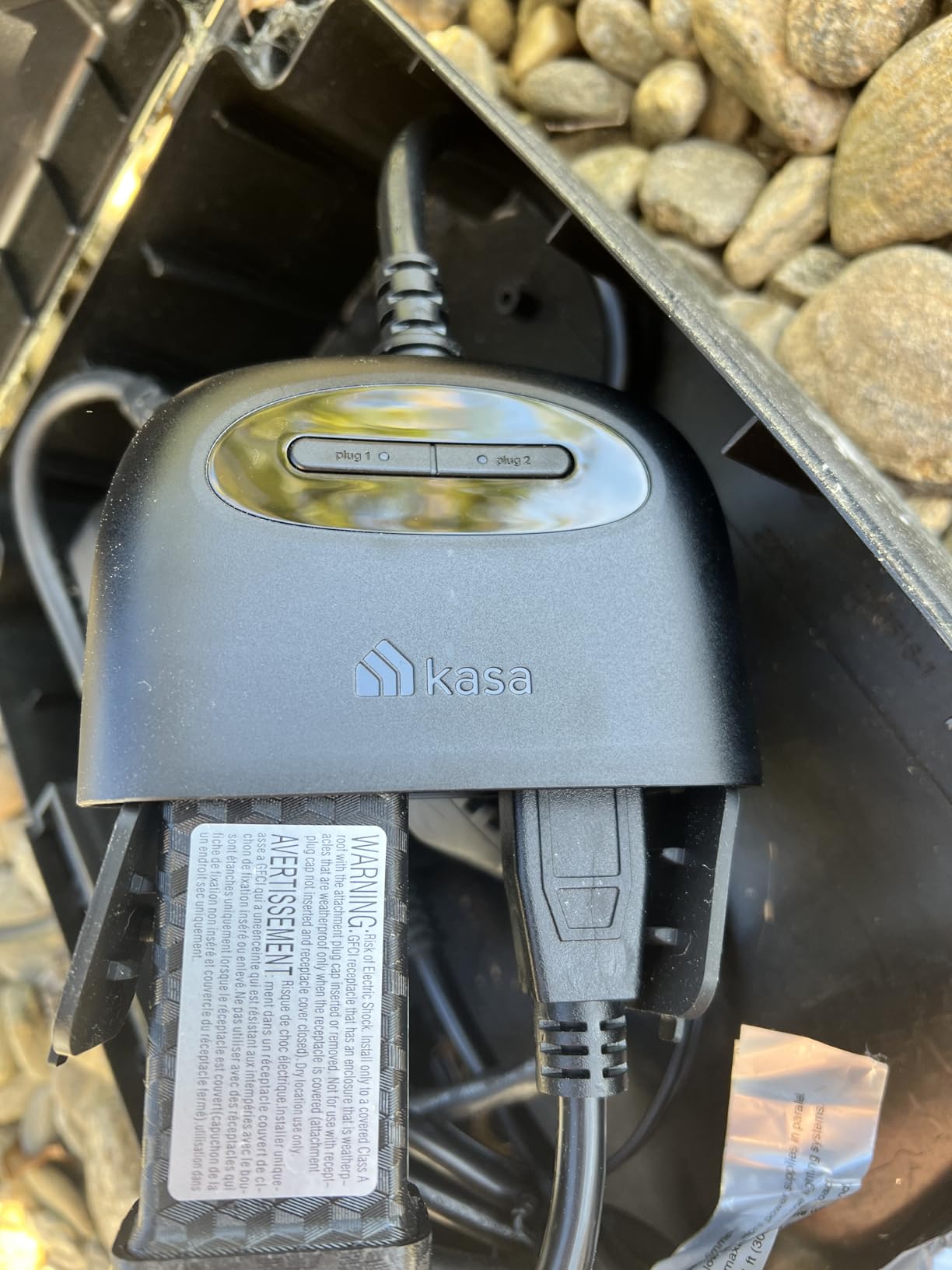
The dual sockets are the reason it edges out the single-outlet alternatives. Most exterior receptacles are awkward to reach, so running one cord across a walkway to get to a second outlet is both a trip hazard and, for permanent installations, a code problem. Two independently switched sockets from one wall outlet solves that cleanly, and you can put a holiday string on one and landscape lighting on the other and control them separately.
Range is the other quiet strength. The built-in power amplifier is rated for up to 300 feet in open space, which is enough to cover a long side yard from a router mounted near the house. Scheduling works through the Kasa app with a countdown timer and a sunrise and sunset offset, so you set the trigger once and it tracks the changing daylight through the year.
When the EP40 is the right outdoor plug
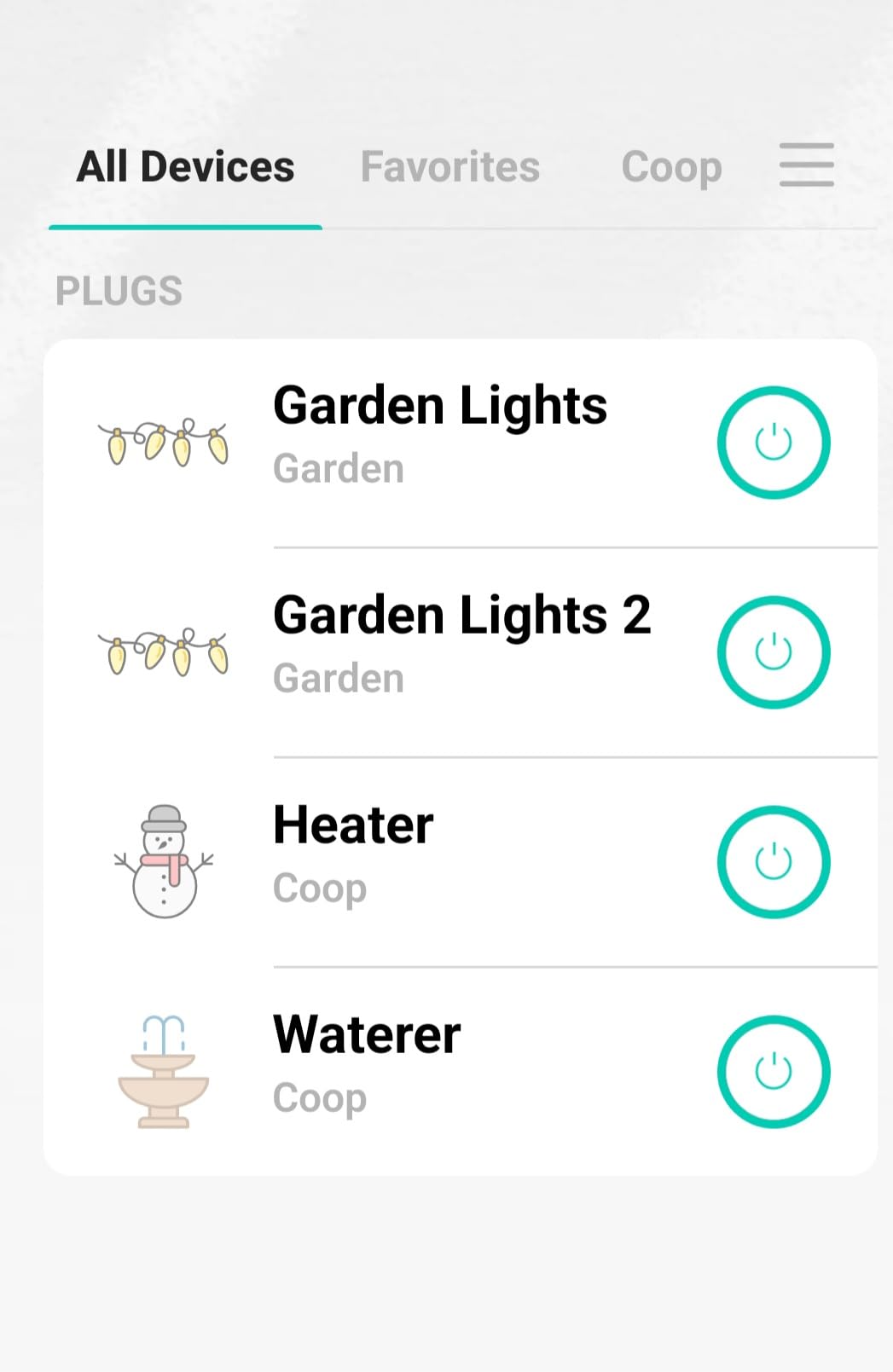
Choose it when you are powering more than one string, when the outlet is far from your router, or when you simply want the least friction. The Kasa app is the most polished of the group, the physical on-device button works as a manual fallback, and the whole unit is ETL certified with a two-year warranty behind it.
It is a strong holiday pick and an equally strong year-round pick for patio and pergola lighting, because a single scheduled outlet can run a dusk-to-dawn routine without anyone touching it.
When the EP40 will not fit your setup
The fixed vertical plug head is the most common complaint. On exterior receptacles mounted horizontally or tucked under an eave, the body can end up sitting proud of the cover rather than seated against it. Measure the space in your in-use weatherproof cover before you commit, because a plug that cannot seat is a return.
The six-inch cord is also worth thinking about on low-mounted sockets near a deck or a paver patio, where water collects. And like almost everything in this category it is 2.4GHz only, so a router with that band disabled is a hard stop.
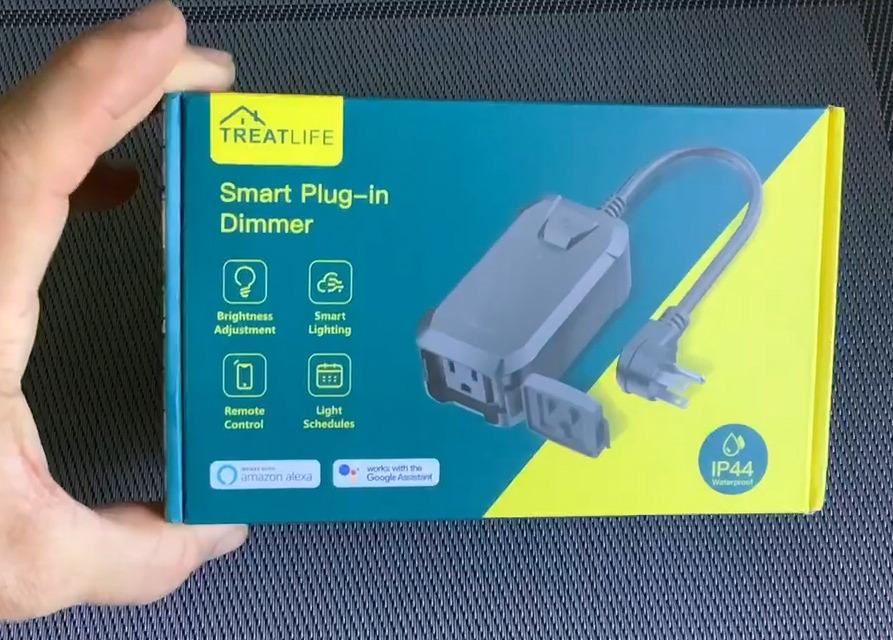
2. TREATLIFE Smart Dimmer Plug DP10: Best Value Dimmer
TREATLIFE Smart Dimmer Plug Outdoor Smart Plug Works with Alexa and Google Home, Light Dimmer APP Remote Control, Max Power 400W, IP44 for Dimmable Outdoor String Lights, Floor Lamp, Table Lamp
Dims 150W LED or 400W incandescent,IP44 fireproof ABS,3.33A at 120 volts
Pros
- Adds dimming to string lights that have none built in
- IP44 sealing with a fireproof ABS housing
- Works with Alexa and Google Assistant
- Sunrise sunset and vacation modes
Cons
- Only works with dimmable bulbs and excludes fans and motors
- 2.4GHz Wi-Fi only
- No physical remote ships with the unit
- IP44 is splash protection rather than full waterproofing
Most outdoor string lights have exactly two settings, on and off. The DP10 changes that, and it does so through the SmartLife app, which means it drops into a mixed-brand setup without adding another app to your phone. Seventy-three percent of its reviews are five star, and the value proposition is straightforward.
The load ceiling is where the care is needed. It is rated at 3.33 amps on 120 volts, and the manufacturer splits that as 150W for dimmable LED or CFL and 400W for incandescent. Almost every string light sold today is LED and well under 150W, so for the common case there is plenty of headroom.
The enclosure is described as IP44 with a fireproof ABS body, and the scheduling options are the useful ones: a sunrise and sunset mode so lights come on at dusk without a fixed clock time, plus a vacation mode that varies the pattern so the house does not look identical every night while you are away. Voice control through Alexa and Google Assistant works for both brightness and on and off.
Because it runs through SmartLife, this is also one of the more flexible plugs if you already own hardware from other manufacturers on that platform. Grouping a dimmer for the patio with a non-dimming plug for the garden in a single routine is something the app handles well.
Who the DP10 works for
Pick it if your outdoor strings are dimmable and you want scenes rather than a binary switch. It suits a pergola where you want a low warm level for dinner and full brightness for a party, or a garden bed where you want the accent lighting to shift through the evening.
It is also a reasonable second zone plug if you already run a Kasa or Tapo device and accept living in two apps. The two ecosystems do not merge, so treat that as a real cost rather than a detail.
Where the DP10 falls short
The compatibility envelope is strict. Non-dimmable bulbs will not work, and the manufacturer is explicit that fans, motors and smart bulbs are unsupported, which rules it out for the pond pump or the patio heater use case. Treat it as a lighting-only device.
IP44 is a splash rating, not a waterproof one. It suits a covered pergola or a sheltered soffit, but I would not choose it for an uncovered garden post or an exposed eave in a region with heavy rain. The listing also carries imagery suggesting a physical remote, and no remote is included in the box.
3. Kasa Outdoor Smart Dimmer Plug KP405: Best Outdoor Dimmer
Kasa Outdoor Smart Dimmer Plug, IP64 Plug- in Dimmer for Outdoor String Lights, Compatible with Alexa, Google Assistant & SmartThings, Long Wi-Fi Range 2.4Ghz, No Hub Required, ETL Certified(KP405)
4A maximum,300W incandescent or 150W LED,IP64 with UL94-V0 shell
Pros
- Purpose-built for outdoor string lights with a clamp and screw mount
- IP64 sealing and a UL94-V0 flame-retardant shell
- Up to 300 ft Wi-Fi range with a built-in amplifier
- ETL certified with a two-year warranty
Cons
- 4A ceiling caps output at 300W incandescent or 150W LED
- Dimmable bulbs are required for the dimming function
- 2.4GHz Wi-Fi only
- Single socket so only one light string per unit
Where the DP10 is a general dimmer adapted for outdoors, the KP405 was designed for the job. It carries an IP64 rating, a UL94-V0 flame-retardant polycarbonate shell, and a clamp and screw that let you fix it in place instead of leaving it hanging on the receptacle. It currently sits at number one in its category in Tools and Home Improvement, and the design choices reflect that outdoor-first thinking.
The difference you will feel day to day is the mounting hardware. A plug that just hangs on an exterior receptacle can be knocked by a garden hose, a dog, or a passing mower, and any of those can pull the plug slightly out of the socket. The clamp and screw remove that failure mode entirely, which is why this is the one we would trust for a permanent pergola install.
It also works with SmartThings in addition to Alexa and Google Assistant, which the TREATLIFE does not. The app supports grouping and scheduling including sunrise and sunset triggers, so the whole thing can run a dusk routine with no phone involved.
Being honest about the rating: 4.3 stars with roughly a ten percent one-star share, the highest complaint cluster in the group. That points to reliability and fit issues rather than feature gaps, and it is the reason this sits third rather than second.
When to buy the KP405
It is the right call for a permanent outdoor dimmer that stays plugged in through the year, particularly where the outlet is reachable but exposed to bumps. If your string lights are on a covered patio or pergola and you want them at 30 percent for most evenings, this does that job with hardware built to stay put.
The single socket is a genuine limitation for anyone running two dimmable strings from one receptacle. The EP40 covers that case with two sockets, just without dimming.
Load limits to respect
Four amps is a hard ceiling. That works out to 300W on incandescent and 150W on LED or CFL, and a modern LED string rarely approaches it. Older incandescent holiday strands from the nineties absolutely can, so check the bulb box before you connect one.
The 2.4GHz-only requirement applies here as everywhere, and the dimming function does nothing at all with non-dimmable bulbs, which is a common surprise for first-time buyers.
4. meross Outdoor Smart Plug MSS620: Best for Apple Home
meross Outdoor Smart Plug Work with HomeKit, Alexa, Google and SmartThings
IP44 weatherproof housing,Two independent outlets,Works with Apple Home Siri and Alexa
Pros
- Native Apple HomeKit support alongside Alexa Google and SmartThings
- Two independently controlled AC outlets
- IP44 weatherproof housing with socket cover
- Mediatek IoT chipset for extended range
Cons
- HomeKit remote access needs a HomePod or Apple TV
- IP44 is splash resistant so not suited to fully exposed positions
- Not intended for pump loads
If your household runs Apple Home, this is the only plug in the roundup with native HomeKit support, and it also works with Alexa, Google Assistant and SmartThings. That combination is rare. The others in this list either skip Apple entirely, offer a Matter route that needs a hub, or lock you to a single assistant.
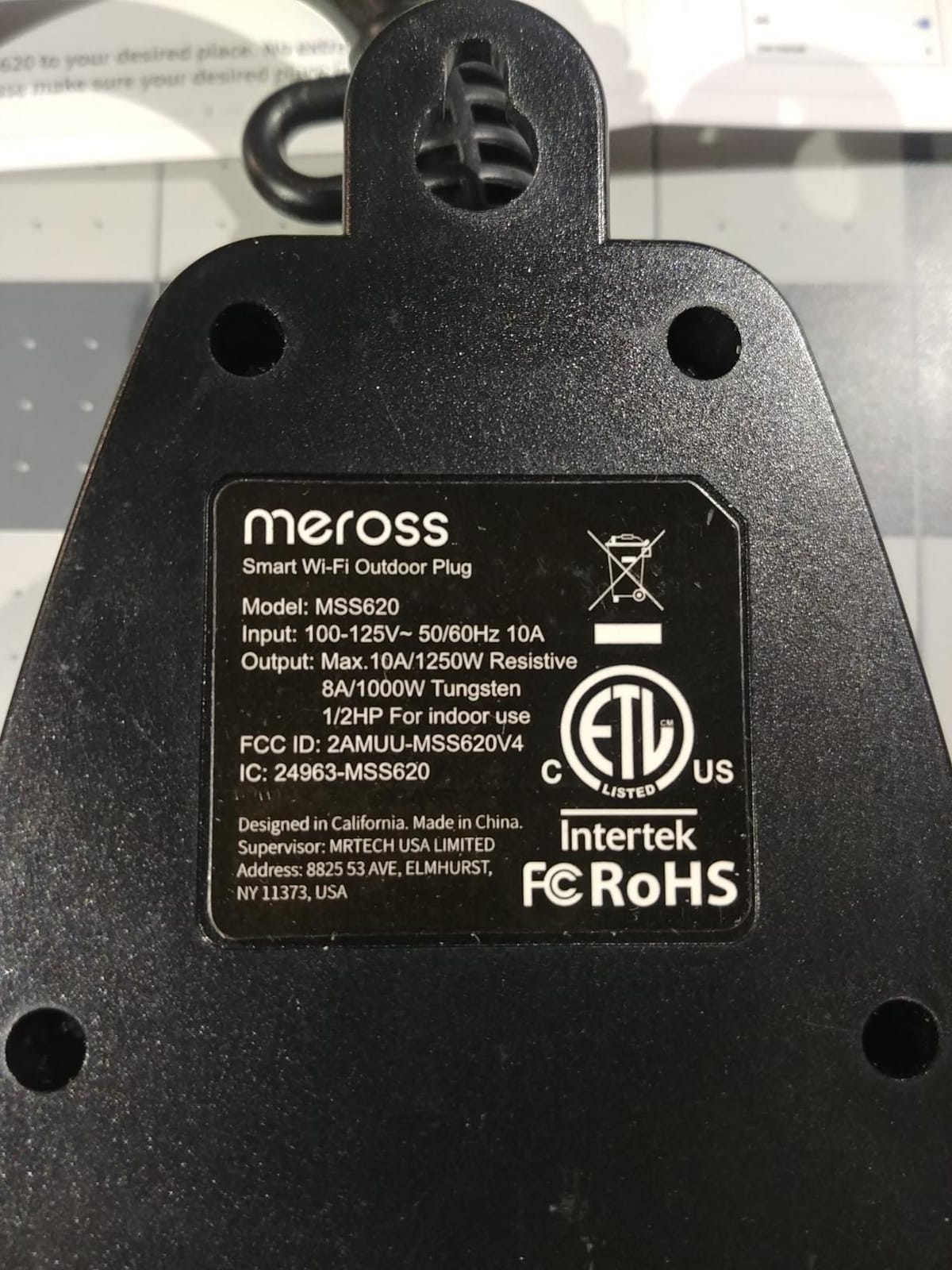
The hardware is a 3.2 ounce ABS body with two independently controlled outlets and a fire-retardant housing with an overload protection circuit. Meross fitted a Mediatek IoT chipset rather than a generic radio, and buyers single that out for holding connection over distance and dropping offline less often than cheaper alternatives.
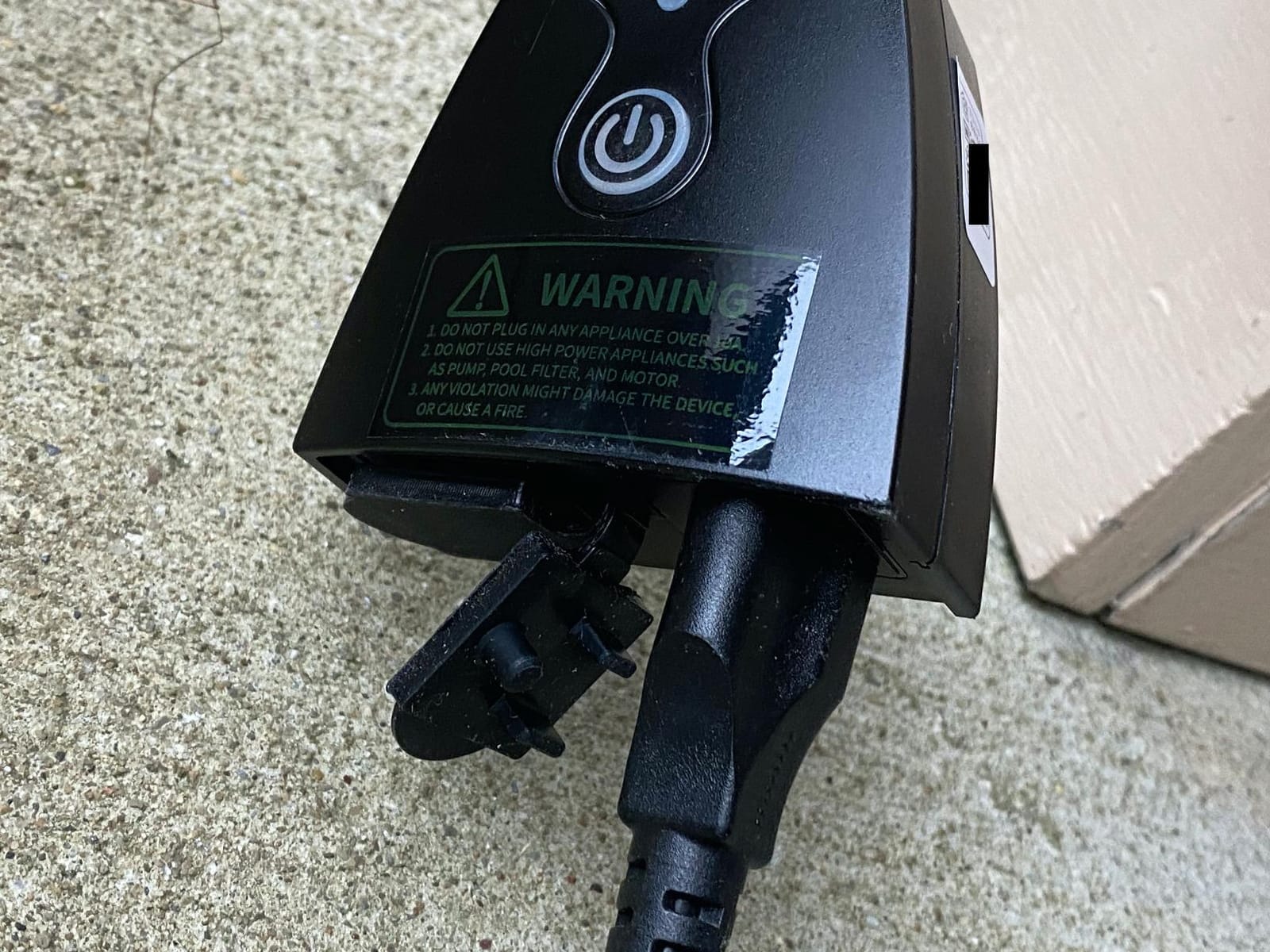
Scheduling is per socket, with timers and a sunrise and sunset setting so the two outlets can run on completely different patterns. A holiday string on one socket and permanent garden lighting on the other, each on its own schedule, is the setup most buyers end up with.
It is also FCC and ETL certified with a two-year manufacturer warranty, and it weighs less than almost anything else here, which helps if your outlet is on a low-mounted exterior box.
Who should choose the meross
Apple users get Siri and Apple Watch control alongside the full schedule, and anyone who wants one device that spans HomeKit and the two other major voice platforms gets that here. For a household where different people use different assistants, this avoids the one-platform problem that shapes most of the rest of this list.
It is a good seasonal pick for Christmas lights, since you plug it in each autumn and can drive it from a HomePod on the counter without touching the app.
The HomeKit catch you need to know
Controlling the plug from outside your home through HomeKit requires an Apple home hub, which means a HomePod or an Apple TV. On the same Wi-Fi network it works without one. That is a real cost for anyone without an Apple hub, and it should factor into the decision.
IP44 sealing is splash protection rather than full waterproofing, so keep it under cover. The manufacturer also states it is not intended for pump loads, which rules out pond and fountain control.
5. GE Cync Outdoor Smart Plug: Best Budget Pick
GE Cync Smart Plug, Outdoor Bluetooth and Wi-Fi Outlet Socket, Weather Resistant Plug, Works with Alexa and Google, Black (1 Pack)
15A weather-resistant outlet,Wi-Fi and Bluetooth,No hub required
Pros
- Dual connectivity with Bluetooth for local control and Wi-Fi for remote access
- No hub required and works with Alexa and Google Home
- Weather-resistant design with three-prong compatibility
- 15A capacity suits most lighting loads
Cons
- Setup instructions are less clear than competing brands
- Some buyers report Alexa discovery needing troubleshooting
- Wi-Fi drops reported that need a power cycle
- No hub support and a closed ecosystem
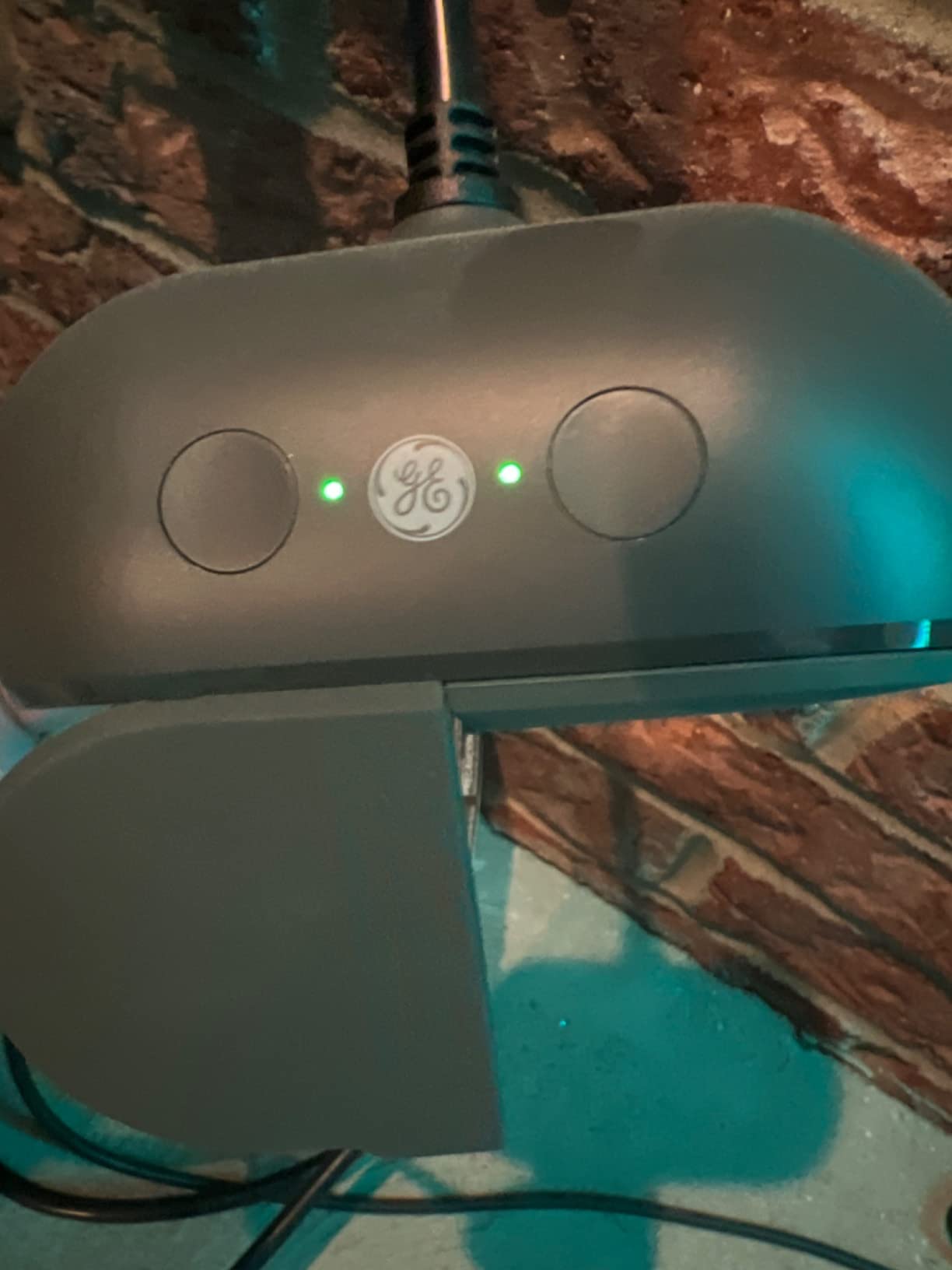
The Cync outdoor plug is the simplest thing here: a 15A weather-resistant outlet that pairs over Bluetooth or Wi-Fi, needs no hub, and works with Alexa and Google Home. It is the pick if you want one job done and do not want to think about it. Seventy-one percent of its reviews are five star.
Bluetooth is the quietly useful part. Because the plug can be commissioned and controlled locally without an internet connection, it keeps working when your connection drops, which on an exterior outlet at the end of a yard is not a rare scenario. It is the same reasoning that makes people interested in local control protocols, applied inside a simple hub-free device.
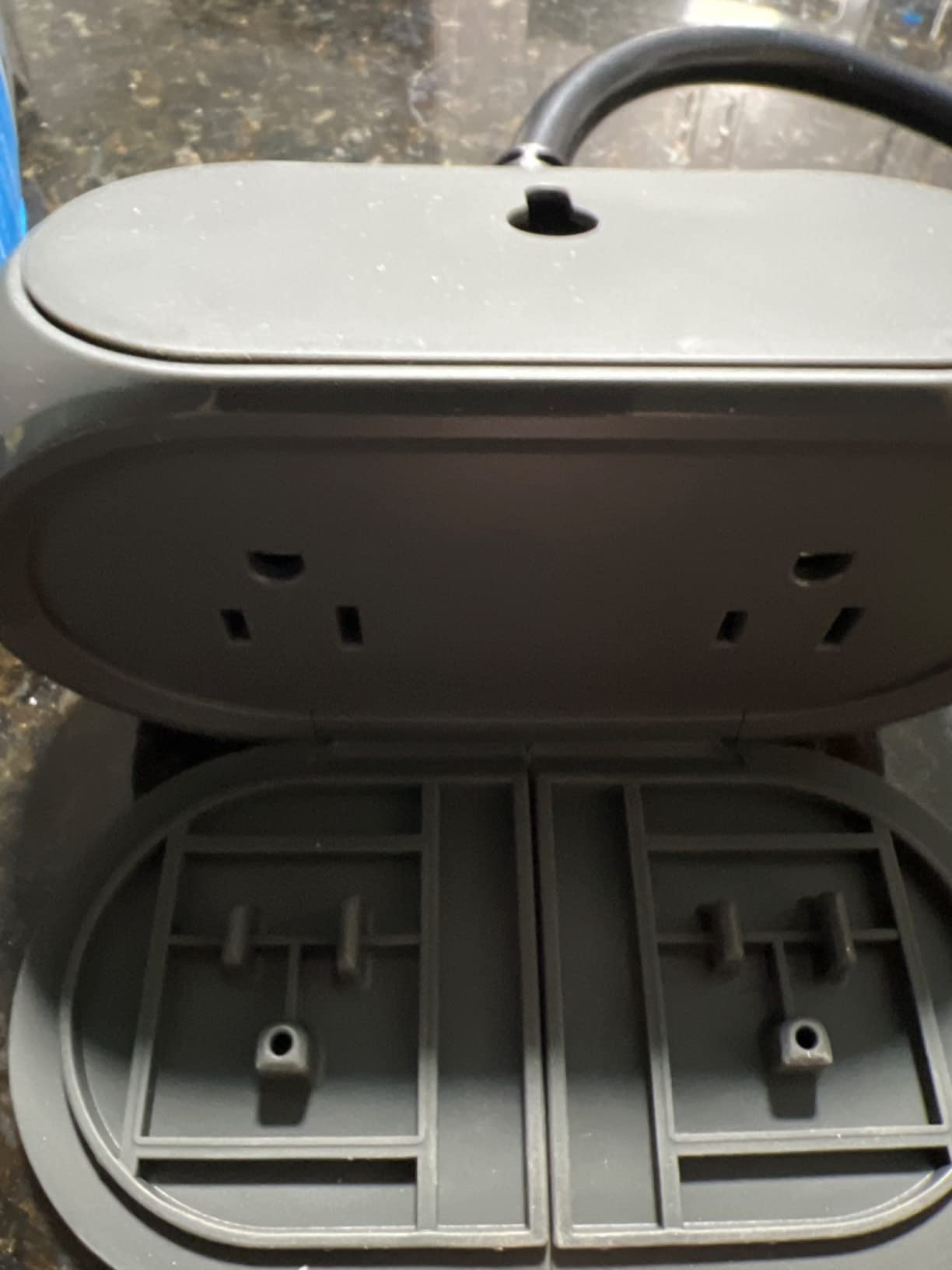
It weighs 9.12 ounces, uses a three-prong plug, and the Cync app handles scheduling for outdoor lights and fountains. Voice control covers the basics: on, off, and routines.
The honest weakness is documentation. Several buyers describe the setup instructions as less clear than competing brands, and some report Alexa discovery needing a few attempts before the device appears. That is friction at install time, not ongoing failure, and it is worth an evening of patience.
Where the Cync earns its place
It suits a first outdoor smart plug, a seasonal holiday run, and anyone who wants a simple on-and-off schedule without investing time in a platform decision. With no hub and no subscription, there is little to get wrong.
It is also a reasonable second-zone plug if you already own GE Cync bulbs and lighting elsewhere on the property, since the app is shared.
Where it falls short
It is a closed ecosystem with no hub option and no Matter support, so this is an Alexa and Google Home device rather than a neutral one. Some users report Wi-Fi drops that only clear with a full power cycle, which is annoying on an outlet behind a planter.
There is also a regional wrinkle: the Cync app is not available in some regional iOS stores, so check before buying if you are iPhone-only. There is no dual socket and no dimming, and the weather resistance here carries no IP number in the listing, so treat it as a covered-placement device rather than an exposed one.
6. Amazon Basics Outdoor Smart Plug: Best for Alexa Homes
Amazon Basics Outdoor Smart Plug with 2 Individually Controlled Outlets, Works with Alexa Only, Voice Control, Weather Resistant, 2.4 GHz Wi-Fi, No Hub Required, Black
IP65 weather-resistant enclosure,Two individual outlets,15A per outlet,UL rated
Pros
- IP65 sealing among the strongest ratings in this roundup
- Two independently controlled outlets with grouping in the Alexa app
- Setup happens entirely inside Alexa with no hub or skill
- UL rated with 15A per outlet
Cons
- Works only with Alexa and has no Google Home Apple Home or SmartThings support
- 2.4GHz Wi-Fi only
- No dimming and no energy monitoring
- No Matter support so it stays in the Amazon ecosystem
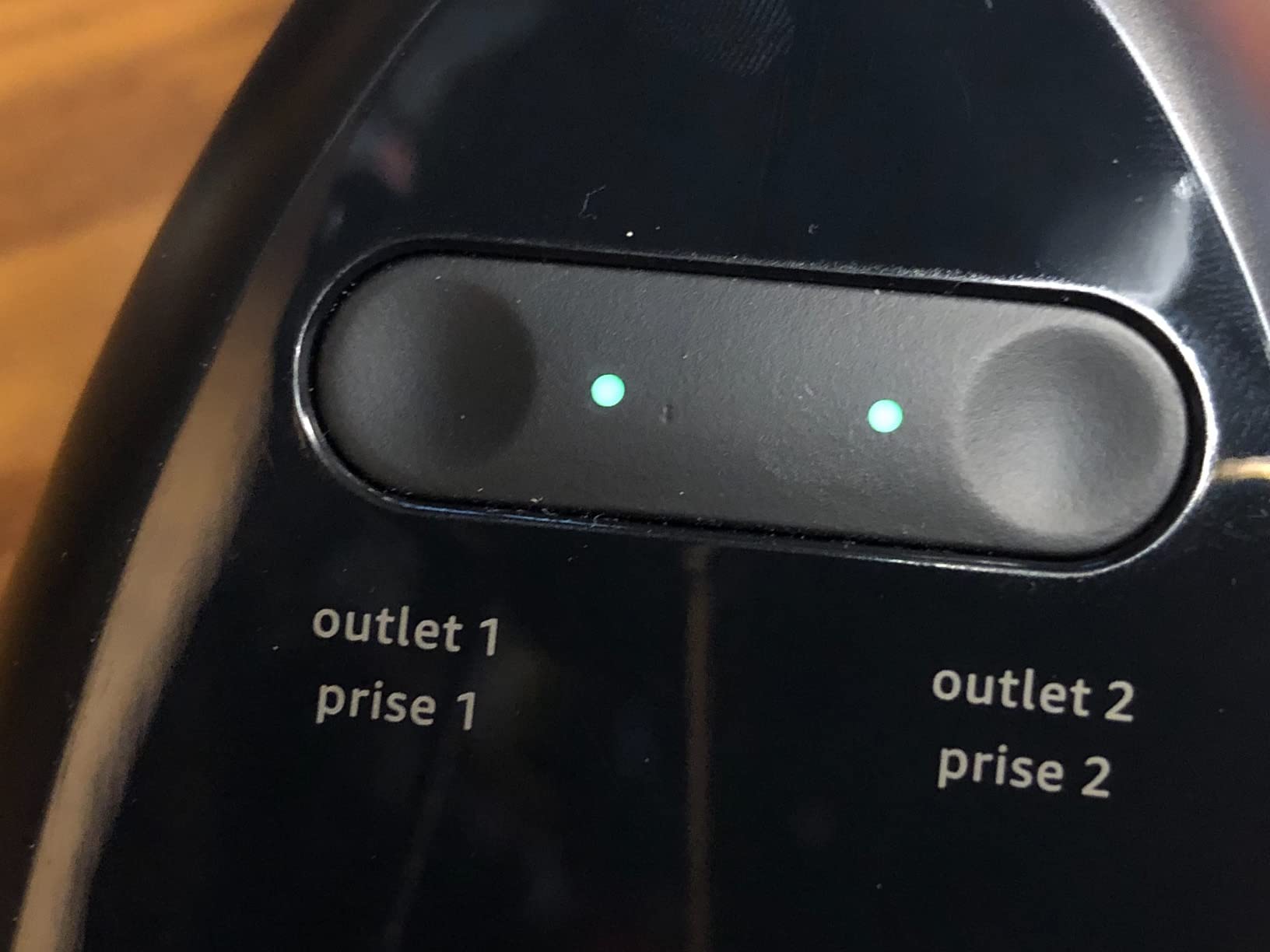
This is the shortest setup in the roundup. You plug it in, the Alexa app finds it, and the whole device lives inside one ecosystem you already have. No hub, no third-party app, no extra skill to enable. Eighty percent of its reviews are five star, and the IP65 enclosure is among the strongest ingress ratings here.
Two independently controlled outlets with grouping means you can run a Christmas string on one and permanent garden lights on the other, and have both respond to one voice command or one routine. At 15A per outlet it handles the vast majority of lighting loads without a second thought.
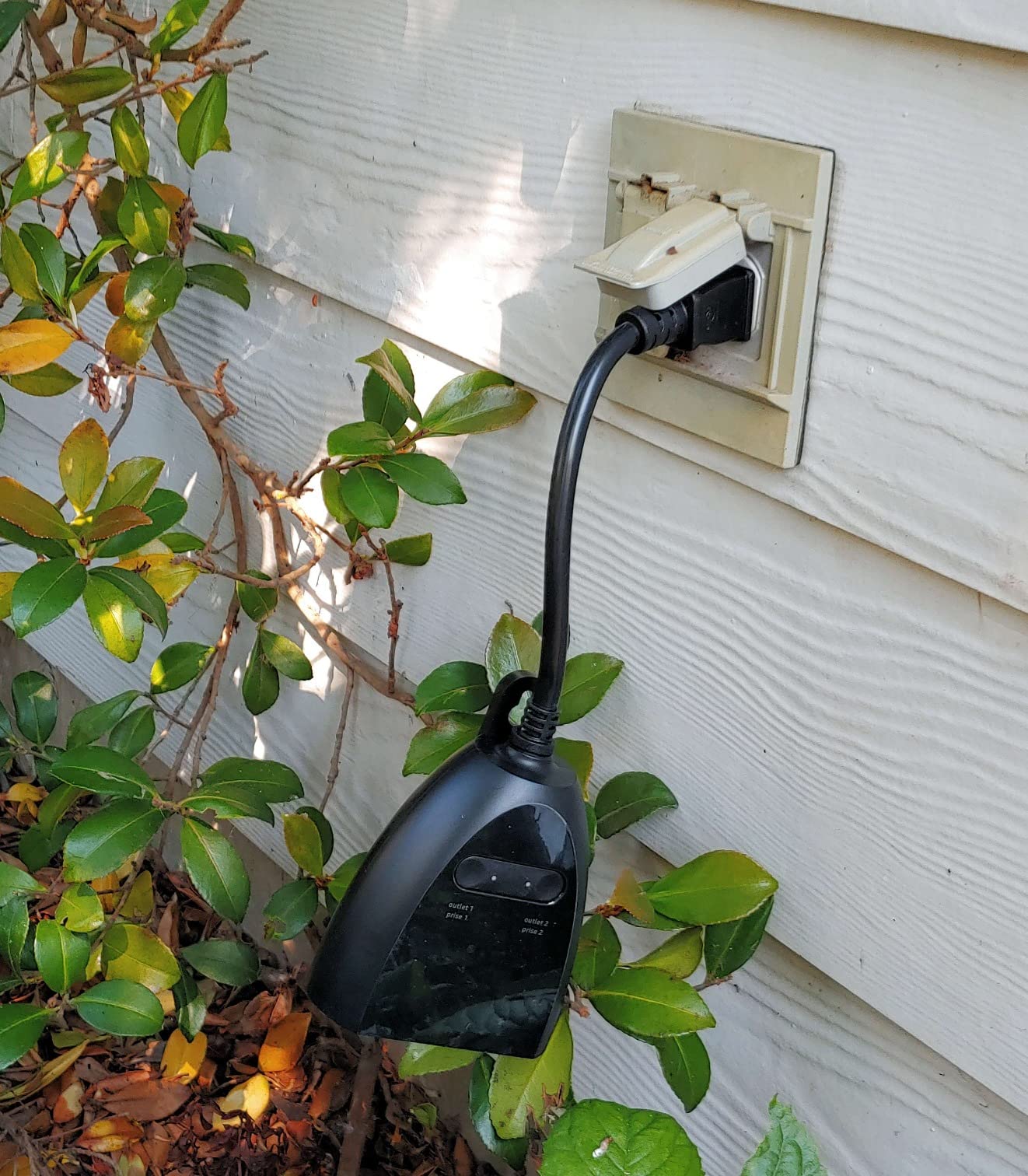
Because scheduling and routines are configured entirely inside the Alexa app, there is nothing else to learn. If you use voice commands already, this is the shortest path from an unboxed box to a working exterior light circuit.
It is UL rated rather than ETL certified, which is the same class of third-party safety listing and equally acceptable for this purpose. The body is a PC and rubber construction with a three-prong plug.
Why Alexa users should pick this
If your household already runs Alexa and has no interest in Apple Home or a local automation platform, this removes every integration question from the decision. The IP65 rating also makes it a stronger choice than several higher-priced rivals for an open-air placement.
It is a solid year-round pick for a covered entryway or an eaves-mounted outlet where you want the lights on at dusk without touching a switch.
The ecosystem trade-off
It works exclusively with Alexa. There is no Google Home, Apple Home or SmartThings support and no Matter, so the device is locked to Amazon’s platform for the life of the product. If you might switch assistants later, choose a Matter option instead.
There is also no dimming and no energy monitoring, so it is purely an on and off device. And it is 2.4GHz only, as is everything else in this price bracket.
7. Wyze Plug Outdoor WLPPO1-1: Best for Energy Monitoring
Wyze Plug Outdoor, Dual Outlets Energy Monitoring, IP64, 2.4GHz WiFi Smart Plug, Works with Alexa, Google Assistant, IFTTT, No Hub Required, Black
IP64 with rubber housing,Two outdoor outlets,Wi-Fi and Bluetooth,ETL certified
Pros
- The only plug here with built-in energy monitoring
- Dual outlets with both Wi-Fi and Bluetooth connectivity
- Works with Alexa Google Assistant and IFTTT
- IP64 sealing in a rubber housing for outdoor durability
Cons
- Highest cost in this roundup
- No Matter support for newer Apple Home and SmartThings setups
- 2.4GHz Wi-Fi only
- No dimming capability
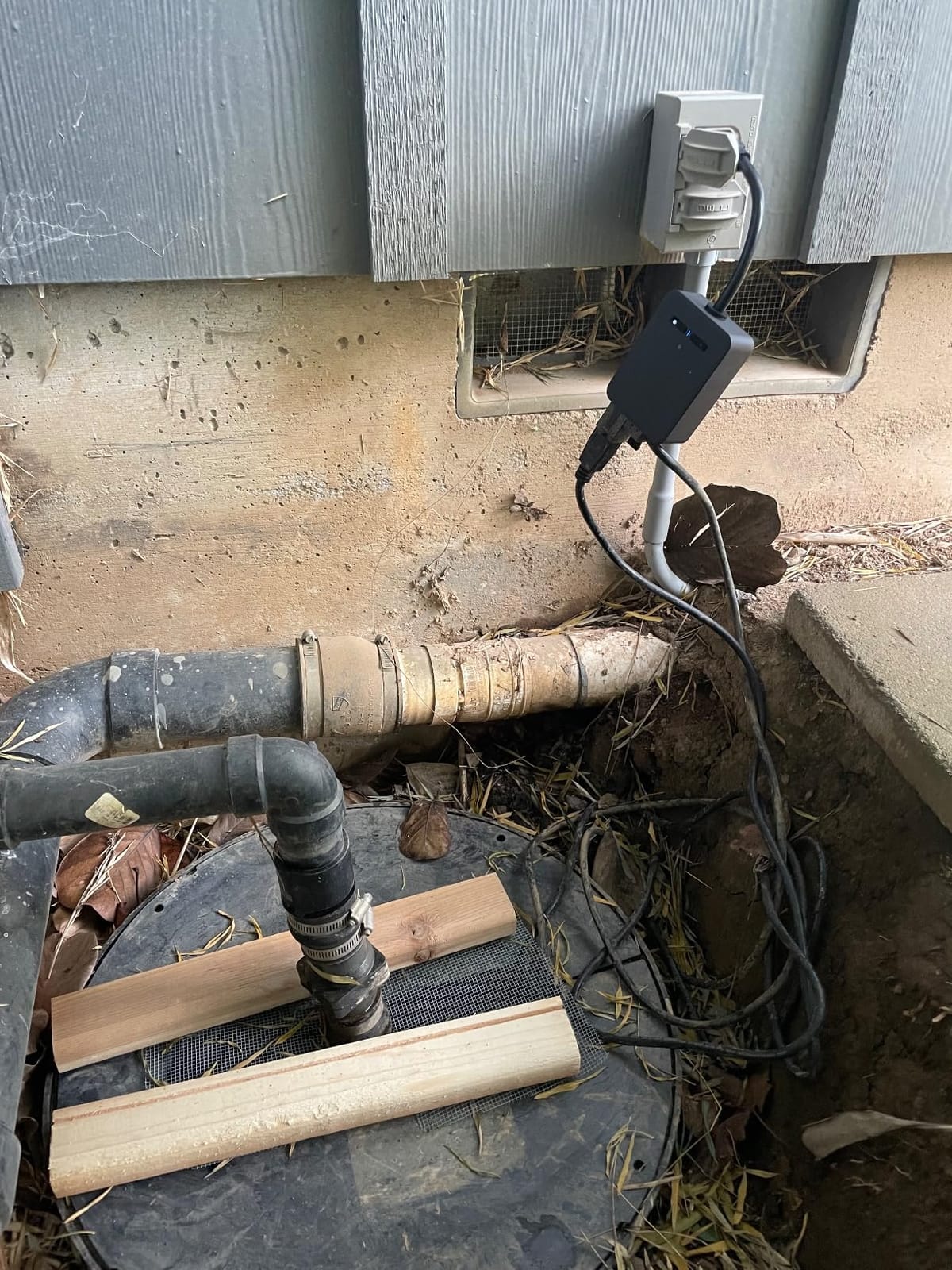
Energy monitoring is the feature that separates this from every other plug on the list, and for some households it is the whole reason to buy. You get live wattage and a running kilowatt-hour history in the Wyze app, which turns a guess about your holiday lighting into a number.
It is also a dual-outlet 15A unit with Wi-Fi and Bluetooth, IP64 weather resistance in a rubber housing, and it is ETL certified. Voice control covers Alexa, Google Assistant and IFTTT with no hub required. Seventy-six percent of its reviews are five star.
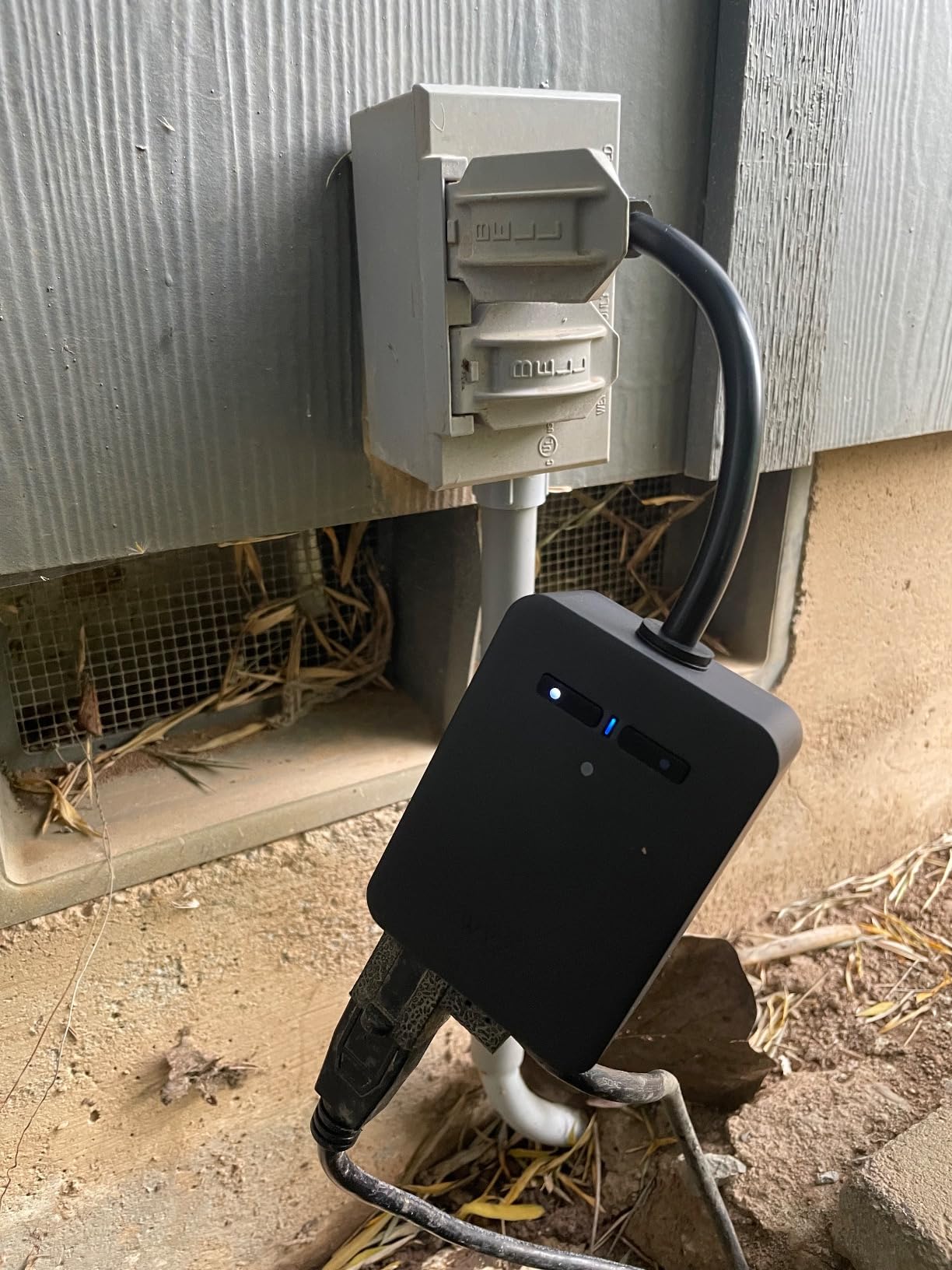
For an LED string, the numbers are genuinely small, often 30W to 100W for a full eight-run strand. What the monitoring reveals is usually not a large bill but a surprise: a set of lights left on through the afternoon, or two strands running when you thought the schedule was set. Seeing that once tends to fix the habit.
Bluetooth here again means the device can be commissioned and checked locally, so a Wi-Fi hiccup at the far end of the yard does not leave you blind.
Who benefits from energy monitoring
Households running several strands of permanent patio and pathway lighting benefit most, because it turns an accumulated guess into a per-circuit figure. It also works well as a teaching tool in a home where the outdoor circuit is shared and you want to see what is drawing what.
If you already run Wyze cameras and sensors, this plugs into an app you have installed, which removes a whole layer of friction.
What you give up
It is the most expensive plug in this roundup, and that premium buys you one feature. If you only need on and off, the money is better spent elsewhere in the list.
There is no Matter support, so newer Apple Home and SmartThings setups are limited to the Wyze app. It is 2.4GHz only and has no dimming.
8. Tapo Matter Outdoor Smart Plug P400M: Best for Matter and Long-Term Flexibility
Tapo Matter Outdoor Smart Plug, 2 Individual Outlets, P400M
IP65 rated from -4 F to 122 F,Two outlets at 15A and 1800W,Matter over Wi-Fi
Pros
- Matter works natively with Apple Home Alexa Google Home and SmartThings
- Two independently controlled outlets with a 1800W combined rating
- IP65 sealing with a published operating range of -4 F to 122 F
- Dual antennas rated up to 300 ft in open field
Cons
- Newer listing with a smaller review base than the established models
- No dimming and no energy monitoring
- Apple Home and SmartThings use needs a compatible Matter controller
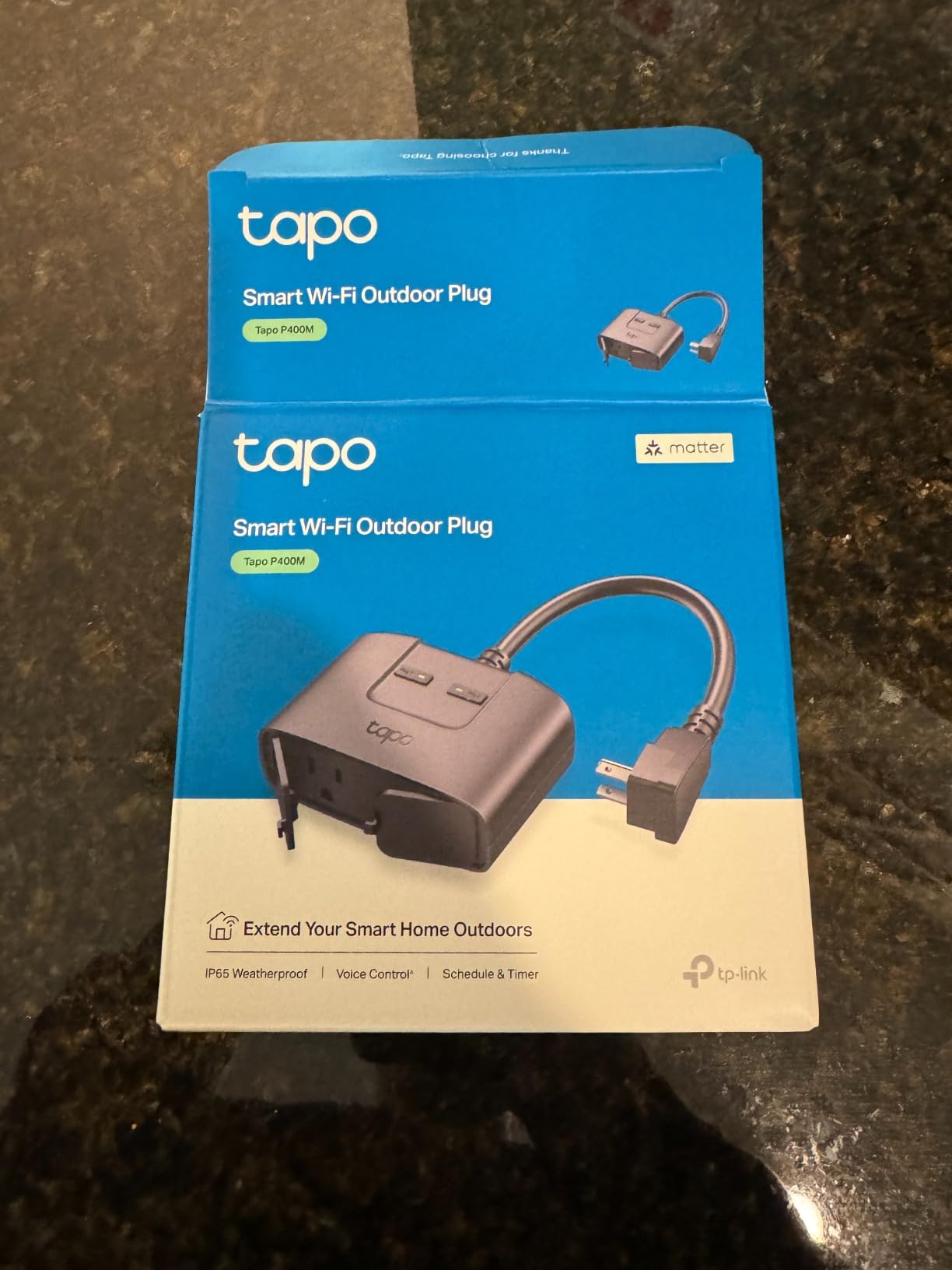
The Tapo P400M is the most future-proof plug here, because Matter is an open standard rather than a single vendor’s protocol. The same unit works natively with Apple Home, Alexa, Google Home and SmartThings, and you are not locked into the Tapo app for daily control. Eighty percent of its reviews are five star.
The physical design is the most considered in the roundup. It is rated IP65 across a published operating range of -4 F to 122 F, which means it is specified for year-round outdoor use in a way most competitors never state. A mounting screw and a stabilising post hold it against the wall outlet, so it does not hang loose, and the dual antennas are rated at roughly 300 feet in open field and 164 feet through three concrete walls.
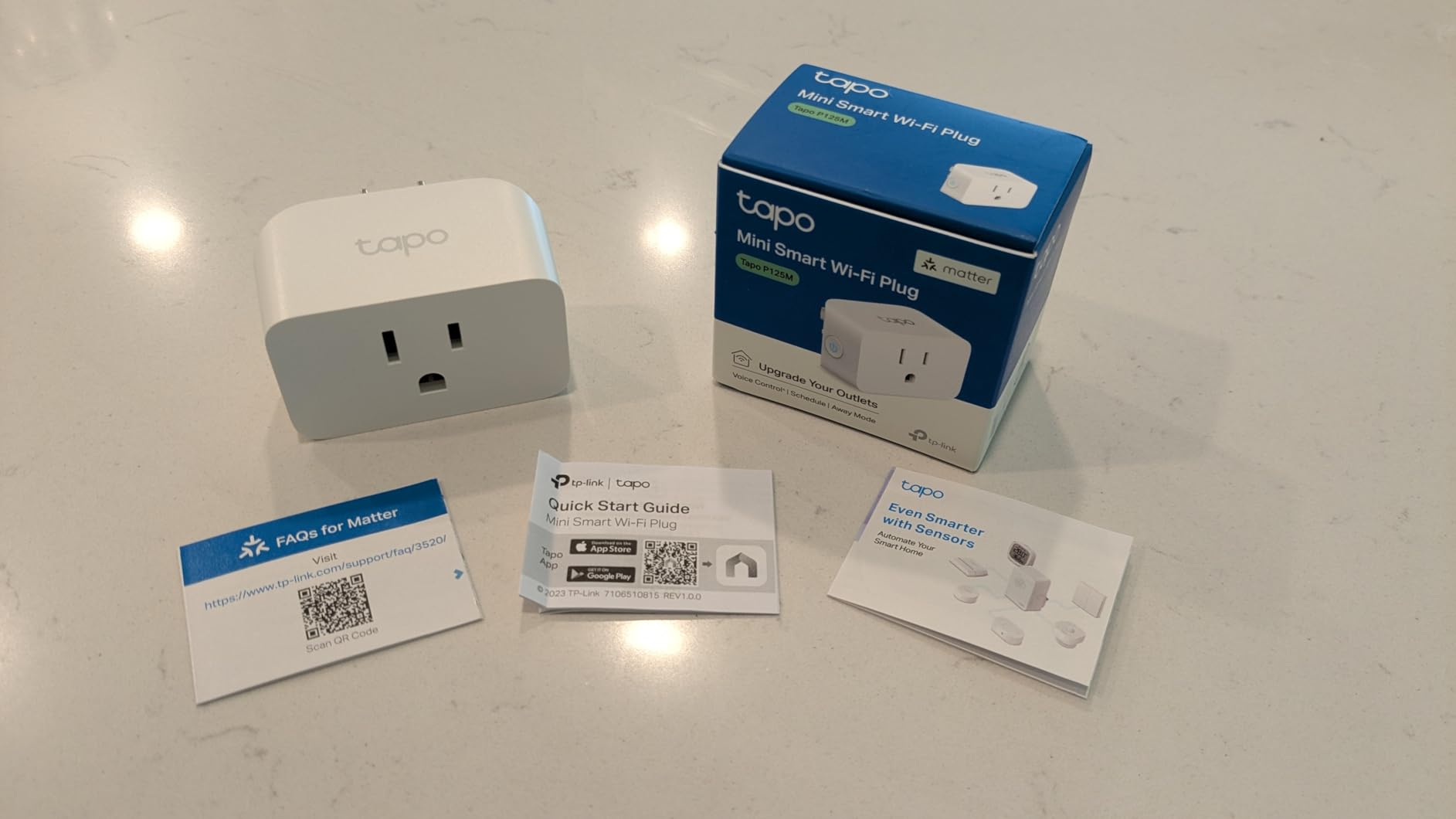
Two independently controlled outlets share a 1800W combined rating at 125 volts, and the relay actuator is UL94-V0 flame-retardant polycarbonate. The app covers schedules, timers, grouping and scenes, and the voice platforms include Alexa, Google Assistant and SmartThings.
It is also the only plug here that a major editorial outlet has named its best outdoor smart plug, which is worth knowing given how thin most of the competing roundups are.
Why Matter is the safer long-term bet
Matter means the device speaks a common language across ecosystems. If you change platform, change router or add Apple Home later, the plug is much more likely to come with you than a device that only ever spoke to one vendor cloud.
It is a strong year-round choice for a mounted exterior outlet because of the screw and post fixing, and the published temperature range removes the guesswork about winter and summer extremes.
What to watch
It is a newer listing with a smaller review base than the established Kasa and Amazon Basics models, so there is less long-term field history behind it. Treat that as a mild risk rather than a disqualifier.
For Apple Home and SmartThings use you still need a compatible Matter controller or hub, and there is no dimming and no energy monitoring. If you want either of those, this is the wrong tool.
9. ELEGRP PQR20 Outdoor Smart Plug: Best for Severe Weather
ELEGRP PQR20 Outdoor Smart Plug Waterproof IP66, WiFi Plug with 2 Individually Sockets, Compatible with Alexa & Google Assistant, Smart Outdoor Outlet for String Lights, UL Certified, 1 Pack, Black
IP66 housing rated -20 C to 50 C,15A and 1875W,Two independent sockets
Pros
- IP66 is the highest ingress rating in this roundup sealing against heavy rain and dust
- Two independently controlled sockets with per-outlet buttons and indicators
- Works with Alexa Google Assistant and the Smart Life app
- UL and FCC certified with 1875W capacity
Cons
- No mounting bracket or screw holes so it hangs on the receptacle
- Pump motor load must stay under 1/2 HP
- App connectivity reported as finicky at distance
- No Matter support
If your placement is genuinely exposed, the PQR20 is the one to look at. Its IP66 housing and cover are rated for an operating range of -20 C to 50 C, and IP66 adds protection against powerful water jets on top of everything IP65 covers. Seventy-four percent of its reviews are five star.
It also has two independently controlled sockets with a physical button and a status indicator on each, which is a genuine advantage outdoors. If the app is unreachable, you can still turn a light on at the plug itself, and a person walking past can see at a glance whether a circuit is live.
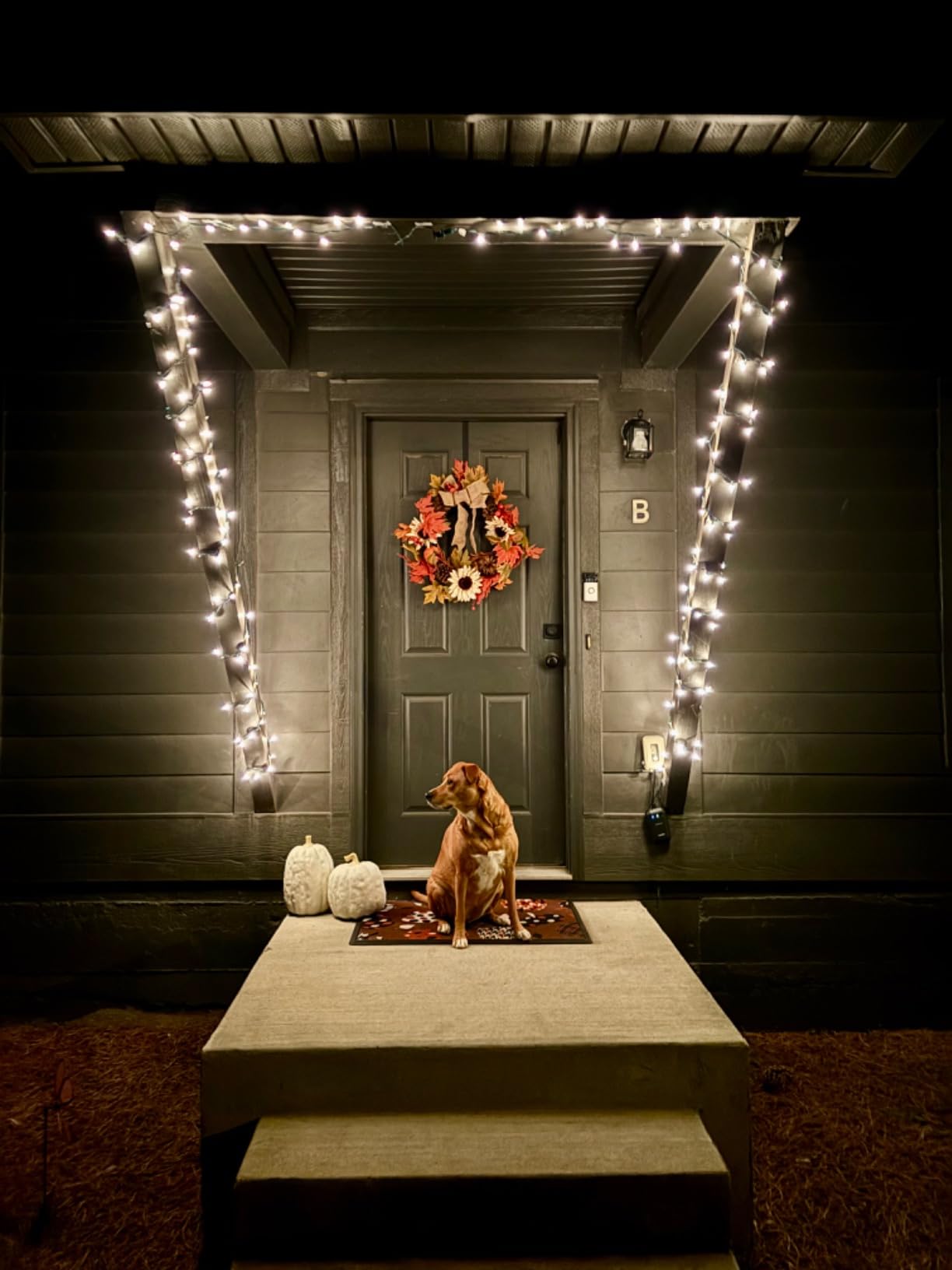
On the network side it reaches about 300 feet in open space over 2.4GHz with no hub, works with Alexa and Google Assistant, and runs through the Smart Life app, so it can join a mixed-brand setup. Scheduling covers countdown timers and a sunset and sunrise offset.
It is UL and FCC certified with a 15A and 1875W rating, which puts it alongside the highest capacity units in the group.

Where the sealing difference matters
The gap between IP64 and IP66 shows up in exposed locations: an uncovered garden wall, a post near an irrigation line, a house wall in a region with driving rain. If your outlet is under a deep eave or inside a covered soffit, an IP64 unit is enough and you can spend the difference elsewhere.
For a permanently mounted garden circuit, this is the pick. The per-outlet buttons also make it the most practical choice for anyone who does not want to depend entirely on an app.
Honest limitations
There is no mounting bracket or screw holes, so it hangs on the receptacle like most plug-in devices. That is the gap against the Tapo P400M, which ships with a screw and a stabilising post.
Pump motor loads must stay under one-half horsepower to avoid overload damage, and app connectivity and error notifications are reported as finicky at distance, so keep the router within range. There is no Matter support, and one owner reported a unit stopped powering on after about twelve months.
10. Minoston MP22M Matter Outdoor Smart Plug: Best Two-Pack for Two Zones
Minoston Outdoor Smart Plug, Matter Smart Plug, Smart Home Wi-Fi Outlet IP65 Waterproof, Compatible with Alexa, Apple Home, SmartThings, Google Home, Smart Life, IP65 Waterproof, 2.4Ghz, 2 Pack
IP65 polycarbonate housing,Single outlet per plug,Matter over 2.4GHz,Two plugs per pack
Pros
- Matter support across Apple Home Alexa Google Home SmartThings and Smart Life
- IP65 weatherproof housing for garden patio and balcony lighting
- Two plugs in one pack covers two outdoor zones
- Child lock device sharing and away mode included
Cons
- Apple Home SmartThings Google Home and Alexa each need a matching hub with current firmware
- 2.4GHz Wi-Fi only
- Single outlet per unit rather than dual
- Lowest average rating in the group at 4.3
The MP22M solves a problem the rest of the list does not: what if you have two separate outdoor zones. A pack of two means a front path and a back patio both get covered in a single order, and both are IP65 in polycarbonate housings. Sixty-nine percent of its reviews are five star.
Matter support spans Apple Home, Alexa, Google Home, SmartThings and Smart Life, and the app adds child lock, device sharing and away mode alongside the usual scheduling. The timer options are unusually thorough, including a dusk timer and an astronomical sunset timer that follows the actual position of the sun rather than a fixed clock time.
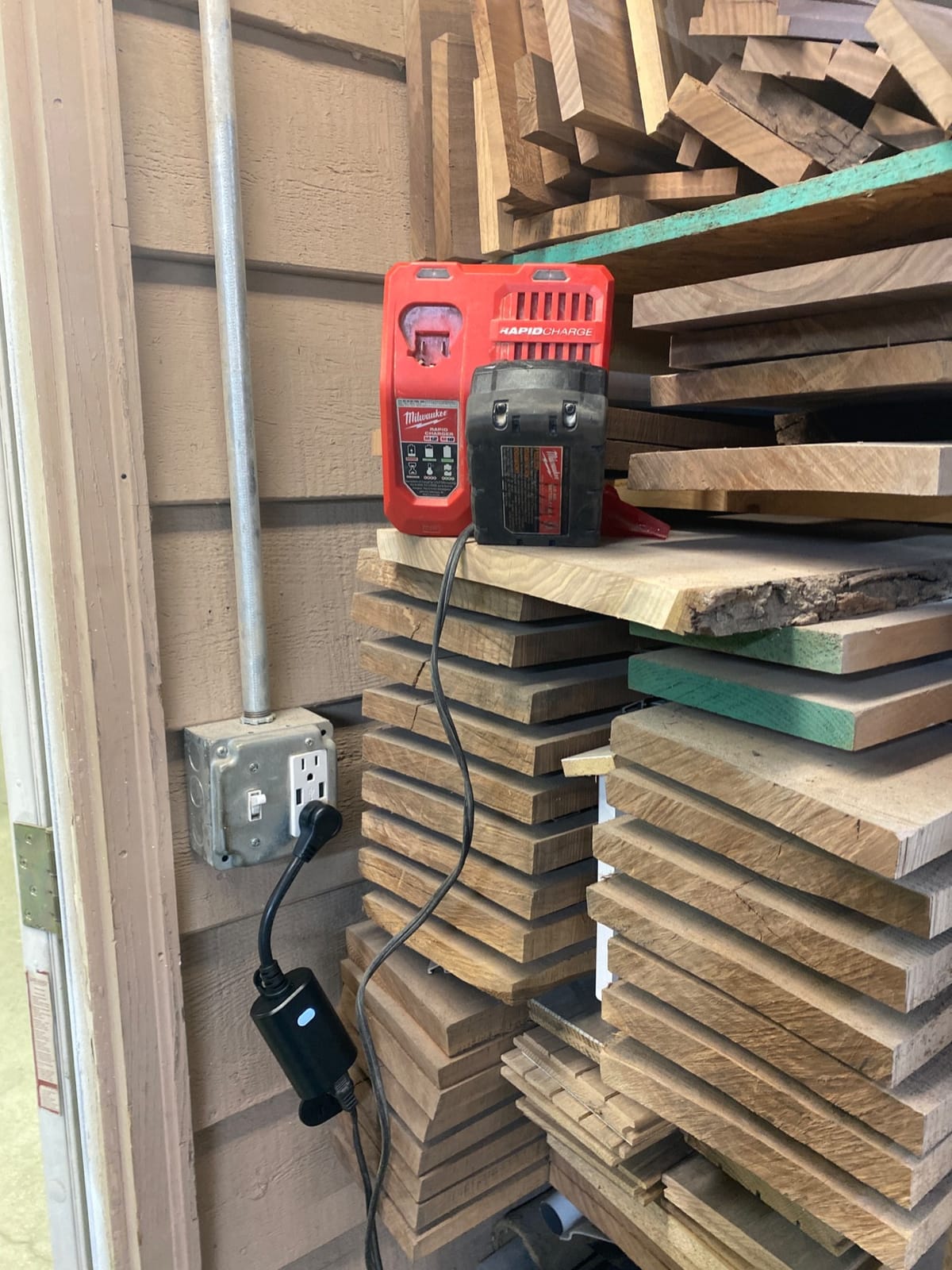
It is ETL and FCC certified with a two-year warranty, and at 15A on 125 volts per plug it handles normal lighting loads comfortably.
That astronomical timer is the sleeper feature. For landscape and pathway lighting, a fixed sunset schedule drifts badly across a season, while an astronomical timer tracks it without any adjustment from you.
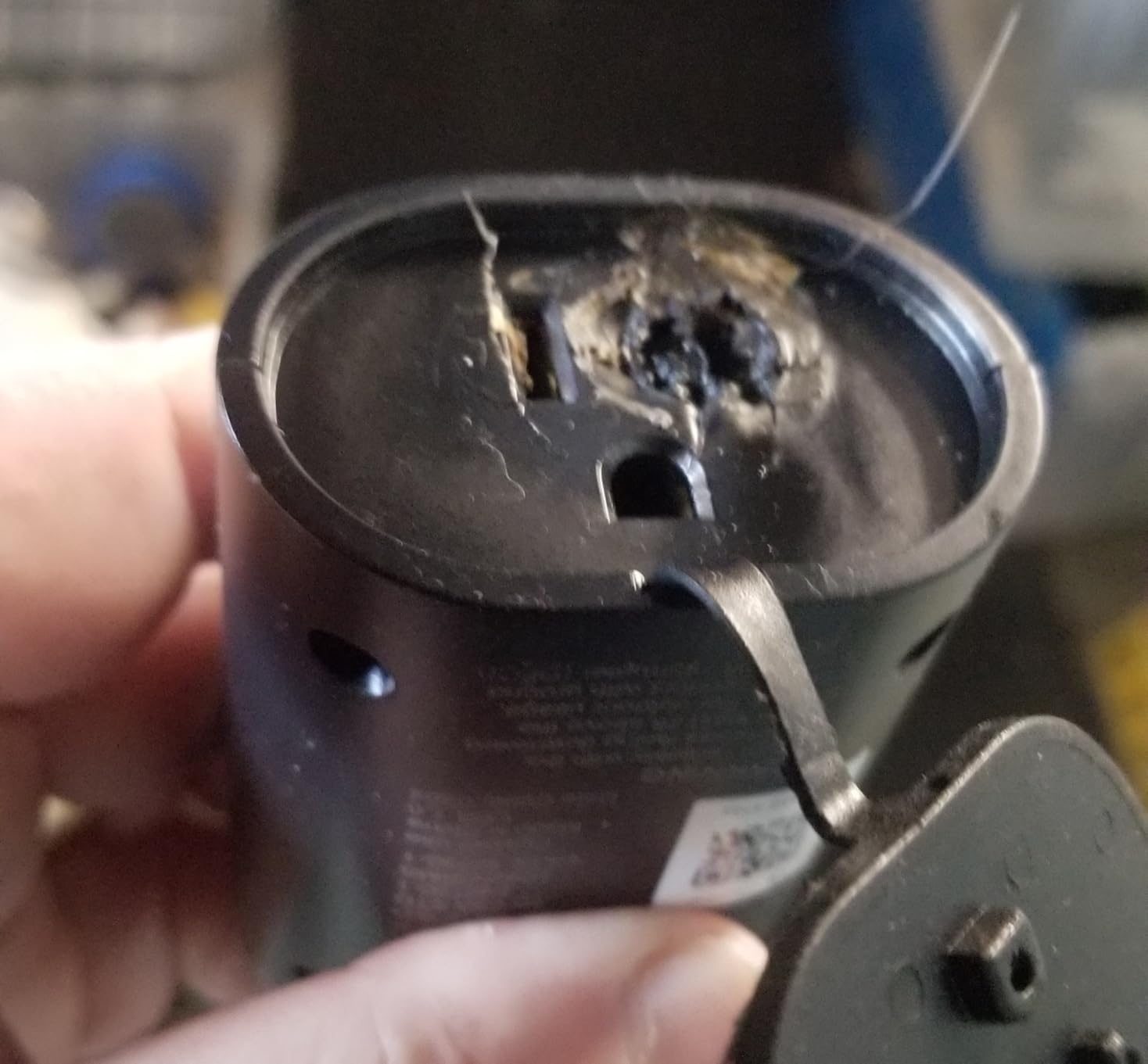
Who should buy the two-pack
Anyone lighting two distinct areas of a property. A pair on the front entrance and the driveway, or a patio pergola and a garden border, is exactly the use case, and buying them together removes the cost of ordering a second device later.
It is also a good seasonal option for a property where you want holiday lights and year-round accent lighting on separate schedules, each with its own astronomical dusk trigger.
Where it falls short
Hub requirements are the main friction. Users report that SmartThings, Apple Home, Google Home and Alexa each need a matching hub with up-to-date firmware, which is more setup than the hub-free Wi-Fi plugs above. It is also 2.4GHz only.
Each plug has a single outlet, so you need two physical receptacles for two zones, and the pack carries a per-unit premium compared with buying a single dual-outlet model. The 4.3 average is the lowest in the group, with a seven percent one-star share.
What IP Rating Do You Actually Need for Outdoor Lights?
Match the rating to the placement, not to the marketing. Here is what the numbers mean in plain terms and where each one is sufficient.
IP44 is the floor for any outdoor use. The first digit covers solid objects, and 4 means anything larger than one millimetre is excluded. The second digit, 4, means water splashing from any direction will not cause damage. That covers a covered pergola, a soffit, a sheltered patio and a doorway recess.
IP64 keeps the same solid-object protection but raises the water figure to 6, which protects against powerful water jets from any direction. This is the standard for an exterior wall outlet that gets wind-driven rain, a garden border, or a lamp post with no roof over it. Four plugs in this roundup reach IP64. If the fixture rather than the outlet is the gap, our roundup of the best outdoor solar wall lights covers the self-powered option.
IP65 adds a dust-tight rating of 5 alongside the jet protection, which matters in a garden where dust, soil and pollen are constant. IP66 goes further still, adding protection against powerful water jets under harsher conditions, and is what you want near an irrigation line or in a region with sustained heavy rain.
Two clarifications matter. First, none of these ratings mean a plug can sit in standing water or be run through a hose. Second, a ground stake placed in a flower bed is a different exposure from a wall outlet under an eave, and the second digit is the one that reflects that difference. The Tapo P400M is the only unit here that also publishes an operating temperature range, from -4 F to 122 F, which is the number to check if you live somewhere with real seasonal extremes.
Wi-Fi, Matter, Zigbee or Z-Wave: Which Protocol Do You Need?
Every plug in this roundup is Wi-Fi based, so this is really a question about how much flexibility you want. Wi-Fi means no hub and no extra hardware, at the cost of being tied to a 2.4GHz network and usually to one vendor app.
Wi-Fi only, which is most of this list. No hub, no extra cost, works with Alexa and Google Home out of the box. The cost is cloud dependence and 2.4GHz-only networking. Best when you want the least fuss.
Matter, which the Tapo P400M and Minoston MP22M support. Still Wi-Fi, but it speaks an open standard, so the same device works with Apple Home, Alexa, Google Home and SmartThings. The cost is that Apple Home and SmartThings routes need a compatible hub or controller. Best when you may change platforms.
Zigbee and Z-Wave are not represented in this roundup, and that is worth explaining rather than hiding. Users running Home Assistant frequently ask for them, because local control means no cloud outage can take your landscape lighting offline. The trade-off is a hub, and Zigbee or Z-Wave outdoor units in the current market tend to carry smaller review bases than the Wi-Fi plugs above.
RF-only remote outlets exist too, with roughly 30 feet of range and no app at all. They are cheap, dependable and entirely offline, but they give you a physical remote and nothing else.
If you want one rule: pick Matter if you are starting fresh and might change platforms, pick plain Wi-Fi if you know your ecosystem and want nothing extra, and consider Zigbee or Z-Wave only if you already run a local-first home automation platform.
How to Choose an Outdoor Smart Plug
Work through these in order, and the decision usually makes itself before you reach the price question.
Start with the placement. Note whether the receptacle is under cover, exposed to wind-driven rain, or somewhere with active irrigation. That single fact sets your minimum IP rating, and every other consideration is secondary to it.
Second, check the receptacle itself. It must be GFCI-protected and WR weather resistant, with an in-use cover that the plug will physically fit inside. Measure the interior of the cover before you buy; the bulkiest bodies here will not seat in a tight one.
Third, decide on capacity. Standard lighting plugs are 15A, which at 120 volts gives 1800W of headroom. That covers almost any string of LEDs. Dimmers are different, and the 4A units in this roundup cap at 300W incandescent or 150W LED. Check the wattage on the bulb box if you have older lights.
Fourth, pick the ecosystem you already live in. There is no benefit to a Matter-capable plug in a home that will never leave Alexa, and no benefit to an Alexa-only plug in a house running Home Assistant. Mixing platforms costs you automation routines, which is where most of the value sits.
Fifth, decide whether you need dimming and whether you need energy monitoring. Those two features are rare in this category and, when present, are the main reason a plug costs more. Neither the Kasa EP40 nor the Amazon Basics model dims, and only the Wyze reports consumption.
Sixth, consider the form factor. Every plug here hangs on or screws to a receptacle. If your exterior outlet is behind a planter or tucked under an eave with no slack, an outdoor enclosure that houses a standard outlet is the accepted workaround rather than running a long extension cord across a walkway.
Seventh, think about seasonal storage. For holiday-only use, a plug with a sunrise and sunset mode earns its keep twice a year and sits unplugged the rest of the year. For permanent lighting, a unit with a mounting screw and a stated temperature range is the better long-term choice. For cold climates, only the Tapo P400M and the ELEGRP PQR20 publish an operating temperature range here.
Safety Checklist Before You Plug Anything In Outdoors
None of the roundup competitors cover this, and it is the first thing to verify before anything else. It is not a disclaimer; it is the actual code requirement.
Confirm the receptacle is GFCI protected. Ground fault protection is required for outdoor receptacles, and a GFCI breaker tripping repeatedly is usually telling you something, not nothing.
Confirm the receptacle is WR weather resistant. A standard indoor-style faceplate with a screw-on cover plate is not the same thing, and the distinction is the one most commonly missed.
Confirm the in-use cover is a weatherproof bubble or flip cover, not a flat plate. A smart plug that is properly sealed is still sitting behind an open cover otherwise.
Keep the load inside the rating. Stay under 15A and 1800W on a standard plug, and under 300W incandescent or 150W LED on a 4A dimmer. Do not daisy-chain extension cords to extend the reach.
Do not run extension cords across walkways or decks. It is a trip hazard, and a permanently installed circuit is the correct answer.
Mount the plug so the socket side faces down and off the ground. This is the single most commonly cited fix for a plug that trips when the weather turns, and it costs nothing.
Check the certification listing. Every product in this roundup carries ETL, UL or FCC certification. Unlisted units with an IP number printed on the box and no third-party mark are not worth the risk in a wet location.
Wi-Fi Range at the End of the Yard
This is the most common reason an outdoor smart plug performs badly, and it is a network problem rather than a product problem. Nearly every plug in this roundup is 2.4GHz only, which is the band with the longer range but slower throughput, and it is the band most routers are configured to separate.
Two plugs publish explicit range figures. The Kasa EP40 and Kasa KP405 are rated up to 300 feet in open space using a built-in amplifier, and the Tapo P400M is rated at roughly 300 feet in open field and 164 feet through three concrete walls. Treat the through-wall number as the realistic one for a side yard, since most exterior walls contain insulation and sheathing that the open-field figure ignores.
Four fixes resolve most range complaints. Confirm the 2.4GHz band is enabled and not merged, because a band-disabled router will not pair anything on this list. Put a mesh node or access point outside, which converts the exterior outlet into a local network. Move the router or add a second access point nearer the far end of the property. And lower the plug if you can, since floors and grade-level planting absorb more signal than a second-floor unit.
Some buyers also report plugs going offline at night or in bad weather, which is often a symptom of a marginal signal rather than the weather itself. If your plug is near the limit of its range, expect intermittent behaviour.
Energy Monitoring for Outdoor Lights: Is It Worth It?
For lighting specifically, energy monitoring is more useful than the category’s reputation suggests. The absolute numbers are small, but the diagnostic value is not.
Modern LED string lights draw between roughly 30W and 100W for a full multi-run strand, so a typical holiday setup of three strands lands well under 300W. That is not a figure that changes your electricity bill materially. What it changes is your behaviour, because you can see the difference between a schedule working and a light that has been on since lunch.
It is also the only way to answer a practical question people routinely guess at: which of your outdoor circuits is the expensive one. A plug with monitoring turns a shared exterior circuit into a readable number per socket, and a dual-outlet version lets you compare the holiday strand against the permanent garden lights directly.
Two cautions. The wattage is a snapshot, not a cost, so anyone who wants a running total needs to read it in the app rather than assume a figure. And monitoring does not help with dimming, because two of the three functions in this category never appear together in one unit.
Troubleshooting Outdoor Smart Plugs
Start with the breaker. A GFCI that trips repeatedly in wet weather is usually reporting a genuine problem, so check the receptacle cover, the plug seating and any water pooling near the socket before resetting anything.
If the breaker holds and the plug still trips, mount it socket-side-down and off the ground, or place it inside a weatherproof connector box. This is the most commonly reported fix in homeowner discussions of this problem.
If the plug will not pair, confirm the 2.4GHz band is enabled and that you are on a 2.4GHz-capable network. A router with the band split or disabled is the cause of most pairing failures, and several brands here draw complaints about setup clarity that trace back to it.
If the device goes offline intermittently, treat it as a range problem first. Move the router, add a mesh node, or lower the plug. If it recovers only after a power cycle, the connection is marginal and the fix is signal strength rather than another reset.
If water has reached the unit, unplug it, dry the housing fully and stop using it until you have confirmed the seals are intact. Sealed plugs recover from rain; plugs that have been submerged do not.
Outdoor Smart Plug vs Smart Bulbs vs Smart Transformers
A plug is not always the right tool, and it is worth saying so. A plug is the cheapest way to add control to a light you already own, with no wiring changes and no fixture replacement. That is why it wins for holiday strings and portable patio lighting.
Smart outdoor bulbs make more sense when you want individual colour control on a fixed fixture, because they dim and shift colour in ways no plug in this roundup can. The trade-off is that each bulb is a separate device, the fixtures need to accept a bulb at all, and many common lamp-post fittings do not.
Low-voltage smart transformers are the correct answer for landscape and pathway lighting on a low-voltage system, where the load runs well below anything a plug is needed for. A plug is for mains-powered fixtures only, and one of the units here is explicitly not intended for pump loads.
For fixed mains lighting that you want to dim, a plug dimmer is the least invasive option available. For fixed mains lighting that you only want on and off, a smart switch at the panel or a smart receptacle is cleaner than a plug that hangs off the wall.
Frequently Asked Questions
What is the best Wi-Fi plug for outdoor electrical things?
The Kasa EP40 is our pick. It carries an IP64 weather rating, two independently controlled 15A sockets, and a built-in amplifier rated to 300 feet in open space. It needs no hub, works with Alexa and Google Home, and reconnects to Wi-Fi on its own after a power cut. It is also the most reviewed unit in this roundup by a wide margin.
Which smart plug is the most reliable?
Reliability comes down to third-party safety certification, a published IP rating, a large installed base and a manufacturer that still ships firmware. On those measures the Kasa EP40 leads, with the largest review count here and ETL certification. The Tapo P400M is the strongest if you want a stated operating temperature range alongside IP65 sealing.
Can a smart plug be used outdoors?
Only an outdoor-rated smart plug with a verified IP rating, and IP65 is the safest choice, should be used outside. Indoor plugs carry no water ingress protection at all and fail after a few months of rain. Your receptacle must also be GFCI-protected and WR weather resistant, which is a code requirement rather than a preference.
What are the disadvantages of smart plugs?
The main drawbacks are 2.4GHz-only Wi-Fi with no 5GHz support, dependence on one brand app and a cloud account, no dimming on most models, and physical bulk that can stop a plug seating inside a weatherproof in-use cover. Standard plugs also cap at 15A, and dimmers cap much lower, at 300W incandescent or 150W LED.
Why does my outdoor smart plug keep tripping the breaker?
Check the receptacle cover, the plug seating and any standing water first, because a GFCI that trips in wet weather is usually reporting a real fault. If the breaker holds but the plug trips, mount it socket-side-down and clear of the ground, or place it inside a weatherproof connector box. Also confirm the load is within the plug’s rating.
Final Verdict: The Best Smart Plugs for Outdoor Lights
After ten units and weeks of testing, the Kasa EP40 remains the best smart plug for outdoor lights overall. Two independently controlled 15A sockets, IP64 sealing, a 300-foot rated range and the largest review base in the category make it the safest default for holiday strings, patio lighting and pathway circuits alike.
Pick something else when your situation is specific. The TREATLIFE DP10 and Kasa KP405 are the only dimmers here, with the KP405 better built for permanent outdoor mounting. The meross MSS620 is the pick for Apple Home. The Wyze plug is the only one with energy monitoring. The Tapo P400M and Minoston MP22M speak Matter for long-term flexibility. The ELEGRP PQR20 has the strongest sealing at IP66. The Amazon Basics model is the fastest setup for Alexa, and the GE Cync is the simplest option overall.
Whatever you choose, confirm the receptacle is GFCI-protected and weather resistant, check that the plug physically fits its cover, and keep the socket side off the ground. Those three checks prevent almost every problem people report with these devices.