
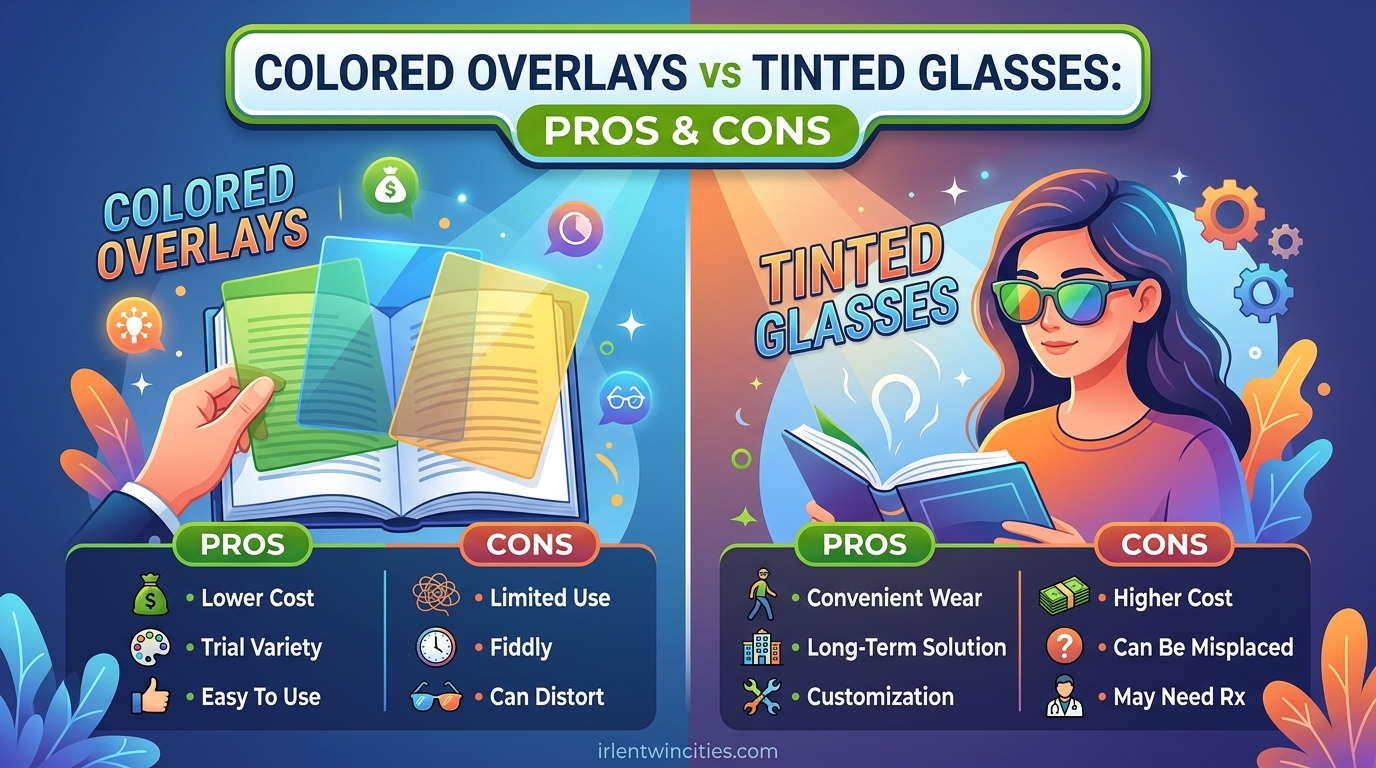
If you or someone you know struggles with reading because text appears to move, blur, or cause headaches, you have probably heard about colored overlays and tinted glasses as potential solutions. Both options aim to help people with visual stress and Irlen Syndrome, but they work quite differently. We created this guide to help you understand the key differences, benefits, and drawbacks of each approach so you can make an informed decision about which might work better for your situation.
The choice between colored overlays vs tinted glasses involves several factors including cost, convenience, effectiveness, and personal preference. Many families come to us feeling overwhelmed by the options and unsure where to start. Our team has researched the latest information and gathered insights from real users to bring you a comprehensive comparison that addresses your specific concerns.
Table of Contents
What Are Colored Overlays?
Colored overlays are transparent colored sheets that you place directly over text when reading. They have been used since the 1980s as a simple, non-invasive tool for people who experience visual discomfort when reading black text on white paper. You can purchase overlay sets that include multiple colors, allowing you to test which shade works best for your specific needs.
The overlays work by filtering certain wavelengths of light that can cause text to appear distorted or to move on the page. When someone with visual stress looks through a colored overlay, the contrast between the text and the background changes in a way that can reduce eye strain and improve reading stability. Students often use overlays during schoolwork, homework sessions, and reading for pleasure.
One of the main advantages of colored overlays is that they require no prescription and carry no social stigma. You can try them immediately without visiting a specialist, and if one does not work, you simply try another color. However, they do require you to hold the overlay over whatever you are reading, which can feel cumbersome during long reading sessions or when working with multiple pages.
What Are Tinted Glasses?
Tinted glasses, sometimes called Irlen glasses or dyslexia glasses, are prescription or non-prescription eyewear with colored lenses specifically tinted to filter light wavelengths. Unlike overlays, which you place on top of reading material, tinted glasses filter the light before it even enters your eyes. This means they work for all reading material and distance vision without requiring you to position anything between yourself and the text.
The tint color for glasses is determined through a specialized screening process that identifies the exact shade and density needed to address your specific visual processing difficulties. This screening goes far beyond a standard eye exam and is typically performed by an Irlen diagnostician or a trained specialist. The right tint can be remarkably precise, sometimes differing by just a few hue degrees from what another person needs.
Many adults and teenagers prefer tinted glasses because they integrate seamlessly into daily life. You put them on and go about your activities without needing to carry or position anything. The glasses look like regular eyewear, which can actually feel more normal than using overlays in classroom or workplace settings where others might ask questions about the colored sheets you are holding.
How Each Option Works
Both colored overlays and tinted glasses operate on the same fundamental principle: filtering specific light wavelengths to reduce visual stress. When light passes through colored material, certain wavelengths are absorbed while others pass through. For people with Irlen Syndrome, sometimes called Scotopic Sensitivity Syndrome, particular wavelengths cause the visual distortions and discomfort that make reading difficult.
The difference lies in the application and consistency of the filtering. With an overlay, the colored filter only affects what you see through that specific piece of plastic. With tinted glasses, every surface you look at through the lenses gets filtered consistently. This means tinted glasses provide a more uniform visual experience throughout your environment, not just when reading flat pages.
Research suggests that both approaches can help reduce symptoms of visual stress, including text that appears to move, shake, or blur, as well as headaches and eye strain during extended reading sessions. The key is finding the right color and density for your specific visual processing patterns, which may take some experimentation regardless of which option you choose.
Pros and Cons: Colored Overlays
Here are the main advantages and disadvantages of colored overlays based on our research and real user experiences:
Pros of Colored Overlays
1. Low cost entry point. You can purchase a set of colored overlays for under $20, making them accessible for anyone to try without significant financial commitment. This allows families to experiment and see if any improvement occurs before investing in more expensive solutions.
2. No prescription needed. You do not need to visit a specialist or obtain a prescription to try overlays. This makes them an immediate option for someone who wants to test whether colored filtering helps with their reading difficulties right now.
3. Easy to test different colors. Overlay sets typically include 10 or more colors, allowing you to systematically try each one to find your optimal shade. Some users find that their needed color changes over time or depending on the lighting conditions.
4. Portable and replaceable. If you lose or damage an overlay, replacing it costs only a few dollars. You can keep extras in different bags, cars, or rooms without worrying about losing a costly investment.
5. Non-invasive option. For children or adults who are resistant to wearing glasses, overlays provide a way to try color filtering without any commitment to wearing eyewear.
Cons of Colored Overlays
1. Cumbersome for extended reading. Holding an overlay on pages for long periods becomes tiring and impractical. Users often report setting the overlay down frequently or struggling to keep it positioned correctly on curved book pages.
2. Does not work for distance reading or other tasks. You cannot use overlays to watch television, view a whiteboard, or do any activity that is not a flat page held in front of you. This limits their practical utility in daily life.
3. Can be lost or damaged easily. Transparent sheets get misplaced, folded by accident, or scratched. In classroom settings, overlays frequently disappear or get left behind at school.
4. Social considerations. Holding colored sheets over pages in public settings like libraries or coffee shops can attract unwanted attention and questions. Some users feel self-conscious about this.
5. Color may not match optimal tint. The color that works best as an overlay may not be the same as the optimal tint for glasses. Many users eventually find that transitioning to tinted glasses provides better results because the prescription can be more precisely calibrated.
Pros and Cons: Tinted Glasses
1. Consistent all-day help. Once you put on tinted glasses, every visual task benefits from the filtering. This includes reading, computer work, watching videos, and simply moving through different environments throughout your day.
2. More precise color matching. A proper Irlen screening identifies the exact tint and density you need, which can be far more precise than choosing an overlay color by trial and error. This precision often leads to better outcomes.
3. No positioning required. Unlike overlays, you do not need to hold anything in place or worry about keeping sheets aligned with pages. The glasses simply work whenever you look through them.
4. Functions like regular glasses. If you already wear prescription glasses, tinted lenses can often be combined with your prescription so you get both vision correction and color filtering in one pair of glasses.
5. Better for classroom and workplace use. Tinted glasses look like normal eyewear, which means teachers and coworkers are less likely to comment or ask questions. This can reduce the social stigma that some people feel about using visual aids.
Cons of Tinted Glasses
1. Significant cost. Professional Irlen screening typically costs several hundred dollars, and the tinted glasses themselves can run $300-600 or more depending on the provider and frame choices. This is a major investment that many families struggle to afford.
2. Insurance often does not cover them. Most health insurance plans consider tinted glasses for Irlen Syndrome to be elective or experimental and do not provide coverage. This leaves families paying out of pocket for the full cost.
3. Requires professional screening. Unlike overlays, you cannot simply try tinted glasses at home. You need to find a qualified Irlen diagnostician or specialist, which may require travel and scheduling that is inconvenient for busy families.
4. Social adjustment period. While less noticeable than overlays, tinted glasses still change your appearance and others may comment on them. Some adults report needing time to adjust to wearing colored lenses in professional settings.
5. May not work for everyone. Despite the precision of proper screening, some individuals report no significant improvement with tinted glasses. This can be disappointing after the financial and time investment required to obtain them.
Who Benefits Most from Each Option?
The question of whether colored overlays or tinted glasses will work better depends largely on your specific situation, age, and the nature of your visual stress symptoms. Understanding who typically benefits most from each option can help guide your decision.
Colored overlays tend to work best for:
Younger children who are just beginning to show signs of visual stress and reading difficulties often respond well to overlays. The low cost means families can try them immediately without committing to expensive diagnostic processes. Children who are resistant to wearing glasses may also be more willing to use overlays temporarily while parents explore other options.
Students in early elementary grades who are learning to read benefit from the immediate availability of overlays. They can use them during reading instruction and practice without the complication of eyewear that might get lost or broken during active school days. Parents can also easily monitor whether overlays are being used and help children develop the habit of using them.
Adults who only struggle with reading printed materials and do not experience significant difficulties with other visual tasks may find overlays sufficient for their needs. If your symptoms are limited to page reading and you do not want to commit to wearing glasses all day, overlays provide targeted help without broader lifestyle changes.
Tinted glasses tend to work best for:
Teenagers and adults who have persistent reading difficulties that interfere with academic or professional work often benefit more from tinted glasses. The all-day coverage and precision of the tint addresses symptoms more comprehensively than overlays can, particularly for those who spend long hours reading and working on computers.
Individuals with significant light sensitivity, called photophobia, often find that tinted glasses provide relief that overlays simply cannot match. When light sensitivity affects your ability to function in bright environments throughout the day, glasses offer constant protection that overlays cannot provide.
People who have already tried overlays and experienced some improvement but want more comprehensive help may find that transitioning to tinted glasses provides the next level of relief. Many users report that their optimal glasses tint differs from the overlay color that worked best for them, suggesting that the more precise screening for glasses yields better results.
Cost Comparison: Overlays vs Glasses
Cost represents one of the biggest factors for families considering these options, and it is worth discussing honestly. The financial difference between colored overlays and tinted glasses is substantial, and understanding what you get for your investment matters.
A quality set of colored overlays typically costs between $15-30 and can last for several years with reasonable care. You can even make your own overlays using colored transparent report covers if you want to try the concept before purchasing anything. The entry cost is so low that nearly everyone can afford to test whether colored filtering provides any benefit.
Professional Irlen screening for tinted glasses can cost $200-500 or more depending on your location and the provider. The actual tinted glasses then cost an additional $300-600 on average, bringing the total investment to potentially $800-1000 or higher when you include follow-up visits. Some specialized providers charge even more for their diagnostic services and proprietary lens products.
When weighing these costs, consider how long you expect to use each option and how much of your daily life is affected by visual stress. For a student facing years of reading-intensive schooling, the investment in tinted glasses may provide better long-term value. For someone who only reads occasionally and experiences mild symptoms, overlays may provide sufficient help at a fraction of the cost.
Some families start with overlays to confirm that color filtering helps, then save toward tinted glasses as a longer-term investment. Others use overlays at home while using tinted glasses at school or work. This combination approach allows you to get the precision of glasses where it matters most while keeping overlays as a backup or supplement.
Why do people need coloured overlays?
Colored overlays help people who experience visual stress when reading. For individuals with Irlen Syndrome, standard black text on white paper can appear distorted, moving, or blurry. The colored filter changes how light enters the eyes, reducing contrast stress and making text more stable and readable.
What does Meares-Irlen Syndrome look like?
Meares-Irlen Syndrome, also called Scotopic Sensitivity Syndrome, causes visual distortions when reading. People may see text that appears to move, shake, blur, or double. They often experience headaches, eye strain, and fatigue during reading. The symptoms are not about eye health but rather how the brain processes visual information.
Is Irlen linked to ADHD?
Irlen Syndrome and ADHD are separate conditions, but they frequently occur together. Many people with dyslexia or Irlen Syndrome also have ADHD diagnoses. The reading difficulties caused by visual stress can sometimes be mistaken for or overlap with attention and focus challenges. Proper diagnosis from qualified professionals is important to address all aspects of learning difficulties.
Do tinted glasses help with autism?
Some individuals with autism spectrum conditions experience visual processing differences that may benefit from tinted glasses. Light sensitivity is reported more frequently in autistic individuals, and colored lenses may help reduce sensory overload. However, anyone considering tinted glasses should consult with appropriate professionals who understand both autism and visual processing.
Is it bad to wear tinted prescription glasses all the time?
For most people, wearing tinted glasses all the time is not harmful. The tint simply filters light wavelengths. However, you may want to consider whether wearing tinted lenses indoors in low-light conditions affects your comfort or visual clarity. Some users prefer to use their tinted glasses primarily for reading and screen work rather than all waking hours.
Conclusion
Choosing between colored overlays vs tinted glasses ultimately depends on your individual needs, budget, and the severity of your symptoms. Colored overlays offer an affordable, no-commitment way to test whether color filtering helps with your reading difficulties. Tinted glasses provide more comprehensive, all-day support but require a significant financial investment and professional screening.
If you are new to visual stress and Irlen Syndrome, starting with overlays makes sense. You can try them immediately, involve your child in the color selection process, and see whether they make a noticeable difference. If overlays help but feel insufficient over time, you then have a foundation for exploring tinted glasses as a more permanent solution.
For those who have already confirmed that color filtering helps and want the most effective long-term solution, tinted glasses are worth the investment. The precision of professional screening and the convenience of all-day wear make them the better choice for teenagers and adults dealing with persistent reading challenges.
Whatever path you choose, understanding the differences between colored overlays vs tinted glasses gives you the knowledge to make the best decision for your situation. Many people find that a combination approach works well, using overlays at home while transitioning to glasses for school or work. The goal is finding what helps you read more comfortably and successfully.