
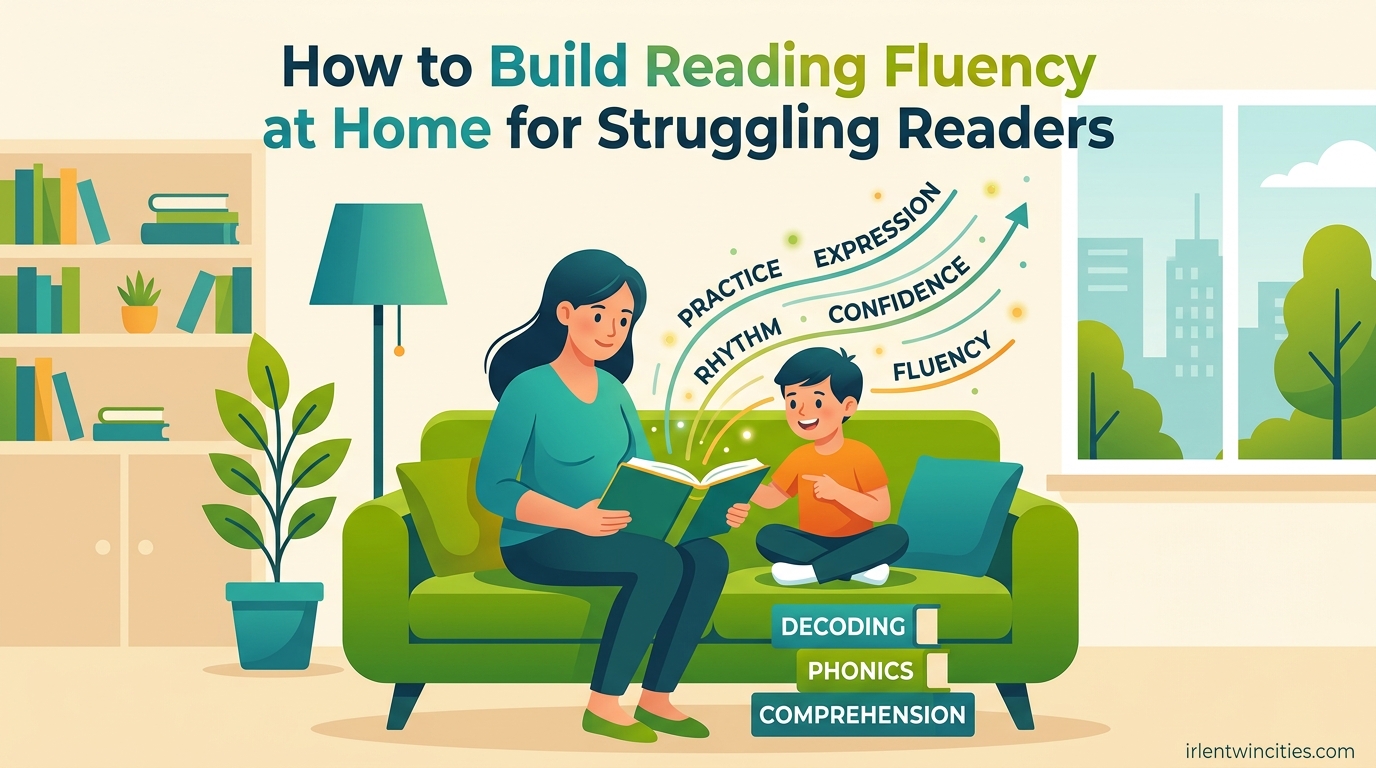
Watching your child struggle through a sentence—stopping at every other word, sounding out the same word three times on a single page, reading in that choppy monotone—can break your heart. You know they understand stories when you read aloud to them. But something happens when they try to read themselves. The words don’t flow. The meaning gets lost. And their confidence crumbles a little more each time.
I have worked with struggling readers for over a decade, both as a reading specialist and as a parent who navigated this journey with my own child. Building reading fluency at home for struggling readers is one of the most impactful things you can do. It does not require expensive programs or teaching credentials. It requires consistency, the right strategies, and texts at the right level.
This guide will walk you through evidence-based techniques that work. You will learn how to assess your child’s current fluency level, implement proven practice strategies like repeated reading and choral reading, create a sustainable home routine, and handle the frustration that often accompanies reading struggles. By the end, you will have a clear action plan tailored to your child’s needs.
Table of Contents
What Is Reading Fluency and Why Does It Matter
Reading fluency is the ability to read text accurately, at an appropriate rate, and with proper expression. Think of it as the bridge between decoding individual words and actually understanding what you read. Without fluency, reading feels like hard labor instead of a meaningful activity.
The three components of reading fluency work together. Accuracy means reading words correctly without guessing or skipping. Rate refers to reading at a pace that sounds like natural speech—not too fast, not painfully slow. Expression (also called prosody) involves reading with appropriate phrasing, emphasis, and intonation. When all three work together, the reader can focus attention on meaning rather than word recognition.
Why does fluency matter so much? Cognitive scientists explain it through what they call the Simple View of Reading. This theory shows that reading comprehension equals decoding ability multiplied by language comprehension. When a child expends all their mental energy just figuring out what each word says, none remains for understanding the sentence, paragraph, or story. Fluent readers free up mental resources for the real goal: comprehension.
Signs of disfluent reading include frequent pauses within sentences, word-by-word reading without natural phrasing, ignoring punctuation marks, and changing tone or volume at random points. A disfluent reader might read “The… cat… sat… on… the… mat” instead of “The cat sat on the mat” as a natural phrase. If you recognize these patterns in your child, they are not being lazy or careless. They need structured fluency practice.
How to Assess Your Child’s Reading Fluency at Home
Before you start any intervention, you need to know where your child stands. Assessing reading fluency at home is simpler than it sounds. You need a short passage at your child’s grade level, a timer, and a simple counting method.
Words Correct Per Minute (WCPM) Benchmarks
WCPM stands for Words Correct Per Minute. This is the standard measure for reading fluency. You calculate it by having your child read aloud for one minute, counting the total words attempted, then subtracting any errors.
| Grade | Fall Target | Winter Target | Spring Target |
|---|---|---|---|
| 1st | Not applicable | Not applicable | 20-40 WCPM |
| 2nd | 30-50 WCPM | 50-70 WCPM | 70-90 WCPM |
| 3rd | 60-80 WCPM | 70-90 WCPM | 80-110 WCPM |
| 4th | 70-90 WCPM | 80-100 WCPM | 90-120 WCPM |
| 5th | 80-100 WCPM | 90-110 WCPM | 100-140 WCPM |
To assess at home, choose a grade-level passage of about 100-200 words. Have your child read aloud while you time one minute. Mark any errors (mispronunciations, skipped words, substitutions, hesitation longer than 3 seconds). Count total words read, subtract errors, and you have WCPM. Repeat with 2-3 different passages and average the results for accuracy.
The 5 P’s of Fluency Assessment
When listening to your child read, evaluate these five elements. Pace refers to speed—not too fast or too slow. Phrasing means grouping words together naturally. Punctuation indicates stopping at periods and pausing at commas. Pitch involves using tone and expression. Passion captures whether the reading sounds engaged or robotic.
Use these 5 P’s as a quick checklist during daily practice. You do not need formal scoring. Simply note which areas need the most attention and choose strategies accordingly. A child who reads word-by-word needs different support than one who reads quickly but without expression.
The R-E-A-D Self-Assessment Rubric for Children
Teaching children to evaluate their own reading builds metacognitive skills. The R-E-A-D rubric gives them a simple framework. R stands for Rhythm—does the reading flow smoothly without choppy stops? E means Expression—does the voice go up and down naturally, showing emotion and emphasis? A is for Automatic—do familiar words come instantly without sounding out? D stands for Deliberate—does the reader pay attention to punctuation and meaning?
After reading a passage, ask your child to rate themselves on each letter using a simple 1-3 scale. This not only builds awareness but also gives them ownership of their progress. Children who can articulate what they are working on tend to improve faster than those who simply read without reflection.
Finding the Right Text Level
For fluency practice, you need texts at your child’s instructional reading level—not too easy, not too hard. The independent level means they can read with 95-100% accuracy and full comprehension. The instructional level shows 90-94% accuracy with good comprehension when supported. The frustration level falls below 90% accuracy, where learning shuts down.
To find the right level, have your child read 100 words from a potential text. Count errors. If they miss 0-1 words, the text is independent level—good for building confidence but not for instruction. If they miss 2-5 words, you are in the instructional zone—ideal for fluency practice. If they miss 6 or more, the text is too hard. Put it aside and find something easier.
Evidence-Based Strategies to Build Reading Fluency
Research consistently supports a handful of techniques for building reading fluency. These strategies work because they combine repeated exposure to text, modeling from fluent readers, and appropriate challenge levels. You can implement all of these at home with minimal materials.
Repeated Reading: The Foundation of Fluency Practice
Repeated reading is exactly what it sounds like: reading the same text multiple times. This technique has more research support than any other fluency intervention. When a child reads the same passage 3-4 times, their brain builds automatic recognition of the words, freeing attention for expression and meaning.
Here is how to implement repeated reading at home. First, select a short passage at your child’s instructional level—about 100-200 words works well. Second, set a purpose for the first reading, such as “Let’s see what happens in this story.” Third, have your child read the passage aloud while you note errors. Fourth, discuss the passage briefly to ensure comprehension. Fifth, have them read it again, aiming for improved accuracy and expression. Sixth, repeat 2-3 more times across different sessions.
Most research suggests 3-4 readings of the same text produces optimal gains. Beyond that, returns diminish. Set specific goals for each repetition. For example: “First time, focus on all the words. Second time, let’s make it sound smoother. Third time, add some expression.” This keeps practice purposeful rather than mechanical.
Choral Reading: Reading Together for Confidence
Choral reading means reading aloud together in unison. It works beautifully for anxious readers who hate reading alone. When voices blend, struggling readers experience what fluent reading feels like without the spotlight on their individual mistakes.
To try choral reading, choose a text at or slightly above your child’s level. Sit side by side so you can both see the words clearly. Read aloud together at a pace set by you, the fluent reader. Keep your voice strong enough to lead but soft enough that your child can hear themselves. Track the text with your finger so your child follows the words visually.
Start with short pieces—poems work excellently because rhythm and rhyme provide natural support. Song lyrics, predictable picture books, and short paragraphs from favorite stories all work well. Gradually increase length as confidence builds. After several choral readings of the same text, have your child try a solo read. You will often hear the phrasing and expression from the choral practice carrying over.
Echo Reading: The Imitation Method
Echo reading builds on the natural way children learn language—through imitation. You read a phrase or sentence aloud, and your child immediately repeats it, echoing your phrasing and expression. This provides instant modeling without the pressure of reading cold.
The procedure is straightforward. Choose a text with natural phrase boundaries. Read the first phrase with good expression. Have your child read the same phrase immediately after you. Move to the next phrase and repeat. For beginners, work phrase by phrase. As skill develops, stretch to full sentences or even short paragraphs.
Echo reading works especially well for struggling readers who decode slowly but understand language well when they hear it. It bridges the gap between listening comprehension and reading ability. Use echo reading with challenging texts that interest your child but frustrate them when reading independently. After several echo sessions, transition to supported independent reading of the same material.
Partner Reading: Taking Turns for Support
Partner reading (also called paired reading) involves two readers taking turns. The stronger reader—whether parent, older sibling, or tutor—provides modeling and support. The struggling reader gets built-in rest breaks and examples to follow.
The classic partner reading structure uses a “whisper read” technique. The fluent partner reads a paragraph aloud while the struggling partner follows along, whispering or mouthing the words silently. Then the struggling partner reads the same paragraph aloud while the fluent partner follows along, providing help only when needed. Roles then reverse for the next paragraph.
Some families prefer simple turn-taking—you read a page, I read a page. This works well for longer texts like chapter books. The key is ensuring the struggling reader’s sections are at their instructional level while the fluent reader handles harder sections. This exposes the struggling reader to richer vocabulary and complex syntax without the frustration of decoding it alone.
Modeling Fluent Reading: Show, Don’t Just Tell
Children learn fluent reading largely through hearing fluent reading. Audiobooks paired with physical texts provide excellent modeling. This technique, sometimes called audio-assisted reading, has strong research support for building fluency.
To use audiobooks effectively, your child needs a copy of the exact text being narrated. They follow along while listening, tracking the words with a finger or bookmark. After listening to a section once or twice, they read the same section aloud. The prosody and phrasing from the professional narrator tend to carry over into their oral reading.
Free resources like Storyline Online and PBS Kids Read-Alongs offer high-quality audiobook experiences. Many public libraries provide free access to apps like Libby and Hoopla with extensive children’s audiobook collections. Choose books slightly above your child’s independent reading level for this activity—the audio support makes the harder text accessible.
Creating an Effective Home Fluency Routine
Strategies only work when implemented consistently. A sustainable home routine matters more than perfect technique. The goal is daily practice—short, focused sessions that build habit without burning out your child or yourself.
Setting Up for Success
Choose a consistent time for fluency practice. After school snack time, after dinner, or before bed all work well. The key is predictability—your child should know that 4:00 PM means reading time just as surely as it means homework or dinner. Consistency reduces negotiation and resistance.
Create a dedicated reading space free from distractions. Turn off the television. Put phones in another room. Some children focus better with soft background music; others need silence. Experiment to find what works. Have materials ready: fluency passages, a timer, pencils for marking, and a progress chart if you use one.
The 15-Minute Daily Structure
Fifteen focused minutes beats an hour of distracted practice. Here is a proven structure. Minutes 1-3: Warm-up with a familiar, easy text your child can read confidently. This builds momentum and positive feelings. Minutes 4-10: Core fluency practice using one of the strategies above—repeated reading, choral reading, or echo reading. Work with instructional level material here. Minutes 11-13: Comprehension check through brief discussion or retelling. Minutes 14-15: Cool-down with independent reading of an easy, enjoyable book.
Follow this basic template but adapt based on your child’s age and stamina. A first grader might work in two 8-minute sessions. A fifth grader could handle 20 minutes. Watch for signs of fatigue and end before frustration builds.
Selecting the Right Materials
Decodable texts work best for early readers still mastering phonics. These texts contain mostly words the child can sound out using taught phonics patterns. High-interest, low-reading-level books work well for older struggling readers who need age-appropriate content without frustration-level difficulty. Look for series like “Step Into Reading,” “I Can Read,” or “Acorn Books” for younger readers. For older elementary students, series like “Orca Currents” or “Saddleback Educational” offer mature themes at accessible levels.
Many free fluency passages are available online. Websites like ReadWorks, Florida Center for Reading Research, and Intervention Central offer printable passages organized by grade level. Teachers Pay Teachers also has quality fluency resources, though quality varies—look for materials aligned with Science of Reading principles.
Tracking Progress Visually
Children need to see they are improving. Create a simple line graph showing WCPM scores over time. Plot the grade-level benchmark as a goal line. Each time you assess, add a new data point. Even small gains—5 words per minute over a month—become visible and motivating.
Some families prefer sticker charts tracking practice sessions rather than scores. Others use a “fluency folder” where children collect passages they have mastered. Find what motivates your specific child. The key is making progress visible and celebrating growth, not just final achievement.
What to Do When Your Child Gets Stuck
Struggling readers get stuck on words constantly. How you respond in these moments matters enormously. The wrong help creates dependence. The right help builds independence. These strategies keep your child moving forward while teaching problem-solving skills.
The Word-Solving Strategy
When your child encounters an unknown word, resist the urge to just tell them what it says. Instead, guide them through a quick visual analysis. Have them circle any prefixes at the beginning (like un-, re-, pre-). Have them underline the vowel pattern in the middle. Ask them to scoop or draw a line under the syllable break. Then blend the parts together.
This process takes seconds once learned. It teaches children to analyze word structure rather than guessing from pictures or first letters. If after this analysis they still cannot decode the word, tell them what it is and have them repeat it. Then return to the sentence for a fresh start so the error does not disrupt comprehension.
Prompts That Build Independence
Use these prompts in order when your child gets stuck. First: “Look at the word. What do you see?” Second: “Check the beginning. What sound does that letter make?” Third: “Look all the way through the word. Does that match what you said?” Fourth: “Try that again.” Fifth: “Look at the picture. Does that make sense?” Only as a last resort: “That word is _____.”
These prompts follow the hierarchy of reading cues. Visual information (letters) takes priority over meaning cues (pictures). This aligns with Science of Reading research showing that fluent reading depends on automatic word recognition, not contextual guessing.
Handling Frustration and Reading Anxiety
Struggling readers often develop anxiety about reading. They anticipate failure. They avoid practice. They may cry, refuse, or act out when it is time to read. These behaviors signal that the text is too hard, the session is too long, or negative emotions have become associated with reading.
When frustration appears, stop immediately. Trying to push through creates negative associations that last far longer than any skill gained. Switch to an easier text. Take a break. Do something enjoyable. Return to reading later with a fresh start and modified approach. The goal is keeping reading a positive experience even while working on hard skills.
For children with significant reading anxiety, start every session with guaranteed success. Have them read something they know well—maybe a memorized picture book from early childhood. Build confidence before tackling new challenges. Some children need weeks of positive, easy reading experiences before they are ready to stretch themselves.
Balancing Fluency with Comprehension
Never sacrifice understanding for speed. Fluency practice should include comprehension checks. After reading a passage, ask your child to retell what happened in sequence. Ask a specific detail question. Ask what might happen next. If they cannot answer, the fluency focus on that passage was too intense or the text was too hard.
The 4-3-2-1 strategy helps maintain comprehension focus. After reading, your child summarizes in 4 sentences. Then they summarize the same content in 3 sentences. Then 2. Then 1. This forces them to identify the most important information. It also provides repetition of the content without re-reading the text mechanically.
When Visual Processing Issues Affect Reading Fluency
Sometimes reading struggles go beyond decoding and fluency. Visual processing difficulties can make text appear to move, blur, or shimmer on the page. Children with these challenges may read slowly despite strong phonics skills. They may skip lines, lose their place, or report that reading hurts their eyes or gives them headaches.
Signs of Visual Processing Difficulties
Watch for these indicators that visual stress affects reading. Your child rubs their eyes frequently during reading. They cover one eye or tilt their head at extreme angles. They report that letters move, swim, or overlap on the page. They avoid reading despite seeming capable of decoding. They read much better with a colored overlay or colored background.
These symptoms may indicate Irlen Syndrome, a perceptual processing disorder affecting the brain’s ability to process visual information. Irlen Syndrome is not a vision problem that glasses correct. It is a neurological condition where certain light wavelengths cause stress to the visual cortex. This stress creates the symptoms above and significantly impacts reading fluency.
Environmental Adjustments for Visual Comfort
Simple changes can reduce visual stress for sensitive readers. Try colored overlays—transparent colored sheets placed over text. Different colors work for different individuals; common helpful colors include blue, green, and yellow. Experiment to find what helps your child. Colored reading rulers or tinted reading glasses may also provide relief.
Adjust lighting in your reading space. Fluorescent lights often trigger visual stress. Natural light or full-spectrum bulbs typically work better. Reduce glare on pages. Ensure adequate contrast between text and background—avoid light gray text on white backgrounds common in some modern books. Use black text on cream or white paper for maximum readability.
If you suspect visual processing issues significantly impact your child’s reading, consider consulting an Irlen Syndrome specialist. At Irlen Twin Cities, we provide diagnostic assessments and personalized color treatment recommendations. Addressing visual stress can dramatically improve reading fluency when it is an underlying factor.
Working With Teachers and Schools on Fluency Goals
You are not alone in supporting your child’s reading development. Teachers and school specialists can be valuable partners. Effective collaboration ensures home practice supports classroom instruction rather than working at cross-purposes.
Opening the Conversation
Start by asking your child’s teacher about current fluency assessments. Most schools use DIBELS, AIMSweb, or similar tools that provide WCPM scores and percentile rankings. Ask: “What is my child’s current fluency score? How does it compare to grade-level expectations? What specific goals are we working toward?”
Share what you observe at home. Note the strategies you are using. Ask which ones align with classroom instruction so you can reinforce rather than confuse. Request specific text recommendations at your child’s instructional level. Many teachers can provide take-home fluency passages or suggest appropriate book levels.
Understanding School Interventions
If your child receives reading intervention at school, learn the specifics. Ask what program they use, how often your child receives services, and what progress data shows. Request regular updates—every 4-6 weeks is reasonable. Ask how you can support the intervention goals at home.
For children significantly below grade level, schools may recommend Response to Intervention (RTI) services, Title I reading support, or special education evaluation. These services provide additional structured support beyond the regular classroom. Your home fluency practice complements these interventions but does not replace them.
Requesting Additional Help
If your child is not making adequate progress after several months of consistent home and school support, request a formal evaluation. In the United States, parents can request a special education evaluation in writing at any time. The school must respond within specific timelines and cannot refuse solely because the child is receiving outside tutoring or making some progress.
Private evaluations from educational psychologists or reading specialists are also an option if school evaluations are delayed or insufficient. These evaluations can identify specific learning disabilities like dyslexia that require specialized intervention approaches.
Free and Low-Cost Resources for Fluency Practice
Building reading fluency does not require expensive programs or materials. Many high-quality resources are free or low-cost. This section provides specific recommendations you can access immediately.
Recommended Book Series by Reading Level
For emergent readers (grades K-1), try “Bob Books,” “Decodable Readers from Flyleaf Publishing” (free online), or “Phonics Books from Progressive Phonics” (free). These controlled vocabulary books let early readers experience success.
For early fluent readers (grades 1-2), “Step Into Reading Step 1-2,” “I Can Read My First,” and “Acorn Books” offer engaging stories at appropriate levels. For transitional readers (grades 2-3), “Branches Books,” “Orca Echoes,” and “Sylvie Scruggs” series work well.
For older struggling readers (grades 3-5), finding age-appropriate content at lower reading levels matters enormously for engagement. Try “Orca Currents,” “Saddleback Educational,” “HIP Junior Novels,” or “Stone Arch Books.” These series feature middle-grade themes and characters with controlled vocabulary and sentence structure.
Free Fluency Passage Sources
ReadWorks.org offers free, research-based fluency passages organized by grade level and topic. Create a free account to access printable materials. The Florida Center for Reading Research (fcrr.org) provides free student center activities including fluency materials. Intervention Central offers the “Reading Fluency Passage Generator” creating custom passages at specified levels.
The “5-Minute Reading Fix” by Emily Kissner provides quick, structured fluency activities parents can implement. Many teachers on Teachers Pay Teachers offer free fluency resources—search for “fluency passages free” and filter by rating to find quality materials.
Technology Tools That Support Fluency
Technology should support, not replace, parent involvement. Epic Books offers an extensive digital library with read-to-me features—free for educators and with limited free home access. Raz-Kids provides leveled books with audio support and comprehension quizzes (subscription-based but often available through schools).
For children with dyslexia or significant decoding struggles, apps like Lexia Core5 or Wilson Fundations provide structured phonics instruction that builds the foundation for fluency. These require school subscriptions or individual purchases but are worth exploring if basic phonics gaps persist.
Printable Resources and Checklists
Printable tools help structure home practice. Create or download a simple daily fluency checklist including: date, passage title, WCPM score, and notes on expression. Use a fluency graph where your child plots their own progress. Print the R-E-A-D rubric for your child to self-assess after readings.
Many of these resources are available in our downloadable guide section. Having physical tools makes abstract concepts concrete for children. A chart on the wall showing climbing WCPM scores provides visible proof that effort produces results.
Frequently Asked Questions
How to teach fluency to struggling readers?
Focus on three evidence-based strategies. First, use repeated reading where your child reads the same short passage 3-4 times to build automaticity. Second, try choral reading where you read together in unison so your child feels the rhythm of fluent reading. Third, model fluent reading daily through read-alouds and audiobook pairing. Keep practice sessions short (10-15 minutes), use texts at the instructional level (90-94% accuracy), and always end before frustration builds.
What is the 4 3 2 1 reading strategy?
The 4 3 2 1 strategy builds comprehension and summarizing skills. After reading a passage, your child summarizes the content in 4 sentences. Then they summarize the same information in 3 sentences, forcing them to identify what’s most important. Next they reduce it to 2 sentences. Finally, they create 1 sentence capturing the main idea. This technique ensures fluency practice does not sacrifice understanding for speed.
What are the 5 P’s of fluency?
The 5 P’s provide a quick framework for assessing reading fluency. Pace refers to appropriate speed—not too fast or slow. Phrasing means grouping words naturally rather than reading word-by-word. Punctuation involves stopping at periods and pausing at commas. Pitch uses tone and expression changes. Passion captures whether the reading sounds engaged and meaningful. Use these as a checklist during daily listening to identify specific areas needing attention.
How can I improve my reading fluency at home?
Create a consistent 15-minute daily routine. Start with a warm-up reading of familiar, easy text. Spend 6-7 minutes on core fluency practice using repeated reading or echo reading with instructional-level passages. Check comprehension through brief discussion or retelling. End with independent reading of enjoyable, easy books. Track WCPM (words correct per minute) weekly to show progress. Use free fluency passages from ReadWorks or Florida Center for Reading Research. Ensure texts are at the right level—if your child misses more than 5 words per 100, the text is too hard.
Building Confidence Alongside Fluency
Reading fluency develops gradually, not overnight. Most children show measurable improvement after 6-8 weeks of consistent daily practice. Some need longer. The key is persistence paired with positivity. Every child can become a more fluent reader with the right support.
Remember that fluency serves comprehension. The goal is not fast reading—it is reading that flows smoothly enough for understanding and enjoyment. A child who reads slowly but understands and loves books is on the right path. Speed comes with practice. Love of reading comes with positive experiences.
Start today with one strategy. Try repeated reading with a short passage. Listen for the 5 P’s during your child’s next read-aloud. Download a free fluency passage and begin tracking WCPM. Small steps, taken consistently, transform struggling readers into confident ones. Your support matters more than any curriculum or program. Stay patient, stay positive, and watch your child grow.