
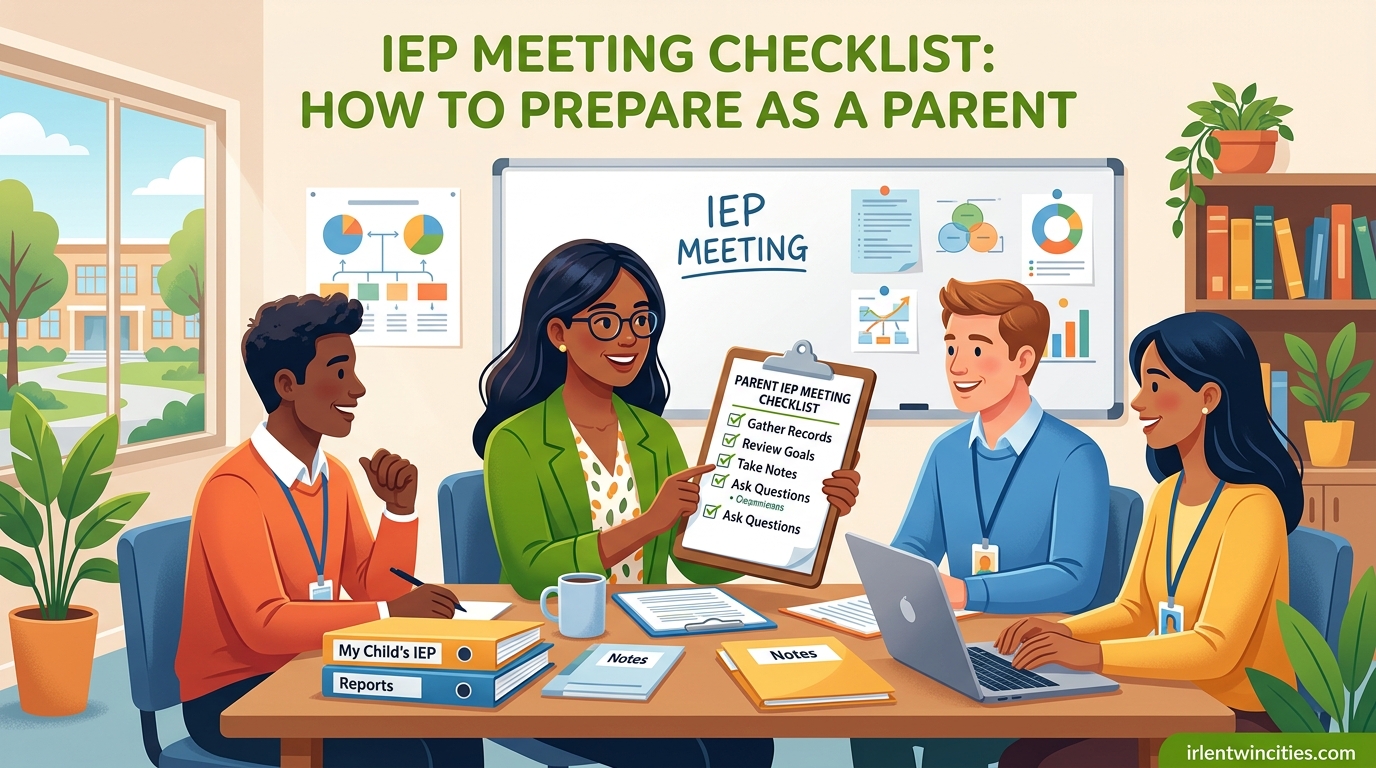
Walking into your child’s IEP meeting feeling prepared and confident makes all the difference. This IEP meeting checklist will guide you through everything you need to know to advocate effectively for your child’s education. I’ve compiled strategies from special education advocates, experienced parents, and special education law to help you feel ready for your next IEP meeting.
Whether this is your first IEP meeting or your tenth, proper preparation transforms overwhelming situations into productive collaborations. Parents who tell me they feel successful at IEP meetings are those who invest time in preparation before walking through the school doors. Let me walk you through exactly how to prepare for an IEP meeting as a parent.
Table of Contents
Understanding IEP Meetings and Your Role
An IEP meeting is a gathering of the IEP team to review, revise, or create your child’s Individualized Education Program. The team includes you (the parent), general education teacher, special education teacher, school administrator, and any related service providers like speech or occupational therapists. Your role as a parent is equal to all other team members—you are your child’s most important advocate.
The IEP meeting serves as the official forum to discuss your child’s current performance, set measurable goals, determine necessary services and accommodations, and make placement decisions. These meetings occur at least annually, though you or the school can request additional meetings anytime concerns arise. Understanding that you are a full team member with equal decision-making power helps shift your mindset from passive participant to active advocate.
The legal foundation for IEP meetings comes from the Individuals with Disabilities Education Act (IDEA), which guarantees your right to participate in all decisions affecting your child’s education. This federal law ensures you receive Prior Written Notice before any changes to your child’s identification, evaluation, placement, or provision of FAPE (Free Appropriate Public Education). Knowing these rights exists helps you approach meetings with confidence rather than apprehension.
IEP Meeting Checklist: Timeline-Based Preparation
The most effective approach to IEP meeting preparation follows a timeline starting from when you receive the meeting notice through the day of your meeting. This structured approach prevents last-minute stress while ensuring nothing important falls through the cracks. I’ve organized this IEP meeting checklist chronologically so you can tackle tasks in manageable steps.
When You Receive the Meeting Notice
☑ Confirm your attendance immediately by responding to the meeting invitation or calling the case manager.
☑ Add the meeting to your calendar with reminders set for 1 week before and 1 day before.
☑ Request a copy of the draft IEP at least 3-5 days before the meeting if one exists.
☑ Ask who will be attending the meeting and their roles.
☑ Request any evaluation reports or data that will be discussed.
☑ Notify the school if you need to bring an advocate, attorney, or support person.
☑ Request an interpreter if English is not your first language (this is your right under law).
☑ Ask if the meeting will be virtual or in-person.
When parents tell me they feel overwhelmed by IEP meetings, it’s often because they wait until the last minute to prepare. Taking action immediately when you receive that meeting notice gives you time to gather your thoughts, documents, and support system. The school district must provide the meeting notice at a reasonable time before the meeting—use this time wisely.
Two Weeks Before Your IEP Meeting
☑ Review your child’s current IEP and progress reports thoroughly.
☑ Gather recent work samples, tests, and assignments showing strengths and struggles.
☑ Write your parent input statement or vision statement (more on this below).
☑ List your concerns organized by area (academic, behavioral, social, functional).
☑ Identify your child’s strengths and interests to share with the team.
☑ Create a list of goals you want to see addressed in the new IEP.
☑ Organize all documents in a binder or digital folder (see document checklist below).
☑ Research any new accommodations or services you think might help your child.
☑ Talk to your child about their school experience and their perspective.
☑ Decide if you want your child to attend part or all of the meeting.
This two-week window is your preparation sweet spot. Parents I’ve worked with who use this time effectively report feeling significantly more confident walking into meetings. Use this period to really think through what’s working, what isn’t working, and what you want to see change. Your observations from home and your child’s feedback are invaluable data points the school doesn’t have.
The Week of Your IEP Meeting
☑ Finalize your list of questions for the team.
☑ Confirm your support person can attend or arrange a backup.
☑ Prepare what you’ll say to open the meeting (your vision statement).
☑ Pack your IEP binder or organize digital documents for easy access.
☑ Arrange childcare if needed and plan your travel time.
☑ Test your technology if meeting virtually.
☑ Prepare emotionally—practice calming strategies.
☑ Review procedural safeguards document (the school should provide this).
☑ Write down your non-negotiables and areas where you can compromise.
☑ Get a good night’s sleep before the meeting.
The week before your meeting is about finalization and self-care. Many parents experience increased anxiety as meetings approach—I know I did. This week, focus on feeling prepared and supported. Connect with other parents who understand the process, review your rights, and remind yourself that you know your child better than anyone else in that room will.
Essential Documents to Bring to Your IEP Meeting
Coming to your IEP meeting with organized documentation demonstrates your preparation and provides concrete evidence to support your requests. Parents who bring documentation feel more confident and are taken more seriously by school teams. Here’s what should be in your IEP binder:
Current IEP Documents: The most recent IEP, all progress reports, current goals and objectives, current accommodations and modifications, service delivery minutes, and placement information. Review these carefully so you know exactly what your child should be receiving.
Evaluation Reports: Most recent evaluation reports, any independent evaluations (IEE) you’ve obtained, medical diagnoses relevant to education, therapist reports (private OT, speech, mental health), and any assessments from outside providers. These reports provide data that can support your requests for services.
Communication Records: Emails with teachers and administrators, notes from phone calls, written concerns you’ve raised, and any responses you’ve received. Documented communication creates a paper trail that can be crucial if disputes arise.
Work Samples and Data: Recent work showing current performance levels, tests or quizzes (with grades), writing samples, behavior charts or logs, and any data you’ve collected at home. This evidence helps illustrate the gap between current performance and what’s needed.
Your Written Input: Parent input statement or vision statement, list of your concerns, list of goals you want addressed, questions for the team, and any research on accommodations or strategies you want considered. Having your thoughts written down ensures you won’t forget to mention important points.
Reference Materials: Copy of procedural safeguards, copy of parent rights under IDEA, notes on relevant laws or regulations, and contact information for advocacy organizations. Having these references handy can help if questions about rights arise during the meeting.
Organize these documents in a binder with tabs or in a well-organized digital folder. Parents I’ve worked with who use this system report being able to find information quickly during meetings, which reduces stress and increases their effectiveness. When you can immediately pull out the exact document that supports your point, you demonstrate thorough preparation and command of the facts.
Writing Your Parent Input Statement
A parent input statement is your opportunity to share your vision, concerns, and priorities with the IEP team in writing. This statement becomes part of your child’s official educational record, so it’s worth taking time to craft carefully. Many parents tell me that writing their input statement helped them clarify exactly what they wanted to communicate.
Start with your vision for your child. What are your long-term hopes? What do you dream about for their future? This vision sets a positive tone and reminds the team that your child has a life beyond school walls. Your vision might include independence, meaningful relationships, employment, or continuing education—whatever matters most for your child’s future.
Next, describe your child’s strengths. What do they love? What do they excel at? What brings them joy? Your child’s strengths should be the foundation for goal-setting and strategy development. When teams focus only on deficits, they miss opportunities to use strengths as building blocks for growth.
Then detail your specific concerns organized by area: academic, behavioral, social, emotional, or functional. Be as specific as possible about what you’re observing. Instead of saying “struggles with reading,” say “reads at 2nd grade level despite 4th grade placement and becomes frustrated with independent reading assignments.” Specificity helps the team understand the exact nature and severity of challenges.
Include any recent changes or new concerns since the last IEP. Has something gotten worse? Have new challenges emerged? Have strategies stopped working? The IEP team needs current information to make appropriate decisions.
Finally, list your priorities for this IEP cycle. What’s most important to you? What must be addressed? What would be nice to address? Knowing your priorities helps you focus energy during the meeting and helps the team understand what matters most to you and your child.
Parents who submit their input statements before the meeting report feeling more heard during discussions. Consider emailing your statement to the case manager 2-3 days before the meeting so team members have time to read and consider your perspective. This simple step can shift the dynamic from reactive to collaborative.
Questions to Ask During Your IEP Meeting
Asking the right questions during your IEP meeting helps ensure you fully understand the team’s proposals and can make informed decisions. These questions also demonstrate your active engagement and help the team know you’re an informed participant. I recommend bringing a written list so you don’t forget anything in the moment.
About Progress Measurement: How exactly will you measure progress toward each goal? What data will be collected? How often will I receive progress reports? What constitutes “sufficient progress” for each goal? If my child isn’t making progress, when will we reconvene to adjust the approach? These questions ensure goals are measurable and that someone is accountable for tracking.
How will each accommodation be implemented? Who is responsible for ensuring implementation? What training will staff receive on these accommodations? How will we know if accommodations are working? Can you show me examples of how these will look in the classroom? The details of implementation matter—an accommodation only works if it’s actually provided consistently.
About Services: What specific services will my child receive? How often and for how long? Who will provide each service? What are their qualifications? Will services be provided individually or in groups? Where will services be provided (pull-out or push-in)? What happens if the provider is absent? Service delivery details significantly impact whether your child actually receives the support specified in the IEP.
What can I do at home to support these goals? How should I handle homework struggles? What communication should I expect from teachers? How can I share home concerns with the team? When should I request additional communication? Collaboration between home and school increases the likelihood that strategies will be effective across settings.
What data supports this recommendation? What research supports this approach for children with similar needs? How have other children with similar profiles succeeded with this approach? What does the research say about alternatives? Has this been tried before with my child, and what were the results? Data-driven decisions should be the norm, but asking for evidence ensures this happens.
When will this start? Who will ensure implementation happens? What’s the plan if implementation doesn’t occur? How will I know if something isn’t being provided? What should I do if I notice inconsistencies? Implementation is where many IEPs fall short—asking these questions helps prevent that gap.
Parents who ask these questions report feeling more informed and more confident in their decisions. Don’t worry about asking “too many” questions—your role is to be an informed decision-maker for your child. If something doesn’t make sense, ask for clarification. If terms are used you don’t understand, ask for definitions. The team should welcome your questions as signs of your engagement.
During the IEP Meeting: Strategies for Success
The actual meeting can feel overwhelming, especially if multiple school staff are present and you’re alone. Having strategies for managing yourself and the meeting dynamics helps ensure your perspective is heard and considered. These techniques come from experienced advocates and parents who’ve navigated hundreds of IEP meetings.
Start with your vision statement. Most schools will begin with introductions and then invite you to share. This is your opportunity to frame the conversation positively and remind everyone that your child is a whole person with a future beyond the classroom. When I lead with vision, I notice the energy in the room shifts from deficit-focused to possibility-focused. Your vision sets a collaborative tone and reminds everyone why they’re there.
Practice active listening throughout the meeting. This means fully focusing on what others are saying rather than planning your response while they’re talking. Take notes on key points, questions raised, and agreements made. Active listening helps you catch important details, shows respect for other team members, and ensures you fully understand proposals before responding.
Use “I notice” and “I’m concerned about” statements rather than accusatory language. Instead of saying “You’re not providing services,” say “I notice the speech therapy minutes in the proposed IEP are less than last year, and I’m concerned about maintaining progress.” This approach reduces defensiveness while still clearly communicating your concerns.
Ask for clarification whenever something isn’t clear. “Can you explain that accommodation in more detail?” or “I’m not sure I understand what that goal would look like in practice—can you give me an example?” It’s better to ask than to leave confused. School staff sometimes use educational jargon without realizing parents may not understand these terms.
Pause before responding to proposals. It’s okay to say “I need a moment to think about that” or “That’s a lot of information—can we come back to this after I’ve had time to process?” Many parents feel pressured to make immediate decisions during meetings, but you have the right to thoughtful consideration. Taking a breath also helps you respond thoughtfully rather than emotionally.
Take thorough notes or ask someone to take notes for you. Document who said what, what was agreed to, what was tabled for further discussion, and any timelines mentioned. If you can’t take notes while participating, bring a support person whose role is specifically to document. Parents who tell me they wish they had documented more often regret not having records of conversations.
Focus on your child’s needs, not on criticizing the school or specific teachers. Even when frustrated, directing criticism at individuals rarely produces positive outcomes. Instead, keep bringing the conversation back to what your child needs to be successful. “My child needs consistent access to these accommodations” is more productive than “Mrs. Smith never provides the accommodations.”
Don’t agree to anything you’re unsure about. If the team is pressuring you to sign or agree and you’re uncomfortable, it’s okay to say “I need to review this at home before I can agree” or “I need to think about this and get back to you tomorrow.” Never sign an IEP you haven’t read thoroughly or that contains elements you don’t support.
Parents who use these strategies report feeling more in control during meetings and more satisfied with outcomes. The goal isn’t to win against the school—the goal is to ensure your child receives appropriate services. These approaches help you advocate effectively while preserving relationships with the team members who will be working with your child daily.
Understanding Your Rights as a Parent
Knowing your rights under special education law transforms you from a meeting participant to an empowered decision-maker. The Individuals with Disabilities Education Act (IDEA) provides specific rights designed to ensure parents can meaningfully participate in their child’s education. Understanding these rights before your meeting helps you assert them when needed.
Procedural Safeguards: Every parent of a child with an IEP must receive a copy of procedural safeguards at least annually. This document outlines your rights under IDEA, including your right to participate in all meetings, your right to consent to evaluations and initial placement, your right to receive Prior Written Notice before changes, and your right to dispute resolution options. Read this document carefully and bring questions to your meeting.
Prior Written Notice (PWN): The school must provide you with written notice before they propose or refuse to initiate or change your child’s identification, evaluation, placement, or provision of FAPE. This notice must explain what the school proposes or refuses, why they’re making this decision, what other options they considered and why those were rejected, and the data supporting their decision. If your child’s services change and you don’t receive PWN, request it immediately—this is a legal requirement.
Independent Educational Evaluation (IEE): If you disagree with the school’s evaluation, you have the right to request an IEE at public expense (meaning the school pays). The school can either agree to pay for the IEE or request a due process hearing to prove their evaluation was appropriate. This right ensures you can obtain additional evaluation data if you have concerns about the school’s assessment.
Consent Requirements: The school must obtain your informed written consent before conducting initial evaluations, conducting reevaluations, and initially placing your child in special education. However, for most other decisions, the school can proceed without your consent after providing notice. This means staying engaged and objecting promptly when you disagree with proposed changes is crucial.
Dispute Resolution Options: If you disagree with the school’s decisions, IDEA provides several options for resolving disputes. You can request mediation (a facilitated negotiation with a neutral mediator), file a due process complaint (a formal legal proceeding), or file a state complaint (alleging the school violated special education law). Each option has different timelines and procedures, so understand which approach best fits your situation.
Recording Meetings: Whether you can audio record IEP meetings depends on state law. Some states allow parents to record meetings as long as they provide notice to the school. Other states prohibit recording or require consent from all parties. Check your state’s specific regulations before recording any meeting. If recording is allowed, notify the school in writing before the meeting.
Attorney and Advocate Rights: You have the right to bring an advocate or attorney to IEP meetings. If you bring an attorney, the school may also have their attorney present. Advocates can be particularly helpful for parents who feel overwhelmed or who have had negative experiences in past meetings. Give the school notice if you plan to bring anyone outside the immediate family.
Understanding these rights helps you participate more confidently in IEP meetings. However, exercising rights should be done strategically—parents who approach every meeting as a potential legal battle often find it harder to build collaborative relationships with their child’s team. Use your rights as tools to ensure appropriate services, not as weapons against the school.
Virtual IEP Meeting Preparation
Virtual IEP meetings have become increasingly common since 2026, bringing both benefits and challenges. Online meetings eliminate travel time and can make it easier for both parents and school staff to attend, but they also require different preparation and engagement strategies. If your upcoming IEP meeting will be held virtually, these specific preparations will help you participate effectively.
Test your technology at least 24 hours before the meeting. Check your internet connection, camera, microphone, and the meeting platform (Zoom, Google Meet, Teams, or whatever system your district uses). Have your device plugged in or fully charged. Technical difficulties during IEP meetings add unnecessary stress and can cause you to miss important information while troubleshooting.
Create a professional meeting environment. Find a quiet space where you won’t be interrupted, position your camera at eye level, and ensure adequate lighting. Consider using headphones to improve audio quality and reduce background noise. A professional environment helps you be taken seriously and minimizes distractions during important discussions.
Organize your documents for easy digital reference. If you have digital documents, organize them in tabs or windows so you can quickly find what you need. If you have paper documents, have them organized and positioned where you can reference them without appearing disorganized on camera. Some parents find it helpful to have a summary document with key points visible on their screen.
Plan for how you’ll take notes. In virtual meetings, it’s harder to see when someone is taking notes versus staring blankly. Consider mentioning at the start that you’ll be taking notes so the team understands. Some parents use a separate device for note-taking, while others use pen and paper. Choose whatever works best for you.
Be mindful of your visibility and engagement. Keep your camera on if possible, as this helps with non-verbal communication and demonstrates your engagement. Look at the camera when speaking (not at yourself on screen) to simulate eye contact. Use reactions like nodding to show you’re following the conversation, even when not speaking.
Minimize distractions throughout your home. Inform family members that you’re in an important meeting and shouldn’t be interrupted. Silence your phone and turn off notifications on your computer. Close unnecessary browser tabs and applications. Giving the meeting your full attention is challenging enough in virtual format—don’t make it harder with avoidable distractions.
Consider your audio options. If your internet connection is unstable, consider calling in by phone for audio while using the computer for video. This prevents freezing or dropped audio during critical moments. However, using computer audio generally provides better quality for participation, so only use phone audio if necessary.
Ask about recording virtual meetings. The same rules apply for recording virtual meetings as in-person meetings. If recording is allowed in your state and you want to record, notify the school in writing before the meeting. Virtual platforms often have built-in recording features, but clarify whether the school will be recording and how those recordings will be used.
Plan for connection issues. Have the case manager’s contact information available in case you get disconnected. Discuss at the start of the meeting what will happen if technical difficulties arise—will they pause, wait a specified time, or reschedule? Having a plan prevents panic if technology fails.
Virtual meetings require the same preparation as in-person meetings, plus additional technological readiness. Parents who treat virtual meetings with the same seriousness as in-person meetings report better outcomes and more satisfaction with the process. The format may be different, but the stakes remain the same—your child’s educational future.
Emotional Preparation and Mindset Strategies
The emotional aspect of IEP meetings deserves as much attention as the logistical preparation. These meetings can bring up intense feelings—love for your child, worry about their future, frustration with past experiences, anxiety about disagreements, and grief over the challenges they face. Parents who acknowledge and prepare for these emotions navigate meetings more successfully and experience less emotional aftermath.
Prepare to hear difficult information about your child. Even when you know your child is struggling, hearing professionals detail those struggles in a meeting can be painful. You might hear about behaviors you don’t see at home, academic gaps you hadn’t fully understood, or social challenges your child hasn’t shared. Allow yourself to feel whatever comes up, but try to stay present and focused on solutions rather than getting stuck in the difficulties.
Recognize that emotional reactions are normal. Many parents cry during IEP meetings, especially the first few. Feeling angry, sad, or overwhelmed doesn’t mean you’re failing—it means you care deeply about your child. However, intense emotions can sometimes interfere with effective advocacy if they prevent you from thinking clearly or communicating your needs.
Develop grounding strategies before the meeting. Practice deep breathing techniques you can use during stressful moments. Identify self-affirming statements that help you stay centered (“I am my child’s expert,” “I have valuable contributions to make,” “I can handle this”). Consider bringing a grounding object—a smooth stone, a photo of your child succeeding, or something else that helps you stay connected to your purpose.
Reframe nervousness as preparation energy. The anxiety you feel before an IEP meeting shows how much you care. Instead of trying to eliminate nerves, channel that energy into thorough preparation. When you’ve done everything possible to prepare, you can walk into the meeting knowing you’ve done your part, which helps reduce anxiety.
Address any past negative experiences. If you’ve had difficult IEP meetings before, acknowledge those experiences but recognize that each meeting is a new opportunity. Consider what went poorly in the past and what you might do differently this time. However, don’t assume this meeting will be difficult because previous ones were—approach each meeting with cautious optimism rather than expecting problems.
Build your support network before and after the meeting. Connect with other parents who understand the process. Schedule time to debrief with a supportive person after the meeting. Have someone you can call or text if you need encouragement during the meeting (step out for a moment if needed). Emotional support makes the IEP journey less isolating and more manageable.
Separate your worth as a parent from your child’s challenges. It’s easy to internalize discussions about your child’s struggles as reflections on your parenting. Remember that your child’s disability or difficulties are not your fault, and neither is the school’s inability to meet their needs necessarily your failure. You’re doing the best you can with the information and resources you have.
Focus on your child as a whole person, not just their challenges. Before the meeting, spend time with your child doing something they enjoy. Remind yourself of their strengths, their personality, their humor, their unique qualities. This whole-child perspective helps maintain balance when discussions focus heavily on problems and deficits.
Plan self-care for after the meeting. Schedule something you enjoy for later that day—a walk, time with a friend, a favorite activity, or simply rest. IEP meetings are emotionally and mentally draining, so plan recovery time. Don’t expect to be at your best for other responsibilities immediately after an intense meeting.
Emotional preparation doesn’t guarantee meetings will be easy, but it does help you navigate challenges more effectively. Parents who acknowledge the emotional dimension of IEP meetings report feeling more resilient and less depleted by the process. Your emotions are valid and understandable—honor them while also preparing to advocate effectively for your child.
Common Mistakes to Avoid at IEP Meetings
Learning from other parents’ mistakes can help you avoid pitfalls that undermine your effectiveness. These common mistakes come from experienced advocates and parents who’ve navigated dozens of IEP meetings. Being aware of these potential missteps helps you recognize and avoid them during your own meetings.
Attending meetings unprepared. Walking into an IEP meeting without reviewing documents, preparing your thoughts, or organizing questions puts you at an immediate disadvantage. The school team has prepared—they’ve reviewed records, discussed your child among themselves, and planned recommendations. When you’re equally prepared, you’re positioned as an equal team member rather than a recipient of decisions made by others.
Signing the IEP at the meeting. Schools often pressure parents to sign immediately, but you have the right to review the IEP at home before signing. Take the document home, read it carefully, compare it to what was discussed, and ensure everything reflects your understanding and agreements. Once you sign, the IEP is implemented, so make sure you’re comfortable with every element before signing.
Agreeing to unclear or vague goals. Goals should be specific, measurable, and include clear criteria for success. If a goal is vague like “will improve reading,” ask for specifics—improve from what level to what level? Measured how? Over what timeframe? By what method? Vague goals can’t be measured effectively, which means you can’t hold the school accountable for progress.
Remaining silent when you disagree. Some parents stay quiet during meetings because they feel intimidated, outnumbered, or afraid of being labeled “difficult.” However, silence is interpreted as agreement. If you disagree with something, say so respectfully but clearly. “I can’t agree to that reduction in services” or “I don’t think that goal is ambitious enough for my child.” Your voice matters in these meetings.
Reacting emotionally rather than responding strategically. Feeling emotional during IEP meetings is normal, but emotional outbursts, accusations, or hostility usually backfire. School staff become defensive, productive discussion stops, and you may lose credibility. It’s okay to pause and say “I need a moment” when emotions run high. Taking breaks allows you to collect yourself and return to the discussion more effectively.
Focusing only on problems without proposing solutions. While it’s important to identify what’s not working, bringing potential solutions demonstrates collaboration and expertise. Instead of just saying “this isn’t working,” try “this isn’t working, but I’ve researched X approach and think it might help. Can we discuss that?” This approach positions you as a problem-solver rather than just a complainer.
Accepting “we don’t have the resources” as an answer. Schools do have budget constraints, but “no resources” is not a legal justification for denying services your child requires. If the team says they can’t provide something due to resources, respond with “I understand resource constraints, but my child needs X service to receive FAPE. How can we address this need within available resources?” Keep the focus on your child’s right to appropriate education.
Not documenting agreements and discussions. If it’s not written down, it didn’t happen as far as implementation is concerned. Don’t leave the meeting relying on verbal agreements or promises. If the team agrees to something, ensure it’s written into the IEP before you leave or document the agreement in a follow-up email. Implementation depends on written documentation, not verbal commitments.
Bringing up entirely new concerns at the end of the meeting. Introducing major new concerns when time is running out means they won’t get proper attention. If you have significant new issues, consider requesting to reschedule or table those items for a focused follow-up meeting. This ensures each concern gets the thorough discussion it deserves rather than being rushed or overlooked.
Attending alone when you need support. Some parents feel they should handle IEP meetings alone, but bringing a support person is often wise—especially for difficult meetings or if you feel intimidated. A spouse, relative, friend, or advocate can provide emotional support, help take notes, and offer another perspective. You don’t have to navigate these meetings alone.
Not following up after the meeting. The IEP meeting is just the beginning—implementation is what matters. Many parents make the mistake of not monitoring whether agreed-upon services are actually provided. Follow up with teachers, check that accommodations are being implemented, monitor progress toward goals, and communicate concerns promptly. Your involvement shouldn’t end when the meeting ends.
Recognizing these common mistakes helps you avoid them. When you know what to watch out for, you can catch yourself before falling into these patterns. Every parent has made mistakes in IEP meetings—the key is learning from them and approaching each meeting as an opportunity to advocate more effectively.
Post-Meeting Follow-Up and Next Steps
Your IEP meeting concludes with decisions about your child’s educational program, but your work as an advocate continues through implementation and monitoring. Effective follow-up ensures that agreements made in the meeting translate into actual services and support for your child. These post-meeting steps are crucial for holding the school accountable and ensuring your child receives the benefits of the IEP.
Review your notes immediately after the meeting. While the discussion is fresh in your mind, organize your notes, clarify any abbreviations or shorthand, and fill in gaps while you remember what was said. Compare your notes to the written IEP document to ensure everything discussed was captured accurately. Parents who review notes right away catch discrepancies they might miss weeks later.
Request a copy of the finalized IEP before leaving or within a few days. Review it carefully to ensure it reflects the actual meeting discussions and agreements. Check that all services, accommodations, and goals are written exactly as agreed. If something is missing or incorrect, contact the case manager immediately to request corrections. This document drives your child’s services, so accuracy matters.
Send a follow-up email summarizing key agreements and next steps. Even if you received the IEP document, a brief email documenting your understanding helps prevent miscommunications. Include any action items, who is responsible, and timelines. For example: “Thank you for today’s meeting. As discussed, my child will receive speech therapy twice weekly for 30 minutes, starting September 15th. I’ll receive weekly progress notes from Ms. Johnson. Please let me know if I misunderstood anything.”
Share relevant information with your child. Depending on their age and maturity, explain any changes to their services or schedule. If they attended the meeting, debrief about what happened and what to expect. For older students, review accommodations and goals so they understand their own educational plan. When children understand their IEP, they can advocate for themselves more effectively.
Communicate with private providers if applicable. If your child sees private therapists, tutors, or other providers, share relevant portions of the IEP with them (with appropriate privacy considerations). These providers can support school goals and help monitor whether services are meeting your child’s needs. Collaboration between school and private providers creates a more comprehensive support system.
Monitor implementation closely in the first weeks. Check that services are starting as scheduled, accommodations are being provided, and teachers are aware of the IEP. Don’t wait until progress reports come out to notice that something isn’t happening. Early intervention on implementation issues prevents your child from losing weeks or months of services they should be receiving.
Track progress toward goals. The IEP should specify how and when progress will be measured. Keep your own records of progress—work samples, test scores, behavior observations, communications from teachers. If progress isn’t occurring as expected, request a meeting to discuss adjustments. Waiting until the annual IEP review to address lack of progress means your child loses an entire year of appropriate support.
Document any concerns about implementation. If accommodations aren’t provided, services are missed, or goals aren’t being addressed, document these issues in writing to the case manager. Be specific about what should be happening, what is actually happening, and the impact on your child. Written documentation creates a paper trail that can be crucial if you need to request compliance or dispute resolution.
Maintain positive relationships with school staff. Implementation depends on the daily work of teachers, therapists, and aides. Even when advocating firmly, maintain professional relationships. Thank staff when things go well, communicate respectfully about concerns, and recognize their efforts. Parents who build collaborative relationships often find that school staff go above and beyond for their children.
Know when to request another meeting. You don’t have to wait for the annual review to address concerns. If something isn’t working, services aren’t being provided, or your child’s needs have changed significantly, request an IEP meeting sooner. Most parents I work with wish they had requested meetings earlier rather than waiting and hoping things would improve.
Prepare for the next meeting starting now. The best time to prepare for your next IEP meeting is right after this one ends. Keep collecting data, documenting concerns and successes, and observing what works and what doesn’t. Continuous preparation means you’ll never be scrambling when the next meeting notice arrives.
Effective follow-up transforms IEP meeting decisions into actual support for your child. The meeting is just the beginning—implementation, monitoring, and ongoing advocacy ensure your child truly benefits from the educational program designed for them. Your continued involvement makes the difference between a document and real support.
How do I prepare for an IEP meeting as a parent?
Prepare by organizing all current IEP documents, evaluation reports, and work samples in a binder. Write a parent input statement describing your child’s strengths, your concerns, and your vision for their future. List specific questions you want answered during the meeting. Request any draft IEP or evaluation reports in advance. Review your procedural safeguards and parent rights. Arrange for a support person to attend with you if needed. Prepare emotionally by acknowledging that the meeting may bring up difficult feelings. Finally, organize your thoughts and documents so you can easily find information during the meeting.
Frequently Asked Questions About IEP Meeting Preparation
Can I bring someone to my IEP meeting?
Yes, you absolutely can and often should bring someone to your IEP meeting. You may bring a spouse or partner, another family member, a friend, an advocate, or even an attorney. Many parents find it helpful to bring someone who can take notes while they focus on the discussion. You may also bring individuals who have special knowledge or expertise about your child, such as a private therapist or tutor. Simply notify the school in advance if you plan to bring anyone outside your immediate family. Bringing a support person can help you feel less outnumbered and more confident during the meeting.
What if I disagree with the IEP team’s recommendations?
You have several options if you disagree with the IEP team. First, clearly and respectfully state your disagreement and the reasons why. Ask questions to understand the team’s perspective and the data supporting their recommendation. Propose alternatives supported by research or your child’s needs. If you cannot reach agreement, you can refuse consent (for initial placement or certain changes) and request further discussion. You can also request mediation, file a due process complaint, or file a state complaint. Many disagreements are resolved through continued discussion and collaboration—don’t assume immediate legal action is necessary. Document your disagreement in writing and request Prior Written Notice explaining the school’s position.
Can I record an IEP meeting?
Whether you can record an IEP meeting depends on your state’s laws. Some states allow parents to audio record IEP meetings as long as they provide advance notice to the school. Other states prohibit recording or require consent from all participants. Check your specific state’s regulations before recording any meeting. If recording is allowed in your state, provide written notice to the school at least 24 hours before the meeting. Be aware that if you choose to record, the school may also record the meeting. Recording can help ensure accurate documentation, but it may also affect the openness of the discussion. Consider whether recording is necessary for your situation.
How long do IEP meetings typically last?
IEP meetings typically last between 30 minutes to 2 hours, with most lasting about 1 hour. The length depends on several factors: whether this is an annual review or an initial IEP, how complex your child’s needs are, how many issues need to be discussed, and whether disagreements arise. Initial IEP meetings and triennial reevaluations often take longer because they involve more comprehensive discussions. If the meeting is running very long and you’re fatigued, it’s acceptable to request a continuation on another day. Important decisions shouldn’t be made when everyone is exhausted. Schools should schedule sufficient time for the meeting, but if you anticipate a longer discussion, you can request a longer time slot when confirming your attendance.
When does my child attend IEP meetings?
Federal law requires that students be invited to IEP meetings when transition planning begins at age 16, though many states begin including students earlier. For younger students, attendance is at parent and team discretion. Consider your child’s maturity, ability to participate meaningfully, and whether their presence would be helpful or stressful. Some children attend only portions of meetings where topics directly concern them. If your child attends, prepare them beforehand about what to expect and what will be discussed. Your child’s participation can provide valuable insights into their experience and needs, but it should be a positive experience, not an overwhelming one.
Conclusion: Your Child’s Best Advocate
Preparing thoroughly for IEP meetings transforms you from an anxious participant into a confident advocate for your child’s education. This IEP meeting checklist provides the framework you need to approach meetings with preparation, knowledge, and appropriate emotional readiness. Parents who invest time in preparation report better outcomes, less stress, and more satisfaction with the IEP process.
Remember that you are your child’s most important advocate and the expert on their strengths, needs, and potential. The IEP team includes valuable professionals, but none know your child the way you do. Your perspective, observations, and vision are essential components of developing an appropriate educational program. Trust your knowledge of your child while remaining open to the team’s expertise.
Effective IEP meeting preparation happens over time, not in a single marathon session. Use the timeline approach to tackle preparation in manageable steps. Build your support network, organize your documentation, clarify your priorities, and prepare emotionally for the discussions ahead. When you walk into your next IEP meeting feeling prepared and supported, you’ll be positioned to secure the services and support your child needs to thrive in school.
The IEP journey continues throughout your child’s education, but each meeting becomes easier as you build knowledge, confidence, and collaborative relationships with your child’s educational team. Use this IEP meeting checklist to prepare for your next meeting, and remember—you’re not just advocating for services, you’re advocating for your child’s future.