
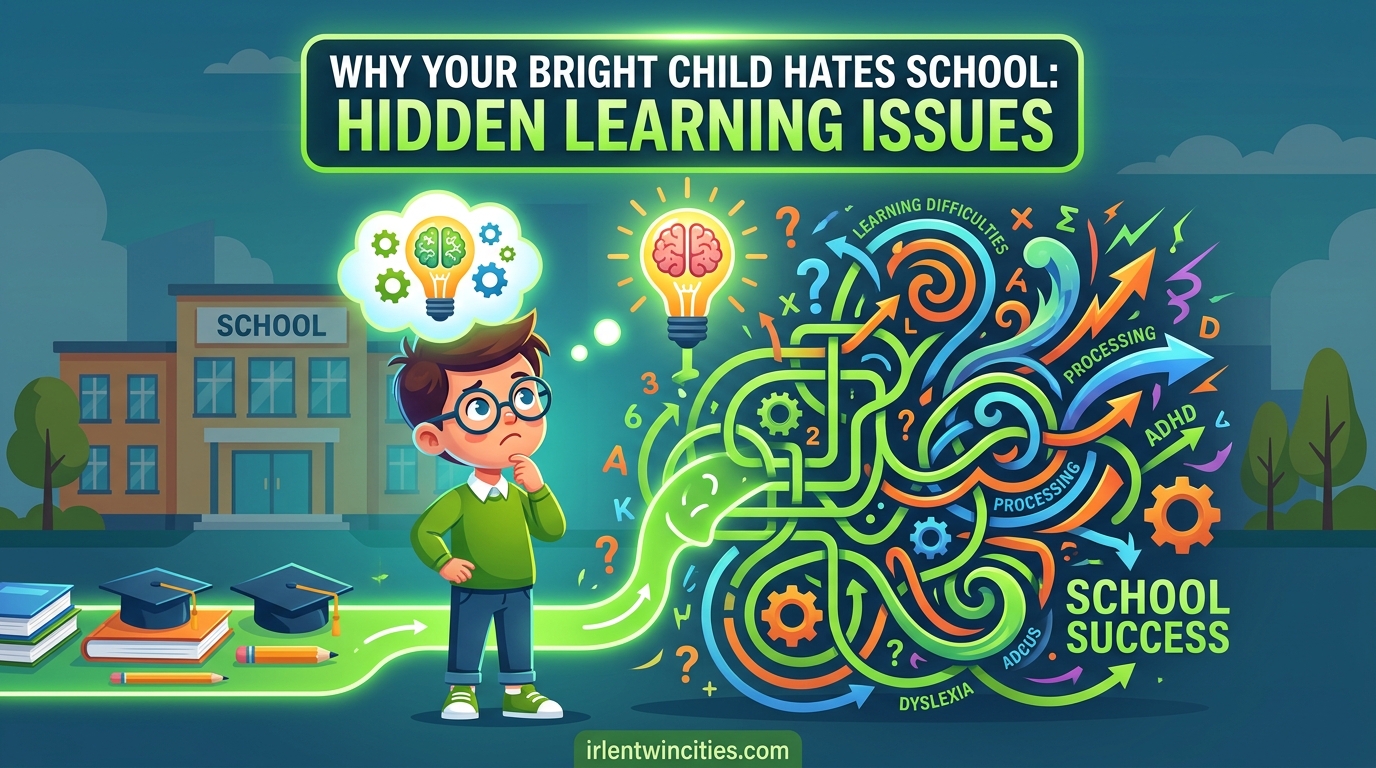
Your child tested into the gifted program but fights you every morning about going to school. They can explain complex scientific concepts at the dinner table but “forget” to turn in homework they’ve completed. Teachers describe them as “lazy” or “unmotivated” while you see a curious, capable child who seems to shut down the moment they walk into a classroom.
You are not alone. This pattern is far more common than most parents realize. The disconnect between a child’s obvious intelligence and their school performance often signals hidden learning issues that standard testing fails to catch. While most articles focus on ADHD and dyslexia, there’s another category of challenges that remains largely invisible: visual processing issues including Irlen Syndrome, which affects how a child perceives text and light in learning environments.
In this guide, I will walk you through why bright children develop school aversion, the specific hidden learning barriers that often go undiagnosed, and practical steps you can take to help your child rediscover their love of learning.
Table of Contents
Why Your Bright Child Hates School: Understanding the Hidden Learning Issues
The frustration parents feel watching a capable child struggle academically runs deeper than grades on a report card. It represents a fundamental mismatch between what we assume about intelligence and how learning actually works in the brain.
The “Bright But Struggling” Paradox Explained
Intelligence and academic performance are not the same thing. A child can possess exceptional reasoning ability, creativity, and knowledge while simultaneously struggling with the mechanics of school. This creates what educators call the “masking effect” – where a child’s high cognitive abilities compensate for underlying learning differences just enough to keep them from falling completely behind, but not enough to let them truly thrive.
These children often develop elaborate coping strategies. They might become class clowns to deflect attention from their struggles. They might rely on verbal participation to demonstrate knowledge while avoiding written work. They might spend three hours on homework that takes peers 45 minutes, then get labeled as perfectionists or slow workers. The energy required to maintain these compensations is exhausting.
By the time many parents seek help, their child has already developed a deep association between school and frustration. The morning stomach aches and tears aren’t manipulation. They’re genuine physical stress responses to an environment that demands more from that child than their brain can comfortably deliver.
What “Twice Exceptional” Really Means
The term “twice exceptional” or “2e” describes children who demonstrate both gifted-level abilities and diagnosed learning disabilities. Research published in Gifted Child Quarterly found that nearly 70 percent of twice exceptional teens report school-related stress significantly higher than their peers. Yet many schools struggle to identify these students because their strengths hide their weaknesses, and their weaknesses mask their strengths.
A twice exceptional child might read three grade levels ahead in their area of interest but struggle to copy notes from the board. They might solve complex math problems mentally but fail written tests because they cannot organize their work on paper. They might lead brilliant classroom discussions but produce writing samples that look careless or incomplete.
Traditional gifted programs focus on acceleration and enrichment. Traditional special education focuses on remediation and support. Twice exceptional children often fall into the gap between these two systems, receiving neither the intellectual challenge they crave nor the specific accommodations they need.
When School Becomes the Enemy
Children experiencing this paradox often develop genuine school aversion. They describe school as “boring,” “pointless,” or “torture.” Parents report that their child is perfect at home – engaged, curious, helpful – but transforms into a different person at school. This isn’t defiance. It’s a protective response to an environment that feels hostile to their neurology.
The tragedy is that these children know they’re capable. They can feel the gap between what they understand and what they can demonstrate. Many internalize their struggles as personal failure rather than neurological difference. By middle school, some begin identifying as “bad at school” despite their obvious intelligence, a label that can limit their trajectory for years.
Hidden Learning Issues That Hold Bright Kids Back
Identifying the specific barrier your child faces is the first step toward real solutions. Most parents are familiar with ADHD and dyslexia, but the landscape of learning differences is broader and more nuanced than these two conditions.
ADHD in High-Ability Children
ADHD doesn’t always look like the stereotype of a hyperactive child bouncing off walls. In bright children, ADHD often presents as inattentive type – daydreaming, difficulty sustaining focus during repetitive tasks, losing materials, and struggling to follow multi-step instructions. These children can hyperfocus on interesting topics for hours while being unable to complete a simple worksheet.
The diagnostic challenge increases with intelligence. A gifted child with ADHD may score well on tests despite not paying attention in class. They might compensate for attention gaps by using reasoning to fill in missed information. Teachers may see a child who performs adequately and assume their reported struggles at home are motivational rather than neurological.
Do kids with ADHD hate school? Many do, especially when their symptoms aren’t recognized and accommodated. The classroom environment – sitting still for extended periods, listening to lengthy verbal instructions, completing repetitive practice work – directly conflicts with how the ADHD brain functions best. Without understanding and support, these children develop anxiety and resistance that can persist throughout their education.
Dyslexia and Gifted Learners
Dyslexia affects 15-20 percent of the population, yet many gifted dyslexic students go undiagnosed for years. Their strong compensatory skills – excellent verbal reasoning, memory strategies, and contextual guessing – allow them to read at grade level or above while struggling with the underlying mechanics of decoding.
These students may show “stealth dyslexia” – reading comprehension that appears fine while spelling, writing, and phonetic processing lag behind. They might refuse to read aloud, take unusually long to complete reading assignments, or develop elaborate avoidance strategies around written work. Their writing often contains advanced vocabulary alongside basic spelling errors, a pattern that confuses teachers who expect consistent performance.
Standard reading assessments sometimes miss these students entirely because they score within the average or above-average range. Only specialized testing that examines processing speed, phonological awareness, and rapid naming reveals the underlying pattern of strengths and weaknesses that defines dyslexia in high-ability learners.
Executive Functioning Deficits
Executive functioning encompasses the brain’s management system: working memory, cognitive flexibility, and inhibitory control. These skills allow us to plan, organize, initiate tasks, manage time, and regulate emotions. When executive functioning is underdeveloped or impaired, every aspect of school becomes harder.
Bright children with executive functioning challenges often know what to do but cannot execute. They can explain the homework assignment perfectly but never write it down. They can discuss a project enthusiastically but miss the deadline. They can find lost items instantly when prompted but walk past them repeatedly when searching independently.
Parents frequently report that their child seems “lazy” because they clearly have the ability but don’t apply it consistently. This is the executive functioning paradox: the child with exceptional reasoning skills paired with impaired working memory and organization. These children need external scaffolding – visual schedules, checklists, broken-down assignments – rather than motivational lectures about trying harder.
Sensory Processing Challenges in the Classroom
The modern classroom is a sensory minefield. Fluorescent lighting, echoing voices, scratchy carpet, hard chairs, and the constant background hum of ventilation systems create an environment that overwhelms some children’s neurological systems. Children with sensory processing disorder experience this overwhelm acutely.
Some children are sensory seekers who need movement and input to regulate their attention. Others are sensory avoiders who become distressed by normal classroom stimuli. Both types struggle with the expectation to sit quietly, focus on the teacher, and filter out environmental distractions for hours at a time.
Parents often notice these patterns at home. The child who covers their ears during the vacuum cleaner or insists on specific clothing textures may be showing sensory sensitivities that affect their school experience. The child who crashes into furniture, chews pencils, or cannot stop moving may be seeking sensory input their body craves. Understanding these needs is essential for creating appropriate classroom accommodations.
Irlen Syndrome: The Hidden Visual Processing Issue
Among all the hidden learning issues affecting bright children, Irlen Syndrome remains the most frequently overlooked. This visual processing disorder affects how the brain interprets light and visual information, particularly from printed text. It is not a vision problem that standard eye exams detect – children with Irlen Syndrome often have 20/20 vision yet experience significant visual stress when reading.
Children with Irlen Syndrome perceive text differently than their peers. Words may appear to move, shimmer, or fade on the page. White paper can create glare that causes eye strain and headaches. Lines of text may seem to blur together or slide off the page. These symptoms increase with reading duration and under fluorescent lighting, which is unfortunately standard in most schools.
The consequences extend far beyond reading difficulties. Children with Irlen Syndrome often avoid reading, are labeled as slow readers, or develop headaches and fatigue during academic work. They may rub their eyes frequently, prefer dim lighting, or complain that the words “look funny.” Some become anxious about school, not because they lack ability, but because the visual environment feels hostile.
What makes Irlen Syndrome particularly challenging to identify is that affected children often have normal or above-average intelligence. They find ways to compensate – using context clues, listening carefully, or avoiding reading-heavy tasks. Their struggles are attributed to attention issues, laziness, or lack of interest when the true barrier is visual processing.
Screening for Irlen Syndrome is straightforward and non-invasive. Colored overlays or specially tinted lenses can provide immediate relief for many children. Addressing this single issue has transformed school experiences for countless bright children who previously believed they simply “weren’t good at reading.”
Processing Speed Gaps
Processing speed refers to how quickly the brain takes in information, makes sense of it, and responds. A child can have exceptional reasoning ability paired with slow processing speed, creating a frustrating gap between what they know and what they can demonstrate in real time.
These children often perform poorly on timed tests despite knowing the material. They may need more time to formulate written responses, causing their essays to look incomplete compared to peers. They might appear “slow to catch on” in fast-paced classroom discussions when actually they’re processing deeply what others skim over.
The mismatch between processing speed and intelligence creates particular anxiety around standardized testing and timed assignments. These children need extended time accommodations not because they need more time to learn, but because they need more time to show what they’ve already learned.
Warning Signs Checklist: By Age Group
Recognizing the warning signs of hidden learning issues early can prevent years of struggle. Use this checklist to identify patterns that warrant further evaluation. Remember that no single sign confirms a learning issue, but multiple indicators suggest the need for professional assessment.
Elementary School Age (Ages 5-10)
- Reluctance to go to school despite appearing happy at home
- Physical complaints (stomach aches, headaches) on school mornings
- Reading that is slow, labored, or avoided despite adequate instruction
- Letter or number reversals that persist beyond first grade
- Difficulty copying from the board or another paper
- Strong resistance to writing or drawing tasks
- Inability to remember simple sequences (days of week, months)
- Excellent verbal explanations but poor written work
- Difficulty following multi-step directions
- Extreme frustration with homework that seems simple
- Frequent erasing, crumpled papers, or perfectionism that prevents completion
- Avoidance of reading out loud, even to family
Middle School Age (Ages 11-14)
- Declining grades despite previous academic success
- Complaints that school is “boring” or “pointless”
- Increasing homework battles and procrastination
- Discrepancy between test scores and class participation
- Difficulty organizing materials across multiple classes
- Lost assignments despite having completed them
- Strong subject area strengths alongside significant weaknesses
- Social withdrawal or changing friend groups
- Anxiety about timed tests and quizzes
- Reluctance to read for pleasure despite early literacy
- Frequent eye rubbing, headaches, or fatigue during reading
- Preference for audiobooks or video content over printed text
High School Age (Ages 15-18)
- School refusal or significant truancy
- Underachievement relative to apparent ability
- Anxiety or depression related to academic performance
- Difficulty with note-taking during lectures
- Inability to complete long-term projects without crisis-mode
- Test performance that doesn’t reflect preparation effort
- Strong verbal reasoning but weak written expression
- Need for extreme multitasking to focus (music, fidgeting)
- Sleep disruption related to academic stress
- Considering dropping out despite college aspirations
- Self-identification as “bad at school” or “not smart”
- Physical exhaustion after school days
Physical and Emotional Red Flags
Regardless of age, certain physical and emotional signs indicate a child is struggling beyond normal developmental challenges. These warrant immediate attention:
- Consistent physical symptoms on school days that resolve on weekends
- Tears, tantrums, or emotional distress around homework
- Changes in sleep or appetite related to school stress
- Withdrawal from previously enjoyed activities
- Statements expressing hopelessness about school
- Perfectionism that paralyzes rather than motivates
- Aggression or defiance specifically around academic tasks
- Significant difference between home and school behavior
Action Steps for Parents
Once you suspect hidden learning issues, knowing what to do next can feel overwhelming. The path forward requires documentation, advocacy, and persistence. Here are concrete steps to move from concern to solutions.
Step 1: Start With Documentation
Before meeting with teachers or professionals, create a clear record of your concerns. Document specific behaviors you’ve observed, when they occur, and any patterns you’ve noticed. Note your child’s strengths alongside their struggles. This documentation becomes evidence when requesting evaluations or accommodations.
Keep a simple log for two weeks. Record homework time, morning routines, physical complaints, emotional responses, and any comments your child makes about school. Note which subjects trigger the most resistance and whether weekends and school breaks show different patterns. This data often reveals patterns that support specific diagnoses.
Collect school records including report cards, standardized test scores, and any previous teacher comments. Look for discrepancies between standardized scores and classroom performance. A child who scores in the 90th percentile on verbal reasoning but the 40th percentile on processing speed may have a learning difference worth investigating.
Step 2: Requesting School Support
Schedule a meeting with your child’s teacher or guidance counselor to discuss your concerns. Frame the conversation around wanting to understand why your bright child is struggling, not accusing the school of failure. Bring your documentation and ask specific questions about what the teacher observes during the school day.
If school-based concerns exist, request a formal evaluation in writing. Schools are required to evaluate children suspected of having disabilities that affect learning. Submit a written request stating specifically that you suspect a learning disability and want your child evaluated under the Individuals with Disabilities Education Act (IDEA) or Section 504 of the Rehabilitation Act.
Understand the difference between an IEP and a 504 plan. An Individualized Education Program (IEP) provides specialized instruction for children with specific learning disabilities, autism, or other qualifying conditions. A 504 plan provides accommodations for children with disabilities that don’t require specialized instruction but need environmental or procedural adjustments. Both can include extended time, reduced distractions, assistive technology, and modified assignments.
Step 3: When to Seek Outside Evaluations
School evaluations are valuable but limited in scope. If your child is twice exceptional, has complex symptoms, or if school testing doesn’t reveal clear answers, consider a private neuropsychological evaluation. These comprehensive assessments examine cognitive abilities, academic skills, memory, attention, executive functioning, and emotional factors in a way that school screenings cannot match.
If your child shows signs of visual stress or reading difficulties that don’t fit standard dyslexia patterns, seek an Irlen Syndrome screening. This specialized evaluation uses colored overlays and precision-tinted lenses to determine if visual processing issues are contributing to your child’s struggles. The screening is non-invasive and results are immediate.
For children with sensory processing concerns, an occupational therapy evaluation can identify specific sensory needs and recommend environmental modifications. For suspected ADHD, a comprehensive evaluation should include input from parents, teachers, and clinical observations rather than relying solely on questionnaires.
Step 4: Home Strategies That Help
While waiting for evaluations or implementing school accommodations, there are strategies parents can use at home. Create a consistent homework environment that minimizes distractions and sensory overload. Use natural lighting where possible and consider whether your child needs different lighting for reading tasks.
Break homework into manageable chunks with scheduled breaks. Use visual timers to help children understand time expectations. Provide fidget tools or movement breaks for children who need sensory input. For writing assignments, allow dictation or typing if the physical act of writing is a barrier to expressing ideas.
Most importantly, validate your child’s experience without lowering expectations. Acknowledge that school is hard for them while maintaining confidence that they can succeed with the right support. Avoid comparing them to siblings or peers. Focus on effort and growth rather than grades alone.
Step 5: Addressing School Refusal
When a child physically refuses to attend school or experiences significant distress at the thought of going, you need immediate intervention. School refusal often indicates underlying anxiety that requires professional treatment. Cognitive behavioral therapy has strong evidence for treating school avoidance anxiety.
Work with a mental health professional to develop a gradual re-entry plan. This might start with partial days, specific classes only, or attending with a support person. Address any underlying learning issues simultaneously – many children resist school because the academic environment feels impossible, not because they have a primary anxiety disorder.
How do you treat school avoidance anxiety? A combination of therapeutic support for the anxiety, academic accommodations that reduce the stressors, and sometimes medication for severe cases. The goal is not just getting the child back into the building but making the school environment tolerable and eventually engaging.
Frequently Asked Questions
What are three warning signs that a child may have a learning disorder?
Three key warning signs include: 1) A significant gap between verbal ability and written performance – your child can explain concepts brilliantly but cannot produce comparable written work. 2) Inconsistent performance despite consistent effort – grades fluctuate wildly or don’t reflect the time invested in studying. 3) Physical or emotional distress specifically related to school – stomach aches, headaches, tears, or anxiety that appears on school days and disappears on weekends.
How do you treat school avoidance anxiety?
School avoidance anxiety responds best to a combination approach. Cognitive behavioral therapy helps children develop coping strategies and gradually face their fears. Academic accommodations reduce the stressors triggering the avoidance. Some children benefit from medication for underlying anxiety. A gradual re-entry plan, developed with school and mental health professionals, allows the child to rebuild tolerance. Addressing any underlying learning issues is essential – children often avoid school because it feels academically impossible, not just anxiety-provoking.
What is the 3-3-3 rule for kids?
The 3-3-3 rule is an anxiety management technique where a child names three things they can see, three things they can hear, and three parts of their body they can move or feel. This grounding exercise helps children manage overwhelming emotions by reconnecting them with their immediate physical environment. It’s particularly useful for children experiencing school-related anxiety or sensory overwhelm. Parents can teach this technique and remind children to use it during stressful moments.
Do kids with ADHD hate school?
Many children with ADHD develop strong aversion to school, though it’s not universal. The traditional classroom environment – requiring sustained attention, sitting still, following multi-step instructions, and completing repetitive tasks – directly conflicts with how the ADHD brain functions best. When these children don’t receive appropriate accommodations and understanding, they experience constant frustration and failure. This creates negative associations with school that can persist for years. With proper support including movement breaks, reduced distractions, and modified assignments, children with ADHD can thrive academically and develop positive relationships with learning.
When Nothing Seems to Work
Some parents find themselves in the devastating position of having tried everything – public school with accommodations, different schools, homeschooling – only to have their child refuse all options. If you are in this situation, know that you are not failing as a parent. Your child’s neurology may require approaches that don’t fit conventional educational models.
Consider alternative educational paths. Micro-schools, unschooling, online programs with flexibility, or therapeutic schools may provide environments where your child can learn without the triggers that cause shutdown. Some children need a complete reset – time away from formal academics to heal their relationship with learning before attempting structured education again.
Focus on preserving your relationship with your child above all else. School struggles can destroy family harmony. If the daily battles are damaging your connection with your child, it may be worth stepping back from traditional expectations to protect that relationship. Children who feel safe and supported at home have better long-term outcomes than those who remain in damaging educational environments just to check attendance boxes.
Conclusion: Hope for Bright Children Who Hate School
The gap between your child’s intelligence and their school performance is not a permanent condition. Hidden learning issues – whether ADHD, dyslexia, executive functioning deficits, sensory processing challenges, or Irlen Syndrome – can be identified and accommodated. Your child does not need to transform into a different kind of learner. They need an environment and support system that recognizes how they learn best.
If you recognize your child in this article, trust your instincts. The morning battles, physical complaints, and declarations that school is pointless are signals worth investigating. Document your concerns. Request evaluations. Explore whether visual processing issues like Irlen Syndrome might be contributing to your child’s struggles.
The path forward requires persistence, but the destination is worth the effort. Every child deserves an education that matches their potential. Your bright child who currently hates school can become a student who engages, achieves, and rediscovers their natural love of learning. Start today.