
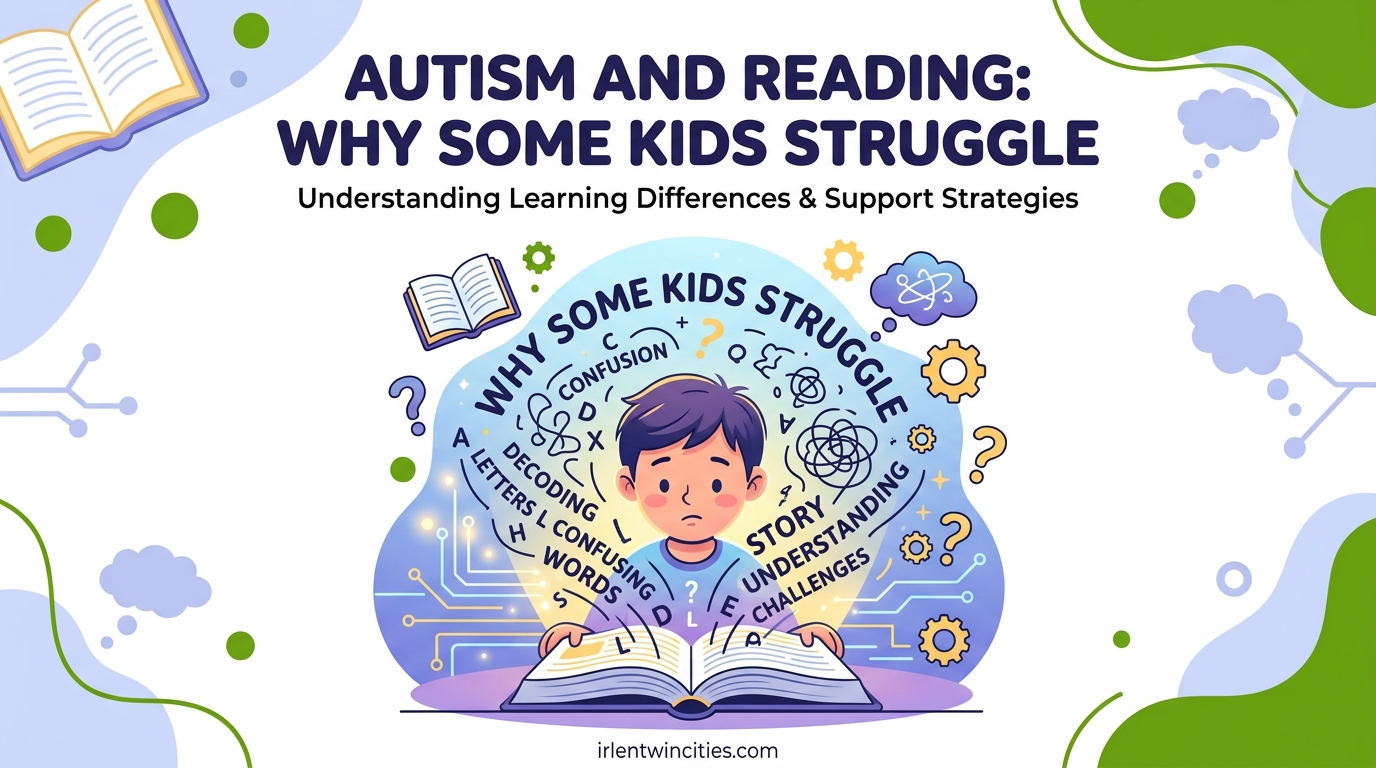
Many parents watch their autistic child breeze through flashcards, decode complex words, and even read books meant for older kids—only to realize later that their child cannot tell them what the story was about. This pattern is more common than most families realize. Understanding the connection between autism and reading challenges is the first step toward helping your child succeed with literacy.
In this guide, I will explain why autistic children often struggle with reading comprehension even when their word-reading skills are strong. You will learn about the three cognitive factors that impact reading, the phenomenon of hyperlexia, and practical strategies you can use at home starting today.
Table of Contents
Why Autistic Kids Struggle with Reading: The Core Difference
Most reading difficulties in non-autistic children involve decoding—the actual process of sounding out and recognizing words. These children might struggle to read the word “butterfly” even if they know what a butterfly is. Autistic children often face the opposite challenge. They can read “butterfly” fluently but struggle to connect that word to their knowledge of what butterflies are, how they move, or why they matter in a story.
The research from the University of Kansas CALL Lab puts it simply: while non-autistic students struggle with identifying words, autistic students struggle less with word identification and more with understanding what they have read. This distinction matters because it changes how we support these children.
Three Cognitive Factors That Impact Reading Comprehension
Reading comprehension requires more than recognizing words. It demands social understanding, the ability to connect details to bigger ideas, and the skills to manage and monitor your own thinking. These three areas often develop differently in autistic children.
Theory of Mind: Understanding Character Motivations
Theory of Mind refers to the ability to understand that other people have thoughts, feelings, and perspectives that differ from our own. In reading, this skill is essential because stories are full of characters who act based on their own beliefs and emotions.
When a story tells us that Sarah hid her brother’s toy because she was angry, a reader must infer that Sarah felt a certain way and that this feeling caused her action. Autistic children often struggle to make these inferences because reading between the lines requires predicting what someone else might think or feel. This affects their understanding of character motivation, plot development, and even humor in stories.
Weak Central Coherence: Seeing Trees Instead of Forests
Central coherence is the brain’s ability to take many small details and pull them together into a bigger picture or main idea. Most people naturally prioritize the overall meaning over individual details. Many autistic individuals have what researchers call “weak central coherence,” meaning they notice and remember the small details extremely well but struggle to see how those details connect to form a larger concept.
In reading, this shows up when a child can recite every fact from a page about dinosaurs—their sizes, their diets, their habitats—but cannot summarize what the main point of the text was. They collected the trees beautifully but missed the forest entirely. This makes summarizing, identifying themes, and understanding the moral of a story particularly challenging.
Executive Functioning: Managing the Reading Process
Executive functioning includes skills like working memory, impulse control, and the ability to monitor your own understanding while reading. Good readers constantly check whether what they are reading makes sense. If something seems wrong, they re-read or adjust their approach.
Autistic children often have differences in executive functioning that make this self-monitoring difficult. They might read an entire chapter without realizing they stopped paying attention three pages ago. They might struggle to hold information in working memory long enough to connect the beginning of a story to the end. These challenges make long texts, complex narratives, and multi-step reading assignments especially demanding.
Understanding Hyperlexia: When Early Reading Masks True Struggles
Hyperlexia is a fascinating phenomenon where children demonstrate an early and intense fascination with letters and numbers, often teaching themselves to read at remarkably young ages. Parents of hyperlexic children are often amazed—and sometimes confused—when their toddler can read street signs, cereal boxes, and even chapter books before preschool.
Here is the challenge: hyperlexia involves exceptional word-reading ability paired with comprehension difficulties. Many parents share stories in forums about children who could fluently read encyclopedia entries about quantum physics at age four but could not answer basic questions about a simple picture book. They could decode the words “quantum” and “physics” perfectly but had no concept of what those words actually meant.
Hyperlexia is not a problem to fix—it is a different learning pattern that requires specific support. These children need explicit instruction in comprehension strategies, background knowledge building, and connecting text to meaning. Their remarkable decoding skills can become a strength once comprehension catches up.
The Age 8 Cliff: Why Comprehension Gaps Widen
Around third grade, something important shifts in education. Before age 8, children are learning to read. They focus on phonics, sight words, and basic decoding. After age 8, children are reading to learn. Textbooks become more complex, stories assume more background knowledge, and teachers expect students to make inferences independently.
For autistic children, this transition can feel like running into a wall. They may have managed well in early grades when reading was about recognizing words. Suddenly, in third or fourth grade, the same child who earned praise for reading fluency is failing reading comprehension assessments. Parents often describe this as the moment they realized their child was not actually understanding what they could read so well.
This age shift matters because it tells us when to be most vigilant. If your autistic child is under 8 and reading fluently, now is the time to focus on comprehension. If they are over 8 and struggling, understanding that this is a known transition point can help you advocate for the right support.
5 Practical Strategies Parents Can Use at Home
Classroom strategies are valuable, but parents often ask what they can do during bedtime stories, weekend reading, and daily life. These five approaches work at home without special training or expensive materials.
Step 1: Build Background Knowledge Before Reading
Background knowledge is everything a reader already knows about a topic before they encounter it in text. The more a child knows about dinosaurs, the better they will understand a story featuring a T-Rex. Autistic children often need explicit background building because they may not have picked up the same cultural knowledge as their peers.
Before reading a book about the ocean, watch a short documentary about sea creatures. Visit an aquarium if possible. Talk about what you already know about fish, whales, and waves. This front-loading of information gives your child mental hooks to hang the story on. When the book mentions a dolphin, they will have a rich mental image to connect with rather than just a word they recognize.
Step 2: Use Visual Supports and Graphic Organizers
Many autistic individuals are visual thinkers who process information better when they can see it. Simple drawings, diagrams, or graphic organizers can make abstract story elements concrete.
Draw a simple story map with boxes for “beginning,” “middle,” and “end.” Use stick figures to show who is in the story. Create a Venn diagram to compare two characters. These visual tools do not need to be artistic—they just need to make the story structure visible. After reading a chapter, ask your child to fill in the story map with what happened. This helps them see the narrative arc rather than getting lost in individual details.
Step 3: Make Connections Explicit
Good readers constantly make three types of connections: text-to-self (how does this relate to my life?), text-to-text (how is this like another book?), and text-to-world (how does this connect to what I know about the world?). These connections do not happen automatically for many autistic children.
Model these connections out loud while reading. Say things like, “This reminds me of when we went to the zoo and saw real monkeys,” or “This character is being brave just like the girl in that other book we read.” Then pause and ask your child, “Does this remind you of anything?” Do not worry if their connection seems unusual—the goal is to build the habit of linking text to meaning, not to get the “right” answer.
Step 4: Teach Inference Making Directly
Inference is reading between the lines—figuring out information that is not explicitly stated. When a character slams a door and stomps upstairs, the author never says “she was angry,” but typical readers infer this emotion.
Autistic children often need direct instruction in making inferences. Start with pictures before tackling text. Show a picture of a child holding an umbrella in a gray scene and ask, “What do you think the weather is like?” Explain your thinking: “I see an umbrella, and the sky looks dark, so I think it is raining.” Gradually move to simple sentences, then paragraphs, then full stories. Celebrate the process of inferring, not just getting the “right” answer.
Step 5: Engage in Reciprocal Questioning
Traditional reading instruction involves the adult asking questions and the child answering. Reciprocal questioning flips this script. After reading a section, you ask a question, then your child asks you a question, then you discuss both answers together.
This approach accomplishes several goals. It reduces the pressure on the child to always have the right answer. It models what good questions sound like. It turns reading into a conversation rather than a test. And it helps you understand what your child is actually comprehending based on the questions they choose to ask. If their questions focus only on details, you know to work more on main ideas. If they ask about character feelings, you know social understanding is developing.
Frequently Asked Questions About Autism and Reading
Why do autistic people struggle with reading?
Autistic individuals often struggle with reading comprehension rather than word recognition. The challenges stem from three main cognitive factors: difficulty with theory of mind (understanding character motivations and perspectives), weak central coherence (focusing on details rather than main ideas), and executive functioning differences (monitoring their own understanding while reading). These factors make it hard to make inferences, connect background knowledge to text, and understand social context in stories.
Can an autistic child learn to read?
Yes, absolutely. Many autistic children become excellent readers. The key is understanding that reading involves two separate skills: decoding words and comprehending meaning. Many autistic children excel at decoding and can be taught comprehension strategies explicitly. With the right support focused on building background knowledge, teaching inference skills, and using visual supports, autistic children can develop strong reading comprehension abilities.
What is hyperlexia in autism?
Hyperlexia is a condition where a child demonstrates an intense, early fascination with letters and numbers, often teaching themselves to read at a very young age. While their word-reading ability is exceptional, their comprehension of what they read often lags behind. Hyperlexic children can decode complex words fluently but may not understand the meaning of those words or the overall message of the text. This is different from typical early reading and requires specific comprehension-focused instruction.
At what age do autism reading challenges become most apparent?
Reading comprehension challenges often become most apparent around age 8 or third grade. Before this age, children are learning to read through phonics and word recognition. After age 8, the educational shift moves to reading to learn, where textbooks assume more background knowledge and require more independent inference-making. This transition point is often called the age 8 cliff because children who seemed to be reading well suddenly struggle with the new comprehension demands.
Moving Forward with Hope and Strategy
Understanding why autism and reading comprehension challenges often go together gives you the power to help your child differently. Your child is not being lazy or stubborn when they cannot tell you what a story was about. They are experiencing real cognitive differences that require specific strategies.
Start with one strategy from this guide. Build background knowledge before your next bedtime story. Draw a simple story map together. Model one text-to-self connection out loud. Small changes add up. With patience, the right support, and an understanding of how your child’s brain processes text, reading comprehension can improve significantly. The journey may look different, but the destination—true understanding of the written word—is absolutely reachable.