
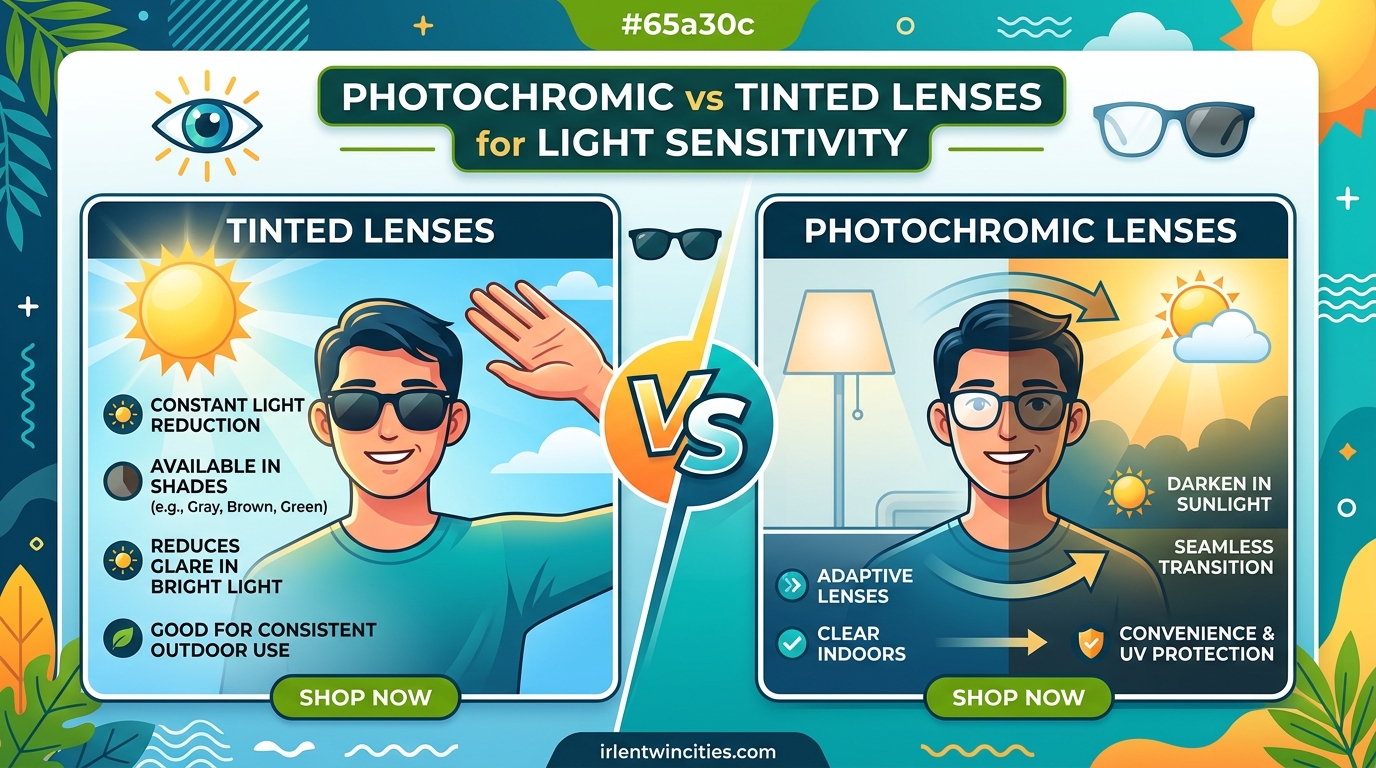
If you struggle with light sensitivity, choosing between photochromic vs tinted lenses can significantly impact your daily comfort. Both options offer relief from photophobia, but they work in very different ways. Photochromic lenses automatically adapt to changing light conditions, while tinted lenses provide consistent protection at a fixed level.
After researching real experiences from light sensitivity communities and consulting current optical research, I’ll break down exactly how each lens type performs for different sensitivity triggers. This comparison focuses specifically on photophobia management rather than general eyewear needs.
Table of Contents
Understanding Light Sensitivity (Photophobia)
Photophobia, or light sensitivity, affects millions of people worldwide. It’s not just about bright sunlight—fluorescent office lighting, computer screens, and even overcast days can trigger discomfort. The severity ranges from mild squinting to severe pain and migraines.
Common causes include migraines, Irlen Syndrome, concussion, autism, PTSD, fibromyalgia, and other neurological conditions. Some people experience sensitivity across the full light spectrum, while others react primarily to specific wavelengths like blue or fluorescent light.
The right lenses can reduce eye strain, prevent headaches, and make daily activities more manageable. However, choosing between photochromic and tinted options depends on your specific triggers and lifestyle needs.
Photochromic vs Tinted Lenses for Light Sensitivity: The Core Difference
Photochromic lenses contain special molecules that react to UV radiation, darkening within 30-60 seconds when exposed to sunlight and clearing in 2-5 minutes indoors. This adaptive technology means you get automatic protection without carrying multiple pairs of glasses.
Tinted lenses have a fixed color coating that blocks a consistent percentage of light regardless of environment. They don’t change—the protection level remains constant whether you’re indoors or outdoors. This predictability makes them ideal for specific lighting situations that consistently trigger your sensitivity.
For light sensitivity specifically, the key difference is convenience vs. precision. Photochromics offer seamless transitions throughout your day, while tints provide targeted relief for known problem environments.
Photochromic Lenses: How They Work for Light Sensitivity
Photochromic technology relies on silver halide crystals or organic molecules embedded in the lens material. When UV rays hit these molecules, they undergo a chemical reaction that darkens the lens. The process reverses when UV exposure stops.
Most photochromic lenses reach 70-85% darkness outdoors and clear to about 20-30% tint indoors. Some premium versions like Transitions XtraActive can activate behind windshields and darken more significantly, addressing two common complaints about standard photochromics.
Pros for Light Sensitivity
Automatic adaptation means you’re never caught off guard by sudden brightness changes. This is crucial if your sensitivity fluctuates throughout the day or if you move frequently between indoor and outdoor environments.
Photochromics eliminate the hassle of switching glasses. Many light sensitivity sufferers report that constantly juggling multiple pairs creates anxiety and stress—which can actually trigger sensitivity episodes.
The gradual darkening helps your eyes adjust more comfortably than sudden full tint exposure. This smoother transition can reduce the shock that often comes with moving from dark to bright environments.
Cons and Limitations
Standard photochromics don’t darken behind car windshields because windshields block UV rays. This is a significant limitation if driving is a major trigger for your light sensitivity. Premium versions like Transitions XtraActive or Drivewear address this but cost more.
Photochromics may not get dark enough for severe photophobia. Maximum darkness typically tops out around 85%, which might not provide sufficient protection if you need near-total light blocking.
The transition isn’t instant. In cold weather, darkening can take several minutes, and clearing may take up to 5 minutes. If you rapidly move between environments, you might spend significant time in an intermediate state that’s neither fully clear nor fully protective.
Temperature affects performance—photochromics darken more in cold weather and less in heat. This means you might get different protection levels on a winter day versus a summer day, even at the same UV intensity.
Some photochromics retain a slight tint even when fully cleared. While minimal (usually 10-20%), this residual tint can be problematic if you need completely clear lenses for certain activities or if you’re sensitive to any color distortion.
Driving Considerations
Driving presents specific challenges for light sensitivity. Glare from wet roads, sun angles at dawn and dusk, and bright headlights at night all compound the problem. Standard photochromics won’t help while driving because the windshield blocks the UV needed for activation.
If driving is a major trigger, consider photochromics specifically designed for windshield use, or plan a combination approach with dedicated driving sunglasses. Some light sensitivity sufferers keep a pair of fixed-tint driving glasses in the car for this reason.
Tinted Lenses: Fixed Protection for Light Sensitivity
Tinted lenses have a permanent color coating applied during manufacturing. The tint density can range from very light (10-20% light blockage) to very dark (80-90% blockage). Unlike photochromics, the protection level never changes.
Tints come in solid (uniform across entire lens) or gradient (darker at top, lighter at bottom) options. Gradient tints can be particularly useful if you need protection from overhead light but want clearer vision for reading or tasks requiring precise color perception.
Types of Tints for Light Sensitivity
Different colors serve different purposes. Gray tints reduce overall brightness without distorting colors, making them versatile for general use. Brown/amber tints enhance contrast and filter blue light—helpful for digital eye strain and certain types of migraines.
Yellow tints improve contrast in low-light conditions and some people find them helpful for fluorescent light sensitivity. Rose/red tints (including FL-41) are specifically designed for migraine and light sensitivity sufferers, with research showing effectiveness in reducing light-triggered headaches.
Green tints provide some blue light filtering while maintaining good color accuracy. Blue tints are sometimes used for specific conditions like epilepsy or visual stress, though research on effectiveness is mixed.
Pros for Light Sensitivity
Consistent protection means predictable performance. You know exactly what you’re getting in any environment, which reduces anxiety about sudden light changes. This predictability is valuable if your sensitivity has specific, known triggers.
Tints can be precisely calibrated to your needs. An eye care provider can help you determine the exact tint density and color that provides relief without over-darkening your vision. This customization is especially valuable for medical conditions causing photophobia.
Tints work in any environment, including behind car windshields. Fixed tints don’t rely on UV activation, so they provide protection while driving, indoors under fluorescent lights, or in any situation where you need consistent relief.
Specialty tints like FL-41 are specifically designed for light-sensitive conditions. These medical-grade tints target the wavelengths most likely to trigger migraines and other photophobia symptoms, offering relief that general-purpose tints may not provide.
Cons and Limitations
Fixed tints can be impractical indoors. A dark enough tint for outdoor sun sensitivity may be too dark for comfortable indoor use, forcing you to remove your glasses or switch to a second pair. This constant switching is inconvenient and can be disruptive.
Multiple pairs may be necessary. Many light sensitivity sufferers end up with different tints for different situations—one for computer work, one for outdoors, one for driving. This approach becomes expensive and cumbersome.
Tints don’t adapt to changing conditions. If you’re wearing a dark tint outdoors and walk inside, everything will be uncomfortably dark until you change glasses. Similarly, a light indoor tint won’t provide sufficient protection if you step into bright sunlight.
Color distortion can affect activities like driving, cooking, or art where accurate color perception matters. Some tints make traffic lights harder to distinguish or affect depth perception, which may be unsafe in certain situations.
Dark tints can actually increase sensitivity in some cases. If you spend significant time in darkened environments, your eyes may become more sensitive to light when you do remove your glasses. This is why professional guidance on tint selection is important.
Specialized Tints for Specific Light Sensitivity Conditions
Not all light sensitivity is the same. Different conditions respond better to specific tint types and colors. Understanding your specific triggers can help guide your choice between photochromic and tinted options.
FL-41 Tint for Migraines and Photophobia
FL-41 is a rose-colored tint specifically developed for migraine sufferers and people with light sensitivity. Research shows it blocks the wavelengths of light most likely to trigger migraines while allowing other light through, reducing the darkening effect that can contribute to light adaptation problems.
Many migraine patients report significant reduction in headache frequency and severity with FL-41 lenses. The tint is available in both photochromic and fixed versions, giving you options depending on your lifestyle needs.
Irlen Syndrome and Colored Filters
Irlen Syndrome is a perceptual processing disorder where the brain has difficulty processing visual information, often resulting in light sensitivity, reading difficulties, and visual stress. Colored overlays or tinted lenses (Irlen lenses) can dramatically reduce symptoms for affected individuals.
The specific color varies from person to person—what helps one person might not help another. Professional testing determines the optimal tint color and density for your specific visual processing needs.
Tints by Medical Condition
Autism spectrum disorders often involve sensory processing differences that include light sensitivity. Many individuals with autism find relief with specific tints, often preferring blue or purple filters that reduce fluorescent light glare.
Concussion and traumatic brain injury frequently cause temporary photophobia. During recovery, tinted lenses (often rose or amber) can make daily activities more tolerable while the brain heals.
PTSD-related light sensitivity often responds well to tints that reduce sudden brightness changes and glare. Gradient tints or photochromics may be particularly helpful if flash sensitivity is a trigger.
Fibromyalgia and other chronic pain conditions often include light sensitivity as a symptom. FL-41 or similar rose tints can provide relief, especially if migraines are also present.
Photochromic vs Tinted Lenses: Key Differences and Choosing Right
| Feature | Photochromic Lenses | Tinted Lenses |
|---|---|---|
| Protection Level | Adjustable (20-85%) | Fixed (customizable) |
| Convenience | High – automatic adaptation | Lower – may need multiple pairs |
| Driving Use | Limited (except premium versions) | Excellent – works behind windshield |
| Indoor Fluorescent | Minimal protection | Consistent protection |
| Color Options | Limited (mostly gray/brown) | Wide range (including medical tints) |
| Best For | Indoor/outdoor transitions, mild sensitivity | Specific triggers, medical conditions, driving |
When to Choose Photochromic Lenses
Photochromics work best if your light sensitivity is moderate and you move frequently between environments throughout the day. They’re ideal if you want one pair of glasses that handles most situations without constant switching.
Consider photochromics if you’re primarily sensitive to outdoor sunlight but can tolerate indoor lighting reasonably well. The automatic adaptation means you’re never caught off guard by bright sun when you step outside.
They’re also a good starting point if you’re new to light sensitivity management and aren’t sure what level of protection you need. The adjustable nature gives you a range of protection in one pair of glasses.
When to Choose Tinted Lenses
Fixed tints are better if you have specific, known triggers that require consistent protection. Indoor fluorescent light sensitivity, migraine-specific triggers, or driving issues are all better addressed with tinted lenses.
Choose tints if you need a medical-grade tint like FL-41 or an Irlen-specific color. These specialized options aren’t available in photochromic form and can make a dramatic difference for specific conditions.
Tints also work better if you need maximum protection that photochromics can’t provide. If you need 90%+ light blockage for severe photophobia, fixed tints are the only practical option.
Combination Approaches
Many light sensitivity sufferers find the best solution involves combining both technologies. This might mean photochromic glasses as your primary pair with a fixed-tint pair for driving or severe episodes.
Another approach is photochromic lenses with clip-on sunglasses for extra protection when needed. This gives you the convenience of photochromics with the ability to add extra darkness for high-exposure situations.
Some people use different tints for different activities—computer glasses for screen time, driving glasses for car trips, and photochromics for general daily wear. While this requires multiple pairs, it provides optimal protection for each situation.
Finding the Right Solution for Your Light Sensitivity
Choosing between photochromic vs tinted lenses for light sensitivity isn’t a one-size-fits-all decision. The right choice depends on your specific triggers, lifestyle, and the severity of your photophobia.
Consider keeping a light sensitivity diary for a week. Note which situations trigger discomfort, the time of day, weather conditions, and what you were doing. This information can help you and your eye care provider identify patterns and recommend the most effective lens solution.
If you’re unsure, start with photochromic lenses and monitor how they perform. Track what situations they handle well and where they fall short. This real-world testing can guide your decision about whether to add fixed-tint glasses to your arsenal.
Consult with an eye care provider who has experience with photophobia. They can help you understand your specific needs, recommend appropriate tints or photochromic options, and ensure your overall eye health isn’t contributing to your sensitivity.
Remember that light sensitivity can change over time. What works now may need adjustment in six months or a year. Regular check-ins with your eye care provider ensure your solution continues to meet your needs as your condition evolves.
Photochromic vs tinted lenses for light sensitivity isn’t about finding a perfect solution—it’s about finding the right tool for your specific situation. Many people find that a combination of both types provides the most comprehensive coverage for the varied lighting challenges they face throughout their day.
FAQ
Which lenses are best for eyes with light sensitivity?
The best lenses depend on your specific triggers. Photochromic lenses work well for mild to moderate outdoor sensitivity with frequent indoor transitions. Tinted lenses, especially medical-grade tints like FL-41, provide better relief for specific conditions like migraines or indoor fluorescent light sensitivity. Many people find a combination approach—photochromics for daily wear with fixed-tint glasses for driving or severe episodes—offers the most comprehensive protection.
What are the cons of photochromic lenses?
Photochromic lenses don’t darken behind car windshields because windshields block UV rays needed for activation. They may not get dark enough for severe photophobia (typically maxing at 85% darkness). Transition times aren’t instant—darkening can take several minutes in cold weather, and clearing may take up to 5 minutes. Temperature affects performance, with lenses darkening more in cold and less in heat. Some photochromics retain a slight tint even when fully cleared, which may be problematic if you need completely clear lenses.
What color lenses are best for light sensitivity?
The best tint color depends on your specific condition. Rose/red tints (especially FL-41) are proven effective for migraine-related light sensitivity. Gray tints reduce overall brightness without color distortion, making them versatile for general use. Brown/amber tints enhance contrast and filter blue light, helpful for digital eye strain. Yellow tints can improve contrast under fluorescent lights. Green tints provide some blue light filtering while maintaining color accuracy. The right color should be determined based on your specific triggers and may require professional testing.
Do photochromic lenses work while driving?
Standard photochromic lenses do NOT work while driving because car windshields block the UV rays needed to activate the darkening process. However, premium photochromic versions like Transitions XtraActive or Drivewear are designed to respond to both UV and visible light, allowing them to darken behind windshields. If driving is a major trigger for your light sensitivity, consider these specialized photochromic options or dedicated driving glasses with fixed tints that provide consistent protection regardless of UV exposure.
Are tinted glasses helpful for light sensitivity?
Yes, tinted glasses can be very helpful for light sensitivity, especially when the tint is matched to your specific triggers. Fixed tints provide consistent protection that doesn’t change with your environment, which is valuable for known problem situations like fluorescent office lighting or night driving. Medical-grade tints like FL-41 are specifically designed for photophobia and can significantly reduce light-triggered symptoms. However, the effectiveness depends on choosing the right color and density for your condition—professional guidance is recommended rather than guessing at what might help.
Do photochromic lenses help with migraines?
Photochromic lenses can help with migraines by reducing the sudden light changes that often trigger attacks. The automatic darkening when moving from indoors to outdoors prevents the shock of bright sunlight that commonly triggers migraines. However, for migraine-specific light sensitivity, FL-41 tint (available in both photochromic and fixed versions) may be more effective as it blocks the specific wavelengths most likely to trigger migraine attacks. Some migraine sufferers find that combining photochromic convenience with FL-41 tint technology provides the best of both worlds.