
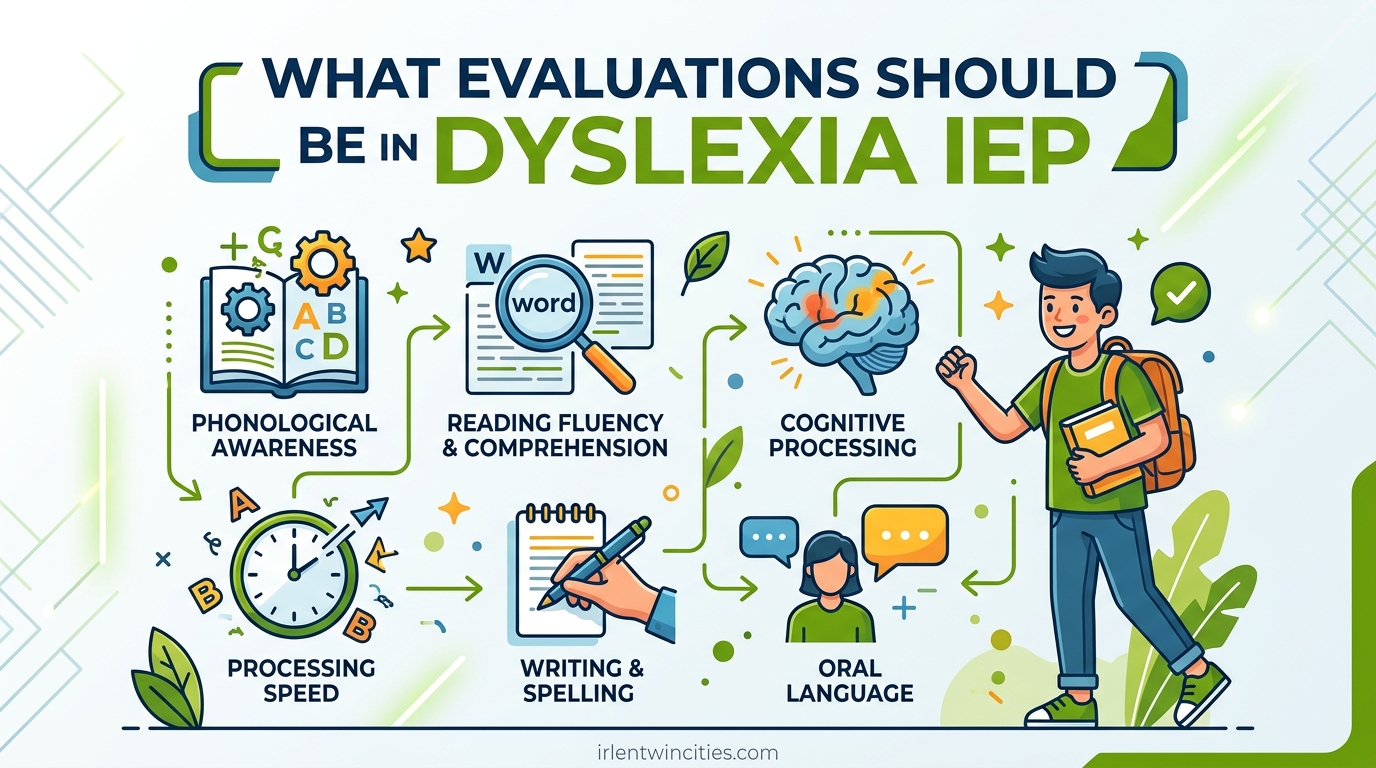
When your child struggles with reading, spelling, or writing, getting the right evaluations becomes the most important step in securing support. I’ve worked with hundreds of families navigating the IEP process, and the question I hear most often is: what evaluations should be in a dyslexia IEP? Understanding what assessments should be included can make the difference between securing necessary services or walking away empty-handed.
Comprehensive evaluations for dyslexia provide the objective data schools need to diagnose learning differences and determine IEP eligibility. Without the right tests, bright children often fall through cracks in the system. Our team has analyzed evaluation protocols across multiple states and consulted with educational psychologists to create this complete guide to dyslexia IEP evaluations.
In this article, you’ll learn exactly what evaluations should be in a dyslexia IEP, why each component matters, how to interpret results, and what steps to take if your school’s evaluation falls short. We’ll also provide practical preparation strategies to help you advocate effectively for your child.
Table of Contents
Understanding Dyslexia IEP Evaluations
An IEP evaluation for dyslexia is a comprehensive assessment process that measures a student’s reading, writing, language, and cognitive processing skills to determine if they qualify for special education services under an Individualized Education Program. This formal evaluation process is protected under federal law (IDEA) and provides the foundation for all special education decisions.
The evaluation process involves formal testing administered by qualified professionals who assess phonological awareness, decoding skills, reading fluency, spelling, and cognitive abilities to identify specific learning strengths and weaknesses associated with dyslexia. These assessments go far beyond simple reading tests – they examine the underlying cognitive processes that support reading and writing development.
Under the Individuals with Disabilities Education Act (IDEA), schools must conduct comprehensive evaluations in all areas of suspected disability. For dyslexia, this means assessing not just reading achievement, but the specific cognitive processes that research has identified as core deficits in dyslexia. Many parents discover too late that their school’s evaluation missed critical components.
It’s important to understand the difference between dyslexia screening and a comprehensive evaluation. Screenings are brief checks that may indicate risk, while full evaluations provide detailed diagnostic information. Screenings can miss dyslexia, especially in bright students who have developed compensatory strategies. Only a comprehensive evaluation following proper protocols can provide the data needed for diagnosis and IEP eligibility.
Qualified evaluators may include school psychologists, speech-language pathologists, educational diagnosticians, and reading specialists. However, the specific qualifications and expertise in dyslexia vary widely. We recommend asking about your evaluator’s experience with dyslexia assessments and their training in identifying specific learning disabilities.
What Evaluations Should Be in a Dyslexia IEP: Core Components
Comprehensive dyslexia evaluations should assess multiple areas of cognitive and academic functioning. Research consistently identifies specific core deficits that must be measured to properly diagnose dyslexia and develop effective interventions. Below we detail each essential evaluation component.
Phonological Awareness Assessment
Phonological awareness testing measures a student’s ability to recognize and manipulate the spoken parts of words. This is the most critical evaluation component for dyslexia, as research identifies phonological processing deficits as the core marker of dyslexia. Without proper phonological awareness assessment, dyslexia diagnoses are incomplete.
These assessments should include phonemic awareness tasks such as:
- Phoneme isolation – identifying individual sounds in words (e.g., “What’s the first sound in ‘cat’?”)
- Phoneme blending – combining sounds to form words
- Phoneme segmentation – breaking words into individual sounds
- Phoneme manipulation – deleting, adding, or substituting sounds to create new words
Common phonological awareness tests include the Comprehensive Test of Phonological Processing (CTOPP-2), the Phonological Awareness Test (PAT-2), and subtests from the Woodcock-Johnson IV Tests of Cognitive Abilities. These tests provide standard scores and percentile ranks that compare your child’s performance to same-age peers.
I’ve evaluated students who could read entire paragraphs yet scored in the first percentile on phoneme manipulation tasks. This disconnect between reading ability and phonological processing is common in bright dyslexic students who have memorized words rather than developing decoding skills. Without phonological awareness testing, these students’ specific learning disabilities remain unidentified.
Rapid Automatic Naming (RAN) Assessment
Rapid automatic naming evaluation measures how quickly a student can name familiar visual stimuli like letters, numbers, colors, or objects. Research shows that slow rapid naming speed is a core deficit in dyslexia, independent of phonological processing difficulties. Students with dyslexia typically show slower naming speeds even when accuracy is good.
RAN tests require the student to name items as quickly as possible while the evaluator records both speed and accuracy. The evaluator should note whether naming becomes automatic or remains effortful. Automaticity is key – students with dyslexia often never develop the rapid, effortless naming that supports fluent reading.
Common RAN assessments include the Rapid Automatized Naming and Rapid Alternating Stimulus Tests (RAN/RAS), CTOPP-2 rapid naming subtests, and the Gray Oral Reading Tests. These evaluations provide crucial data about processing speed and automaticity, both of which impact reading fluency.
In my experience, RAN results often surprise parents. Students who can accurately name letters may do so very slowly compared to peers. This timing difference isn’t visible during casual reading but becomes clear through formal RAN assessment. Without RAN testing, this aspect of dyslexia remains undetected.
Word Recognition and Decoding Evaluation
Decoding skills assessment measures a student’s ability to read words by applying letter-sound correspondence rules. This is different from simply recognizing familiar words – true decoding involves sounding out unfamiliar words using phonics skills. Both real word reading and nonsense word reading should be evaluated.
Word recognition testing should assess:
- Real word reading – ability to read familiar and unfamiliar real words
- Nonsense word reading – ability to decode pseudowords (e.g., “bap,” “mig,” “fone”)
- Sight word recognition – automatic recognition of high-frequency words
- Structural analysis – reading multi-syllabic words and recognizing prefixes/suffixes
Common decoding assessments include the Woodcock Reading Mastery Tests (WRMT-III), Test of Word Reading Efficiency (TOWRE-2), and subtests from the Woodcock-Johnson IV Tests of Achievement. These tests identify whether students are reading words by sight or by decoding, which is essential information for intervention planning.
I frequently see students who can read grade-level texts but score poorly on nonsense word reading. These students have developed strong sight word memories but lack decoding skills. This pattern becomes problematic in upper grades when texts contain more unfamiliar vocabulary. Without nonsense word assessment, this critical weakness remains hidden.
Reading Fluency and Comprehension Testing
Reading fluency evaluation measures the accuracy, rate, and prosody (expression) of oral reading. Fluency assessment should include both oral reading fluency (reading aloud) and silent reading fluency. Comprehension testing should assess understanding of both orally presented and silently read text.
Essential fluency and comprehension components include:
- Oral reading fluency – words correct per minute with accuracy tracking
- Reading comprehension – understanding passages read silently
- Listening comprehension – understanding passages read aloud to the student
- Reading rate – speed of reading both orally and silently
Common assessments include the Gray Oral Reading Tests (GORT-5), Qualitative Reading Inventory (QRI-7), Woodcock-Johnson IV reading comprehension subtests, and curriculum-based measures like DIBELS. These tests identify whether comprehension difficulties stem from reading problems or language comprehension issues.
The comparison between listening comprehension and reading comprehension is particularly revealing. Students whose listening comprehension significantly exceeds their reading comprehension typically have dyslexia rather than broader language disorders. I’ve seen many students who could understand complex stories when read aloud but struggled to comprehend the same text when reading independently. This discrepancy pattern clearly indicates reading disability.
Spelling and Written Expression Assessment
Spelling evaluation is essential for dyslexia IEP assessments because spelling difficulties often persist even after reading improves. Written expression assessment should include both spontaneous writing samples and standardized spelling tests to capture different aspects of writing ability.
Spelling and writing evaluation should include:
- Spelling tests – both isolated words and dictation sentences
- Writing samples – spontaneous writing across different genres
- Handwriting evaluation – assessment of motor output and letter formation
- Written expression – organization, vocabulary, and grammar in writing
Common assessments include the Test of Written Spelling (TWS-5), Woodcock-Johnson IV spelling and writing samples subtests, and the Written Expression scale from the Wechsler Individual Achievement Test (WIAT-III). These tests capture the encoding (spelling) difficulties that are a hallmark of dyslexia.
In my work with students, I often see spelling abilities lag significantly behind reading skills. Students who have improved their reading may still struggle with spelling, particularly irregular words and multisyllabic words. Without spelling assessment, this ongoing need may be overlooked. Additionally, many dyslexic students have handwriting difficulties (dysgraphia) that should be identified and addressed.
Oral Language and Vocabulary Evaluation
Oral language assessment is critical because dyslexia is a specific learning disability in reading, not a general language disorder. Evaluators must determine whether reading difficulties stem from dyslexia or broader language impairments. Vocabulary knowledge should also be assessed as it impacts reading comprehension.
Oral language evaluation should include:
- Expressive vocabulary – ability to name objects and describe concepts
- Receptive vocabulary – understanding of spoken words
- Following directions – comprehension of increasingly complex directions
- Oral discourse – ability to tell stories, explain concepts, and hold conversations
Common assessments include the Clinical Evaluation of Language Fundamentals (CELF-5), Peabody Picture Vocabulary Test (PPVT-5), Expressive Vocabulary Test (EVT-3), and oral language subtests from the Woodcock-Johnson IV. These tests help distinguish dyslexia from language disorders and identify co-occurring difficulties.
I’ve evaluated students with excellent oral language skills whose reading difficulties clearly indicated dyslexia rather than broader language impairment. Conversely, some students have both dyslexia and language disorders, which requires more comprehensive intervention. Oral language assessment clarifies the nature of reading difficulties and guides appropriate intervention planning.
Cognitive Processing Assessments
Cognitive processing evaluation examines the underlying mental abilities that support learning. While not required for dyslexia diagnosis, processing assessments provide valuable information about learning strengths and weaknesses that can guide intervention and accommodation decisions.
Important cognitive assessments include:
- Working memory tests – ability to hold and manipulate information in mind
- Processing speed measures – speed of mental processing on simple tasks
- Executive function assessment – planning, organization, and attentional control
- Intellectual ability – general cognitive ability to rule out intellectual disability
Common assessments include the Woodcock-Johnson IV Tests of Cognitive Abilities, Wechsler Intelligence Scale for Children (WISC-V), and subtests measuring specific cognitive processes. These tests provide standard scores that identify cognitive strengths and weaknesses.
Working memory assessment is particularly important for dyslexia evaluations. Research shows that many students with dyslexia have working memory weaknesses that impact reading, spelling, and math. I frequently see students who can decode accurately but struggle to remember what they’ve read due to working memory limitations. Identifying these weaknesses helps explain academic difficulties and informs accommodation decisions.
The Evaluation Process and Timeline
Understanding the formal evaluation process helps parents advocate effectively and ensure their child receives comprehensive assessments. The IDEA law establishes specific timelines that schools must follow, though many parents report schools exceeding these deadlines.
Step 1: Request for Evaluation
The process begins when parents or teachers request an evaluation in writing. We recommend submitting a written request that documents specific concerns and requests comprehensive dyslexia assessment. The request should specify that you suspect dyslexia and list all areas of concern (reading, spelling, writing).
Once the school receives your written request, they must respond within a reasonable timeframe (typically 10-14 days). The school will either agree to evaluate or provide prior written notice (PWN) explaining why they refuse evaluation. If they refuse, you have recourse through dispute resolution procedures.
Step 2: Consent and Planning Meeting
If the school agrees to evaluate, they will request your written consent. Within 30 days of receiving consent, the school must hold an evaluation planning meeting to determine what assessments will be conducted. This is your opportunity to advocate for comprehensive evaluation including all components discussed in this article.
At the planning meeting, ask specifically about:
- What tests will be administered in each area?
- Who will conduct each assessment?
- Will phonological awareness be assessed?
- Will rapid automatic naming be tested?
- Will nonsense word reading be included?
- Will both listening and reading comprehension be tested?
- Will spelling and writing be evaluated?
I strongly recommend bringing a written list of desired assessments to this meeting. Many parents report that schools initially propose minimal evaluation but agree to add components when parents specifically request them. Document what assessments are agreed upon in the meeting notes.
Step 3: Testing Period
After the planning meeting, the school has 60 days to complete the evaluation and hold the eligibility meeting. This federal timeline may vary slightly by state, but 60 days is the maximum under IDEA. During this period, your child will be pulled from class for various testing sessions.
The testing should occur across multiple sessions to avoid fatigue affecting results. Typical evaluations require 4-8 hours of total testing time spread over several days. If your child completes testing in just one or two brief sessions, this may indicate an incomplete evaluation.
Step 4: Results Meeting
After testing is complete, the school will schedule a meeting to review results and determine IEP eligibility. You should receive written reports before this meeting – request them at least 5 days in advance so you can review results carefully. These reports contain standard scores, percentile ranks, and qualitative observations.
The team will review all assessment results and determine whether your child qualifies for special education services under one of the IDEA disability categories. For dyslexia, the relevant categories are typically Specific Learning Disability (SLD) or Other Health Impairment (OHI) if there are co-occurring attention difficulties.
If eligibility is determined, the team will develop the IEP with goals, accommodations, and services based on evaluation results. If eligibility is denied, you have the right to disagree and pursue independent evaluation.
Understanding Evaluation Results and Reports
Evaluation reports contain technical data that can be confusing for parents. Understanding how to interpret these results helps you advocate effectively for your child and ensure the evaluation captures all areas of need.
Standard Scores and Percentile Ranks
Most tests report standard scores with a mean of 100 and standard deviation of 15. A score of 100 represents average performance. Scores between 85-115 are considered average range. Scores below 85 indicate below-average performance, with lower scores indicating greater difficulty.
Percentile ranks indicate what percentage of same-age peers scored below your child. A percentile rank of 16 means your child scored higher than 16% of students. Percentile ranks below 25 typically indicate academic difficulties requiring intervention.
When reviewing results, look for:
- Intra-individual differences – significant gaps between your child’s own abilities (e.g., strong oral language but weak reading)
- Discrepancies from ability – reading scores significantly below cognitive ability
- Pattern of strengths and weaknesses – consistent weaknesses in phonological processing, rapid naming, and decoding
I’ve seen reports that present standard scores without explaining what they mean. Don’t hesitate to ask for clarification. A score of 85 in phonological awareness while oral language scores are 110 clearly indicates a specific phonological processing disability consistent with dyslexia.
Red Flags in Inadequate Evaluations
Many parents report receiving incomplete evaluations that failed to assess critical areas. Red flags that indicate inadequate evaluation include:
- No phonological awareness testing
- No rapid automatic naming assessment
- No nonsense word reading test
- Only reading comprehension tested (no listening comprehension comparison)
- No spelling assessment
- No writing sample evaluation
- Only brief screening tools rather than comprehensive batteries
- Testing completed in 1-2 hours total
- Report focuses on behavior rather than academic skills
If your evaluation shows these red flags, you have grounds to request additional testing. Under IDEA, you can request an Independent Educational Evaluation (IEE) at public expense if you disagree with the school’s evaluation. Many parents find that private evaluations provide more comprehensive dyslexia assessment.
IEP Eligibility and Next Steps
Evaluation results determine whether your child qualifies for an IEP and what services they will receive. Understanding eligibility criteria helps you advocate effectively and ensures appropriate support.
Eligibility Determination
To qualify for special education services under the Specific Learning Disability category, students must demonstrate:
- A disorder in one or more psychological processes involved in understanding or using language
- Difficulties in reading, writing, or mathematics
- That these difficulties are not primarily due to other factors (sensory impairment, intellectual disability, emotional disturbance, or lack of appropriate instruction)
- That the difficulties adversely affect educational performance
- That the student requires special education services
Many schools use a “discrepancy model” requiring a significant gap between ability and achievement. However, IDEA no longer requires discrepancy models, and many schools now use response-to-intervention (RTI) data or patterns of strengths and weaknesses. Underachievement alone is sufficient if it adversely affects educational performance.
I frequently see bright students denied services because their achievement scores are “too low” to qualify under discrepancy models. However, IDEA allows eligibility based on patterns of strengths and weaknesses without requiring severe discrepancy. If your school denies eligibility despite clear dyslexia indicators, you may need to advocate more strongly or seek independent evaluation.
Developing IEP Goals Based on Evaluations
Once eligibility is established, the IEP team develops annual goals based on evaluation results. Goals should address specific weaknesses identified in testing. For dyslexia, typical goal areas include:
- Phonological awareness skills
- Decoding strategies
- Reading fluency (accuracy and rate)
- Reading comprehension strategies
- Spelling patterns and rules
- Written expression skills
Goals should be SMART (specific, measurable, achievable, relevant, and time-bound). For example: “Given multisyllabic words, Student will decode words with 85% accuracy as measured by weekly samples.” Each goal should connect directly to assessment results showing current levels of performance.
Accommodations and Modifications
Evaluation results also inform appropriate accommodations and modifications. Typical accommodations for students with dyslexia include:
- Extended time on tests and assignments
- Audio versions of textbooks and reading materials
- Speech-to-text for writing assignments
- Reduced reading load
- Alternative assessment formats (oral instead of written)
- Use of assistive technology (text-to-speech, phonetic spell-check)
- Preferential seating
- Copy of teacher notes
Accommodations should address specific weaknesses identified in evaluation. For example, students with slow processing speed may need extended time, while students with severe decoding difficulties may need audio materials.
Parent Preparation and Advocacy
Effective parent advocacy begins with preparation and knowledge. Understanding what evaluations should be in a dyslexia IEP empowers you to ensure your child receives comprehensive assessment and appropriate services.
Pre-Evaluation Preparation Checklist
Before the evaluation planning meeting, gather documentation and prepare your advocacy:
- Document concerns – Write specific examples of reading, spelling, and writing difficulties
- Collect work samples – Save examples of struggles (spelling errors, slow writing, reading errors)
- List family history – Note any relatives with dyslexia or reading difficulties
- Research tests – Familiarize yourself with evaluation components from this article
- Prepare questions – Write questions about what tests will be administered
- Consider advocate support – Bring an advocate or educational consultant if possible
I recommend creating a written summary of your concerns to share with the evaluation team. Document specific examples like “struggles to sound out unfamiliar words,” “spells same word multiple ways in one paragraph,” or “reads very slowly and hesitantly.” These concrete examples help evaluators understand your concerns.
Questions to Ask Evaluators
During the evaluation planning meeting, ask specific questions to ensure comprehensive assessment:
- What specific tests will you administer to assess phonological awareness?
- Will rapid automatic naming be evaluated? Which test?
- Will nonsense word reading be included to assess decoding skills?
- How will you compare listening comprehension to reading comprehension?
- Will spelling and written expression be assessed? With what instruments?
- Who will conduct each assessment and what are their qualifications?
- How long will the testing take? How many sessions?
- When will I receive the written report before our meeting?
Don’t hesitate to ask for additional assessments if the proposed plan seems incomplete. Schools may initially propose minimal evaluation but often agree to add components when parents specifically request them. Document what assessments are agreed upon.
Requesting Specific Tests
You have the right to request specific tests be included in the evaluation. While schools have some discretion in test selection, they must assess all areas of suspected disability. If the school refuses specific tests, ask for the rationale in writing and consider requesting an Independent Educational Evaluation.
Common tests to request include:
- CTOPP-2 for phonological processing and rapid naming
- TOWRE-2 for word reading efficiency
- WRMT-III for reading decoding and comprehension
- CELF-5 for oral language assessment
- Woodcock-Johnson IV for comprehensive cognitive and achievement testing
When to Seek Independent Evaluation
If you disagree with the school’s evaluation results or find it inadequate, you can request an Independent Educational Evaluation (IEE) at public expense. An IEE is conducted by a qualified examiner not employed by the school district. Common reasons for seeking IEE include:
- School evaluation lacked critical components
- School results don’t match your observations or private testing
- School denies eligibility despite clear evidence of dyslexia
- School used outdated or inappropriate tests
- You want more comprehensive assessment than schools typically provide
To request an IEE, notify the school in writing that you disagree with their evaluation and are requesting an IEE at public expense. The school must either pay for the IEE or request a due process hearing to prove their evaluation was appropriate. Many parents find private educational psychologists or neuropsychologists provide more comprehensive dyslexia evaluations than schools typically offer.
Frequently Asked Questions About Dyslexia IEP Evaluations
What does a dyslexia evaluation consist of?
A comprehensive dyslexia evaluation consists of assessments in phonological awareness, rapid automatic naming, word recognition, decoding skills, reading fluency, reading comprehension, spelling, written expression, oral language, and cognitive processing. These tests identify specific strengths and weaknesses in reading and related skills to diagnose dyslexia and guide intervention planning.
What to include in an IEP for dyslexia?
An IEP for dyslexia should include specific goals addressing phonological awareness, decoding, reading fluency, reading comprehension, spelling, and written expression. It should also include appropriate accommodations like extended time, audio materials, assistive technology, and modifications to reading and writing assignments based on the student’s evaluation results.
How long does a dyslexia evaluation take?
A comprehensive dyslexia evaluation typically requires 4-8 hours of testing time spread across multiple sessions. The entire evaluation process from request to eligibility meeting must be completed within 60 days under federal law, though many schools exceed this timeline. Testing itself usually occurs across 3-6 sessions to avoid fatigue affecting results.
Who can diagnose dyslexia for an IEP?
Qualified professionals who can diagnose dyslexia include school psychologists, educational diagnosticians, clinical psychologists, neuropsychologists, and speech-language pathologists with specific training in learning disabilities. The evaluator should have expertise in dyslexia assessment and use comprehensive, research-based evaluation protocols.
What if I disagree with the school dyslexia evaluation?
If you disagree with the school’s evaluation, you can request an Independent Educational Evaluation (IEE) at public expense. Submit a written request stating your disagreement and asking for an IEE. The school must either pay for the IEE or request a due process hearing to prove their evaluation was appropriate. You may also choose to pay for private evaluation and share those results with the school.
How often should dyslexia evaluations be updated?
Dyslexia evaluations should be updated every 3 years as part of the triennial reevaluation process required by IDEA. However, you can request more frequent reevaluation if your child’s needs change significantly or if the current evaluation no longer reflects their abilities. Reevaluations should reassess all areas previously evaluated and any new areas of concern.
Conclusion
Understanding what evaluations should be in a dyslexia IEP empowers you to advocate effectively for your child. Comprehensive assessment is the foundation of appropriate support, and ensuring all critical components are included can make the difference between securing necessary services or watching your child continue to struggle without adequate help.
Remember that you are your child’s best advocate. If the school’s evaluation seems incomplete, ask for additional testing. If eligibility is denied despite clear evidence of dyslexia, pursue independent evaluation. Your persistence ensures your child receives the thorough assessment and appropriate services they deserve.
The evaluation process can feel overwhelming, but you don’t have to navigate it alone. Educate yourself about your rights, document your concerns, and don’t hesitate to seek support from advocates or parent organizations. With comprehensive evaluation and appropriate support, students with dyslexia can succeed academically and reach their full potential.