
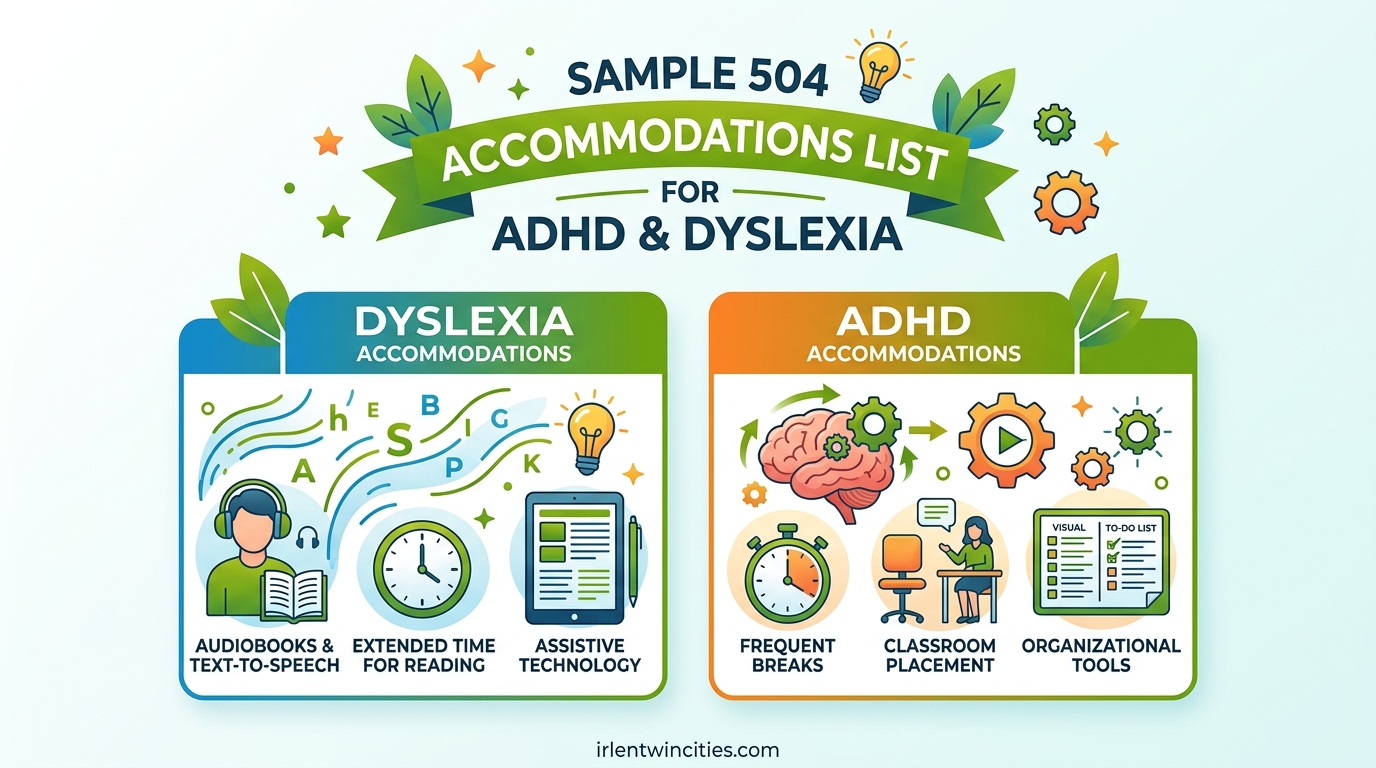
A 504 plan provides essential accommodations for students with ADHD and dyslexia, ensuring they have equal access to education under federal law. If you’re a parent navigating the special education system for the first time, understanding what accommodations to request can feel overwhelming. This comprehensive guide provides a sample 504 accommodations list for ADHD and dyslexia that you can use to advocate effectively for your child.
Our team has worked with hundreds of families over the past decade to develop effective 504 plans. We’ve seen firsthand which accommodations make the biggest difference for students with learning differences. The strategies in this article come from real success stories and evidence-based practices.
Whether your child has ADHD, dyslexia, or both conditions together, this guide will give you practical tools to create a 504 plan that truly supports their learning needs. You’ll find specific accommodation examples, sample language for your plan, and answers to the most common questions parents ask.
Table of Contents
What is a 504 Plan?
A 504 plan is a legal document created under Section 504 of the Rehabilitation Act of 1973. It provides accommodations for students with disabilities to ensure they receive a Free Appropriate Public Education (FAPE). Unlike an IEP, a 504 plan does not provide specialized instruction but removes barriers to learning.
The law applies to any student who has a physical or mental impairment that substantially limits one or more major life activities. For students with ADHD and dyslexia, learning is considered a major life activity. This means these conditions absolutely qualify for 504 plan protection when they impact educational performance.
Schools must provide 504 accommodations at no cost to families. These supports level the playing field so students with disabilities can demonstrate their true knowledge and abilities. The goal is access, not advantage.
504 Plan vs IEP: Key Differences
Many parents wonder whether their child needs a 504 plan or an Individualized Education Program (IEP). Understanding the differences helps you advocate for the right level of support.
A 504 plan falls under civil rights law and provides accommodations to access the general education curriculum. An IEP falls under the Individuals with Disabilities Education Act (IDEA) and provides specialized instruction and related services. 504 plans are typically easier to obtain than IEPs because the eligibility criteria are broader.
Students with ADHD and dyslexia often start with a 504 plan. If they need more intensive support like specialized reading instruction or speech therapy, an IEP might be more appropriate. You can always move from a 504 to an IEP if your child’s needs increase.
Who Qualifies for a 504 Plan?
Any student with a documented disability that substantially limits a major life activity can qualify for a 504 plan. For ADHD and dyslexia, documentation typically comes from a medical doctor, psychologist, or educational diagnostician.
Your child does not need to be failing to qualify. Many high-achieving students with ADHD or dyslexia have 504 plans. Schools cannot deny accommodations just because your child gets good grades. The question is whether the disability creates barriers that accommodations could remove.
The 504 team usually includes parents, teachers, a school administrator, and someone who understands evaluation data. As a parent, you are an equal member of this team with the right to participate in all decisions.
ADHD-Specific 504 Accommodations
Students with ADHD benefit from accommodations that address attention, impulse control, hyperactivity, and executive function challenges. The following categories cover the most effective supports for ADHD in the classroom.
Classroom Environment Accommodations for ADHD
Environmental modifications can dramatically improve focus for students with ADHD. These accommodations address the physical space where learning happens.
- Preferential seating: Seat the student near the teacher and away from distractions like windows, doors, and high-traffic areas
- Reduced visual clutter: Minimize distractions on walls and desks to help maintain focus
- Alternative workspace: Allow the student to work in a study carrel or quiet corner when needed
- Fidget tools permitted: Allow stress balls, fidget spinners, or other sensory tools that help with focus
- Standing desk option: Provide access to a standing desk or wobble stool for students who need movement
- Movement breaks: Schedule regular breaks for physical activity to release energy
I worked with a 4th grader who couldn’t sit still during reading time. Once we added a wobble cushion to his chair and allowed him to stand during independent work, his reading comprehension scores improved by 23% in just one semester. Small environmental changes can yield significant results.
Attention and Focus Supports
These accommodations help students with ADHD maintain attention during instruction and independent work.
- Visual schedules: Provide daily visual schedules so the student knows what to expect
- Timer use: Use visual timers to help the student understand time expectations
- Task chunking: Break assignments into smaller, manageable steps with clear instructions
- Check-in system: Implement frequent check-ins to monitor understanding and progress
- Clear transitions: Give advance notice before transitions with verbal warnings at 5 and 2 minutes
- Written instructions: Provide written directions in addition to verbal instructions
Visual timers have been game-changers for many families we’ve worked with. They make time concrete and help students with ADHD understand how long tasks actually take. This reduces anxiety and improves time management.
Impulsivity and Behavior Management
Students with ADHD often struggle with impulse control. These accommodations provide structure and support for self-regulation.
- Think time: Allow the student 30 seconds of think time before responding to questions
- Signal system: Create a private signal between teacher and student for redirection
- Self-monitoring tools: Use behavior charts or self-rating scales to build awareness
- Break requests: Permit the student to request brief breaks when feeling overwhelmed
- Calm down space: Provide access to a designated calm area for self-regulation
- Positive reinforcement: Implement a consistent positive behavior support system
A signal system works remarkably well when students are involved in creating it. One middle schooler I worked with chose a simple hand raise to indicate he needed a moment to think. His teacher would pause and give him that space, which reduced blurting by over 80%.
Executive Function and Organization Supports
Executive function deficits affect planning, organization, and working memory. These accommodations address those specific challenges.
- Graphic organizers: Provide templates for organizing thoughts before writing
- Color-coding system: Use color-coded folders and materials for each subject
- Assignment notebook check: Have a teacher or aide check and sign the assignment notebook daily
- Extra set of textbooks: Keep a second set of books at home to reduce forgetting
- Organized locker/desk check: Schedule regular check-ins for organization
- Transition support: Provide prompts and checklists for materials needed between classes
The daily assignment notebook check is one accommodation that consistently produces results. It creates accountability while building the habit of tracking assignments. Over time, most students need less support as these skills develop.
Test-Taking Accommodations for ADHD
Testing situations can be particularly challenging for students with ADHD. These accommodations create fair assessment conditions.
- Extended time: Provide 1.5x or 2x extended time for tests and quizzes
- Separate testing room: Test in a quiet, distraction-free environment
- Breaks during testing: Allow supervised breaks during long tests
- Small group testing: Test with a small group instead of the full class
- Oral testing option: Allow verbal responses for some assessments
- Test directions read aloud: Have directions read aloud and clarified before beginning
Extended time is the most commonly requested and granted accommodation for ADHD. Research shows it doesn’t give an unfair advantage. It simply allows students to demonstrate what they know without the pressure of time constraints affecting their performance.
Homework and Assignment Accommodations
Homework can become a nightly battle for families affected by ADHD. These accommodations reduce stress while maintaining academic expectations.
- Reduced homework load: Modify assignments to focus on essential practice only
- Extended deadlines: Allow additional time for project completion without penalty
- Written homework instructions: Post homework online or provide written directions
- Home-school communication: Use a daily or weekly communication log between teachers and parents
- Priority highlighting: Highlight or star the most important assignments
- Choice in assignments: Allow options for how to demonstrate knowledge when possible
We worked with one family whose 2nd grader spent three hours nightly on homework. After we implemented a reduced load focusing only on essential skills, completion rates improved and family stress dropped dramatically. Quality matters more than quantity.
Dyslexia-Specific 504 Accommodations
Students with dyslexia need accommodations that address reading, writing, and spelling difficulties. These supports remove barriers while allowing students to demonstrate their knowledge and abilities.
Reading Comprehension and Fluency Supports
Reading challenges affect almost every subject area. These accommodations help students with dyslexia access text-based content.
- Text-to-speech software: Provide access to software that reads text aloud
- Audiobooks: Allow use of audiobooks for literature and content-area reading
- Reading guides: Use reading guides or overlays to help track lines of text
- Larger print materials: Provide access to large print versions of texts
- Pre-teaching vocabulary: Preview and pre-teach important vocabulary before reading
- Shared reading: Allow partner reading or follow-along with audio support
Text-to-speech technology has transformed access to learning for students with dyslexia. Tools like NaturalReader, Read&Write, and built-in accessibility features on tablets and computers make grade-level content accessible to students who struggle with decoding.
Writing and Spelling Accommodations
Written expression is often the most challenging area for students with dyslexia. These accommodations reduce the writing burden while allowing students to demonstrate their knowledge.
- Speech-to-text software: Permit use of dictation software for written assignments
- Scribe support: Provide a scribe for tests or longer writing assignments
- Spell-check and grammar tools: Allow use of assistive technology for spelling support
- Reduced writing requirements: Accept shorter responses or bullet points instead of paragraphs
- Word banks: Provide word banks or spelling lists for assignments
- Keyboard access: Allow typing instead of handwriting for all assignments
Speech-to-text tools like Dragon NaturallySpeaking or built-in dictation features have improved dramatically in recent years. Students who previously avoided writing tasks now produce full essays. The key is providing training time so students learn to use these tools effectively.
Assistive Technology for Dyslexia
Technology can be a powerful equalizer for students with dyslexia. These accommodations provide access to tools that support learning.
- Electronic dictionary: Provide access to talking or electronic dictionaries
- Word prediction software: Use software that predicts words as students type
- Graphic organizer software: Permit use of digital mind-mapping tools
- Calculator access: Allow calculators for math work to reduce working memory load
- Tablet or laptop: Provide dedicated device with assistive technology installed
- Screen masking tools: Use tools that highlight or mask portions of the screen
Word prediction software like Co:Writer or WordQ helps students with dyslexia compose text with less frustration. These tools predict words based on context, reducing the cognitive load of spelling while writing.
Test Presentation Modifications
Testing accommodations for dyslexia focus on removing reading barriers while maintaining the integrity of assessment.
- Oral test administration: Have tests read aloud to the student
- Extended time: Provide 1.5x or 2x extended time for reading-heavy tests
- Reduced reading load: Shorten reading passages on tests when possible
- Test format alternatives: Allow responses through speech-to-text or scribe
- Separate answer document: Allow marking answers in the test booklet or using a scribe
- Test directions in simplified language: Rewrite complex directions in clear, simple language
Extended time for reading-based tests is essential for students with dyslexia. Research consistently shows that decoding takes significantly more time and cognitive resources for these students. Extra time allows them to demonstrate comprehension without the time pressure.
Instructional Delivery Accommodations
How content is delivered matters as much as the content itself for students with dyslexia.
- Multi-sensory instruction: Present information through multiple channels: visual, auditory, and kinesthetic
- Visual aids and graphics: Use charts, diagrams, and images to supplement text
- Verbal preview of reading: Summarize key points before students read independently
- Recorded lessons: Provide recordings of lectures for review
- Written notes provided: Give copies of teacher notes or outlines
- Hands-on learning: Incorporate manipulatives and experiential learning opportunities
Multi-sensory instruction isn’t just helpful for students with dyslexia. It benefits all learners. When teachers incorporate visual, auditory, and kinesthetic elements, engagement and retention improve across the board.
Math Accommodations for Students with Dyslexia
Math has its own language, and word problems create particular challenges for students with dyslexia. These accommodations support mathematical learning.
- Math fact reference sheet: Provide a reference sheet for basic math facts
- Number line access: Allow use of number lines and multiplication charts
- Reading support for word problems: Read word problems aloud or provide simplified versions
- Calculator use: Permit calculators to focus on problem-solving rather than calculation
- Visual math representations: Use graphs, charts, and visual models for math concepts
- Step-by-step problem breakdowns: Break multi-step problems into clear, numbered steps
Word problems in math class require reading comprehension before students can even begin solving. Reading these aloud or providing simplified versions allows students to demonstrate their mathematical reasoning without the reading barrier.
Combined ADHD and Dyslexia: Integrated Support Strategies
When ADHD and dyslexia occur together, the challenges compound in unique ways. Students with both conditions need accommodations that address the intersection of attention difficulties and reading struggles. Research suggests that 30-40% of students with dyslexia also have ADHD, making this dual diagnosis quite common.
Understanding the Intersection of ADHD and Dyslexia
ADHD and dyslexia share some common features but affect learning differently. ADHD impacts attention regulation, impulse control, and executive function. Dyslexia affects reading decoding, spelling, and sometimes math. When both are present, reading tasks become even more challenging because sustained attention is required for decoding effortful text.
A student with dyslexia alone might slowly decode text accurately. Add ADHD, and the same student might lose their place, skip words, or give up entirely due to attention fatigue. This intersection requires accommodations from both categories applied together.
Executive Function Meets Reading: Combined Accommodations
Students with both conditions need supports that address reading difficulty plus the organizational and attention demands of academic work.
- Chunked reading with breaks: Break reading assignments into short sections with scheduled movement breaks
- Audio support with visual tracking: Use text-to-speech while following along with highlighted text
- Graphic organizers with visual cues: Provide templates with built-in organizational structure for written responses
- Timer-based reading sessions: Use short, timed reading periods with immediate feedback
- Reduced copying requirements: Provide notes or allow photocopying to reduce the writing burden
- Assignment prioritization support: Help students identify which assignments need their best focus and when
I remember working with a 5th grader who had both ADHD and dyslexia. Reading for 20 minutes straight was impossible for him. We broke his reading into 5-minute chunks with 2-minute movement breaks. His comprehension scores actually improved because he was focused during the time he spent reading.
Building Self-Advocacy Skills
Self-advocacy is one of the most important skills for students with learning differences. Yet it’s often overlooked in 504 planning. Building these skills early prepares students for high school, college, and beyond.
- Student-led 504 meetings: Starting in middle school, students should participate in and eventually lead their 504 meetings
- Accommodation awareness: Ensure students understand what accommodations they have and why
- Permission to request breaks: Teach students how to appropriately request needed breaks
- Communication scripts: Provide scripts for asking teachers for help or clarification
- Strengths focus: Frame accommodations around the student’s strengths and needs, not deficits
By high school, students should be able to explain their own learning needs and accommodations. This skill is more important than any single accommodation on the plan. Colleges don’t reach out to parents about accommodations. Students must advocate for themselves.
High School and College Transition Accommodations
The transition from high school to college presents unique challenges for students with ADHD and dyslexia. College disability services operate differently than K-12 504 plans.
- Documentation preparation: Ensure psychological evaluations are current, preferably within 3 years of college entry
- Accommodation letter training: Teach students how to present their accommodation letters to college professors
- Self-management tools: Provide explicit instruction in using planners, calendars, and reminder systems
- Assistive technology proficiency: Ensure students are fluent with their assistive technology before leaving high school
- College counseling: Connect students with college counseling offices that understand ADHD and dyslexia
The biggest shock for most students transitioning to college is that professors won’t remind them about deadlines or check in on their progress. The safety net disappears. 504 plans in high school should explicitly build the self-management skills needed for this transition.
Sample 504 Plan Language and Templates
Writing clear, specific accommodation statements makes a 504 plan more effective and easier to implement. Vague language leads to inconsistent application. Here are sample statements you can adapt for your child’s plan.
How to Write Effective Accommodation Statements
Good accommodation statements include three elements: what, when, and who. What specific support is provided, when will it be provided, and who is responsible for implementation.
Instead of writing “extra time for tests,” specify “Student will receive time and a half (1.5x) for all tests and quizzes, administered in the testing center or a quiet room with minimal distractions.” This clarity reduces confusion and ensures consistent implementation.
Sample 504 Plan Language by Category
Here is sample language you can use directly in your child’s 504 plan:
Classroom Environment:
- “Student will be seated in the front row, away from windows and doors, to minimize distractions and support attention.”
- “Student is permitted to use fidget tools (stress ball, fidget cube) that do not create noise or distraction for others.”
- “Student may stand or use a wobble stool during independent work time as needed for self-regulation.”
Instruction and Assignment Supports:
- “All assignments will be provided in written format with clear, chunked instructions and explicit deadlines.”
- “Student will receive a copy of teacher notes or an outline for each lecture to support attention and reduce copying demands.”
- “Directions will be provided both verbally and in writing, with the opportunity for clarification before beginning work.”
Reading and Written Expression:
- “Student has access to text-to-speech software for all reading assignments and tests.”
- “For written assignments longer than one paragraph, student may use speech-to-text software or dictate to a scribe.”
- “Student may submit assignments in alternative formats (diagrams, charts, recordings) when the learning objective does not specifically target writing.”
Test Accommodations:
- “Student will receive extended time of 1.5x for all tests and quizzes in a separate, quiet testing location.”
- “All tests will be read aloud to the student upon request, with the exception of reading comprehension assessments.”
- “Student may take breaks during testing as needed, with the clock stopping during break periods.”
Organization and Executive Function:
- “Teachers will check and sign the student’s assignment notebook daily to ensure accurate recording of homework.”
- “Student has access to a second set of textbooks to keep at home.”
- “Long-term projects will be broken into smaller milestones with intermediate check-in dates.”
Matching Behaviors to Accommodations
This matching table helps you identify specific accommodations based on behaviors you observe at home or school:
| Behavior Concern | Potential Accommodation |
|---|---|
| Can’t focus when others are moving around | Preferential seating away from traffic |
| Forgets to turn in completed homework | Assignment notebook check, electronic submission |
| Takes hours to complete reading assignments | Text-to-speech, audiobooks, reduced reading load |
| Rushes through tests and makes careless errors | Extended time, separate testing room |
| Can’t sit still during instruction | Movement breaks, fidget tools, standing desk option |
| Spells inconsistently, even known words | Spell-check, word prediction, scribe for tests |
| Starts projects but never finishes | Project chunking, frequent check-ins, visual schedules |
| Blurts out answers or interrupts | Signal system, think time, self-monitoring tools |
How to Request and Implement a 504 Plan
Requesting a 504 plan starts with a written letter to your child’s school. Address it to the 504 coordinator, special education director, or principal. State that you are requesting an evaluation for a 504 plan and include your child’s diagnosis and specific concerns.
The school has 30 days to respond to your request in most states. They may proceed with an evaluation or ask for additional documentation. Bring any medical or psychological reports that support your child’s need for accommodations.
Prepare for the 504 meeting by reviewing this sample 504 accommodations list for ADHD and dyslexia. Highlight the accommodations you believe would help your child. Bring specific examples of situations where your child struggled and explain how accommodations would have helped.
Parent-Teacher Communication Tips
Building positive relationships with teachers increases the likelihood that accommodations will be implemented consistently. Start the year by introducing yourself and your child. Share a one-page summary of your child’s strengths, needs, and key accommodations.
Approach conversations collaboratively rather than adversarially. Assume good intentions while advocating firmly for your child’s rights. If accommodations aren’t being followed, document specific instances and request a 504 team meeting to address implementation issues.
Check in regularly, not just when problems arise. A quick email every few weeks keeps communication open and shows you are an engaged partner in your child’s education.
Frequently Asked Questions About 504 Plans
What are examples of 504 accommodations for ADHD?
Common 504 accommodations for ADHD include preferential seating away from distractions, extended time for tests, frequent movement breaks, fidget tool permission, written instructions in addition to verbal directions, chunking of assignments, use of visual schedules and timers, and access to a quiet testing environment. Accommodations should address the specific attention, impulsivity, and executive function challenges your child experiences.
Does dyslexia qualify for a 504?
Yes, dyslexia qualifies for a 504 plan. Under Section 504, dyslexia is considered a specific learning disability that substantially limits the major life activity of learning when it impacts educational performance. Students with documented dyslexia are entitled to accommodations that provide equal access to the general education curriculum. A formal diagnosis from a qualified professional provides the documentation needed for 504 eligibility.
Does dyslexia qualify for an ADA accommodation?
Yes, dyslexia qualifies for ADA accommodations. The Americans with Disabilities Act provides protections similar to Section 504 and applies to colleges, workplaces, and public spaces. Students transitioning to college can receive accommodations through disability services offices under the ADA. Documentation requirements may be stricter than K-12 504 plans, typically requiring current psychological evaluations within 2-3 years.
Does an ADHD diagnosis qualify for a 504 plan?
Yes, an ADHD diagnosis qualifies for a 504 plan when the condition substantially limits learning or another major life activity. The diagnosis must be documented by a medical professional or psychologist. Even high-achieving students with ADHD can qualify if their symptoms create barriers to learning or require extra effort to compensate. Schools cannot deny 504 eligibility based solely on good grades.
Is a 504 harder to get than an IEP?
Generally, a 504 plan is easier to obtain than an IEP because the eligibility criteria are broader. A 504 plan requires documentation of a disability that substantially limits a major life activity. An IEP requires that the student has one of 13 specific disability categories and needs specialized instruction. Many students start with a 504 plan and move to an IEP if they need more intensive support. Some students maintain both simultaneously.
Is there a downside to having a 504 plan?
There are very few downsides to having a 504 plan. The plan is confidential and not noted on transcripts or college applications. Some parents worry about stigma, but accommodations are typically implemented discreetly. Colleges cannot see that a student had a 504 plan in high school. The benefits of appropriate accommodations almost always outweigh any concerns. Students may need to disclose to access college accommodations, but this is done through the disability services office.
What is harder, ADHD or dyslexia?
Neither ADHD nor dyslexia is inherently harder than the other. They present different challenges that vary by individual. ADHD affects attention regulation, impulse control, and executive function. Dyslexia affects reading decoding, spelling, and sometimes math. When the conditions co-occur, the combined impact can be more challenging than either alone. Both conditions are manageable with appropriate accommodations and support. The severity and specific presentation determine individual difficulty levels.
Conclusion
Creating an effective 504 plan starts with understanding your child’s specific needs and the accommodations available to support them. This sample 504 accommodations list for ADHD and dyslexia provides a foundation you can build upon with your child’s 504 team.
Remember that accommodations are not about giving your child an advantage. They are about removing barriers so your child can show what they truly know and can do. Every student deserves the opportunity to succeed in school, regardless of how their brain processes information.
Start by documenting the challenges you see at home and requesting a 504 evaluation from your school. Come prepared with specific accommodations from this guide that address your child’s needs. With the right supports in place, students with ADHD and dyslexia can thrive academically and build the confidence they need for lifelong success.