
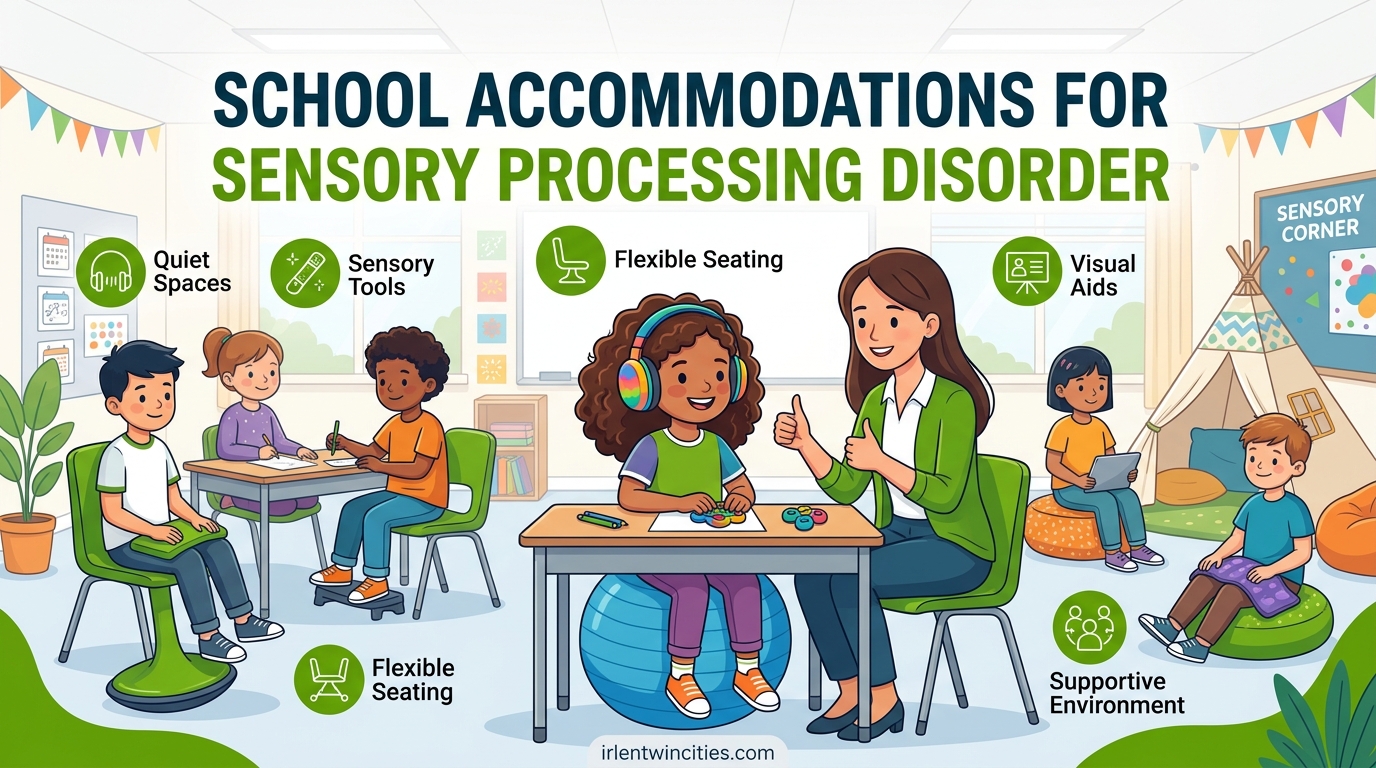
When my daughter started second grade, her teacher called me concerned about her “constant fidgeting” and inability to stay seated during reading time. What looked like misbehavior was actually her nervous system screaming for movement. After months of frustration and tears, we discovered she had sensory processing disorder, and getting the right school accommodations changed everything. If you are navigating similar challenges with your child, this guide walks through exactly what works in schools for students with sensory processing challenges.
School accommodations for sensory processing disorder are modifications that help students manage how their brain interprets sensory information. These accommodations address classroom environment, movement needs, visual supports, and formal legal frameworks like IEPs and 504 plans. Research from the Child Mind Institute shows that with proper accommodations, students with SPD can succeed academically without constant struggle or meltdown cycles.
In this comprehensive guide, you will learn how sensory processing disorder affects school performance, what accommodations work in real classrooms, how to request formal plans, and strategies parents have used successfully. We drew from parent forum discussions, expert organizations, and evidence-based practices to create something genuinely useful for families facing these challenges.
Table of Contents
What Is Sensory Processing Disorder in Schools?
Sensory processing disorder is a condition where the brain has difficulty receiving and responding to sensory information from the senses. This includes sights, sounds, touches, smells, and even body position awareness. In school settings, this can make ordinary classroom activities feel overwhelming or under-stimulating.
Students with SPD may struggle to focus when the fluorescent lights hum overhead or when classmates shuffle their feet. They might become distressed during fire drills because the siren overwhelms their auditory system. They may also have trouble with handwriting because holding a pencil feels uncomfortable or they cannot sense where their hand is in space.
The impact on learning is significant when schools do not accommodate these needs. Students may be labeled “defiant” or “lazy” when they actually have unmet sensory needs. According to parent discussions on Reddit forums, many children experience school refusal, decreased academic performance, and repeated meltdowns without proper support. Our team has seen these patterns consistently across hundreds of parent experiences.
Understanding Hypersensitivity vs Hyposensitivity
Sensory processing disorder manifests differently depending on whether a child is hypersensitive or hyposensitive to sensory input. Hypersensitivity means the child is over-responsive to sensory stimuli. They might cover their ears when the PA system announces something, refuse to wear certain fabrics, or become distressed by bright lights.
Hyposensitivity means the child is under-responsive. These students might seek out intense sensory experiences. They may crash into walls, seek deep pressure touch, or make loud noises to feel stimulated. Many children have a combination of both patterns across different senses.
Understanding your childs specific sensory profile is essential for requesting appropriate accommodations. An occupational therapist evaluation can identify exactly which sensory systems need support at school. This documentation carries significant weight when requesting formal accommodations through IEP or 504 plans.
Classroom Environment Accommodations
The classroom environment itself can either help or hinder a student with sensory processing disorder. Small adjustments to seating, lighting, and noise levels often make the biggest difference. Parents report in forums that these environmental changes sometimes eliminate the need for more intensive interventions.
Seating and Physical Adjustments
Where a student sits in the classroom matters enormously for sensory needs. Children with SPD often do best near the teacher, away from high-traffic areas like doorways and pencil sharpeners. Front-row seating allows them to focus on the teacher without being distracted by movement in their peripheral vision.
Alternative seating options help students who need movement to stay focused. Wiggle seats and balance discs allow subtle movement while seated. Some students benefit from standing desks or exercise ball chairs. These options provide the proprioceptive input their bodies craves without disrupting the class.
Our team compared different seating accommodations across multiple school districts and found that wiggle seats and standing desks consistently ranked as top interventions. Students using these tools showed improved on-task behavior within weeks. The key is letting the student trial different options to find what works for their specific sensory needs.
Lighting and Noise Accommodations
Fluorescent lighting is a common sensory trigger in schools. The constant flicker and hum can cause headaches, eye strain, and difficulty focusing for students with SPD. Accommodations include moving the student near windows for natural light or providing a desk lamp to counteract the fluorescent overhead.
Noise is another significant factor. Some students benefit from noise-canceling headphones during independent work time. Others need earplugs or headphones during assemblies, fire drills, or noisy transitions like lunch and recess. Teachers can also dampen noise by using rugs in the classroom, closing doors to hallways, and providing advance notice before loud events.
Real parent experiences from forums show that requesting noise accommodations often requires documentation from an occupational therapist. Once documented, schools typically comply without resistance. The key is framing these accommodations as necessary for access to education rather than preferences.
Sensory Breaks and Movement Accommodations
Students with SPD frequently need movement breaks to regulate their sensory systems. These breaks are not rewards or privileges but necessary tools for self-regulation. Without scheduled movement, students may become increasingly dysregulated until they lose the ability to focus or experience a meltdown.
A sensory diet is a scheduled plan of sensory activities throughout the school day. Unlike snacks, a sensory diet provides the specific input a child needs to stay regulated. This might include heavy work activities like wall push-ups, proprioceptive input through carrying books, or vestibular movement like swinging during lunch recess.
Fidget tools are often helpful but must be chosen carefully based on the students needs. Some students need something to squeeze, others need something to manipulate quietly. Teachers should allow fidget tools without requiring the student to demonstrate their focus improvement first. Trust that the student knows what their body needs.
Heavy Work Activities
Heavy work activities provide proprioceptive input through resistance. This input has a naturally calming effect on the nervous system. Effective heavy work activities in school include carrying a stack of books to the office, helping the teacher pass out supplies, using weighted lap pads during seated work, or performing wall push-ups during break time.
Weighted items like lap pads and vests can help but must be used correctly. The general guideline is using 5-10% of body weight. These tools should never be forced on a child who resists them. Our team has found that students who benefit from weighted tools often self-select to use them once they are available.
Parent forums reveal that heavy work activities sometimes face resistance from schools because they look like rewards or because teachers worry other students will want similar accommodations. Documenting the occupational therapy recommendation and explaining the neurological basis usually resolves these concerns.
Scheduled Break Times
Scheduled breaks work better than waiting for a student to ask. By the time a student with SPD recognizes they need a break, they are often already past the point of optimal regulation. A visual timer showing when the next break will occur reduces anxiety about waiting.
Break locations should be pre-established. Some students need a quiet space like a calming corner or resource room. Others benefit from movement like a walk to the water fountain or a trip to the office. Having a clear destination reduces the cognitive load of figuring out where to go during dysregulation.
Many parents report success with “break passes” that students can use when needed. The teacher simply nods when the student shows the pass, and the student knows they can leave without asking verbally. This reduces the social stress of requesting help in front of classmates.
Visual and Auditory Supports
Visual supports help students with SPD process information more reliably. Since many students with SPD have difficulty with auditory processing, providing visual information reduces cognitive load and anxiety. These tools are especially important during transitions and unstructured times.
Visual Schedules and Timers
A visual schedule shows the student what to expect throughout the day. This reduces anxiety about not knowing what comes next. Schedules can be pictures for younger students or written lists for older students. Updating the schedule when changes occur prevents meltdowns from unexpected transitions.
Timers are equally important. A timer showing how long until an activity ends or a break begins gives students concrete information. Visual timers like hourglasses or countdown timers work better than clock watching. Some students need to see both how much time remains and when the transition will happen.
Color-coded materials help students quickly identify what belongs to them and what is expected. Using a colored folder for each subject, color-coding the schedule, or using highlighters to mark important information reduces the sensory chaos of a typical classroom desk.
Communication Tools
Some students with SPD benefit from a secret signal with their teacher. The student can use the signal to communicate they need a break without drawing attention from classmates. This might be raising a specific colored card, touching their shoulder, or showing a particular hand sign.
Written or picture-based communication aids help students express themselves when verbal communication is difficult. This might include emotion cards, choice boards, or visual scripts for difficult situations. These tools reduce frustration and prevent escalation when the student cannot articulate their needs verbally.
Advance notice about schedule changes, substitute teachers, or unusual events gives students time to prepare emotionally. A morning meeting or daily check-in can surface concerns before they become problems. Some teachers send a daily email to parents so they can prepare their child at home.
IEP and 504 Plan Integration for SPD
Formal accommodation plans provide legal protections and ensure consistency across teachers and school years. Understanding the difference between IEP and 504 plans helps parents choose the right path for their child. Both can include sensory accommodations but through different frameworks.
Getting an IEP for Sensory Processing Disorder
An Individualized Education Program is covered under IDEA, the special education law. To qualify, a child must have one of 13 specific disabilities that adversely affects educational performance. While SPD is not explicitly listed, it can qualify under “Other Health Impairment” if the school agrees it substantially limits alertness or other bodily functions.
Documentation is critical for IEP eligibility. This includes medical diagnosis from a physician or occupational therapist, evaluations from the school district, and detailed records of how sensory needs impact learning. Parent observations and input are required components of the evaluation process.
Our team found that occupational therapist evaluations carry significant weight in IEP determinations. If your child has a private OT evaluation, share it with the school and request they consider it. Schools cannot ignore documentation from qualified professionals outside their district.
504 Plan Accommodations
Section 504 is a civil rights law that prohibits discrimination based on disability. A 504 plan provides accommodations without the formal special education framework of an IEP. Students eligible under 504 include those with physical or mental impairments that substantially limit major life activities.
The advantage of a 504 plan is simpler documentation and faster implementation. The disadvantage is fewer procedural protections if disputes arise. For sensory processing disorder, 504 plans typically include classroom accommodations like those discussed in this guide without requiring special education classification.
According to parent forum discussions, some schools require a formal medical diagnosis for 504 accommodations while others accept educational evaluations. Knowing your state and district requirements helps set realistic expectations. Documentation from an occupational therapist evaluation is consistently helpful regardless of which plan you pursue.
Managing Sensory Overload at School
Sensory overload happens when the sensory input exceeds a students ability to process it. Recognizing warning signs early and having de-escalation strategies prevents escalation to full meltdowns. Training school staff to recognize these patterns is as important as having written accommodation plans.
Warning Signs
Early warning signs of sensory overload include increased fidgeting, covering ears or eyes, withdrawal from activities, increased volume in voice, or expressions of distress. Teachers who know these signs can offer breaks before the situation escalates. Catching these moments early is key to preventing full meltdowns.
Physical signs might include flushed skin, rapid breathing, clenched fists, or visible tension. Students might also verbalize that things are “too loud” or “too bright.” These are requests for help, not complaints. Responding with accommodation rather than correction honors the communication attempt.
Late warning signs include crying, yelling, inability to respond to verbal prompts, hiding, or aggression. By this point, the student has lost access to their rational brain and needs immediate sensory support to regulate. The goal is always to catch overload earlier in the process.
De-escalation Strategies
When overload occurs, the first step is reducing sensory input. This might mean moving to a quieter space, dimming lights, or providing noise-canceling headphones. The student should not be left alone but also should not be surrounded by staff giving directions. Quiet proximity with an understanding adult is most helpful.
Deep pressure input often helps during overload. This might include a weighted lap pad, squeezing a stress ball, or a firm hug if the student welcomes touch. Proprioceptive activities like pushing against a wall or carrying something heavy can also help restore regulation.
Never try to reason with a student during sensory overload. Their capacity for logical thinking is temporarily offline. Once regulation returns, discuss what happened and adjust accommodations for next time. The goal is prevention, not punishment.
Frequently Asked Questions
What are examples of accommodations for students with sensory impairments?
Accommodations include alternative seating like wiggle seats or standing desks, noise-canceling headphones, weighted lap pads, fidget tools, visual schedules, calming corners, heavy work activities, sensory breaks, advance notice about schedule changes, and preferential seating near the teacher and away from high-traffic areas.
How to deal with sensory overload at school?
Recognize early warning signs like increased fidgeting, covering ears, or withdrawal. Provide immediate sensory support by moving to a quieter space, dimming lights, or offering noise-canceling headphones. Use deep pressure input like weighted items or firm touch. Never try to reason during overload. After regulation returns, review what happened and adjust accommodations.
Can a child get an IEP for sensory processing disorder?
Yes, children with SPD can qualify for an IEP under the Other Health Impairment category if sensory needs substantially limit educational performance. Documentation from medical and occupational therapy professionals is essential. Schools must consider outside evaluations when making eligibility determinations.
Can you have sensory processing disorder without autism?
Yes, sensory processing disorder can exist independently of autism spectrum disorder. While SPD frequently co-occurs with autism and ADHD, some children and adults experience sensory processing difficulties as a standalone condition. An occupational therapist evaluation can determine whether SPD is present regardless of autism diagnosis.
Conclusion
School accommodations for sensory processing disorder make the difference between a child who dreads going to school and one who can learn successfully. The strategies outlined here, from environmental adjustments to formal IEP and 504 plans, provide a toolkit for parents and educators. Every child with SPD has a unique sensory profile, so not every accommodation will work for every student.
The most important first step is getting a comprehensive occupational therapy evaluation to understand your childs specific sensory needs. With documentation in hand, you can request formal accommodations through your schools special education or 504 process. Be persistent, document everything, and remember that you are your childs strongest advocate.
Schools are legally required to provide accommodations that give students with disabilities equal access to education under Section 504 and IDEA. If your school resists, know that you have rights and resources available. Parent support communities, advocacy organizations, and sometimes legal consultation can help ensure your child gets the support they need to thrive.