
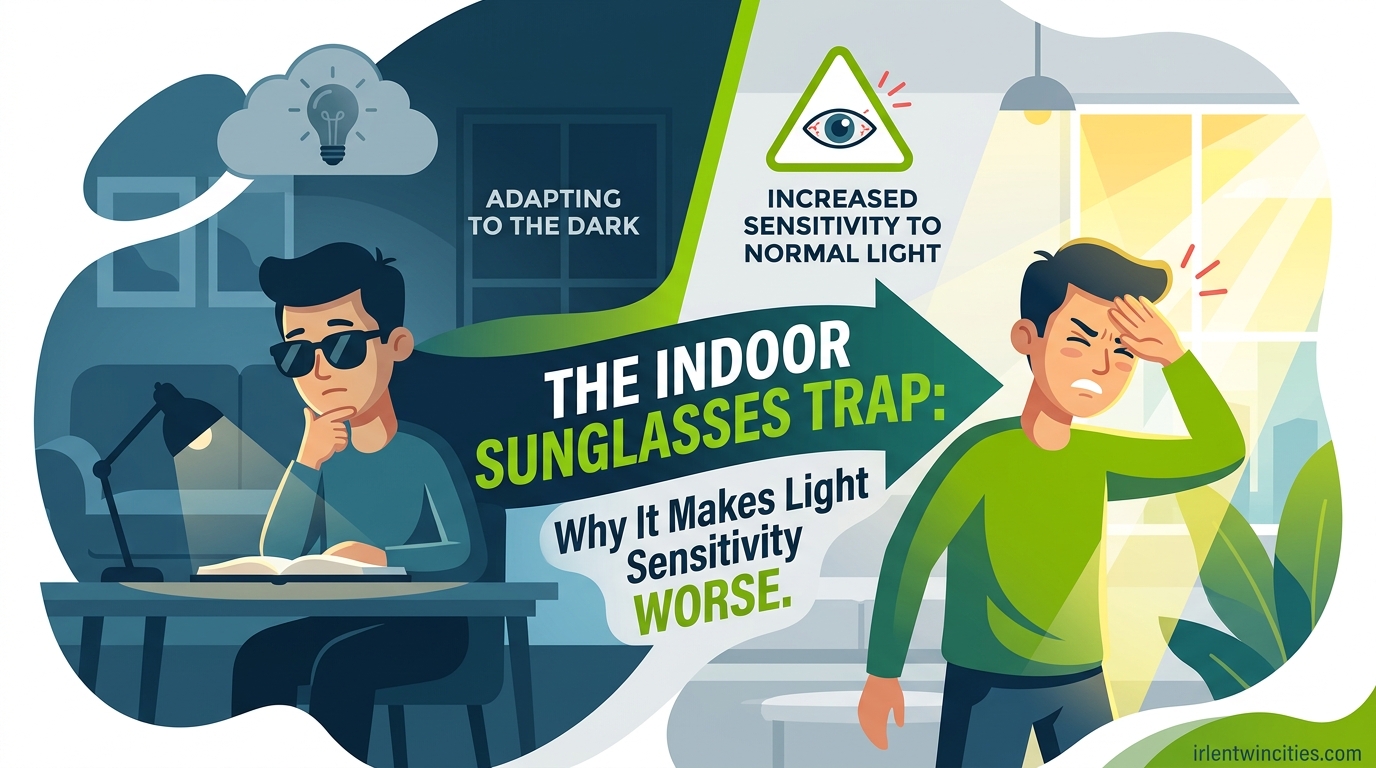
Yes, wearing sunglasses indoors can actually make your light sensitivity worse – not just a little, but significantly. While it seems logical that blocking light would reduce discomfort, this approach triggers a biological feedback loop called dark adaptation that leaves your eyes increasingly vulnerable to ordinary indoor lighting over time. Understanding why this happens is the first step towards genuinely managing photophobia rather than inadvertently intensifying it.
This article explains the science behind dark adaptation, why standard sunglasses are poorly suited for indoor use, and what evidence-based alternatives can provide real relief without the long-term consequences.
Table of Contents
Why Sunglasses Indoors Make Light Sensitivity Worse
At its core, the problem is a mismatch between what your eyes expect and what they receive. When you wear dark sunglasses indoors, your brain interprets the reduced light as a signal that you have moved into a low-light environment. In response, your visual system makes a series of adjustments – primarily through pupil dilation (mydriasis) and increased production of the light-sensitive pigment rhodopsin in your retina – that collectively make your eyes dramatically more sensitive to light than they would otherwise be.
The result is paradoxical: the very act of shielding your eyes from light leaves them more vulnerable to it. Every time you remove those indoor sunglasses, even moderate light feels overwhelming because your eyes have been artificially sensitised. And with repeated cycles of this behaviour, your baseline sensitivity ratchets upward permanently – what began as situational discomfort becomes a chronic, worsening condition.
Understanding Dark Adaptation: Your Eyes’ Response to Low Light
Dark adaptation is a fundamental process by which your eyes adjust to low-light conditions. When you enter a dim environment, your pupils (the black openings in the centre of your eyes) automatically dilate – expanding from their normal size of around 2-4mm to as much as 7-8mm in diameter. This dilation allows more light to enter the eye.
Simultaneously, your retina undergoes chemical changes. Nerve cells in the retina called photoreceptors begin producing greater quantities of a light-sensitive pigment called rhodopsin, also known as visual purple. Rhodopsin makes the retina dramatically more sensitive to light – in fact, fully dark-adapted eyes can be up to 10,000 times more sensitive to light than eyes in normal daylight conditions.
“The fully dark-adapted eye is about 10,000 times more sensitive to light than the fully light-adapted eye.”
– Standard ophthalmology textbooks, consistent with findings in the 2015 Survey of Ophthalmology study
This remarkable adaptability is precisely why humans can function from bright sunlight to near-darkness. However, it is also the mechanism that makes wearing sunglasses indoors so counterproductive for people with photophobia.
When you put on dark sunglasses in a normally-lit indoor space, your pupils interpret this as a signal that the environment has become low-light. They dilate fully, and the retina begins producing extra rhodopsin in response. If you then remove the sunglasses – or step outside into natural daylight – your wide-open pupils and rhodopsin-saturated retina are suddenly overwhelmed by even moderate light levels.
Why Sunglasses Work Outdoors But Fail Indoors
Outdoor sunlight and indoor lighting are fundamentally different in their spectral composition – and this difference explains why the same pair of sunglasses that feels comfortable at the beach can feel inadequate (or worsening) in an office.
The Smooth Spectrum of Sunlight
Natural daylight, whether direct or cloud-filtered, has a relatively smooth, continuous spectrum across visible wavelengths. Think of it like a carefully balanced equaliser playing music across all frequencies at moderate volume. The light from the sun distributes its energy relatively evenly across the visible spectrum, with a natural peak in the yellow-green range (around 550nm) that corresponds well with where human vision is most sensitive.
The Spiky Spectrum of Indoor Lighting
Indoor lighting – particularly fluorescent tubes and many LED bulbs – produces light with a radically different profile. Rather than a smooth spectrum, these light sources emit energy in sharp, concentrated peaks at specific wavelengths. A typical fluorescent tube might emit intense spikes in the blue-green range (around 435nm and 545nm) while producing relatively weak output in other areas.
This is often described as “spiky light” – imagine an equaliser with the bass and treble turned way down but with two enormous peaks in the mid-range. These concentrated wavelength spikes are particularly problematic for people with light sensitivity because they stimulate specific photoreceptor cells (particularly those containing melanopsin in the retinal ganglion cells) more intensely than smooth-spectrum light would.
The Core Problem
Sunglasses are designed to reduce overall light quantity – they filter everything, including the wavelengths that might actually help regulate your light adaptation system. What they cannot do is selectively filter the problematic spiky peaks while preserving useful light. Precision-tinted lenses (discussed later) attempt to solve exactly this problem.
So while dark sunglasses reduce the quantity of indoor light reaching your eye, they do nothing to address the quality problem – and by triggering dark adaptation, they make your eyes progressively worse at handling even reduced light levels over time.
The Science: 2015 Survey of Ophthalmology Study
The medical community has increasingly warned against the indiscriminate use of sunglasses indoors for photophobia patients. A landmark 2015 review published in the journal Survey of Ophthalmology examined the evidence base for optical treatments of light sensitivity and reached conclusions that should give pause to anyone who reaches for sunglasses as a first response to indoor brightness.
The study, authored by researchers including Dr. Bradley Katz and colleagues, found that the mechanism of dark adaptation described above has measurable clinical consequences for patients who habitually wear dark sunglasses in indoor environments. The authors noted that patients who “dark-adapt” their retinas through consistent indoor sunglass use are essentially training their visual system to become progressively more sensitive – and more reactive – to light.
“By wearing dark sunglasses indoors, patients are dark adapting their retinas and aggravating their sensitivity to light.”
– Dr. Bradley Katz, as cited in Survey of Ophthalmology, 2015
Dr. Kathleen B. Digre, a recognised expert in the field of photophobia and headache medicine, has similarly cautioned against the overuse of fully dark lenses in indoor settings. Her research emphasises that while complete darkness can be genuinely helpful during acute migraine episodes, long-term reliance on heavily tinted indoor eyewear tends to perpetuate rather than resolve light sensitivity problems.
The Survey of Ophthalmology paper also noted that the retina’s sensitivity is not fixed – it is continuously recalibrated based on ambient light levels. When you chronically signal “low light” to your visual system, it obligingly increases sensitivity. When you then remove the dark glasses, even ordinary light feels intolerable because your system has been set to an artificially high sensitivity threshold.
The Vicious Cycle: How Short-Term Relief Creates Long-Term Problems
The progression from occasional indoor sunglass use to chronic dependency typically follows a recognisable pattern – and once you understand it, you can see why it is so difficult to break without deliberate intervention.
Stage 1: Initial Relief
You experience light sensitivity (perhaps during a migraine phase, or due to fluorescent office lighting) and reach for sunglasses indoors. The immediate reduction in light feels helpful. This positive association is powerful – it trains you to associate dark glasses with relief.
Stage 2: Escalating Use
Over days or weeks, you notice that ordinary indoor light feels increasingly uncomfortable even with the same glasses. You may try darker lenses, or wear them more frequently. Each extension of wear time deepens the dark adaptation effect.
Stage 3: Worsening Baseline Sensitivity
Your baseline light tolerance drops. Rooms that felt normal now feel bright. You begin avoiding activities you previously enjoyed. Forum discussions describe people wearing two pairs of sunglasses indoors, using wide-brimmed hats, and dimming all household lights to near-darkness.
Stage 4: Dependency and the Spiral Downwards
The more you wear dark glasses indoors, the more sensitive your eyes become, which necessitates more dark glasses, which produces further dark adaptation. You are trapped in a feedback loop that progressively narrows the range of light levels you can comfortably tolerate.
Real accounts from people managing photophobia capture this pattern vividly. One person on a migraine forum described needing “two pairs of sunglasses and a wide-brimmed hat” just to go outside. Another observed: “wearing sunglasses indoors doesn’t help me much with migraines and does make me more light-sensitive in general, so I try not to do it much.” The awareness that the coping strategy is itself the problem is an important recognition – and the first step towards breaking the cycle.
Who Is Most Affected? Migraines, Autism, and Photophobia
Light sensitivity does not affect everyone equally. Certain populations are particularly vulnerable to both photophobia and to the worsening effects of indoor sunglass use.
Migraine Sufferers
Photophobia is one of the most common and debilitating symptoms of migraine attacks, present in an estimated 80-90% of migraine patients during episodes. Fluorescent office lighting is a well-documented migraine trigger, with its spiky blue-green wavelength profile stimulating trigeminal nerve pathways involved in migraine pain. Migraine sufferers often reach for sunglasses as a coping strategy without realising the long-term cost.
Autism and Sensory Processing Differences
One area that receives insufficient attention in mainstream photophobia content is the strong connection between autism spectrum conditions and light sensitivity. Research consistently shows elevated rates of visual sensitivity among autistic individuals, with many describing indoor lighting as physically uncomfortable or even painful.
For autistic people, light sensitivity is often tied to broader sensory processing differences. The nervous system’s threat response may be more readily triggered by certain light wavelengths, and the cumulative sensory load of fluorescent lighting in schools or offices can be genuinely overwhelming. Importantly, the dark adaptation vicious cycle may develop differently in autistic individuals because the underlying sensory calibration mechanisms can work differently.
Autistic adults who are light sensitive may also use sunglasses indoors as a social strategy – reducing visual overwhelm to enable participation in conversations or public spaces – alongside a physiological sensitivity. This dual function means the habit can be particularly entrenched and the consequences particularly impactful.
Post-Concussion and Neurological Photophobia
Patients recovering from traumatic brain injuries, particularly concussions, frequently develop severe photophobia. The visual processing pathways can become sensitised, and what would previously have been comfortable light levels become intolerable. This population is at high risk of falling into the dark adaptation trap because the discomfort is genuine and acute.
General Photophobia Conditions
Beyond migraines and autism, conditions such as iridectomy, certain retinal diseases, blepharospasm, and Fuchs’ heterochromic cyclitis can all produce chronic light sensitivity. In all these cases, the same dark adaptation risk applies.
Breaking the Cycle: Practical Strategies for Managing Light Sensitivity
Understanding why sunglasses indoors worsen light sensitivity is important – but what should you actually do about it? Here are evidence-based strategies for managing photophobia without triggering dark adaptation.
Strategy 1: FL-41 Precision Tints
FL-41 is a specific rose-tinted lens formula developed specifically for light sensitivity conditions. Unlike standard dark sunglasses, FL-41 lenses selectively filter the blue-green wavelengths (around 480-560nm) that are most problematic for migraine sufferers and photophobia patients, while allowing other wavelengths through relatively normally.
The result is that FL-41 lenses reduce the discomfort of spiky fluorescent and LED light without triggering full dark adaptation. Your pupils do not dilate dramatically, and your retina does not flood with rhodopsin. Brands offering FL-41 tints include TheraSpecs, Axon Optics, and Avulux.
Strategy 2: Gradual Light Re-Exposure
If you have been wearing dark sunglasses indoors for an extended period, you will need to gradually re-train your visual system. This does not mean abruptly removing them in a bright office – that would be as counterproductive as the original habit. Instead:
- Start by wearing your indoor sunglasses in slightly dimmer conditions than usual
- Progressively reduce the darkness of your lenses (some suppliers offer graduated tint options)
- Gradually increase the brightness of your typical environment
- Build tolerance over weeks, not days
Strategy 3: Amber and Warm Lighting at Home
Real experiences from photophobia forums consistently recommend amber or warm-spectrum lighting as one of the most helpful home modifications. Switching from fluorescent tubes to incandescent or warm LED bulbs, using lower wattage (25-40W equivalent where possible), and installing dimmer switches allows you to control your home environment in ways that support visual comfort without dark adaptation risk.
Amber light is particularly helpful because it falls at the longer-wavelength end of the visible spectrum, away from the problematic blue-green spikes. It also does not trigger the same pupillary response as brighter broad-spectrum light.
Strategy 4: Targeted Wavelength Filtering
Beyond FL-41, precision-tinted lenses can be custom-formulated to target your specific wavelength sensitivities. An optometrist or neuro-optometrist with experience in photophobia can sometimes recommend tints that are calibrated to your particular triggers. The key advantage over standard sunglasses is that these tints reduce problematic wavelengths while preserving a more natural overall light level – avoiding the dark adaptation trap.
Strategy 5: Environmental Modifications
- Use desk lamps with warm-spectrum bulbs rather than overhead fluorescent lighting where possible
- Apply anti-glare screen filters to computer monitors
- Consider fluorescent tube replacement with LED panels in your workspace
- Position seating to avoid direct exposure to light fixtures
- Take regular breaks from screen and fluorescent environments
Frequently Asked Questions
Do sunglasses make light sensitivity worse?
Yes, wearing dark sunglasses indoors can make light sensitivity progressively worse over time. This happens through a process called dark adaptation, where your pupils dilate and your retina becomes more light-sensitive in response to the reduced light entering your eyes. The more you wear dark sunglasses indoors, the more sensitive your eyes become – creating a vicious cycle where you need increasingly dark lenses to achieve the same relief.
Is it bad for eyes to wear sunglasses indoors?
For occasional use in genuinely bright conditions, indoor sunglasses are not inherently harmful. However, habitual use in normally-lit indoor environments triggers dark adaptation, which increases your baseline light sensitivity. The 2015 Survey of Ophthalmology study and multiple ophthalmologists (including Dr. Bradley Katz) specifically caution against regular indoor use of dark sunglasses for photophobia patients.
Are there glasses for indoor light sensitivity?
Yes. Precision-tinted lenses such as FL-41 (available from TheraSpecs, Axon Optics, and Avulux) are specifically designed for indoor light sensitivity. Unlike dark sunglasses, FL-41 lenses selectively filter the blue-green wavelengths that cause the most discomfort while allowing other light through, avoiding the dark adaptation problem. Consult an optometrist experienced with photophobia for personalised recommendations.
Does wearing sunglasses indoors help with migraines?
For some migraine sufferers, wearing sunglasses indoors provides short-term relief during an acute migraine episode, which can be genuinely helpful. However, as a long-term daily strategy, it typically worsens light sensitivity over time and may increase migraine frequency. The better approach is to use precision-tinted FL-41 lenses during the day and reserve very dark lenses only for genuine acute episodes.
Is it okay to wear sunglasses inside the house?
Occasionally wearing sunglasses inside the house during an acute migraine or headache episode is generally fine. The concern is with regular, habitual indoor sunglass use as a default coping strategy. If you find yourself reaching for sunglasses every time you are indoors, you are likely dark-adapting your eyes and worsening your long-term light tolerance. Consider switching to FL-41 precision tints or amber lighting instead.
Ready to Break the Dark Adaptation Cycle?
Understanding the science behind your light sensitivity is the first step. If you have been relying on dark sunglasses indoors, consider booking a consultation with a neuro-optometrist or discussing FL-41 tinted lens options with your eye care provider.
Need more support? Explore our dedicated resources on managing light sensitivity and photophobia support options.