
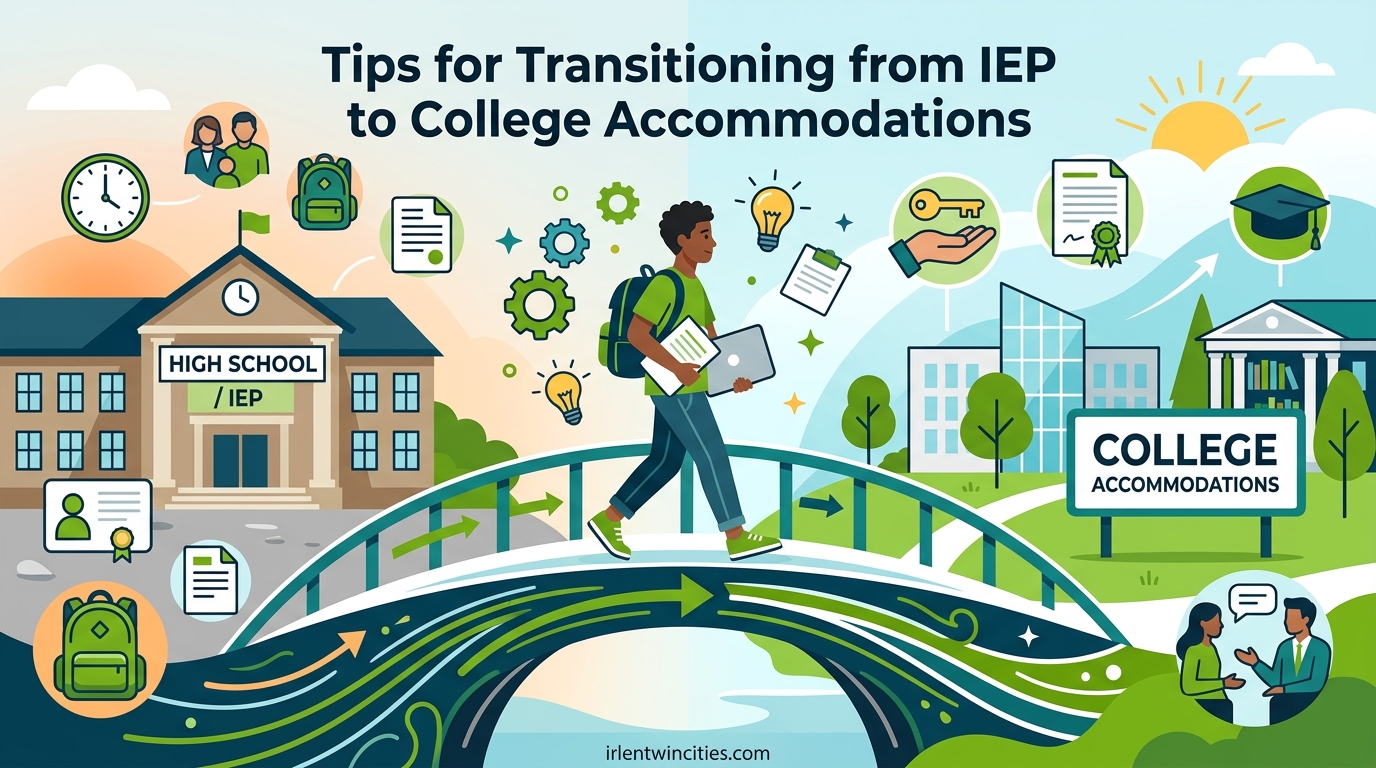
Transitioning from IEP to college accommodations is one of the most significant shifts students with disabilities face in their academic journey. The process can feel overwhelming, especially when you discover that the support system you relied on throughout high school does not automatically follow you to campus.
No, IEPs do not transfer to college. When students graduate from high school or age out of the K-12 system, their Individualized Education Program (IEP) expires. Colleges are not required to follow IEPs or 504 plans from high school. Instead, students must contact the college’s disability services office, submit current documentation of their disability, and formally request accommodations under the Americans with Disabilities Act (ADA) and Section 504 of the Rehabilitation Act.
I have worked with dozens of families navigating this transition, and the most common mistake I see is waiting until August before freshman year to start thinking about accommodations. The students who thrive are the ones who understand these changes early and take proactive steps throughout high school to prepare for self-advocacy in college.
Table of Contents
Understanding the Legal Shift: From IDEA to ADA
Before you can successfully navigate the transition from high school to college, you need to understand why everything changes. The legal framework that protected you in K-12 simply does not apply to higher education.
What Is an IEP and How Does It Work in High School?
An Individualized Education Program (IEP) is a document created under the Individuals with Disabilities Education Act (IDEA). This federal law guarantees Free Appropriate Public Education (FAPE) to students with disabilities through high school graduation or age 21.
Under an IEP, your high school is legally required to identify your disability, assess your needs, and provide specialized instruction and related services. Your case manager coordinates everything. Teachers are responsible for implementing accommodations. Parents are deeply involved in the process and have significant rights to advocate on your behalf.
Why IEPs Do Not Transfer to College
IDEA is education-specific legislation that ends when you graduate from high school or age out of the special education system. Colleges do not operate under IDEA. They operate under the Americans with Disabilities Act (ADA) and Section 504 of the Rehabilitation Act of 1973.
These laws have different purposes and requirements. While IDEA mandates that schools identify students with disabilities and provide services, ADA and Section 504 require colleges to provide equal access to qualified individuals who self-identify and request accommodations. The burden of initiation shifts entirely to the student.
IDEA vs ADA/Section 504: What’s the Difference?
| Factor | High School (IDEA) | College (ADA/Section 504) |
|---|---|---|
| Legal Basis | Individuals with Disabilities Education Act | Americans with Disabilities Act, Rehabilitation Act Section 504 |
| Purpose | Provide Free Appropriate Public Education (FAPE) | Provide equal access and reasonable accommodations |
| Who Identifies Need | School must identify and evaluate | Student must self-disclose |
| Who Initiates Services | School develops IEP and implements | Student must register and request |
| Parent Role | Active participant with legal rights | Student is adult; parents not involved without consent |
| Documentation | School conducts evaluations | Student provides external documentation |
| Type of Support | Specialized instruction, modifications, related services | Accommodations only; no curriculum modifications |
The Vocabulary Changes When You Reach College
Beyond the legal differences, the language used in college disability services is fundamentally different from what you heard in high school IEP meetings. Understanding these vocabulary shifts will help you communicate more effectively with college staff.
Case Manager Becomes Disability Coordinator
In high school, you had a case manager who monitored your progress, coordinated services, and advocated on your behalf. In college, you will work with a disability coordinator, accessibility specialist, or DSS (Disability Support Services) director.
However, the coordinator does not manage your case in the same way. They process your accommodation requests and approve reasonable accommodations. They will not check in on you, remind you of deadlines, or contact professors on your behalf unless there is a specific accommodation issue to resolve.
IEP Team Becomes Individual Student
Your IEP team included parents, teachers, specialists, and administrators. In college, the team is just you. You are responsible for understanding your disability, knowing which accommodations you need, and communicating those needs to the appropriate people.
Entitled Becomes Eligible
Under IDEA, you were entitled to services. Under ADA, you are eligible for accommodations if you meet the criteria and follow the process. This subtle shift in language reflects a fundamental difference: IDEA guarantees services. ADA provides access if you qualify and request it.
Plan Becomes Letter of Accommodation
Your IEP was a comprehensive document that followed you throughout high school. In college, you will receive an accommodation letter or memo each semester. This letter simply lists the approved accommodations. You are responsible for delivering copies to each professor and discussing implementation.
How to Transition from IEP to College Accommodations
Successful transition requires planning that begins well before graduation. Here is a grade-by-grade roadmap to help you prepare.
Junior Year (11th Grade): Start Planning Early
The transition planning process should begin by age 16 according to federal law, but starting earlier gives you more time to prepare. During junior year, focus on these priorities:
First, understand your own disability. You should be able to explain what your diagnosis is, how it affects your learning, and which accommodations help you succeed. Many students reach college without ever having been taught to articulate this information.
Second, request updated psychoeducational testing if yours is more than three years old. Most colleges require documentation within three years of enrollment. Getting tested during junior year means your evaluation will be current when you start college.
Third, research disability services at colleges you are considering. Visit their websites, read about their processes, and note whether they offer orientation programs specifically for students with disabilities.
Senior Year (12th Grade): Take Action
Senior year is when preparation turns into action. Once you have been accepted to colleges, begin reaching out immediately.
Contact the disability services office at each school you are seriously considering. Ask about their documentation requirements, typical timeline for approval, and what orientation resources they offer. Do this before you make your final decision.
Gather all your documentation. You will need diagnostic evaluation reports, IEP or 504 plan summaries, and any medical documentation relevant to your disability. Create both physical and digital copies.
Attend transition workshops if your high school offers them. Many districts host sessions specifically for students with IEPs who are heading to college.
Summer Before College: Final Preparations
The summer between high school and college is critical. Do not wait until August to start this process.
Submit your documentation to the disability services office as soon as you commit to a college. Most offices have online portals where you can upload evaluations and request forms.
Schedule your intake meeting. This is your first formal interaction with the disability office. Come prepared to discuss your disability, past accommodations, and what you anticipate needing in college.
Practice self-advocacy conversations. Role-play with a parent or counselor. Practice explaining your disability and requesting accommodations. You will need to do this with professors, and preparation reduces anxiety.
First Semester: Activate Your Accommodations
Once classes begin, your work is not done. You must activate your accommodations each semester.
Pick up or download your accommodation letters from the disability services office. These letters do not automatically get sent to professors. You must distribute them yourself.
Meet with each professor during office hours to discuss your accommodations. This conversation should happen early in the semester, ideally within the first two weeks. Be prepared to explain how specific accommodations work in that class context.
Monitor your progress and adjust as needed. If an accommodation is not working, contact your disability coordinator to discuss alternatives.
What Documentation Do You Need for College Accommodations?
Colleges require specific documentation to verify your disability and determine appropriate accommodations. Understanding these requirements prevents delays in approval.
Acceptable Types of Documentation
Most colleges require a comprehensive psychoeducational evaluation or neuropsychological assessment conducted by a qualified professional. This evaluation should include your diagnosis, testing results, functional limitations, and specific recommendations for accommodations.
Medical documentation from physicians or specialists may be required for physical disabilities, chronic health conditions, or psychiatric diagnoses. These reports should include diagnosis, treatment history, and impact on major life activities.
Your high school IEP or 504 plan is valuable as supplemental documentation but is rarely sufficient on its own. Colleges want current, comprehensive evaluations that establish the presence of a substantial limitation.
Recency Requirements
Most colleges require documentation within three years of enrollment. Some highly selective programs or professional schools may require testing within one year.
If your evaluation is outdated, you will need to schedule new testing before starting college. Many insurance plans cover psychoeducational evaluations, but they can take months to schedule and complete. Plan accordingly.
What Documentation Should Include
Effective documentation includes: a clear diagnostic statement, the methodology used to make the diagnosis, current functional limitations, expected progression or stability of the condition, and specific recommended accommodations with rationale.
If your current IEP or 504 plan does not include recent testing, request a reevaluation from your high school before graduation. Schools are required to conduct triennial reevaluations, and you can request one earlier if needed.
Common College Accommodations Available
While colleges cannot provide the same level of support as high school IEPs, many accommodations are available to level the playing field. Here are the most commonly approved accommodations:
Extended Test Time
Time and a half (1.5x) or double time (2x) on exams is one of the most frequently granted accommodations. Testing typically occurs in the disability services office or a designated distraction-reduced environment rather than the regular classroom.
Note-Taking Assistance
Options include access to a peer note-taker, permission to audio record lectures, use of smart pens or note-taking technology, or receiving instructor-provided notes or slides. You will need to work with your coordinator to arrange these supports before each semester.
Priority Registration
Many colleges allow students with disabilities to register for classes early. This helps you secure optimal class times, avoid back-to-back classes if needed, or ensure you get sections with professors who are experienced with accommodations.
Assistive Technology
Colleges may provide text-to-speech software, speech-to-text programs, screen readers, or access to smart pens. Some schools have assistive technology labs where you can borrow equipment or receive training.
Reduced Course Load
Students may be approved to take fewer credits while maintaining full-time status for financial aid and housing purposes. This accommodation is common for students with ADHD, mental health conditions, or processing disorders.
Distraction-Free Testing
Testing in a quiet, individual room reduces environmental distractions that can interfere with performance. This accommodation pairs well with extended time for students with attention or processing challenges.
Why Self-Advocacy Is Your Most Important Skill
The most significant difference between high school and college is who is responsible for initiating and managing accommodations. Self-advocacy becomes your most critical skill.
Parents Step Back, Students Step Up
Under federal privacy laws like FERPA, colleges cannot discuss your academic or disability information with parents without your written consent. Even if parents are paying tuition, they are not entitled to access your records or communicate with professors on your behalf.
This shift often surprises families. In high school, parents attended IEP meetings and communicated regularly with teachers. In college, you are legally an adult, and the responsibility for self-advocacy falls entirely on you.
How to Communicate with Professors
Delivering your accommodation letter and discussing implementation requires confidence and clarity. Schedule a brief meeting during office hours in the first two weeks of class.
Introduce yourself, provide the letter, and briefly explain which accommodations you anticipate using. Ask about any specific procedures for that class. For example, if you have extended time, ask how to schedule testing sessions.
Keep the conversation professional and focused on logistics. You do not need to disclose extensive personal information or justify your need for accommodations.
Sample Email Template for Contacting Disability Services
If you are unsure how to begin the conversation with your college disability office, here is a template you can adapt:
Subject: Request to Register for Disability Services
Dear Disability Services Staff,
My name is [Your Name], and I am an incoming freshman/admitted student for the [Fall/Spring] 2026 semester. I received accommodations in high school under an IEP/504 plan for [general description: learning disability/ADHD/anxiety/etc.], and I would like to request accommodations for my college coursework.
I have attached my recent psychoeducational evaluation dated [date] and my most recent IEP/504 plan summary. I would appreciate the opportunity to schedule an intake meeting to discuss appropriate accommodations for my courses.
Please let me know what additional information you need and when we might meet.
Thank you,
[Your Name]
[Student ID if assigned]
[Phone Number]
Who Might Be Denied Accommodations and Why
Not every accommodation request is approved. Understanding common reasons for denial helps you prepare realistic expectations.
Outdated or Insufficient Documentation
If your testing is more than three years old, or if your documentation lacks specific diagnostic information, the college may request updated evaluation before approving accommodations.
Test Anxiety Without Underlying Disability
Test anxiety by itself typically does not qualify for accommodations unless it is part of a documented anxiety disorder or learning disability that substantially limits a major life activity. The anxiety must be severe, persistent, and documented by a qualified professional.
Non-Substantial Limitations
Colleges must provide accommodations for disabilities that substantially limit major life activities like learning, reading, or concentrating. Mild difficulties that do not meet this threshold may not qualify for formal accommodations.
Appeals Process
If your accommodations are denied or you disagree with the approved accommodations, you have the right to appeal. Start by discussing your concerns with the disability services director. If unresolved, colleges have formal grievance procedures under Section 504 and ADA.
Frequently Asked Questions
Can you transition from an IEP to a 504?
Yes, some students do transition from an IEP to a 504 plan in high school. An IEP provides specialized instruction and related services, while a 504 plan provides accommodations without special education services. Schools may recommend a 504 if a student no longer needs specialized instruction but still requires accommodations to access the general curriculum. However, both IEPs and 504 plans expire upon high school graduation. Neither transfers automatically to college.
Why do schools push 504 instead of IEP?
Schools sometimes recommend 504 plans over IEPs when they determine a student can succeed in general education with accommodations alone and no longer needs special education instruction. This can happen when a student makes significant progress or when their needs are primarily related to access rather than specialized teaching. However, parents have the right to request an evaluation for an IEP if they believe their child needs more support than a 504 provides. The IEP offers stronger legal protections and more comprehensive services.
What are 5 examples of accommodations for students who have an IEP?
Five common accommodations that students with IEPs often use include: 1) Extended time on tests and assignments, allowing students additional time to complete work without penalty. 2) Reduced distraction testing environment, providing a quiet space away from the regular classroom. 3) Note-taking assistance, which can include access to peer notes, permission to record lectures, or use of assistive technology. 4) Assistive technology such as text-to-speech software, speech-to-text programs, or smart pens. 5) Preferential seating near the instructor or away from distractions to improve focus and access.
Does a 504 plan follow you to college?
No, 504 plans do not follow students to college. Like IEPs, 504 plans expire when you graduate from high school or age out of the K-12 system. Colleges are not required to follow high school 504 plans. Instead, students must contact the college disability services office and request accommodations under the Americans with Disabilities Act and Section 504 of the Rehabilitation Act. The college will review current documentation and determine which accommodations are reasonable for the postsecondary environment.
When should I contact disability services?
You should contact disability services after you have been accepted to college but before you enroll. Ideally, reach out in the spring of senior year or early summer. This timing allows you to complete the registration process, submit documentation, and receive approved accommodations before classes begin. Some students wait until they are struggling, but this creates unnecessary stress. Early contact ensures your accommodations are in place from day one of your first semester.
Do I have to tell my professors about my disability?
You are not required to disclose your specific diagnosis to professors. You only need to share your accommodation letter from the disability services office, which lists the approved accommodations without detailing your diagnosis. However, you do need to have a conversation with each professor about how the accommodations will work in their specific class. This conversation focuses on logistics, not medical details. For example, you might discuss how to schedule extended time testing or how note-taking assistance will be arranged.
Conclusion
Transitioning from IEP to college accommodations requires understanding a fundamental truth: your high school support system does not follow you to campus. The shift from IDEA to ADA changes everything about how services are delivered, who is responsible for initiating them, and what types of support are available.
The students who thrive in this transition are those who start early, understand their own disabilities, and develop strong self-advocacy skills before freshman year begins. By contacting disability services during senior year, gathering current documentation, and practicing communication with professors, you set yourself up for success.
Transitioning from IEP to college accommodations is not just about maintaining the same supports you had in high school. It is an opportunity to learn how to advocate for yourself as an adult, access the tools you need to succeed, and take ownership of your educational journey. With proper preparation and realistic expectations, students with disabilities can and do thrive in college.