
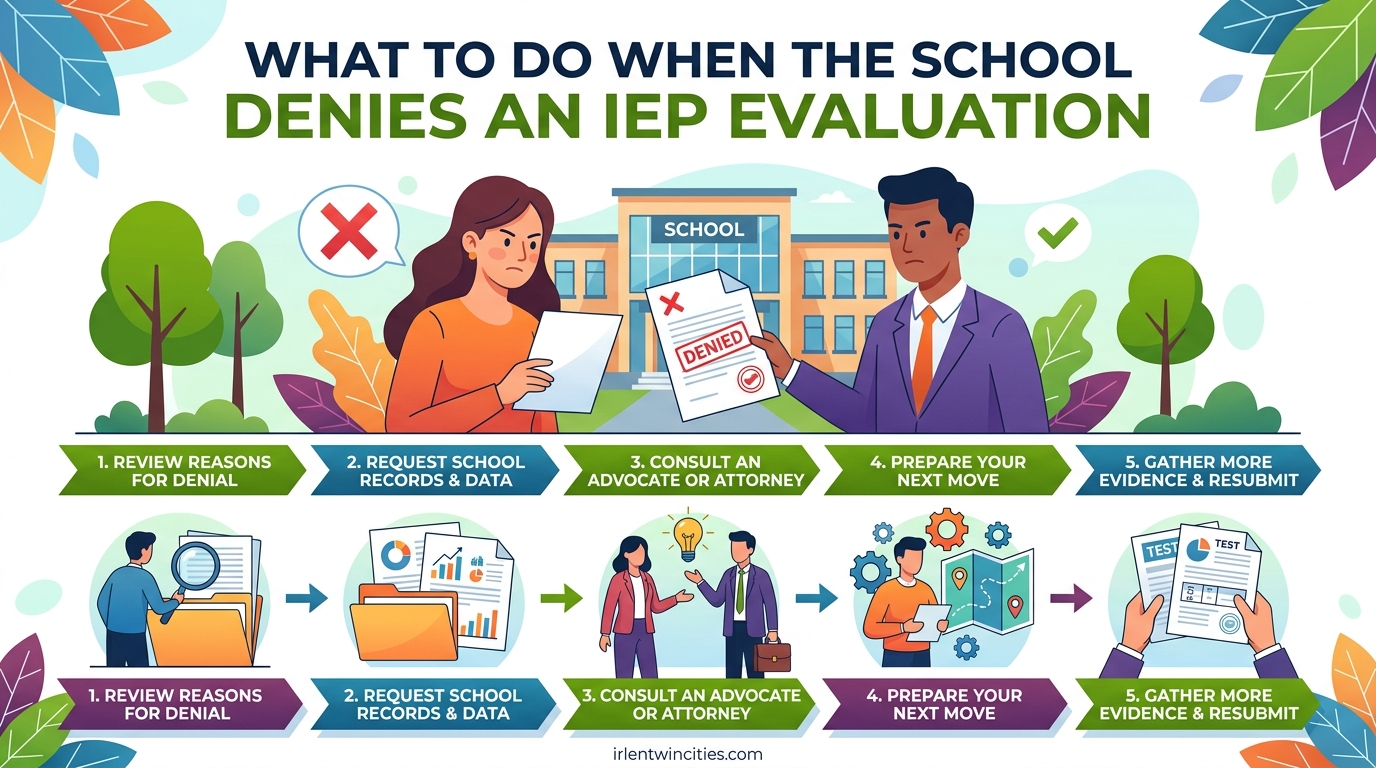
Facing a denied IEP evaluation can feel devastating. You know your child is struggling, yet the school says they do not qualify for testing. This guide explains exactly what to do when the school denies an IEP evaluation, with actionable steps you can take starting today.
Under the Individuals with Disabilities Education Act (IDEA), schools cannot simply refuse to evaluate your child without providing specific written reasons. Parents have powerful legal rights, including options to challenge the denial through multiple pathways. I will walk you through everything from requesting proper documentation to pursuing formal dispute resolution.
Before diving into the steps, take a breath. This process is stressful, but thousands of parents successfully navigate IEP denials every year. Your child deserves support, and these strategies will help you advocate effectively.
Table of Contents
Understanding Why the School Denied the IEP Evaluation
Schools deny IEP evaluations for various reasons. Understanding their rationale helps you craft a stronger response. Some denials are based on legitimate criteria; others reflect misunderstandings of special education law.
What Is Prior Written Notice (PWN)?
Prior Written Notice (PWN) is a formal letter the school must provide when they deny your evaluation request. Under IDEA, this notice must include specific elements: the action the school refuses to take, an explanation of why they refused, a description of other options considered and why they were rejected, and information about your procedural safeguards.
Many parents report schools verbally denying evaluations without providing written documentation. This is a procedural violation. You have the right to receive PWN before any denial takes effect. If the school has not provided written notice, your first step is requesting it formally.
Common Reasons Schools Deny Evaluations
Schools typically cite several rationales for denying IEP evaluations. The most common is that the child does not show sufficient educational impact from their suspected disability. They may claim academic performance is adequate, behavior is not disruptive enough, or that the child is making progress with current interventions.
Other frequent reasons include suggesting the child needs more time in response to intervention (RTI) programs, claiming insufficient evidence of a disability, or stating that the child’s struggles are due to language barriers or cultural factors rather than disability. Each of these rationales can be challenged with proper documentation and understanding of your rights.
What to Do When the School Denies an IEP Evaluation: 10 Steps
When the school denies an IEP evaluation, taking systematic action protects your child’s rights. These ten steps progress from immediate documentation to formal dispute resolution. Start with step one and work forward as needed.
Step 1: Request Prior Written Notice in Writing
If the school denied your evaluation request verbally, send a written request for Prior Written Notice immediately. Use certified mail with return receipt requested. This creates a paper trail and establishes a timeline.
Your letter should state that you are requesting PWN regarding the school’s refusal to evaluate your child. Ask for specific explanations of each reason for denial and any data supporting their decision. Keep copies of everything you send.
Step 2: Document Everything
Start a dedicated file for all communications, assessments, and observations. Document every conversation with school staff, including dates, times, who was present, and what was discussed. Follow up verbal conversations with email summaries.
Gather any work samples showing your child’s struggles, report cards, teacher comments, outside medical or therapy evaluations, and observations from home. This evidence becomes crucial if you need to challenge the denial.
Step 3: Review the School’s Reasoning
Once you receive Prior Written Notice, analyze the school’s rationale carefully. Look for weak points, inconsistencies, or missing information. Schools sometimes cite lack of educational impact when the child is actually struggling significantly but compensating through excessive effort.
Compare the school’s stated reasons against your documentation. If they claim your child performs adequately academically, but you have evidence of failing grades, missing assignments, or teacher concerns, you have grounds to challenge their decision.
Step 4: Gather Evidence of Educational Impact
Educational impact is the key criterion for IEP eligibility. Schools must evaluate if a suspected disability affects the child’s educational performance. Collect documentation showing how struggles manifest in the classroom and at home.
Evidence may include teacher emails expressing concern, examples of incomplete work, documentation of emotional outbursts or shutdowns during homework, reports of social difficulties or isolation, and medical diagnoses from qualified professionals. The more specific your documentation, the stronger your case.
Step 5: Contact Your State’s PTI Center
Parent Training and Information (PTI) centers provide free guidance to families navigating special education. Every state has a PTI funded by the Department of Education. These centers offer workshops, one-on-one support, and resources specific to your state’s procedures.
A PTI representative can review your situation, explain your rights, and help you prepare for meetings or disputes. Many parents report that PTI support was invaluable in successfully challenging evaluation denials. Find your state’s PTI through the Center for Parent Information and Resources website.
Step 6: Request an Independent Educational Evaluation (IEE)
An Independent Educational Evaluation (IEE) is conducted by a qualified examiner who does not work for the school district. If you disagree with the school’s evaluation or they refused to evaluate, you can request an IEE at public expense.
Send a written request for an IEE at public expense. State that you disagree with the school’s decision to deny evaluation and are requesting an independent assessment. The school must either agree to fund the IEE or file for a due process hearing to prove their evaluation was appropriate.
Step 7: Consider a 504 Plan as an Interim Option
While pursuing an IEP, a Section 504 plan can provide immediate accommodations. 504 plans serve students with disabilities who need accommodations but do not require specialized instruction. This can include seating near the teacher, extended time on tests, or reduced homework loads.
Requesting a 504 evaluation simultaneously with challenging an IEP denial gives your child some support while the larger process unfolds. Some parents find that 504 accommodations reveal additional needs that eventually support IEP eligibility.
Step 8: Request Another IEP Meeting
Sometimes denial decisions can be reversed through collaborative problem-solving. Request another IEP team meeting to present new evidence or clarify your concerns. Bring documentation you have gathered since the initial request.
Approach this meeting professionally but firmly. Present your evidence calmly and ask the team to reconsider based on the educational impact you have documented. Some schools will reverse their decision when presented with compelling new information, avoiding the need for formal dispute resolution.
Step 9: File a State Complaint
If the school violated procedural requirements, such as failing to provide Prior Written Notice or missing timeline requirements, you can file a state complaint with your state’s Department of Education. State complaints address violations of IDEA procedures rather than substantive disagreements about services.
State complaints must be filed within one year of the violation. The state will investigate and issue a written decision. If violations are found, the school must take corrective action. This process is less adversarial than due process and can resolve timeline or procedural issues.
Step 10: Pursue Mediation or Due Process
When other options fail, formal dispute resolution becomes necessary. Mediation involves a neutral third party helping you and the school reach agreement. It is voluntary, confidential, and less confrontational than a hearing. Many disputes resolve successfully through mediation.
Due process is a formal legal proceeding where an impartial hearing officer decides whether the school must evaluate your child. You may represent yourself or hire an attorney. Due process decisions are binding but can be appealed to state or federal court. Consider this option when the school clearly violated your child’s rights or refuses all reasonable alternatives.
When the School Denies IEP Because of Good Grades
One of the most frustrating scenarios parents face is denial based on academic performance. Schools sometimes claim that good grades mean no educational impact, but this misunderstands IDEA requirements. Academic performance is only one factor in determining eligibility.
A child can achieve high grades while struggling tremendously. Many bright students with learning disabilities, ADHD, or autism compensate through excessive time on homework, parental support, or sheer determination. This compensation masks the underlying disability but creates significant educational impact in terms of time, stress, and energy expenditure.
When challenging a denial based on good grades, focus on the whole child. Document the effort required to achieve those grades, emotional toll, missing social skills, executive functioning struggles, or any regression when support is removed. Teacher observations about attention difficulties, incomplete assignments, or behavioral concerns also support your case.
The key question is not whether your child achieves acceptable grades, but whether their suspected disability adversely affects educational performance. Educational performance includes academic achievement, social skills, emotional regulation, behavior, and ability to benefit from instruction. Present evidence across all these domains.
Understanding Your Dispute Resolution Options
Federal law provides multiple pathways for resolving IEP disputes. Understanding each option helps you choose the most appropriate strategy for your situation. These options range from collaborative to adversarial, informal to formal.
Independent Educational Evaluation (IEE) at Public Expense
When you request an IEE at public expense, the school has two options. They can grant your request and provide a list of qualified examiners, or they can file for due process to prove their evaluation decision was appropriate. Schools often grant IEE requests rather than risk losing a hearing.
If the school agrees to fund an IEE, they will provide criteria for selecting the examiner. You are not required to choose from their list, though you must select someone meeting their qualifications. The independent evaluator works for you, not the school, and their report becomes part of your child’s educational records.
Mediation: A Less Adversarial Path
Mediation brings you and school representatives together with a trained, neutral mediator. The mediator facilitates discussion but does not make decisions. Many parents find mediation less stressful than due process hearings and more likely to preserve working relationships with the school.
Mediation is voluntary and confidential. Discussions during mediation cannot be used as evidence in subsequent due process hearings. If you reach agreement, it becomes a binding written document. If not, you retain all other dispute resolution rights.
Due Process Hearing
A due process hearing is a formal legal proceeding similar to a trial. An impartial hearing officer hears evidence from both sides and issues a binding decision. Due process addresses substantive disagreements about identification, evaluation, educational placement, or provision of free appropriate public education.
You have the right to be accompanied and advised by an attorney, present evidence, confront and cross-examine witnesses, and receive a written decision. Due process can be time-consuming and expensive if you hire an attorney, but it provides the strongest protection of your child’s rights.
State Complaint Process
State complaints address procedural violations of IDEA rather than substantive disagreements. You can file a state complaint if the school failed to provide PWN, missed timeline requirements, violated your procedural safeguards, or otherwise failed to follow IDEA procedures.
File your complaint with your state’s Department of Education special education division. The complaint must be in writing and describe the specific violations. The state has 60 days to investigate and issue a written decision. Remedies may include corrective action, staff training, or compensatory services.
When to Contact an Attorney or Advocate
Some situations warrant professional legal or advocacy support. Consider contacting a special education attorney or advocate if the school has repeatedly violated your child’s rights, the case involves complex legal issues, your child has significant needs requiring extensive services, or the school has retaliated against you for advocating.
Special education advocates are typically less expensive than attorneys and can provide significant assistance with meeting preparation, documentation, and negotiation. Attorneys become essential if you file for due process or need to appeal a hearing decision.
Many communities have legal aid organizations offering free or low-cost special education representation. Your state’s PTI center can refer you to qualified advocates and attorneys in your area.
Taking Care of Yourself During This Process
Navigating a denied IEP evaluation takes an emotional toll. Parents report high levels of stress, anxiety, and feelings of isolation during this process. Taking care of yourself is not selfish; it is necessary for effective advocacy.
Connect with other parents who understand. Online communities, local support groups, and social media groups provide spaces to vent, share strategies, and realize you are not alone. Many parents who have successfully navigated denials are eager to support those beginning the journey.
Set boundaries around the time and energy you devote to this process. It is easy to let advocacy consume your life, but burnout helps no one. Schedule breaks, engage in activities you enjoy, and remember that this is a marathon, not a sprint.
Consider speaking with a counselor or therapist if the stress becomes overwhelming. Your mental health matters, and professional support can help you navigate the emotional challenges while remaining effective as your child’s advocate.
Frequently Asked Questions
Can a school deny IEP testing?
Yes, a school can deny an IEP evaluation, but they must provide Prior Written Notice explaining their specific reasons. Under IDEA, schools must evaluate if they suspect a child has a disability and needs special education. However, they may deny if they believe there is insufficient evidence of a disability or educational impact. Parents have the right to challenge any denial through dispute resolution options.
How long does the school have to respond to an evaluation request?
Under IDEA, states set their own specific timelines, but most require schools to respond within 10 to 15 school days of receiving a written request. Some states require a meeting to discuss the request; others allow the school to respond in writing. If the school misses these deadlines, it constitutes a procedural violation you can report through a state complaint.
What is the difference between an IEP and a 504 plan?
An IEP provides specialized instruction and services for students with disabilities that adversely affect educational performance. A 504 plan provides accommodations for students with disabilities who do not need specialized instruction but require supports to access the general curriculum. IEPs fall under IDEA; 504 plans fall under Section 504 of the Rehabilitation Act. Both provide legal protections, but IEPs offer more comprehensive services.
Do I need a lawyer to fight an IEP denial?
You do not need a lawyer to challenge an IEP denial. Many parents successfully navigate the process independently or with support from advocates and PTI centers. However, consulting an attorney becomes advisable for due process hearings, complex cases, or situations involving significant rights violations. Legal aid organizations often provide free or low-cost special education assistance.
Can a child with good grades still qualify for an IEP?
Yes, academic performance is only one factor in IEP eligibility. A child with good grades can still qualify if their disability adversely affects educational performance in other ways, such as requiring excessive effort to achieve those grades, struggling with social skills, experiencing emotional difficulties, or having behavioral challenges. IDEA considers the whole child, not just grades.
What is an Independent Educational Evaluation?
An Independent Educational Evaluation (IEE) is an evaluation conducted by a qualified examiner who does not work for the school district. Parents can request an IEE at public expense if they disagree with the school’s evaluation or if the school refused to evaluate. If the school denies the IEE request, they must initiate due process to prove their position was appropriate.
How much does an IEE cost if I pay privately?
Private IEE costs vary widely depending on the type of evaluation and your location. Comprehensive psychoeducational evaluations typically range from $1,500 to $5,000. Speech and language evaluations may cost $300 to $800. Occupational therapy evaluations range from $500 to $1,500. Many families choose to pay privately if they cannot wait for the school process or want an independent opinion.
What if the school refuses to provide an IEE at public expense?
If the school refuses to fund an IEE, they must file for a due process hearing to prove their evaluation decision was appropriate. Parents can either accept the school’s refusal and pay privately for an IEE or file for due process themselves to challenge the school’s refusal. Many schools choose to fund the IEE rather than risk losing a due process hearing.
Conclusion
What to do when the school denies an IEP evaluation involves understanding your rights, documenting thoroughly, and systematically pursuing dispute resolution options. Remember that you are not alone in this process. Thousands of parents successfully challenge evaluation denials every year using these exact strategies.
Start with requesting Prior Written Notice and documenting everything. Work through the steps outlined here, from contacting your PTI center to requesting an Independent Educational Evaluation if necessary. Your child deserves an appropriate education, and IDEA provides the legal framework to ensure they receive it.
The process takes time, but persistence pays off. Stay organized, seek support from other parents and advocacy organizations, and remember why you started: your child needs help, and you are their best advocate. You can navigate this challenge successfully.