
Your child reads chapter books at age six but struggles to write her name. She solves complex math problems in her head but forgets to turn in homework. She can debate philosophy with adults yet falls apart when routines change. If this sounds familiar, you may be raising a twice-exceptional child.
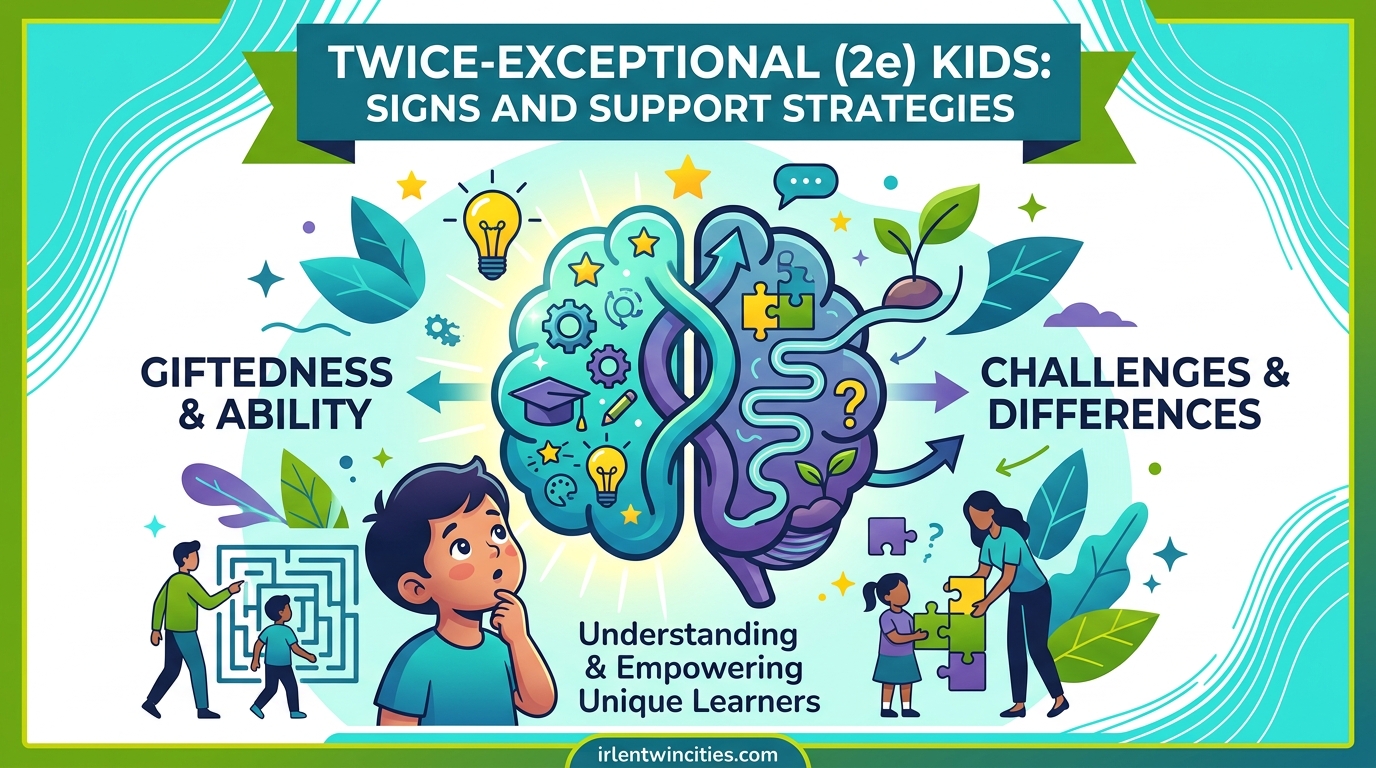
Twice-exceptional (often abbreviated as 2e) refers to children who are both intellectually gifted and have a learning disability or neurological challenge. This combination creates a unique profile that confuses parents, educators, and sometimes the children themselves. A 2e child might coast through early reading but suddenly hit a wall in third grade when comprehension demands increase. They might show remarkable insight in conversations yet struggle to organize their thoughts on paper.
This article covers everything you need to know about twice-exceptional children: what the term means, common signs and characteristics, the challenges these children face, and, most importantly, practical support strategies you can use today.
Table of Contents
What Does Twice Exceptional Mean?
Twice exceptional is not a diagnosis but a descriptor for children who have both high intellectual ability and a learning or neurological difference. The “twice” refers to two exceptionalities: one being giftedness and the other being a disability or challenge such as ADHD, autism spectrum disorder, dyslexia, sensory processing disorder, or executive function difficulties.
What makes 2e children particularly complex is the concept of asynchronous development. These children may think like older children in some areas while functioning at a younger developmental level in others. A seven-year-old might analyze cause and effect like a teenager yet have the emotional regulation of a five-year-old when frustrated. This mismatch between cognitive and emotional development often leads to confusion about what the child actually needs.
Identifying twice-exceptional children is challenging because one area can mask the other. A child’s strong vocabulary and quick thinking might cause teachers to overlook reading comprehension difficulties. Conversely, a child’s ADHD symptoms might eclipse recognition of their advanced problem-solving abilities. Many 2e children learn to camouflage their challenges, presenting a capable face to the world while internally struggling.
Common co-occurring conditions include:
- ADHD — Difficulty with attention, hyperactivity, impulsivity alongside high intellectual engagement
- Autism Spectrum Disorder — Social communication differences with enhanced focus and deep interests
- Dyslexia — Reading challenges with strong oral reasoning and creative thinking
- Sensory Processing Disorder — Sensory sensitivities or seeking behaviors with sophisticated cognitive abilities
- Executive Function Differences — Challenges with planning, organization, and working memory despite strong conceptual thinking
Signs and Characteristics of Twice-Exceptional Kids
Recognizing twice-exceptionality requires looking at the whole child. Here are signs organized by category:
Intellectual and Giftedness Signs
- Advanced vocabulary and complex sentence structure from an early age
- Exceptional problem-solving abilities and logical reasoning
- Intense focus on topics of interest for extended periods
- Curiosity about abstract concepts (time, death, justice, universe)
- Early ability to see patterns and make connections others miss
- Rich imagination and creative thinking
Learning Challenge Signs
- Inconsistent performance across subjects (excellent in math, struggling in writing)
- Difficulty with written expression despite strong verbal skills
- Trouble following multi-step directions
- Poor working memory: losing track of thoughts, forgetting assignments
- Slow processing speed on timed tasks despite quick thinking
- Difficulty with fine motor tasks (handwriting, cutting)
Behavioral and Emotional Signs
- Perfectionism: refusing to try activities where they cannot excel immediately
- Intense emotional reactions to failure or frustration
- High sensitivity to criticism or perceived slights
- Resistance to routine changes or transitions
- Executive function challenges: disorganization, time blindness, starting tasks
- Hyper-focus on interests to the point of ignoring other responsibilities
Social and Relational Signs
- Feeling like they do not fit in with peers (both gifted and non-gifted)
- Difficulty relating to same-age children; often prefer older or younger companions
- Awareness of being different without understanding why
- Social skills that seem advanced in some ways but immature in others
- Strong need for intellectual peers but struggle to find them
No single sign indicates twice-exceptionality. The pattern of high ability combined with specific challenges, particularly when one area seems to hide the other, is the key indicator.
Challenges Twice-Exceptional Children Face
Understanding the specific challenges 2e children face helps parents respond with empathy and effective strategies.
The Masking Problem
Two types of masking complicate identification. Giftedness masking challenges occurs when a child’s strong verbal abilities, quick thinking, and apparent comprehension cause adults to assume everything is fine. The child’s reading comprehension difficulties, for example, might be invisible because they have memorized enough words to seem fluent. Challenges masking giftedness happens when ADHD symptoms, anxiety, or learning disabilities dominate the picture, causing adults to see only the struggle and miss the child’s advanced potential.
Social Isolation and Asynchronous Development
When a child’s intellectual development outpaces their social-emotional development, making friends becomes difficult. They may crave deep conversations but lack the social skills to sustain friendships. Many 2e children report feeling like they do not belong anywhere—too advanced for typical peers but isolated among gifted peers who do not share their challenges. This loneliness compounds as children age, with peer relationships becoming more complex.
Underachievement and School Frustration
Perhaps the most painful challenge is watching a capable child refuse to engage with school. A twice-exceptional child may understand concepts easily but feel defeated by tasks requiring organization, written output, or sustained attention. Homework battles are common, with children who can solve complex problems refusing to complete simple worksheets. This is not laziness but a mismatch between the child’s abilities and the demands being placed on them.
Emotional Toll
Living in a body and mind that seem contradictory takes a psychological toll. Many 2e children develop anxiety about school, relationships, and their own worth. They internalize the message that they should be able to perform at the level their intelligence suggests, leading to shame when they cannot. Some children develop learned helplessness, believing they are incapable even when they are not.
How to Identify and Assess Twice-Exceptional Kids
If you suspect your child is twice-exceptional, a comprehensive evaluation provides clarity and opens doors to accommodations.
Neuropsychological Assessment
A comprehensive neuropsychological evaluation is the gold standard for identifying twice-exceptionality. Unlike school screenings, a neuropsychological assessment evaluates cognitive abilities, academic achievement, and behavioral/social-emotional functioning across multiple areas. Look for a diagnostician experienced with gifted children who understand that a high IQ can coexist with learning challenges.
What Assessment Measures
- Cognitive abilities (reasoning, processing speed, working memory, verbal comprehension)
- Academic achievement (reading, math, writing)
- Attention and executive function
- Social-emotional functioning
- Identifying discrepancies between cognitive ability and academic performance
Understanding Testing Terms
Tests like the WISC-V (Wechsler Intelligence Scale for Children) provide multiple index scores. A common finding in twice-exceptional children is a significant spread between verbal and visual-spatial indices or between processing speed and working memory. Discrepancy scoring compares these indices against academic performance to identify areas of strength and challenge.
Educational Plans: IEP, 504, and GIEP
Assessment results open the door to educational accommodations. Three main options exist:
- IEP (Individualized Education Program) — A legal document under IDEA for students with specific disabilities who need specialized instruction. Requires meeting specific eligibility criteria.
- 504 Plan — A legal document under Section 504 for students with disabilities who need accommodations to access education. More flexible than IEP but less intensive.
- GIEP (Gifted Individualized Education Program) — Specifically for gifted students requiring modifications to curriculum and instruction. Available in some states for students who qualify as gifted and also have learning needs.
When seeking evaluation, document specific concerns in writing to the school. If the school refuses to evaluate, you have the right to request an independent evaluation at public expense through due process procedures.
Support Strategies for Parents and Caregivers
Supporting a twice-exceptional child requires balancing celebration of strengths with compassion for challenges. Here are strategies that work.
Adopt a Strength-Based Approach
Focus on what your child can do and use those strengths as bridges to challenges. If your child loves coding, use that interest to develop executive function skills through programming projects that require planning and debugging. When discussing your child with teachers and professionals, emphasize strengths alongside challenges. This does not mean ignoring difficulties but rather building from a foundation of capability.
Build Emotional Regulation Skills
Twice-exceptional children often need explicit instruction in emotional regulation. Teach identifying emotions by naming them throughout the day. Create a calm-down routine with specific steps (deep breaths, count to ten, talk about feelings). Validate the intensity of their emotions while setting limits on behavior. Model healthy emotional expression yourself.
Develop Executive Function Support Systems
Do not expect your child to manage executive function demands without support. Use visual schedules, checklists, and timers. Break large tasks into small steps. Create external structures for time management rather than relying on internal time sense. Check in regularly on assignments without micromanaging. Reward systems that acknowledge effort alongside completion build motivation.
Create Homework Strategies That Work
Homework battles often stem from mismatched demands. Negotiate with your child about when and where homework happens. Some 2e children need movement breaks; others need complete quiet. Use the “first-then” approach: first complete this task, then you can return to your interest. Consider whether homework is truly necessary for your child’s learning and advocate with teachers if the volume exceeds what your child can handle.
Foster Self-Awareness and Self-Advocacy
As children approach adolescence, they need to understand their own profile. Share age-appropriate information about their strengths and challenges. Teach them to explain their needs to adults. Practice self-advocacy by having them speak up in low-stakes situations before larger conversations. When they leave your home, they must be able to request their own accommodations.
Build Your Support Network
Raising a 2e child can feel isolating. Seek out other parents on the same journey through local support groups, online communities (like the SENG Parent Network), and gifted advocacy organizations. You need people who understand both the complexity and the joy of parenting a twice-exceptional child. Professionals familiar with twice-exceptionality—therapists, educational consultants, tutors—provide specialized support beyond what general practitioners offer.
Talking to Schools: Accommodations and Advocacy
Navigating the school system on behalf of your 2e child requires preparation and persistence.
Preparing for IEP and 504 Meetings
Before any meeting, gather documentation of your child’s abilities and challenges. Note specific examples of how current interventions are or are not working. Prepare a parent statement describing your child from your perspective. Bring a checklist of accommodations you believe will help. Know that you are an equal member of the team; your input matters alongside school staff input.
Key Accommodations to Request
- Extended time on tests and assignments
- Alternative assessment formats (oral instead of written, computer instead of handwriting)
- Movement breaks and sensory accommodations
- Simplified directions and repeated clarification
- Executive function supports (visual schedules, organizers, assignment templates)
- Pre-teaching of new concepts and vocabulary
- Social-emotional support through counseling or social skills groups
When Schools Resist
Schools may push back on evaluation requests or accommodation proposals. Document everything in writing. Know your legal rights under IDEA and Section 504. Request specific reasons for denial in writing. Seek support from parent advocacy organizations. In disputes, mediation often resolves conflicts more quickly than formal due process. Keep the focus on your child’s needs rather than winning arguments.
Alternative Educational Options
If your child’s needs exceed what public school can provide, explore other options. Private schools specializing in gifted education may better serve some 2e children, though costs can exceed $20,000 annually. Homeschooling allows customization of curriculum and pacing. Some families find success with hybrid approaches, using school for socialization while providing academic instruction at home.
Resources for Twice-Exceptional Families
You do not have to navigate this journey alone. Several organizations specialize in supporting 2e children and their families:
- SENG (Supporting Emotional Needs of the Gifted) — sengifted.org — Provides parent support groups, resources, and education about gifted children’s social-emotional needs
- NAGC (National Association for Gifted Children) — nagc.org — Advocacy, research, and resources for gifted education
- Davidson Institute — davidsongifted.org — Supports profoundly gifted young people with programs and guidance
- Twice Exceptional Newsletter — Regular articles and community connection for 2e families
- Reddit Communities — r/TwiceExceptional and r/Gifted offer peer support and shared experiences
Recommended Reading: “The Twice-Exceptional Child” by Sterling, “Gifted Without Adjustment” by Webb, and “2e Newsletter” archives provide deeper exploration of topics covered here.
Finding professionals who understand twice-exceptionality may require searching outside your immediate area. Neuropsychologists, therapists trained in giftedness, and educational consultants specializing in 2e profiles offer specialized expertise worth traveling for or accessing via telehealth.
Frequently Asked Questions About Twice-Exceptional Children
What does twice exceptional mean?
Twice exceptional (2e) refers to children who are both intellectually gifted and have a learning disability or neurological challenge such as ADHD, autism, dyslexia, or sensory processing disorder. The term acknowledges that a child can have high abilities while also facing significant learning challenges.
How do I know if my child is twice exceptional?
Look for a pattern of high ability alongside specific challenges. Your child might read early and advance in math while struggling with written expression or focus. They might debate complex topics yet have difficulty with organization. A comprehensive neuropsychological assessment can provide definitive answers about whether your child meets criteria for twice-exceptionality.
What teaching strategies work for twice-exceptional students?
Effective strategies include strength-based approaches that build on interests, flexible pacing that allows acceleration in areas of strength, executive function supports (visual schedules, task breakdown), sensory accommodations, and social-emotional learning. Curriculum should be adjusted for both depth and support rather than simply remediating below grade level.
What accommodations are needed for twice-exceptional students?
Common accommodations include extended time on assignments and tests, alternative assessment formats (oral instead of written), movement breaks, sensory accommodations, executive function supports (organizers, visual schedules), simplified multi-step directions, and curriculum modifications that provide acceleration alongside support.
Conclusion
Twice-exceptional children embody a beautiful paradox: they are both highly capable and significantly challenged, often simultaneously. Their giftedness can mask their struggles while their challenges can obscure their potential, making identification and support elusive goals.
If you recognize your child in this article, know that understanding is the first step. Comprehensive assessment clarifies the picture. Strength-based support builds on capabilities while addressing challenges. Community and resources remind you that you are not alone.
Your twice-exceptional child does not need you to fix them. They need you to see them fully—brilliant and struggling, capable and frustrated, advanced and still developing. With your understanding and advocacy, they can grow into adults who leverage their unique profile to contribute in ways no one else can.